


Part 1: The Keys
When my twenty-one-year-old niece ripped the keys to my daughter’s new car out of her hand and shrieked, “MINE NOW!” I believed I was watching the most shameless act of entitlement I would ever witness. I was mistaken. Those keys were merely the opening move. In less than three weeks, I would uncover a forged property document, a hidden bank account, and a financial betrayal that stretched all the way back to my husband’s death. And before the end, the woman who raised me would sit across from me in a lawyer’s office and speak five words that forever changed how I saw our family. “You were never supposed to know.”
But I’m getting ahead of myself. To grasp how everything collapsed, you need to know the family I spent forty-three years trying to hold together—and you need to know my daughter, because in the end, she was the one who showed me what real courage looked like. My name is Melanie Carter. That summer I was forty-three, living on the outskirts of Louisville, Kentucky, and working as an operations manager for a medical supply company. My daughter, Emma, had just turned eighteen, and for seven years it had been the two of us against everything. My husband, Daniel, died suddenly of a heart condition when Emma was eleven. One evening he was at our kitchen table helping her build a model of the human heart for school. By the next afternoon, he was gone. Some moments split a life into two halves—before and after. Daniel’s death was mine. For months I drifted through the house as if I were walking underwater, going to work, paying bills, cooking, helping with homework, and remembering almost none of it.
Emma was what kept me moving. She had her father’s brown eyes, his stubborn grit, and his habit of lifting one eyebrow whenever she suspected someone was lying. Daniel used to tell her, “Being dependable matters more than being impressive, sweetheart. Anybody can look important for five minutes. Character is what you do when nobody’s watching.” Emma took that to heart. By graduation she had a 3.91 GPA, a partial academic scholarship, and a place in a nursing program. She also worked every Saturday at a veterinary clinic, and over two years she had saved exactly $4,300 toward her first car. I knew the figure because she logged every dollar in a spreadsheet. Daniel would have been thrilled; he loved spreadsheets nearly as much as he loved awful dad jokes.
Her college was twenty-three miles away, and the idea of her making that drive in some unreliable old car frightened me. So I began saving. I gave up vacations, trimmed every unnecessary expense, took overtime whenever it was offered, and quietly set money aside. After more than a year, I bought a three-year-old silver Mazda 3 for $21,400 before taxes and fees. I registered it in Emma’s name, set up the insurance, and hid it in our garage under a gigantic silver bow. My best friend since college, Rosa Martinez, helped me plan the surprise. Rosa could tell I was upset just from how I said hello on the phone. The night before graduation, she stood in my garage fussing with the bow.
“Melanie,” she said, “please tell me Sandra isn’t coming.” I sighed. “She’s my sister.” “That’s not an answer.” “Yes. Sandra’s coming. So are Britney and Mom.” Rosa stared at me. “Do you remember Christmas?” “Of course.” “Britney opened Emma’s headphones before Emma even got to unwrap them. Then she complained that Emma had better ones than she did.” “She gave them back.” “Three days later.” I smiled in spite of myself. “Rosa, it’s a graduation party. I’m not excluding half my family.” She looked at the car. “Then promise me one thing.” “What?” “Don’t let them turn your daughter’s accomplishment into another excuse to demand something from you.” I glanced away, because Rosa knew my family’s history, and sadly, she had every reason to worry.
My younger sister, Sandra, had been taking my things since we were kids. Occasionally she asked; usually she didn’t. At twelve, I watched her wreck my cassette player trying to take it apart. At fourteen, she damaged my bicycle so badly that I had to pay for the repairs myself, using babysitting money. Our mother, Linda, always said the same thing: “Melanie, you’re older. Be understanding.” Sandra was never asked to understand anything. When I complained about the bike, Mom called me dramatic—and bought Sandra new roller skates because she seemed to need cheering up. That was our family’s formula. Sandra made the mess, Mom explained why it wasn’t really Sandra’s fault, and I was expected to clean it up. Eventually I quit arguing. Giving in was simpler.
Adulthood only made the pattern costlier. I helped with Sandra’s bills when money was tight. I covered school supplies for her daughter, Britney. I bought Britney a laptop, and she complained the color was wrong. When Britney needed a car, I offered $1,500 toward it, and Sandra insisted I should pay for the whole thing. “You’re doing so much better than I am,” she said. “It wouldn’t even hurt you.” When I refused, Mom phoned. “Successful people share their blessings, Melanie.” I wanted to ask why my blessings always seemed to end up as Sandra’s. Instead, I said I’d think about it. Then there was the house. Six years before Emma graduated, Sandra told me she couldn’t afford rent. Britney was still a teenager, and Sandra worked at a dental office. She sobbed into the phone. “I don’t know what I’m going to do, Mel. I can’t have my daughter sleeping in a shelter.”
I couldn’t stand the idea of my niece losing her home. I had already been thinking about an investment property, so I purchased a three-bedroom house on a quiet street and offered it to Sandra for $700 a month—already below market. Over the years she complained until I dropped it to $450, while similar homes nearby rented for about $1,650. Meanwhile, I kept paying the mortgage, taxes, insurance, and major repairs. Sandra called about everything: a dripping faucet, a broken dishwasher, a ceiling-fan remote Britney had lost. Each request carried the same message—because we were family, I should handle it right away. I told myself it was temporary, that things would get better. The truth was simpler and uglier. After losing Daniel, I was terrified of losing anyone else. I had mistaken keeping people happy for keeping them close, and Sandra and Mom had learned exactly how to use that fear.
Graduation Saturday was warm and muggy. Emma wore her navy-blue cap and gown, with the small silver necklace Daniel had given her on her tenth birthday. Sandra showed up late, Britney even later with an iced coffee in hand, and Mom wore a massive floral hat that blocked several unlucky people’s view. None of it mattered when the announcer called, “Emma Grace Carter.” I leapt up so fast my purse slid off my lap. I clapped until my hands stung. Emma crossed the stage, took her diploma, faced the crowd—and raised one eyebrow, exactly like Daniel. I grabbed Rosa’s hand. “He should be here,” I whispered. Rosa squeezed my fingers. “He’d be proud of both of you.”
Afterward, fourteen relatives and friends gathered at my house for sandwiches, fruit salad, barbecue, lemonade, and a chocolate graduation cake. Once Emma had opened her cards, I signaled my neighbor, and the silver Mazda rolled into the driveway, gleaming in the sun, its huge bow quivering in the breeze. “Emma,” I said, “there’s one last present.” She stepped outside and clapped both hands over her mouth. “Mom. Please tell me that’s somebody else’s car.” I handed her a small gift bag holding the key fob on a blue metal tag engraved with seven words: “For every road ahead. Love, Mom.” She looked from the keys to the car. “You bought this for me?” “It’s yours, sweetheart. Registered in your name.” “But my savings—” “Can go toward college.” Her eyes brimmed, and she flung her arms around me. “Mom, I love you so much.” For a moment I could almost feel Daniel beside us. “Dad would’ve loved this,” Emma whispered. “He would have loved watching you graduate.” I was still holding her when Britney shoved past two guests. “Wait. That’s a brand-new car?” “It’s used,” Emma said, smiling. Britney’s face shifted. She eyed the Mazda, then the keys—and before Emma could react, she snatched them from her fingers and thrust her arm into the air. “MINE NOW!”
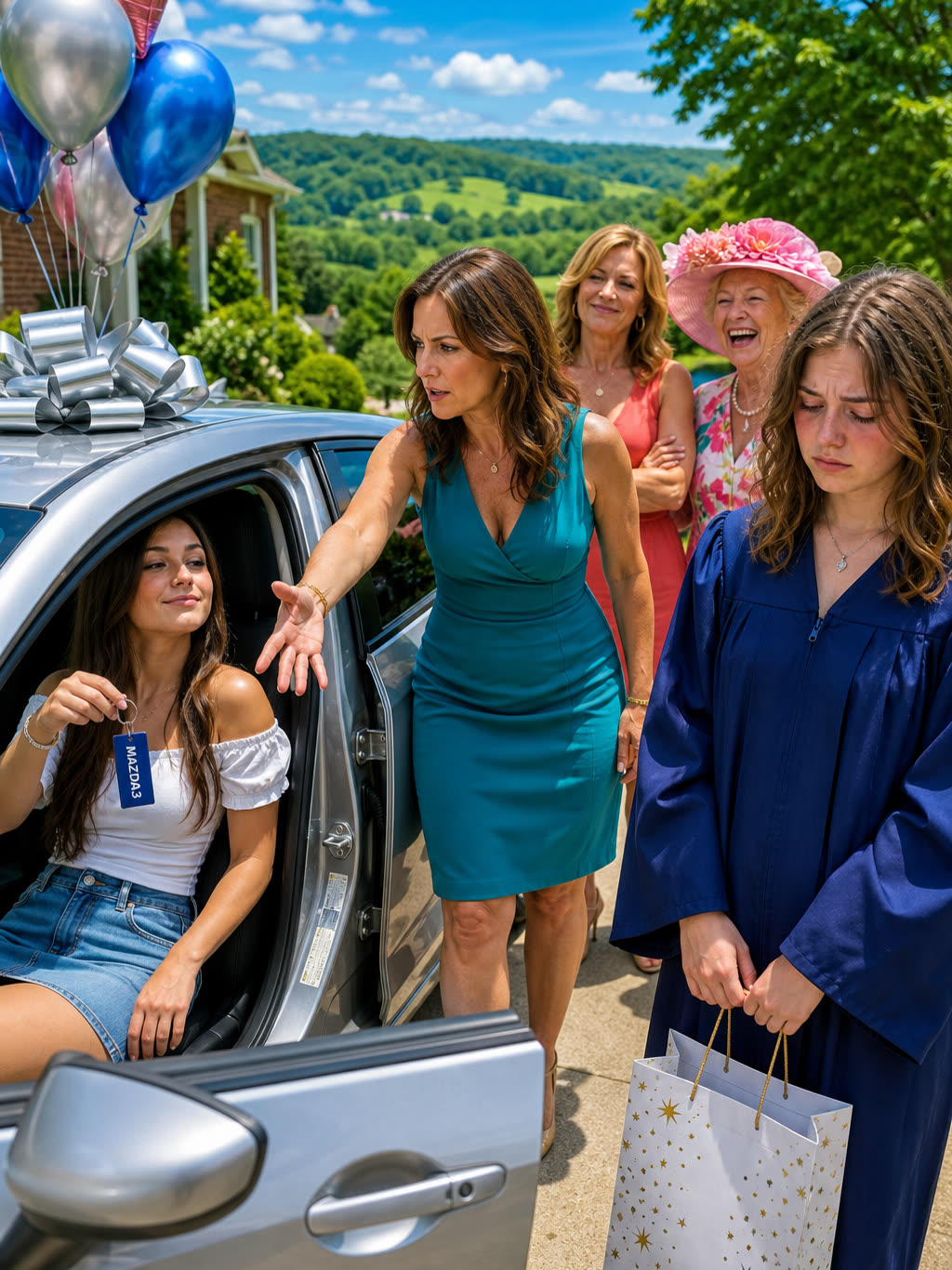
Sandra clapped. My mother burst out laughing. A few relatives chuckled awkwardly. Emma reached for the keys, and Britney stepped back. “Too slow!” She hit the unlock button, and the Mazda chirped. “Britney,” I said, “give those back.” “Oh my God, Aunt Melanie. Relax. I’m joking.” Yet instead of returning them, she opened the driver’s door and slid in. Emma stood frozen beside me, still clutching the empty gift bag. Britney adjusted the seat, ran her hands over the wheel, studied the dashboard. “Can I drive it around the block?” she called. “No.” Sandra strolled over, smiling. “Melanie, honestly. Britney’s Nissan has been giving her so much trouble. Letting her enjoy a decent car for a few minutes wouldn’t hurt.” “Emma hasn’t even driven it yet.” Sandra shrugged. “Well, Emma already has a scholarship. Britney doesn’t have things nearly as easy.” I stared at her. Somehow my daughter’s achievements had become a justification for taking from her. Then Mom touched my elbow. “Please don’t turn this into an argument. It’s just a car.”
Just a car. Twenty-one thousand four hundred dollars. More than a year of saving. A gift for a daughter who had worked so hard and asked for so little. I looked at Emma. Her cheeks were flushed, her eyes fixed on the pavement, and I recognized that look. It was the one I had worn every time Sandra took something from me and I was expected to smile. I walked straight to the driver’s door. “Keys, Britney.” She rolled her eyes. “Seriously?” “Now.” She climbed out. “Nobody in this family knows how to take a joke.” She dropped the keys into my hand, and I gave them to Emma. “Go ahead, sweetheart. Sit in your car.” Behind me Sandra complained loudly. “You didn’t have to embarrass my daughter.” I ignored her. But as Emma slowly settled behind the wheel, something made my stomach knot. Even inside her own car, she kept glancing toward Britney—as if she needed permission to be happy about it.
That night, after most guests had gone, I found Emma alone in the kitchen, turning the blue key tag in her fingers. The moment I walked in, she looked guilty. “I’m sorry, Mom.” I stopped. “What are you sorry for?” “The argument.” I pulled out a chair. “Emma, you didn’t cause that.” She stared at the tag. “Sometimes I think things would be easier if I just didn’t tell Grandma or Aunt Sandra when something good happens.” My chest tightened. “What do you mean?” She hesitated, then confessed that a few weeks earlier, Mom had called her privately and suggested she use part of her scholarship to help Britney with an apartment deposit. Emma had explained it only covered part of her tuition, but Mom kept pushing. “Grandma said Britney needed help getting started,” Emma whispered. “She said I should be generous because things come easier to me.” “Why didn’t you tell me?” Her eyes filled. “Because I knew everyone would fight.”
Those words hurt more than anything Sandra had ever said. My daughter was already learning to hide her joy to protect other people’s feelings—that success brought guilt, that love meant sacrifice, that family meant giving until nothing remained. And she had learned it by watching me. I laid my hand over hers. “Emma, listen to me. You never have to make yourself smaller to keep this family comfortable.” She nodded, then asked something I couldn’t answer. “Mom, if Grandma and Aunt Sandra love me, why do they always seem disappointed when something good happens to me?” I sat in silence, suddenly understanding this was never really about a car. It was about who my daughter would become if I let the pattern go on. After she went upstairs, I opened my laptop and tallied what I had paid for Sandra over the years—rent subsidies, repairs, school costs, gifts, emergency transfers. I quit counting when the number became too painful. Then I opened a new spreadsheet and typed three words at the top: WHAT CHANGES NOW. I didn’t know it yet, but those words would launch the biggest fight of my life.
Sandra called the next morning while I was having coffee on the back porch. “Melanie,” she began, “I think you owe Britney an apology.” I nearly laughed. “For what?” “For embarrassing her at the party.” “She took Emma’s car keys.” “She was joking.” “She got into the driver’s seat.” “Because she was excited!” “That’s not an excuse.” Sandra sighed theatrically. “Mom agrees with me.” Naturally. Then she said something that made me sit up. “Honestly, if you were thinking about fairness, you’d give Britney the Mazda and buy Emma something cheaper.” “Excuse me?” “Emma already has everything going for her. Britney’s Nissan barely runs.” “Emma worked hard for her scholarship.” “And Britney has struggled! Why can’t you acknowledge that?” “Because struggling doesn’t entitle her to my daughter’s belongings.” “You’re financially comfortable, Melanie. Stop being selfish.” I glanced through the window at my open spreadsheet. “You’re right about one thing, Sandra.” “Finally.” “I’ve been giving too much.” “Exactly. That’s what I’ve been trying to—” “You’ll receive a letter from my attorney this week.” Silence. “What letter?” “Your reduced-rent arrangement is ending. I’ll have my attorney review the lease and explain the lawful options for changing the terms.” “You’re kidding.” “No.” “Melanie, you can’t do that! We’re family!” “That’s what you’ve been reminding me for twenty years.” “Mom is going to be furious.” “She can be furious.” Then Sandra screamed words that turned my blood cold. “MOM ALREADY PROMISED BRITNEY THAT HOUSE! YOU CAN’T TAKE IT BACK!”
“What did you just say?” “You heard me.” “Sandra, that property belongs to me.” “That’s not what Mom said.” “What exactly did Mom say?” She hesitated. “She said the house was going to be Britney’s. She said it was already arranged.” “Arranged how?” “I don’t have to explain anything to you.” “Yes, Sandra. You do.” But she had already hung up. The deed, the mortgage, every tax bill and repair invoice bore my name. My mother had no power to promise that house to anyone, so why had Sandra sounded so sure? I called Mom. “Melanie, I heard you were horrible to your sister.” “Did you promise my house to Britney?” A pause. “Don’t start.” “Answer the question.” “We discussed some possibilities.” “What possibilities?” “Your sister needs security, and Britney deserves a stable future.” “That doesn’t answer my question.” “You have a good job, a paid-off home, and a daughter headed to college. Sandra doesn’t have those advantages.” “Mom, I own that rental property.” “And what is ownership worth if you won’t help your own family?” “Did you tell Sandra that the house belonged to Britney?” “Melanie, you’re being unnecessarily legalistic.” My heart began to pound. “Did you sign something?” Another silence. Then, very softly: “I think you should come over and discuss this in person.” “Tell me what you signed.” Her voice changed, and for the first time in my life, my mother sounded afraid. “There are things about that house you don’t understand.” And then the line went dead.
Part 2: The Signature That Wasn’t Mine
By Monday I had hired a real estate attorney named Olivia Price, a woman so calm and direct she could probably describe a hurricane without raising her voice. I brought her everything: the deed, mortgage statements, insurance policies, tax records, Sandra’s lease, and six years of spreadsheets tracking rent and expenses. She studied it all for nearly an hour before looking up. “Melanie, based on these documents, you’re the property owner. Your mother can’t simply give your house away.” I let out a breath. “That’s what I thought.” “But,” she added, “I want to investigate why Sandra believes otherwise.”
Two days later she called me at work. “Can you come to my office this afternoon?” Something in her tone made my stomach sink. “What’s wrong?” “I’ve found a document you need to see.” I drove straight over. Olivia laid three pages on her desk. The first was titled FAMILY PROPERTY TRANSFER AGREEMENT. It named me as owner, Sandra as recipient, and Britney as the eventual beneficiary, claiming I had promised to hand the house to Sandra, with Britney inheriting it once she finished school. At the bottom was a signature: Melanie Carter. “That’s not my signature.” Olivia nodded. “I thought you’d say that.” It was a convincing imitation, but the last letter curved in a way I never write it. The date was six years earlier, right after I bought the house. “Where did you get this?” “A copy was submitted during a preliminary title inquiry. Someone was exploring a transfer involving the property.” “Who?” “According to the information I received, a representative acting for your sister.” Sandra hadn’t just assumed the house would be hers someday. Someone had already started preparing to take it.
“Is this legally binding?” I whispered. “Not merely because someone typed an agreement and signed your name. But it creates a serious issue if someone tries to rely on it.” The second page carried a notarization—a stamp and a signature from a Darlene Keene. “I’ve never met that woman.” Olivia jotted a note. “Then we’re going to find out whether she actually notarized this.” I rubbed my forehead. “How bad is this?” She folded her hands. “Melanie, I need you to understand something. This may no longer be a disagreement about family expectations. It may be an attempt to obtain property through fraud.” I felt sick. She said she would contact the right offices, preserve the records, alert my mortgage lender, and protect the title, and she warned me not to confront Sandra or Mom yet. “Let us establish the facts first.”
As I rose to leave, one line near the bottom caught my eye: the transfer was meant to satisfy “previous family financial arrangements.” “What does that mean?” Olivia read it. “I don’t know.” Neither did I, but it was the first sign the house might be tied to something far larger. That evening I drove past the rental. Sandra’s Nissan sat in the driveway beside Britney’s older car, and through the front window I could see my sister laughing at the television. For six years I had kept a roof over her head. While I worried about her security, she had apparently been plotting to take the house itself. I drove home without stopping. For the first time in my life, I didn’t feel guilty. I felt betrayed.
Mom phoned Friday afternoon while I was picking tomatoes at the grocery store. “Sunday. Four o’clock. My house.” “What?” “We need a family meeting.” “About what?” “About your behavior.” I shut my eyes. “Mom, if this is about the car—” “It’s about everything, Melanie. You’ve become cold since your husband passed.” The words hit exactly where she aimed them. Daniel’s death was the worst pain of my life, and now she was wielding it as a weapon. “I’ll be there,” I said. “But don’t bring Rosa. This is family business.” I hung up and called Olivia, who listened carefully. “Don’t discuss documents you haven’t verified,” she advised. “Don’t sign anything. And if the conversation becomes threatening, leave.”
I had planned to go alone, but Emma refused to stay behind. “Mom, they keep talking about me like I’m a little kid who doesn’t get a say.” “Sweetheart, I don’t want you dragged into this.” “I’m already in it.” She was right. Mom still lived in the brick ranch house where Sandra and I grew up. The living room still held the floral sofa we were never allowed to sit on in jeans, and family portraits covered the walls. In nearly every one, I stood a little behind Sandra. I had never noticed before. Sandra was on the couch, Britney sprawled beside her scrolling on her phone, and Mom sat in her favorite armchair with a folder on the coffee table. “Sit down,” Mom commanded. I took the chair across from her, Emma at my side.
Mom launched into a long speech about sacrifice, loyalty, and duty before Sandra took over. “You’ve been threatening to throw us out of our home.” “I haven’t threatened anyone,” I replied. “I said the reduced-rent arrangement needs to end.” “Where exactly are we supposed to go?” “You work, Sandra. Britney is twenty-one. You’re both capable of contributing to housing expenses.” Sandra scoffed. “Easy for you to say.” Mom leaned in. “Melanie, your father raised you to take care of family.” “Dad also taught me not to take things that weren’t mine.” Her face hardened. “Don’t use your father’s memory against me.” That was almost funny, given she had used Daniel’s memory against me two days earlier.
Sandra slid the folder toward me. “Mom says you promised us the house. We have it in writing.” I didn’t touch it. “Olivia Price is reviewing all property-related documents.” Sandra’s expression shifted. “Who’s Olivia Price?” “My attorney.” Britney finally glanced up. “Wait, you got a lawyer?” “Yes.” Sandra let out a short, stunned laugh. “You’re suing your own sister?” “I’m protecting my property.” Mom slapped the armrest. “We do not involve outsiders in family matters!” I held her gaze. “Then family members shouldn’t forge documents.” The room went silent. Sandra turned pale. Mom stared. Britney sat up straight. “What documents?” she asked. No one answered, and I realized Britney might not know the full story.
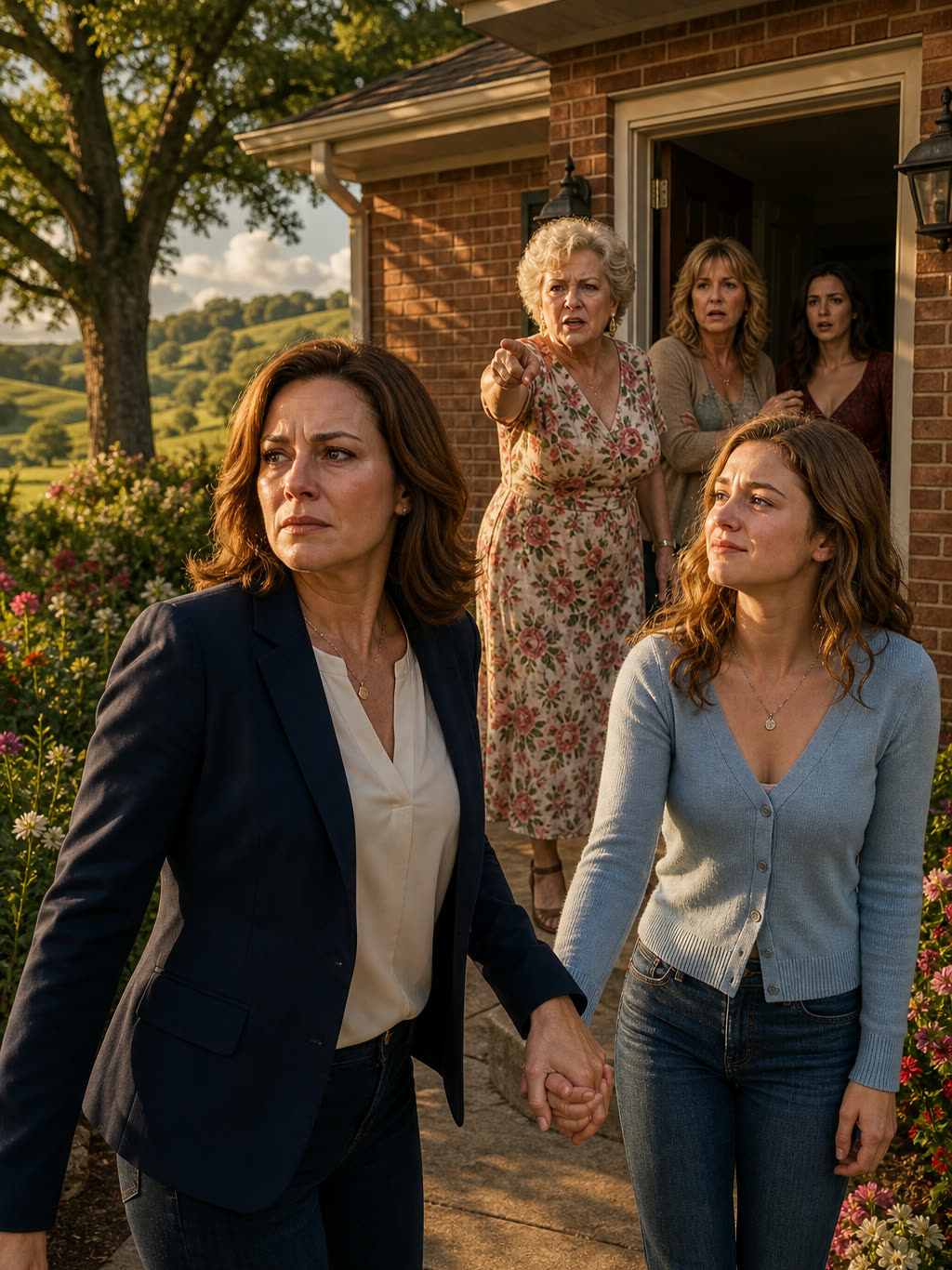
Mom stood. “I think you should leave.” “Gladly.” As Emma and I rose, Sandra snapped, “You’ve changed, Melanie.” I turned. “No. I’m finally behaving the way I should have behaved years ago.” We had reached the door when Mom called after us. “Your husband understood the importance of helping Sandra. He’d be ashamed of you.” I stopped. For one awful second I wanted to scream. Instead I faced her. “Daniel loved our daughter. He would never have asked Emma to sacrifice her future because Sandra wanted something.” Mom opened her mouth, but I wasn’t done. “And don’t ever use my dead husband to manipulate me again.”
Outside, under a wide, bright afternoon sky, Emma took my hand, and we walked to the car without a word. Then she said, “Mom?” “Yes?” “I’m proud of you.” I almost cried. It was the first time in years I had stood up to my mother without instantly apologizing. I had expected to feel awful. Instead I felt something unfamiliar. Free.
The next clue came from somewhere I never expected—a cardboard box in Emma’s room. Three evenings after the meeting, she appeared in my doorway holding an old cream-colored envelope. “Mom, can I ask you something weird?” “Of course.” “Did Grandma Grace leave me money?” The question startled me. Grace Carter was Daniel’s mother—a retired elementary teacher with silver hair, a gorgeous garden, and a remarkable gift for making people feel important. She adored Emma. She died four years earlier, three years after Daniel, and losing her devastated me; she was the closest thing I had to a second mother. “Why do you ask?” I said. Emma handed me the envelope. “I found this while sorting through my old school things.”
Inside was a birthday card Grace had given Emma shortly before she died, showing a little girl biking down a country road. In Grace’s graceful handwriting it read: “My darling Emma, Your father would be so proud of the young woman you’re becoming. Never stop asking questions, and never believe that kindness requires you to surrender your dreams. The future can be frightening, but I have tried to make the road a little easier for you. When the time is right, the arrangements I’ve made will help you go wherever your heart leads. All my love, Grandma Grace.” I read it three times. “What arrangements?” I asked. Emma shook her head. “I thought maybe you knew.” “No.” “Grandma Linda said there were some papers I shouldn’t worry about until I was older.” “When did she say that?” “After Grandma Grace’s funeral. I remember because she took a folder from the dining room and said she was handling all the financial stuff.” A memory stirred: Mom offering to help, me sitting numb and exhausted in Grace’s kitchen, Mom assuring me there was almost nothing to settle—a few belongings, some small expenses. I had believed her. She was my mother.
Emma went back to her room and returned with another envelope holding a folded page from a financial institution. Near the top it said GRACE CARTER EDUCATION TRUST, along with an account reference and a law firm’s name: Mercer & Associates. My hands shook as I photographed both pages and sent them to Olivia. She called the next morning. “Melanie, where did you find this?” “In Emma’s old things.” “Did anyone ever tell you Grace had established an educational trust?” “No.” “Did you ever receive an accounting?” “No.” A pause. “All right. I’m going to contact the firm named on the document.” “Olivia, is this serious?” “It could be.” Across the kitchen, Emma ate cereal, her Mazda keys beside the bowl. “How serious?” “If Grace established a trust for Emma, and someone has been managing it without proper authority, we need to find out exactly what happened to that money.” Watching my daughter, so young and unaware of the storm forming around us, I recalled my mother’s words—There are things about that house you don’t understand—and wondered whether she had meant something other than property.
The following week dragged. I worked, answered emails, reviewed supply reports, sat through meetings, and jumped every time my phone rang. The attorney who had served Grace had retired, but his former partner, Thomas Mercer, remembered her and agreed to see us. His office sat on the third floor of an old downtown Louisville building, all dark wood and windows overlooking a quiet street. Mr. Mercer was in his seventies, with neatly combed white hair and tired blue eyes. When he saw Emma, his face softened. “You look very much like your grandmother.” Emma smiled nervously. “Thank you.” He opened a thick file. “Grace was one of the most thoughtful clients I ever represented.” I leaned forward. “Did she establish a trust for Emma?” “Yes.” “How much?” He hesitated. “At the time of funding, approximately $286,000.”
The room seemed to tilt. “What?” Emma went white. Mr. Mercer explained that Grace had built her savings through decades of careful investing and the sale of a small parcel of inherited land, wanting it to carry Emma through college, a career, and early adulthood. Educational costs could be paid from the fund, and Emma would gain more control at twenty-one. “Why wasn’t I told?” He looked uneasy. “Grace originally named Daniel as trustee, with you as successor. After Daniel’s death, she confirmed the succession arrangement in updated paperwork.” “Then why didn’t anyone contact me?” He opened another folder. “Because shortly after Grace’s death, we received documents indicating that you had declined to serve.” He slid a page across. A typed statement claimed I was emotionally overwhelmed and unable to manage Emma’s finances—and beneath it, my signature. Except it wasn’t. “Who became trustee?” He lowered his eyes. “Your mother. Linda Whitmore.” Emma gasped. A successor appointment had been filed and accepted, Mr. Mercer said quietly, and administration later moved away from his firm. “We believed the transition had been handled properly.” Olivia’s face was grim. “We’ll need the complete records.” “I’ll cooperate fully.” Emma turned to me. “Mom, what does this mean?” I couldn’t answer.
I was replaying every conversation with Mom about college—every time she urged me to be grateful for Emma’s partial scholarship, every reminder that Sandra needed help, every hint that Emma should share her good fortune with Britney. All the while, a substantial trust had existed specifically for my daughter. On the drive home, Emma gazed out the window and finally whispered, “Do you think Grandma took it?” I swallowed. “I don’t know, sweetheart.” It was true. But deep down, I was starting to fear the answer.
Two weeks later Olivia called an urgent meeting and introduced a forensic accountant named Daniel Reeves. I almost laughed—hearing my husband’s name spoken so casually made the room feel smaller. Mr. Reeves spread statements across the conference table. “I want to walk you through what we’ve confirmed so far.” The trust had been funded as planned, earned investment income, and been managed normally for a time. Then Linda took control, and money began to drain out—a few hundred dollars, then a few thousand—labeled as educational support, living expenses, beneficiary assistance. But the destination accounts told a different story: transfers to Sandra, transfers through an account Linda controlled, purchases unrelated to Emma’s education. He pointed to one entry. “Do you recognize this payment?” It was from last year: $450, sent to my rental-property account. “That’s Sandra’s monthly rent.” “Exactly.” Another $450. And another. “Are you telling me Sandra was paying her rent with Emma’s trust money?” “At least some of the payments appear to have been funded through trust withdrawals routed through another account.”
I pressed my fingers to my temples. For years I had subsidized Sandra’s housing, cut her rent, covered repairs, taxes, and insurance—and now I learned that some of what she did pay came from money meant for my daughter. The next page listed a furniture store, a vacation booking site, a vehicle financing company, a cosmetics business, and several large cash withdrawals. The dental-office employee who swore she couldn’t afford rent had somehow afforded vacations, expensive electronics, and new furniture. I had assumed credit cards and never asked. “We haven’t completed the accounting,” Mr. Reeves said. “But the preliminary records indicate that a substantial portion of the trust’s assets may have been diverted.” “How much?” I whispered. He looked at Olivia, then at me. “Potentially more than $200,000, depending on how the remaining transfers are classified and what supporting documentation exists.” Emma’s education. Her emergency fund. Her future. Something rose in me stronger than anger—grief for Grace, who had saved so carefully; for Daniel, who would have trusted his mother to protect his child; for all the overtime I worked while someone quietly spent what Grace had left.
Olivia gave me a moment, then said, “There’s something else.” The property agreement’s reference to previous family financial arrangements, she explained, suggested the house was part of a plan to cover the missing money. She laid down an unsigned loan proposal: Sandra had apparently explored borrowing $175,000 against the rental once it was in her name. “If they obtained the house fraudulently,” Olivia explained, “they might have attempted to use it as collateral, or sell it.” “But they don’t own it.” “No. And we’re taking steps to prevent anyone from relying on fraudulent paperwork.” The meaning landed with horrible clarity. My mother hadn’t promised Britney my house as a gift. She had promised property she didn’t own because her hidden scheme was starting to crumble—and Emma turning eighteen had changed everything. Emma could now ask questions, demand records, and challenge what had been done. “What happens now?” “We protect the property, demand a full trust accounting, pursue recovery where possible, and preserve evidence for the appropriate authorities.” “Can we get Emma’s money back?” “Some of it may be recoverable. We need to find out where it went.” “Do you think Sandra knew?” “I can’t tell you what she knew. But there are enough connections that we need to investigate her involvement.”
I drove home feeling my whole childhood had been rewritten, and a terrible thought settled over me: Sandra might not have started with Emma’s car. She might have been taking from my daughter for years. A few nights later, on a rainy Thursday, the doorbell rang. Through the glass I saw Britney—alone. No Sandra, no Mom, no grand entrance. She wore jeans and a gray sweatshirt, and her face held something I hadn’t seen there since she was small. Fear. I nearly left the door shut. Then I noticed the thick envelope clutched to her chest. “Aunt Melanie,” she said, “I need to talk to you.”
Part 3: The Five Words
I stepped onto the porch. “What about?” She glanced at the street. “Can I come inside?” After a moment, I moved aside. Emma was at the kitchen table with her anatomy notes, and her expression cooled the instant Britney walked in. “Hey,” Britney whispered. Emma said nothing, and I understood. My daughter had spent her life watching Britney receive what was taken from her; she owed her cousin no instant forgiveness. Britney sat down, silent for almost a minute, and then began to cry—not the performative tears I’d seen whenever Sandra refused her something, but quiet, embarrassed, frightened tears. “My mom told me the house was going to be mine,” she said. “I know.” “She said Grandma had arranged it because Aunt Melanie promised to help our family after Uncle Daniel died.” “That’s not true.” She nodded. “I know that now.”
She pushed the envelope toward me. Inside were copies of messages, bank correspondence, photos of documents, and screenshots from a family group chat I had never been part of. It was called Our Next Chapter. The earliest messages dated from months before graduation. Sandra had written: “Once we get the deed settled, the house can finally work for us.” Mom had answered: “Melanie will cooperate. She always does when you approach her correctly.” Britney pointed to another, sent six weeks before graduation. Sandra: “Emma turns eighteen soon. We need everything settled before she starts asking questions about the account.” My mouth went dry. “What account?” Britney shook her head. “I didn’t know.”
Further down were messages about a loan application, a broker, an appraisal—and then one from Mom that chilled me. “Do not mention Grace’s paperwork around Melanie.” “Britney, did your mother tell you about Emma’s trust?” Her face crumpled. “Not until yesterday.” She had found an old statement in Sandra’s desk, assumed it was a retirement account, and then seen Emma’s name. She turned to her cousin. “Emma, I swear I didn’t know.” Emma studied her without speaking. “Mom told me Grandma had been helping us financially for years. I thought she meant Linda. I didn’t know the money came from your other grandmother.” She wiped her face. “I thought we were poor. I thought Aunt Melanie was rich and just didn’t want to help us.” My heart twisted. Sandra had built an entire family mythology around her own hardship, and Britney had grown up inside it. But that excused nothing.
“Why did you take Emma’s keys?” I asked. Britney stared at the table. “Because I was jealous.” It was the first honest answer I had ever heard from her. “I saw everyone making such a big deal over Emma. Then I saw the car, and I felt like she’d gotten something else I didn’t have.” Emma’s voice was steady. “I worked for my scholarship.” “I know.” “And Mom worked for that car.” “I know.” Britney looked up, crying. “I’m sorry.” Emma didn’t answer at once. Finally she said, “You made me feel like I wasn’t allowed to be happy.” Britney bowed her head. “I know.”
Then she said something that made me go still. “Grandma told Mom that the car thing proved there was a problem.” “What problem?” “She said you’d started saying no.” “Explain that.” “After the party, I heard Mom and Grandma talking. Grandma said if you were willing to stand up to us over car keys, we needed to move faster with the house.” The room seemed to tip. Her voice broke. “She said the old way of handling you wasn’t working anymore.” The words fell like stones. That driveway confrontation hadn’t just angered my mother—it had warned her I would no longer surrender whatever the family demanded, and it had made her desperate.
Britney pulled out one last page: a draft loan document bearing her own name. “Mom was going to have me sign as a borrower.” It proposed using the rental as security for a large loan, with Britney listed beside Sandra. “Did you agree to that?” “No.” She looked terrified. “Grandma told me it was just paperwork for the house they were giving me.” If the plan had worked, Britney could have been saddled with debt she didn’t even understand. They weren’t gifting her a house; they were using her. “Britney, I need to give these to my attorney.” “That’s why I brought them.” She faced Emma. “I don’t expect you to forgive me.” Emma’s eyes shone. “Good. Because I’m not ready.” Britney accepted it—no argument, no guilt trip. At the door, hugging neither of us, she whispered, “I wish I’d known what was really happening.” As she walked to her car, Emma came to stand beside me. “Mom? Do you think people can change?” “I think they can. But change has to be something they do, not something we give them credit for promising.” Emma nodded, and I watched her begin to grasp the difference between forgiveness and trust.
Olivia had Britney’s documents preserved, and then the investigation turned again. Darlene Keene, the notary on the fake property agreement, agreed to talk. She was a former church acquaintance of my mother’s, and her commission had expired before the supposed agreement was ever signed. “I never notarized that document,” she told Olivia. Her old records held no matching entry and no sign I had ever appeared before her. The stamp had been copied—and that same counterfeit notarization appeared on the trustee resignation filed after Grace died. Side by side on Olivia’s desk, the pages shared the same seal, the same name, the same suspicious signature. One tried to hand my sister my house; the other handed my mother Emma’s inheritance. Two forged signatures. Two assets. One family.
Mercer’s firm then found archived files, including a fully executed copy of Grace’s trust and her final instructions. When Olivia opened it, I saw my name, then Daniel’s, then a third: Rosa Martinez. “Rosa?” “Grace listed Rosa as an alternate successor trustee if neither Daniel nor you could serve.” “My mother wasn’t listed?” “No.” Olivia turned the page toward me. In a separate memo, Grace had specifically excluded Linda, writing that she wanted the account managed by someone independent of financial demands from other family members. Grace had known—maybe not how far it would go, but she had seen the pattern I spent my life calling normal, and she had tried to shield Emma from it. After her death, someone altered the paperwork to put Linda in charge, and the institutions accepted it without proper verification. There would be questions about their procedures, Olivia said—questions with serious legal consequences. I barely heard. I was staring at Rosa’s name.
That evening I went straight to Rosa’s house. She answered in an apron. “Melanie? What’s wrong?” “Did Grace ever ask you to look after Emma’s inheritance?” Rosa froze. “What inheritance?” I told her everything. By the end she was crying on her kitchen stool. “Grace asked me something once,” she whispered. “Shortly after Daniel died. She asked whether I’d be willing to help Emma if something happened to you. I thought she meant emotionally. I told her of course I would. She never said anything about money.” When I showed her the document, she wept harder. “Melanie, I would’ve helped. You know I would’ve helped.” “I know.” “If someone had contacted me—” “I know, Rosa.” I finally saw another layer of the betrayal: my mother hadn’t merely seized an account; she had bypassed the very people Grace trusted to ask questions and refuse to spend Emma’s future on Sandra. I took Rosa’s hand. “Grace trusted you.” “So do you.” “With my life.” She squeezed my fingers. “Then we’re going to make sure Emma gets the future Grace wanted for her.”
The confrontation came in Olivia’s office—not staged as a showdown, but as a meeting with Linda, Sandra, and their lawyer about the disputed documents. I hadn’t planned to go until Emma said, “Mom, you’ve spent your whole life letting Grandma tell your story for you. Maybe it’s time she hears yours.” Mom arrived in a cream blouse and pearl earrings, Sandra trailing her. Neither looked at Emma. Olivia calmly laid out the disputed property agreement, the altered trust papers, the missing funds, and the bank summaries. Sandra’s hands began to shake. Olivia asked whether anyone could show legitimate authorization for spending Emma’s trust on Sandra’s expenses. Sandra looked at Mom. Mom straightened. “Everything I did was for the family.” “That’s not an explanation for these transactions.” “Grace had plenty of money. Sandra was struggling. I knew what Grace would’ve wanted.” “Grace wrote down what she wanted,” I said. “Melanie, you don’t understand how difficult things were.” Something inside me snapped. “No, Mom. I understand perfectly. I understand that you watched me work overtime to provide for Emma. I understand that you told me Sandra couldn’t afford rent while money from Emma’s inheritance was helping pay it. And I understand that you told my daughter to give Britney her scholarship money while you were spending money Grace had already left for her education.” Silence filled the room. Mom pressed her lips together. “It wasn’t supposed to get this complicated.” “What wasn’t?” “The arrangements.” “You mean the forged documents? The house? The trust? The money?” She finally met my eyes. They were wet, but there was no apology in them—only exhaustion. Then she whispered the five words I will never forget. “You were never supposed to know.”

It felt like a blow. Not denial, not confusion—a confession that she had meant to hide it all. Emma made a small sound. “Grandma,” she said quietly, “was any of it really for me?” Mom blinked. “What do you mean, sweetheart?” “All those times you said you wanted me to succeed. Did you mean it?” For once, my mother had no answer. Then Sandra lurched forward. “Mom told me the money was hers to manage! She said Grace wanted us to be comfortable! She said it was family money!” “You knew you were receiving money from Grace’s trust?” “I knew Mom was helping. I didn’t know everything.” Olivia’s voice was firm. “We’ll need to establish exactly what you knew, Sandra.” Sandra was already sobbing. “I didn’t make the documents!” Mom turned on her. “Sandra, stop talking.” “No! You told me Melanie would never find out!” Mom closed her eyes, and I watched the authority she had wielded all my life—deciding who sacrificed, who was selfish, who apologized—collapse under paperwork she couldn’t explain away.
Olivia directed further discussion through counsel, and the meeting ended without a settlement. As we stood, Mom grabbed my wrist. “Melanie, please.” For forty-three years, that touch had been enough to make me stop, reconsider, surrender. Not anymore. I gently removed her hand. “Don’t.” Tears ran down her cheeks. “I’m your mother.” “Then you should have protected my daughter.” She cried harder, and for the first time in my life, I walked away without trying to comfort her.
The legal process ground on for months. Olivia secured the title, the fake transfer documents were challenged, the financing never went through, the lender was notified, and authorities began reviewing the evidence while a separate recovery effort targeted the trust. Nothing moved as fast as it does on television. Some money was spent, some records incomplete, some assets slow to trace. The forensic accounting confirmed that much of Emma’s inheritance had paid for things unrelated to her care or schooling, benefiting Sandra’s household and Linda herself. Then came one final discovery—the one that made Emma cry hardest. Olivia showed me a purchase agreement from several years earlier: buyer, Sandra Whitmore; vehicle, a used Nissan. “Britney’s car?” “Yes.” Most of it had been paid with money traced to Grace’s trust. The car Sandra had called unreliable at the party, the excuse she used to justify Britney grabbing the Mazda, had been bought largely with my daughter’s stolen inheritance. My niece had tried to take Emma’s graduation car while driving one Emma’s grandmother had unknowingly paid for. I didn’t know whether to scream or laugh.
When I showed Emma, she stared for a long while before the tears came. “Grandma Grace bought Britney a car?” “Not willingly, sweetheart.” “She was trying to help me.” “I know.” “And they took it.” I held her as she wept—not over a gift, not for revenge, but because she finally understood the size of the betrayal. When she sat up, she said, “I don’t want the money to be the thing that defines Grandma Grace. I want to remember that she loved me enough to think about my future.” “That’s exactly how she should be remembered.” She touched the blue key tag. “I think Dad would’ve told me the same thing.” I smiled through my tears. “He would have.”
Sandra eventually left the rental under an agreement worked out by the attorneys, and she and Britney moved into separate apartments. Walking through the empty house—sagging cabinets, scuffed walls, an overgrown yard—I remembered Sandra crying the day I gave her the keys. “You saved us, Mel.” I had believed helping her would bring us closer. Instead it became one more reason she thought she owned whatever I could provide. I called a contractor and resolved to rent the house to someone who would treat it as a home, not an entitlement—security for my future and Emma’s. Linda and Sandra were eventually charged in connection with the forged documents and misappropriated funds. More than a year later, both cases ended in negotiated guilty pleas, with restitution and other court-imposed consequences, while civil recovery continued. Not every dollar came back, but enough was recovered and protected that Emma’s education no longer hinged on my endless overtime. When Olivia showed us the first confirmed recovery deposit, Emma whispered, “I wish Grandma Grace could know.” “She would be proud that you stood up for yourself.” Emma shook her head gently. “She’d be proud of you too, Mom.”
Mom kept trying to reach me—angry messages, then defensive ones, then tearful ones. One voicemail ran nearly eight minutes, ending with, “Melanie, I made mistakes. But I’m still your mother.” I listened once and deleted it. I didn’t hate her; hate took more energy than I wanted to spend. But I no longer confused blood with unlimited access to my life. Britney’s path was different. After learning where her Nissan’s money came from, she cooperated with the recovery team, surrendered the car toward restitution, and gave a full statement. Over time she found steady work, moved into a modest apartment, and paid her own bills. Months later she phoned Emma, and I overheard my daughter: “No, Britney. I don’t want you to buy me anything. Because an apology doesn’t need a gift. Just keep doing better. That’s enough for now.” Eighteen years old, and already wiser than I had been at forty-three.
The most important discovery didn’t happen in a courtroom. Nearly a year after graduation, Rosa arrived one Sunday with a small wooden box. “Grace gave me this years ago,” she said, unusually emotional. “A letter. Actually, two.” Inside were two envelopes—one for Melanie, one for Emma—both in Daniel’s handwriting. My knees nearly buckled. Grace had given them to Rosa after Daniel died; he had written them when his heart trouble first became serious, meaning for us to open them once Emma reached adulthood. Rosa had packed the box away after Grace’s death and found it while searching for Olivia’s records. Seven years since I had heard his voice, and suddenly there were his words.
Mine read: “Mel, If you’re reading this, it means our little girl is growing up, and I wasn’t able to stay as long as I wanted. I’m sorry for every birthday, school event, and ordinary Tuesday I’ll miss. I know you’ll try to be everything for Emma. That’s who you are. But promise me something. Don’t spend your life proving you’re a good person to people who only appreciate you when you’re giving them something. You have always been enough. You were enough when we met. You were enough when we had nothing. And you will be enough even when you start saying no. Please teach Emma that love should make her feel safe, not indebted. I love you more than these words can hold. Daniel.” By the end the page swam with tears. He had never wanted me to hold the family together at any cost; he wanted me to protect the life we built.
Emma read hers silently, then her hand flew to her mouth and she passed it to me. “My sweet Emma, One day you’re going to be a young woman with your own dreams, your own decisions, and probably your own car. I hope you’ll drive carefully, because your old dad worries about everything. I hope you’ll choose a career that makes you proud. I hope you’ll fall in love with someone who celebrates your victories. And I hope you’ll never believe that you need to give away your happiness to deserve someone else’s love. There will be people who think being kind means you should always say yes. They’re wrong. Sometimes the kindest thing you can do for yourself is close a door. Sometimes the bravest thing you can do is take the road nobody else understands. Whatever happens, remember that your mother and I have loved you since before you could speak. We’re proud of who you are, not what you can give us. For every road ahead, my girl, remember that you have always been loved. Dad.” For every road ahead—the exact words on her key tag. “Mom, how did you know?” I hadn’t. I had picked them because they felt right. But now I remembered Daniel shouting them as Emma first pedaled away on her bicycle: “For every road ahead, sweetheart! I’ll be cheering!” Some memories don’t vanish; they wait for the right moment to return. Emma pressed the blue tag against her father’s letter, and for the first time since he died, the years didn’t feel as if they had taken him completely.
Two years after the party, Emma and I drove past the old rental on the way to a friend’s wedding. Fresh paint, a repaired porch, flowers along the walk; a young couple rented it now, paid on time, and sent polite emails when something needed fixing. “Remember when Aunt Sandra said that house belonged to Britney?” Emma asked. “Unfortunately.” “That feels like another lifetime.” In a way it was. She was twenty, thriving in nursing school, working part-time at a hospital, surrounded by friends who cheered her on. She still drove the silver Mazda, the blue tag scratched from daily use. Rosa still came most Sundays; we still made Daniel’s favorite pancakes on his birthday and talked about Grace at the botanical garden she loved. But I no longer answered the phone out of guilt or measured my worth by how much others needed me. Contact with Sandra was limited, Mom remained distant, and Britney and Emma spoke cautiously now and then. Some damage can’t be undone with words, but lives can still move forward.
That evening on the back porch, under an orange-and-pink sunset, Emma paused mid-story about a tough exam. “Mom, can I ask you something? Do you ever wish you hadn’t bought me the car?” “Why would you ask that?” “Because everything got so complicated afterward.” I thought of the investigations, the forged signatures, the lawyers, the betrayal—then of the girl who saved $4,300, earned a scholarship, and cried over a gift because her father wasn’t there. “No,” I said. “Not for a second.” “Really?” “Really. That car didn’t cause what happened, sweetheart. It only showed us what had been happening for years.” She nodded. “Yeah. I guess you’re right.” In the garage sat the Mazda—a little dusty, a textbook on the seat, a coffee cup in the holder, and a small scratch near the bumper she had apologized for about seventeen times. Not perfect. But hers. Earned, given with love, and protected. She kissed my cheek. “Good night, Mom.” At the door she turned. “Hey, Mom? I’m really glad you stopped trying to make everyone happy.” My throat tightened. “Me too.”
I stayed out a long time, thinking of the girl who paid for her own bicycle repairs, the teenager who learned to apologize for being upset, the woman who thought generosity would earn equal love, and the mother who nearly handed those lessons down. I couldn’t go back and tell her that love shouldn’t feel like a bill that never stops coming due. I could only choose what came next. The real treasure wasn’t the money or the house. It was that once I said no, my daughter stopped apologizing for good news, stopped hiding her accomplishments, stopped wondering whether she deserved what she had earned—and I stopped mistaking silence for peace. That was the inheritance Daniel and Grace had wanted for us: the freedom to be happy without guilt. I looked up at the stars. “Daniel,” I whispered, “I think we’re finally getting it right.” A warm breeze stirred the trees, and somewhere down the street a car engine started. I smiled. I hadn’t lost my family when I started saying no. I had finally stopped losing myself. And the greatest gift I ever gave my daughter wasn’t a silver Mazda. It was showing her that when someone reaches for the keys to her future, she has every right to hold on—because the road ahead belongs to her.
Disclaimer: This story is a work of fiction inspired by real-life themes. Names, characters, places and events are fictionalized, and any resemblance to real persons is purely coincidental. Images are for illustration purposes only.
