

Part 1: The Car Behind Him
Anyone who works a drive-thru window in Bangor, Maine, figures out the same truth before their first winter is over: at 6:40 in the morning, people show you exactly who they are. Nobody has their guard up at that hour. They roll down their windows with damp hair and half-shut eyes, and for about forty seconds you get the real version of them. The impatient ones lean on the horn. The sad ones forget to say thank you. The kind ones somehow remember your name even though you never told it to them.
I’d been working the window at Kettle & Pine for nearly four years by then. It’s a tiny coffee stand at the edge of Hammond Street, painted dark green, with a little peaked roof that grows icicles from November straight through March. Inside there’s room for two people, an espresso machine older than I am, a pastry case, and a space heater that only runs if you kick it. My name is Tessa Marsh. I was twenty-six, my headset had left a permanent dent in my hair, and I knew most of my regulars by their orders long before I knew their faces.
My shift lead was Kurt. Kurt was fifty-four, built like a refrigerator, and had been making coffee since long before coffee was trendy. He wore the same gray fleece every single day, and he believed with his whole chest that nobody ever did anything nice without an angle. "Everybody wants something," he liked to say, usually while counting the tip jar. "Some people just take longer to ask."
Mostly I tuned him out. You learn to, in a stand built for two. But I’ll admit that the first time the boy in the maroon sedan showed up, a small part of me wondered whether Kurt might be right.
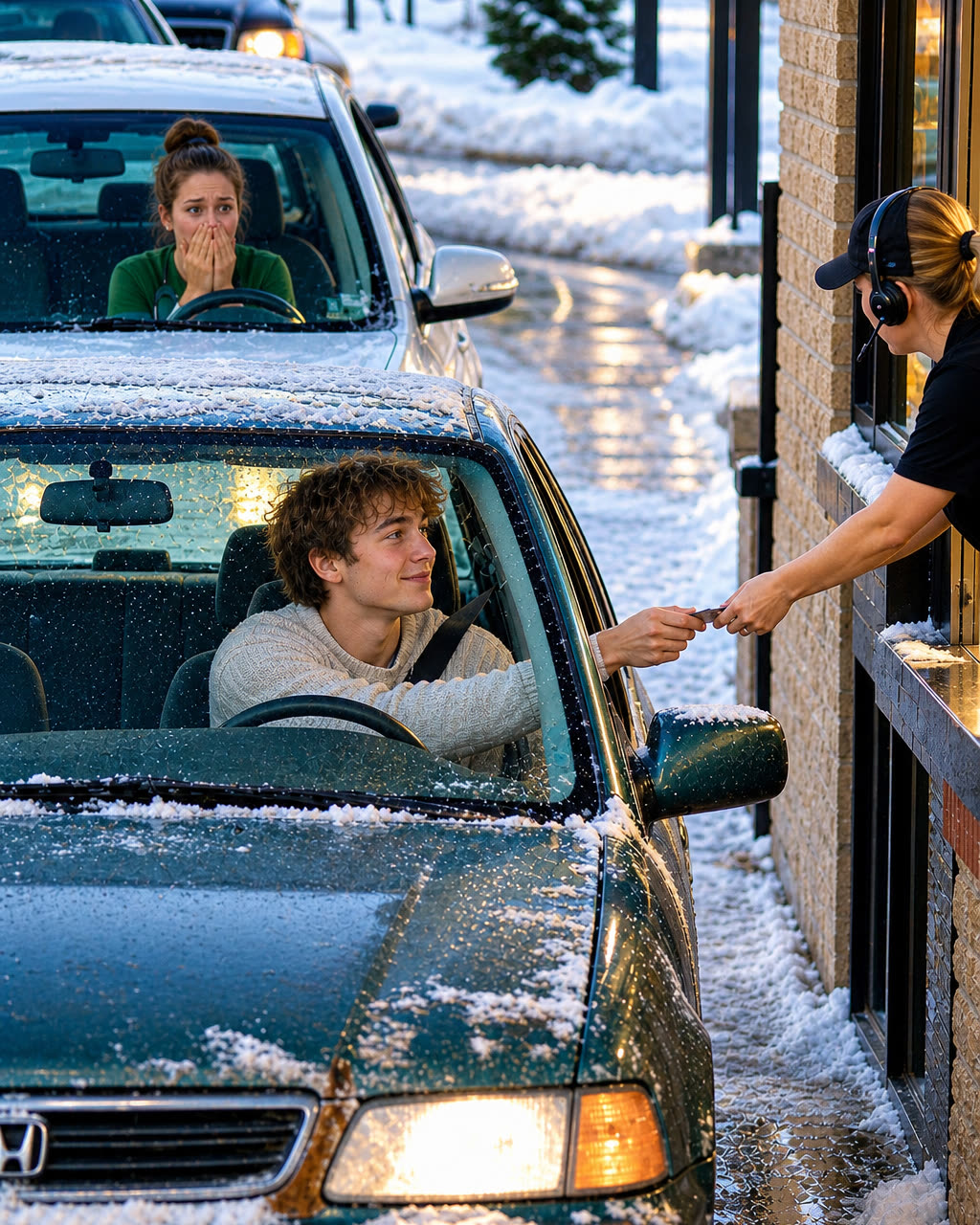
It was the second week of January, a year before everything happened. Snow had been blowing sideways since midnight, and the plows hadn’t reached our lot. The car that crawled up to my window looked like it had outlived three owners and a war. It was an old maroon Ford, rusted along the bottom of every door, the driver’s side mirror held in place by a thick wrap of silver duct tape. The heater must have been dead, because the boy behind the wheel had his hood up and his hands pulled up inside his sleeves.
He couldn’t have been more than sixteen. A thin face, a tangle of curly brown hair escaping from his hood, a navy sweatshirt under a tan canvas jacket that was too wide in the shoulders. He looked tired in a way teenagers usually don’t — not stayed-up-gaming tired, but something older and heavier. "Small hot chocolate," he said. Then he flicked his eyes to the rearview mirror. "And whatever the car behind me is getting."
I leaned out a little to look. Behind him sat a silver Toyota Corolla, clean except for a crust of road salt on the bumper. The woman at the wheel wore teal hospital scrubs, a stethoscope still draped around her neck, her dark blond hair twisted into a bun that had obviously surrendered somewhere around three in the morning. She was rubbing her eyes with the heel of her hand. "You know her?" I asked. He shook his head a little too quickly. "No. Just — it’s cold. People should get coffee." He paid with a debit card, took his hot chocolate, and said very softly, "Please don’t tell her it was me. Just say it’s paid."
When the Corolla rolled forward, the nurse ordered a small vanilla latte and reached for her wallet. I told her it was taken care of. She stared at me as if I’d answered in another language. "By who?" "The car ahead of you," I said, which was technically true. She turned toward the road, but the maroon Ford was already gone, its single working taillight fading into the snow. She laid a hand flat against her chest. "Well," she said, her voice going a little thick. "Tell them thank you. I really needed that this morning."
I assumed that was the end of it. A random kindness from a kid who’d probably watched some video online. But the next morning, at 6:40 on the dot, the maroon Ford pulled up again. "Small hot chocolate," the boy said. A glance in the mirror. "And whatever the car behind me is getting." I looked. The silver Corolla was there. Same nurse. Same scrubs. Same worn-out bun.
It turned into a ritual so reliable I could have set my watch by it. Every morning snow would be stacking up on that rusted maroon hood, the headlights glowing gold in the blue dark, and the boy would reach his arm out the window with his card pinched between two fingers, smiling faintly to himself as he checked the mirror. And every morning, in the car behind him, the nurse would pull up to my window, learn that her latte had already been paid for, and press both hands over her mouth as if she couldn’t believe the world still had that much kindness left in it. I watched her do it a dozen times that winter. It never stopped looking like the first time.
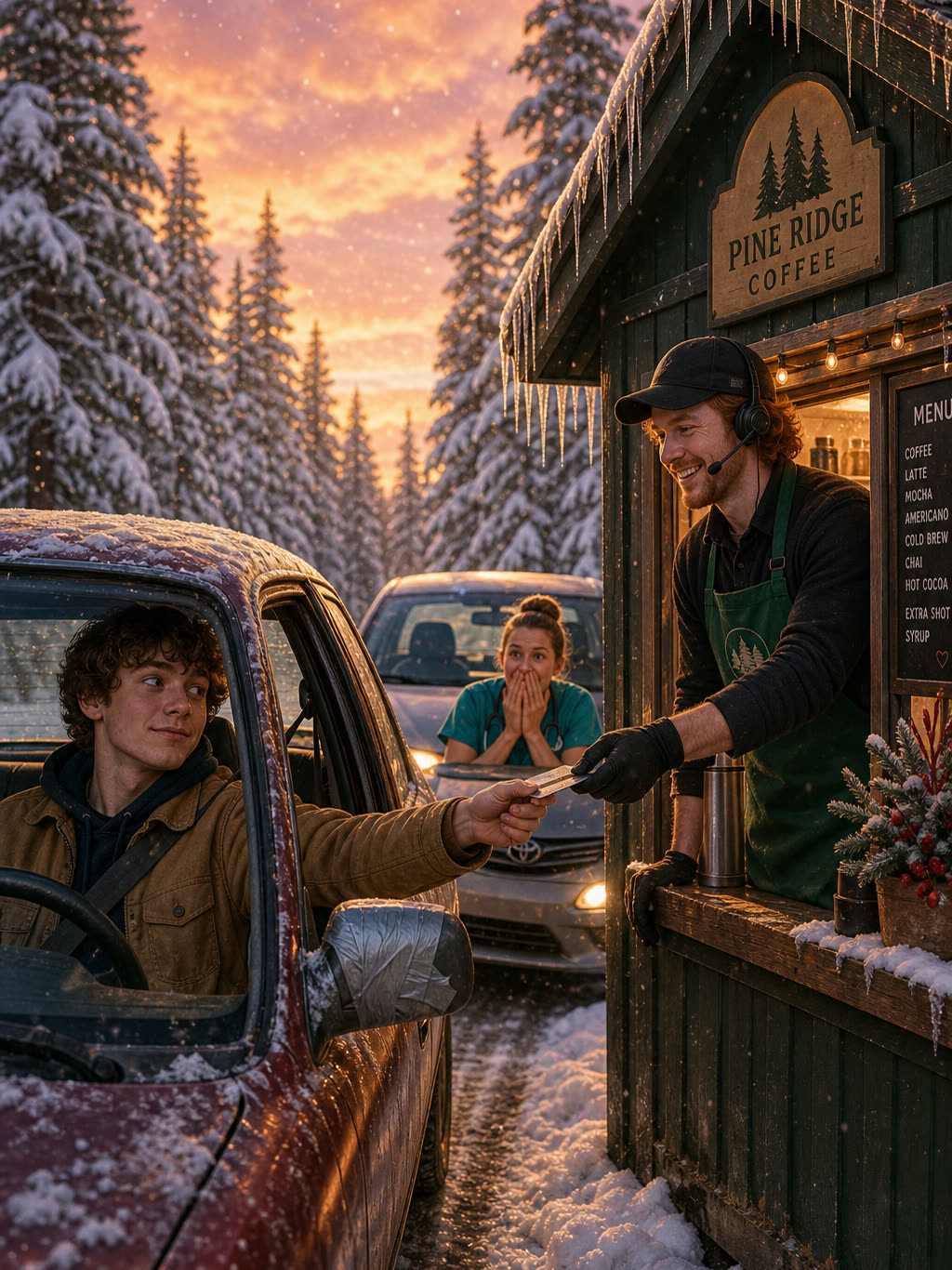
Kurt caught on by the end of January. "That kid’s running a con," he said, watching the Ford pull away. "Nobody pays for the same car every day. He’s gonna hit her up for money. You watch." "He’s a kid, Kurt." "Kids run cons too." "He orders a small hot chocolate," I said. "It’s the cheapest thing on the menu. He’s not running anything. He’s broke." Kurt grunted and went back to the tip jar, but the next morning at 6:39 I caught him staring out the window, waiting.
Once, I tried to ask the boy about it. It was February, close to Valentine’s Day, and the nurse had left something with me the morning before — a folded napkin that read THANK YOU, WHOEVER YOU ARE. YOU HAVE NO IDEA. I passed it to him with his hot chocolate. He read it by the light from the window and didn’t speak for a long moment. Then he folded it with enormous care, the way you’d fold something you meant to keep for the rest of your life, and slid it into the pocket of that oversized canvas jacket.
"Why her?" I asked. "Why every day?" He looked at me, and for a second I thought he might actually tell me. Then he only smiled. "Because she’s the car behind me," he said. And he drove off.
Spring arrived, and then summer. In July he still ordered hot chocolate, even on mornings when it was eighty degrees and the asphalt was already shimmering, and eventually I quit asking why. The nurse’s schedule shifted now and then — some weeks she came through at 6:15, some weeks closer to 7:05 — yet somehow the boy always knew. No matter what time the Corolla turned into our lot, the maroon Ford was right in front of it. Kurt found this deeply suspicious. I found it the most quietly beautiful thing I’d ever witnessed through a four-foot window.
In October the owner decided we needed a Regulars Wall — a corkboard by the pickup window covered in photos of our favorite customers. I asked the boy if I could take his picture. He said no. I teased him about it for a week until he finally let me snap one on my phone: him at the window, hood down for once, curls everywhere, holding his little cup with that half-smile. "Just don’t put it up," he said. "Okay? Not where she can see it." So I didn’t. I kept it on my phone. I couldn’t have told you why at the time.
Somewhere in there, a full year went by. I knew his order, his car, the rattle of his muffler from a block away. I knew he hummed along to whatever was playing on the classic rock station and that he always tipped exactly one quarter. What I didn’t know was his name. His card was one of those prepaid ones with no name printed on it, and asking had somehow never felt right. He was just the boy in the maroon Ford. And she was just the car behind him.
Then, in the second week of the following January — almost exactly one year after the first time — he didn’t show up.
It was a storm morning, the kind where the snow comes down so thick the streetlights look like they’re underwater. 6:40 came and went. Then 6:45. Then 7:00. At 7:04, the silver Corolla pulled up to my window by itself. The nurse ordered her small vanilla latte and reached for her wallet automatically, then paused, hand hovering. "Nobody today?" she asked, with a small, embarrassed laugh. But she glanced at her mirror, and then ahead at the empty road, as if she expected someone to materialize out of the snow. She paid. I handed her the cup, and the whole thing felt wrong, like a song that stops one note too early.
The next morning was the same. No maroon Ford. The Corolla came through alone, and the nurse paid without asking this time, though she sat at my window a second longer than she needed to. "Told you," Kurt said once she’d gone. "Con’s over. He got bored." But he said it to the espresso machine instead of to me, and he didn’t sound like he believed it.
On the third day, the space heater died again, and while Kurt was kicking it, I scrolled through the local news on my phone to keep my hands busy between cars. I almost scrolled past. A short clip from Channel 5: a car had slid on black ice along Route 2 out past Hermon and been struck by a logging truck coming the other way. The driver, a seventeen-year-old boy whose name hadn’t been released, was in critical condition at the hospital downtown. He had not regained consciousness.
The footage only lasted a few seconds. A crumpled car in a snowbank, lit up by red and blue lights. Maroon. Rusted along the doors. And dangling from the driver’s side, swinging on a strip of silver duct tape, a broken mirror.
I dropped the milk pitcher. It hit the floor and sprayed steamed milk across my shoes, and I didn’t even feel it. Kurt turned around, saw my face, and came over to look at my phone. He watched the clip twice. "That’s him?" he asked quietly. "That’s him." For the first time in four years, Kurt had nothing to say. He just picked up the pitcher, wiped the floor, and took over the window for the rest of my shift without being asked.
I didn’t sleep that night. I kept thinking about the nurse. Every morning for a year, a stranger had paid for her coffee, and she had no idea who he was. Every morning now, she’d be pulling up to my window and checking her mirror for someone who wasn’t coming — and she’d never know why. Somewhere around three in the morning, staring at my ceiling, I decided I wasn’t going to let that happen. He’d asked me not to tell her it was him. But he’d also never imagined a morning when he wouldn’t be there.
The next day, the Corolla pulled up at 6:52. The nurse looked worn down to the bone, her bun lopsided, dark circles under her eyes. She started to order. I didn’t let her finish. "Can I show you something?" I asked, and before she could answer I pulled up the photo and held out my phone. "This boy has paid for your coffee every morning for a year," I said. "Every single day. He made me promise not to tell you. He was in an accident three days ago. He’s in the hospital."
She took the phone from my hand. She looked at the picture — at the curls, the half-smile, the little cup of hot chocolate — and I watched every bit of color drain out of her face. Her hand rose slowly to her mouth. The phone trembled in her fingers. "Oh my God," she whispered. "I know him. I know exactly who he is."
Part 2: The Night She Stayed
The nurse’s name was Nadine Fogarty. I didn’t even know that much until that morning. A whole year of vanilla lattes, and I’d never once asked.
She parked her Corolla and came inside the coffee stand, still in her scrubs, still holding my phone. Kurt didn’t say a word. He just slid over to the window, pulled on my headset, and started taking orders himself so I could step back beside the pastry case with her. There really isn’t space for three people in there. Nobody cared.
Nadine stood next to the espresso machine with steam curling around her, staring down at the screen as if it might change if she looked away. Outside, the line of cars was getting longer. Kurt was handling it. "Three years ago," she said slowly, "I was a night nurse in hospice. There was a woman named Maureen Whitley. Ovarian cancer. She was only 41."
She looked at the photo again. Her thumb brushed across the screen, right over his hair, the way you’d smooth a child’s curls off his forehead.
"Her son came every night after school. Fourteen years old. He’d sit in the corner and do his homework so she wouldn’t worry about his grades."
Her voice cracked. She pressed her lips together for a second, steadying herself, and when she spoke again the words came out low and careful. "The night she died, he was there. He wouldn’t leave. Everyone else had gone home. He had nobody else."
The machine hissed behind her. Kurt was saying "Medium dark roast, anything else?" into the headset, his voice gentler than I’d ever heard it. Nadine stared at the little window above the sink, where the snow was falling on the pines out back. "So I stayed. After my shift. I sat with him until 7 in the morning."
She wiped her eyes. "I bought him a hot chocolate from the vending machine. It was all I could think to do."
I stared at her. A small hot chocolate. Every single morning for a year.
"His name is Jonah," Nadine whispered. "Jonah Whitley." She said it like she was afraid the name might break if she spoke it too loudly. She stood there in her teal scrubs with my phone cupped in both hands, tears running down her face and catching in the steam, the morning sun breaking through the clouds outside and lighting up the snowy hills beyond the window. I had watched this woman cover her mouth in surprise a hundred times at my window. I had never seen her look like this — like someone had handed her back a piece of her own heart she hadn’t known was missing.
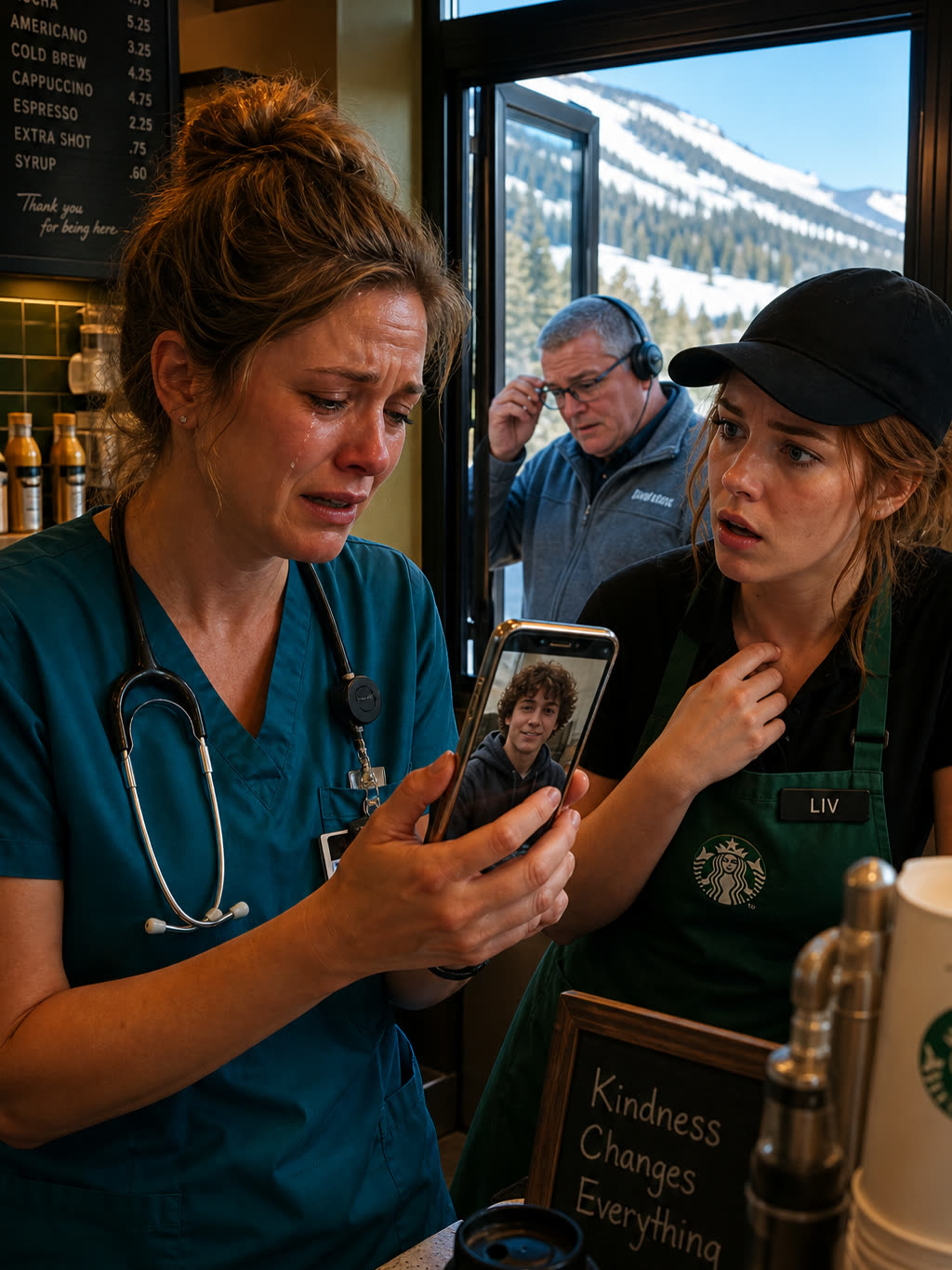
Kurt turned halfway from the window. He’d heard everything. He met my eyes for a second, and then, without a word, he looked back out at the cars and kept working. But I saw him take off his glasses and wipe them on his fleece, and they hadn’t been foggy.
"I never saw him again after that night," Nadine said. "The social worker told me he was going to live with his grandfather, somewhere out past Hermon. I thought about him all the time. Every time I walked past that vending machine. I used to wonder if he was okay. If anyone was making sure he ate. If anyone sat with him."
She let out a broken little laugh. "And all this time he’s been right in front of me. Every morning. I kept checking my mirror, trying to figure out who it was. I never once looked ahead."
We went to the hospital together that afternoon. My shift ended at one, and Nadine had gone home to sleep for a few hours, though I doubted she’d slept at all. She picked me up in the Corolla. It felt strange sitting in the passenger seat of the car I’d watched pull up to my window every day for a year. Neither of us said much on the drive. The heater hummed. The windshield wipers pushed snow back and forth. At one red light she said, mostly to herself, "He was so small then," and I didn’t know what to say, so I didn’t say anything.
Nadine talked her way onto his unit. She knew everyone. She’d worked at that hospital for six years before moving to the night shift at the hospice, and every nurse at the station seemed to know her face. A charge nurse with silver hair hugged her without asking what she was doing there. Ten minutes later, we were walking down a quiet hallway that smelled like hand sanitizer and old coffee, past rooms where machines beeped in slow, patient rhythms.
Jonah was in bed four, still unconscious. He looked smaller than he ever had behind the wheel of that maroon Ford. His curls were pressed flat on one side, there was a white bandage wrapped around his head, and a tube ran from his mouth to a machine that breathed for him in soft, steady hisses. His left arm was in a cast. The skin around his eyes was bruised purple and yellow. His grandfather was sitting beside him, a quiet old man in a John Deere cap.
When Nadine told him who she was, the old man put his face in his hands.
He stayed like that for a long time. His shoulders shook. Nadine knelt down next to his chair and put her hand on his back, the way I imagine she’d done for a thousand families in a thousand dim rooms. Finally he lifted his head. His eyes were red. "He talked about you," he said. "The nurse who stayed. He found out where you worked last year. He figured out what time you got coffee."
His name was Walt. He told us the rest slowly, in pieces, the way men like him talk when they aren’t used to saying much. Jonah had started working weekends at the hardware store on Union Street the spring after his mother died. He saved every dollar he could. Gas money, school money, and a little extra he loaded onto a prepaid card every Friday. Walt hadn’t known what the card was for until Jonah finally told him, months in. "He sat out in the lot by that hospice for a whole week, mornings, watching who came out," Walt said. "Then he followed that silver car of yours. Just once. Just to see where you went. Said you stopped for coffee at the same place every day after your shift. And he thought — well. He thought that was something he could do."
"Why didn’t he just come say hello?" Nadine asked.
The old man smiled sadly. "He said you’d done something for him without asking for anything back. So that’s how he wanted to pay you back. Without you knowing."
Nadine sat beside Jonah’s bed and held his hand.
Walt told us about the accident, too, though I almost wished he hadn’t. It was that first storm morning, the morning the Corolla came to my window alone. Jonah had left the house early because of the snow. He’d told Walt the roads would be bad and he didn’t want to miss her. "Said if he was late, she’d have to pay for her own coffee," Walt said, staring at the floor. "Like that was the worst thing that could happen." I had to step out into the hallway after that. I stood by a window that looked out over the frozen river and cried harder than I had in years, because somewhere in my head I kept hearing my own voice saying, Good morning, welcome to Kettle & Pine, and I kept thinking about how he’d been on his way to hear it.
She came every day after her shift. I came every afternoon after mine.
The days blurred together. Nadine would arrive around eight in the morning, still in her scrubs, and sit with Jonah until she nearly fell asleep in the chair. Walt was there almost all the time; the nurses had stopped trying to send him home. I came after one o’clock with a cardboard tray: black coffee for Walt, a vanilla latte for Nadine, and a small hot chocolate that I set on the rolling table by the bed, even though I knew Jonah couldn’t drink it. It felt like the only thing I knew how to do. On the fourth day Kurt sent a box of blueberry muffins with me and a note that just said FOR THE GRANDFATHER, in his blocky handwriting. He wouldn’t talk about it when I got back.
Nadine talked to Jonah constantly. She told him about her shifts and her patients and the terrible country music her coworker played in the break room. She told him about his mother — little things he might not remember, like how Maureen used to ask the nurses whether Jonah had eaten dinner, every single night, even near the end, when she could barely speak. She told him about the napkin she’d left at my window. "You kept it?" she asked, when Walt mentioned it was pinned above Jonah’s desk at home. Walt nodded. Nadine looked at Jonah’s still face and laughed through her tears. "You sentimental kid," she said. "You absolute sentimental kid."
The doctors were careful with their words. The swelling around his brain was going down, they said, but slowly. They began easing off the sedation on the sixth day and took the breathing tube out on the seventh. He was breathing on his own now, which was good. But he still didn’t wake. "Sometimes it takes time," one of them told Walt, in the soft, practiced voice I’d come to dread. "Some patients wake up within days. Some take much longer. And when they do, they may be confused. They may not remember everything. We just have to wait."
By the eighth day, nobody said much anymore. Walt had stopped reading the newspaper he brought. Nadine had stopped talking and just held Jonah’s hand, her thumb moving in slow circles over his knuckles. I sat in the corner chair — the same corner, I realized, where a fourteen-year-old boy had once done his homework so his mother wouldn’t worry — and listened to the monitors beep and tried not to count the days.
On the ninth morning I was back at the window. It was 6:40. I caught myself looking toward the road out of habit, waiting for a maroon Ford that was never coming again, when my phone buzzed in my apron pocket. It was Nadine. She never called during my shift. I pulled off my headset and answered, and at first all I could hear was her breathing — ragged and uneven, like she’d been running, or crying, or both. "Tessa," she said. "You need to get here. Right now. It’s Jonah." And then the line went quiet, and I couldn’t tell, for the life of me, whether she’d been crying from joy or from grief.
Part 3: Already Paid
I don’t remember most of the drive. I remember Kurt grabbing the headset out of my hand and saying, "Go. Just go," before I’d even explained. I remember my car fishtailing a little on the slush at the corner of State Street and my heart slamming against my ribs. I remember thinking, over and over, Please. Please. Please. I didn’t even know who I was asking.
I parked crooked across two spaces and ran. I ran through the lobby and up the stairs because I couldn’t stand to wait for the elevator, and by the time I reached his unit I could barely breathe. The silver-haired charge nurse saw me coming and just pointed down the hall. Her face gave nothing away. I couldn’t read it. I couldn’t read anything.
The door to bed four was open. Walt was standing at the foot of the bed with his John Deere cap crushed in both hands. Nadine was beside Jonah’s pillow, bent close over him, her back to me. For one horrible second, nobody moved, and the whole room was so quiet I could hear the snow ticking against the window.
On the ninth day, Jonah opened his eyes. I found out later that it had happened about twelve minutes before I got there. Nadine had been dozing in the chair with her hand in his, and she’d woken up because his fingers squeezed hers.
The first person he saw was Nadine. She’d been leaning over him when his eyelids finally fluttered all the way open, and her face was the first thing in the world he saw in more than a week.
He looked confused for a long time. His eyes were glassy and slow. They drifted from the ceiling to the machines to the window, then to his grandfather standing at the foot of the bed, then back to Nadine. His lips moved without making a sound. His forehead creased under the bandage, as if he were working hard on a math problem he couldn’t quite solve.
"Jonah," Nadine said softly. "Hey. It’s okay. You’re in the hospital. You’re safe. Your grandpa’s right here."
He kept staring at her. I watched it happen — I’ll never forget it. Something shifted slowly behind his eyes, like a light coming on in a house at the end of a long road. The confusion didn’t vanish all at once. It melted away bit by bit, and what replaced it was recognition, and then something like wonder.
Then he whispered, "Small vanilla latte."
She laughed so hard she cried. She laughed so hard she had to grab the bed rail to stay upright, both hands shaking, tears pouring down her face while the morning sun streamed through the big window behind her and turned the frozen river and the snowy pines on the far hills to gold. Walt let out a sound I’d never heard from a grown man, half sob and half laugh, and pressed his cap against his mouth. And Jonah — battered, bandaged, barely able to lift his head — smiled up at her. That same small half-smile I’d seen through my window every morning for a year.
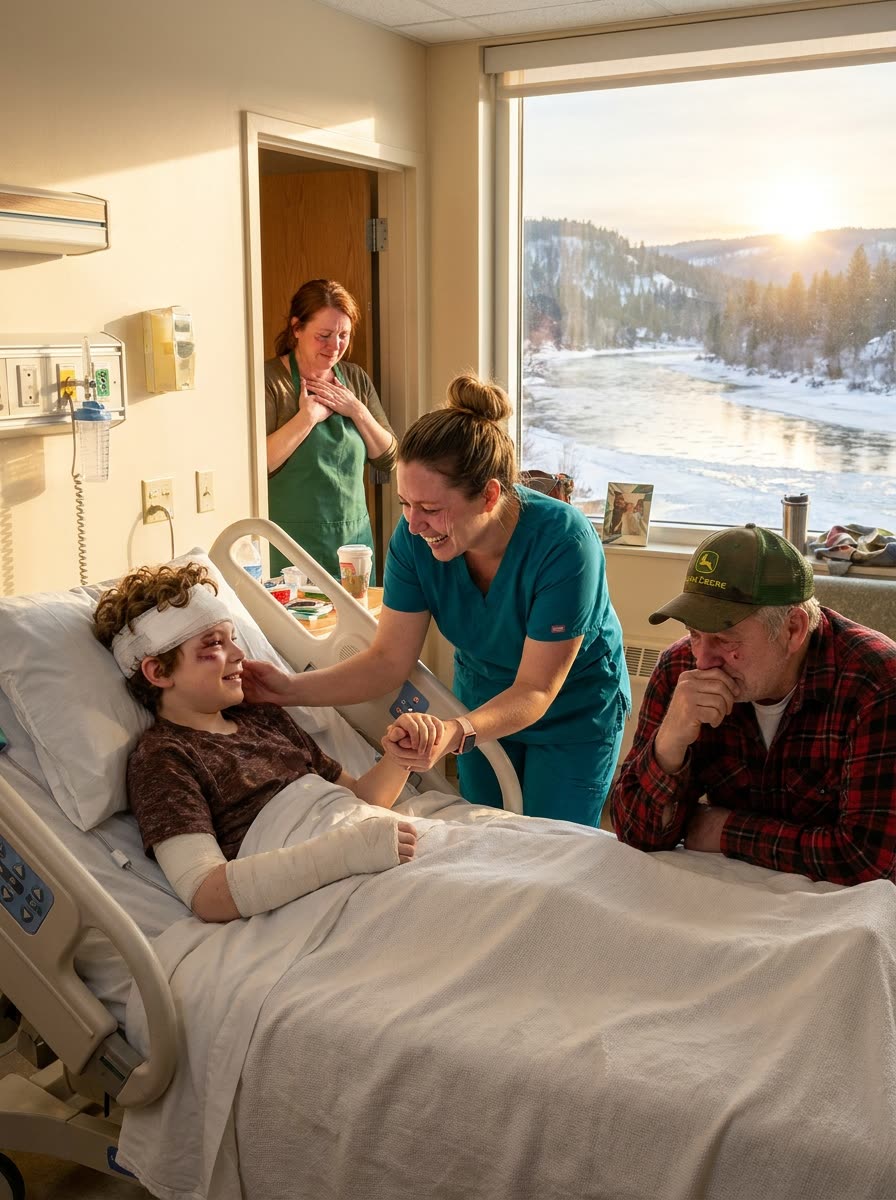
I was standing in the doorway with my hands pressed against my heart, crying so hard I couldn’t see straight. Jonah’s eyes slid past Nadine and found me. He frowned a little, trying to place me without the window frame around my face. Then he got it. "You told her," he croaked. "I told her," I said. "I’m sorry. You weren’t there to stop me." He closed his eyes for a second. When he opened them, there was the faintest spark of a joke in them. "Kurt’s gonna say it was a con," he whispered. And all four of us burst out laughing, there in that little hospital room, so loudly that a nurse poked her head in to make sure everything was all right.
Later that afternoon, when he’d had some water and the doctors had come and gone with cautiously happy faces, Nadine sat on the edge of his bed and asked him the question she’d been holding for nine days. "Why didn’t you just tell me?" Jonah looked at his cast for a long time. "Because then you’d feel like you owed me," he said finally. "And you didn’t. You never owed me anything. You stayed when nobody else did. I just wanted you to have a good morning. Every morning. That’s all." Nadine took his face very gently in both hands. "You were fourteen," she said. "You were fourteen, and you’d just lost your mother. Nobody in the world owed you more than I did that night." He didn’t answer. He just leaned into her hands and closed his eyes.
Jonah spent three weeks in rehab learning to walk without a cane. It was hard, and he hated it. His left leg had been badly bruised in the crash, his balance was off from the head injury, and the first time he tried to stand between the parallel bars, his knees buckled and a physical therapist named Rosa had to catch him. He got so frustrated he threw a foam ball across the room. Then he apologized to Rosa four times in a row. By the end of the first week he could walk the length of the hallway with the cane. By the end of the second, he could make it to the vending machine on his own. By the end of the third, he left the cane leaning in the corner and walked out to Walt’s truck without it.
Nadine was there for almost every session. She’d show up after her night shift, still in her teal scrubs, and sit on the bench along the wall cheering him on like a mom at a hockey game. I came by after work with a cardboard tray. Small hot chocolate for Jonah. Small vanilla latte for Nadine. Black coffee for Walt. Jonah would take his cup, look at the tray, and shake his head. "You know you’re supposed to charge people for these," he said once. "Somebody already paid," I told him, and he didn’t argue.
Word got around Bangor. I’m still not sure exactly how. Maybe one of the hospital nurses told her sister, who told her book club. Maybe Walt said something at the hardware store. Maybe it was the silver-haired charge nurse, who I suspected had been telling the story to every patient on the floor. All I know is that one day a woman in a minivan pulled up to my window and asked, "Is this the place? With the boy and the nurse?" And I knew we weren’t keeping it quiet anymore.
The local news did a story. People started coming to my window and paying for the car behind them. Every morning. For weeks.
It began with a few cars, then dozens. A contractor in a pickup truck paid for the minivan behind him. The minivan paid for a college kid in a beat-up Subaru, who scraped together enough change to cover a teacher in a sedan. One Tuesday in March the chain lasted from 6:15 in the morning until almost noon without breaking once — ninety-three cars in a row. I wrote the number on a sticky note and stuck it to the espresso machine. People left notes in the tip jar. People cried at my window. A man in a suit told me he’d lost his own mother the year before and hadn’t been able to talk about it until he heard the story. Then he paid for the car behind him and drove away before I could say anything.
Even Kurt paid for one. He didn’t tell anyone. I saw him do it.
It was a gray morning near the end of March. Kurt had stepped outside on his break to smoke the one cigarette a day he swore he didn’t smoke, and I watched him through the side window. A woman in a rusty hatchback was idling at the back of the line, her kids fighting in the back seat, her forehead resting against the steering wheel. Kurt stubbed out his cigarette, walked up to the car ahead of hers, and handed the driver a twenty. "For the one behind you," I heard him mumble. "Don’t say it was me." When he came back inside, he caught me watching. He looked at me for a long second, cleared his throat, and said, "Somebody’s gotta keep the chain going." Then he went back to counting the tip jar. I never brought it up. Not once.
When Jonah finally came back to the drive-thru in April, the line was eleven cars long. The maroon Ford was gone for good, so he was driving Walt’s old blue Buick, which was only slightly less rusty and had both of its mirrors attached. I heard it before I saw it. I’d know the sound of a teenager nervously revving an engine anywhere. When it reached my window, Jonah was sitting behind the wheel in that same oversized tan canvas jacket, curls sticking out in every direction, a thin pink scar running along his hairline where the bandage used to be.
He ordered a small hot chocolate.
Then he checked his rearview mirror out of habit.
Nadine’s Corolla was right behind him.
But this time, before he could say anything, I handed him a cup.
"Already paid," I said. "By the car behind you."
He looked back.
Nadine waved.
For a moment Jonah just sat there, holding the cup in both hands and staring into his mirror. Then his face crumpled and broke open into the biggest smile I had ever seen on him — not the small, secret half-smile, but a real one, wide and unguarded and seventeen years old. He laughed and wiped his eyes with the back of his hand, and behind him, in the silver Corolla, Nadine was laughing too. Kurt leaned over my shoulder to see what was going on. "Huh," he said. Then, quieter: "Good for them."
Now they get coffee together every Saturday. At a table. Inside. That spring the owner finally built the little heated porch onto the side of the stand that we’d been begging him for, with three small wooden tables and a window that looks out over the pines. Every Saturday morning at nine, the Buick and the Corolla pull into the lot side by side. Jonah orders a small hot chocolate. Nadine orders a small vanilla latte. Walt comes along sometimes and orders black coffee and a blueberry muffin, which Kurt insists on giving him for free. They sit at the corner table and talk about Jonah’s college applications and Nadine’s terrible coworkers and Maureen, who loved bad puns and never let anyone leave the house without a hat. Sometimes they don’t talk at all. They just sit there in the sunlight, two people who found each other in the dark.
Like family.
I still work the window. I still see people at their most honest, at 6:40 in the morning. But I look at the cars a little differently now. Every time someone says, "And whatever the car behind me is getting," I think about a boy in a rusty maroon Ford with duct tape on his mirror, and a nurse who stayed until 7 in the morning when nobody else would, and a vending-machine hot chocolate that somehow turned into a whole year of mornings — and then into a whole town of them.
THE END.
You never know who’s been quietly paying it forward for you. Sometimes it’s someone you saved. Have you ever had a stranger pay for your coffee? Tell us in the replies.
Disclaimer: This story is a work of fiction inspired by real-life themes. Names, characters, places and events are fictionalized, and any resemblance to real persons is purely coincidental. Images are for illustration purposes only.
