


PART 3
Clare stiffened.
“Are you threatening my position?”
“No.”
He shook his head.
“I’m telling you that leadership carries responsibilities beyond protecting your own reputation.”
He gestured toward the street.
“People look at you and decide whether the company you represent deserves their trust. Your father’s name may open doors, but your actions determine what people find when they walk through them.”
Clare swallowed.
“I made a mistake.”
“Yes.”
She seemed surprised that he agreed so plainly.
“I can apologize.”
“You can.”
“Will that be enough?”
David glanced toward the house.
“An apology is a beginning. It isn’t a substitute for changing how you treat people.”
He turned away.
“Have a good morning, Ms. Whitmore.”
Clare remained where she was.
She watched him pick up his keys, walk toward the Ferrari, and open the driver’s door.
The brass compass swung gently from the key ring.
For a moment, she wanted to call after him.
She wanted to demand an explanation for everything she had just learned.
She wanted him to tell her that the incident would have no consequences, that her position at the company was safe, and that the neighbors would forget what they had witnessed.
Instead, David got into the car.
The Ferrari’s engine started with a low, controlled growl.
He did not drive away.
He simply moved the car farther into the driveway to make room for the moving truck.
Then he stepped out again and returned to helping the movers.
Clare stood across the boundary between their properties, watching him carry a box through his front door.
He did not look like a man eager to punish her.
He looked like someone who had a home to unpack.
And somehow, that made her feel smaller than any insult could have.
By noon, the moving truck had departed.
David’s house was quiet except for the occasional sound of furniture being moved into place.
Across the street, Clare sat in her living room with the curtains open.
Her father’s old company photograph rested on the side table.
Thomas Whitmore stood in the center of the picture, surrounded by a dozen employees in front of the original warehouse.
He was younger than she remembered him in her final years with him.
His sleeves were rolled up.
His tie was loosened.
And hanging from a belt loop was a small brass compass.
Clare picked up the frame.
She studied the photograph closely.
There was David Brooks, standing near the far end of the group.
He looked younger, with darker hair and the same steady expression.
He was wearing work boots and a canvas jacket.
Beside him, Thomas had one hand resting on his shoulder.
Clare stared at the image for a long time.
She had seen that photograph hundreds of times.
She had never paid attention to the man at the edge.
That evening, she called her father’s former assistant, Margaret Ellis, who had retired several years earlier.
Margaret answered after the third ring.
“Clare? Is everything all right?”
Clare hesitated.
“I need to ask you something about my father.”
“Of course.”
“Did he know a man named David Brooks?”
The pause on the other end of the line was immediate.
“Oh, yes,” Margaret said softly. “Your father trusted David more than almost anyone.”
Clare closed her eyes.
“Why didn’t I know that?”
“Your father believed you knew him.”
“What does that mean?”
Margaret sighed.
“Your father wanted you to understand the business from the ground up. He hoped you’d spend time with the employees, learn how the operations worked, and see what it took to keep everything running. David was the person he trusted to teach you.”
Clare stared at the photograph.
“He never told me that.”
“He tried, dear. More than once.”
The words stung.
Margaret continued carefully.
“David was there during some very difficult years. He helped your father through the restructuring and stayed when other people thought the company couldn’t recover. Your father used to say that David could find direction when everyone else was arguing about the map.”
Clare glanced toward the front window.
Across the street, a light glowed in David’s kitchen.
“What happened to the compass?” she asked.
“Your father gave it to David near the end of his life. He said it belonged to someone who understood what the company was meant to be.”
Clare’s fingers tightened around the phone.
“Did my father ever say anything about me?”
Margaret was silent for a moment.
“He loved you very much.”
“That isn’t what I asked.”
“No,” Margaret replied gently. “It isn’t.”
Clare looked down.
Margaret continued.
“He worried that you’d become so accustomed to being recognized as a Whitmore that you might forget to earn people’s trust for yourself. He wanted you to have every opportunity, but he also wanted you to understand that a family name is a responsibility.”
Clare felt her throat tighten.
“Did he think I was a bad person?”
“No, dear. He thought you were capable of becoming a good leader. He was afraid you would mistake privilege for proof that you were already one.”
The call ended a few minutes later.
Clare remained seated long after the screen went dark.
She thought about the way David had stood in his driveway, calmly offering his registration while she accused him of stealing.
She remembered the neighbors watching.
She remembered the officer’s body camera.
Most of all, she remembered the question David had asked.
Would it have changed anything?
She knew the answer.
Yes.
If she had known he was chairman, she would never have spoken to him that way.
And that was precisely the problem.
The following Monday morning, Clare arrived at Whitmore Mobility Group’s headquarters earlier than usual.
The company’s offices occupied several floors of a modern building in Charlotte.
Glass walls separated the conference rooms from the main corridors. Employees moved between meetings carrying laptops and folders. The reception area displayed photographs documenting the company’s growth from a small transportation operation into a major mobility business.
Clare had walked through those doors thousands of times.
That morning, she noticed the employees differently.
The security guard who greeted her had been working there for nearly a decade.
The receptionist remembered the names of visiting drivers.
A maintenance supervisor held the elevator for a woman carrying two heavy boxes.
None of those people had inherited the company.
They had helped build its daily reality.
Clare entered her office and closed the door.
At nine o’clock, she received notice of an extraordinary board meeting scheduled for later that week.
The agenda included a review of leadership conduct and public-facing responsibilities.
Her stomach tightened.
She knew David had not threatened her.
But she also knew that the company could not ignore an incident involving its chief operating officer and the chairman.
For the first time, she considered what might happen if the board asked questions.
Would she defend herself?
Would she say she had been protecting the neighborhood?
Would she blame a misunderstanding?
Or would she tell the truth?
On Wednesday, Clare entered the boardroom carrying no prepared speech.
David sat at the far end of the table, the brass compass resting beside his notebook.
He wore a charcoal suit that morning, but something about his demeanor remained unchanged. He listened while the directors discussed operations, staffing, and the company’s long-term plans.
When the discussion turned to leadership responsibilities, the board’s general counsel addressed the room.
“An incident occurred over the weekend involving a member of the executive team and the chairman. The matter has been reviewed, and no criminal wrongdoing by Mr. Brooks was established. However, the board believes the circumstances raise questions about judgment, conduct, and the responsibilities attached to executive leadership.”
Clare kept her hands folded on the table.
The general counsel continued.
“The board does not intend to turn a private disagreement into a public spectacle. We do, however, expect our executives to treat people fairly and to avoid making accusations without a factual basis.”
David looked toward Clare.
He did not interrupt.
The board’s chairperson asked whether she wished to respond.
Clare stood.
For a moment, she looked around the table at the people who had spent years working alongside her.
Then she began.
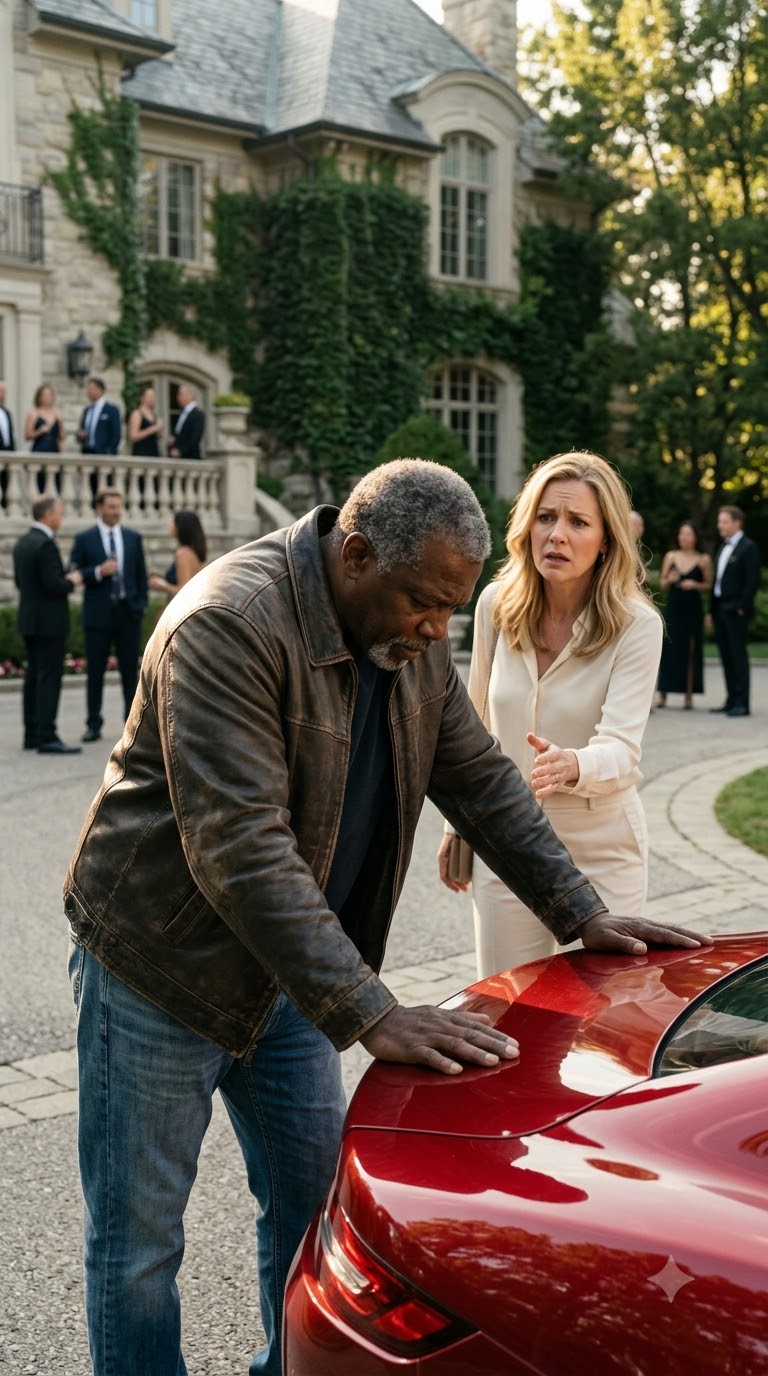
“On Saturday, I saw David Brooks standing beside a Ferrari outside his home. I made assumptions about him based on his appearance. I accused him of possessing a stolen vehicle and called the police without having evidence that a crime had occurred.”
Her voice trembled slightly.
“I also questioned the legitimacy of a personal item that had been given to him by my father. I did not know who he was, and instead of asking reasonable questions, I treated him as though he had to justify his presence in his own driveway.”
Nobody spoke.
Clare took a breath.
“I could say I was concerned. I could say I misunderstood the situation. But those explanations would not change what I did.”
She looked directly at David.
“I was wrong.”
The words were simple.
They did not erase what had happened.
But for the first time since Saturday morning, Clare was not trying to escape the truth.
“I apologize to David Brooks for the accusation, for the way I treated him, and for calling the police without a legitimate factual basis. I also apologize to the company and to the employees whose trust depends on our leadership.”
She sat down.
The room remained silent for several seconds.
David finally spoke.
“Thank you for acknowledging what happened.”
Clare looked at him.
“I know an apology doesn’t undo it.”
“No,” David replied. “It doesn’t.”
She nodded, accepting the answer.
“But it gives you somewhere to start.”
The board did not dismiss Clare.
