

PART 1
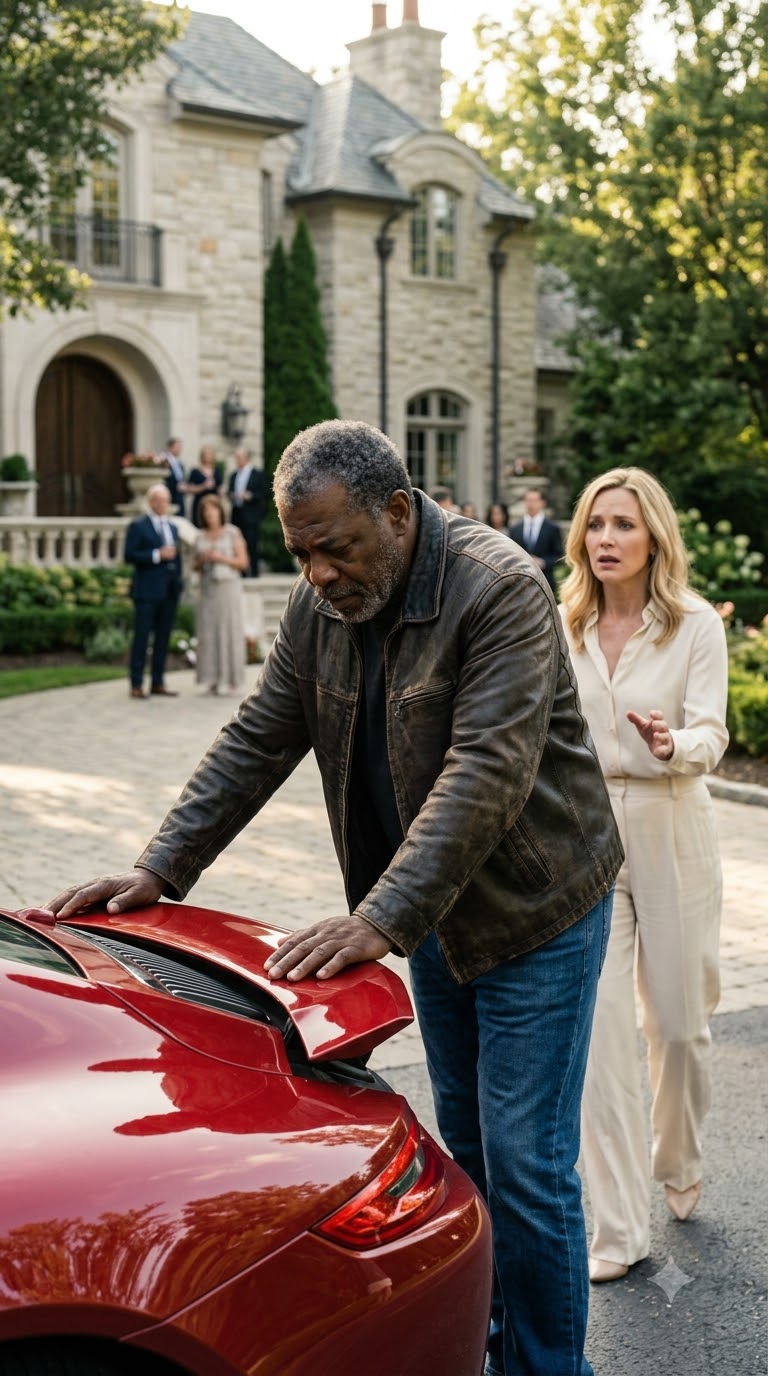
“Step away from the Ferrari.”
Clare called the police while neighbors watched David stand accused in his own driveway.
He remained calm, offering to show his registration as everyone else stood silently by.
Yet dangling from his keys was a battered brass compass engraved with WMG, a symbol Clare assumed had been stolen too.
Then the patrol car pulled up, its body-camera light flashing.
She had no idea what that tiny clue was about to uncover.
“Step away from that Ferrari.”
The command rang across the quiet Saturday morning before David Brooks had even finished closing the trunk.
He turned slowly.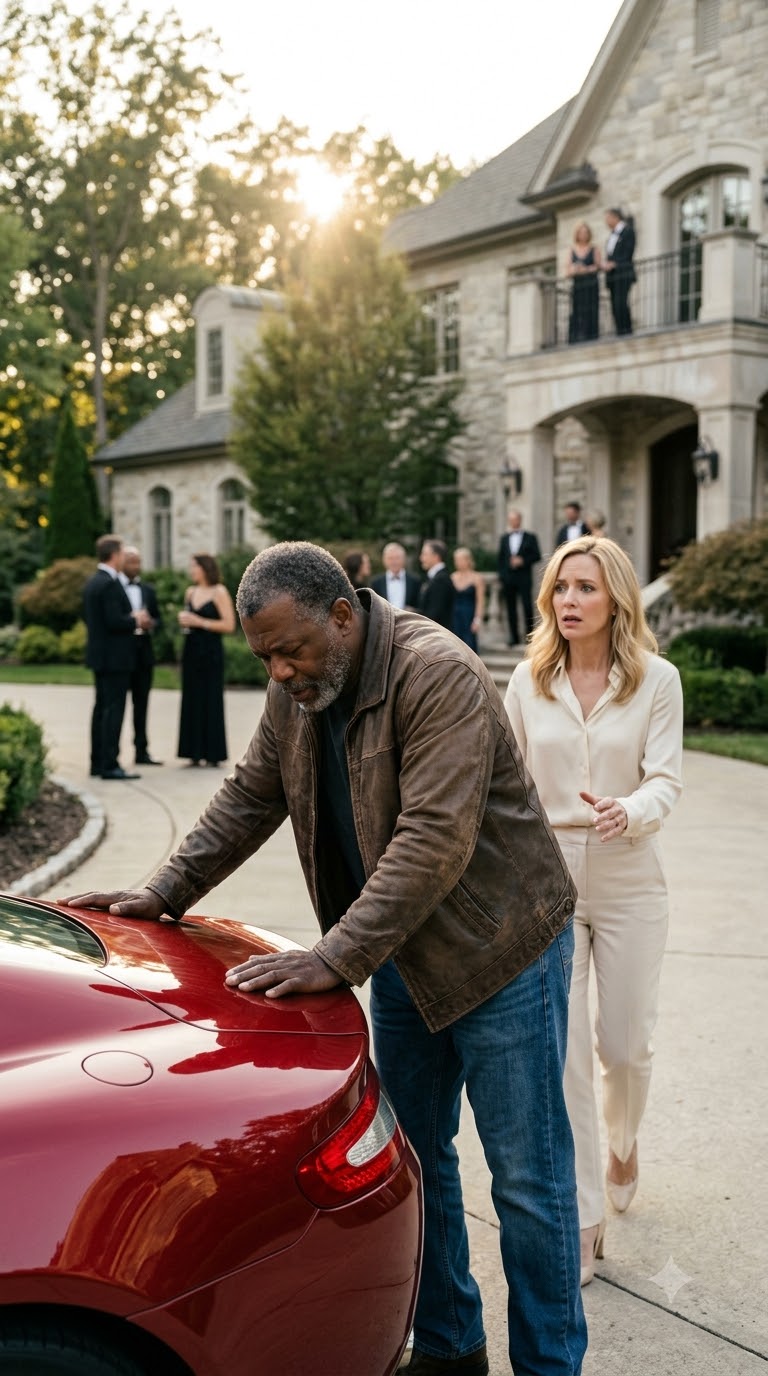
A woman marched across the immaculate lawn from the house opposite his, her cream-colored blouse bright beneath the Carolina sunshine.
She moved with the certainty of someone who had already decided what she was looking at.
David glanced at the red Ferrari beside him, then toward the open front door of the stone house behind him.
Three movers were carrying boxes inside.
A fourth was guiding a leather chair, wrapped in protective material, up the front steps.
David turned back toward the woman.
“Excuse me?”
“You heard me.”
She stopped several feet inside his driveway.
“Step away from the car.”
David was forty-six, broad-shouldered, and had closely cropped hair that was beginning to gray at the temples.
He wore dark jeans, scuffed work boots, and a faded brown canvas jacket he had owned for years.
Nothing about him suggested that he was trying to impress anyone.
Apparently, that bothered her.
Her eyes traveled over his clothes before returning to the Ferrari.
“What are you doing with it?”
David slipped one hand into his jacket pocket.
“My name is David Brooks.”
He gestured toward the house.
“I live here.”
The woman actually laughed.
Not loudly.
Somehow, that made it worse.
She looked at the two-story residence behind him, with its tall windows, pale stone exterior, and freshly trimmed hedges.
“You live here?”
“I moved in this morning.”
Hawthorne Ridge sat outside Charlotte, tucked behind brick entrance columns and rows of mature oak trees.
Its streets curved between expensive homes set well back from the road.
There were no sidewalks on David’s side of the street.
Only immaculate lawns, stone mailboxes, and driveways large enough to accommodate three cars.
The neighborhood was so quiet that the rumble of the moving truck had already attracted attention.
A gray-haired man stood on a porch two houses away.
Across the street, a woman holding a coffee mug had stopped halfway through opening her newspaper.
Nobody said a word.
The stranger folded her arms.
“I’m Clare Whitmore.”
David waited.
The name was clearly supposed to impress him.
When he showed no reaction, her face tightened with irritation.
“My family has lived in Hawthorne Ridge for twenty-three years.”
She glanced around.
“I know the people on this street.”
“Well,” David replied evenly, “now you know me.”
Clare’s expression hardened.
She pointed at the Ferrari.
“Whose car is that?”
“Mine.”
“Don’t insult me.”
David studied her for a moment.
“I wasn’t.”
He slowly took his keys from his pocket.
“I can show you the registration if there’s some reason you need to see it.”
The keys caught the sunlight.
Among the ordinary metal keys hung a battered brass compass, no larger than a silver dollar.
Years of handling had worn its edges smooth.
Three tiny letters were engraved on the back.
WMG.
Clare’s eyes fell on it.
For the first time, something other than contempt crossed her face.
Recognition.
It disappeared almost immediately.
“Where did you get that?”
David closed his fingers around the compass.
“It’s mine.”
“That wasn’t what I asked.”
David remained composed.
“You’ve asked several questions you don’t have any reason to ask.”
Clare stepped closer.
“That emblem belongs to Whitmore Mobility Group.”
David said nothing.
“My family’s company.”
Still nothing.
Clare examined the compass.
Then she looked at David’s worn jacket.
Her suspicions seemed to intensify.
“Did you take that too?”
David’s jaw tightened.
It was the first visible sign that her words had affected him.
But when he answered, his voice remained low.
“No.”
Behind him, one of the movers paused in the doorway.
David gave the man a small nod.
“Keep going, please.”
The mover hesitated before disappearing inside with the box.
Clare watched him go, then turned her attention back to David.
“You expect me to believe you just moved into that house, drive a Ferrari, and somehow ended up with a Whitmore Mobility Group compass?”
David looked down at the brass object.
“I don’t expect you to believe anything.”
“Then perhaps you can explain why a man dressed like you is driving a car worth more than most houses.”
One of the neighbors shifted uncomfortably.
David’s expression remained steady.
“What does the way I dress have to do with who owns my car?”
Clare’s cheeks flushed.
“Don’t twist my words.”
“I’m not twisting anything.”
He held out his keys, allowing the compass to hang visibly between his fingers.
“You asked whether the car belonged to me. I answered. You asked about the compass. I answered that too. If you’d like to see the registration, I’ll show it to you.”
Clare pulled out her phone.
“I’m calling the police.”
David nodded once.
“That’s your choice.”
He stepped away from the Ferrari and placed the keys on the trunk.
The gesture should have settled the matter.
Instead, Clare seemed even more convinced that something was wrong.
She turned away and spoke rapidly into her phone, glancing at David several times as she described the situation.
“Yes, I need an officer at Hawthorne Ridge. There’s a man here with a Ferrari, and I believe the vehicle may be stolen. He’s acting suspiciously, and there’s a company emblem on his keys that he can’t explain.”
David heard every word.
He said nothing.
Across the street, the woman with the coffee mug slowly lowered it.
The gray-haired neighbor on the porch took out his own phone, though he did not approach.
When Clare ended the call, she slipped her phone into her handbag.
“Stay right there.”
David looked at her.
“I’m standing in my own driveway.”
“You’re not going anywhere until the police arrive.”
He almost smiled, but there was no humor in it.
“I wasn’t planning to.”
For several seconds, neither spoke.
The moving truck’s engine hummed at the curb.
Somewhere down the street, a dog barked.
Then Clare’s gaze returned to the compass.
“WMG,” she murmured.
Her expression changed again, and this time the recognition seemed to bother her more than the possibility of theft.
“Where did you get that compass?” she repeated.
David looked directly at her.
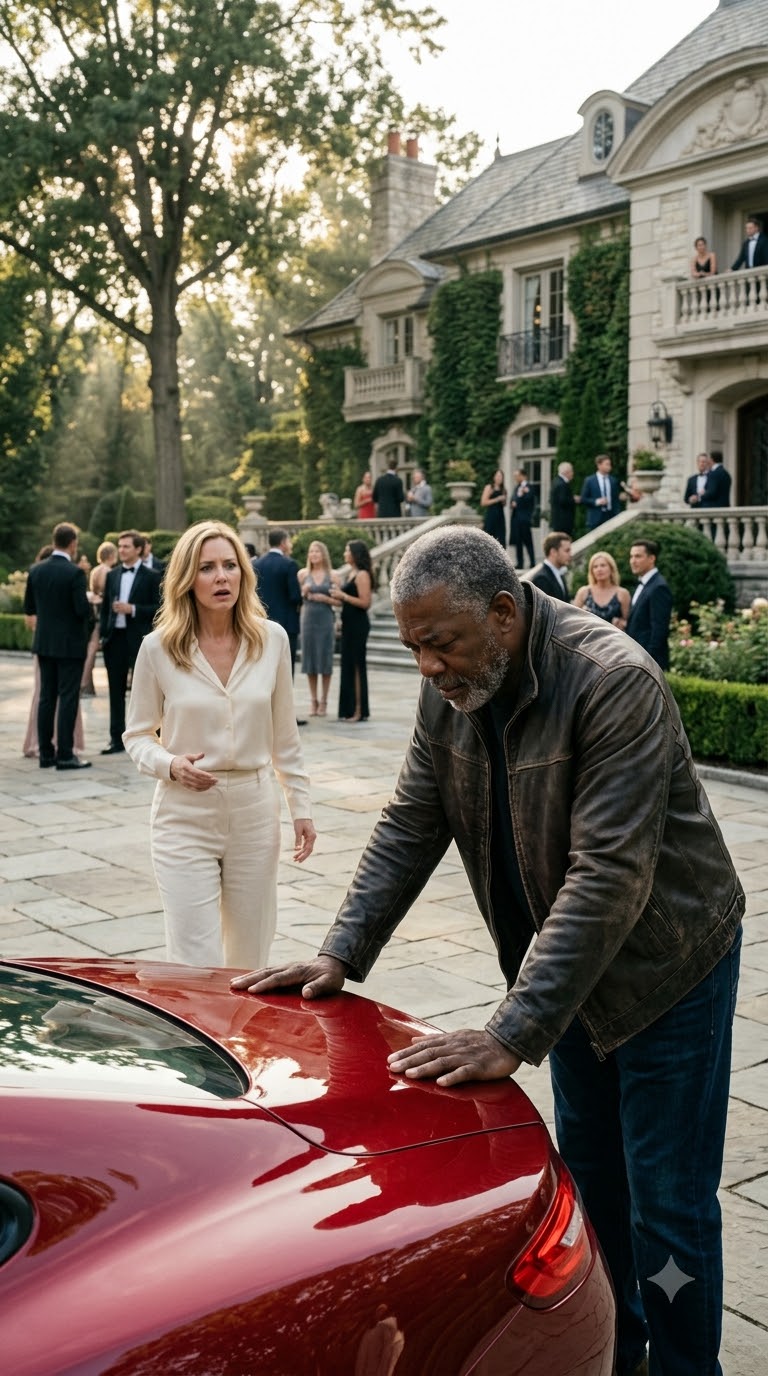
“Someone gave it to me a long time ago.”
“Who?”
“Someone who understood what that company was supposed to stand for.”
Clare’s lips pressed together.
“My father built that company.”
David’s gaze softened for a fraction of a second.
“Your father built a company. A lot of people helped make it what it became.”
Her face reddened.
“You don’t know anything about my family.”
“Perhaps not.”
“Then stop pretending you do.”
David picked up his keys.
“I haven’t pretended anything.”
Clare took a step backward and raised her phone again, as if she wanted to document every movement he made.
“You’d better have a convincing explanation when the police get here.”
David looked at the house, where the movers were still carrying his belongings inside.
“I hope they do their jobs fairly.”
The words were quiet.
But the gray-haired neighbor heard them.
He lowered his head.
A few minutes later, the patrol cruiser appeared at the end of the street.
Its tires rolled slowly over the smooth pavement before it stopped behind the Ferrari.
The body-camera light flashed as the officer stepped out.
Clare straightened immediately.
She smoothed her blouse, lifted her chin, and walked toward him with the confidence of someone expecting to be thanked for making the call.
“Officer, thank goodness you’re here.”
The officer, a Black man in his late thirties, looked from Clare to David.
“Who called?”
“I did. I’m Clare Whitmore. I live across the street.”
She pointed at the Ferrari.
“That man has a car I don’t believe belongs to him. And he has a company emblem that appears to have been taken from my family’s business.”
The officer did not respond immediately.
He turned to David.
“Sir, can you tell me your name?”
“David Brooks.”
“Do you live at this address?”
“Yes, officer. I moved in this morning.”
“May I see your identification and the vehicle registration?”
“Of course.”
David reached into his jacket slowly, explained what he was retrieving, and handed over his driver’s license and registration.
The officer examined both documents.
Then he looked at the Ferrari’s license plate and entered the information into his system.
Clare stood nearby, visibly impatient.
“Officer, I really think you should take this seriously. Whitmore Mobility Group is a major company, and that emblem is proprietary.”
The officer raised his eyes.
“Ma’am, I’m checking the vehicle information.”
“I understand, but—”
“Please give me a moment.”
For the first time that morning, Clare fell silent.
David stood with his hands visible, watching the officer work.
There was no anger in his posture.
No attempt to intimidate anyone.
Only a quiet patience that seemed to irritate Clare more than an argument would have.
The officer checked the identification, compared the registration details, and examined the information on his screen.
Then he looked at David again.
“Mr. Brooks, the registration information appears consistent with what you’ve provided.”
Clare frowned.
“Appears consistent?”
“I’m completing the check, ma’am.”
“But he could have obtained fraudulent documents.”
The officer turned toward her.
“Do you have any specific evidence that the vehicle is stolen?”
“The car itself is suspicious.”
“What about it is suspicious?”
“Look at him!”
The words came out before Clare seemed to realize how they sounded.
The street went completely quiet.
The officer’s expression became more serious.
“Look at him and what, exactly?”
Clare hesitated.
“He doesn’t look like the sort of person who would own a Ferrari.”
The officer looked at David, then back at Clare.
“Vehicle ownership isn’t determined by someone’s clothing or appearance.”
Clare’s face flushed a deeper red.
“I wasn’t trying to make it about race.”
“Then let’s focus on verifiable information.”
The officer returned his attention to the registration.
David remained silent.
He had heard variations of that accusation before. He had learned that reacting too quickly often gave people an excuse to ignore what they had said.
But this time, something in his expression had changed.
He looked tired.
Not physically exhausted.
Tired of having to prove that his presence in an expensive place did not automatically make him a suspect.
The officer completed another check, then handed back the identification.
“The information I have does not indicate that the vehicle is stolen.”
Clare stared at him.
“What about the compass?”
“It’s a personal item,” David said.
The officer glanced at it.
“Do you have any reason to believe it was stolen?”
Clare opened her mouth, then closed it.
“My family owns the company. That emblem is ours.”
“An emblem can be recognized without the item itself being stolen,” the officer replied. “Do you have evidence that this particular compass was taken unlawfully?”
