

PART 2
Clare’s silence answered the question.
The officer turned back to David.
“Mr. Brooks, is there anything else you’d like to tell me?”
David looked at the compass resting against his palm.
“Yes, actually.”
He lifted it slightly.
“This compass belonged to someone who helped establish Whitmore Mobility Group’s earliest operations. He gave it to me before he died.”
Clare’s eyes widened.
“Who?”
David looked at her.
“Thomas Whitmore.”
The name seemed to stop the entire morning.
Clare stared at him as though she had misheard.
“My father died six years ago.”
“I know.”
“How did you know him?”
David ran his thumb along the worn brass edge.
“I knew him long before the company became what it is today.”
Clare let out a short, disbelieving laugh.
“That is ridiculous. My father never gave away personal company property.”
David’s face became still.
“It wasn’t company property. It was his compass.”
The officer watched the exchange carefully.
Clare shook her head.
“No. My father kept everything. He had an entire collection of memorabilia from the company’s early days. He would never have given something like that to a stranger.”
David did not argue.
Instead, he turned the compass over and held it so that the officer could see the engraving.
The letters were worn but unmistakable.
WMG.
Beneath them, nearly obscured by decades of scratches, was a tiny inscription.
T.W. — KEEP US ON COURSE.
The officer leaned forward slightly.
“That’s quite an old item.”
“It is,” David replied.
Clare stared at the inscription.
Her face had lost some of its color.
She had seen those words before.
Not on a compass.
On a brass plaque that had once hung in her father’s private office, long before the company occupied glass towers and filled conference rooms with executives.
Thomas Whitmore had used the phrase whenever he spoke about the company’s future.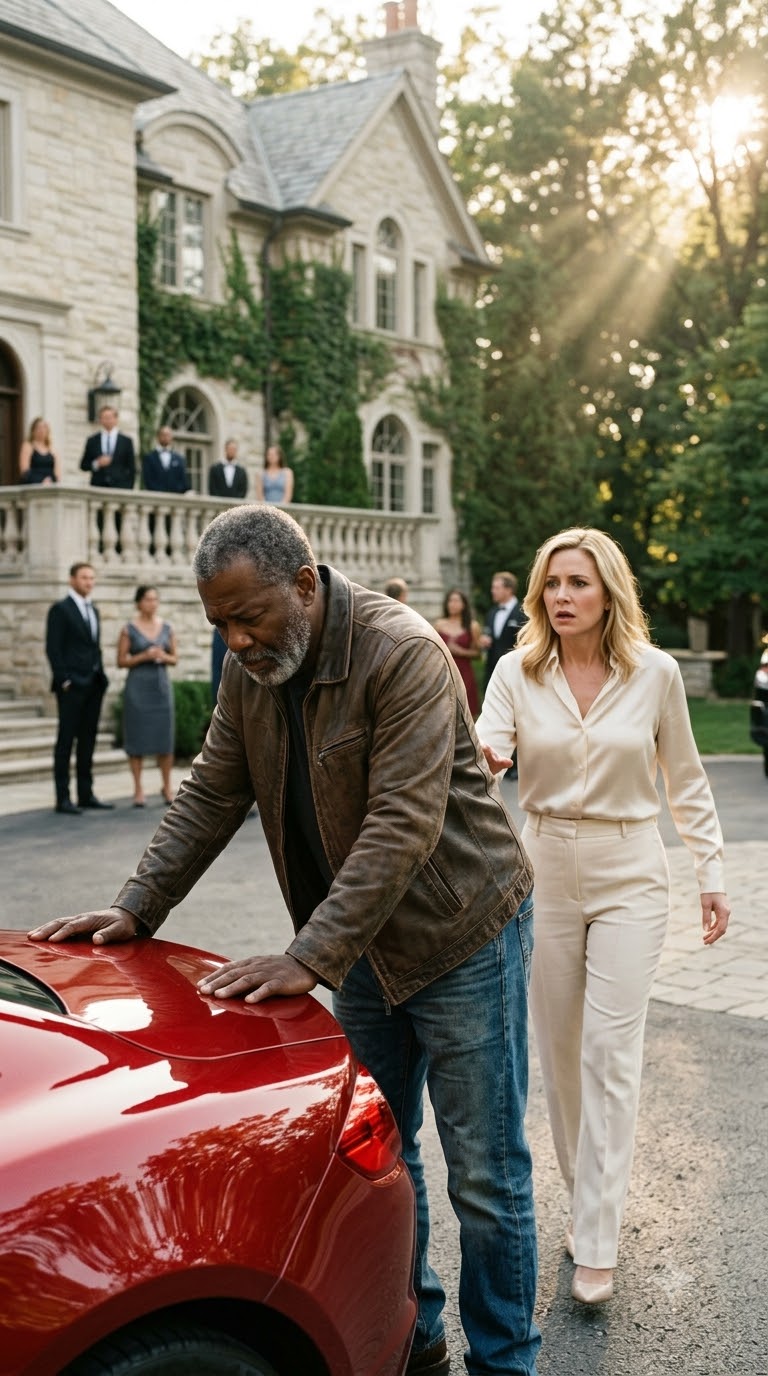
Keep us on course.
He had said it to his first employees, to the engineers who built the original systems, and to the people who worked late repairing vehicles when the business could barely afford payroll.
Clare had been a child then.
She remembered standing in the doorway of that old office while her father explained to a visitor why a business was only as strong as the people who kept it running.
But she had never seen the compass after his death.
She had assumed it had been packed away with his personal belongings.
“Where did you get it?” she asked again, her voice noticeably quieter.
David looked at her.
“Your father gave it to me.”
“When?”
“Years ago.”
“Why?”
“Because he trusted me.”
Clare stared at him.
“You’re lying.”
The accusation came out weakly this time.
David’s expression hardened, though his voice remained calm.
“I don’t need to convince you of my past, Ms. Whitmore. But you called the police on me in my own driveway because you decided what kind of man I was before you asked a single reasonable question.”
Clare looked away.
The officer closed his notebook.
“Ma’am, unless you have additional evidence of a crime, there’s no basis for me to detain Mr. Brooks.”
“But—”
“I’ve checked the information you’ve provided. The vehicle’s registration is consistent with his identification, and you haven’t established that the compass was stolen.”
He returned David’s documents.
“Mr. Brooks, you’re free to go about your business.”
“Thank you, officer.”
The officer nodded.
He then turned to Clare.
“I also need to make it clear that calling the police based solely on someone’s appearance is not a valid reason to accuse them of a crime. If you have a genuine concern, provide specific facts. Otherwise, please don’t misuse emergency services.”
Clare’s jaw tightened.
“I was protecting my neighborhood.”
“Then make sure you have a factual reason before making an accusation.”
The officer returned to his cruiser.
For a moment, it seemed the encounter was over.
Then David spoke.
“Officer, would you mind staying another minute?”
The officer stopped.
“Of course. What’s the matter?”
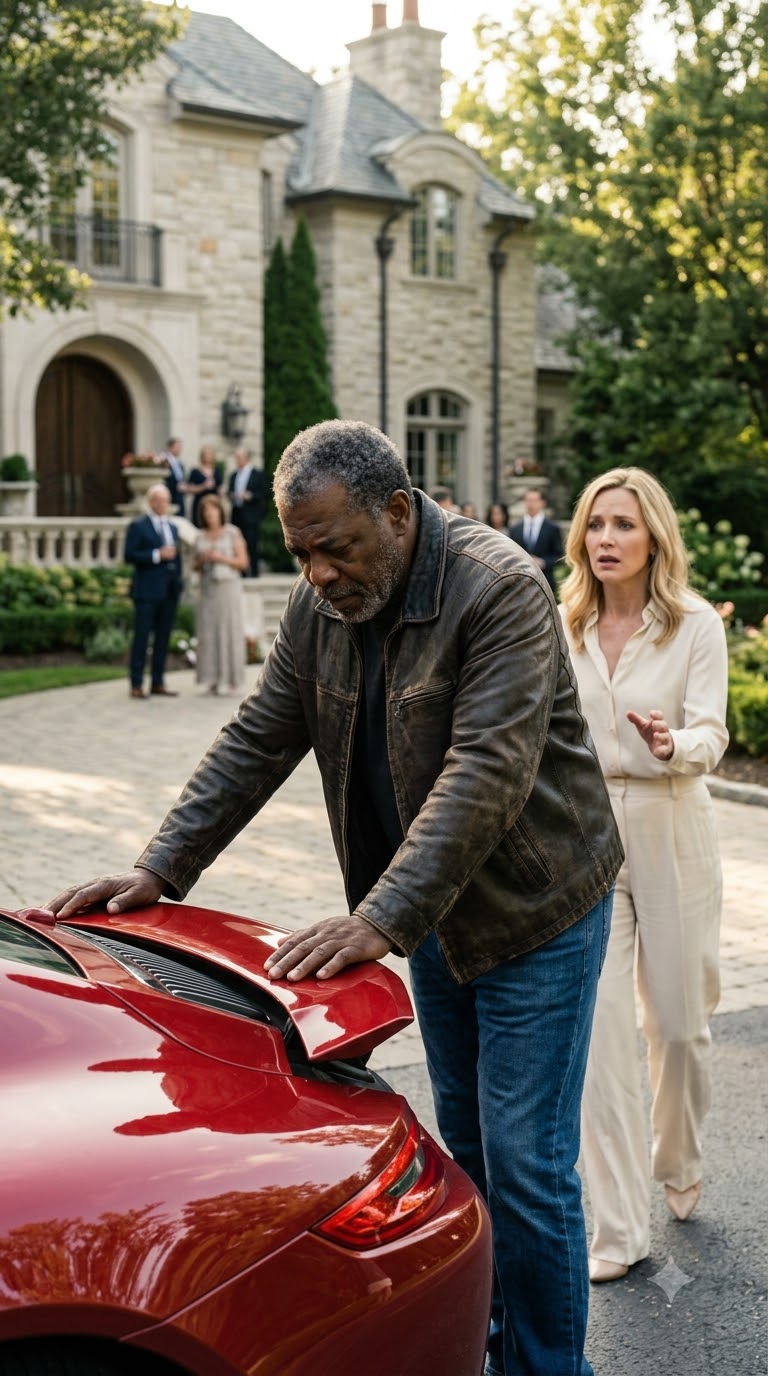
David glanced toward the open doorway of his house.
“There’s something I think Ms. Whitmore should know. And I believe it would be better if we discussed it with everyone present.”
Clare looked at him sharply.
“What are you talking about?”
David reached into his jacket again, this time removing a slim black leather wallet.
He opened it carefully.
Inside were a few identification cards, several folded papers, and a business card with a simple white design.
He handed the card to the officer first.
The officer read it.
His eyebrows rose.
Clare stepped closer.
“What is that?”
David extended the card toward her.
She took it reluctantly.
The card carried a name and title.
DAVID BROOKS
CHAIRMAN OF THE BOARD
WHITMORE MOBILITY GROUP
For several seconds, Clare did not move.
She read the words once.
Then again.
Her fingers tightened around the card.
“That can’t be right.”
David said nothing.
“You can’t be the chairman.”
“I am.”
“My family controls the company.”
“Your family founded it,” David replied. “That isn’t the same thing as owning every share forever.”
Clare stared at him.
The officer remained beside them, his expression neutral but attentive.
“How?” she finally demanded.
David closed his wallet.
“Your father knew the company needed more than a famous name. He needed people who understood the work, respected the employees, and were willing to protect the business when it faced difficult choices.”
“My father would never have handed control of his company to you.”
David’s eyes settled on hers.
“He didn’t hand it to me.”
He paused.
“He asked me to help save it.”
The words were quiet, but they seemed to carry more weight than a shout.
Clare shook her head.
“That’s impossible.”
“Your father and I met when Whitmore Mobility Group was still operating out of a modest warehouse. I was working in logistics and transportation systems. I had spent years learning how to make complicated operations work when money was tight and mistakes could cost people their jobs.”
David glanced down at the compass.
“Thomas was one of the few executives I met who understood that a company’s reputation wasn’t built by its executives alone. It was built by the people who showed up every morning and did the work.”
Clare said nothing.
“He asked me to advise him when the company began struggling with debt and an expansion that wasn’t producing the expected returns. I helped restructure its operations. I worked with the teams that were keeping the business alive.”
He paused.
“Your father and I became friends.”
Clare’s face remained tense.
“That still doesn’t explain why you’re chairman.”
“After his health began to fail, Thomas became concerned about the company’s future. He wanted the business to remain independent, protect its employees, and continue growing without being broken apart by people who cared more about short-term profits than its long-term survival.”
David met her eyes.
“He supported a restructuring that brought in new capital and changed the ownership structure. I invested in the company, accepted responsibility for its turnaround, and eventually became its largest individual shareholder. The board elected me chairman.”
Clare looked at the business card as if it might disappear if she blinked.
“My father never told me any of this.”
“He may not have believed you were ready to hear it.”
Her expression flashed with anger.
“Are you suggesting my father didn’t trust me?”
“I’m suggesting he made decisions based on what he believed was best for the company.”
David’s tone was neither cruel nor triumphant.
That seemed to make the answer more difficult for her to dismiss.
“My father was the founder,” Clare insisted. “I grew up around that business. I know how it works.”
“Then you know it takes more than a family name to keep it running.”
The officer quietly shifted his attention between them.
David continued.
“Your father left you an opportunity to contribute. Whether you chose to understand the business or simply inherit its prestige was something you had to decide for yourself.”
Clare looked away.
The neighbors were still watching from their porches and windows.
The moving truck had become silent.
Even the movers at the front door had stopped to listen.
Clare suddenly seemed aware of every pair of eyes directed toward her.
She lowered the business card.
“Why didn’t you say who you were when I first approached you?”
David looked at her for a long moment.
“Would it have changed anything?”
She opened her mouth.
No answer came.
“If I’d stepped out of a limousine wearing a tailored suit, would you have asked whether the Ferrari was stolen? If I’d introduced myself as chairman before you saw the compass, would you have assumed I belonged here?”
Clare’s cheeks burned.
David didn’t raise his voice.
“You didn’t ask my name because you wanted to know me. You asked because you had already decided I didn’t belong.”
The words landed heavily.
Clare glanced at the Ferrari.
Then at the stone house.
Then at the compass.
She had spent years believing that she could recognize people who belonged in her world.
That morning, she had looked at a man in a worn jacket and seen a trespasser.
She had not considered that he might be the person whose decisions helped keep her family’s company alive.
The realization was humiliating.
But the humiliation was not the worst part.
The worst part was that David had not needed his title to expose her mistake.
He had simply needed her to treat him like a human being.
The officer cleared his throat.
“Mr. Brooks, is there anything else you need from me?”
“No, officer. Thank you for handling this professionally.”
The officer nodded.
“I’m glad we were able to resolve it.”
He turned toward Clare.
“Please remember what we discussed.”
Then he returned to the patrol car.
The engine started, and the cruiser rolled slowly away.
For several moments, Clare and David stood facing one another in the driveway.
She still held his business card.
Finally, she spoke.
“I didn’t know.”
David looked at her.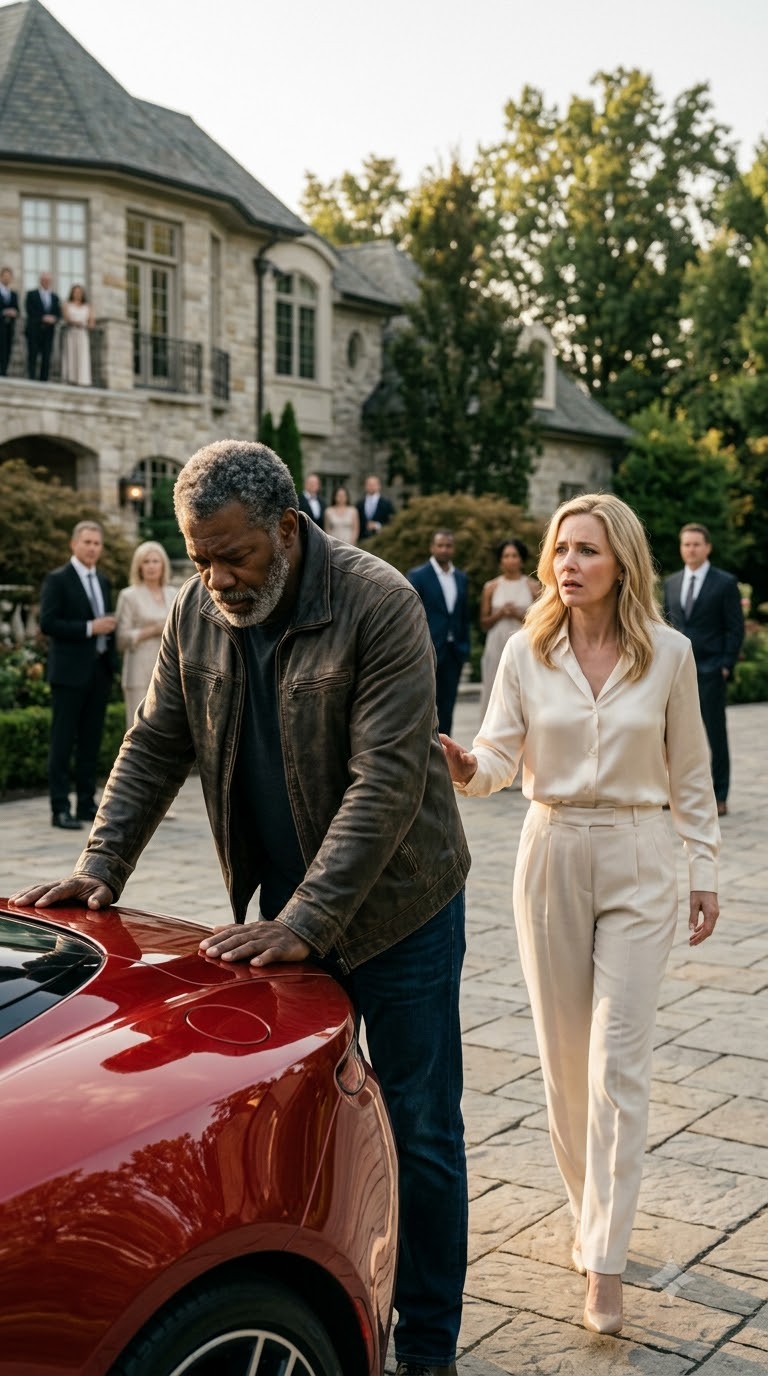
“You didn’t try to find out.”
She flinched.
“I thought the car—”
“You thought I didn’t look like someone who could own it.”
Clare lowered her eyes.
“I was concerned.”
“Concern is asking a question. Suspicion is making an accusation before you have the facts.”
He took the card from her hand.
“You chose the second.”
Clare’s lips trembled slightly, though whether from anger or embarrassment was difficult to tell.
“My family has been part of this neighborhood for a long time.”
“So have many other families. That doesn’t give any of us the right to decide who deserves to be here.”
She looked at him.
“Are you going to report me to the company?”
David considered the question.
“Why would I?”
“Because I’m the chief operating officer.”
For the first time, David’s expression changed.
Not dramatically.
Just enough to show that he had expected her to understand the implications of what she had done.
“Then you should understand why this matters.”
