

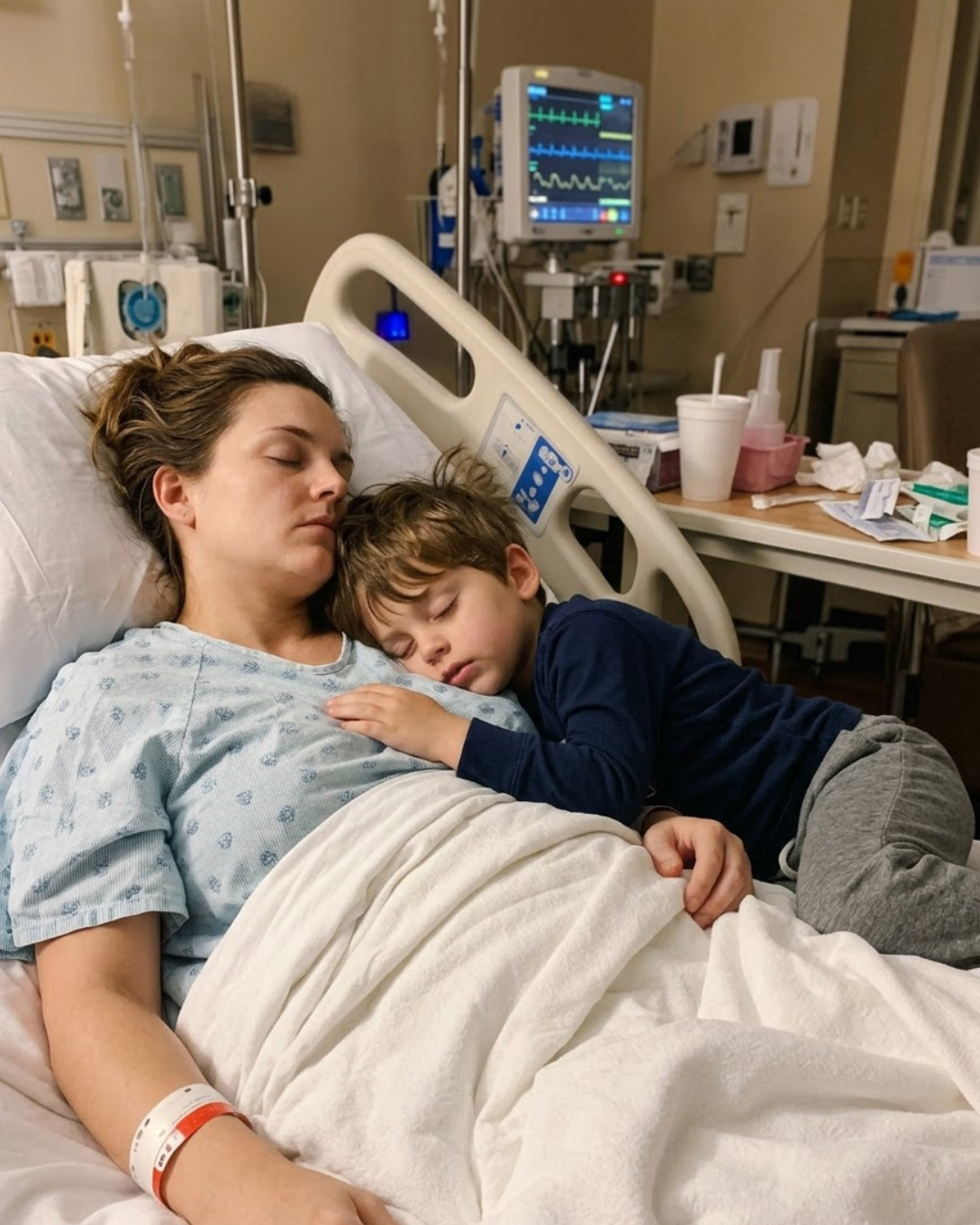
PART 3: THE SATURDAYS THAT CHANGED OUR FAMILY
The weeks that followed were different.
Emma was still in the hospital.
Her condition remained serious.
There were no sudden miracles.
No dramatic moment when she opened her eyes and immediately began speaking.
Her progress came slowly.
Sometimes so slowly that I wondered whether anything had changed at all.
But the doctors continued evaluating her.
They observed occasional movements.
Brief responses that seemed to follow familiar voices.
Moments when her eyes opened.
Some days brought encouraging signs.
Other days brought uncertainty.
We learned not to treat every movement as proof of awareness.
The medical team reminded us that recovery from a prolonged disorder of consciousness could be unpredictable.
We listened.
We asked questions.
We learned to appreciate each small development without assuming it meant more than the doctors could establish.
And through all of it, I kept my promise.
I stayed.
Not every minute of every day.
I still had responsibilities.
Work still existed.
Bills still needed attention.
Noah still needed his father at home.
But I stopped treating Emma’s hospital room as a place I had to escape whenever things became quiet.
I rearranged my schedule.
Delegated tasks when possible.
And learned that being present didn’t always require saying something.
Sometimes it meant sitting beside her.
Holding her hand.
Reading aloud.
Or simply allowing the silence to exist without running from it.
Noah noticed the difference.
He still visited Emma after school.
But he no longer insisted on remaining until he was exhausted.
He began going home for dinner.
He spent time with friends.
He returned to activities he’d stopped enjoying.
Sometimes he complained when it was time to leave a playdate and visit the hospital.
And strangely, those complaints made me happy.
They reminded me that he was seven.
He was supposed to have ordinary childhood concerns.
Spelling tests.
Superhero comics.
Games.
Friends.
Not the constant fear that his mother would be alone if he went home.
My mother noticed the change too.
She told me Noah was sleeping better.
He laughed more.
He seemed less anxious when leaving the hospital.
And he no longer asked to spend every night beside Emma’s bed.
He knew someone else would stay.
Someone he trusted.
His father.
Saturdays remained important to him.
He still brought his comic books.
He still sat beside Emma and told her stories.
Sometimes he asked simple questions and watched her hand.
But he no longer treated those visits like a responsibility only he could fulfill.
Now we shared them.
One Saturday, several weeks after the first finger movements, Noah arrived with a particularly serious expression.
He’d been having trouble with a spelling word at school.
The word was separate.
He’d practiced it repeatedly.
And he’d complained every time I reminded him to check the spelling.
That afternoon, he sat beside Emma and told her about his week.
He described a classroom activity.
Mentioned his friends.
Then talked about a funny moment at school.
I listened from the chair beside the bed.
For a while, everything felt peaceful.
Then Noah turned toward me.
“Dad, you ask her today.”
I smiled.
“Are you sure?”
He nodded.
I moved closer to Emma.
Gently took her hand.
And leaned toward her.
“Hey, sweetheart. It’s me.”
Her fingers felt warm against mine.
I watched her face for a moment.
I thought about all the serious questions I could ask.
Questions about whether she could hear us.
Whether she recognized our voices.
Whether she understood what was happening.
But we’d learned to leave medical interpretation to the professionals.
And that afternoon, I wanted to speak to Emma the way I used to.
As my wife.
As Noah’s mother.
As someone who’d always appreciated a little humor.
So I smiled.
“Emma, do you think Noah will ever learn how to spell ‘separate’?”
Noah immediately protested.
“Dad! That’s not funny.”
I laughed softly.
Then looked toward Emma’s hand.
Several seconds passed.
Her index finger moved.
Once.
Noah burst out laughing.
I laughed with him.
We couldn’t know for certain what had caused that movement.
But for the first time in months, our laughter filled the hospital room without being followed immediately by fear.
For a moment, we were simply a father and son sharing something joyful beside someone we loved.
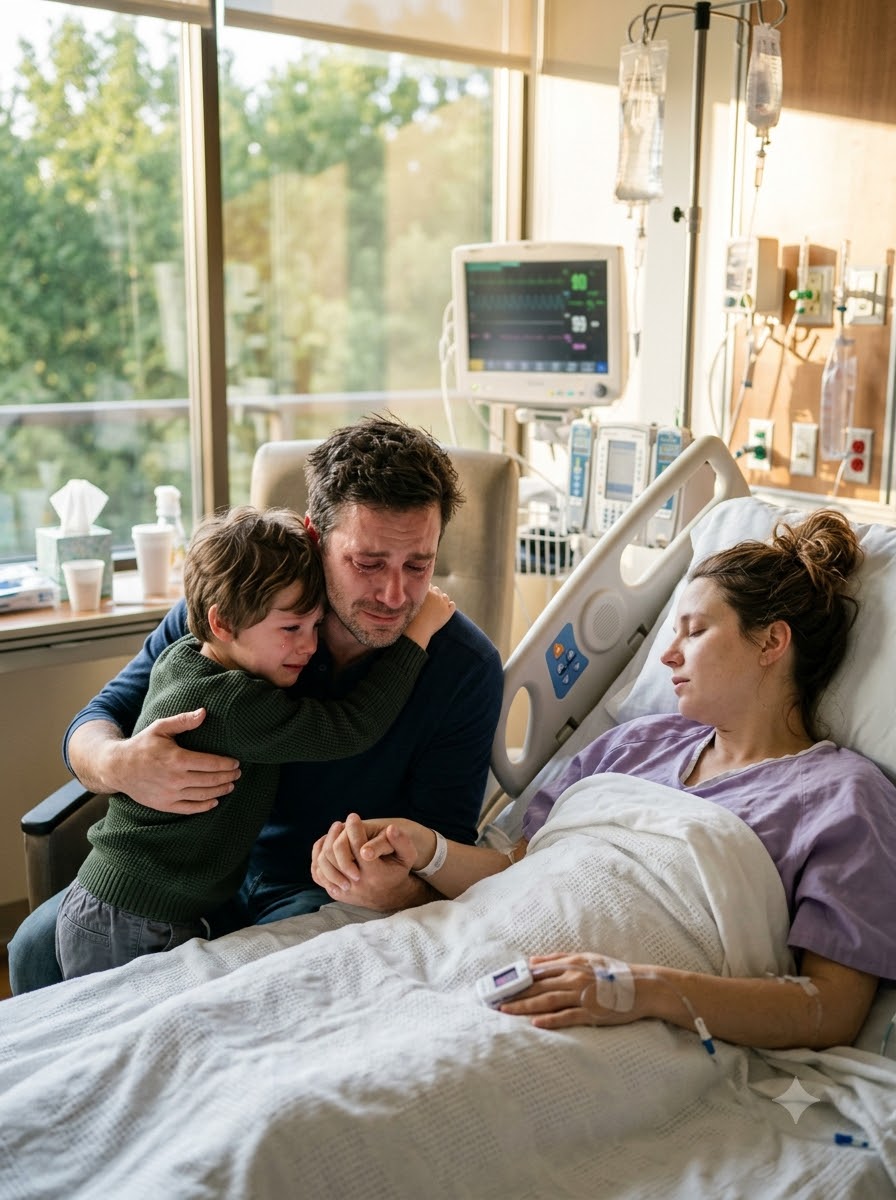
I looked at Noah.
He was smiling.
His face looked younger than it had in weeks.
And I realized how much had changed since the Saturday he’d first told me his mother could talk.
At the time, I’d believed he refused to leave because he couldn’t accept Emma’s condition.
I thought he was clinging to hope.
Perhaps imagining responses because he missed her so much.
But I’d misunderstood the burden he was carrying.
Noah wasn’t simply afraid of losing his mother.
He was afraid of leaving her alone.
He believed someone needed to stay beside her.
And he’d decided that someone had to be him.
Meanwhile, I had convinced myself I was doing everything a responsible husband should do.
I visited the hospital.
Spoke with doctors.
Managed our finances.
Handled school arrangements.
Kept our household running.
I was constantly moving.
Constantly solving problems.
Constantly finding something useful to accomplish.
But when the room became quiet, I struggled to remain.
Because silence gave me time to remember our last argument.
It reminded me of the things I wished I’d said differently.
The time I couldn’t recover.
The conversation we hadn’t finished.
Noah had noticed what I was avoiding.
He’d seen that I could spend hours at the hospital without ever becoming comfortable simply sitting beside Emma.
And he had asked me the question I needed to hear.
“Dad, why are you always scared to stay with Mom?”
That question changed the way I understood love.
I’d spent years believing that providing for my family was the clearest proof of my devotion.
I worked hard.
I accepted demanding assignments.
I traveled when necessary.
I told myself that everything I did was for Emma and Noah.
And much of it was.
But somewhere along the way, I’d begun treating time together as something that could always be postponed.
Another evening.
Another weekend.
After the next meeting.
After the next deadline.
I’d assumed there would always be another chance.
Emma had tried to tell me that wasn’t enough.
“Jeremy, please don’t go this time.”
I hadn’t listened.
Now I understood what she’d been asking.
She didn’t need me to abandon every responsibility.
She didn’t expect me to solve every problem.
She wanted to know that when our family needed me, I could make room for them.
Not only in my schedule.
But in my attention.
In my heart.
In the moments when there was nothing to fix and nowhere else to go.
That was what Noah had been trying to show me.
And it took his small hand holding Emma’s, along with a few uncertain movements of her finger, to make me understand.
I looked at my son again.
He was still laughing about the spelling joke.
I reached over and gently squeezed his shoulder.
He leaned against me.
Then turned back toward Emma.
“Mom, Dad’s being silly again.”
I smiled.
It was something Emma used to say all the time.
For a moment, I could almost hear her voice.
I didn’t know exactly what the future would bring.
I didn’t know how much Emma would recover.
The doctors were still monitoring her.
We still had questions without answers.
There would be difficult days ahead.
I understood that.
But I no longer believed I had to respond to uncertainty by running toward the next task.
I could stay.
I could listen.
I could support Noah without asking him to become an adult before his time.
And I could love Emma without needing every moment to produce a measurable improvement.
That evening, when visiting hours drew toward a close, Noah gathered his belongings.
He placed his comic book inside his backpack.
Then leaned over Emma’s bed.
“See you tomorrow, Mom.”
He gently touched her hand.
Afterward, he looked toward me.
“Are you coming home for dinner?”
I nodded.
“Yes, buddy.”
He smiled.
“And you’ll come back?”
“Of course.”
He seemed satisfied.
There was no panic.
No desperate insistence that someone remain every second.
He trusted that we had a plan.
That his mother was receiving care.
That he wasn’t responsible for keeping the entire family together.
We walked toward the door.
I looked back at Emma.
Her eyes were closed.
Her hand rested on the blanket.
I paused for a moment.
Then spoke softly.
“I’ll see you soon, sweetheart.”
No movement followed.
No dramatic response.
But I didn’t need one to know what I wanted to do.
I would return.
I would keep showing up.
And when I was beside her, I would truly be there.
Because there’s a difference between visiting someone you love and truly being present for them.
It took my seven-year-old son and one tiny movement of Emma’s finger to teach me that lesson.
And this time, I wasn’t going anywhere.
THE END.
