

PART 2: WHAT I WAS REALLY AFRAID OF
I stared at Noah.
For a moment, I thought I’d misunderstood him.
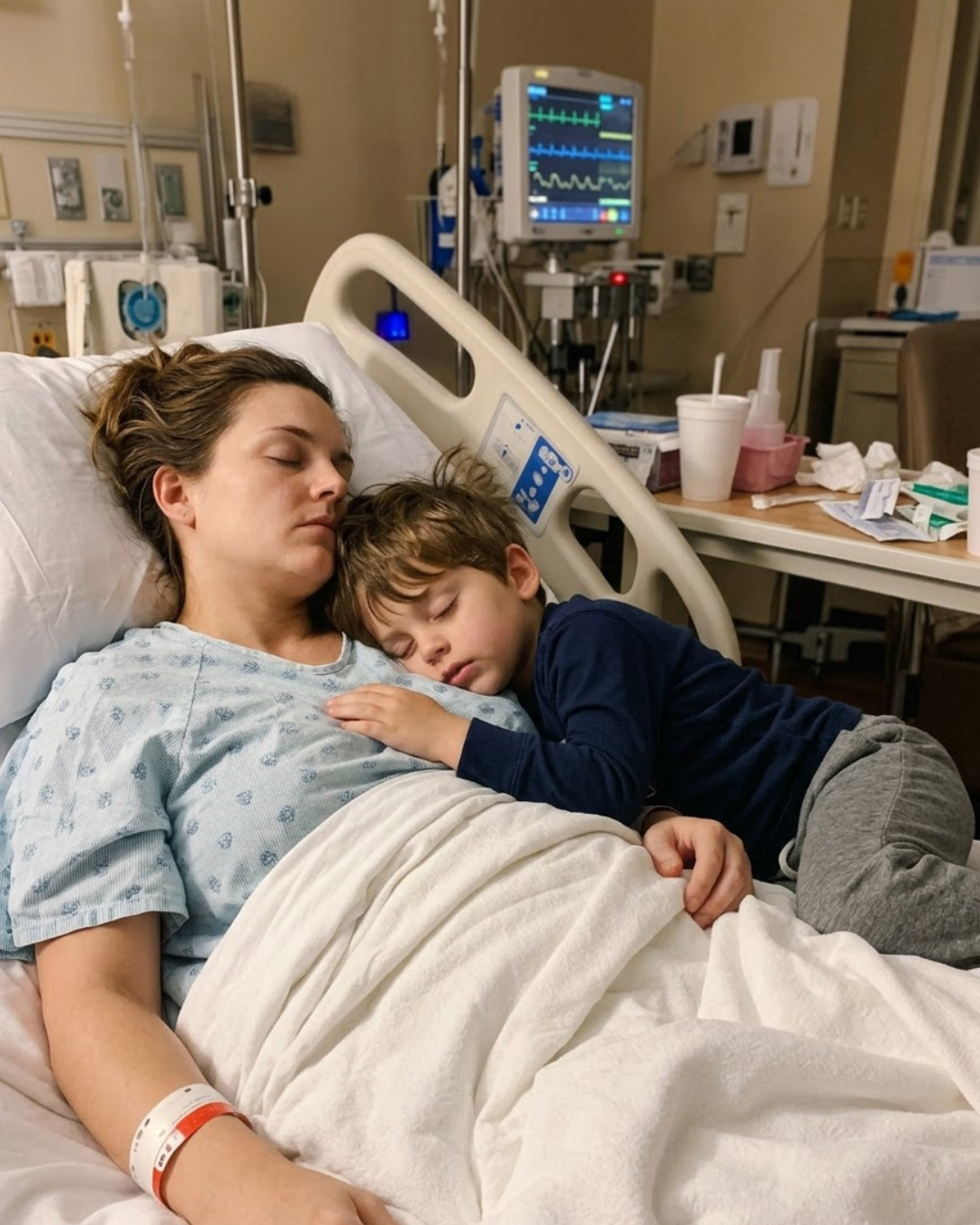
My seven-year-old son sat beside his unconscious mother, watching me with an expression that seemed far older than his years.
“I think you’re scared Mom will remember.”
The words stayed between us.
I swallowed.
“Remember what?”
Noah looked down at his hands.
Then answered quietly.
“You two fighting before your trip.”
I closed my eyes.
Of all the things he could have mentioned, that was the one memory I’d spent two months trying to avoid.
The evening before my business trip, Emma and I had argued in our kitchen.
I remembered every detail.
My suitcase stood near the door.
My laptop bag was packed.
I was checking my phone while Emma stood across from me.
She looked exhausted.
Not physically ill.
Just tired of having the same conversation.
“Jeremy, please don’t go this time.”
I barely looked up.
“Emma, it’s only three days.”
“It’s never just three days. You’re always working.”
“The meeting is important.”
“And what about us?”
I remember feeling frustrated.
I thought she didn’t understand the pressure I was under.
I believed I was working hard for our family.
I wanted to provide stability.
A comfortable home.
Opportunities for Noah.
I convinced myself that every extra hour at work was proof of my devotion.
But Emma wasn’t asking for more money.
She was asking for my time.
And I didn’t want to hear it.
I picked up my suitcase.
“We’ll talk when I get back.”
Then I left.
We never had that conversation.
Emma suffered her medical emergency while I was away.
The doctors hadn’t connected her condition to my business trip.
I understood that leaving town hadn’t caused what happened.
But guilt doesn’t always respond to logic.
For two months, I’d replayed our argument.
I imagined Emma waking up and remembering that I’d walked away.
I wondered whether she’d still be angry.
Whether she’d forgive me.
Whether I’d ever have the chance to explain.
And because those questions frightened me, I stayed busy.
I spoke to doctors.
Answered emails.
Managed bills.
Organized appointments.
Made phone calls.
I was constantly doing something.
Anything that kept me from sitting in silence beside my wife.
Noah had noticed.
He’d noticed every time I found a reason to leave the room.
And he’d reached a conclusion I hadn’t been willing to face.
I opened my eyes.
He was still watching me.
“Was Mom angry when you left?”
I nodded.
“Yes.”
“Is that why you won’t stay?”
I drew a slow breath.
“Partly.”
He frowned.
“But you love Mom.”
“More than anything.”
“Then why?”
I looked toward Emma.
How could I explain something so complicated to a child?
How could I tell him that adults sometimes hide behind responsibilities because they’re frightened of feelings they can’t control?
I tried to find the simplest words.
“Sometimes I get so busy fixing problems that I forget people need more than solutions.”
Noah considered that.
Then turned toward his mother.
“Mom just wanted you here.”
I nodded.
“I know that now.”
He sat quietly for a moment.
Then his expression brightened slightly.
“Let’s ask her something.”
I looked at him.
“What?”
“If she’s still mad.”
My heart began pounding.
The idea terrified me.
I’d spent weeks avoiding that very question.
“Noah, maybe we shouldn’t.”
But he had already turned toward Emma.
He gently held her hand.
“Mom, are you mad at Dad?”
We waited.
Nothing happened.
He leaned closer.
Then asked again.
Still nothing.
I looked away.
“Maybe she’s tired.”
Noah frowned thoughtfully.
“Maybe that’s too hard.”
He seemed to be considering what his mother might be able to understand.
Then he asked something different.
“Mom, do you want Dad to stay?”
The room became completely quiet.
I watched Emma’s hand.
One second passed.
Then another.
I barely breathed.
Several seconds later, her index finger moved.
Once.
Noah smiled.
“See, Dad? She wants you here.”
I couldn’t speak.
I knew the movement didn’t prove what Emma understood.
The doctors would need to evaluate it.
But the moment affected me more deeply than I expected.
For two months, I’d been afraid of what Emma might say if she woke up.
I’d imagined anger.
Disappointment.
Questions I couldn’t answer.
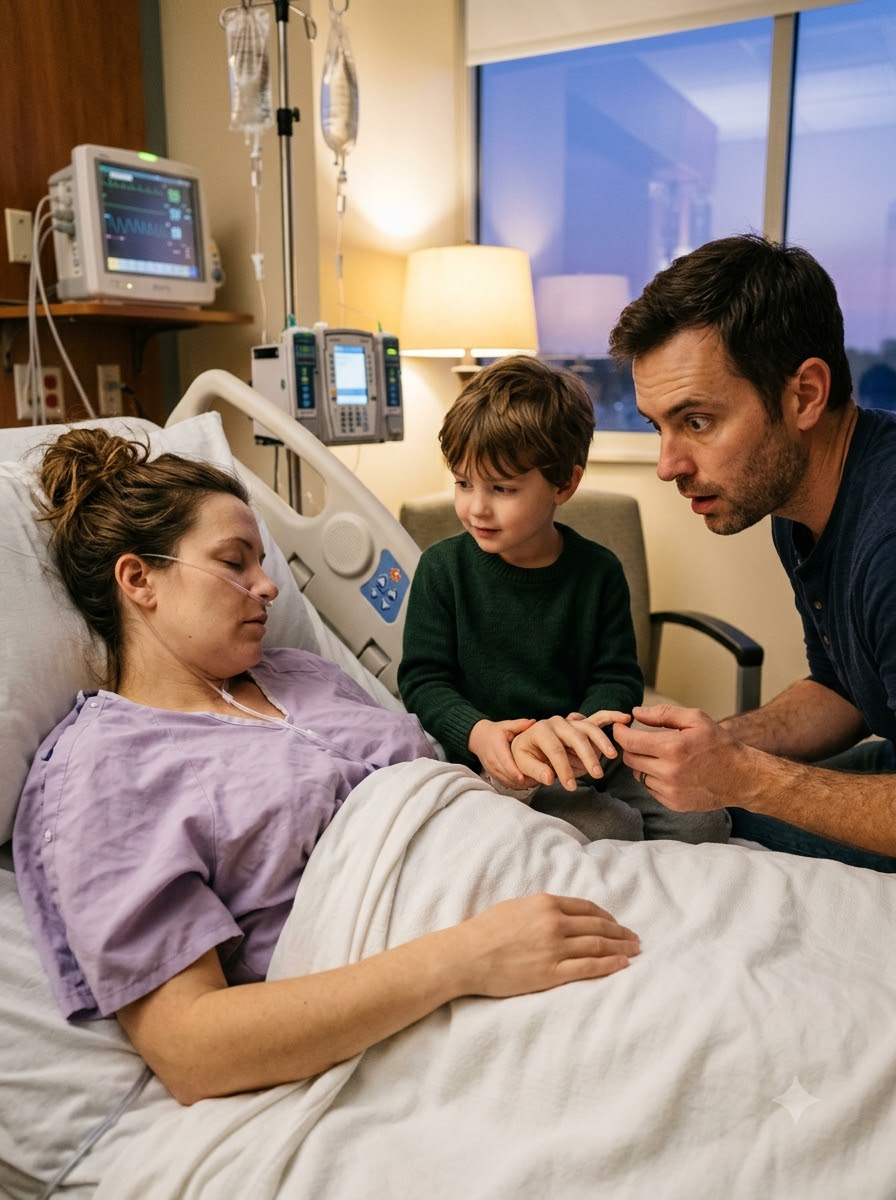
Yet the only thing Noah was asking me to do was remain beside her.
I reached for Emma’s hand.
Her skin was warm.
I held it gently.
And for the first time in weeks, I stopped thinking about what I needed to accomplish next.
I simply sat with her.
Then I turned toward Noah.
“Buddy, you don’t have to do this alone anymore.”
He frowned.
“But Mom needs someone.”
“I know. And I’m here.”
“What if she wakes up?”
“I’ll be here.”
“What if she tries to talk?”
“I’ll listen.”
“What if work calls?”
“Someone else can handle it when possible.”
He studied me carefully.
“What about coffee?”
I smiled through the tears gathering in my eyes.
“Coffee can wait.”
For the first time that evening, Noah laughed.
It was a small laugh.
But it sounded wonderful.
I placed my hand on his shoulder.
“I’ve got Mom, Noah. You can rest.”
His chin trembled.
I realized how much responsibility he’d been carrying.
He was only seven.
He should have been thinking about school, games, and friends.
Instead, he’d spent weeks believing that if he left the hospital, his mother might need him and nobody would be there.
He’d become the person who stayed.
And without intending to, I’d allowed him to feel that responsibility was his alone.
I wanted to change that.
But first, I needed to make sure Emma received proper medical attention.
I called the nurse.
When she arrived, I explained exactly what Noah and I had observed.
The questions.
The finger movements.
The apparent pattern of one movement for yes and two for no.
I didn’t claim Emma had awakened.
I didn’t insist that every movement was deliberate.
I simply asked the medical team to evaluate what we’d seen.
The nurse listened carefully.
She documented our observations and arranged for the doctors to review them.
Over the following days, the team monitored Emma closely.
Some movements appeared after questions.
Others occurred without any obvious connection.
Sometimes there was no response at all.
The doctors explained that assessing awareness in patients with impaired consciousness could be complicated.
Movements might be reflexive.
They might be inconsistent.
Repeated observation and appropriate clinical assessment were necessary.
I listened.
And this time, I didn’t rush to turn uncertainty into a conclusion.
I wanted to understand Emma’s condition as accurately as possible.
But one thing had already changed.
Noah knew we’d taken him seriously.
His observations mattered.
And he no longer had to carry them alone.
That night, my mother returned to the hospital.
She found Noah sitting beside Emma.
I began gathering his school things.
Immediately, his shoulders stiffened.
“I’m not leaving Mom.”
I knelt beside him.
“I’m staying tonight.”
He looked toward the window.
“But it’s Saturday.”
“I know.”
“She needs someone.”
“And she has me.”
He searched my face.
“You promise?”
“Yes.”
“Right here?”
“Right here.”
He hesitated.
Then slowly nodded.
He stood beside Emma’s bed and hugged her as gently as he could.
“Good night, Mom.”
Then he walked toward the door with Grandma.
Before leaving, he turned back.
“Dad’s staying with you.”
I smiled.
He looked relieved.
That night, Noah slept in his own bed for the first time in weeks.
And I stayed with Emma.
I didn’t wander the hallways.
I didn’t make unnecessary calls.
I didn’t invent errands.
I pulled my chair close to her bed.
Then took her hand.
The room was quiet.
For a long time, I simply watched her breathe.
Eventually, I leaned forward.
“I’m sorry,” I whispered.
Her fingers remained still.
I continued anyway.
“I thought taking care of everything meant I was being a good husband.”
I looked at her face.
“But I forgot how important it was to simply be here.”
I remembered the argument in our kitchen.
The way she’d asked me not to leave.
The frustration in her voice.
The suitcase in my hand.
I wished I could change that evening.
But I couldn’t.
I could only change what I did now.
So I stayed.
Through the quiet hours.
Through the darkness outside the window.
Through the moments when fear returned.
I held my wife’s hand.
And when morning arrived, I was still there.
