

PART 1 — Beside the Garbage
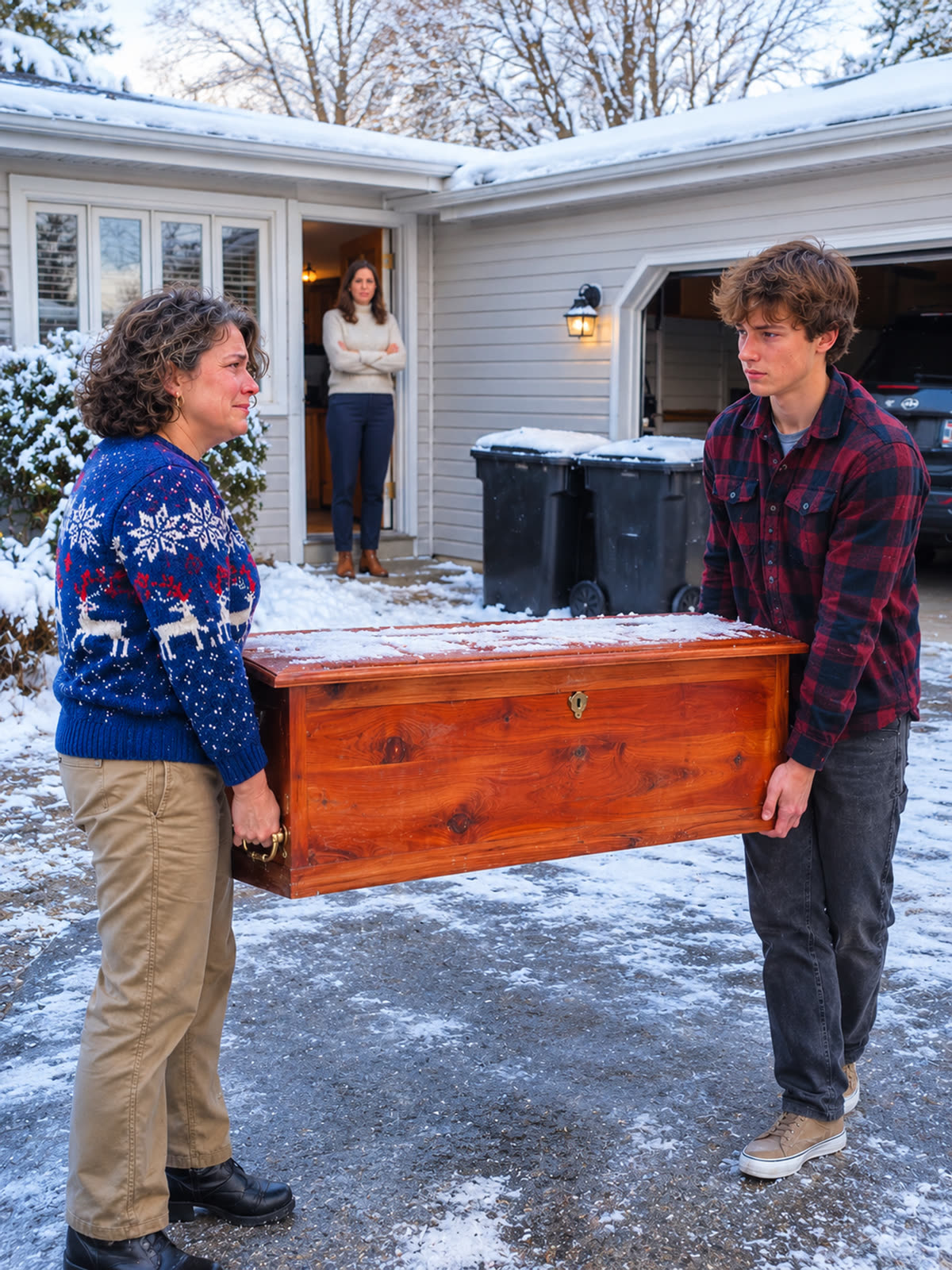
“Mom,” my son said. “It’s by the garbage.” Rowan stood in the entrance to my brother’s living room, wearing his red flannel shirt without a coat. Snow was dissolving in his hair. He had gone to our van to fetch the other gift he had brought his grandmother: a small box of her favorite peppermint bark from the candy store in De Pere. Instead, he had returned with nothing in his hands. His face had gone almost colorless, and he spoke so softly that, for a moment, I couldn’t make sense of what he meant. I was perched at the end of Danica’s white sectional, holding a cup of coffee, with scraps of Christmas paper scattered around my shoes. I glanced up. “What is?” “The chest,” Rowan said. “Grandma’s chest. It’s out by the garbage cans.”
I placed my coffee on the glass table beside the couch, stood, and crossed to the large front window. Christmas afternoon sunlight shone over the cul-de-sac. Clean snow covered the roofs and front yards, capped the mailboxes, and rested on the pine wreath across the street. My brother’s driveway had been cleared earlier that morning, and his garage stood open. Beside its entrance were two black plastic garbage bins. Next to them sat the cedar chest Rowan had devoted four months to making for his grandmother. Someone had left it in the snow as though it were something worn out and unwanted, the sort of furniture people abandon at the curb for collection. Sunlight flashed on the brass handles. A thin accumulation of snow had already begun gathering across the lid. I stood looking at it, trying to absorb the sight of something my son had worked so hard to create sitting there among the trash.
Rowan had started that chest in September and finished it during the final week before Christmas vacation. The money for the wood had come from a summer spent mowing lawns. Every Saturday between June and August, he had taken our old Toro around eleven yards in our Ashwaubenon neighborhood, charging twenty-five dollars for each lawn. Whatever he earned went into a coffee can on his dresser. The aromatic red cedar boards from the lumberyard in Green Bay cost a hundred and eighty-five dollars. There was also the school’s thirty-five-dollar shop fee and another twenty-two dollars for the brass handles he selected at Menards. In August, he had spread graph paper across our kitchen table and drawn his own plans. Later, in Mr. Kowalczyk’s woodworking classroom at Ashwaubenon High School, he had cut every board on the table saw. He had glued and clamped the joints himself, then used a hand plane to level the lid. None of it had arrived ready-made. None of it had been somebody else’s work with his name added afterward.
He kept sanding long after most boys would have considered the chest finished. In November, Mr. Kowalczyk actually telephoned me about it. He had taught shop for twenty-three years, he said, and had never encountered a student so determined to keep sanding the same project. Rowan was remaining after school three afternoons every week. “Mrs. Tanner, I had to take the sandpaper away from him. He was going to sand it into sawdust.” I had remembered that call with pride. Now I stood at my brother’s window while the finished chest collected snow beside his garbage cans. When I turned back toward the room, Danica was in the armchair near the Christmas tree. My sister-in-law was carefully creasing used wrapping paper into tidy squares so she could save it for another year. Nothing in her manner suggested that anything unusual had happened.
You need to understand what Rowan is like. He is fifteen, a sophomore, tall and thin, with more knees and elbows than he seems to know what to do with. He has Brett’s dark hair and my father’s long hands. Conversation has never come easily to him. As a little boy, while other children occupied themselves with soccer or video games, he preferred to sit in his grandfather’s garage and watch him make birdhouses. My father died when Rowan was nine. Afterward, something in my son seemed to fall silent, and for years I wasn’t sure it would ever find a way out again. Then he took shop. He had enrolled in Woodworking One as a freshman only because it was the elective that fit his timetable. By October, he was staying late. Before that school year ended, he had made himself a bookshelf, made me a spice rack, and built his grandmother a little step stool. Mr. Kowalczyk allowed him into Woodworking Two the following year, although that class was ordinarily reserved for juniors.
That August, Rowan came to the kitchen table carrying a sheet of graph paper. “I want to build Grandma a cedar chest,” he said. “For Christmas. For her sweaters.” His pencil drawings showed the front, side, and top, with all the measurements carefully marked: forty inches in length, twenty inches from front to back, and eighteen inches high. He had planned brass hinges for the lifting lid, brass handles at either end, and a narrow border of molding along the base. “Why cedar?” I asked. “Because of Great-Grandpa Emil,” he said. My grandfather, Emil Jaskolski, had been a Polish farmer in Pulaski, Wisconsin. He died in 1992. Inside his farmhouse was a cedar-lined closet where he hung his wool coats and Sunday suit. Mom used to tell us that, as a child, she hid there during thunderstorms because the scent made her feel protected. She had told Rowan the same story years before. I hadn’t realized he still carried it with him. “She says she misses it,” Rowan said. “Grandma. She told me last time we were over. She said she hasn’t smelled cedar since Grandpa Emil’s farm got sold.”
From September until the week school let out, he kept working. September was for cutting boards, October for joining panels, and November for fitting the lid. Then came three weeks of sanding. He applied three coats of finish, bringing out the bands of red and cream until the cedar seemed to hold the colors of a sunset. On the last school day before vacation, he borrowed Mr. Kowalczyk’s wood-burning pen and added something beneath the lid. He refused to show me. That part, he said, was a surprise for Grandma. My mother, Lorraine Jaskolski Brandt, is seventy-four. For thirty-eight years she worked as a nurse at St. Vincent Hospital in Green Bay. She raised my brother Kyle and me in a small ranch house on the city’s west side and remained there by herself for six years after Dad died. Then, two winters ago, she slipped on her icy driveway while collecting the mail. Her hip broke in two places. She lay in the snow for forty minutes before a neighbor discovered her. Surgery at Bellin Hospital was followed by six weeks of rehabilitation in De Pere. Afterward, stairs were beyond her, and the laundry in her house was in the basement.
Brett and I couldn’t bring her home with us. Our two-bedroom place in Ashwaubenon has a steep front stoop, and its only bathroom is upstairs. Kyle and Danica had a newer four-bedroom house in Hobart, with a bedroom and walk-in shower on the main level. Mom moved in with them after rehabilitation. Her own house sold for a hundred and sixty-two thousand dollars. She gave them forty-eight thousand to adapt the downstairs bedroom: wider doorways for her walker, different flooring, and an accessible bathroom with grab bars and a shower seat. Kyle said contributing was fair because she would be living there. There was no written agreement. Mom simply handed them a check. Yet Danica continued referring to the space as the guest room. On my first visit after the renovation, she showed me the bathroom and the widened doorway. “And this is the guest room,” she said. “Where your mom’s staying.” Staying, as though Mom had arrived with an overnight bag and would soon leave again.
The room was lovely in the way a magazine photograph is lovely: gray walls and rug, white trim, a white bed dressed with gray pillows, a white dresser, and a white lamp. Almost nothing in it belonged to my mother’s old life. Her furniture had been sold at an estate sale. Her photographs remained boxed in Kyle’s basement. Her sewing machine, quilts, and inherited rocking chair were gone because, according to Danica, there wasn’t room and they didn’t match. I knew something about why the house mattered so much to her. Once, after several beers at a Packers game, Kyle told me about her childhood near Shawano. Her mother had raised four children on a failing dairy farm. When Danica was eight, they lost their house and moved into an old milking barn that an uncle had partly converted. For six years, home meant concrete floors, a wood stove, and the lingering odor of hay and cattle. She had washed her clothes in the bathtub at school, desperate to stop other children smelling the barn on her. She eventually put herself through nursing school at UW Oshkosh, married Kyle, and went to work in billing at Bellin Health. Their spotless white-and-gray home in Hobart was the thing she had finally made perfect. I understood that. But understanding did not make it acceptable to put a boy’s Christmas gift beside the garbage.
We had arrived that Christmas afternoon with the chest wrapped in an old moving blanket. Brett was out driving a Brown County snowplow, as he had been every Christmas for twelve years. The storm had called him out at four that morning. At noon, he sent a photograph from County Road EB: coffee thermos, working windshield wipers, and a Santa hat on the dashboard. Rowan had loaded the chest into our van himself, refusing help, then ridden with one hand stretched back against it. Kyle was shoveling when we reached Hobart. “That it?” he asked. “The famous chest?” “That’s it,” Rowan said. “Let’s get it in before Mom sees it,” Kyle said. “Danica’s got her in the living room with the presents.” Together, they carried it inside. Mom sat by the window in her recliner, wearing a red Christmas sweater beneath the blanket covering her knees. “What on earth?” she said as they approached. Rowan pulled away the moving blanket after they set the chest before her. She studied the glowing cedar, the handles, and the molding before leaning carefully forward and resting her fingers on the lid. “Rowan,” she said. “You made this?” “In shop class,” he said. “Since September.” She lifted the lid and breathed deeply, closing her eyes. Her face softened until she looked like a little girl. “Oh, honey,” she said. “That smells like my dad’s closet.”
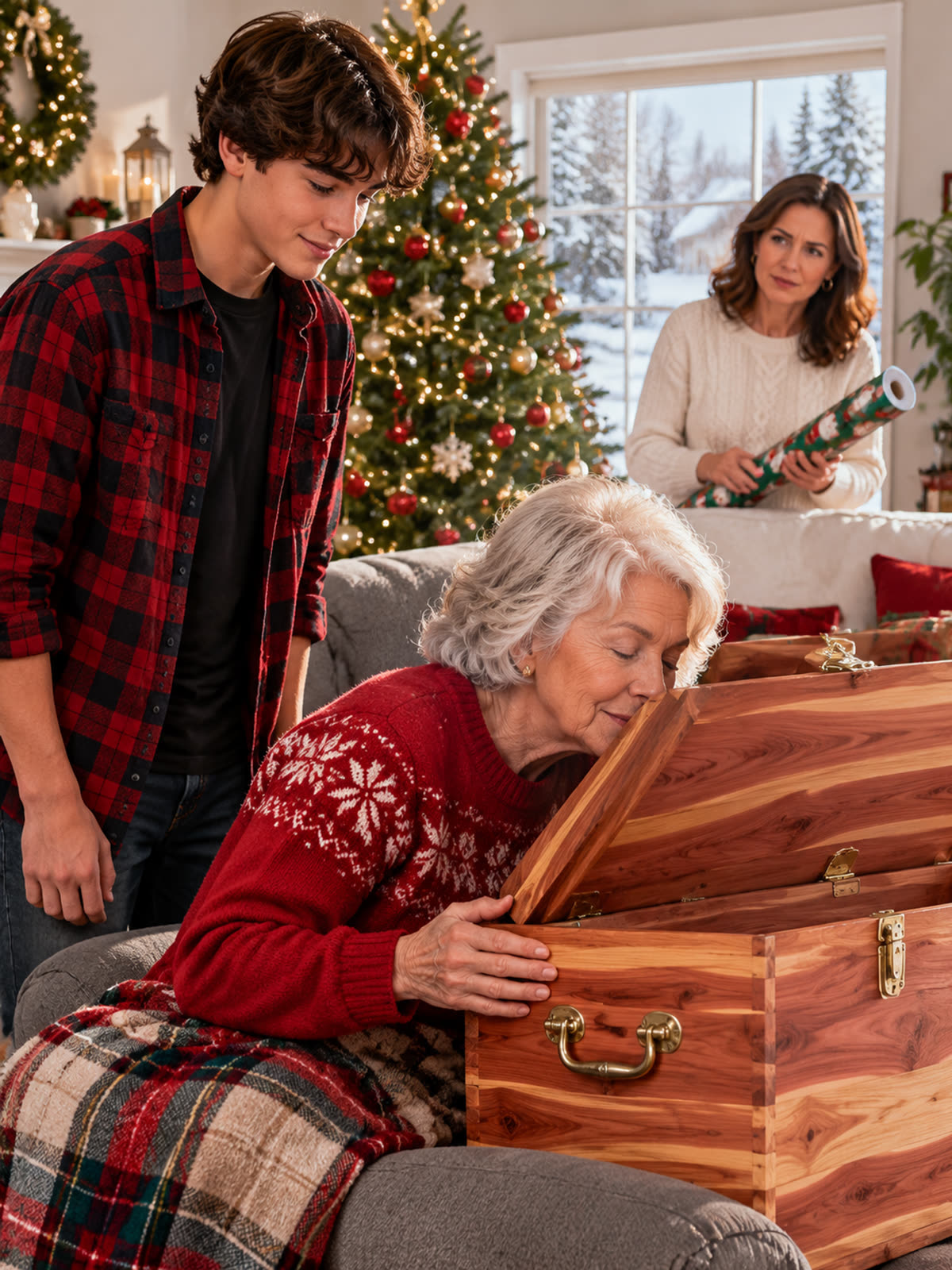
Danica was behind the couch, holding a pile of wrapping paper. The scent reached her too. Her nose tightened. “It smells like a barn,” she said. No one laughed. Mom opened her eyes and looked at her. Rowan remained beside the chest, his hands hanging at his sides. Kyle glanced from his wife to the floor. Then his phone vibrated. Dave Lindgren, who lived three houses down, couldn’t start his truck in the cold and needed a jump. Kyle paused, uncertain about leaving, but Mom told him to go. He collected his coat and jumper cables and headed outside. The rest of us returned to the presents. Mom unwrapped the slippers Kyle had bought her and the crossword book I had brought. Rowan opened his grandmother’s gift, a Menards gift card, and broke into a grin. The chest had been sitting directly in front of Mom, part of the afternoon, part of everything we had brought there to celebrate.
I cannot say exactly when Danica removed it. I never saw her leave with it. About ten minutes into the next round of presents, she got up, saying she needed to check the ham. At the time, I gave it no thought. Looking back, she must have passed through the kitchen into the garage, then used the garage’s side entrance to reach the hallway. Kyle keeps a red hand truck for hauling bags of water-softener salt. She must have brought it in and wheeled the chest out that way. We were opening Christmas gifts barely twenty feet from her, with A Christmas Story playing quietly on television. Somehow, while we were occupied with paper and ribbons and presents, she took my son’s work out of the house. When she returned, she settled into the armchair beside the tree and began smoothing and folding the used wrapping paper. Another ten minutes passed before Rowan went to the van for the peppermint bark.
Then he came back without it, still wearing only his flannel shirt. “Mom,” he said. “It’s by the garbage.” After looking through the front window, I looked again at the patch of carpet where the chest had stood. Empty. Then I looked at my mother. Her hands were folded neatly over the blanket in her lap, and she sat with an unnatural stillness. I understood from her expression that she had watched it happen. She had seen Danica take away her Christmas gift. She had sat there, in the house where she lived, and said nothing. That realization hurt almost as much as the sight outside. Rowan had made her something that belonged to her, something carrying a memory no white dresser or matching pillow could replace. Now it was beside two garbage cans, and she was keeping her hands folded as though she had no right to object.
Danica was creasing a square of red paper patterned with little snowmen when I turned toward her. She did not raise her eyes. “It doesn’t go with anything,” she said. “It can go to the curb or to your house.” Heat rose through my face. There were more words waiting behind my teeth than I could have trusted myself to say. I wanted to tell her about every lawn Rowan had mowed, every afternoon he had spent in the school workshop, every measurement he had checked at our kitchen table. But it was Christmas. My mother lived there. My son stood in the room, already hurt enough. I would not turn his present into the center of a shouting match. Instead, I went to put on my boots. Whatever Danica thought of the color or the scent, I was going to get that chest. By the time I reached the door, Rowan was already outside.
PART 2 — The Same Scent, a Different Ending
Rowan’s jaw was clenched in a way I recognized immediately. Brett gets that same expression when somebody swerves in front of his salt-loaded plow: no outburst, just a small muscle jumping beside his mouth. My son walked straight down the snowy driveway toward the trash cans, wearing his flannel and sneakers, still without a coat. I followed him to the chest. He took one end, and I took the other. Forty inches of solid cedar, with a lid an inch thick, made a substantial weight. The brass handles had spent ten minutes in the snow and were cold enough to sting my uncovered fingers. I held on anyway. As we raised it, the loose snow on top slipped from the polished lid and fell onto the driveway. There was nothing disposable about what we were carrying. It was heavy in our hands, carefully built, and painfully familiar.
“Don’t look at the house,” I told him. “Look at me.” He did. His eyes were wet. He was fifteen years old and six feet tall, and I had not seen him cry in front of me since his grandfather’s funeral. Now he was struggling not to. “Just look at me,” I said again. “We’re going to carry this inside and put it where it belongs. That’s all.” I needed him looking at me instead of the doorway, needed him concentrating on the next step rather than wondering what anyone watching might think. We had the two handles between us. We had the front walk ahead. For the moment, that was enough. I couldn’t take away what he had already seen, but I could help him carry his work back inside.
Danica stood at the front entrance with the storm door open. She was wearing a white sweater, her arms folded across it. She neither spoke nor moved to block us. We came up the walk and through the doorway, passing close enough that I could have reached out and touched her. We went down the hall, past the living room, and into Mom’s room at the far end. Mom was already waiting there. To this day, I don’t know how she moved so quickly with that hip and her walker. She must have stood as soon as we went outside. Now she sat against the gray pillows on the bed, her slippers on, the walker within reach. “Foot of the bed,” she said. “Facing the window.” We lowered the chest onto the gray rug, directly in front of the white bed, with its front toward the broad window and the snow-covered backyard.
“Now the sweaters,” she said. “Bottom drawer first.” I pulled open the lowest drawer of the white dresser. Her sweaters were packed tightly together. The drawers were small, and Mom owned plenty of sweaters; ever since her fall, she seemed to feel cold all the time. We began taking them out and folding them. There was her navy cardigan, the one she had worn over her St. Vincent scrubs for twenty years, its little front pocket once used for pens. There was the gray sweater with wooden buttons Dad had bought her at a Door County shop for their fortieth anniversary. We found a blue one, a green one, and the brown sweater with leather patches at the elbows. Each had its own place in the life she had brought with her, whether or not it suited the room’s carefully chosen colors.
Then came the Christmas sweater Aunt Bea had knitted in 1979. Mom’s sister had made it for her the first Christmas after I was born. Bea died in 2004, but the sweater remained: red, white, and green, a row of reindeer across the chest, one with a red pom-pom nose. Mom had worn it every Christmas Eve for forty-six years. One elbow had a hole she had repaired three separate times. From her place on the bed, she directed the folding. Sleeves tucked inward, then the body folded into thirds. Rowan and I followed her instructions and laid the sweaters in the cedar chest. Navy first, then brown, then blue and green, then the gray one with its wooden buttons. “The reindeer last,” she said. “On top. So I can get to it.” Rowan raised the lid farther, making more room for us to arrange everything.
That movement revealed what he had kept hidden from me. In the middle of the lid’s underside, careful brown lettering had been burned into the red cedar: For Grandma. Love, Rowan. 2025. Beneath those words was a smaller image, a farmhouse with a cedar tree beside it. He had copied Great-Grandpa Emil’s farm in Pulaski from the old photograph hanging in my hallway. It was all there, worked into the wood by my quiet fifteen-year-old son: the gift, the memory, and the reason he had chosen cedar in the first place. Mom placed her palm flat against it. For a long time, she said nothing. Rowan stayed beside her, holding the lid. The sweaters waited inside, and her hand remained over his careful work.
A truck door shut outside. Boots stamped snow from the front step. From the kitchen came Kyle’s voice, asking where everyone had gone. A moment later, his footsteps approached along the hall. He stopped at Mom’s doorway, still wearing his winter coat, snow resting on his shoulders and the jumper cables looped in one hand. The cold had reddened his cheeks. Mom was on the bed’s edge with the reindeer sweater held in both hands. The chest stood open before her, the other sweaters neatly stacked inside. Rowan knelt beside it, supporting the lid. Danica appeared behind Kyle. She had followed him from the kitchen and now stood in the hall with her arms crossed. He looked first at the chest and then at his wife. No one offered an explanation.
The silence lasted long enough for me to notice the furnace and the television from the other room. Onscreen, Ralphie’s mother was saying something about the leg lamp. Finally Kyle spoke. “Dave said there was a chest by our garbage cans,” Kyle said finally. Quietly. “When I walked back up the street. He said, Kyle, did you mean to throw that out? It looks brand new.” He looked at Danica. “I told him no. I told him Rowan made it for Mom. And then I came up the driveway and it was gone, and there were footprints in the snow.” Danica gave him no answer. “Did you put it out there?” Kyle asked her. She lowered her arms, then folded them again. Everything in the little room seemed to wait while she decided what she would say.
“It doesn’t go with anything, Kyle,” she said. “Look at it. It’s orange. It smells. The whole room smells like a barn now. I spent forty-eight thousand dollars on this room.” “Mom spent forty-eight thousand dollars on this room,” Kyle said. Danica flushed. Her mouth opened, then closed without an answer. My brother has never enjoyed confrontation. He works as an accountant for a paper company in Green Bay, and for as long as I can remember, he has been the one to redirect an argument, smooth over an uncomfortable moment, or remind everyone not to fight on a holiday. I had never heard him address his wife that way. He put the coiled jumper cables on the hallway floor and stepped into Mom’s room. At the foot of the bed, he paused over the folded sweaters and the inscription under the lid.
He read Rowan’s words and studied the little farmhouse beside the cedar tree. Then he lowered himself onto the gray rug next to his nephew and rested his hand on the lid beside Mom’s. “Grandpa Emil’s closet,” he said softly. “God, Mom. I forgot about that closet.” Mom looked at him with tears in her eyes. “I hid in it,” Kyle said. “Remember? When I was six. The night Grandpa died. I hid in his closet with his coats, and you found me in there in the morning, asleep.” “I remember,” Mom said. Kyle remained kneeling beside Rowan for another long moment. The two of them were there together at the chest, my brother’s hand beside our mother’s, my son holding up the lid he had worked on for months. Finally Kyle stood and turned toward Danica. “Danica,” he said. “Can I talk to you? In the kitchen?”
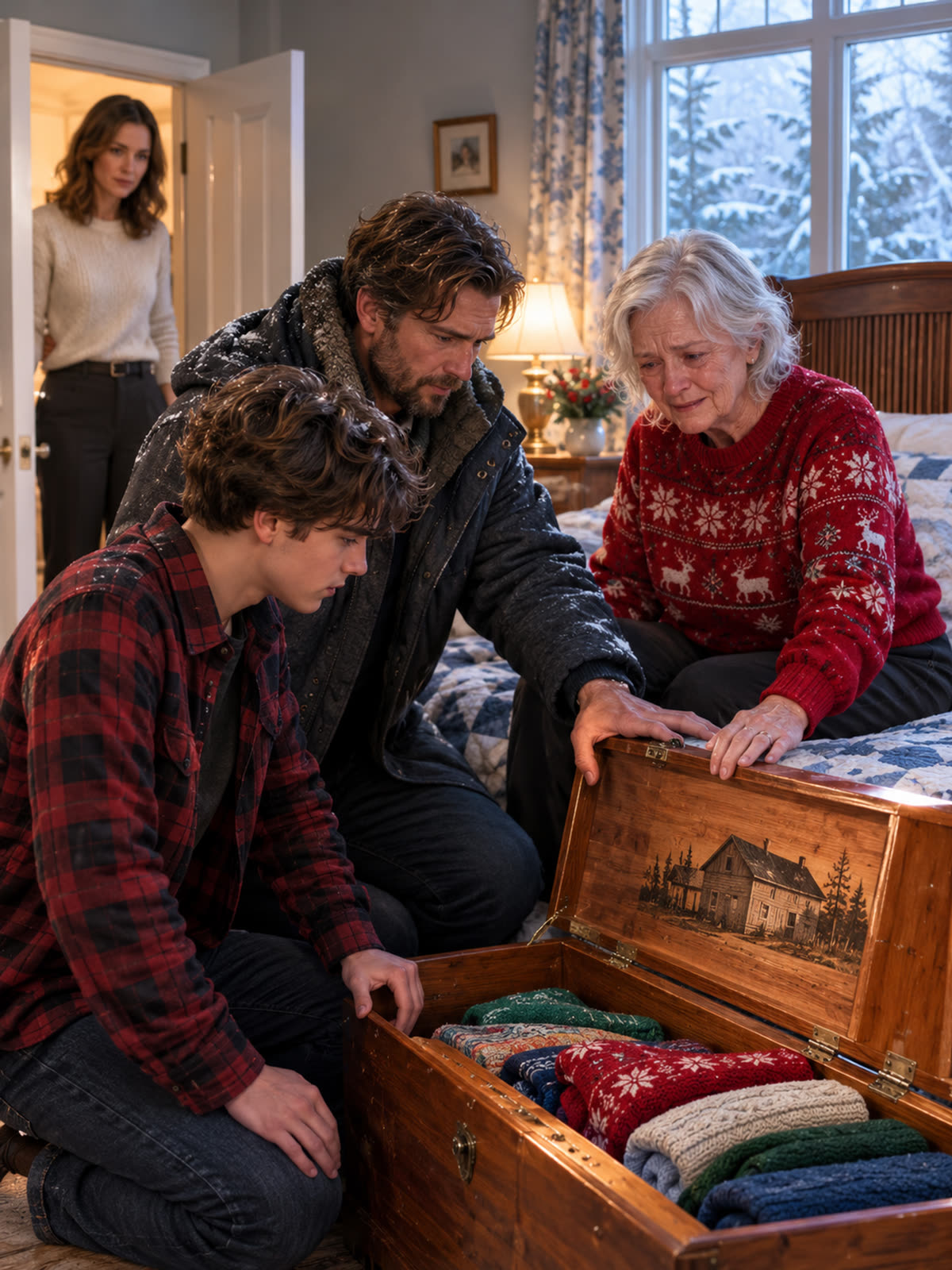
They stayed in the kitchen for quite a while. Mom, Rowan, and I remained where we were. Through the wall came the sound of their voices, quiet at first, then rising, then dropping again. I couldn’t distinguish the words, and I made no effort to. Mom placed the reindeer sweater on top of the others and smoothed its knitted surface with her hand. After that, she sat on the bed looking down into the chest. The room had the same gray rug, the same white bed, the same matching furniture. Yet the open cedar chest, filled at her direction, had already changed the way it felt. It held things she recognized, things she had chosen to keep, things that did not need to match anything else.
“She’s not a bad person, Lainey,” Mom said quietly. “Danica.” I turned toward her. “She’s scared,” Mom said. “All the time. I’ve lived in this house two years. I see it every day. She cleans when she’s scared. She cleans until her hands are raw. She bought a new set of white towels last month because one of them had a little stain on it.” Mom shook her head. “She’s never once been mean to me. Not really. She brings me tea. She drives me to my doctor’s appointments. She sits with me when Kyle works late. She’s just…” She paused, trying to settle on the right words. “She’s just never once let me have anything of mine in here.” I could hear the distinction she was making. She wasn’t pretending the hurt had not happened. She was trying to explain the woman who had caused it.
“Why didn’t you tell us?” I asked. Mom kept her gaze on the chest. “Because I’m a guest,” she said. “That’s what she calls this room. The guest room. And a guest doesn’t complain.” Rowan was still on his knees beside the chest. He lifted his face toward her. “You’re not a guest, Grandma,” he said. “You paid for this room.” She watched him for a long moment before reaching out and placing her hand on his dark hair. Neither of them added anything. From the kitchen, the voices eventually stopped. Then footsteps sounded in the hallway. Danica appeared alone in the doorway; Kyle remained behind. She had been crying. Dark traces of mascara marked the skin beneath her eyes. Her hands were clasped in front of her white sweater. She did not look at me. She looked at the chest.
“Can I come in?” she asked. Mom nodded. Danica crossed the gray rug slowly and stopped at the bed’s foot. For a moment, she studied the open chest and the row of reindeer visible on the top sweater. Then she turned to Rowan, who was still kneeling beside it. “Rowan,” she said. “I’m sorry.” He looked up without speaking. “It’s beautiful,” Danica said. “It is. It’s the most beautiful thing in this house.” Her voice broke. “And when your grandma opened it and I smelled it, I was eight years old again. In my uncle’s barn. In the winter, with the wood stove going and the walls sweating and that smell. Old cedar boards and hay and animals.” She closed her eyes. “My uncle lined the walls of the room where we slept with old cedar planks he pulled off a corncrib. To keep the mice out. It never got the smell out of anything. I smelled like that barn for six years.”
Rowan stayed motionless. “Every kid in my school knew,” Danica said. “They’d hold their noses when I sat down. They called me Barn Girl. All the way through eighth grade.” She opened her eyes again. “And when I smelled that chest, I just panicked. I couldn’t breathe. I wanted it out. I wanted it gone. I didn’t even think. I just got the hand truck.” She stood looking down at the wood for a long while before continuing. “And then I sat there folding wrapping paper,” she said, “like it was nothing. Because if I act like it’s nothing, maybe it is.” She shook her head. “That’s what I’ve done my whole life. I put things out with the trash and act like they were never there.” Mom listened without interrupting. She let Danica finish everything she had come to say.
Afterward, Mom remained seated with her hands resting in her lap. Then she said something I had never heard from her before. “Danica,” she said. “Sit down. Next to me.” Danica hesitated, then lowered herself onto the white bed beside her mother-in-law. “I lived in a barn too,” Mom said. Danica turned toward her in astonishment. “In 1958,” Mom said. “When I was seven. My father’s house burned down in March. The whole farmhouse, in Pulaski. A chimney fire. We lived in the hay barn for a whole summer while he rebuilt it. Me and my mother and my sister Bea and my father. On cots, in the hayloft.” A small smile crossed her face. “I’d forgotten it. I hadn’t thought about it in years. Until you said that.”
“I didn’t know,” Danica whispered. “Nobody knows,” Mom said. “We didn’t talk about it. You didn’t, back then. It was something you were ashamed of. Poor people lived in barns.” She reached across and took Danica’s hand. “When my father rebuilt the house, the first thing he did was line one closet with cedar. Just one. Because cedar’s what he could afford. And he told me it was the safe place. The place that was ours. That nothing could take from us.” Danica began crying again. “That’s why I hid in it, during storms,” Mom said. “That’s why it smells like home to me. To you, it smells like the barn. To me, it smells like getting out of the barn.” She tightened her hand gently around Danica’s. “Same smell. Different ending.”
No one spoke. Rowan had settled back on his heels and was staring up at his grandmother. “Danica,” Mom said. “I want to tell you something, and I want you to hear it. This house is beautiful. You made it beautiful. You came from nothing and you made something perfect, and I’m proud of you. I’ve told Kyle that a hundred times.” She paused before going on. “But I don’t live in a magazine. I live in this room. And I’m seventy-four years old, and I’ve lived in it for two years, and there’s not one thing in it that’s mine.” Her eyes moved around the room, taking in the white walls, the gray rug, the white dresser, and the gray lamp. The words were quiet, but there was nothing uncertain about them.
“I’m not a guest,” she said quietly. “I’d like this to be my room. With my things in it. And I’d like that chest to stay at the foot of my bed. And if it smells like a barn, then that’s all right. It smells like my father too.” Danica sat beside her for a long time, their hands still joined. Eventually she nodded. She couldn’t manage words, so she nodded again. Kyle stood in the doorway. I had no idea how long he had been listening. Mom had finally said what none of us had understood she needed to say. But there was still that forty-eight-thousand-dollar check, and nobody had ever put a word of their arrangement in writing.
PART 3 — The Year Left Blank
We stayed for Christmas dinner. Every one of us. There was ham, scalloped potatoes, green bean casserole, and a pan of Mom’s kolaczki, the little apricot-filled Polish cookies she had taught Danica to bake during her first Christmas in the house. Brett arrived at six, directly from his county plow shift, still dressed in his work coveralls. He ate three platefuls, removed his boots, and fell asleep on the white sectional. Danica spread a blanket over him without making a single remark about the couch. After the meal, she and Rowan took care of the dishes while Kyle and I sat at the kitchen table with coffee. The afternoon had not disappeared, and nothing about it could be undone. But we were still there together, eating the dinner Danica had made and the cookies Mom had taught her to make.
“I didn’t know,” Kyle said. “About the room. About Mom feeling like a guest. I work twelve-hour days in tax season. I come home and she’s in her room and Danica’s made dinner, and everything looks fine.” He shook his head. “I should’ve seen it.” I had been thinking about something else as well, something that had troubled me long before Rowan discovered the chest outside. “Kyle,” I said. “Can I ask you something? About the forty-eight thousand.” He looked across the table at me. “Did anybody write anything down?” I asked. “When she gave you the money?” He did not answer immediately. When he finally did, he spoke quietly. “No,” he said finally. “She just wrote us a check. We put it in our account and paid the contractor.”
For roughly a year, a conversation at work had stayed with me. A woman in the Aurora BayCare billing office, where I work, had told me what happened in her own family. Her mother had given her brother money toward a house. Three years later, the mother needed nursing-home care. Once a person’s money runs out, Medicaid pays for much of that care in Wisconsin, but the program examines money given away during the preceding five years. Without documentation, a transfer to a child may be treated as a gift. A penalty can follow, leaving a family responsible for paying privately for months before assistance begins. I explained the whole conversation to Kyle: the money, the lack of paperwork, and why that other family’s experience had made me uneasy about Mom’s check.
“Mom’s seventy-four,” I said. “She’s got a bad hip. She might need a nursing home someday. And if she does, and the state looks at that forty-eight thousand dollar check with nothing in writing, she could be stuck.” Kyle stared at me. Being an accountant, he grasped the implications more quickly than I had when my coworker first described them. I could see him working through what the undocumented payment might mean. The renovation had happened. Mom had paid for it. Everyone knew what the money had been intended to accomplish, but knowing among ourselves was not the same as having an agreement. “We need an elder law attorney,” he said slowly. “We need an elder law attorney,” I said.
In January, we found Patricia Novak in De Pere. She had practiced elder law for nineteen years. Kyle, Danica, Mom, and I went to her office together on a Thursday afternoon and listened while she walked us through the situation. She told us there were ways to address it. Then she prepared an agreement for everyone to sign, spelling out that Mom’s forty-eight thousand dollars had purchased the right to occupy that room for the remainder of her life. She called it a life lease. Its value was calculated using a formula rather than leaving the payment characterized as a gift. Patricia said the arrangement should protect Mom if she eventually required care. For the first time, what that room meant was written down rather than assumed.
Danica was the first to sign. She put her name beneath the provision stating that the room at the end of the hall belonged to Lorraine Brandt for as long as she lived. There was no longer merely a check everyone remembered or an understanding that could be described differently later. Mom’s place in the house had been put into words. After signing, Danica turned toward her. “Lorraine,” she said. “I’m going to make you a sign. For your door.” It was such a small thing to promise after the discussion we had just had, a sign on an inside door. Yet I thought of the two years Mom had spent being told, in one way or another, that she was staying in a guest room.
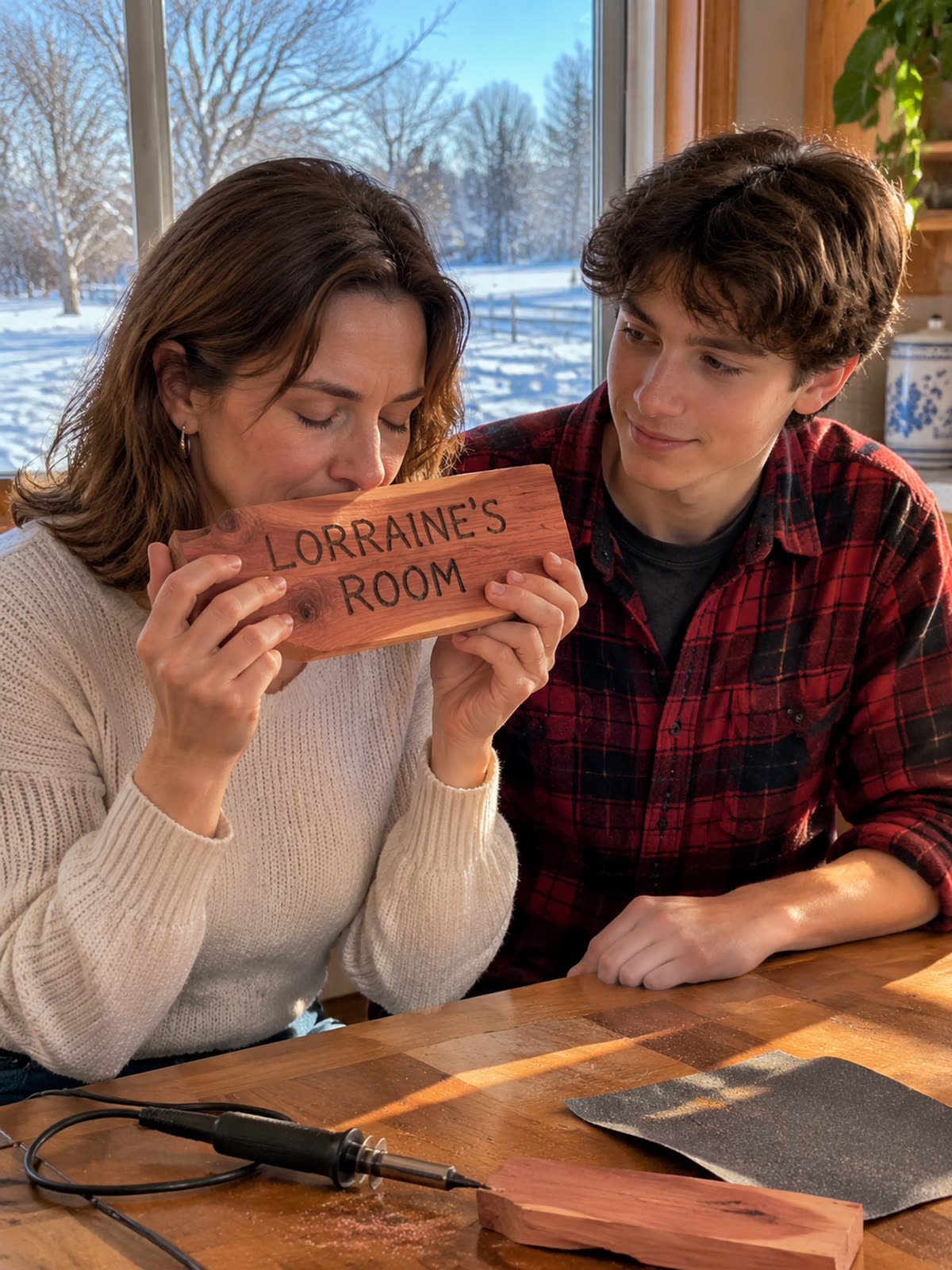
Danica made good on that promise in February. She decided to make the sign herself, from cedar. One Saturday she called Rowan and asked whether he would help her. The request surprised him, and it surprised me too. She drove her white SUV to our house in Ashwaubenon and sat down at the kitchen table with him. He had a scrap left from the chest, a small piece of the same red wood she had once been unable to bear inside her home. Now it lay between them on our table. Rowan showed her how to sand it, then explained how to handle the wood-burning pen. The boy who had kept the inscription beneath Grandma’s lid secret was teaching his aunt how to make a different piece of cedar say that his grandmother belonged.
She was not good at it. Her hand trembled. The letters refused to stay straight, and twice she burned her thumb. Still, she kept going. Rowan stayed beside her while she worked, both of them leaning over the little board. She did not hand it to him to finish neatly for her. For three hours that Saturday afternoon, she worked her way through the letters herself. There was nothing magazine-perfect about the result, nothing that could have been mistaken for the matching pieces she ordinarily chose for her house. It was a scrap of cedar with crooked lettering, made at our kitchen table under the instruction of my fifteen-year-old son. But the words were clear.
LORRAINE’S ROOM. Danica had burned every letter herself. When the lettering was done, she sanded the sign and rubbed oil into the wood. The red cedar brightened beneath her hands, just as the boards of Rowan’s chest had brightened under their coats of finish. It was the same kind of wood, the same unmistakable scent, yet this time she had chosen to sit with it. Rowan had shown her the tools, but she had done the work. The uneven sign would go on the door at the end of the hall, where the guest room had been. It would not announce a visitor or a temporary arrangement. It would carry my mother’s name.
When she finished, Danica lifted the little sign to her nose and took a breath. Then she shut her eyes. “It’s not so bad,” she said quietly. “When it’s yours.” She hung it on Mom’s door that very day. At the end of the gray hallway in the spotless white-and-gray house in Hobart, the small red cedar sign sat against the white door. It was a little crooked. It was also the only red thing in the entire hall. Months earlier, that color and that smell had been reasons to wheel a gift outside. Now Danica had carried them into the house herself and fixed them to the door where everyone could see them.
During the following two months, pieces of Mom’s life began returning to her room. Kyle went into the basement and brought up the box of photographs. Her wedding picture took its place on the dresser. On the nightstand went a photograph of Dad holding Rowan as a baby. The picture of Great-Grandpa Emil’s farm in Pulaski was hung near the window. Danica found the family rocking chair at a resale shop in Shawano, where it had ended up after the estate sale, and paid sixty dollars to bring it back. She set it in the corner by Mom’s window, beside the cedar chest. The furniture no longer looked as though every item had been selected from the same photograph. There were faces in the room now, and memories, and a chair with a life before that house.
In March, Danica came to see us again, this time without anyone else. She carried a cardboard box. “Rowan,” she said. “I need help with something.” Inside was a small wooden keepsake box, old and damaged. Its lid had split into two pieces, and rust covered the hinges. It looked like the sort of box a child might use for precious little things. “My grandma made this for me,” Danica said. “When I was seven. Before we moved into the barn. She died when I was nine.” She looked at Rowan. “It got broken when we moved. I’ve kept it in the back of my closet for thirty years. I never let anybody see it.”
Rowan lifted the box out and turned it over in those long hands of his. He examined the split lid, the old hinges, and the dried wood. “It’s cedar,” he said. Danica nodded slowly. “It’s cedar.” He repaired it after school in Mr. Kowalczyk’s workshop. The job took six weeks. He glued the broken lid together and held it in clamps, then sanded the wood and fitted small brass hinges from Menards. He worked oil into it until it glowed again. It was a much smaller project than the chest, but he gave it the same attention: the damaged wood, the joins, the hardware, the finish. When he returned it, Danica sat in her car in our driveway and lifted the lid. She breathed in the scent and cried so hard that Rowan went back into the house, not knowing what else to do.
The following Christmas, we went to Kyle’s again. Snow covered every roof around the cul-de-sac. Brett was once more out with his plow, sending photographs of the Santa hat on his dashboard. Rowan was sixteen now and taller still. He had his driver’s license and drove us to Hobart himself, holding the steering wheel carefully at ten and two. When we stepped through the front door, I noticed the cedar immediately. It wasn’t overpowering, just a faint fragrance reaching us from the room at the hallway’s end, the one with the uneven sign. It mingled with the ham baking in the oven and the pine Christmas tree in the living room, sweet and sharp at once, like an old closet in a Polish farmhouse.
Danica greeted us in a red sweater. Not white. Red. I had never seen her wear that color before. She hugged Rowan first and then wrapped her arms around me. “Your grandma’s waiting for you,” she said to Rowan. “She’s been up since six. She won’t tell me why.” Mom was in her room, seated by the window in the recovered rocking chair, wearing the reindeer sweater from 1979 with its repaired elbow. The cedar chest remained exactly where she had directed us to place it the year before, at the foot of her bed and facing the window. Photographs stood on the dresser and hung on the walls. A quilt she had made in 1985 lay folded across the bottom of the white bed. The room no longer resembled a magazine spread. It looked like my mother.
“Rowan,” she said, when he came in. “Come here. I’ve got a Christmas present for you. And I need you to do something for me.” She indicated the chest. He knelt beside it and opened the lid. Resting on her sweaters was a small paper shopping bag from Menards. Rowan reached inside and pulled out a new wood-burning pen, still sealed in its packaging. “Your own,” Mom said. “So you don’t have to borrow Mr. Kowalczyk’s anymore.” He studied the package and then looked at her. “And I want you to use it,” she said. “Right now. On my chest.” He stared. “Grandma, it’s finished.” “Not quite,” she said.
She leaned forward slowly, careful of her hip, and touched the underside of the raised lid. Her finger rested by the lettering he had burned there a year earlier: For Grandma. Love, Rowan. 2025. “Under that,” she said. “I want you to write something else.” By then Danica had come to the doorway behind us, with Kyle just beyond her. “Write: Then back to Rowan,” Mom said. “With the year left blank.” The room became very quiet. Rowan stayed on his knees with his new pen in his hand. He understood what she meant. So did the rest of us. “Grandma,” he said. His voice cracked. “I don’t want to.”
“I know, honey,” she said gently. “That’s why I’m asking you now. While I’m here to watch.” She laid her hand on his head. “Your great-grandpa built a cedar closet to be the safe place. The place that was ours. And then he died, and it got sold with the farm, and I never got to keep it.” Her gaze settled on the chest. “I’m not letting that happen twice. This goes back to you. Someday. And then you put your own grandbaby’s sweaters in it. And you tell them about Emil’s closet, and the barn in Pulaski, and the Christmas your aunt put it out with the garbage and you carried it back in.”
Rowan looked toward Danica in the doorway. Tears were running down her face, but she was smiling too. “Tell them that part,” Danica said softly. “Please. Tell them I learned.” He plugged in the new wood-burning pen and waited for it to become hot. He remained kneeling at the foot of his grandmother’s bed. Outside the window, snow continued falling. The ham was in the oven, and the house smelled of cedar. Beneath the inscription he had made a year earlier, he carefully burned the words she had requested: Then back to Rowan. Where a year would eventually belong, he left the wood untouched.
When he had finished, Mom leaned forward in her rocking chair and studied the new lettering for a long time. Then she pressed her palm flat against the lid, just as she had when she first discovered the farmhouse he had drawn there. She said nothing. There was no need. Instead, she reached into the chest and lifted out the reindeer sweater from the top of the stack, the one she was wearing a copy of. She held it out to Danica. “You’re cold,” she said. “You’re always cold in this house. Put this on.”
Danica looked down at the sweater in her hands. Red, white, and green. Reindeer crossing the front. Knitted in 1979 by a woman she had never known. She raised it to her face and breathed in the cedar scent. Then she put it on. And beneath the chest’s lid, below the words that would someday send it back to Rowan, the space for the year remained blank.
Disclaimer: This story is a work of fiction inspired by real-life themes. Names, characters, places and events are fictionalized, and any resemblance to real persons is purely coincidental. Images are for illustration purposes only.
