

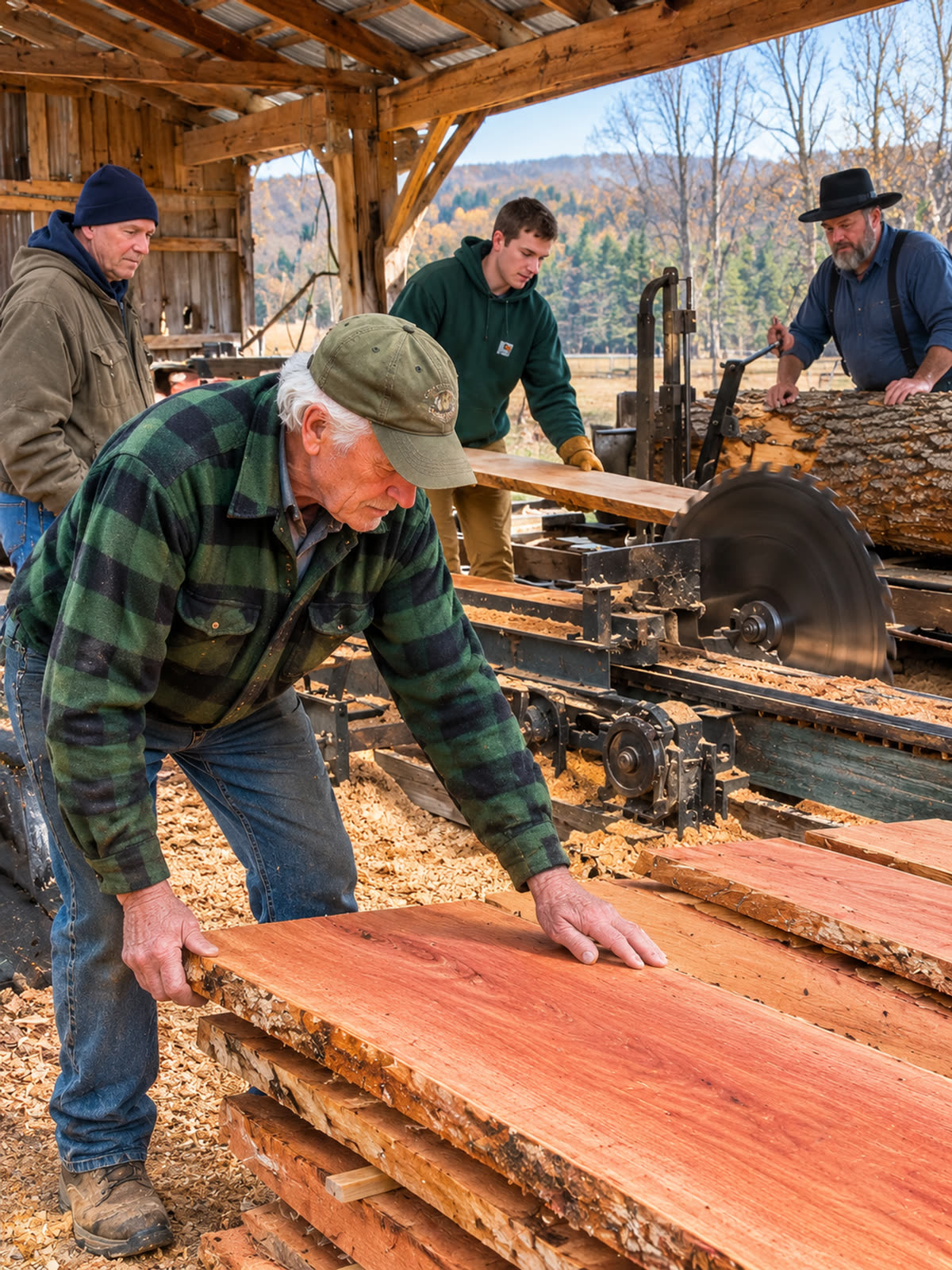
PART 1 — The Yellow Marks
When I crossed the mill yard and returned to my log truck, Dad was still in the cab. He hadn’t climbed down once during our visit. He said his knees hurt, though I knew that wasn’t what had kept him there. With the heater on and the passenger window open barely an inch, he had watched the grading deck through the windshield. I thought he wanted to witness everything without letting anyone watch his face. The check rested between both his hands. He gripped its edges as carefully as if it were a hospital letter containing news he couldn’t bear to read. I climbed behind the wheel, and without looking at me, he extended it. Six hundred dollars. Lindholm Lumber Company, Hemlock Run, Pennsylvania. Made payable to Arvid Lindholm. Across the memo line, my cousin had printed one word: Pallet.
My cousin Lyle operates the town sawmill. Our family has owned it since 1961, when his father, my uncle Walt, bought a secondhand steam engine and an old circular saw and established the business in a pole barn beside the railroad tracks at Hemlock Run’s north end. Over the next forty years, Walt cut oak, maple, and cherry from farms and woodlots throughout McKean County. His grades were as honest as a priest listening to confession. Lyle inherited the operation when Walt died nine years ago. That morning, his yard man had unloaded our twenty-two logs onto the grading deck, arranging them along the steel skids, butt to top. They were substantial black cherry logs, twelve or fourteen feet long, measuring sixteen to twenty-two inches at their smaller ends. Dark, flaky bark covered them, looking like scorched potato chips. Dad had felled every tree on the hillside behind his barn.
Lyle emerged from his office wearing his Carhartt jacket and reading glasses, carrying the thick yellow lumber crayon familiar to every Pennsylvania log grader. At the first log, he glanced at the butt for perhaps three seconds before marking a large P across it. Pallet. At the second, he repeated the mark. Then the third. Along the entire row he went, assigning the same grade to every log. Pallet is the bottom classification: wood destined for Bradford’s pallet mill, where it becomes rough shipping-skid boards. That grade belongs to crooked timber, rotten timber, logs riddled with knots, metal, or bird damage. It brings next to nothing. Yet I stood beside my truck while my cousin labeled some of the finest cherry I had encountered in twenty-six years of hauling as worthless material. In the north woods, you learn that an argument won’t change a grader’s crayon. He owns the deck and the decision. Complain, and he tells you to haul somewhere else. To settle what a log contains, you find someone willing to open it with a saw. So I kept my mouth shut.
Back in August, Lyle had visited Dad’s farm on a Saturday afternoon, something he hadn’t done in years. He sat at Mom’s kitchen table, drank coffee, and ate two slices of rhubarb pie before asking to see the cherries. Dad agreed. Up the hill they went, my eighty-year-old father carrying his walking stick beneath his green seed cap, Lyle following with his clipboard and reading glasses. Two hours passed before they returned. Lyle offered four thousand dollars for the standing trees. His crew would bring chainsaws and a skidder, cut everything, and haul it away without Dad doing any work. Twenty-some cherries scattered over four hillside acres, for four thousand dollars cash. Dad thanked him, called it a fair offer, and declined. He intended to do the cutting himself. “Uncle Arvid,” Lyle said. “You’re eighty years old.” “I know how old I am,” Dad said. “I was there.”
Throughout October, Dad worked that steep ground with the old Stihl he had purchased in 1986 and his little Ford tractor and log chains. He brought down one tree a day, occasionally two when the weather cooperated. My son Mason helped on Saturdays and after finishing shifts at the Walmart distribution center. Most days, though, Dad worked alone in his plaid coat, felling, limbing, and dragging the logs into the barn lot. Mom watched from the kitchen window. Later she admitted that she had carried the telephone in her apron pocket all October, ready to summon an ambulance. Those trees had been part of Dad’s life since childhood. His father, Nils, emigrated from Sweden in 1922 and bought the farm in 1938: a hundred and twenty acres of stones, second-growth forest, and rough ground. The hillside had been logged the previous year, and young cherries had sprung up among the slash.
Dad was born in 1945. Once, he told me his earliest memory was of climbing that hill with his hand inside his father’s. Nils stopped beside a cherry sapling no taller than the little boy and said, in his thick Swedish accent, “That one’s for your old age, Arvid.” Eight decades later, those cherries rose above everything else on the farm. Their trunks stood straight as utility poles, with sixty feet below the first branches and dark sides too broad to reach around easily. Dad had watched their white spring blossoms, their yellow autumn leaves, and winter snow gathering on their limbs. He always said he would leave them standing. They would live longer than he would. Then Mom needed dental work. She was seventy-eight and had postponed it for three years. Her Bradford dentist said she needed four implants, a bridge, and two crowns. If she delayed further, she could lose the teeth she still had. The bill was eleven thousand four hundred dollars. Their Medicare Advantage dental allowance was fifteen hundred a year. They had to find everything else.
Dad never announced how he planned to cover the cost. On October first, he simply carried his chainsaw up the hill. The cherries would pay for Mom’s teeth, with a little left for the grandchildren. Meanwhile, everyone around Hemlock Run knew Lyle’s mill had fallen behind on payments that spring. Hardwood prices had collapsed the year before as southern furniture factories turned to cheaper imported lumber. Lyle had borrowed heavily for a new band saw and kiln in 2022. At the diner, I had heard talk of a letter from the bank. That explained pressure. It did not excuse what he was doing to his own uncle. Leaving Dad in the cab, I went back to the grading deck. Lyle stood there recording figures on his clipboard with that crayon still in hand. He looked up without surprise. Mostly, he looked exhausted. “Pete,” he said. “Lyle.”
He extended the clipboard. Twenty-two logs. Four thousand three hundred board feet on the Doyle scale. Every one pallet grade. Fourteen cents per foot, making six hundred and two dollars, which he had rounded down to six hundred. “We’re not selling at that,” I said. He only shrugged. He didn’t argue or even glance toward the timber. “Suit yourself,” he said. “Nobody’s buying cherry this fall. You won’t do better anywhere in McKean County.” He slipped the crayon into his shirt pocket. “You can leave them here and think about it. Or you can haul them home. But the check stands either way. Uncle Arvid already has it.” I stood looking at the cousin who had grown up a mile from me, attended Hemlock Run High School beside me, and served as best man at my wedding. When Dad suffered his heart attack in 2015, Lyle had stayed with me all night in the Bradford hospital waiting room. Now he wouldn’t meet my eyes.
Mason was already making his way into the loader seat. Until then, he had stood near the rear of the trailer, hands buried in his pockets, his face turning steadily redder. He was nineteen, six foot two, and quiet like his grandfather. He had helped me with the truck since he was twelve and had operated its knuckle boom almost as long as he could reach the controls. Behind the cab sat the hydraulic loader, a large crane fitted with a grapple. In Mason’s hands, it could lift a twelve-foot log as delicately as someone lifting an egg. He settled into the seat, engaged the hydraulic pump, and brought the boom over the grading deck. We didn’t need to discuss what came next. Those logs were going back on our trailer.
He reloaded all twenty-two, one after another. The grapple dropped, closed around a log, and raised it from the skids. Then the boom swung above the trailer and lowered the load softly into its bunks. He repeated the movement twenty-two times over forty minutes. Tanner, Lyle’s yard man, watched with his hands in his pockets. He was perhaps twenty-five and never spoke while Mason worked. When the final log settled into place, Tanner removed his cap and gave my son one nod—the kind a man gives another man who has done the right thing. No one tried to stop us. I secured the load with four chains and binders. Mason climbed down and stood beside me. Lyle had disappeared inside his office and closed the door.
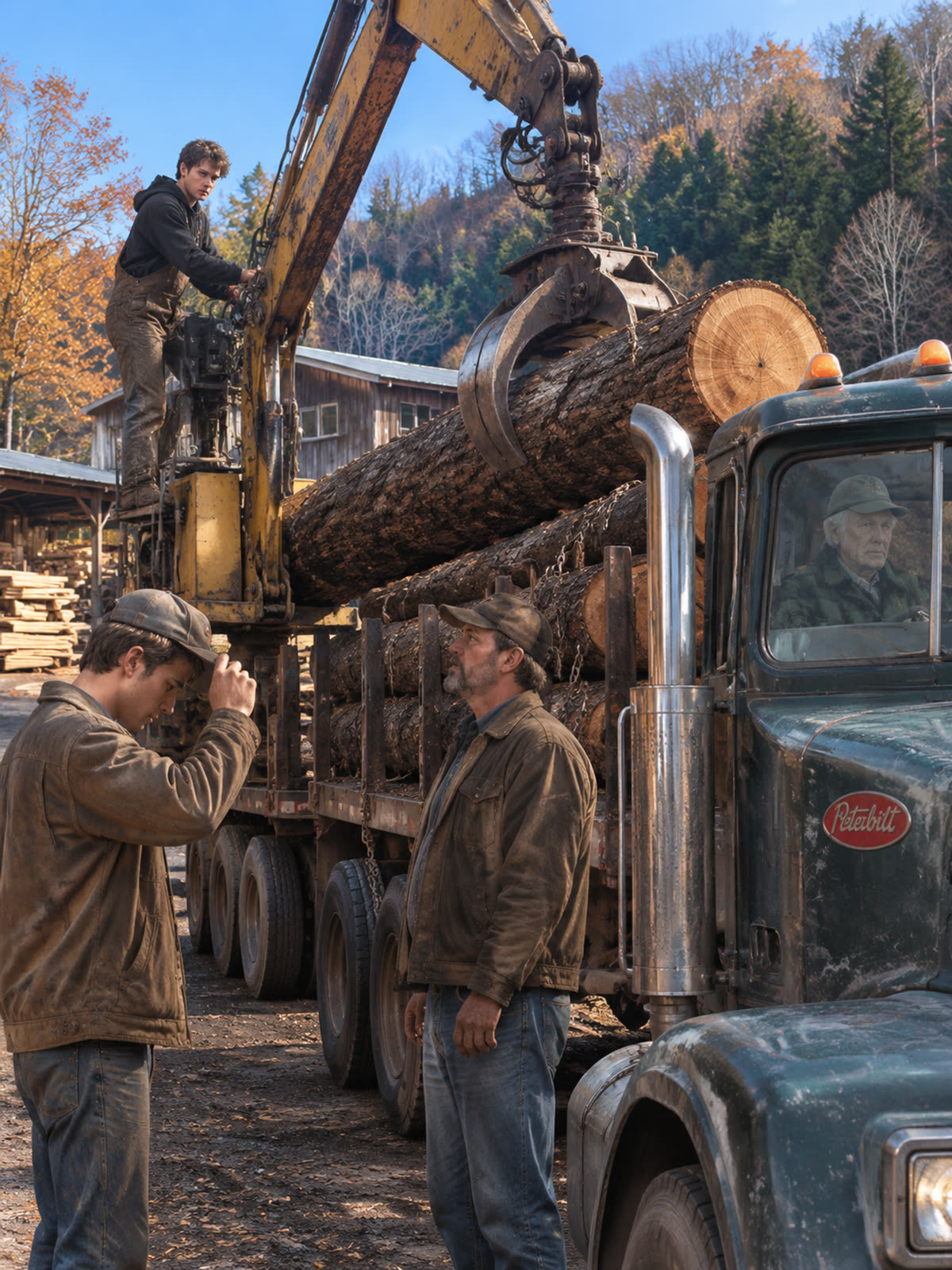
Back in the cab, I found Dad still holding the check. He studied it once more, folded it precisely in half, and slipped it into the inner pocket of his green-and-black plaid coat. Then he buttoned the pocket. He never deposited it. We hauled the timber home: twelve miles out of Hemlock Run, along Route 321, and onto the gravel road past the farm. No one spoke. Mason sat with folded arms; Dad watched the hills through the window while I drove. Mom was waiting on the back porch in her apron when we entered the barn lot. She took in the loaded trailer and Dad’s expression without asking anything. She went inside and started the coffee.
The four of us gathered around her kitchen table with coffee and the remaining rhubarb pie. Dad laid the folded check before him. Mom read it, including the single word on the memo line. “Lyle,” she said quietly. Just his name. “It’s not his fault, Ingrid,” Dad said. “The mill’s in trouble.” “I don’t care if the mill’s on fire,” Mom said. “Those are your father’s cherries.” That afternoon, I placed one call. Twenty-six years of trucking timber had taken me to every mill between Olean and DuBois, and to operations most people in Hemlock Run had never heard of. One stood on an Amish farm outside Smicksburg in Indiana County, sixty miles south through the hills. Over the years, I had delivered several oak loads there for a Punxsutawney log buyer. The man who owned it was Levi Yoder.
There was no telephone in Levi’s house. At the end of his lane, however, stood a little wooden phone shanty shared by half a dozen Amish households. At three o’clock, I dialed it and listened through twenty rings before a young woman answered. In a gentle Pennsylvania Dutch accent, she said she would fetch Levi from the barn. Eleven minutes passed. At last, heavy boots sounded across the booth’s wooden floor, followed by a deep, unhurried voice. “This is Levi.” I introduced myself, and he remembered me. Then I described the load: twenty-two black cherry logs from a north-facing McKean County hillside, harvested by an eighty-year-old who had watched them grow from boyhood. I told him about my cousin, the yellow crayon, and six hundred dollars. Pallet on every end. Levi remained silent long enough for me to hear wind coming through the shanty’s cracks.
“How big?” he asked finally. “Sixteen to twenty-two inches at the small end. Twelve and fourteen foot.” “North slope?” “North slope. Old field. Came up in the slash in 1937.” Another silence followed. Then he gave me his answer. “Bring them Saturday morning,” Levi said. “And bring your father.” We left at first light on the first Saturday of November. The morning was clear and bitter, the windshield frosted, western stars still visible as we pulled away from Dad’s barn. Mason followed in his own pickup. We wanted a second vehicle available to get Dad home if anything went wrong. Mom had packed ham sandwiches, a thermos of coffee, and an entire rhubarb pie wrapped in a dish towel. She also insisted on Dad’s long underwear and good wool socks.
Dad claimed the middle of my truck’s seat. Mason had offered him the warmer, more comfortable ride in his pickup, but he refused. His logs were on that trailer, and he meant to travel with them. We followed Route 219 south through Kane, Ridgway, and Brockway, sixty miles of two-lane pavement twisting across the Allegheny hills. Pennsylvania in November scarcely gets more beautiful. The leaves had fallen, leaving brown and gray slopes broken by deep-green hemlocks in the hollows and pale birches along the ridges. Cold creeks ran high, and the sky brightened into a clearer blue with the rising sun. Most of the way, Dad hummed the hymn Mom plays every Sunday morning.
All my life, Mom has played their old upright Baldwin before they leave for Mount Zion Lutheran. She always begins with “Children of the Heavenly Father.” My grandmother Hanna sang that Swedish hymn to Dad as a baby, and Mom learned it during their first year of marriage. He hummed between Kane and Ridgway, fell quiet, then began speaking somewhere below Brockway. “My father planted the first one,” he said. “Did I ever tell you that?” I glanced toward him. “I thought they came up wild. In the slash.” “Most of them did,” he said. “But the big one at the top of the hill, by the stone wall, he planted it. The spring I was born. From a seed he brought from his mother’s farm in Småland, in his coat pocket, in 1922.” Dad watched the passing country. “He said in Sweden, when a son is born, you plant a tree. For his old age.” I said nothing and kept my eyes on the road. “That’s the first log on your trailer,” Dad said. “The big one. Twenty-two inches. Lyle wrote pallet on it.”
PART 2 — What the Saw Revealed
Levi’s mill stood beneath an open-sided wooden shed, surrounded by sawdust. A long gravel lane led us there from a back road outside Smicksburg, past a white farmhouse, a gray buggy, and a pasture where great Belgian draft horses breathed steam into the morning. No electric lines followed the lane. There wasn’t a single pole. A diesel powered the saw. The mill occupied a clearing at the woodlot’s edge: a long structure of wooden posts beneath a metal roof, with no enclosing walls. Inside, a circular blade five feet across stood beside a steel carriage running on tracks. At one end, a green Detroit Diesel drove it through a long flat belt. Sawdust coated everything and rose in heaps outside, red, white, and gold. Bare hills circled the clearing beneath a bright, cold sky. There was no snow yet. As we arrived, sunlight crested the eastern ridge and turned the frost on those piles to drifting steam.
Levi waited beside the carriage. He was about sixty and broadly built, with a long gray beard and the clean upper lip customary among Amish men. He wore a black felt hat, dark blue shirt, black suspenders, and a black wool coat. His hands were enormous, thick and scarred, but there was gentleness in them. Two sons, both young men in their twenties with matching hats and beards, stood quietly beside the lumber stacks. Levi began at one end of my trailer and examined every log. He took his time, studying the butt, walking the bark-covered length, then inspecting the opposite end. Sometimes he laid his palm against the bark and drew it along the trunk. At the big twenty-two-inch log, he knelt and studied the end for a long while. His thumb passed across Lyle’s yellow P. Through the entire inspection, he didn’t speak.
Mason helped Dad descend from the cab. Dad stood in the sawdust with his walking stick, wearing that faded seed cap and green-and-black coat, and watched Levi examine the timber he had brought off his hill. At the trailer’s far end, Levi turned toward him. Then he gave Mason a nod and indicated the loader. Mason climbed to the controls, started the hydraulic pump, and transferred all twenty-two logs to the deck beside Levi’s carriage. Again, he handled them one at a time. When everything was unloaded, Levi selected the first log for the saw. It was the largest one, the twenty-two-incher from beside the stone wall. My grandfather’s tree. Levi and his sons moved it onto the carriage with cant hooks and fastened it beneath the steel dogs.
Levi crossed to the diesel and started it. The engine coughed, roared, and found a deep, even rhythm. The great blade gathered speed until its teeth vanished into a silver blur and its hum rose into a high singing note. At the control lever, Levi drew the carriage forward, easing the log into the saw. First came the bark slabs, the rough outer pieces dropping onto the rollers with their bark attached. He used his cant hook to turn the log a quarter turn, cut another slab, and repeated the process until it was squared. Then he cut the first board. A long, climbing scream filled the shed as the blade passed through. The board separated and settled onto the rollers while a red cloud of sawdust burst outward. Red wood. Clean wood. Not one knot.
Freshly sawn black cherry looks like salmon: pinkish red, with a delicate straight grain that seems almost silky. With age, it deepens toward the rich reddish brown of a fine violin. The board in front of us measured fourteen feet long and eleven inches wide. From one end to the other, nothing marred it. No tiny knot, no wormhole, no gum streak. It was flawless. One of Levi’s sons lifted it from the rollers and laid it on a stack beside the shed. Dad made his way over, his stick sinking through the sawdust as he walked. He stopped beside the lumber and looked down. Then he placed one hand flat on its surface and left it there, touching it as tenderly as a sleeping child’s head. I watched his shoulders begin to shake.
Mason kept bringing boards in his leather gloves. The saw continued running, and my son continued carrying. He caught the lumber as it left the rollers and set it beside his grandfather, carefully matching the edges as Levi’s son had shown him. Some boards stretched sixteen inches across. Others were twenty. The same clean red grain ran through them. I stayed one step behind Dad and said nothing. Keeping quiet was harder than anything I had done. I wanted to tell him we had known. I wanted to call Lyle a crook. I wanted my cousin on the telephone immediately, wanted him standing there looking at the lumber he had called pallet stock. But that moment belonged to my father, not to me. So I stood in the sawdust, watched his hand resting on the cherry, and kept those words to myself.
Levi worked steadily through the morning and through all twenty-two logs. He didn’t pause for water or lunch. His sons alternated at the lever while he moved along the carriage and turned the timber, and Mason carried board after board. The pile beside Dad reached his waist by noon. At one, it stood level with his shoulders. A few pieces held knots or small amounts of gum. Some larger logs had heart checks, the splitting old trees develop near their centers. Levi cut around the flaws and separated those boards from the clear lumber. Most of the load, though, came off the saw clean. The finest pieces qualified as FAS—firsts and seconds, hardwood’s top grade. That was cherry for fine furniture, kitchen cabinetry, church altars, and violin backs, not shipping pallets.
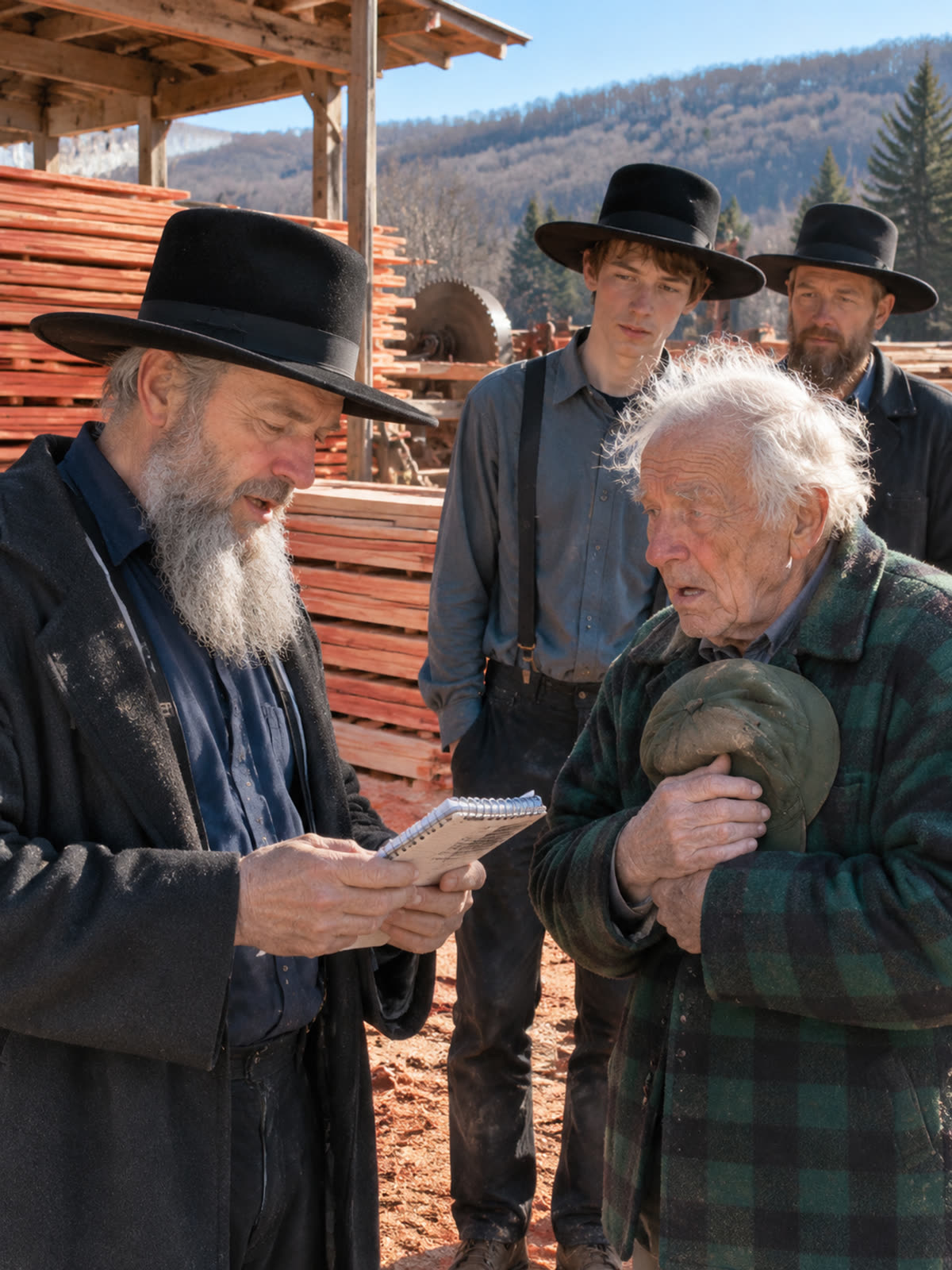
When the final log was finished, Levi shut off the diesel. The blade gradually lost speed, and silence washed into the clearing. Wind stirred the bare trees. Over by the farmhouse, the Belgians stamped in their pasture. Levi reached into his shirt pocket and brought out a small spiral notebook, the inexpensive kind with a pencil stub tucked into its wire binding. He went to Dad’s stack and began counting under his breath. Using a wooden tally stick, a long flat rule marked with burned-in numbers, he checked the width and length of every board. He laid it across the wood, read the measurement, murmured a number in Pennsylvania Dutch, and wrote in the notebook. Board after board, he continued, tallying the clear pile and the common pile separately. It took forty-five minutes.
Dad removed his faded seed cap and pressed it to his chest. The cold wind lifted his white hair while he stood beside all that cherry, watching the count without a word. He held his cap over his heart just as he does in church during the doxology. Eventually, Levi shut the notebook and approached him. “Arvid,” he said. “I will tell you what I can pay.” They faced each other in the sawdust, almost equal in height, two older men—one beneath a black felt hat, the other bareheaded with a seed cap against his chest. Around them stood the evidence the saw had uncovered. None of us interrupted while Levi prepared to explain his figures.
“You have four thousand six hundred board feet,” Levi said slowly. “Of that, three thousand one hundred is firsts and seconds. Clear. The best cherry I have sawn in ten years.” He tapped his notebook against his palm. “The rest is number one common. Good wood. A few knots.” Dad remained silent. “There is a cabinet shop in Lancaster that buys all the clear cherry I can saw,” Levi said. “They pay me well for it. Three dollars and forty cents a foot, green.” He consulted the book again. “For the clear, I can pay you two dollars and eighty cents a foot. For the common, one dollar and forty. That is what I would pay any man.” He worked through the arithmetic aloud in his deliberate voice: thirty-one hundred feet at two eighty, fifteen hundred at one forty. “Ten thousand, nine hundred and eighty dollars,” Levi said.
No one answered. A gust carried sawdust across the open space. Dad kept his cap against his chest, his expression unchanged as the figure settled over him. Ten thousand nine hundred and eighty dollars. Not six hundred. Not four thousand. Mason pulled off his gloves and stood holding them. At last Dad found his voice, rough with emotion. “Levi,” Dad said finally. His voice was rough. “That’s more than the trees were worth standing.” “The trees were worth what they were worth,” Levi said. “Standing is one price. Sawn is another. You cut them. You skidded them. Your son hauled them. My saw opened them.” His eyes moved toward the lumber. “Now everybody can see what they are.” He closed the notebook. “I will pay you by check,” he said. “From the Farmers and Merchants Bank in Marion Center. Or I will pay in cash, if you want. Today.”
Then Levi surprised me. He spent a long moment studying the flawless red boards stacked higher than Dad before turning back to him. “But Arvid,” he said. “I think you should not sell all of it.” Dad looked at him. “The big log,” Levi said. “The first one. The one with the yellow mark on the end.” He walked to seven of the widest boards and rested his hand on them. They were twenty inches wide, fourteen feet long, and the richest red of the lot. “This came from that log. Seven boards. I have never in my life seen boards like these. Not in forty years of sawing.” “That’s my father’s tree,” Dad said quietly. “He planted it the spring I was born.” Levi nodded as if the answer did not surprise him.
“Then I think,” Levi said, “a man should keep his father’s tree. And make something of it. With his own hands.” He lifted his palm from the lumber. “Take those seven boards home, Arvid. I will pay you for the rest. Ninety-four hundred dollars. And I will put those seven boards in my kiln and dry them for you. No charge. Six weeks. Then your son can come get them.” For a long time Dad offered no answer. When he finally spoke, he wasn’t thinking aloud about the money or what he might build. He was thinking about the crayon. “Levi,” he said. “My nephew graded these logs pallet. All twenty-two. His father was my brother. His father graded logs for forty years, and I never once heard a man in McKean County say Walt Lindholm cheated him.” Levi listened without speaking. “Why would he do that?” Dad asked. “To his own uncle.”
Levi studied the red lumber a long while. Then he removed his black hat and held it between his hands. “A man in trouble,” he said, “sometimes thinks the people closest to him are the ones who will forgive him. So he takes from them first.” He put his hat back on. “Cherry does not lie, Arvid. You can lie about a log standing. You can lie about a log on the deck with a crayon. But when you open it on the saw, it shows you what it is. Every time.” He looked directly at Dad. “Your nephew knew what these logs were,” he said gently. “He walked your hill in August. He offered four thousand for them standing. That was an honest offer. Maybe a little low.” He shook his head. “Then in November, the same logs, he writes pallet. Something happened to him between August and November. Not to the trees.”
Dad received cash. One of Levi’s sons counted ninety-four hundred dollars across my truck’s hood and put it into a brown paper envelope. Dad tried to say a check would do, but Levi told him that someone who had carried an uncashed check in his coat for a week deserved cash. We headed home late that afternoon with the empty trailer rattling behind us and orange sunset spreading behind the ridges. Dad occupied the middle of the seat again. In his coat, the envelope lay beside Lyle’s folded check. This time he did not hum. He watched the country pass until somewhere north of Brockway, when he spoke. “Your mother can get her teeth,” he said quietly. “All of them. The good ones.” “Yes, Dad.”
“And the grandkids. Your two and Karin’s three. Two hundred dollars each for Christmas. I promised them in September.” He paused before continuing. “And I want to put something away for Mason. For his schooling. He wants to go to Penn State DuBois. For forestry.” I looked toward him. Mason had never told me he wanted college. “He told me in October,” Dad said. “Up on the hill. Cutting the big cherry. He said he wants to learn to manage woods. So nobody can ever cheat his grandfather on a log again.” A smile almost reached Dad’s face. “I told him he’d have to learn to grade first.”
By the time we reached the farm, darkness had settled. Mom waited on the back porch in her coat beneath the porch light. She saw the trailer was empty. Then she saw Dad’s face while Mason helped him from the truck. Leaning on his stick, Dad crossed the yard and slowly climbed to her. He took the brown envelope from his coat and placed it in her hands. She looked inside, then lifted her eyes to him. “Arvid,” she said. “What did you do?” “I let a man saw them open,” Dad said. “That’s all.” Mom began crying there on the porch. She wrapped her arms around him, crushing the envelope between them, and cried against his plaid coat. He held her with his eyes shut.
In January, Dr. Hensley in Bradford completed Mom’s dental work: four implants, the bridge, and both crowns. The total came to eleven thousand four hundred dollars. Their Medicare plan covered fifteen hundred, and Dad paid the remainder in cash from the brown envelope at the office counter. The receptionist counted it twice. The next Sunday, Mom smiled at church with her new teeth. Before they left home, she played “Children of the Heavenly Father” on the old Baldwin. This time she sang along, out loud and in Swedish, just as Dad’s mother once had. But there was still another piece of paper in the story—the check Dad had folded so carefully and never cashed. Lyle would have to face the man whose father’s tree he had marked with that yellow crayon.
PART 3 — What a Man Can Keep
Lyle arrived at the farm two weeks before Christmas, during the winter’s first proper snowfall. Heavy, wet flakes drifted through the yard light. I was stacking a load of firewood on the back porch when headlights appeared along the gravel road. His pickup entered the barn lot and stopped. For a long while, the doors stayed shut. Eventually, my cousin stepped out in his Carhartt jacket and stood in the falling snow. Rather than approach the house, he went toward the barn. Dad’s October cutting had left a pile of slabs and bark beneath a tarp near the door. Lyle stopped beside it and studied the end of a slab, where red cherry showed below its bark. Snow gathered across his shoulders while he remained there.
Dad noticed him from the kitchen window. He put on his seed cap and plaid coat and went outside, crossing the lot toward his nephew. I followed a few steps behind because I didn’t want him facing this alone. Hearing us, Lyle turned. His face looked gray, as if he had gone a month without sleeping. “Uncle Arvid,” he said. “Lyle,” Dad said. From inside his jacket, Lyle brought out a printed sale ticket from Levi Yoder’s mill. I never learned where he obtained it. Perhaps the Lancaster cabinet shop, perhaps conversation at the diner. The figures were there: four thousand six hundred board feet, thirty-one hundred of them clear. He held the paper toward Dad. “I heard,” Lyle said. His voice cracked. “I heard what Levi paid you.” Dad said nothing.
“The bank’s foreclosing on the mill,” Lyle said. “They sent the letter in September. I’ve got until March. I owe them three hundred and twelve thousand dollars on the band saw and the kiln.” He lowered his eyes. “I’ve been grading logs low since August. Not just yours. Everybody’s. Old men, mostly. Farmers who don’t know any better. I’d grade them down, buy them cheap, and sell the lumber high to try to make the payment.” He swallowed before going on. “I told myself it was just this one season. Just till I caught up.” “And mine,” Dad said quietly. “And yours.” Lyle’s face folded. “I knew those were the best cherry logs I’d seen in ten years. I knew it in August. I walked your hill and I knew. And in November, when Pete brought them in, I’d already cheated so many people that one more didn’t seem to matter.” He wiped at his eyes with his glove. “I wrote pallet on my own grandfather’s tree. My dad would’ve…” He couldn’t finish.
Dad looked at him through the snow for a long time. Then he reached into his plaid coat, into the same inside pocket he had buttoned in my truck six weeks earlier. Out came the carefully folded check. Six hundred dollars from Lindholm Lumber Company. Pallet. He extended it to his nephew. “I never cashed it,” he said. Lyle stared down at the paper. “Your father built that mill on honest grades,” Dad said. “Forty years. I helped him pour the concrete for the first saw pad in 1961. I was sixteen. He told me, Arvid, the only thing a sawmill really sells is a man’s word. The wood’s just what it comes wrapped in.” Lyle accepted the check with a trembling hand.
“You call every man you cheated this fall,” Dad said. “Every one. You go to their houses. You tell them what you did. And you pay them the difference. Whatever it takes.” “Uncle Arvid, I can’t. I don’t have the money. I’m going to lose the mill.” “Then lose it honest,” Dad said. “A man can come back from losing a mill. A man doesn’t come back from losing his name.” Lyle did what Dad told him. Through January and February, he drove snowy roads across McKean, Elk, and Potter counties to visit eleven farmers. Most were older men, exactly as he had admitted. He sat at their kitchen tables and confessed to the false grades. Some ordered him out. Others cried. In Smethport, an old man whose red oak Lyle had bought for half its value made him split a cord of firewood before agreeing even to hear him.
He repaid whatever he could. To raise money, he sold his pickup and his Potter County hunting camp. What he couldn’t settle immediately, he arranged to repay in monthly installments of a few hundred dollars. He is still making those payments. In March, the bank took the mill. A West Virginia company bought the band saw and kiln at auction. All spring, the pole barn beside the railroad tracks stood empty—the place where Walt Lindholm had spent forty years cutting honest lumber. Then, in April, Lyle made the sixty-mile drive south through the hills to Smicksburg. He told me afterward how he had sat for an hour in the phone shanty at the end of Levi’s lane, waiting for Levi to return from the fields.
When they met in the sawdust beside the mill, Lyle told him everything. He asked whether Levi could use another worker—not a grader, just someone to roll logs, carry boards, or do whatever labor needed doing. Levi considered him for a long time. “Arvid’s nephew,” he said. “Yes, sir.” Slowly, Levi nodded. “Cherry does not lie,” he said. “Neither does a man who drives sixty miles to say he was wrong.” He passed Lyle a pair of leather gloves. “You start Monday. I will teach you to grade again. The honest way.” My cousin works there now, three days every week, driving sixty miles down and sixty back. He handles logs, carries lumber, and sweeps the sawdust. Levi pays fifteen dollars an hour. Lyle has told me he has never had a better job.
Dad spent that winter in his workshop. In January, he and Mason went to Levi’s and brought back the seven boards from Nils’s tree. Kiln drying had left them hard and smooth, their red deepening toward the color of a fine violin. Dad arranged them across sawhorses near the woodstove in the workshop at the back of his barn. Each morning after breakfast, he put on his plaid coat and went out to work. He wouldn’t tell anyone what he was making. Not even Mom knew. He said she would find out when he finished. The work occupied four months. He used hand planes, chisels, and the table saw he had bought in 1971. On Saturdays, Mason came to help and learn.
Sometimes I joined them and stood beside the woodstove while Dad worked. At eighty, he still fitted dovetail joints by hand, patiently and carefully, using the methods his father had taught him. These were the seven boards Levi had urged him not to sell, the widest and reddest pieces from the tree planted in the spring of his birth. The same timber that Lyle had dismissed with a yellow P was taking shape beneath Dad’s hands. Through those winter mornings, he kept his work to himself and continued at his own pace. Mom would see it when it was ready. By April, after four months of shaping and fitting, it was finished.
Mason and I helped Dad carry it into the house. The piece was heavy: a long, broad piano bench for Mom’s old Baldwin, with a lifting lid and room underneath for her hymnals. He had made it from his father’s black cherry and oiled the wood until its grain shone red and gold, like fire. Inside the lid, he had used a wood-burning tool to leave an inscription in his careful, unsteady handwriting: Planted 1945 by Nils Lindholm for his son’s old age. Cut 2025 by Arvid Lindholm for his wife. Barn Tack ar Gud. The tree from beside the stone wall had become something Mom could sit on whenever she played.
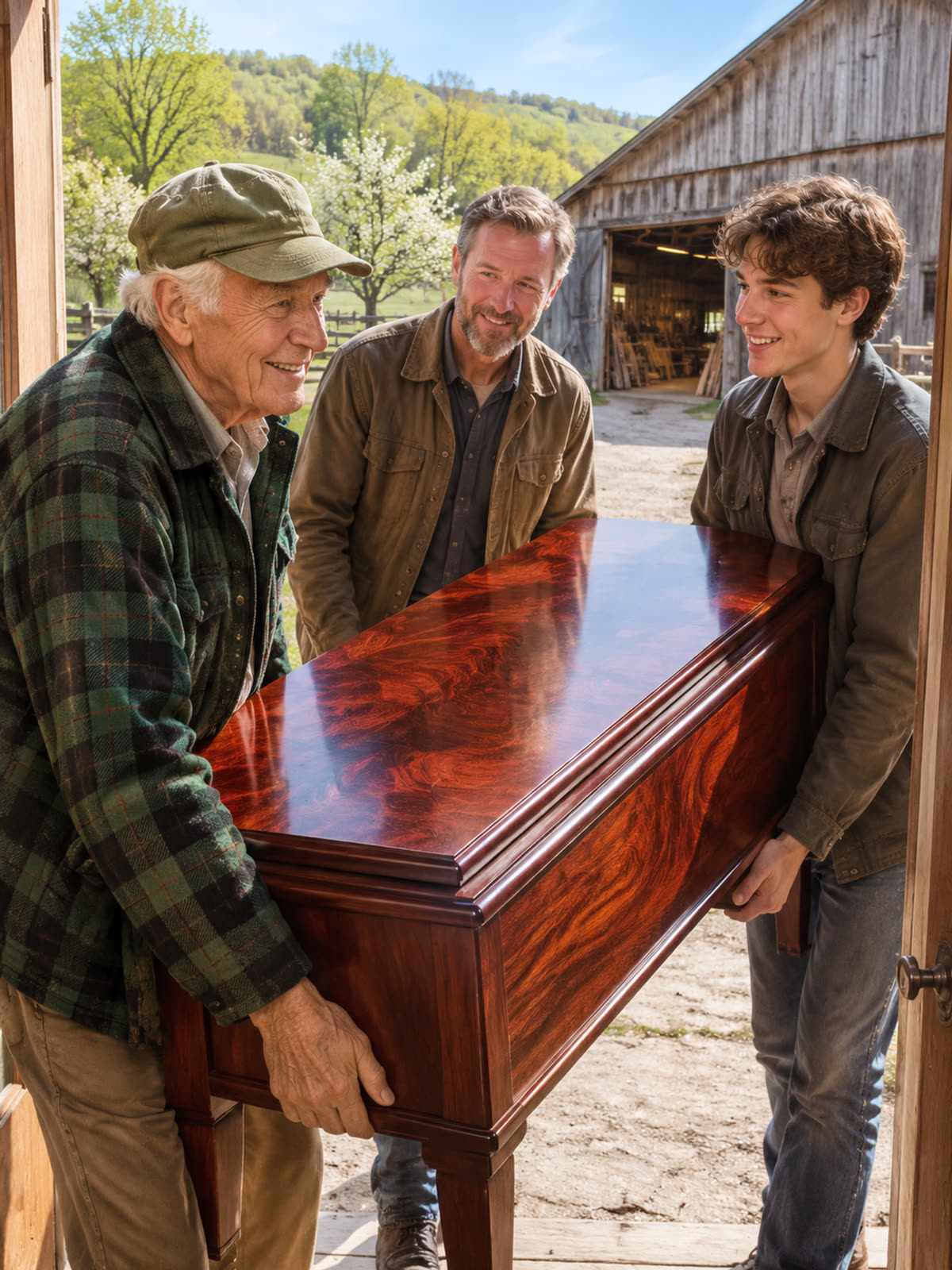
Barn tack är Gud. It was the opening line of the old Swedish hymn, “Children of the Heavenly Father.” Mom first sat on the bench on Easter Sunday. For a long while, she ran her hands across the red wood. Then she opened the Baldwin and began the hymn. Dad stood behind her in his good suit and rested his hand on her shoulder. Neither spoke. His father had planted a tree for his old age, and the wood now stood beneath the piano where his wife played the music his mother had once sung. The seven boards had stayed in the family, just as Levi had suggested. Outside, winter had given way to spring.
On May’s first warm Saturday, Dad asked Mason and me to get to the farm early. At seven that morning, he was waiting in the barn lot with his walking stick in one hand and a cardboard box in the other. Inside were twenty-two black cherry seedlings, each roughly a foot high, their roots bundled in wet newspaper. They had come from the state nursery in Spring Mills and cost two dollars apiece. “Twenty-two,” Dad said. “One for every log.” Together, the three of us started up the hillside behind the barn. We went slowly because his knees weren’t what they once had been. Mason carried the box, and I brought the planting bar.
The slope looked different without the mature cherries. Open ground lay between their gray, weathered stumps, with fresh green grass growing around them. Morning sunlight reached places the big trees had shaded. We worked our way across the hill all morning. Mason drove the planting bar into the ground and opened the holes. Dad lowered each seedling into place, then pressed the earth snugly around its roots with his boot. Afterward, I set a small wire cage around it to protect it from deer. One by one, the young trees took their places among the stumps of the old. We kept planting until only the last seedling remained in the box.
Dad carried that final one to the top himself. He went to the stone wall and the largest stump, the remains of his father’s tree. Its gray surface measured twenty-two inches across, with eighty rings visible in the wood—one for each year Dad had lived. Keeping one hand against the wall, he lowered himself slowly to his knees. Mason knelt beside him. Dad lifted the seedling from the box with both hands, its roots still wrapped in damp newspaper. Then he offered it to his grandson. “You plant this one,” he said. Mason looked at him. “My father planted the first one the spring I was born,” Dad said. “For my old age.”
He held Mason’s gaze. “I’m eighty years old, Mason. I’ll never see this tree get big. Neither will your father, probably. But you will.” He pressed the little cherry into the boy’s hands. “This one’s for your old age.” Mason did not answer. He accepted it, used the planting bar to open a hole beside his great-grandfather’s stump, and lowered the roots into the ground. As Dad had done, he firmed the earth with his boot. Then he removed his leather gloves and pressed the last loose soil into place with his bare hands. Dad set a hand on his shoulder.
“Somebody’s going to come along someday,” Dad said. “Sixty years, seventy, maybe eighty. They’re going to walk this hill and look at these trees and offer you money. Some of them will be honest. Some of them won’t.” He tightened his hand on Mason’s shoulder. “You remember what Levi said. Cherry doesn’t lie. You saw it open. You don’t take anybody’s word for what it is. You take it to a man who’ll saw it open in front of you.” “Yes, Grandpa,” Mason said quietly. When the planting was finished, we sat together on the stone wall for a long time. Three generations of Lindholm men rested in the May sunshine, looking over twenty-two seedlings in their wire cages across the ground where the old cherries had stood.
From the farmhouse below, piano music drifted through the open front window. Mom was sitting on the bench made from Nils Lindholm’s tree, playing his mother’s hymn. Dad began to hum. After a while, the humming became a very soft song in Swedish. Mason and I didn’t know the words, so we joined with our own humming. The sound traveled across the hillside, over the seedlings and the old stumps, down through the barn lot toward the road. A pickup was turning into the lane. It was Lyle. On his day off, he had driven up from Levi’s with something wrapped in a blanket on the seat beside him.
What he brought was cherry: a clear red board fourteen feet long. It was the last board he had graded himself at Levi’s mill that week, from the first log he had graded honestly since August. He stepped out of the pickup and stood at the foot of the hill with the board in his arms, looking toward the three of us on the stone wall. Dad noticed him. The soft singing stopped. Then he lifted a hand and waved. “Come on up, Lyle,” he called down. “We saved you a seat.”
Disclaimer: This story is a work of fiction inspired by real-life themes. Names, characters, places and events are fictionalized, and any resemblance to real persons is purely coincidental. Images are for illustration purposes only.
