

PART 1
I wasn’t supposed to be back home.
Officially, I was on medical leave.
Unofficially, I was a classified asset recovering from a shrapnel injury that wasn’t something you mentioned in the family group chat.
But I came home anyway.
Quietly.
I didn’t call ahead.
I didn’t warn anyone.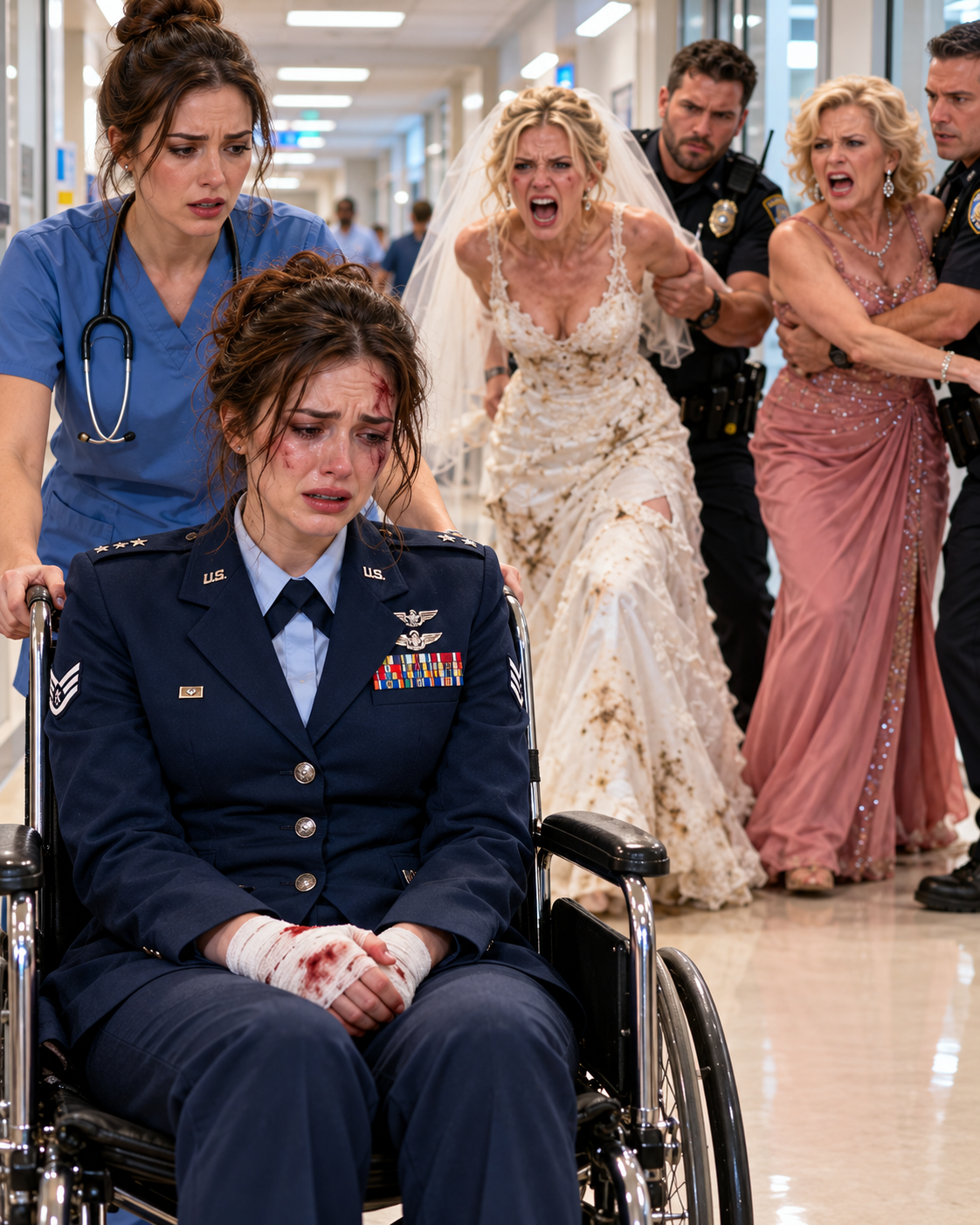
When I pulled into my parents’ driveway, there were two catering vans parked outside, a large white tent being erected on the front lawn, and someone arguing about white hydrangeas.
Of course.
Jessica’s wedding.
I stepped into the house with my duffel bag slung over one shoulder, the stitches beneath my jacket pulling painfully with every movement.
Nobody reacted as though I had been away for months.
My mother, Barbara, was busy giving instructions to the hired staff.
My father, William, had his phone pressed to his ear.
And Jessica stood in the center of the living room wearing a white silk robe, surrounded by bridesmaids and stacks of boxes.
She glanced in my direction.
“Oh.
You’re here.”
That was it.
My entire welcome home.
Then, as though my mere presence wasn’t already an inconvenience, she told me to carry several heavy boxes upstairs.
Shoes.
Crystal presents.
Wedding accessories.
“Don’t drop anything,” she warned.
The first box wasn’t a problem.
The second strained the injury beneath my jacket.
By the time I made the third trip, the pain had become unbearable.
It was so sharp that I had to stop at the foot of the staircase and press my hand against my side, where blood had begun seeping through.
Jessica noticed.
She sighed as though I were interrupting her photo shoot.
“Could you stop being so dramatic today?”
I managed to get halfway through another trip before my vision started going blurry.
When I finally came back downstairs, my legs buckled.
I collapsed onto the hardwood floor, right in the middle of the chaos surrounding her perfect wedding.
Struggling to breathe, I managed to say, “I think I need to go to the hospital.”
I still remember the expression on Jessica’s face.
She looked irritated.
Not frightened.
Not concerned.
Just annoyed, as though I’d dragged dirty shoes across a freshly cleaned carpet.
Things only got worse once we reached the emergency room.
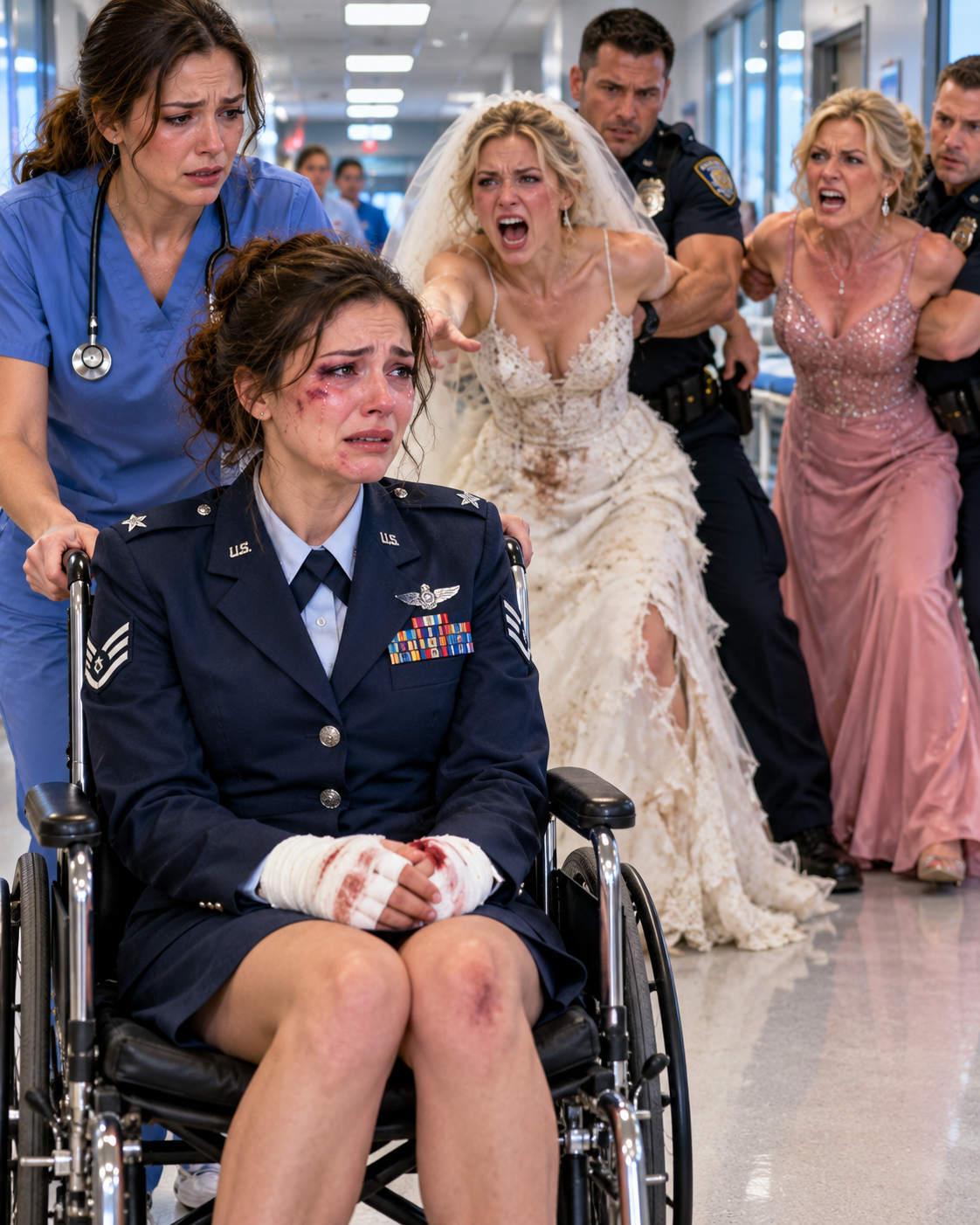
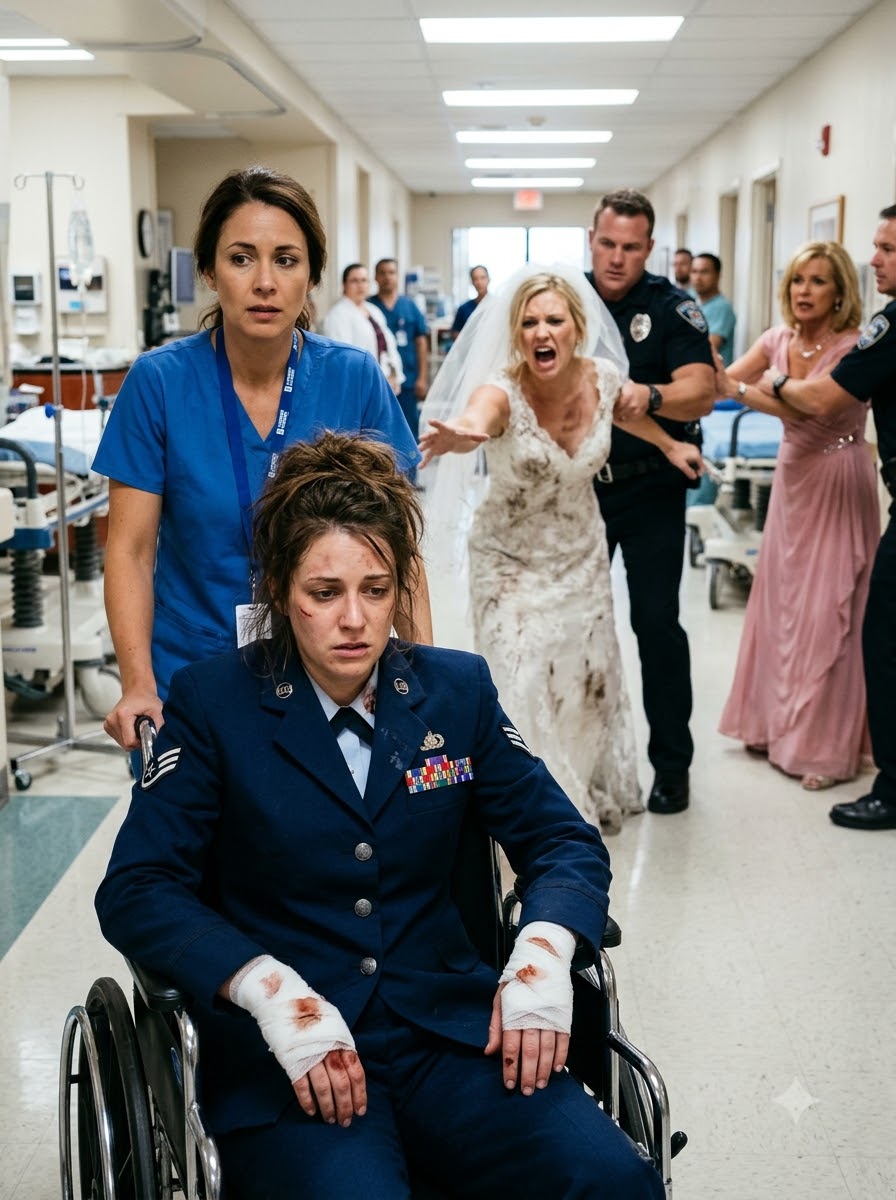
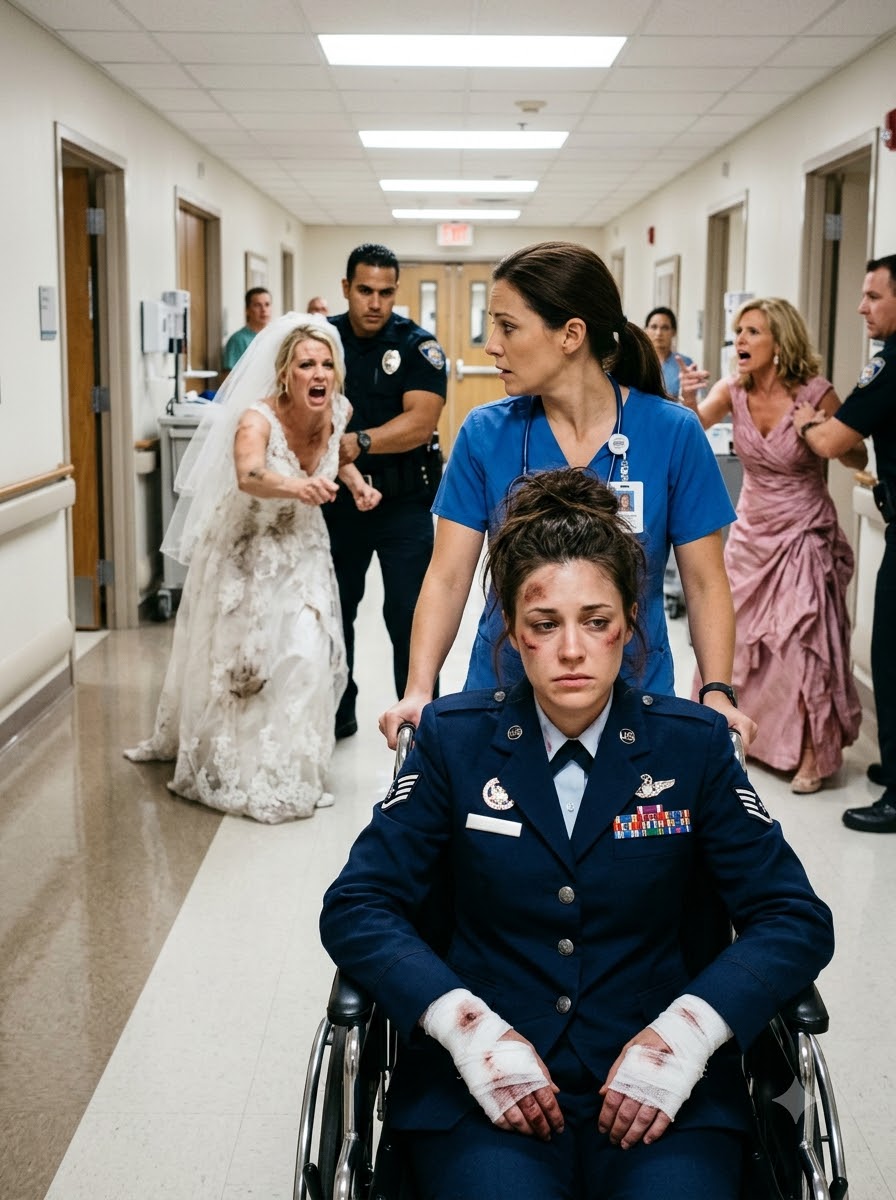
The triage nurse, Claire, took one look at my pale face and immediately brought over a wheelchair.
I told her my abdomen hurt.
Her entire demeanor changed as she shifted into trauma-response mode.
Then Jessica interrupted.
“She’s just being dramatic,” she announced.
“It’s probably an anxiety attack.”
For a brief moment, Claire seemed unsure.
Jessica seized that hesitation.
“Just let her wait,” she said.
“It’s not an emergency.”
And then my sister walked away.
My parents arrived sometime later.
Somehow, their presence made everything worse.
Claire explained that my vital signs were deteriorating rapidly.
She warned them that I might be suffering from internal bleeding.
Then she placed a consent form for an emergency CT scan in front of them.
My father folded his arms.
His first question was about the price.
My mother leaned closer and spoke in a lowered voice.
“We’re not approving thousands of dollars in pointless medical tests just because she wants to spoil her sister’s wedding.”
Claire argued with them.
I could hear the anger building in her voice.
But my father signed the refusal-of-care paperwork anyway.
He did it without hesitation.
As casually as though he were signing off on a dinner check.
Then my parents left.
They actually walked away and left me there to die.
The staff put me on IV fluids.
Claire repeatedly told me to keep my eyes open.
I wanted to respond, but my body was already slipping into hypovolemic shock.
The beeping from the monitor beside me grew slower.
My fingers turned cold.
Darkness began creeping inward from the edges of my vision.
And somewhere inside that growing silence, my military training took control.
It wasn’t emotion.
It wasn’t panic.
It was training.
I slipped my fingers beneath the lining of my tactical jacket and searched until I located the reinforced seam.
The concealed compartment.
The one thing nobody in that emergency room knew about.
The one thing my family had no idea I carried.
I opened it and felt around until my fingers closed over the device.
A subcutaneous emergency beacon.
Small.
Flat.
A single button.
No markings.
No second opportunity.
It was the kind of device you activated only when the people around you had already decided your life was expendable, and you needed to summon the full force of the agency.
Claire’s voice sounded distant now.
The gaps between the monitor’s beeps stretched longer.
I could barely feel my hand anymore.
But I pressed the button.
Hard enough to break the seal.
One second later, the line on the monitor went flat.
And then the hospital doors burst open…
The first thing I heard was someone shouting my name.
Not Jessica.
Not my mother.
Not my father.
Claire.
“She’s coding!
I need a crash cart in here!
Now!”
Then came the unmistakable sound of shoes striking the hospital floor, the metallic rattle of equipment, and a man’s voice giving rapid instructions.
“Start compressions.”
There was pressure against my chest.
Then nothing.
For a few seconds, the world vanished completely.
I had survived explosions, gunfire, and a battlefield evacuation that had left three men dead and a piece of shrapnel buried dangerously close to my abdominal artery.
But the closest I ever came to dying happened in a hospital less than twenty minutes from the house where I grew up.
And my family had walked away from it.
What I didn’t know at that moment was that the small device beneath my jacket had already transmitted its emergency signal.
Within seconds, the encrypted alert reached a secure operations center hundreds of miles away.
The signal carried three pieces of information.
My assigned identification number.
My location.
And a distress classification reserved for situations in which an operative’s life was in immediate danger.
It didn’t explain what had happened.
It didn’t identify my family.
It simply told the people responsible for my safety that I had activated a device I had been instructed to use only as a last resort.
And those people took that signal very seriously.
I later learned that a woman named Commander Evelyn Shaw was the first person to receive the notification.
Shaw had supervised my recovery after the operation that nearly killed me.
She was one of only a handful of people who knew the full circumstances of my injury.
When the alert appeared on her terminal, she immediately attempted to reach my secure phone.
No answer.
She called the medical liaison responsible for monitoring my leave.
The liaison confirmed that I had missed my scheduled afternoon check-in.
That was enough.
Shaw contacted the federal duty office assigned to our emergency support network and requested immediate verification of my condition.
Then she made one more call.
“Get me the hospital administrator,” she said.
“And tell them this concerns a critically injured federal military asset.”
By the time the hospital’s emergency department received that call, doctors were fighting to restart my heart.
A physician named Dr. Marcus Reed had taken over my case.
Unlike my family, he hadn’t wasted time deciding whether my symptoms were genuine.
He had seen my rapidly falling blood pressure, my distended abdomen, and the blood soaking through the layers beneath my jacket.
He recognized the signs of catastrophic internal bleeding.
“She’s hemorrhaging,” he told the team.
“We need blood products and an operating room.
Immediately.”
One of the nurses mentioned the paperwork my father had signed.
Dr. Reed looked at it for approximately two seconds.
Then he set it aside.
“She’s an adult patient,” he said.
“Her family doesn’t get to make this decision simply because she’s too sick to argue with them.”
It was the first time that evening someone had said aloud what should have been obvious.
My parents had no authority to deny lifesaving treatment on my behalf.
Not because they disliked the expense.
Not because my sister had a wedding.
And certainly not because they found my medical emergency inconvenient.
I had become too unstable to provide informed consent, and the doctors had the authority to act under emergency treatment protocols.
They began the transfusions.
A second physician prepared for surgery.
And while the staff worked to save me, an administrator began reviewing how a critically injured patient had nearly died after her relatives persuaded anyone to delay her care.
That review would eventually become as important as the medical records themselves.
I woke up in intensive care with a breathing tube in my throat.
At first, I couldn’t understand where I was.
Everything seemed distorted.
The ceiling lights were too bright.
My abdomen felt as though someone had carved a trench through it.
There were machines on both sides of my bed.
A woman wearing dark civilian clothing stood near the window.
When she noticed my eyes opening, she crossed the room.
“Don’t try to speak,” she said.
“You’re safe.”
I recognized her voice.
Commander Shaw.
I tried to raise my hand.
She gently stopped me.
“You’ve had emergency surgery.
The bleeding is controlled, but you lost a significant amount of blood.”
My first instinct was to ask whether the situation had compromised my assignment.
Even then.
Even after nearly dying.
Training had a way of making personal concerns feel secondary.
Shaw seemed to read the question in my eyes.
“Your secure equipment has been recovered.
Nothing operational was exposed.”
I relaxed slightly.
She pulled a chair closer.
“Your beacon worked.”
I closed my eyes.
For the first time since pressing that button, I understood that I had actually survived.
Shaw waited until I looked at her again.
Then her expression changed.
“There’s something else you need to know.”
I stared at her.
“Your family has been contacted.”
My pulse accelerated.
She noticed immediately.
“No,” she said firmly.
“They are not coming in here.
Not unless you want them to.”
I shook my head.
The motion was small.
But it was enough.
Shaw nodded.
“Understood.”
Then she said something that stayed with me longer than anything else.
“You are not required to protect people who abandoned you.”
The breathing tube came out the next morning.
By afternoon, I could speak in short sentences.
My throat felt raw, and every movement sent pain through my abdomen.
Claire came to see me after her shift.
She stood in the doorway, looking strangely uncertain.
“Can I come in?”
I nodded.
She approached the bed and studied the monitors before looking at my face.
“You gave us quite a scare.”
I managed a weak smile.
“Sorry.”
Her expression tightened.
“Don’t apologize.”
She pulled a chair beside the bed.
For several seconds, she said nothing.
Then she looked down at her hands.
“I should have pushed harder when your sister told me you were exaggerating.”
I watched her carefully.
She wasn’t trying to excuse herself.
She was telling me something that clearly troubled her.
“I saw how sick you were,” she continued.
“I knew something wasn’t right.
But your sister was so confident, and your parents kept insisting you had a history of making things dramatic.”
My stomach tightened.
They had said that?
Claire nodded when she saw my expression.
“Your mother told us you were trying to ruin the wedding because you were jealous.”
I stared at the ceiling.
For most of my life, I had believed that if I achieved enough, endured enough, or sacrificed enough, my parents would eventually see me differently.
I had joined the military.
Earned responsibilities they never fully understood.
Survived assignments I couldn’t discuss.
And returned home with an injury severe enough to require medical leave.
Yet one accusation from Jessica had been sufficient to erase everything.
Claire leaned forward.
“I need you to understand something.
Their refusal wasn’t legally controlling.
We should have escalated your treatment sooner.
The hospital is reviewing that.”
I looked at her.
“Did I really die?”
Her face softened.
“Your heart stopped.
The team brought you back.”
I swallowed.
“How long?”
“Long enough to frighten everyone in that room.”
She reached for my hand.
“You’re still here.”
And for reasons I couldn’t explain, those three words nearly made me cry.
My family found out I was alive at 8:17 the following morning.
I know the exact time because it appeared in the official incident summary Commander Shaw eventually showed me.
My mother had called the hospital demanding an update.
At first, she spoke as though she were checking on an inconvenient guest.
Then someone informed her that I had undergone emergency surgery.
According to the receptionist’s account, Barbara went silent.
A few seconds later, she asked whether I would be discharged before the wedding rehearsal dinner.
That was her first question.
Not whether I would survive.
Not whether I had suffered permanent damage.
Whether I would be available before Jessica’s rehearsal dinner.
When the hospital declined to release information without proper authorization, she became furious.
She demanded to speak to the administrator.
She claimed she was my mother.
She insisted she had already signed paperwork concerning my treatment.
And she threatened to have the hospital investigated if anyone continued to make the family look bad.
Unfortunately for Barbara, an investigation was already underway.
And this time, she wasn’t the person directing it.
The first federal investigator arrived that afternoon.
His name was Daniel Mercer.
He was a civilian special agent assigned to the agency’s internal security and protective operations division.
He wasn’t wearing sunglasses.
He didn’t carry a mysterious briefcase.
He looked like an ordinary man in a gray suit who had spent too many hours dealing with paperwork.
But he was very precise.
He introduced himself to the hospital administrator, presented his credentials, and explained that his office was examining the circumstances surrounding the activation of my emergency beacon.
The purpose wasn’t to punish everyone who had been near me.
It was to determine whether the incident involved a threat to personnel, a compromise of protected equipment, or deliberate interference with an emergency response.
That distinction mattered.
My family hadn’t committed some magical federal offense simply by treating me terribly.
But their actions were now part of an official inquiry concerning a critically injured service member whose protected emergency system had been activated.
And investigators were going to document exactly what had happened.
Mercer began with the hospital.
He obtained statements from Claire, Dr. Reed, and the other medical personnel involved in my care.
He reviewed the treatment timeline.
He examined the refusal form my father had signed.
Then he requested preservation of the security footage covering the emergency department.
That footage showed something no one in my family would later be able to explain away.
Jessica speaking to the triage nurse.
My father arguing over the price of the scan.
My mother standing beside him.
And all three of them leaving while I remained in a wheelchair, pale, bleeding, and barely conscious.
When Mercer finally interviewed me, he placed a recording device on the table and asked whether I felt well enough to continue.
I said yes.
He opened his notebook.
“Tell me what happened before you came to the hospital.”
So I did.
I told him about the boxes.
The stitches.
The pain.
Jessica’s irritation.
My collapse.
PART 2
And the way my parents had treated my medical emergency as a financial inconvenience.
He didn’t interrupt.
When I finished, he looked at me for a long moment.
“Did you tell your family about your injury before carrying those boxes?”
“No.”
“Why not?”
I hesitated.
Because I didn’t want to be difficult.
Because I was tired of being accused of seeking attention.
Because I had spent years learning to endure pain without complaining.
Finally, I answered.
“I didn’t think they’d care.”
Mercer stopped writing.
For the first time during the interview, his professional expression slipped.
Just slightly.
Then he said, “They should have.”
Jessica’s rehearsal dinner was scheduled for Friday evening.
By Thursday afternoon, my parents knew that federal investigators were involved.
They didn’t learn that through me.
A hospital employee had advised my father that the incident was being reviewed by multiple authorities and that any further inquiries should go through the appropriate offices.
Within minutes, he began calling.
First, my phone.
Then the hospital.
Then several military contacts whose names he had collected over the years.
He apparently believed someone could make the problem disappear if he reached the right person.
Instead, he was directed back to the investigators.
My phone remained switched off.
I was recovering from a major abdominal operation, and my medical team had made it clear that stress could interfere with my recovery.
But Barbara wasn’t accustomed to being unable to reach me.
She sent messages.
At first, they sounded concerned.
Sweetheart, we heard you had surgery.
Please call.
Then they became defensive.
We didn’t know it was serious.
Then angry.
You need to tell these people that we did nothing wrong.
Finally, the message that explained everything.
Jessica is devastated.
You’re destroying the most important weekend of her life.
I read it twice.
Then handed my phone to Commander Shaw.
She looked at the screen.
“Would you like me to have these preserved with the incident records?”
“Yes.”
She nodded.
“And would you like us to stop passing along nonmedical messages?”
I looked toward the window.
For years, I had answered every demand because refusing felt like betraying my family.
Now I was lying in a hospital bed, held together by surgical staples, with someone finally asking what I wanted.
“Yes,” I said.
“Please.”
The next day brought the first real change.
The hospital’s internal review concluded that my care had been delayed in part because staff had given improper weight to my relatives’ statements.
A hospital representative came to my room with a patient advocate.
She didn’t try to minimize what had happened.
She apologized.
She explained that additional training, disciplinary review, and corrective measures were being implemented.
The hospital also confirmed that it would address the billing and administrative consequences of the delayed care.
I listened carefully.
Then I asked one question.
“What happens to Claire?”
The administrator looked surprised.
“Why do you ask?”
“Because she was the only person who kept telling me not to close my eyes.”
The woman glanced toward the advocate.
“Claire’s actions are part of the review, but she also repeatedly escalated concerns about your condition.”
I nodded.
“Then please make sure the record reflects that.”
The administrator promised it would.
I didn’t want someone else punished merely because my family had been cruel.
I wanted accountability.
There was a difference.
Friday evening, Jessica arrived at the hospital.
She wasn’t alone.
Barbara accompanied her, wearing a cream-colored designer dress and carrying a handbag that probably cost more than my first car.
Jessica was still dressed for the rehearsal dinner.
Her makeup was flawless.
Her hair had been professionally styled.
According to the security officer stationed outside my room, she walked straight to the intensive care unit and demanded to see me.
“My sister is in there,” she announced.
“You can’t keep me away from her.”
The officer calmly explained that my visitors were restricted.
Jessica raised her voice.
“Do you know how humiliating this has been for my family?”
He didn’t respond.
Barbara stepped forward.
“I am her mother.”
“I understand, ma’am.”
“Then open the door.”
“She’s requested privacy.”
Jessica laughed sharply.
“She doesn’t know what she wants.
She’s always been dramatic.”
The officer remained still.
“Then I suggest you respect her request until she’s ready to speak with you.”
For a moment, neither woman moved.
They had spent their lives assuming that enough pressure would make someone surrender.
But hospital security didn’t care about Barbara’s social connections.
And the officer wasn’t interested in Jessica’s wedding.
Eventually, they were escorted back toward the elevator.
Not one of them asked whether I was in pain.
The wedding took place on Saturday.
At least, the ceremony did.
I learned the details several days later from a cousin named Rebecca, who had never been particularly close to my parents.
She called after hearing I was recovering and asked whether she could visit.
I agreed.
Rebecca arrived carrying flowers and an awkward expression.
“I don’t know how much you’ve heard,” she said.
“Very little.”
She sat down.
“Things got ugly.”
Apparently, Jessica had spent the entire rehearsal dinner telling guests that I was deliberately trying to sabotage her wedding.
She claimed I had staged a medical emergency.
She claimed the hospital had overreacted.
She even suggested that my military contacts had been used to intimidate our parents.
But by Saturday morning, the story had begun falling apart.
Several guests had heard that I was in intensive care.
One of Jessica’s bridesmaids had a brother who worked in emergency medicine.
He quietly pointed out that emergency abdominal surgery, blood transfusions, and a cardiac arrest weren’t things a person could fake to avoid carrying wedding decorations.
People started asking questions.
And Jessica didn’t have answers that made sense.
Then my father made the situation worse.
During the reception, William apparently stood beside the bar and told several business associates that the federal inquiry was “a misunderstanding” caused by his daughter’s connections.
He insisted he would have everything cleared up by Monday.
One guest asked whether I was going to recover.
My father replied, “She’s always been tougher than she looks.”
Rebecca looked at me as she repeated those words.
“I think that’s when people realized how bad it was.”
I stared at my hands.
“Did Jessica get married?”
“Yes.”
“Good.”
Rebecca blinked.
“You’re not angry?”
“I didn’t want to ruin her wedding.”
I looked at her.
“I wanted to stay alive.”
For a few moments, Rebecca said nothing.
Then she reached across the bed and squeezed my hand.
“I’m glad you did.”
The wedding itself wasn’t canceled.
But the version Jessica had imagined—the perfect photographs, the admiring guests, the celebration where everyone praised her flawless family—didn’t survive.
Several relatives left early.
Others confronted my parents.
Her new husband, Andrew, reportedly learned the full severity of my condition only after the ceremony.
Jessica had told him I was being treated for exhaustion.
When he discovered that I had required emergency surgery after collapsing in her parents’ house, he was furious.
Rebecca had overheard part of their argument.
“You told me she was pretending,” Andrew said.
“She always does this,” Jessica replied.
“People don’t pretend to have their hearts stop.”
Jessica accused him of taking my side.
He told her there shouldn’t be sides when someone’s life was at stake.
It was the first time, according to Rebecca, anyone had challenged Jessica during her own celebration.
And she didn’t handle it well.
There were tears.
There was shouting.
At one point, Jessica disappeared into the bridal suite for nearly an hour.
But none of that interested me as much as Rebecca seemed to expect.
I had spent so much of my life reacting to Jessica’s emotions that even the news of her ruined reception felt strangely exhausting.
I didn’t celebrate.
I didn’t feel victorious.
I just felt tired.
Three days later, Commander Shaw brought me a folder.
“Before you read this,” she said, “I want you to understand what it does and doesn’t mean.”
Inside were preliminary findings from the federal security review.
The agency had confirmed that my emergency beacon had functioned correctly.
My protected equipment had remained secure.
There was no evidence that my family had known about the device or deliberately attempted to compromise an operation.
That portion of the inquiry was closing.
But the circumstances surrounding my near-fatal medical emergency had been formally documented.
My statements and the relevant records were being preserved and referred to the appropriate civilian authorities for evaluation.
Shaw explained that any determination of criminal responsibility would have to be made under applicable law, based on evidence—not simply because my family had behaved cruelly.
I appreciated that.
I didn’t want the government to invent crimes to punish people who had hurt me.
I wanted the truth to exist somewhere beyond my family’s ability to rewrite it.
Then Shaw showed me a second document.
It was a report from the military medical team responsible for my original shrapnel injury.
The surgeons had concluded that carrying heavy objects during my recovery likely contributed to the failure of the healing tissue around the wound.
The injury hadn’t been a minor strain.
It had caused renewed internal hemorrhaging near the site of the original damage.
Without surgery, I almost certainly would have died.
I stared at the words.
Almost certainly would have died.
They looked clinical.
Impersonal.
But they described the distance between me and an empty hospital bed.
Shaw closed the folder.
“You have options,” she said.
“You can cooperate with the civilian investigation.
You can consult your own attorney.
You can pursue whatever remedies are available.
None of those decisions need to be made today.”
I looked at her.
“And my family?”
She waited.
“Do they know how close I came?”
“Yes.”
“What did they say?”
Shaw hesitated.
Then she answered.
“Your father asked whether the findings could be kept private.”
I laughed.
It came out as a sharp, painful sound that made me grab my abdomen.
Of course he had.
Even with a medical report documenting how close I had come to dying, William’s first concern was whether people would find out.
Shaw didn’t smile.
“There’s something else.”
I looked up.
“Your mother asked whether you could provide a statement saying the family had acted in good faith.”
I closed my eyes.
There it was.
The request I’d been expecting.
Not an apology.
Not concern.
A favor.
They wanted me to protect them.
Again.
My father came to the hospital the following afternoon.
This time, he requested a meeting through the patient advocate instead of trying to force his way inside.
I almost refused.
But there were things I needed to say.
So I agreed to fifteen minutes.
Commander Shaw remained nearby, and a hospital representative was present at my request.
William entered wearing a dark suit and an expression I had rarely seen.
Uncertainty.
He stopped when he saw me.
I was sitting upright in bed, with an IV line in my arm and a large bandage covering my abdomen.
My face was pale.
I had lost weight.
The bruising from the surgery had begun spreading along my side.
For several seconds, he simply stared.
“God,” he whispered.
I said nothing.
He approached the chair.
“Can I sit?”
I nodded.
He sat slowly, placing both hands on his knees.
“I didn’t know it was that bad.”
I watched him.
“Claire told you I might be bleeding internally.”
He looked down.
“We thought she was being overly cautious.”
“She told you my blood pressure was dropping.”
“Your mother said—”
I raised one hand.
“Don’t.”
He stopped.
“Don’t blame Mom.
Don’t blame Jessica.
You were there.”
His jaw tightened.
“I was trying to make a reasonable decision.”
“About my life?”
He swallowed.
“About a medical test.”
I stared at him.
“Dad, I was bleeding to death.”
He looked away.
I waited until he faced me again.
“You were worried about the cost of finding out whether your daughter was dying.”
His mouth opened.
Then closed.
For once, there was no quick answer.
I continued.
“I came home because I wanted to see you.
I had survived something terrible, and I wanted to spend time with my family.”
His expression changed.
“I know.”
“No,” I said quietly.
“You didn’t.
You didn’t even ask why I was home.”
He pressed his lips together.
“I thought you were taking a break.”
“I was recovering from a combat injury.”
He looked toward the bandage.
“I didn’t realize—”
“You didn’t ask.”
The room fell silent.
Finally, he leaned forward.
“We made mistakes.”
I felt something harden inside me.
“Mistakes?”
He nodded quickly.
“Yes.
Terrible mistakes.
And we want to make this right.”
I studied his face.
“What does that mean?”
He hesitated.
Then reached inside his jacket.
My entire body went cold.
But he only pulled out a folded sheet of paper.
He placed it on the bed.
“Our attorney drafted something.
It’s just a statement explaining that there was confusion about your medical condition.
It would help everyone move forward.”
I didn’t touch it.
“Everyone?”
He nodded.
“The family.
Jessica.
Your mother.
The hospital situation has gotten out of control.”
I looked at the paper.
Then at him.
“You came here to ask me to sign something.”
He frowned.
“I’m trying to protect our family.”
I felt tears burning behind my eyes.
For one foolish second, when he’d first walked through the door, I had hoped he was there because he loved me.
Because seeing me in that bed had frightened him.
Because he had finally understood.
Instead, he had brought paperwork.
I pushed the document back toward him.
“No.”
“Please be reasonable.”
“No.”
His expression tightened.
“You don’t understand what this could do to us.”
I looked directly into his eyes.
“You don’t understand what you did to me.”
He leaned back.
PART 3
And suddenly, I saw the man who had raised me.
The same man who had always mistaken obedience for respect.
The same man who believed that family loyalty meant protecting him from consequences.
“You’re willing to destroy your family over this?” he asked.
I felt something settle inside me.
Not anger.
Not hatred.
Certainty.
“Dad,” I said, “I didn’t destroy anything.”
I touched the edge of my hospital blanket.
“I was the one lying here with no heartbeat.”
He didn’t speak.
“And when I needed you, you walked away.”
The hospital representative quietly stood.
“I think we should end this visit.”
William looked toward her, then back at me.
For a moment, I thought he might apologize.
A real apology.
Without excuses.
Without paperwork.
Without asking for anything.
Instead, he picked up the statement.
And left.
My mother called two days later.
I let it go to voicemail.
She left a message that lasted almost four minutes.
At first, she cried.
Then she complained about the embarrassment our family had suffered.
Then she said Jessica’s marriage was already under strain.
Apparently Andrew had insisted that they attend counseling after their honeymoon was canceled.
Barbara blamed me.
She said I’d always been distant.
That I’d never understood how much pressure Jessica was under.
That I was using my military position to punish people who loved me.
Near the end of the message, her voice became hard.
“You’ve always needed to be the center of attention.
I just never thought you’d take it this far.”
I saved the recording.
Then turned off my phone.
For the first time in my adult life, I didn’t feel obligated to answer.
Recovery was slower than I expected.
The surgeons had repaired the bleeding and stabilized the damaged tissue, but my body had taken a tremendous beating.
I spent another week in the hospital.
Then I was transferred to a military medical facility for rehabilitation and continued monitoring.
There were days when walking the length of a hallway felt harder than carrying a full combat load.
There were nights when I woke up convinced I could hear the monitor slowing beside me.
Sometimes, I dreamed that I was back on the hardwood floor in my parents’ house.
I would be trying to breathe.
Jessica would be standing above me.
And no matter how hard I tried, I couldn’t make anyone listen.
Those dreams stayed with me for months.
I started seeing a counselor.
At first, I hated admitting how deeply the experience had affected me.
I’d been trained to remain functional under pressure.
To compartmentalize.
To keep moving.
But there was no battlefield skill that could make betrayal by your own family disappear.
One afternoon, my counselor asked me what I had felt when I pressed the emergency beacon.
I thought about it for a long time.
“Fear,” I said.
She nodded.
“Of dying?”
I shook my head.
“Of being forgotten.”
The words surprised me.
But once they were spoken, I knew they were true.
I’d spent years being the daughter who didn’t need anything.
The daughter who could handle herself.
The daughter who was expected to show up, help out, and disappear when she was no longer useful.
And when I had finally needed something as basic as medical care, my family had acted as though my survival was negotiable.
My counselor let me sit with that realization.
Then she asked, “What would you tell someone under your command if they were treated the same way?”
I didn’t hesitate.
“I’d tell them to get somewhere safe.”
She nodded.
“And then?”
“To stop trusting the people who put them in danger.”
She waited.
I looked down.
For the first time, I understood what she was asking.
The legal consequences unfolded over the following months.
Not as quickly as my family feared.
And not as dramatically as Jessica later claimed.
There were no federal agents storming the wedding reception.
No miraculous court hearing where a judge instantly declared my parents guilty.
The process was slower.
More methodical.
And, in some ways, far more devastating.
The hospital completed its internal review and implemented changes to its emergency escalation and consent procedures.
I received a formal written acknowledgment that my family’s objections should never have delayed the urgent assessment of my condition.
The civilian authorities reviewed the available evidence, including my statements, the security footage, the medical findings, and the hospital records.
They also considered whether anyone had knowingly provided false information that interfered with my treatment.
The inquiry didn’t produce the sensational criminal charges my family had convinced themselves were coming.
But it produced something they couldn’t escape.
A documented account of what had happened.
One that didn’t depend on their explanations.
My attorney also advised me about possible civil claims arising from the incident.
After reviewing the evidence, I authorized her to pursue the matter.
The resulting legal process forced my family to respond formally to the events they had spent months trying to minimize.
My father could no longer dismiss the refusal paperwork as a harmless misunderstanding.
My mother couldn’t erase her statements about Jessica’s wedding.
And Jessica couldn’t pretend she had never told the nurse to let me wait.
They had to answer questions.
Provide records.
And confront the difference between what they said had happened and what the evidence showed.
Eventually, through their attorneys, my family agreed to a settlement.
The financial terms remained confidential.
But the agreement did not require me to withdraw my truthful account or deny what had happened.
That mattered more to me than the money.
Because I hadn’t pursued the case to become wealthy.
I had pursued it because I refused to let them turn my near-death experience into another story about how difficult I was.
Jessica sent me a letter six months after the wedding.
It arrived at the rehabilitation center in a plain white envelope.
I recognized her handwriting immediately.
For several minutes, I left it unopened.
Then I sat by the window and unfolded the pages.
Her first paragraph was about Andrew.
Their marriage had survived, but not without difficulty.
He had been horrified by the way she’d treated me.
They were still attending counseling.
Jessica wrote that he’d asked her a question she couldn’t stop thinking about.
If your sister had died that night, what would you have told yourself?
She admitted that her first instinct had been to blame me.
Even in death, apparently, I would have been guilty of ruining her celebration.
That sentence hurt more than I expected.
But as I kept reading, her tone changed.
She wrote about growing up as the daughter everyone celebrated.
How my parents had excused her behavior.
How she’d learned to interpret every inconvenience as an insult.
And how she’d mistaken my silence for weakness.
Then came the part that made me stop.
When you fell on the floor, I knew something was wrong.
I read it again.
I saw the blood.
I saw how pale you were.
But I was angry because everyone was looking at you instead of me.
I told myself you were exaggerating because that made it easier to walk away.
My hands began trembling.
For months, I’d wondered whether Jessica genuinely believed I was pretending.
Now I knew.
She had suspected I was seriously hurt.
And she’d chosen not to care.
The final page contained an apology.
Not a request for forgiveness.
Not a demand that we reconcile.
Just an acknowledgment of what she’d done.
I don’t expect you to answer.
I don’t expect you to trust me.
I just wanted you to hear the truth from me for once.
I folded the letter.
And cried.
Not because everything was repaired.
Because some part of me had spent my entire life waiting for someone in that family to tell the truth.
I didn’t answer immediately.
Three weeks passed.
Then I wrote Jessica a short letter.
I told her I’d read what she sent.
I appreciated her willingness to admit what had happened.
But I wasn’t ready to rebuild our relationship.
And I couldn’t promise that I ever would be.
I told her forgiveness wasn’t something she could schedule around another major event.
It wasn’t a wedding appointment.
It wasn’t a social obligation.
It would have to be earned through time and behavior, and even then, reconciliation would remain my choice.
I mailed the letter.
Then I went back to physical therapy.
My father’s response was different.
He never wrote an apology without conditions.
He sent occasional messages through relatives.
He asked whether I would consider dropping the legal matter.
He worried that people in his business community were treating him differently.
He complained that Barbara wasn’t sleeping.
He said the family had suffered enough.
But he never asked what I needed to feel safe.
Eventually, the messages stopped.
My mother continued trying to contact me for several months.
Then she began telling relatives that I’d been manipulated by the military.
That my career had changed me.
That I’d chosen strangers over my own blood.
Rebecca called one afternoon to warn me.
I listened without interrupting.
When she finished, I said, “She can tell people whatever she wants.”
“Doesn’t it bother you?”
“Of course it does.”
I looked across the rehabilitation garden, where several wounded service members were walking with their therapists.
“But I can’t spend the rest of my life defending myself against people who already know the truth.”
Rebecca was quiet for a moment.
Then she said, “I think you’re going to be okay.”
For the first time, I believed that might be possible.
Almost a year after the incident, I returned to limited duty.
My assignment had changed.
The injury had left permanent restrictions, and my medical team made it clear that returning to certain operational environments would be unsafe.
At first, I struggled with that.
I’d built my identity around being useful in difficult situations.
I knew how to function in places where ordinary rules didn’t apply.
I knew how to make decisions under pressure.
What I didn’t know was how to build a life that wasn’t defined entirely by surviving things.
Commander Shaw helped.
She recommended me for a training and operational planning role, one that allowed me to pass along years of experience without placing my body under the same physical demands.
I accepted.
On my first day, I stood in front of a room filled with young service members preparing for assignments that would test them in ways they couldn’t yet imagine.
They expected a lecture about operational security.
Instead, I began with something else.
“There’s a difference between being strong and believing you have to endure everything alone.”
The room became quiet.
I didn’t tell them about Jessica.
Or my parents.
Or the hospital.
Those details belonged to me.
But I spoke about recognizing danger.
About asking for help early.
About refusing to let pride or fear stop them from protecting themselves.
And about the responsibility every member of a team had to take another person’s suffering seriously.
At the end, a young woman approached me.
She looked nervous.
“Ma’am, can I ask something?”
“Of course.”
“How do you know when you can trust someone?”
I thought about the people who had stood beside my hospital bed.
Claire.
Dr. Reed.
Commander Shaw.
The surgeons.
The rehabilitation staff.
People who had no personal obligation to love me, but who had cared enough to act.
Then I answered.
“Watch what people do when helping you costs them something.”
She considered that.
I continued.
“It’s easy to stand beside someone when they’re successful.
The important question is whether they’ll still be there when you’re frightened, injured, or inconvenient.”
She nodded slowly.
“Thank you, ma’am.”
After she left, I stood alone in the empty classroom.
And realized I’d finally stopped hoping that my parents would become the people I needed.
On the anniversary of the emergency, I received a small package.
There was no return address I recognized.
Inside was a framed photograph.
It showed a group of hospital staff standing outside the emergency department.
Claire was in the center.
Dr. Reed stood beside her.
Several nurses and technicians smiled at the camera.
Tucked behind the frame was a handwritten note.
One year ago, we almost lost you.
We’re grateful we didn’t.
Keep living.
There were signatures beneath it.
I sat at my kitchen table and stared at the photograph for a long time.
Then I got up and placed it on the shelf above my desk.
Beside it was another photograph.
One taken several months earlier, at a small gathering with my new colleagues.
Commander Shaw was laughing.
Rebecca had come to visit.
Claire had driven nearly two hours to join us for dinner.
There were no designer gowns.
No crystal decorations.
No photographers arranging everyone into perfect positions.
Just people sharing food, telling stories, and laughing until their faces hurt.
I looked at the two photographs.
For years, my mother had told me that family was everything.
She had used those words whenever she needed something.
Whenever she wanted me to sacrifice another weekend, another holiday, another part of my life for Jessica’s benefit.
And I had believed her.
But lying in that hospital bed had taught me something I would never forget.
Family wasn’t automatically defined by the people who shared your last name.
Sometimes it was defined by the people who refused to leave when staying became difficult.
A few weeks later, Jessica called.
I almost let it ring.
But something made me answer.
“Hello?”
For a moment, there was silence.
Then her voice came through.
“Hi.”
She sounded nervous.
I waited.
“I didn’t know if you’d pick up.”
“Neither did I.”
She gave a small, uncomfortable laugh.
Then she became serious.
“I wanted to tell you something.”
I sat down.
“Okay.”
“I’ve been volunteering at a community health clinic.”
I frowned slightly.
“Why?”
“Because I needed to do something that wasn’t about me.”
I didn’t answer.
She continued.
“I know it doesn’t change what happened.
And I’m not calling because I want credit for it.”
I listened.
“I just wanted you to know that I’ve been trying.”
There was a long pause.
Then she said, “How are you feeling?”
It was such an ordinary question.
The kind of question sisters asked each other every day.
But Jessica had never asked it when it mattered most.
I looked at the photograph on my shelf.
“Better,” I said.
“I’m glad.”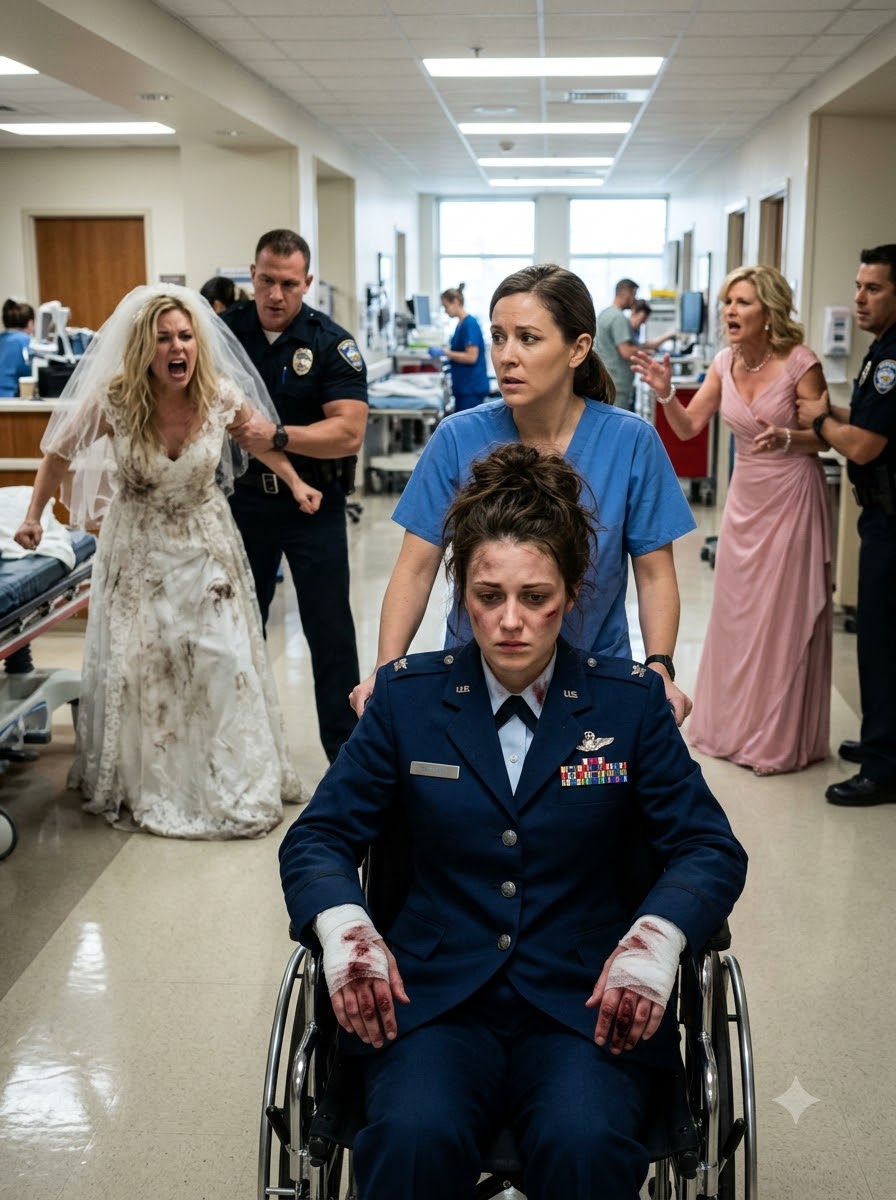
Another silence followed.
Then she added, quietly, “I really am.”
I believed she meant it.
That didn’t erase the past.
It didn’t mean I was ready to invite her back into my life.
But for the first time, our conversation wasn’t about a favor she needed or an event she wanted me to attend.
It was about me.
We spoke for another few minutes.
Then I told her I needed to go.
“Okay,” she said.
“Thank you for answering.”
After I hung up, I sat quietly for a while.
I didn’t feel the sudden warmth of a perfect reconciliation.
I didn’t feel obligated to forgive everything.
But I did feel something I hadn’t expected.
The possibility that Jessica might one day become someone I could know without being hurt.
For now, that was enough.
One evening, after finishing work, I took a walk along the river near my apartment.
The sun was sinking behind the buildings, turning the water a deep shade of gold.
My abdomen still ached occasionally when I walked too far.
There were scars that would never disappear.
Some days, I still woke from nightmares.
And there were moments when a particular sound or smell brought me straight back to that emergency room.
Healing hadn’t erased what happened.
It had taught me how to live with it.
I stopped near a bench and watched the river move beneath the bridge.
A year earlier, I had returned home hoping to find comfort in the people who had raised me.
Instead, I’d discovered how little my survival mattered to them when it interfered with the life they’d built around Jessica.
I had carried boxes until my stitches failed.
I’d collapsed on their floor.
I’d been told to stop being dramatic.
And when doctors warned that I might die, my parents had chosen to leave.
For a long time, that knowledge had felt like proof that I was somehow less deserving of love.
But I understood something different now.
Their failure to care for me wasn’t a measure of my worth.
It was a measure of their choices.
I didn’t have to spend the rest of my life trying to earn the compassion they should have shown freely.
I took out my phone.
There was a message from Commander Shaw asking whether I wanted to join a few colleagues for dinner.
Another from Rebecca, reminding me about our plans that weekend.
And one from Claire.
Just checking in.
Hope you’re doing well.
I smiled.
Then I typed three replies.
Yes.
Looking forward to it.
Doing better than ever.
I slipped the phone into my pocket and started walking again.
For years, I had carried an emergency beacon because my work sometimes took me into places where no one could guarantee my safety.
I’d been trained that activating it meant everything had gone wrong.
That it was the last option.
The final call for help when survival depended on someone answering.
But I never imagined the most important time I would use it would be in a hospital, surrounded by people, after my own family decided I wasn’t worth saving.
That signal had brought help.
It had exposed the truth.
And it had forced me to confront a painful reality I’d spent my whole life avoiding.
I wasn’t weak because I needed someone.
I wasn’t selfish because I wanted to live.
And I wasn’t betraying my family by refusing to let them hurt me again.
I had spent so many years trying to prove that I deserved a place in their lives.
Now, finally, I understood that I had a life of my own.
One worth protecting.
One worth rebuilding.
And one I intended to live fully.
The last time my heart stopped, I had pressed a button and hoped someone would come.
They did.
But the person who ultimately had to choose what happened next was me.
And this time, I chose myself.
THE END.
