

PART 1
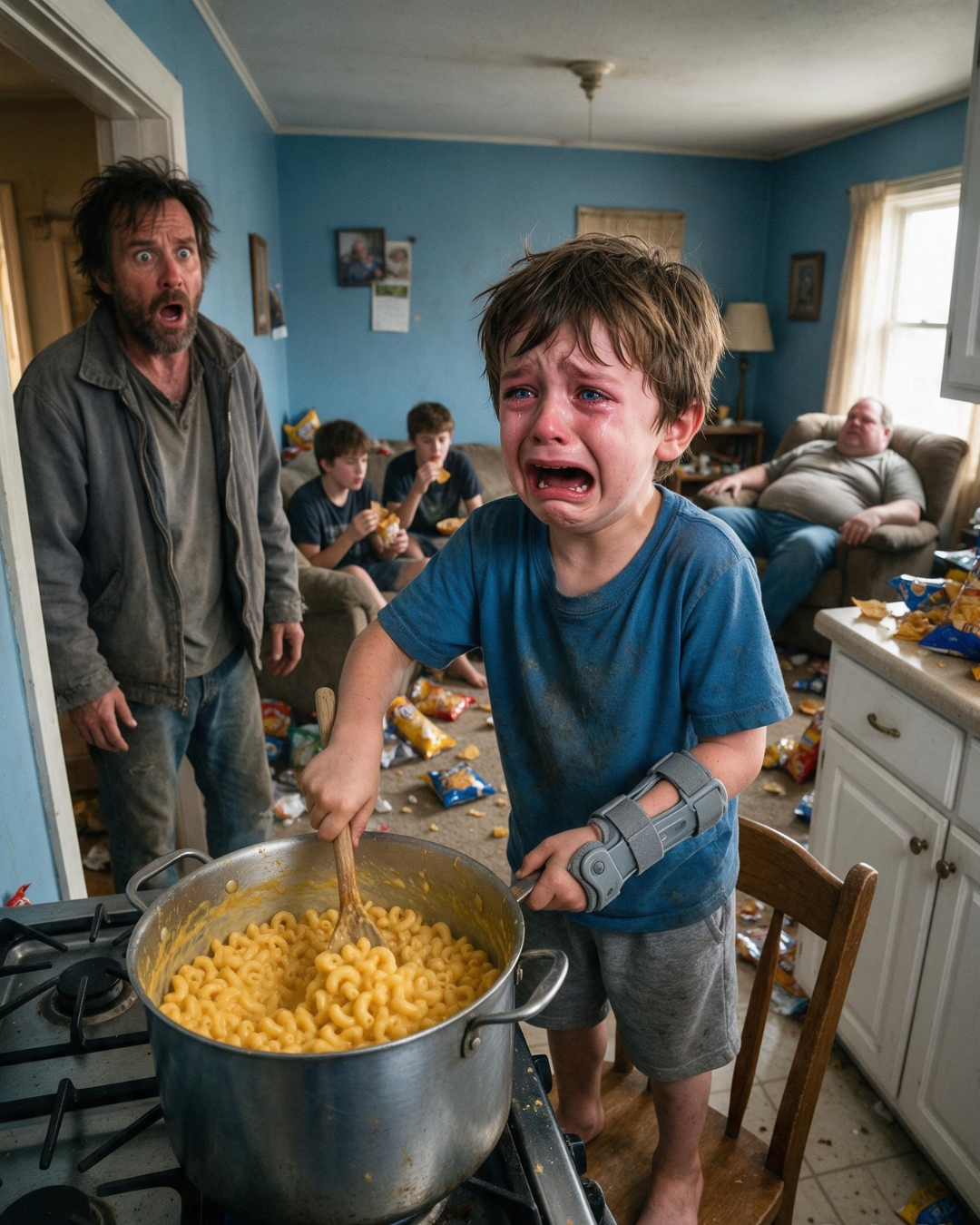
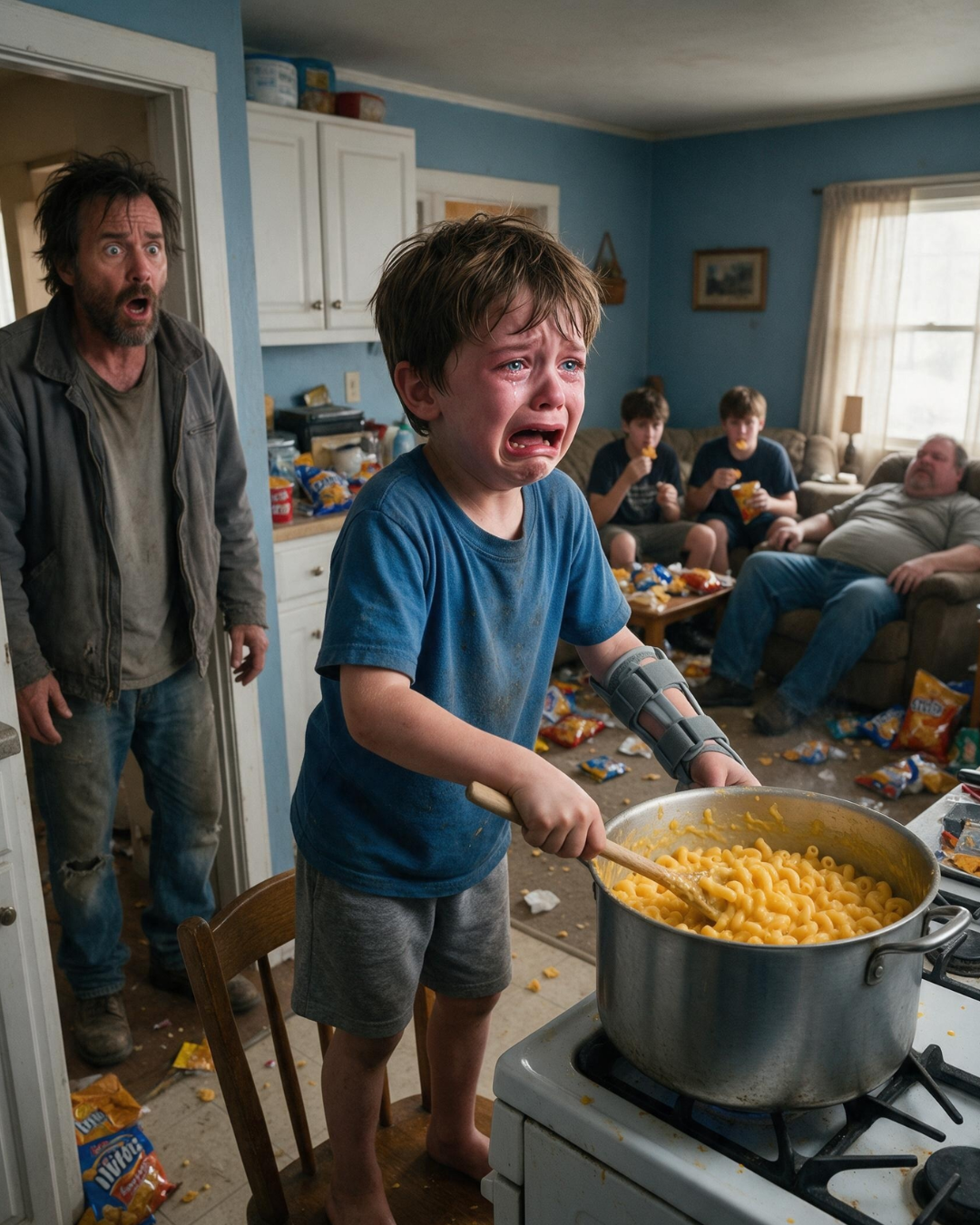
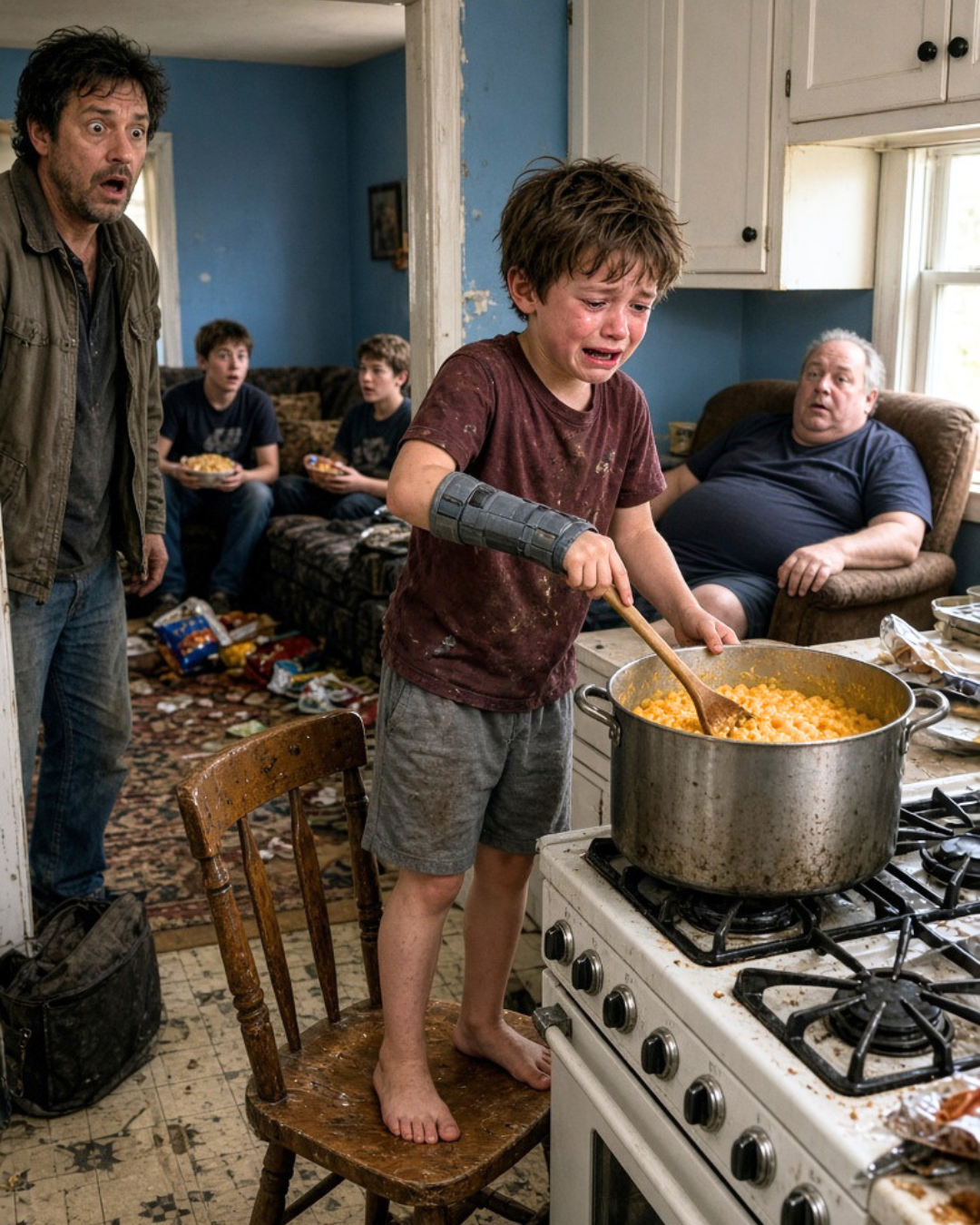
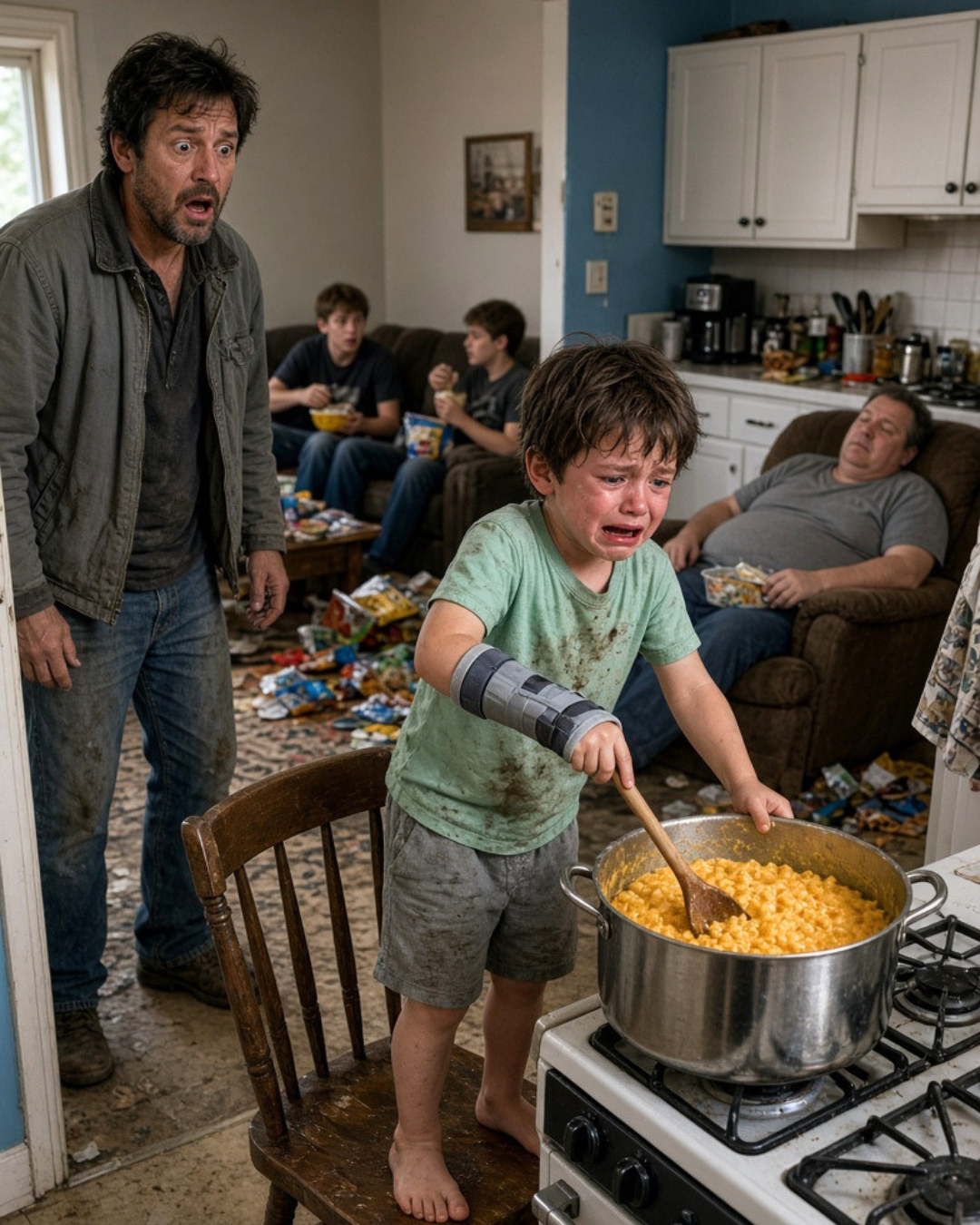
My eight-year-old son was standing on a chair in front of the stove, preparing dinner for another man’s children. Silver duct tape covered his injured forearm from his wrist to his elbow.
When he saw me, his face brightened for one brief second before terror replaced his smile.
“Please don’t be mad, Dad. Dwight says if dinner’s late, I sleep in the shed.”
I stared at my little boy, trembling in front of a pot of macaroni, and realized that something terrible had been happening inside my own home while I was hundreds of miles away.
Twenty-eight days working offshore. Twenty-eight days at home.
That was the schedule I’d followed for years on an oil rig in the Gulf of Mexico.
The work was exhausting, dangerous, and lonely, but the paycheck made it seem worthwhile. It paid the mortgage on our house outside Lafayette, Louisiana. It covered my wife Brandi’s SUV, our groceries, and the speech therapy our son needed. It even paid for the wooden swing set I’d built in the backyard during one of my breaks.
I told myself every sacrifice was for my family.
Especially Finn.
My son was eight, smaller than most boys his age, and painfully shy around people he didn’t know. But when we were together, he could talk for hours. He told me about school, the lizard he kept as a pet, and the secret fort he was constructing beneath our porch.
Every evening at seven, we were supposed to FaceTime.
It was our routine.
No matter how tired I was after a shift, I made sure I was somewhere with a decent connection when seven o’clock came around.
But during my latest rotation, something changed.
Our conversations became shorter.
Sometimes Finn barely spoke.
Other nights, Brandi answered instead.
“He’s tired,” she would tell me. “He’s already in bed.”
At seven in the evening?
I questioned it more than once.
“Kids grow, Wade. He’s fine. Stop worrying.”
I wanted to believe her.
I needed to believe her.
Working offshore requires trust. You cannot inspect every detail of your household from a platform in the Gulf. You have to rely on the person waiting at home to tell you the truth.
So I kept working.
Then a hurricane warning forced our platform to shut down operations. The company evacuated us by helicopter, sending everyone home two weeks ahead of schedule.
I was relieved.
More than anything, I wanted to surprise Finn.
I pictured him racing across the living room, throwing himself into my arms, and immediately launching into a story about whatever he’d been building beneath the porch.
I didn’t call Brandi.
I wanted the moment to be spontaneous.
At 9:58 that night, I pulled into our driveway.
The first thing I noticed was a pickup truck parked where I usually left mine.
It was lifted, with oversized tires covered in dried mud.
I didn’t recognize it.
Our front door was unlocked.
Inside, the television was blasting a football game.
Two unfamiliar boys, perhaps ten and twelve, were stretched across my couch, eating chips and dropping crumbs onto the cushions.
A large man was asleep in my recliner.
His boots were still on.
A beer can rested in his hand.
And in the kitchen, standing on a chair because he couldn’t comfortably reach the stove, was Finn.
My son.
He was stirring boxed macaroni in a pot that looked too heavy for him.
His school uniform was stained. His hair was overgrown. His cheeks seemed thinner than they had been when I left.
Then I noticed his left arm.
Silver duct tape had been wrapped around it from his wrist nearly to his elbow.
For a moment, I couldn’t move.
“Finn.”
He turned so abruptly that the chair rocked beneath him.
His face lit up.
“Dad?”
Then he looked toward the living room.
The happiness vanished.
“Dad, you’re not supposed to be home.”
I crossed the kitchen and lifted him off the chair.
He felt frighteningly light in my arms.
I held him close, breathing in the familiar smell of his hair, trying to understand what I was seeing.
“What happened to your arm, buddy?”
He looked past my shoulder toward the sleeping man.
“I got burned,” he whispered. “It’s okay. I put tape on it.”
My stomach tightened.
“Who burned you?”
Finn didn’t answer.
Instead, the words came tumbling out of him.
“Don’t be mad, Dad. Dwight says if dinner’s late, I sleep in the shed.”
The shed.
I had built that shed myself to keep our lawnmower and gardening tools dry.
It had no windows.
No electricity.
No proper light.
And my eight-year-old son was afraid of being locked inside it.
The man in my recliner stirred.
He opened his eyes, noticed me holding Finn, and slowly stood.
He was broad, with a tattoo on his neck and no shirt.
“You must be Wade,” he said. “I’m Dwight. Brandi’s friend.”
I kept Finn against me.
“Where’s my wife?”
“Casino in Coushatta. Girls’ night.”
He gave a smug little smile.
“Somebody’s gotta watch the kids while she relaxes. Your boy needs discipline, man. Little guy’s soft. Cries at everything.”
The two boys on my couch laughed.
“Cries like a baby,” the older one said. “Dad made him sleep in the shed Tuesday.”
Dwight shrugged.
“Builds character. My old man did worse to me.”
I wanted to hit him.
I wanted to drag him outside and make sure he never came near my child again.
But Finn was shaking in my arms.
Years of working around heavy machinery had taught me something important: losing control in a dangerous situation usually makes it worse.
So I made myself speak calmly.
“Okay,” I said. “Thanks for watching him.”
Dwight grinned.
He mistook my restraint for weakness.
I didn’t correct him.
Not yet.
I made sure Finn was safe and kept him close for the rest of the night.
Brandi returned around one in the morning, smelling of cigarettes and perfume.
She stopped when she saw me sitting at the kitchen table.
“Wade. You’re early.”
I looked at her.
“Who is Dwight?”
Her expression hardened.
“Someone who’s actually here. You’re gone half the year. You don’t get to come home and judge me.”
I gestured toward the hallway where Finn was resting.
“What happened to his arm?”
Brandi rolled her eyes.
“He grabbed the pan handle. He’s clumsy. Your son’s always been clumsy.”
Your son.
Not our son.
I heard that distinction clearly.
I didn’t argue with her.
I needed to understand what had happened before deciding what to do.
The following morning, while Brandi was still asleep, I went into my old office closet looking for medical supplies.
Instead, I found an old phone.
It was the one I’d replaced before my last offshore rotation.
There was no SIM card inside.
It couldn’t make ordinary calls or send text messages.
But the battery still held a charge.
When I turned on the screen, I noticed a note in the Notes app.
The title was simple.
FOR DAD.
I opened it.
Twenty-six entries.
Every single one addressed to me.
The first read:
Day 1. Hi Dad. I’m writing you every night like you said. I’m ok.
I stood in the closet, reading.
The messages continued, one after another.
Finn had been writing to me every night.
Not sending the words.
Just leaving them somewhere he hoped I might eventually find them.
I scrolled toward the bottom.
The final entry had been written two nights before I returned.
Day 26. Dad, Dwight pressed my arm on the stove because the noodles burned. A man taped a paper to our door. Mom cried. Dwight said the bank is taking our house and it’s your fault for not sending enough money. Mom said I can’t tell you, because then you’ll find out where the money went. Please come home. I’m not ok.
I read it again.
Then again.
Then a fourth time.
My knees gave way.
I slid down against the closet wall and sat on the floor, clutching a phone that couldn’t send a single message.
For the first time since my father’s funeral, I cried.
My little boy had spent twenty-six nights telling me the truth.
Twenty-six nights trying to reach me.
And while I was offshore, believing that everything was fine, he had been frightened, hurt, and forced to keep silent.
I scrolled backward.
Day 9. Dwight’s boys took my lizard. They said it ran away.
Another entry.
Day 14. I slept in the shed. It was dark. I counted to 1,000.
Another.
Day 19. Mom said if I tell you anything, you’ll stop sending money and we’ll lose the house.
Then:
Day 22. I miss you. I put your hoodie on my pillow.
I covered my mouth.
The boy I’d imagined playing beneath the porch had been sleeping in a dark shed.
The child I’d believed was safely tucked into bed had been wearing my old hoodie because he missed me.
And the money I’d worked so hard to earn was somehow disappearing.
I photographed every entry and preserved the phone.
Then I went searching for the paper Finn had mentioned.
I found it folded inside Brandi’s purse on the kitchen counter.
It was a notice of default from our mortgage company.
We were four months behind.
Four months.
I had transferred the mortgage money every month without fail.
Beneath the notice was a stack of casino markers.
Thirty-one thousand dollars.
There was also a cashier’s check payable to Dwight Pruitt.
Eight thousand dollars.
The memo read:
truck payment.
I stared at the documents.
My mortgage money.
My son’s home.
My family’s security.
It was all being consumed by gambling debts and payments to the man who had hurt my child.
I went outside and called the Lafayette Parish Sheriff’s Office.
Then I called Brandi’s mother, Gloria, in Tulsa.
When I told her what I’d found, she began crying.
“She asked me for money twice this summer,” she said. “She told me you’d been laid off. Wade, I had no idea.”
Neither had I.
But I was beginning to understand.
At nine that morning, two deputies arrived.
Dwight was asleep in my recliner again.
He woke to find a deputy standing over him.
“What is this?” he muttered. “Wade, man, come on.”
One deputy examined Finn’s arm.
He carefully removed enough of the duct tape to see the injury beneath.
His expression changed immediately.
The skin was blistered.
The edges appeared infected.
The burn followed the curved shape of a pan’s rim.
The deputy crouched beside Finn.
“Who did this, son?”
Finn looked at me.
I knelt next to him and held his uninjured hand.
“You can tell the truth now, buddy. I’m home. I’m not going anywhere.”
My son slowly raised his finger.
He pointed at Dwight.
The deputies arrested Dwight in my living room.
His own children watched as they placed him in handcuffs.
Brandi came downstairs wearing her robe.
When she saw what was happening, she started shouting.
“You’re ruining my life! You’re never here! You don’t get to—”
The second deputy stopped her.
“Ma’am, you’re going to want to stop talking and call a lawyer.”
The mortgage notice and casino documents had already become part of the investigation.
I stood beside Finn, trying to keep my voice steady.
For the first time since I’d stepped through our front door, my son wasn’t looking toward the recliner.
He was looking at me.
And I realized that getting Dwight out of the house was only the beginning.
I still had to discover how badly Finn had been hurt, whether we could save our home, and what it would take to make him feel safe again.
PART 2
Dwight was charged with felony child abuse.
Brandi faced charges involving child neglect and failure to report the abuse.
The court granted me emergency custody of Finn that same afternoon.
Within nine days, my lawyer and I managed to bring the mortgage current.
Our house was no longer in immediate danger.
Gloria drove from Tulsa the day after the arrests.
She arrived with a shoebox full of tiny holes and a new lizard for Finn.
When he lifted the lid, he smiled in a way I hadn’t seen since before my offshore rotation.
Gloria cried.
She later testified in support of Finn and me.
I resigned from the rig and accepted a job at a refinery twenty minutes from home.
Day shift.
Home by five.
The salary was smaller.
But my son was worth more than the difference.
His arm eventually healed, leaving a pale crescent-shaped scar.
He liked telling people a shark had bitten him.
I let him tell the story that way when he wanted.
On the first night it was just the two of us in the house, Finn climbed into my bed carrying his new lizard and the old phone.
“Can I still write to you?” he asked.
I pulled him closer.
“You don’t have to anymore, buddy. I’m right here.”
He considered that.
“I want to,” he said. “So you never miss a day again.”
So we kept the tradition.
Every evening, Finn typed a short entry.
Every morning, I read it while we ate cereal.
One of the first messages after everything changed said:
Day 61. Dad made pancakes. Lizard is named Rig. I’m ok. For real this time.
I wanted to believe those words meant the nightmare was over.
But nobody prepares you for what comes after the arrest.
I’d thought the hardest part would be seeing Dwight taken away.
It wasn’t.
That was simply the part that looked dramatic.
The real work began in a pediatric burn clinic in Lafayette.
A nurse named Ms. Odom carefully cleaned Finn’s arm while he stared at the ceiling and counted aloud.
“Four hundred twelve. Four hundred thirteen.”
I leaned toward him.
“Buddy, you can stop counting.”
“I’m not scared,” he said. “I just like numbers when it hurts.”
I had to step into the hallway.
I stood there with my hands against the wall, trying to breathe.
The doctor explained that Finn would have a permanent scar, but we had caught the infection in time.
Another week beneath that duct tape, she warned, and the consequences could have been much worse.
She was gentle.
She was also thorough.
Every observation, every measurement, and every detail went into Finn’s medical record.
Those records would eventually become evidence.
Two days later, Finn attended an interview at the Children’s Advocacy Center.
I wasn’t permitted inside the interview room.
I understood why.
The interview needed to be conducted by someone trained to speak with children without influencing their answers.
Still, sitting outside was agonizing.
I waited beneath a painting of a cartoon whale, holding a paper cup of coffee that grew cold in my hands.
A woman named Ms. Vance spent fifty minutes talking with Finn.
When she came out, she sat beside me.
“He’s very brave,” she said. “And he’s very worried about you.”
I turned toward her.
“About me?”
“He asked if you were mad at him. Three times.”
I stared at the cartoon whale.
My eyes burned.
“I’m not mad at him,” I said. “I’m mad at me.”
She didn’t dismiss what I was feeling.
She simply replied, “Then let’s make sure he hears the first part more than the second.”
That sentence stayed with me.
Finn needed to hear that he hadn’t done anything wrong.
He needed to know that adults were responsible for what had happened, not him.
And he needed to hear it more often than he heard me blaming myself.
When we got home, I called his former speech therapist.
Her name was Ms. Tran.
She had worked with him for two years before Brandi told me, earlier that spring, that the sessions were no longer necessary.
I’d accepted her explanation.
It had been convenient to believe it.
I was hundreds of miles away, and she was the parent at home.
When I explained what had happened, Ms. Tran began crying.
Then she said, “Bring him Thursday. Don’t worry about the bill.”
“I can pay it,” I told her.
“I know. Bring him anyway.”
We resumed his sessions.
Meanwhile, the criminal investigation continued.
The prosecutor assigned to the case was Ms. Delacroix, a careful, exhausted-looking woman who never promised more than she could deliver.
Early on, she warned me that the process would be difficult.
“People want a clean story,” she said. “Defense attorneys love to muddy it. Everything we have is going to be examined, including the notes on your old phone.”
“The notes are real.”
“I believe you. But a judge needs more than my belief.”
So investigators examined the phone properly.
A forensic specialist at the Sheriff’s Office created an image of its contents.
He studied the metadata associated with all twenty-six entries.
He confirmed that the notes had been created and edited on the dates recorded, in sequence, using the same account.
The device had no SIM card and couldn’t send ordinary messages.
The findings supported what Finn had told us.
Then the examiner pointed out something I hadn’t noticed.
“The last entry has three edits,” he said. “He started it, stopped, came back, and rewrote it. Looks like he deleted a few lines.”
My stomach tightened.
“Can you recover what he deleted?”
He shook his head.
“Not from this. Sorry.”
I sat in the parking lot afterward, thinking about those missing words.
My eight-year-old son had written twenty-six messages that he knew I might never read.
And even there, in the one place he could express himself without someone watching, he had apparently decided that certain things were too frightening to put into words.
I couldn’t stop wondering what he’d erased.
Dwight’s attorney attacked the evidence aggressively.
He suggested that Finn had been coached.
He argued that the burn was accidental.
He claimed Dwight was merely a guest in the house and that Brandi bore the real responsibility.
That last argument created a problem for both defendants.
Brandi’s attorney wasn’t willing to accept a defense that shifted everything onto her.
Within a week, the two sides stopped presenting a united position.
Then my attorney received a call.
“My client wants to cooperate,” Brandi’s lawyer said.
“With what?” mine asked.
“With everything.”
I didn’t see Brandi face-to-face again until the custody hearing.
She had lost weight.
Her hair was pulled tightly back, and she wore a plain gray blazer.
She looked older and younger at the same time.
When I entered the courtroom, she glanced at me once and immediately looked away.
The judge was a gray-haired woman with reading glasses hanging from a chain.
She reviewed the evidence methodically.
The deputies’ reports.
The burn clinic records.
The old phone.
The mortgage notice.
The casino markers.
The cashier’s check.
Then she looked directly at Brandi.
“Mrs. Hollis, do you dispute that your son was left in the care of Mr. Pruitt while you were out of the home?”
Brandi’s lawyer leaned toward her.
She answered before he could speak.
“No, Your Honor.”
“Do you dispute that he was made to sleep in an outbuilding?”
Brandi hesitated.
“I didn’t know about that until after,” she said.
Then she stopped.
Shook her head.
“No. That’s not true. I knew about it Tuesday. I told myself it was one night.”
The courtroom became silent.
For weeks, I’d imagined confronting her.
I’d rehearsed accusations while driving, showering, and trying to fall asleep.
I’d pictured her denying everything.
I’d imagined her blaming me.
I hadn’t imagined her admitting the truth.
The judge granted me full temporary custody.
Brandi was ordered to undergo an evaluation, including treatment related to her gambling.
Any contact with Finn would remain supervised until the court authorized otherwise.
After the hearing, Brandi approached me in the hallway.
She caught my sleeve.
I looked down at her hand until she released it.
“I’m not asking you to forgive me,” she said.
“Good.”
Her eyes filled.
“I just wanted you to know I read the notes. My lawyer gave me copies.”
I didn’t answer.
“Day 22. The hoodie. I read that one a lot.”
I had a hundred cruel things I could have said.
Every one of them felt deserved.
But when I finally spoke, I told her the truth.
“He was saying goodbye to me every night, Brandi. In a language only I could read. And you made it so he had to.”
She nodded.
Tears ran down her cheeks.
Then she let the deputy escort her away.
I returned to my truck and sat behind the wheel without starting the engine.
I couldn’t undo what had happened.
I couldn’t erase the burn or the nights in the shed.
I couldn’t give Finn back the twenty-six evenings he’d spent writing messages to a father who didn’t know he needed help.
But I could be present for every day that came next.
And I was determined that nobody would ever again make him feel responsible for keeping an adult’s secrets.
PART 3
Dwight eventually accepted a plea agreement.
There was no dramatic confession.
No emotional speech.
No moment when he suddenly appeared to understand the damage he’d caused.
There was a signature, a court proceeding, and a sentence.
Nine years on the felony child abuse count, with the remaining charges addressed through the agreement.
His two sons were placed with their mother’s sister in Opelousas.
I thought about those boys more often than I expected.
The older one had laughed when Finn was frightened.
He had admitted that Dwight made my son sleep in the shed.
But he was also a child living under the authority of the same man.
One afternoon, a caseworker forwarded a letter he’d written to Finn.
It was a single sheet of paper, written in pencil.
The eraser marks were still visible.
I’m sorry about your lizard. It didn’t run away. My dad let it out the back door. I knew and I didn’t say. I should have said.
I didn’t force Finn to read it.
I told him it was there and allowed him to decide.
For two days, the letter remained untouched.
Then he carried it onto the porch and read it alone.
When he came back inside, he looked thoughtful.
“He’s a kid too, Dad.”
I nodded.
“Yeah, buddy. He is.”
Finn glanced toward the backyard.
“I’m not mad at him anymore. Is that okay?”
I knelt so we were eye to eye.
“It’s okay to be mad. It’s okay to not be. Either way is okay.”
He considered my answer.
Then he asked whether we could make pancakes.
It was dinnertime.
We made pancakes anyway.
We did that often during the fall.
Sometimes Finn wanted breakfast for dinner.
Sometimes he wanted to sit on the kitchen floor with Rig while I cooked.
Sometimes he wanted to talk.
Sometimes he didn’t.
I was learning that helping him heal didn’t mean demanding that he explain every feeling.
It meant giving him a safe place to have those feelings.
Brandi began doing the work required of her.
I want to be clear about that.
She entered an inpatient treatment program in Baton Rouge.
She sold the SUV my offshore paychecks had purchased and directed the proceeds toward the mortgage arrears created by her gambling.
She provided a full account of the missing money.
That information helped the lender’s attorneys restructure our loan so we could keep the house.
She attended every court-ordered session.
Then she attended additional sessions voluntarily.
None of those actions erased what she’d allowed to happen to Finn.
They didn’t restore the trust she’d broken.
But they mattered because accountability required more than saying she was sorry.
She began writing Finn a letter every week.
I reviewed each one before deciding whether to offer it to him.
None demanded forgiveness.
None blamed him.
Most described ordinary things.
A bird outside her treatment-center window.
A book she was reading.
A joke she thought he might enjoy.
For four months, Finn refused to open them.
I didn’t push him.
I wasn’t going to turn his mother’s recovery into another responsibility he had to carry.
Then one afternoon in February, he entered the kitchen holding one of her letters.
“Can you read this one to me?” he asked. “I want to know if it’s mean first.”
I opened it.
It wasn’t mean.
Brandi apologized.
She told him that none of what had happened was his fault.
She said she wasn’t asking him to feel anything he didn’t feel.
I read every word aloud.
Finn listened quietly.
When I finished, he said, “Okay.”
Then he returned to his room.
That was all.
And that was enough.
His first supervised visit with Brandi took place in April.
The courthouse had a family room with a box of board games and a caseworker assigned to observe.
I waited outside the glass.
Finn entered carrying a shoebox.
He stopped about three feet from his mother.
Brandi remained seated.
Neither moved for several seconds.
Then Finn said something I couldn’t hear.
Brandi covered her mouth with both hands.
The caseworker later told me what he’d said.
I don’t know if I’m ready to hug you. But I brought Rig. You can say hi to him.
He had brought his lizard.
There were holes punched in the shoebox lid.
For forty minutes, they sat together on the floor.
A mother who had failed her child in ways that could never be excused.
And a boy who was slowly learning that forgiveness, distance, affection, and anger could all be his decisions.
Watching through the glass, I realized that Finn was giving his mother something she hadn’t given him when he needed it most.
A choice.
I don’t know what their relationship will look like years from now.
I don’t know whether Brandi and I will ever be friends.
I don’t know what future custody reviews will decide.
Those questions remain open.
What matters is that Finn’s safety comes first and that he gets to move at a pace he can manage.
The adults around him have agreed to respect that.
As for me, I’m still working at the refinery.
Day shift.
Home by five.
I don’t miss the helicopter rides or the endless offshore nights.
I don’t miss staring at a phone screen, trying to decide whether Finn sounded tired or frightened.
I know where he is when I finish work.
Most afternoons, he’s waiting with a story.
Sometimes it’s about school.
Sometimes it’s about Rig.
Sometimes it’s about something funny that happened with a friend.
And sometimes he has nothing particular to say.
Those quiet afternoons are good too.
The swing set is still in our backyard.
So is the fort beneath the porch.
Last spring, Finn asked if we could rebuild it.
We spent several weekends measuring boards, cutting wood, and fitting everything together.
This time, he wanted a proper door.
And a window.
And a latch that could only be operated from inside.
He was very specific about the latch.
I didn’t ask him why.
I understood.
We built it exactly the way he wanted.
The first time he sat inside and closed the door, I remained outside.
A few seconds later, I heard the latch click.
Then he opened it himself.
He smiled.
I smiled back.
That small moment meant more to me than any promotion or bonus I’d ever received offshore.
Months passed.
Finn grew taller.
His arm healed completely apart from the scar.
He continued attending therapy and learning how to speak about difficult things without feeling ashamed.
He also continued writing in the old phone.
I never made him do it.
It had become his own ritual.
Some evenings, he typed only a sentence.
Other nights, he wrote several paragraphs.
I read what he chose to share with me.
And I learned to respect the entries he wanted to keep private.
On the evening of Day 365, I found him sitting on the back steps.
The porch light illuminated the pale crescent scar on his arm.
Rig was safely inside.
Finn held the old phone in both hands, typing slowly with his thumbs.
I sat beside him.
For a while, neither of us spoke.
Then I said, “You don’t have to keep writing, you know. You can stop whenever you want.”
“I know.”
“Then why do you?”
He thought for a moment.
“Because the first twenty-six were for you to find,” he said. “These ones are just for me. I like having a place to put the day.”
I slipped my arm around his shoulders.
He leaned against me.
For a moment, I remembered how he used to fall asleep in my truck when he was younger.
Back then, I’d assumed there would always be more time.
More evenings.
More chances to make up for the weeks I was away.
Now I knew how precious an ordinary evening could be.
“Can I read it?” I asked.
Finn turned the screen toward me.
His latest entry was longer than usual.
Day 365. Dad picked me up from school and was early. He’s always early now. I’m taller than the doorknob on the shed. I don’t think about the shed much anymore. Rig is fat. Mom’s visit was good. I laughed at something she said and then felt weird, but then it was okay. I’m learning that you can feel two things. Dad says that’s normal. I’m ok. I’m better than ok.
I’m home.
I read the words once.
Then again.
I thought about the first night I’d returned from the Gulf.
The unfamiliar truck.
The television.
The man in my recliner.
My son standing on a chair, stirring macaroni with duct tape around his arm.
I remembered his fear when he saw me.
I remembered him whispering that he might have to sleep in the shed.
Then I looked at the boy beside me.
He was taller now.
Stronger.
Still carrying things no child should have experienced, but no longer carrying them alone.
And for the second time since my father’s funeral, I cried.
The first time had been on the floor of a closet, holding twenty-six messages my son couldn’t send.
This time, I was sitting beside him beneath our porch light.
Finn noticed my tears.
He placed one small hand against my back.
“It’s okay, Dad. You can write one too.”
I laughed through the tears.
Then I took the phone.
I opened the note.
Beneath twenty-six entries written when he was frightened and alone, and hundreds more written after he was safe, I added my own message.
Day 1 (for real this time). I’m here. I’m not leaving. I love you.
I handed the phone back.
Finn read it.
He nodded once.
Then he said, “Send.”
I smiled.
“It can’t send, buddy. There’s no SIM.”
He looked up at me with the crooked smile I’d missed so desperately during those long weeks offshore.
“I know,” he said. “But it got there.”
I put my arm around him again.
He rested his head against my shoulder.
The night was quiet.
There was no helicopter waiting to take me away.
No offshore shift beginning in the morning.
No seven-o’clock call that might end before I could ask the right questions.
Just my son and me, sitting together outside the home we’d almost lost.
For years, I’d measured what I provided by the money I brought home.
The mortgage.
The car.
The therapy.
The groceries.
The swing set.
I thought being a good father meant making sure my family never had to worry about those things.
But Finn had taught me something I should have understood much sooner.
A child needs more than a house.
He needs to know that home is safe.
He needs someone who listens when he speaks, notices when he goes quiet, and believes him when he says something is wrong.
He needs to know he doesn’t have to earn kindness by being useful or obedient.
And he needs to know that love will never send him outside into the dark because dinner is late.
I couldn’t change the twenty-six nights I’d missed.
I couldn’t undo the pain he’d suffered.
But I could be there for the nights ahead.
I could listen.
I could show up.
I could make pancakes at dinnertime, rebuild a fort with a lock on the inside, and sit quietly beside him when he needed someone close.
And every morning, when I opened that old phone over breakfast, I could remind myself that the most important message my son had ever sent wasn’t really a message at all.
It was the trust he was slowly learning to place in me again.
Finn leaned closer.
“Dad?”
“Yeah, buddy?”
“Can we make pancakes tomorrow?”
I smiled.
“Absolutely.”
“With chocolate chips?”
“With chocolate chips.”
He grinned.
Then he tucked the phone into his pocket and stood.
“Come on,” he said. “Rig probably wants dinner.”
I followed him inside.
And this time, I wasn’t coming home too late.
I was already there.
THE END.
