

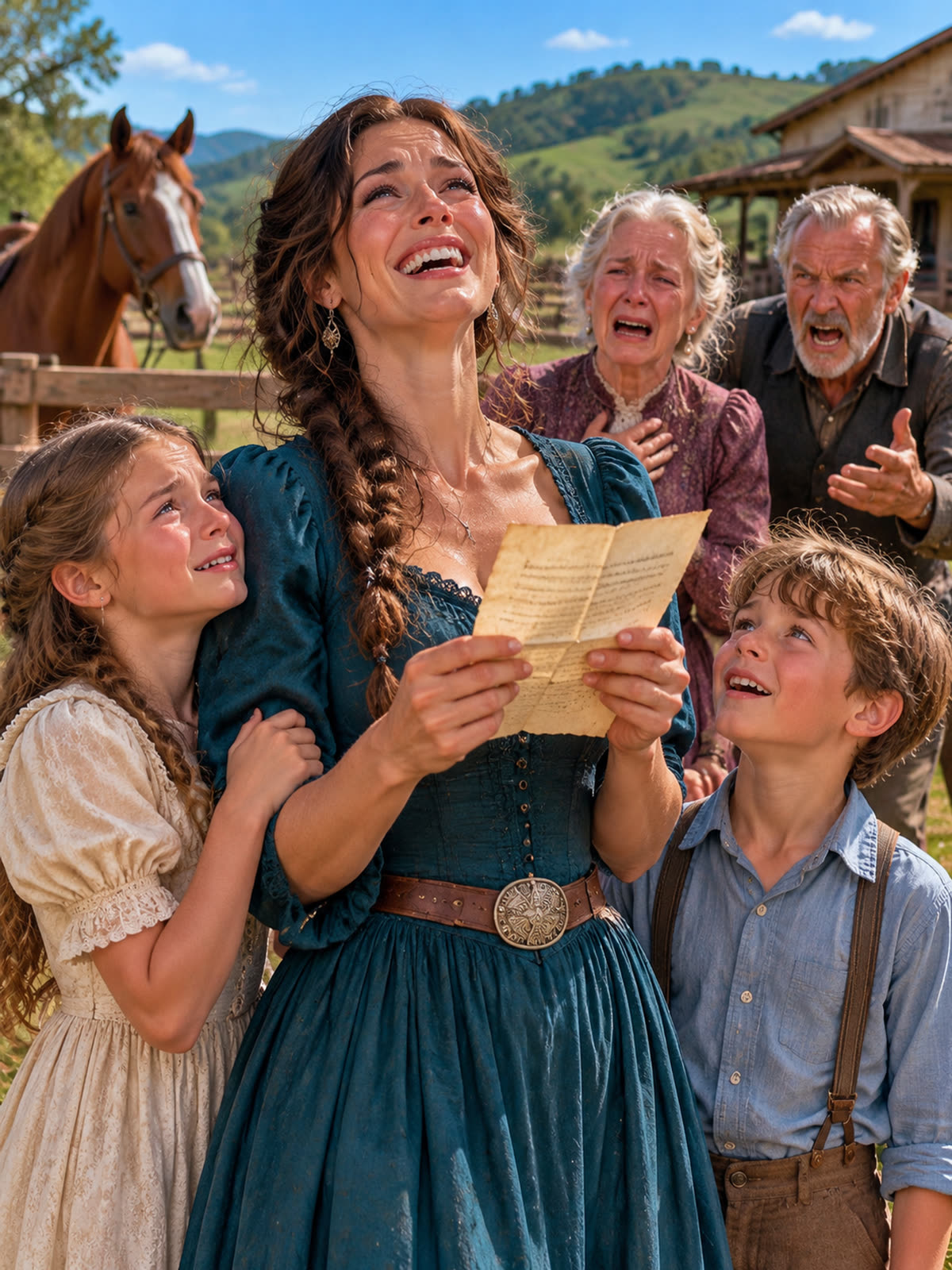
PART 1: THE DOOR THEY CLOSED
Eight years afterward, my business sold for $2.5 million. My greedy parents promptly appeared at my celebration, interrupting an evening attended by 300 guests to demand their “family share.” Taking the microphone, I met my mother’s eyes and whispered, “Family helps family, right?” My attorney then approached with a single document that would change everything. But the story had begun long before that celebration, with two babies in my arms and a door shutting in front of us.
Eleven days after my husband died, I went to my parents’ house and begged to sleep on their couch with my one-year-old twins. My mother shut the door in my face. “We are not your safety net.” My name is Lauren Bennett, and I was twenty-six when my husband, Andrew, was killed in a tractor accident. I had $400 in my bank account, nineteen days remaining on our lease, and two children, Sophie and Owen, relying on me for everything. All I had asked for was somewhere to stay while I searched for work.
My parents would not help. They would not even allow their grandchildren inside. After leaving the house where I had grown up in Springfield, Missouri, I cried and called the only other people I could think to ask: Andrew’s parents. Forty minutes later, my father-in-law arrived in his pickup. My mother-in-law had brought hot food in a container and the blue blanket she had knitted for the twins. They took us to Willow Creek Ranch, their struggling horse ranch in the Missouri countryside.
They welcomed us despite their own difficulties. Foreclosure was a possibility only eighteen months away. At the ranch, I met Clover, a four-year-old mare whose slightly crooked front leg had persuaded everyone that she had no value. I had spent years studying equine science, however, and what others dismissed as a defect struck me as an unusual physical advantage. I pleaded with my father-in-law to keep her instead of selling her. For fourteen months, I trained her carefully.
When Clover finished third in a competition, an experienced breeder, Victoria Hayes, noticed her. Together, Victoria and I built a breeding program that turned the struggling ranch into a thriving business. Eventually, we received an offer of $2.5 million for the land, facilities, brand, and breeding program. After all the uncertainty, the work we had done had become something someone wanted to buy. Suddenly, my mother seemed to remember that she had my telephone number.
My brother called as well. His gym was failing, and he wanted a loan. Then a message forwarded to me by mistake exposed what had really happened eight years earlier. My parents had declined to help because they thought my circumstances made me a poor investment. They had even talked about keeping reconciliation possible in case the ranch became valuable someday. Their refusal had not been a misunderstanding. They had considered my need and decided it offered them too little.
I said nothing to them about the message. Instead, I quietly secured my children’s inheritance, arranged for my in-laws to have the original ranch without its debt, and created a scholarship honoring Andrew. By the time we gathered to celebrate the sale, the important decisions were already protected. Almost 300 people came. As I announced gifts for those who had helped me rebuild, my mother-in-law began to cry, and the guests rose to applaud.
That was when I noticed three people in the front row whom I had not wanted there: my mother, my father, and my brother. They had dressed as though they were attending a family portrait sitting. Their expectation was unmistakable. They had come to collect. Looking straight at them, I spoke into the microphone. “Family isn’t defined by blood. It’s defined by who was there when it mattered.” My mother sprang from her chair, furious.
My brother began demanding money, unaware that every major financial arrangement had been signed and completed before he stepped onto the ranch. “That money belongs to us too!” he shouted, coming toward the stage. My mother raised her chin. “Lauren, we’re your parents. After everything we did for you, we deserve our share.” I glanced at Andrew’s parents beside Sophie and Owen. When no one else would help us, they had shared the little they possessed.
“What exactly did you do for me?” I asked. My father struck the table with his hand. “We gave you life!” Beside me, my attorney, Michael Foster, lifted the document he had brought. “Ladies and gentlemen, before we continue, you should understand the contents of this irrevocable trust.” In front of the assembled guests, he explained that the sale proceeds had already been legally assigned to my children’s future, my in-laws, and Andrew’s memorial scholarship.
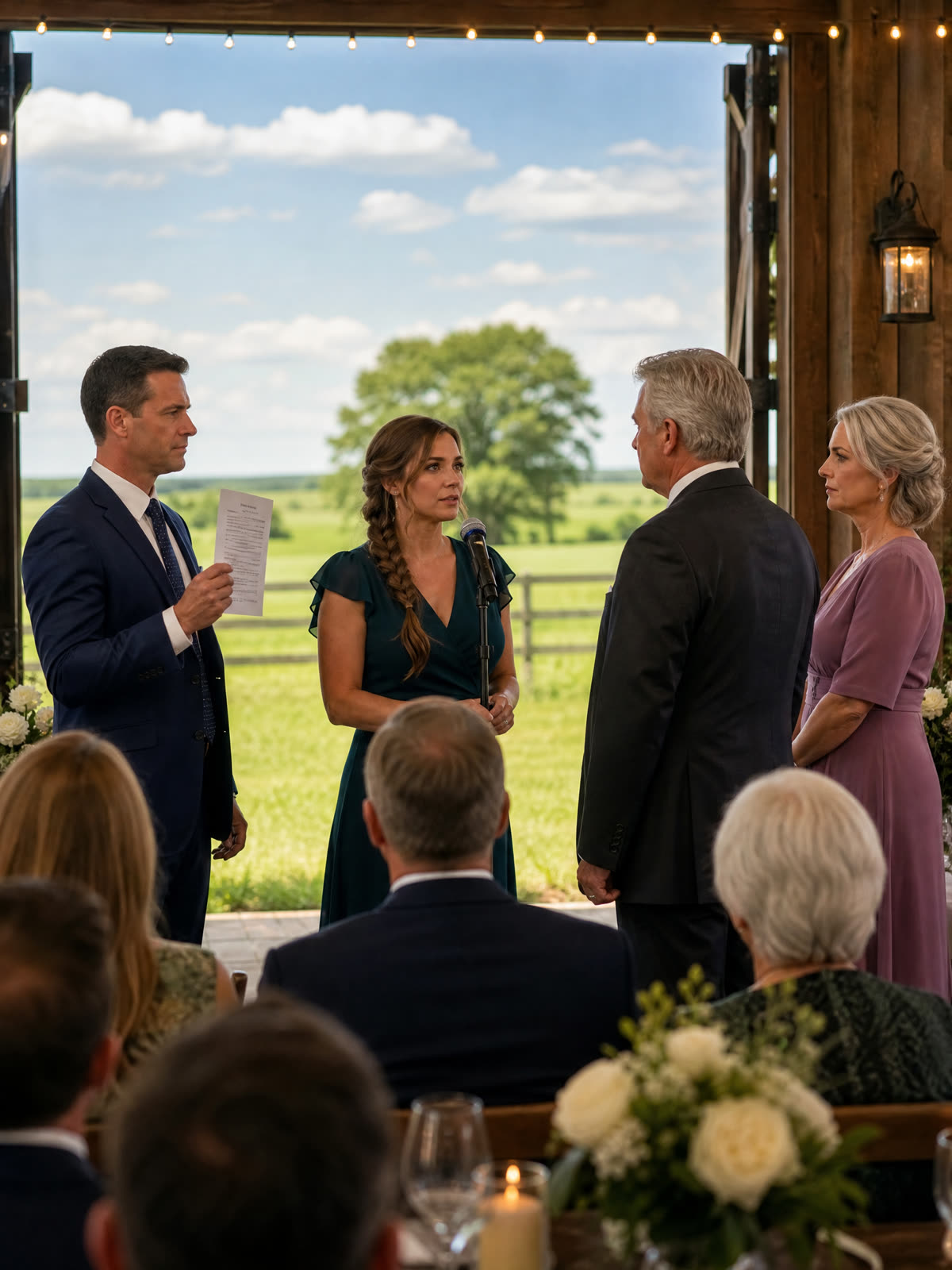
My brother’s smile vanished. “So there’s nothing left for us?” Michael answered, “Nothing you have a legal claim to,” and my mother started crying. Yet I could still picture that door closing before my babies as plainly as if it had happened the previous day. Her tears could not erase the memory. Then Michael said something I had not expected. “Lauren, during the financial review, we discovered an old document connected to Willow Creek Ranch.”
My father-in-law looked up. “What document?” Michael turned his attention directly to my father. “A confidential proposal to acquire the ranch through its mortgage debt. It was submitted eight years ago.” When Michael identified the person who had signed it, my father-in-law became utterly still. My father abruptly got to his feet. “That’s private information!” His protest brought the room to silence.
Michael set the document in front of me. My father’s signature was there. Eight years earlier, while Andrew’s parents struggled to hold on to Willow Creek Ranch, my father had tried negotiating with the financial institution to purchase the rights to its mortgage debt. “You wanted to take our property?” my father-in-law asked, unable to believe it. My father would not meet his eyes. “It was just an investment opportunity.”
My throat tightened. “Is that why you closed the door on me? Were you waiting for us to fail so you could buy everything?” My mother bowed her head. “Lauren, things weren’t that simple…” I answered, “They were simple enough for me,” and then, “I needed somewhere my children could sleep.” My brother attempted to interrupt, but Michael demonstrated that the proposal had never been accepted and that the property rights were now protected.
My mother-in-law walked over and held my hand. “Andrew would be proud of you.” For a moment, I believed we had reached the end of the revelations. Then my mother took a yellowed envelope from her purse. “There’s something we never told you about Andrew’s final days.” I recognized the handwriting immediately. When I read the opening line, I understood that another family secret had remained hidden from me.
Lauren, if you’re reading this, something has happened that I didn’t get the chance to explain. My hands began shaking. Everything around me seemed to recede. There was the familiar, slightly crooked capital L, the heavy pressure Andrew used when forming a T, and the little dash he always drew beneath his signature. These were my husband’s words. Somehow, my mother had kept them from me for eight years.
I lifted my eyes. “Where did you get this?” She swallowed before answering. “Andrew brought it to our house a few days before his accident.” I stared at her. “Andrew came to see you?” My father shifted uneasily, and my mother nodded. “He wanted to talk about the ranch.” I looked at the envelope once more. “Why didn’t you give this to me?” Her reply was almost impossible to take in. “Because we didn’t think it was necessary.”
“Necessary?” My voice rose. “My husband died. You had a letter he wrote to me, and you decided I didn’t need it?” My mother glanced toward the guests. “Lauren, please. Not in front of everyone.” I gave a bitter laugh. “You came here demanding money in front of everyone.” She could offer no reply. I opened the letter, its folds worn with age, and began to read.
Lauren,
I’ve been worried about Mom and Dad’s ranch. They’re trying to hide how bad things have gotten, but I found out the bank has been sending notices.
Dad says he’ll figure something out. I know he will try, but I don’t want him carrying this alone.
I met with your father because I thought he might be willing to help us arrange better financing. I didn’t want to involve you until I understood our options.
The meeting didn’t go the way I expected.
PART 2: WHAT THEY CALLED AN INVESTMENT
I stopped and looked at my father. He was staring at the floor. Then I returned to Andrew’s letter.
Your father asked questions about the land, the horses, and how much the ranch would be worth if Mom and Dad couldn’t keep up with their payments.
When I explained that we weren’t looking to sell, he became irritated.
He said family and business should never be mixed unless there was a profit.
I told him I wasn’t asking for charity. I was asking whether he knew anyone who could help us refinance.
He said he’d think about it.
But something about the conversation bothered me.
My chest tightened. Even before his death, Andrew had begun to understand who my parents really were. The next passage nearly undid me.
I know you’ve always wanted your parents to be proud of you. I wish they could see what I see.
You’re the strongest person I know, Lauren.
And if life ever becomes difficult, please remember that you don’t have to prove your worth to people who only measure it in dollars.
Tears blurred the page, and I held it against my chest. For eight years, I had longed for another conversation with him, another chance to hear his voice. Now, amid a celebration overtaken by confrontation, his words had finally reached me.
My mother spoke quietly. “He left it with us because he wanted your father to reconsider.” I looked at her. “And you kept it?” She nodded. “Your father thought it might cause problems.” Turning toward him, I asked, “Problems for whom?” He gave no answer. Michael came to my side. “Lauren, there’s something else you should know.” I looked at him. “What?” He replied, “The letter may explain why your father became interested in the ranch’s debt.”
My father suddenly rose. “That’s enough!” Michael’s composure did not change. “Mr. Bennett, your daughter’s father-in-law has a right to know what happened to his property.” My father-in-law slowly stood. He was seventy-one now, his hands roughened by decades of outdoor work. Facing my father, he asked, “Did my son come to you asking for help?” After hesitating, my father nodded. “Yes.” My father-in-law continued, “And instead of helping him, you tried to buy our mortgage?” My father answered, “It was business.” My father-in-law stared at him before saying words I would never forget. “My son wasn’t a business opportunity.”
My father attempted to justify himself. “You don’t understand how investments work.” My father-in-law shook his head. “I understand perfectly.” He pointed toward the twins. “Those children lost their father before they could even remember him.” Then he looked at me. “And their mother came to your door asking for a place to sleep.” My mother started crying again, but my brother crossed his arms. “This is getting ridiculous. We came here to talk about the money.” I faced him. “Then let’s talk about money.” He straightened, apparently believing he was finally making progress.
I turned to Michael. “Would you explain the sale?” He nodded. “The $2.5 million was the total acquisition price. That is not the same as $2.5 million in personal spending money.” He outlined what the transaction covered: the breeding program, equipment, facilities, business assets, and associated land rights. Closing costs, outstanding business obligations, and taxes also had to be considered. The final ownership arrangements protected the original ranch, leaving my in-laws their home and the acreage we had agreed they would keep. The remaining proceeds were allocated through documents completed before the celebration.
My brother frowned. “How much did she actually get?” Michael looked at him. “That information is private.” Color rose in my brother’s face. “I’m her brother!” Michael replied, “And that doesn’t give you a right to her financial records.” Several guests nodded. Wiping her face, my mother said, “But surely Lauren can help her own family.” I looked at her. “She can.” Her expression brightened until I added, “And I have.”
I gestured toward my in-laws. “When I had nowhere to go, they gave me a home.” Looking at Victoria, I continued, “When I had an idea nobody believed in, she gave me a chance.” Then I turned toward the employees gathered near the back. “When this business started growing, those people worked beside me.” My voice shook. “They are my family too.” My brother scoffed. “You’re really going to give money to strangers instead of your own brother?” I stared at him. “Those strangers showed up.” As he opened his mouth, I lifted my hand. “No. You don’t get to interrupt me.”
The room fell quiet. “Eleven days after Andrew died, I came to Mom and Dad’s house carrying two babies.” My mother turned her face away. “I wasn’t asking for a vacation. I wasn’t asking for a new car. I wasn’t asking anyone to pay my bills forever.” I swallowed. “I asked for a couch.” My voice broke. “One couch.” No one spoke. “And Mom looked at me and said, ‘We are not your safety net.’” I turned to her. “Do you remember?” She gave a faint nod. “Yes.” I asked, “Then why do you expect me to be yours?” My brother stood still, my father stared ahead, and for the first time that evening, none of them had an answer.
I expected them to go. Instead, my mother approached the stage. “Lauren, please.” Her voice had become smaller and less assured. “I know we hurt you.” I waited while she looked toward the twins. “They’re so big now.” Sophie sat beside her grandmother, clutching a little stuffed horse. Owen leaned against his grandfather’s shoulder. Neither child regarded my mother as an important person in their life, because she had never made the effort to become one. She extended her hand toward Sophie. “Sweetheart, I’m your grandma.” Sophie looked at me, then at the woman who had helped me raise her for eight years, and moved closer to my mother-in-law.
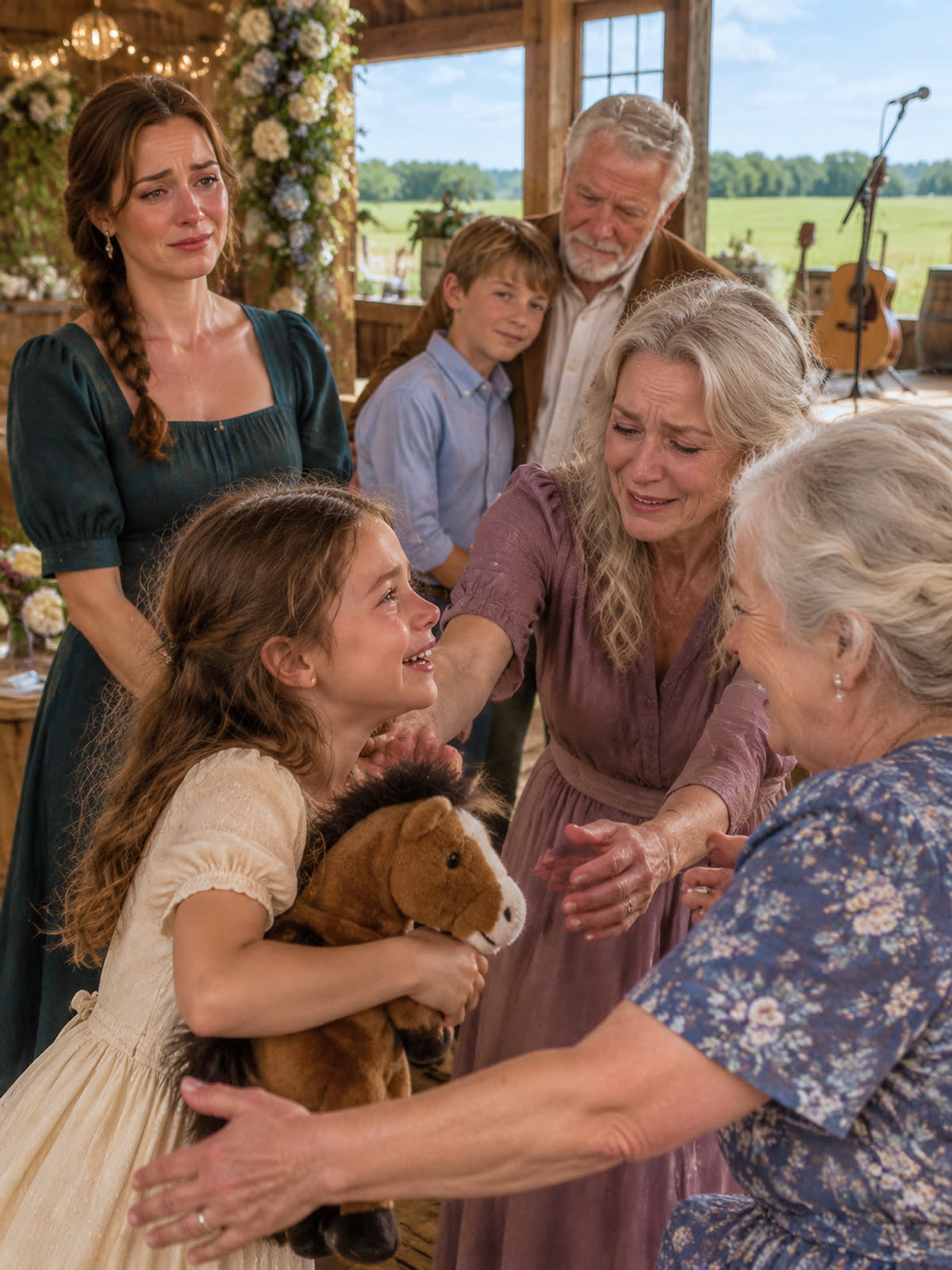
My mother’s expression crumpled. Pain twisted through my chest, but there was no satisfaction in it, no sense of revenge. Only sadness. She had missed eight years of birthdays and Christmas mornings, first steps, first words, and first days of school. She had missed them because helping us had seemed like more trouble than we were worth. “Lauren,” she whispered, “can we start over?” I studied her for a long moment. “Not tonight.” She lowered her gaze. “I understand.” Gently, I answered, “No,” and then, “I don’t think you do.”
I drew a breath. “You came here because you heard about the sale.” She stayed silent. “You didn’t come when Sophie was hospitalized with pneumonia.” She flinched. “You didn’t come when Owen broke his arm.” I kept going. “You didn’t come when the ranch nearly lost its electricity, or when I worked sixteen-hour days and fell asleep sitting at the kitchen table.” Tears slipped down her face. “But now that you think I have money, you want to be a family again.” She whispered, “I’m sorry.” I nodded. “I hear you.” Then I spoke the words I had spent years learning to trust. “But forgiveness doesn’t mean access.”
My father came forward. “You’re going to regret treating us this way.” Michael immediately moved beside me. “Mr. Bennett, I suggest you leave.” My father glanced around the room. Almost 300 people were watching, and several members of the ranch’s security team had moved near the entrance. My brother muttered under his breath, turned, and headed for the doors. My father went after him. My mother stayed a moment longer, looking first at the twins and then at me. “I’m sorry, Lauren.” I did not answer. At last, she followed them out.
The three people who had arrived expecting their share were gone. There was no shouting as they left, no dramatic pursuit—only three people walking out of a room in which they had expected to be honored. The guests remained silent. Then my father-in-law stood and approached me, moving slowly and carefully. He folded me into his arms. “You’re home, sweetheart,” he whispered. That was when I finally broke down. Eight years earlier, when his pickup arrived to collect us, he had said almost those same words. This time, I knew they were true.
When everyone had settled, I went back to the microphone. “I’m sorry for the interruption.” A few guests gave quiet laughs. Looking at my in-laws, I continued, “But there’s one more announcement.” My mother-in-law immediately shook her head. “Lauren, you’ve already done too much.” I smiled. “Not quite.” Michael placed another folder in my hands. Inside were the final documents setting out the arrangements for Willow Creek Ranch—the home my in-laws had spent decades trying to protect.
PART 3: WHAT THEIR OPEN DOOR MADE POSSIBLE
The original homestead and its surrounding acreage would stay with my in-laws. There would be no mortgage debt, no remaining threat of foreclosure, and no risk to their home from the business transaction we had just completed. My father-in-law stared at me. “Lauren…” I left the stage and put the folder in his hands. “This is your home.” He shook his head. “You didn’t have to do this.” I answered, “I know.”
He looked down at the documents and back at me. “Andrew would have wanted you to keep that money for the children.” Through my tears, I smiled. “And that’s why their future is already protected.” I glanced toward Sophie and Owen. “Andrew wanted them to grow up knowing where they came from.” My mother-in-law covered her mouth as I continued. “And I want them to know that when their mother had nothing, their grandparents gave her everything they could.”
Applause filled the room. My father-in-law drew me into another embrace, carrying the same familiar scent of leather, hay, and coffee I remembered from the day he took us home. For an instant, I felt twenty-six again: exhausted, terrified, and holding two babies. Only this time, the fear was gone. We were standing in the place that had sheltered us, surrounded by people who knew what it had taken to reach that evening.
I turned toward Victoria, who had remained quietly near the back. “Victoria, come here.” She looked startled. “Me?” I answered, “Yes, you.” When she reached the stage, I smiled at her. “Eight years ago, you saw potential in a horse everyone else had given up on.” Victoria laughed. “Clover was never worthless.” I agreed. “No,” I said. “She wasn’t.”
I gave her a framed photograph of Clover in the pasture with her first foal. Then I explained that part of the sale proceeds had been committed to an equine education and training fund. It would help young people who wanted to learn responsible horse care and breeding but could not afford the training they needed. The program would give others an opportunity to pursue the work that had helped us build a future.
Victoria stared at me. “You named it after Andrew?” I nodded. “The Andrew Bennett Memorial Scholarship.” Her eyes filled with tears. I continued, “Andrew believed a ranch was more than land and buildings. He believed it was a place where people could build a future.” I looked toward my children. “And I want his name to keep helping people do exactly that.”
The applause went on long enough that I had to pause before continuing. Then Sophie climbed onto the stage and tugged at my dress. “Mommy?” I crouched beside her. “Yes, sweetheart?” She asked, “Can I say something?” Smiling, I answered, “Of course.” I lowered the microphone so she could reach it, and she turned toward the guests.
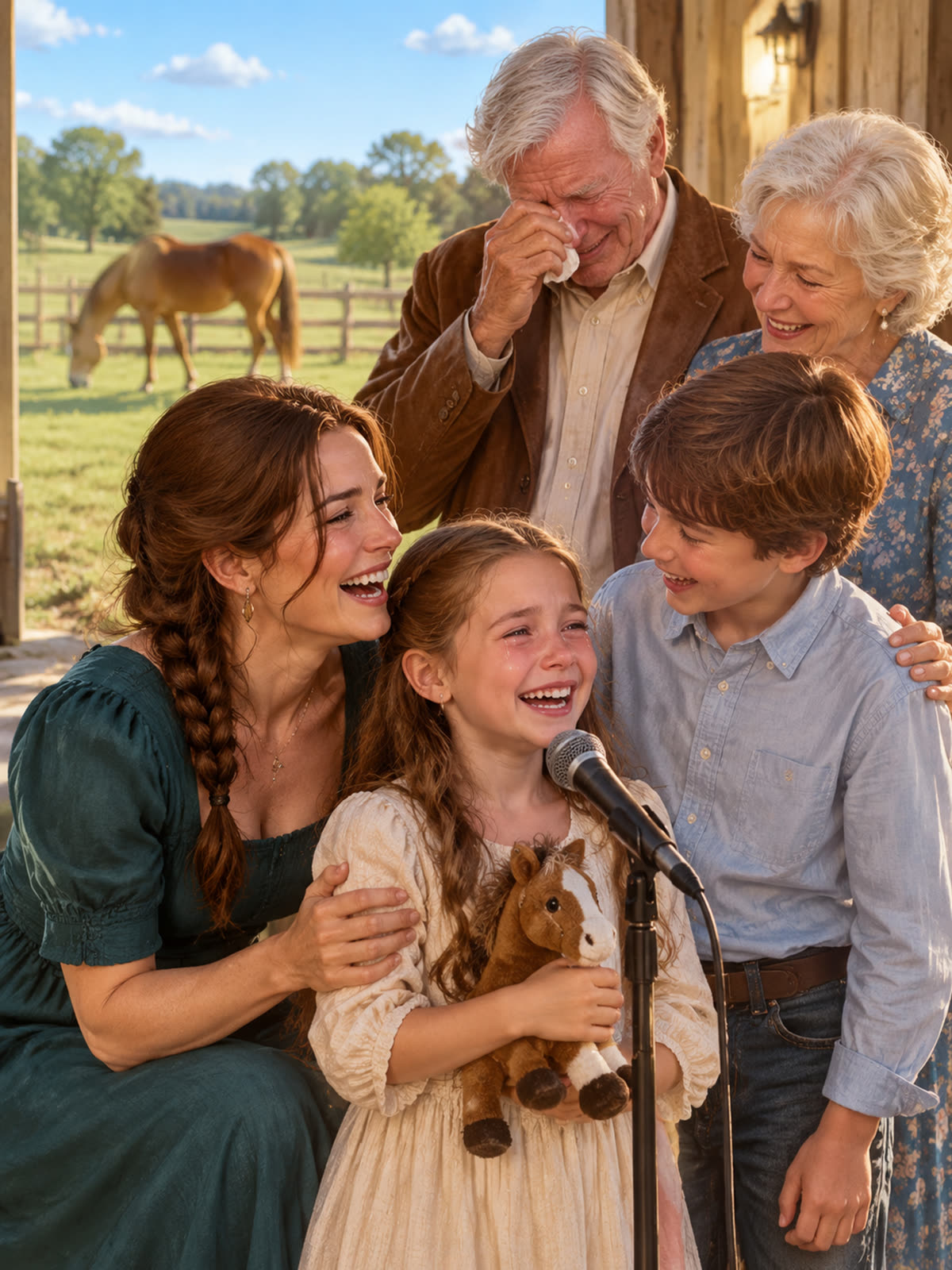
“My daddy loved horses.” Her simple statement quieted the room. I nodded. “Yes, he did.” Sophie smiled. “And Grandpa says Daddy would’ve loved Clover.” My father-in-law wiped at his eyes. I wrapped my daughter in my arms. “Grandpa’s right.” In that moment, Andrew’s place in our family was as clear as it had been in the words of his letter.
Then Owen ran toward us. “Can we have cake now?” Laughter broke out across the room. I kissed his head. “Yes, honey. We can have cake.” Just like that, the evening became a celebration again. The confrontation no longer belonged at its center. We could return to honoring the work, the people, and the love that had brought us there.
Sophie remained close as the laughter spread, her stuffed horse with her, while Owen’s question brought everyone back to the happiness of the occasion. My father-in-law had wiped his eyes, and my daughter’s words still rested with me. Andrew had loved horses. His children knew that, and they knew he had been loved. After everything my parents had demanded, these were the moments that made the evening ours again.
Six months after the sale, I sat on the porch at Willow Creek Ranch, watching Sophie and Owen near the pasture. They were nine now, old enough to ask about their father and understand that he would not return. They were also old enough to understand how deeply people had loved him. My father-in-law was showing Owen how to mend a fence, while my mother-in-law helped Sophie plant flowers beside the barn.
Nearby, Clover grazed in peace. She was older, with a few more gray hairs in her coat, and she still moved with the unusual stride that had once made people think she was not worth keeping. I smiled. Sometimes, I thought about how profoundly our lives had changed because someone had looked at that mare and recognized possibility rather than failure.
My phone vibrated with a message from my mother.
Lauren, I know I don’t deserve a reply. I just wanted to tell you that I’ve started seeing a counselor. I’ve been thinking about what you said.
I read it twice before putting the phone down. I had not spoken with my parents since the celebration. My brother had contacted me several times about his struggling gym. I had directed him to publicly available small-business resources, but I had not sent money.
My father had written one angry letter, which Michael handled. My mother, however, had begun sending occasional messages that contained neither demands nor excuses, only brief apologies. I did not know if she had genuinely changed. I would not pretend that a few texts could repair eight years of absence. Still, I hoped that someday she might understand what she had lost.
I watched my children laughing. They were safe and loved, surrounded by people who had never considered them a burden. Something became clear to me: my life did not require my parents to become different people before it could be complete. Without their approval, I had already built something beautiful. Their absence was part of our history, but it did not determine the worth of what we had now.
Later that afternoon, my mother-in-law joined me on the porch with two mugs of coffee. She passed one to me. “Thinking about Andrew?” I gave a sad smile. “A little.” Sitting beside me, she said, “He’d be proud of you.” I looked out toward the pasture. “I wish he could see the kids.” She nodded. “So do I.” We sat together in easy silence for a while.
Then she reached into her sweater pocket. “I found something while cleaning the old barn.” She handed me a small photograph of Andrew beside Clover when the mare was young. He was smiling, one hand resting against her neck. On the back, he had written:
This little one might surprise everybody someday.
I stared at the picture and began to cry.
Before everything changed, Andrew had believed in the very horse that would eventually help save our family. My mother-in-law put an arm around me. “He always saw the good in things,” she whispered. I nodded. “He did.” I looked from Sophie and Owen to the ranch—the place that had welcomed us when we had nowhere else, where I had learned to survive, work, hope, and eventually succeed.
Eight years earlier, I had stood outside my parents’ door with $400 and two babies. My mother’s declaration that they were not my safety net had haunted me for a long time. Now, I understood what I had not understood then. I had not needed someone to spare me every hardship. I had needed people who would not turn away while I struggled to stand on my own.
My in-laws were not rich. They could not solve every problem. What they could do was open their door, share their food, make space for my children, and believe I deserved an opportunity. That had been enough to transform our lives. Looking at Andrew’s photograph, I whispered, “We made it.” A breeze passed through the pasture. Clover raised her head, and behind me, my children started laughing again. I smiled through my tears.
My parents had once decided that, because I had nothing, I was not worth helping. Eight years later, believing I had millions, they arrived to claim a share. Yet money was never the greatest thing I gained. That was the family who loved me before I had anything to give them—something no fortune could purchase. My life with them was already whole. Whether my mother had truly begun to change, however, was something I still did not know.
Disclaimer: This story is a work of fiction inspired by real-life themes. Names, characters, places and events are fictionalized, and any resemblance to real persons is purely coincidental. It does not represent any person or organization and does not encourage inappropriate behavior. Images are for illustration purposes only.
