


PART 1: THE KEY HE NEVER KNEW SHE HAD
“If my mother dies while I’m gone, don’t ruin my vacation by calling me. Just handle it.” My husband believed he could entrust his sick mother to me and fly off with his mistress as though neither of us mattered. This time, he was wrong. My name is Maren Whitcomb. I was fifty-eight, and until that Tuesday, I had devoted thirty-one years to being the kind of wife who apologized when her husband stepped on her feet. Inside our costly home in Ashbrook, Oregon, Grant straightened the cuffs of his designer shirt. “I’ll be in Maui for at least fifteen days,” he declared. “The company has a major development project. Don’t bother me unless it’s absolutely necessary.” He bent to fasten his shoes beside an enormous black suitcase. He ordinarily traveled with a carry-on. This looked more like luggage for an extended honeymoon.
“Did you hear me, Maren?” “Perfectly.” My calmness appeared to irritate him. He straightened and added, “And make sure Mom’s taken care of. I don’t want another call from the home health agency complaining about payments.” I looked at his wedding ring, thinking about three decades of faithfulness, sacrifices, and promises that apparently carried no weight anymore. “Have a wonderful trip,” I replied. His expression tightened. “You’re acting strange.” “Am I?” “Usually you complain when I travel.” I allowed myself a small smile. “People change.” He dismissed that with a shrug, collected his suitcase, and walked outside. From the window, I watched him head toward his silver Mercedes. A beautiful blonde wearing oversized sunglasses waited in the passenger seat.
Her name was Tessa Langley. She was thirty-four, his executive assistant, and, judging by the messages I had discovered three nights earlier, the woman he intended to spend the rest of his life with. When he opened the driver’s door, she leaned over the console and kissed him. His affectionate laugh was a sound I had not heard directed at me in more than ten years. As their car disappeared, my fingers closed around the brass key inside my apron pocket. Under my breath, I murmured, “You have no idea what you’ve just left behind.” Downstairs, Evelyn Whitcomb lay in her adjustable hospital bed. My mother-in-law was eighty-three. A stroke three years earlier had severely damaged her speech and movement, but Grant insisted the damage had taken her understanding, too.
“Mom’s gone,” he would tell people dismissively. “Her body just hasn’t figured it out.” I knew that was untrue. I brought a chair close to her bed and spoke quietly. “He’s gone,” I murmured. “Just like we expected.” She blinked once, deliberately, using the signal we had established for agreement. I wrapped my hand around hers. “Are you ready?” Another purposeful blink answered me. Three days before, while I was replacing her bedding, her fingers had unexpectedly caught my wrist. The grip was weak, but the determination behind it frightened me. Again and again, she looked toward the antique dresser near the mirror. Eventually, I understood. Behind the mirror, I found an envelope secured with tape. Inside were a brass key and a folded note containing four unsteady words: Don’t trust my son.
The paper almost fell from my fingers. Tears gathered in Evelyn’s eyes. For three years, visitors had spoken around her as if she were furniture. Grant discussed money within her hearing, made calls about selling her property, and complained that her medical expenses were eating away at what he already considered his inheritance. She had understood it all. I used the key on the dresser’s bottom drawer and found three folders, a bank statement, and a thick envelope marked with Grant’s initials. One folder traced payments from Evelyn’s accounts into his, then onward to Tessa. Another contained real estate documents supposedly authorizing Grant to control Evelyn’s home. The signature was immediately wrong. It looked like his imitation of her handwriting rather than the writing I knew.
The large envelope held a proposed power of attorney, a copy of Evelyn’s identification, and documents authorizing a property sale. Another false signature appeared beneath an unfamiliar notary’s stamp. Grant was not simply betraying his marriage. He was taking money from his disabled mother and preparing to sell her house to finance a luxurious new life with Tessa. After photographing everything, I called Nolan Pierce, an attorney who had known my parents for years. “He’s gone,” I told him. “Did you find the documents?” “Yes.” “Good. Don’t confront him. I’ll contact the bank’s fraud department and start the emergency protective filings. What about Evelyn?” “She’s ready.” “Then we move her today.” When the call ended, I met Evelyn’s anxious eyes. “I promise you,” I murmured. “He won’t hurt us again.”
Before we left, I entered Grant’s upstairs office. His tablet still opened with the same four-number code he had used for years. On its screen was a photograph of him and Tessa on the balcony of an expensive oceanfront condominium. Beneath it, a message read: Once we sell the old woman’s house, we’ll have enough to disappear permanently. I scrolled farther. Another message made my stomach turn. I’ve already opened the account in Maren’s name. When the auditors start asking questions, everything will point to her. She’ll be too busy caring for Mom to figure it out. He intended to leave me carrying the blame for theft, along with every other burden he had discarded. Then I read something even worse: By the time we come home, Mom won’t be our problem anymore. I’ve arranged for someone to take care of that.
My hands shook around the tablet. His greatest mistake had been assuming his mother could no longer understand him. She had heard enough to know what he was planning. At eleven, a medical transport van pulled up outside. Grant could scarcely have reached the airport, where I imagined him sharing champagne with Tessa in the first-class lounge. Meanwhile, four people at home were preparing to remove the woman he believed could never escape him. Heather Kincaid, the social worker involved in Evelyn’s treatment for almost three years, stepped out of the van and hugged me. “You did the right thing, Maren.” “I hope so.” “Your mother-in-law deserves better than this.” “So do I.” Her expression softened. “Yes. You absolutely do.”
We had quietly planned the transfer during the preceding week. Evelyn’s physician had recorded her ability to make dependable choices using eye movements and a letter board. Before the stroke, she had also completed an advance healthcare directive naming me as her preferred decision-maker if she became unable to act for herself. Grant had never bothered to read it. Together with Evelyn’s expressed wishes and her doctor’s approval, it allowed us to arrange a safe move without giving him control over it. The nurses carefully shifted her onto a stretcher. When they brought her out of the dim bedroom, daylight touched her face for the first time in three years. I stayed beside the van while they secured her equipment and wheelchair.
“Evelyn,” I reassured her, “you’re going somewhere beautiful.” She blinked twice, asking a question. I leaned closer. “Yes. I’ll visit every day.” Her fingers tightened over mine. That slight pressure carried me back twenty-six years, to the first time she had held my hand. It was Christmas Eve. Grant’s relatives had filled our dining room, drinking expensive wine and criticizing the meal I had prepared. Then his aunt began ridiculing my inability to have children. “At least a woman should give her husband a family,” she announced. Everyone laughed. Grant laughed with them. Before they could notice my tears, I gathered dirty dishes and retreated to the kitchen. Evelyn followed me, carrying a cup of hot tea that she placed carefully between my shaking hands.

“Listen carefully, Maren,” she said. “A woman’s worth isn’t measured by how many children she has.” I looked up at her. “Then why does everyone treat me like I’m useless?” “Because some people mistake cruelty for importance.” She brushed a tear from my face with unexpected tenderness. “You belong in this family because I say you do.” After that evening, she became much more than my husband’s mother. She offered comfort when the rest of his family made me feel small. When the stroke came, abandoning her was never something I could do. Grant understood that, and he used my love for her against me. He withdrew from her care, grumbled about the smell of disinfectant, and reduced the household money while treating himself to watches, clothing, and golf clubs.
Once, when I was feverish and struggling to remain upright in Evelyn’s room, he demanded to know when dinner would be ready. “Order something,” I murmured. He looked at me with open contempt. “What exactly do you do all day?” Remembering that moment as the transport van drove away, I understood how thoroughly he had mistaken my devotion for helplessness. He had left his sick mother in my hands while he traveled with another woman. He expected me to keep serving him. Instead, I packed two changes of clothing, my mother’s silver locket, a photograph of my parents, and the keepsake box I had owned as a child. Everything I needed from thirty-one years of marriage fitted into one battered suitcase.
I walked through the house, convinced I would never live there again. In the kitchen, I had prepared thousands of meals. In the dining room, I had endured his family’s mockery. On the staircase, I had paused countless times, listening for his movements before deciding whether it was safe to speak. I placed Nolan’s preliminary divorce documents at the center of the dining table. Then I removed my worn, scratched wedding band and set it over my signature. “Enjoy your vacation, Grant.” I locked the door behind me and drove fifteen miles to my parents’ property on a quiet street. They had both been gone for years, but I had refused every demand Grant made to sell their home. To him, it was an unnecessary expense. To me, it was the one place where I could still recognize myself.
The living room smelled of familiar cedar furniture and looked almost as it always had. My father’s glasses remained in their wooden tray. My mother’s favorite blue blanket lay over the sofa. I approached their photograph on the mantel. “Mom. Dad.” My voice broke. “I’m home.” For a long time, I simply stood there. Then my phone rang. It was Nolan. “Maren, are you somewhere private?” “Yes.” “I’ve spoken with the compliance officer at Grant’s company.” I sat down. “What did they say?” “Your husband has been diverting company money for months.” “I know.” “No, Maren. You don’t understand.” His voice grew more serious. “The amount is much larger than we originally believed.” I held the phone more tightly. “How much?”
“Potentially more than seven hundred thousand dollars. The investigators are still reconciling the accounts.” I could not answer. I had known Grant was stealing, but hearing the possible amount made everything around me seem to recede. “And there’s something else,” Nolan continued. “Grant told his employer that you were terminally ill.” My eyes returned to my parents’ photograph. “What?” “He claimed you needed an emergency organ transplant overseas. He used that story to obtain hardship advances and solicit money from employees and clients.” My heartbeat quickened. “That’s insane.” “He also opened an account under your identity. Some of those funds passed through it.” Even now, away from the house and his voice, he had found a way to make me afraid.
For years, Grant had twisted explanations until I doubted my own memory. Now I pictured him doing the same thing to investigators, colleagues, and bank employees. He would sound reasonable. He would present himself as the responsible husband who had tried to care for a sick wife and a helpless mother. I would be the woman whose name appeared on an account full of stolen money. “Am I going to be arrested?” I asked. “We’re documenting the identity theft now. The bank has preserved the application, and the signatures don’t match yours. But I need you to bring every original document you found.” I turned toward my suitcase. The heavy envelope from Evelyn’s dresser was still inside it. Until that moment, I had thought its contents could not possibly hold anything worse.
I opened the case and took out the envelope. My fingers moved along its edges while Nolan remained on the line. Something about its thickness felt wrong. “Nolan?” “Yes?” “There’s something strange about that envelope.” “What do you mean?” “It has a second lining.” Between two cardboard layers, I found additional bank records and a copied driver’s license. The name printed on the license was my full legal name. The face belonged to another woman. Grant had not merely written my name on forms. Someone had pretended to be me, and he had apparently trusted her to help make his crimes look like mine.
I held the copy nearer the light. A dark wig and glasses altered the woman’s appearance, but they could not change the small scar on her chin. I had seen that scar on the blonde waiting in Grant’s Mercedes. It belonged to Tessa. While I had been changing his mother’s sheets and worrying about grocery money, his mistress had been wearing my identity. The messages on his tablet had already shown his willingness to frame me. This photograph showed how deliberately they had prepared to do it. I had left our marriage carrying a suitcase and a set of papers. Now I was looking at evidence that someone else had been living behind my name.
I thought about the terminal illness he had invented, the money collected from sympathetic people, and the account he expected investigators to trace back to me. I thought about Evelyn, unable to interrupt the conversations taking place around her bed. Both of us had been useful to him only while we were silent: his mother as a source of money, and his wife as someone available to absorb the consequences. Neither of us had been silent in the way he imagined. Evelyn had hidden a key. I had taken the documents. Nolan had begun making calls. Yet the message about someone taking care of his mother would not leave my mind.
The room around me was peaceful, unchanged, and familiar. Nothing about it could explain the stranger staring back from a license with my name on it. I had believed the worst part of leaving Grant would be finding the courage to go. Instead, my escape had uncovered a plan that reached into my identity, Evelyn’s property, and an account holding stolen money. I lifted the phone again, the copied license trembling between my fingers. The woman in the photograph had helped open the account that could destroy me—and she was in Maui with my husband.
PART 2: THE EMPTY WHEELCHAIR AT MIDNIGHT
I sent Nolan a photograph of the false license immediately. He called within minutes. “Keep everything exactly as you found it,” he instructed. “And don’t contact either of them.” “Can they really get away with this?” “Not if we establish the chain of transactions and prove your identity was used without authorization.” “Then let’s establish it.” He contacted the bank, the company’s investigators, and a financial crimes detective. The bank opened a fraud investigation and restricted the account, while Grant’s employer preserved its accounting records. I also learned that Tessa’s role went far beyond having an affair. She had helped produce false invoices, move corporate funds, and arrange the purchase of a condominium in Maui. Every discovery made my husband seem more like someone I had never known.
That afternoon, I visited Evelyn at Willowbrook Rehabilitation Center, on a wooded hill outside town. Her private room had large windows and fresh flowers. The nurses spoke directly to her, treating her as a person rather than a body requiring attention. When I entered, she was looking out at the garden. “Hello, beautiful.” Her face brightened. I sat down and showed her a photograph of my parents’ house. “Remember where my mother used to make those cinnamon rolls?” She blinked yes. “I’m staying there now.” She lifted her hand to my cheek. After three years of hearing people describe her as unaware, I found that small movement extraordinary. “I found the papers,” I told her softly. “All of them.” Her expression changed, and she tried to speak.
“Don’t worry. Nolan is handling everything.” I held her hand. “You’re safe.” But as I got ready to leave, she became restless. Her gaze moved repeatedly between my document bag and the window. Using her letter board, she slowly identified three words: HOUSE. MORE. DESK. I stared at her. “There’s something else in Grant’s office?” One blink confirmed it. I called Nolan at once. He informed the detective investigating the fraudulent accounts, and I returned to identify the records Evelyn meant and collect personal belongings. Nolan warned me not to disturb anything that could become criminal evidence. In Grant’s office, a strip of tape beneath his desk caught my attention. A key came away with it. For a man so concerned with security, he had always hidden spare keys predictably.
The key opened the lowest drawer. Inside was a black folder labeled PROPERTY DISPOSITION. Reading it left my mouth dry. Grant had made an agreement with a business I did not recognize, Shoreline Property Acquisitions. The price was unusually low, and the property was to be delivered vacant. The proposed transfer date fell exactly fifteen days after his departure—the day he expected to return from Maui. Another sheet recorded a $10,000 advance through Tessa’s account. Below it was a handwritten instruction: Remove remaining occupants and personal property before possession. He had reduced his wife and disabled mother to obstacles standing between him and a profit. We were not family in those papers. We were simply occupants who needed to disappear.
I photographed the pages without taking the originals. When Nolan reviewed the images, his concern was unmistakable. “This company may have been cooperating with him. We’re asking the court to block the transfer while the ownership dispute is investigated.” “Can they still take the house?” “Not lawfully based on forged documents. But I don’t want anyone entering before we secure the property.” With the detective’s approval, I hired licensed movers that evening to collect the belongings police had cleared. They packed Evelyn’s family photographs, handmade quilts, carved dresser, and the purple sweater she had knitted for me. My own clothes and personal keepsakes went with them. We left Grant’s expensive furniture, watches, suits, and golf equipment exactly where they were.
Watching Evelyn’s dresser being carried out, I felt a great weight begin to loosen inside me. The building I had once called home now looked much more like a place where I had been confined. Later, in my parents’ kitchen, a newly synchronized message appeared on Grant’s tablet. It was addressed to someone named Rick: The old lady will be alone tonight. Pick her up after midnight. No hospital, no paperwork, and don’t tell Maren until it’s done. I stopped breathing for a moment. Another message followed: I canceled the private-care payments. By the time anyone asks where she went, we’ll be back from Hawaii. Make sure the facility is somewhere nobody checks. I reached for my phone and called Nolan.
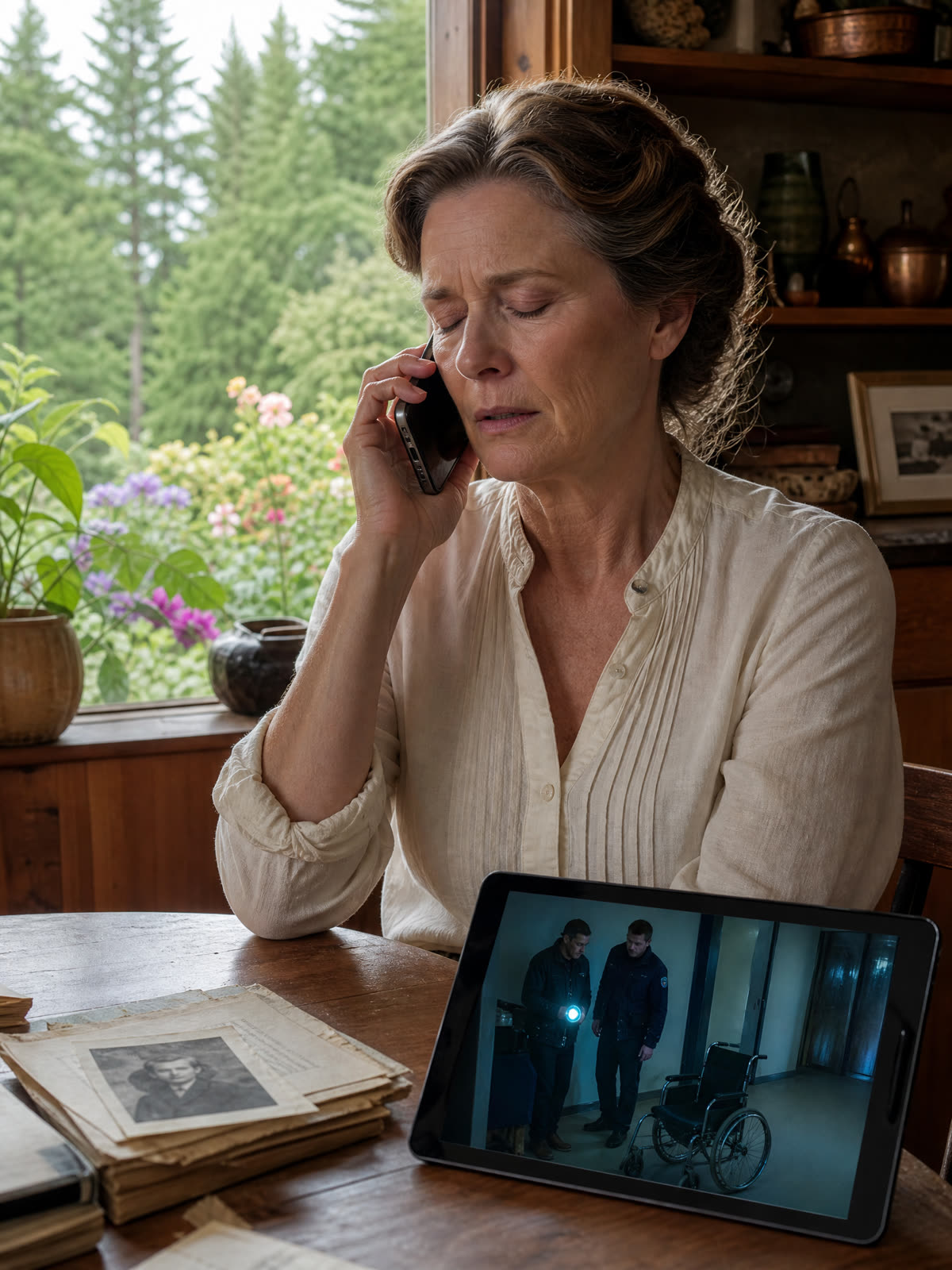
Before he answered, a notification appeared from the hallway cameras I had installed. Someone had unlocked the house. At 12:17 a.m., the live footage showed two men wearing dark work jackets. One held a flashlight. The other pushed an empty wheelchair. “Where’s the patient?” the first asked. “Back bedroom,” his companion answered. I watched them walk down the corridor toward the room where Evelyn had spent the past three years. They moved as if they expected no resistance, no questions, and no witnesses. A moment later, the first man shouted, “What the hell? She’s gone!” His companion swore. “Call Grant.” I watched as he made two calls. Neither was answered.
Then the second man said something that chilled me. “We were supposed to take that old woman to the place outside Bend. They already paid us to leave her there.” The first turned toward the security camera and smiled. “Well, if she’s missing, maybe we can tell them she died before we got here.” He took out a document bearing my forged signature. According to that paper, I had willingly surrendered Evelyn into their care. Without her warning, they would have taken her away that night. If anyone later asked questions, Grant already had paperwork prepared to make it my responsibility. I called 911 and Nolan while the men were still inside the house.
Through the live feed, I watched police stop them beside their van as they came outside. One claimed to work for a patient transportation company. The other said they had simply been told to collect an elderly woman. Neither could produce valid authorization, and the form supposedly signed by me was false. The following morning, the detective investigating Grant’s finances called. The men were Rick Dalton and Travis Boone. Neither held the qualifications required for medical transportation. The destination outside Bend was an unauthorized residential facility that had already attracted neglect complaints. “Mrs. Whitcomb,” Detective Rowan Mercer said, “we’re looking into who hired them and what they were instructed to do.” “Did Grant pay them?” “We have evidence of a payment through an intermediary. We’re tracing it.”
“Please find out everything.” “We intend to.” I closed my eyes. If I had stayed, they might have removed Evelyn while I slept. If I had tried to stop them, they might have hurt me. If she later died, the forged authorization would have pointed to me. All the while, Grant was enjoying a holiday with his mistress. That afternoon, Nolan called with the first audit results from Cascade Development Group. Approximately $800,000 was missing. Some had gone into false vendor accounts, some through the account opened under my identity, and substantial amounts had reached Tessa before being directed toward the Hawaii condominium. “The company has reported everything to law enforcement,” Nolan said. “Their investigators also found falsified invoices that Tessa approved.”
“Then she knew.” “She certainly knew about the false accounting. How much she knew about Evelyn’s situation is still being investigated.” I pictured her smiling from the passenger seat of Grant’s Mercedes. The comfort she was enjoying had been purchased partly with money stolen from a vulnerable elderly woman, and she had helped carry out the theft. “What’s happening to the condominium?” “The financial investigation has reached the lender and escrow company. The authorities are examining whether criminal proceeds were used. The ownership and financing are under scrutiny.” “And Grant?” “His company has suspended him. His corporate cards are disabled, and the bank has restricted the accounts implicated in the fraud.” I imagined him attempting to explain those sudden inconveniences to Tessa.
For years, he had inspected my grocery receipts and complained about the cost of medical supplies. He had even called a cake for my birthday wasteful. Now, thousands of miles away, the man who questioned every dollar I spent was losing access to money he had no right to possess. Three days after leaving, he started calling repeatedly. I let eleven calls go unanswered. Messages followed: Why isn’t my corporate card working? Call the bank immediately. Where the hell is Mom? The house phone is disconnected. What did you do? When I did not respond, his demands became threats. You’d better fix this before I get home. Don’t forget whose money pays your bills. I can throw you out whenever I want.
Once, those messages would have sent me rushing to apologize and repair whatever had displeased him. This time, I read them on my parents’ porch with a glass of iced tea beside me and sunlight warming the garden. He no longer controlled the roof over my head, the accounts bearing my name, or the decisions about Evelyn’s future. The following afternoon, another call arrived. Tessa’s number appeared on the screen. I answered. “Hello?” “What the hell is wrong with you?” she demanded. She sounded furious. Behind her voice, I heard waves breaking. “Excuse me?” “Grant says you’ve been interfering with our accounts.” I almost laughed. “Our accounts?” “Yes! We’re trying to buy something, and his cards keep getting declined.”
“That sounds inconvenient.” “Don’t get smart with me.” I took another sip of tea. “Maren, listen carefully. Grant is leaving you. You need to accept that and stop acting like a pathetic old woman.” Her insult did not hurt the way she intended. Instead, it made everything clearer. “Tessa,” I asked, “did you enjoy pretending to be me?” The line went quiet. “What are you talking about?” “The fake driver’s license. The bank account. The paperwork with my signature.” Her breathing changed. “I don’t know what you mean.” “Then you’ll have no trouble explaining it to Detective Mercer.” I heard an indistinct argument, followed by Grant taking the phone.
“Maren! What have you done?” “Hello, Grant.” “Why are the police talking to people at my office?” “Maybe someone finally checked your accounting.” “Don’t play games with me!” Beneath his anger, there was something I was not accustomed to hearing. Fear. “Where’s my mother?” “Safe.” “Where?” “Somewhere you can’t reach her.” “You had no right!” I closed my eyes briefly. He was not relieved that Evelyn was unharmed. He was angry that he could no longer control her. “Your mother is alive, Grant,” I said quietly. “I understand that wasn’t part of your plan.” For several seconds, I heard only wind and the distant sea. At last, he asked, “What do you know?” “Enough.” I ended the call.
That evening, I contacted Lowell Whitcomb, Grant’s seventy-nine-year-old uncle. A retired judge’s clerk and a respected family elder, Lowell was someone whose approval Grant had always wanted. He liked presenting himself to his uncle as a devoted son, a successful businessman, and a generous husband. At first, Lowell could not believe what I told him. Nolan sent him the relevant records. Twenty minutes later, Lowell called back, and his voice was different. “Maren, I owe you an apology.” I said nothing. “We let him treat you terribly.” “Yes,” I replied. My direct answer seemed to surprise him. He sighed. “I should have seen it.” “You could have listened.” A long silence followed. “You’re right.”
For the first time in thirty-one years, someone from Grant’s family admitted what had happened without immediately finding an excuse for him. Lowell asked to visit Evelyn. She approved the request through her communication board. At Willowbrook the next day, he wept beside his sister-in-law’s bed. Later, he told Nolan that he wanted to be there when Grant returned. Meanwhile, Nolan found Evelyn’s original will among her estate papers. She had signed it before the stroke, long before either of us understood the full extent of her son’s character. Its instructions showed that she had already decided whom she trusted. Even after everything I had learned, that discovery reached a place in me that Grant’s cruelty had never quite destroyed.
The days that followed were no longer measured by Grant’s needs. They were measured by legal calls, preserved records, visits to Evelyn, and the slow recognition that I did not have to answer every demand he made. Temporary court orders stopped the property transfer while investigators examined the evidence. Evelyn remained the lawful owner. The suspicious funds were under investigation, and my divorce petition was ready to be served. Nothing about the process was as simple as leaving a wedding ring on a table. There were signatures to examine, accounts to trace, and lies that had been carefully built over time. But for once, people were studying Grant’s version of events instead of expecting me to accept it.
I kept returning in my mind to the camera footage: the empty wheelchair rolling down the corridor, the men looking for Evelyn, the forged paper already waiting to make me responsible. The sight explained why her fingers had closed around my wrist with such urgency. She had not merely been asking me to protect her money. She had been trying to save us both. Grant had dismissed her eyes because he could not understand what they were saying. He had dismissed my patience because he mistook it for an inability to act. By the time he began demanding answers from Maui, the two women he believed helpless had already moved beyond his reach.
On the fifteenth day, he came back. He apparently still believed that anger and intimidation would straighten out whatever had gone wrong. He did not know how much evidence had been gathered, what his mother had communicated, or who would be waiting inside the house with her permission. I was in my parents’ sitting room when Nolan called. “He’s landed.” “Are you certain?” “Yes. Detective Mercer has confirmed his arrival. Lowell is with me at the house, with Evelyn’s permission.” “Does Grant know?” “Not yet.” My mother’s silver locket rested on the table beside me. In a few hours, Grant would open the front door—and discover that the wife and mother he had left behind were no longer there to obey him.
PART 3: WHAT WAITED IN THE EMPTY HOUSE
My mother had fastened that silver locket around my neck on the morning of my wedding, thirty-one years earlier. “Marriage shouldn’t cost you your dignity,” she had murmured. Only now did I fully understand her warning. At 4:42 p.m., Nolan called again. I answered immediately. “He’s here.” Through the phone, I heard the front door open, followed by Grant’s voice carrying along the empty hallway. “Maren! I’m home!” No one answered. “Maren?” Shoes crossed the wooden floor. Then Tessa spoke. “Why is everything so dark?” Grant tried two light switches without success. “Unbelievable,” he muttered. “That woman couldn’t even keep the utilities running.” I remained still in my chair, listening.
His footsteps reached the sitting room. “What the hell?” The family photographs were gone, along with Evelyn’s quilts and belongings. Without the things that had given it warmth, the room looked emptied of its history. The old dining table remained, with my wedding ring and divorce petition resting on top. “Where’s the furniture?” Tessa asked sharply. Grant did not answer. He hurried into Evelyn’s room, and I heard the door hit the wall. “Mom?” Silence. “Mom! Where are you?” He rushed into the hallway. “Maren! Come out right now!” Then he ran upstairs. When he apparently reached his office, a desperate cry came down the line. “My files!” From below, Tessa called, “Grant, what is going on?”
He stumbled back downstairs. That was when Lowell finally spoke. “Looking for something, Grant?” Everything became still. “Uncle Lowell?” “Your mother, perhaps?” “Why are you here?” Lowell’s voice stayed level. “Because someone needs to explain what you did to her.” Grant tried to recover his usual authority. “I don’t know what Maren told you, but she’s been acting irrationally.” “Stop.” “I think she’s having some kind of breakdown.” “Stop lying.” My husband fell silent. Then Nolan introduced himself. “Mr. Whitcomb, I’m Nolan Pierce. I represent your wife and your mother.” “My mother doesn’t need a lawyer.” “Actually, she does.” Grant gave an uneasy laugh. “Listen, I just got off a long flight. We can discuss this tomorrow.” “No,” Lowell replied. “We’ll discuss it now.”
I heard papers being placed on the table. “These are copies of the property documents you submitted using your mother’s forged signature,” Nolan said. Grant made no reply. “And these are records showing transfers from her accounts.” “That was family money!” “It was Evelyn’s money.” “I was handling her affairs!” “Without valid authorization. You used a fraudulent power of attorney.” Tessa interrupted. “Grant, what are they talking about?” Nolan continued without answering her. “We also have records from Cascade Development Group showing fraudulent invoices and transfers into accounts connected to you and Ms. Langley.” She drew in a sharp breath. “Connected to me?” “Your signature appears on several financial documents.”
Tessa turned on Grant. “You said the money came from your investments!” “Tessa, shut up.” “You told me you owned the company!” “Tessa!” Lowell struck his walking stick against the floor. “Enough!” His voice rang through the bare room. “Your wife spent three years caring for your mother while you stole from her, abandoned her, and prepared to sell her house!” Grant’s breathing sounded uneven. “That’s not true.” “Then explain the two men who came here at midnight with an empty wheelchair.” No answer. “Explain the fake caregiver authorization bearing Maren’s signature.” Still nothing. “And explain why your mother was supposed to be taken to an unlicensed facility outside Bend.” At last, Grant spoke so quietly I could barely hear him. “Mom doesn’t understand anything.”
After a pause, Nolan set down another page. “Your mother understood enough to identify where you hid the evidence.” “What?” “She gave Maren the key.” Something clattered in the room. “That’s impossible.” “She also left a written message.” Nolan read it aloud. “Grant is stealing from me. Maren, get out.” Genuine terror entered Grant’s voice. “She wrote that?” “Yes.” “But she can’t—” “She communicates using her eyes and her right hand. Her medical team has documented it.” Grant whispered, “She heard us?” Lowell answered him. “She heard everything.” I shut my eyes. The woman he had treated as an object had heard his plans, understood his cruelty, and helped expose him.
Nolan opened the remaining envelope. “There’s one more document you should know about.” He explained Evelyn’s valid will, signed well before the stroke. It named me as the principal beneficiary of the estate she might eventually leave and deliberately excluded Grant. The will did not transfer her property while she was alive, but it made her wishes unmistakable. A strangled sound escaped my husband. “She left everything to Maren?” “Her current property remains hers,” Nolan clarified. “But yes. Those are her estate instructions.” “I’m her son!” Lowell’s reply was devastating in its simplicity. “And you treated her like she was already dead.” Grant began shouting. “That house belongs to me! I can sell it! I’ve spent my whole life working for this family!”
“You cannot sell property you don’t own,” Nolan answered calmly. At last, I spoke. “Nolan, put me on speaker.” A click sounded, followed by Grant’s sharp intake of breath. “Maren?” “Hello, Grant.” His voice softened immediately. “Sweetheart, listen. Whatever happened, we can work it out.” I looked at the bare place on my finger. “No, Grant. We can’t.” “Please. Don’t do this.” “You spent years telling me I owed you everything. But you were the one taking everything from us.” “I made mistakes.” “You tried to make your mother’s disappearance my responsibility.” He said nothing. “You forged my identity. You stole her money. You lied about me needing a transplant. And you abandoned the woman who raised you.”
He struggled for breath before pleading, “Maren, please save me.” I finally gave him the answer I had needed thirty-one years to find. “I’m not your servant, Grant. And I’m not your property.” Another voice interrupted. “Grant Whitcomb?” Footsteps drew closer. “Detective Rowan Mercer. We have a warrant for your arrest.” Grant protested. Tessa began crying. Then, over the phone, I heard the unmistakable closing of metal handcuffs. Fifteen days earlier, he had walked out believing every part of our lives remained under his control. Now he was being escorted from his mother’s property with only the clothes he was wearing. I sat in my parents’ home, holding the phone, and waited to feel whatever was supposed to come next.
When Nolan called back, I expected relief, satisfaction, perhaps even laughter or tears. Instead, I was simply exhausted. I did not feel guilty, and I was not grieving the marriage. Thirty-one years of fear had stopped with the sound of those handcuffs, leaving a silence I did not yet know how to fill. In my parents’ kitchen, I made tea. Nobody complained that the kettle was taking too long. Nobody demanded dinner or criticized how much sugar I used. I sat beside the window and watched darkness gather over the garden. Only then did I let myself cry. I was not crying because I wanted Grant back. I was mourning all the years I had spent trying to satisfy someone who had chosen to be cruel.

The next morning, I went to Willowbrook. Evelyn sat in her wheelchair near the window. Heather had placed yellow roses in a small vase on the table. “Good morning, sweetheart,” I murmured, kneeling beside her. “It’s over.” Her eyes widened slightly. “Grant won’t be coming back to hurt us.” She studied my face, then reached toward the communication board resting across her knees. Slowly and deliberately, she selected four words: ARE YOU SAFE NOW? My throat tightened. After everything her son had done, she was not asking about her house, her savings, or his arrest. She wanted to know whether I was all right. “Yes,” I whispered. “I’m safe.” Tears filled her eyes, and a faint smile appeared. I rested my forehead against her hand. “And so are you.”
During the months that followed, investigators reconstructed the transfers, forged documents, and identity theft involving Tessa. Cascade’s losses approached $800,000. Faced with the counterfeit identification and account applications, she began cooperating with prosecutors. She admitted moving money through fraudulent accounts and knowing that Evelyn’s property had been used without permission. Her own messages contradicted her claims of ignorance. Grant first tried to blame Tessa, then tried to blame me. After that, he argued that his mother’s condition made her incapable of understanding financial matters. Independent medical assessments established that Evelyn remained aware of her circumstances and could communicate her preferences. Once again, people listened to her rather than accepting her son’s description.
The tablet, bank records, and midnight security footage became important evidence. Rick and Travis faced proceedings connected to the unauthorized entry and their participation in the plan to remove Evelyn. The unlicensed facility was investigated separately. Grant pleaded guilty to multiple financial and identity offenses. He was sentenced to imprisonment and ordered to pay restitution. The attempted removal of his mother was addressed through additional investigative and related proceedings. No legal outcome could return the years Evelyn had spent being dismissed, but the proceedings prevented further exploitation. The forged property documents were invalidated, and the disputed sale was permanently stopped. The house was hers—not an inheritance Grant could spend before she died.
After the required assessments and safeguards were completed, Evelyn chose to arrange a lawful sale of the residence. “I don’t want you living in that place anymore,” I told her. She agreed through her letter board. When the legitimate sale eventually went through, the proceeds were placed in accounts administered for her welfare and continuing medical care. Her will remained unchanged, but it was never the reason I stayed beside her. I would have cared for her if she had possessed nothing. Perhaps that was why she had trusted me. Grant had seen her resources and calculated what they could buy him. I had seen the woman who followed me into a kitchen when everyone else laughed.
Eight months after his arrest, our divorce became final. Nolan went with me to the hearing. Grant had his own attorney. There were no dramatic speeches or emotional declarations, only the signatures that formally ended something that had been broken long before I left. When the judge declared us divorced, I looked down at my hands. For years, my ring had left a pale mark around my finger. Even that impression was beginning to disappear. I reclaimed my maiden name: Maren Delaney. I had not heard it used for me in more than thirty years. Outside the courthouse, the cool autumn air touched my face. I paused on the steps and smiled. At fifty-nine, I was responsible for my own life again.
After Grant’s arrest, Lowell began visiting Evelyn regularly. One afternoon, he also came to my house carrying a container of old family photographs. “I found these while going through some things,” he said. “I thought you and Evelyn might want them.” I accepted them with gratitude, but he lingered as though there was something more he needed to say. “Maren, I’ve been thinking about what you said.” “What was that?” “That I could have listened.” When I looked at him, he lowered his eyes. “You were right. We all saw how Grant treated you. We just preferred to believe it was none of our business.” I did not hurry to relieve his discomfort. He had spent too many years looking away for me to make that admission easy.
“We praised him for being successful while you did the work that actually mattered,” Lowell continued. We were quiet for a while. Then I answered, “You can’t change what happened.” “I know.” “But you can treat people differently now.” He nodded, and for the first time I believed he might truly do that. His apology did not erase the Christmas dinners, the insults, or the occasions when silence had supported Grant more effectively than words. But he no longer asked me to pretend those things had been harmless. That mattered. I did not need him to rewrite the past. I needed the people around Evelyn and me to stop protecting the person who had hurt us.
Six months after the divorce, spring returned to Oregon. I had begun working three mornings a week at a small independent bookshop. I planted rosebushes beside my parents’ veranda, bought a comfortable reading chair, and renewed friendships with two women I had not seen in years. None of those things would have impressed Grant. They were ordinary pleasures, too modest to display as proof of success. To me, they represented possibilities I had once believed belonged to other people. I could leave the house without arranging every hour around his temper. I could enjoy a conversation without listening for his car. I could buy something for comfort rather than explaining why I deserved it.
Sundays belonged to visits with Evelyn. Therapy brought small improvements in her speech. She could manage a few words, though eye movements, gestures, and the letter board remained her main ways of communicating. One beautiful afternoon, Heather helped us into Willowbrook’s garden. Evelyn sat beneath a cherry tree heavy with blossoms, and I spread the purple cardigan over her knees. “Remember when you made this for me?” I asked. She smiled. “Pretty,” she murmured. I laughed softly. “Yes, you did a wonderful job.” She moved her head from side to side and reached toward me. “You,” she managed. My smile faltered as she worked to form the next word. “Pretty.”
Tears blurred my sight. Through everything we had survived, after so many years when I had felt invisible, she still found ways to tell me I mattered. I knelt beside her wheelchair. “Thank you, Evelyn.” Her fingers touched my cheek. Slowly, with great effort, she said the words I would remember for the rest of my life. “My daughter.” I leaned forward, embraced her, and cried. For thirty-one years, I had been encouraged to believe I was an inadequate wife and an insignificant woman. I had not given Grant children. I had not earned his relatives’ approval. I had accepted their suggestion that my value depended on how much hurt I could endure without protest. Beneath that flowering tree, Evelyn gave me something greater than an inheritance: the knowledge that I had always deserved love.
When I returned to my parents’ house that afternoon, I opened the windows. Spring air moved the curtains, and sunlight stretched across the wooden floor. I brewed tea, settled into my reading chair, and looked out at the garden. Far away, Grant was living with the consequences of his choices. I no longer wanted to know the details of his days. He had wanted a fresh beginning with his mistress, financed by his mother’s money. He had planned to remove me from his life and leave me answering for his offenses. Instead, he had lost his freedom, his reputation, his marriage, and the trust of the family who had genuinely cared about him.
What I had found was something he had never understood: peace. I could wake without fear, make my own decisions, and love someone without being required to surrender the whole of myself. When Grant boarded that flight to Maui, he expected to return fifteen days later to the same frightened wife in the same house, ready to accept whatever explanation he offered. But the woman he abandoned had changed. I was no longer waiting for my husband. At last, I was living my own life. And beyond that quiet room lay the one question he could never again answer for me: what would I choose next?
Disclaimer: This story is a work of fiction inspired by real-life themes. Names, characters, places and events are fictionalized, and any resemblance to real persons is purely coincidental. It does not represent any person or organization and does not encourage inappropriate behavior. Images are for illustration purposes only.
