

PART 1: The Lie on My Mother’s Doorstep
At four in the morning, officers came to my mother’s house intending to arrest me over a drunk hit-and-run. Two hours earlier, my younger sister had taken my car, crashed it, and given them my name. When I insisted I hadn’t been driving, my mother stepped forward to support her. “I saw Marisa leave around two,” she said. “She’s been exhausted since having the baby. She hasn’t been herself.” I could only stare. I had delivered my son three weeks before, and now my own mother was helping my sister pin a crime on me.
I’m Marisa Dunleavy, a thirty-year-old payroll specialist living in Peoria, Illinois. My little boy, Arlo, was only beginning his life when everything happened. My husband, Ryan, serves in the National Guard, and shortly after the birth he departed for a three-week training assignment. Mom urged me to stay at her house until he came back. “You need someone looking after you,” she said. I accepted because caring for a newborn without Ryan was exhausting, although sharing the house with my twenty-four-year-old sister, Kenzie, came with its own difficulties.
Kenzie was attending nursing school and had no vehicle of her own. Throughout that week, she had been borrowing mine. Mom had always treated her differently, finding explanations for behavior she would never have accepted from me. That night, I fed Arlo at about midnight, settled him in the bassinet next to my bed, and went to sleep. My keys remained in my purse on the kitchen counter. Around two, I woke to pump breast milk. My lactation consultant had asked me to log every session through the pump’s companion app. After pumping, I put the milk away and returned to bed.
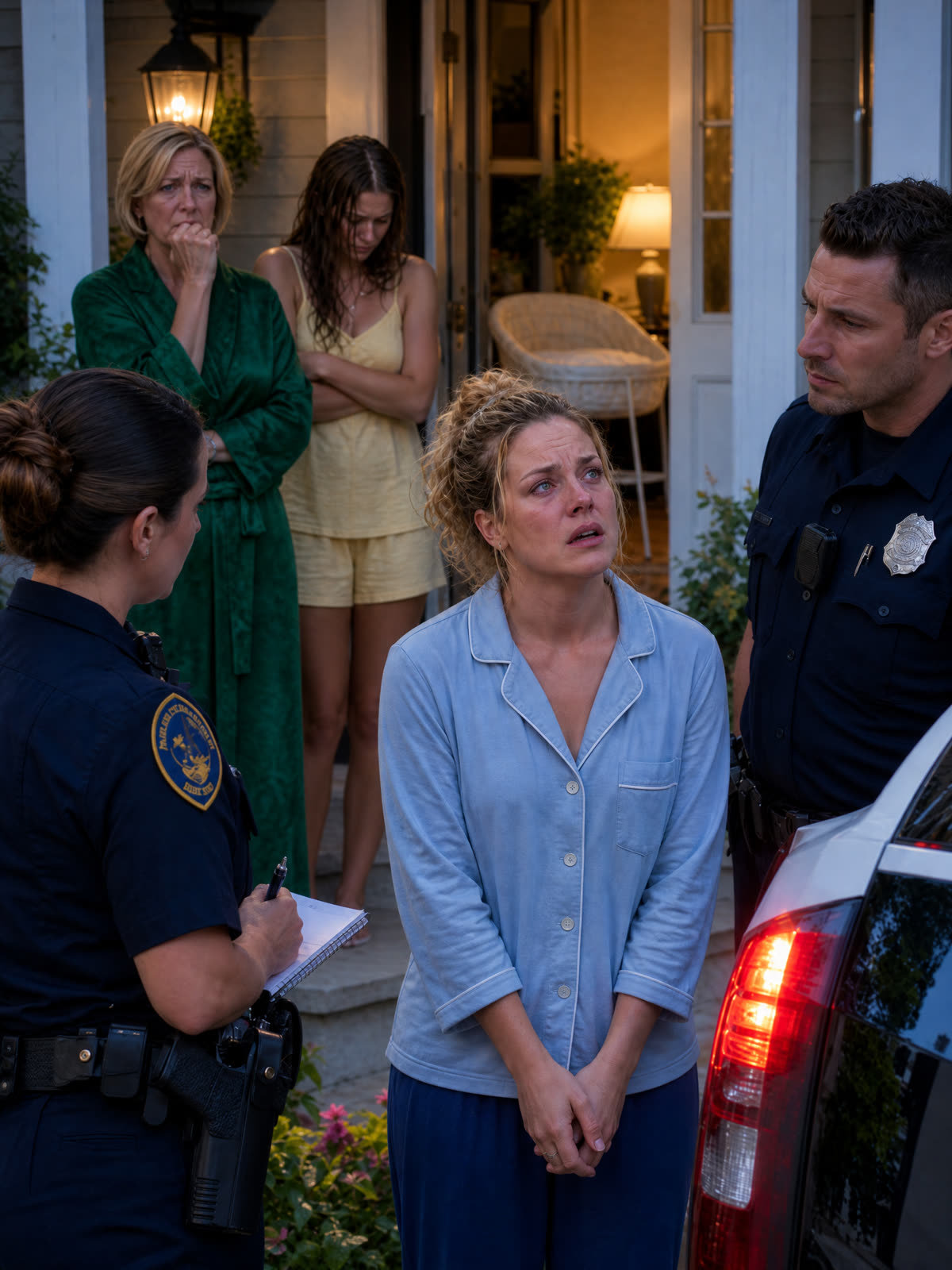
The next thing I heard was pounding at the front entrance. Two officers waited outside. Mom had put on her bathrobe, and Kenzie stood behind her, her hair still damp. “Are you Marisa Dunleavy?” one officer asked. “Yes.” He explained why they were there. “Your vehicle struck a mailbox and a parked car on Knoxville Avenue around 2:15 a.m. The driver left the scene.” My eyes immediately went to Kenzie. She kept hers lowered, staring at the floor instead of looking back at me.
“I haven’t left the house,” I said. “I’ve been upstairs with my newborn.” Before I could explain further, Mom interrupted. “Marisa was driving. I saw her car leave.” The accusation was so direct that for a moment I could hardly believe she had said it. “Mom, that’s a lie!” She responded with a sorrowful shake of her head. “She’s been terribly sleep-deprived, officer. I’m worried about her.” Kenzie joined in. “I was asleep. She took the car.” Neither of them acknowledged where I had actually been.
The officers asked me to step outside so they could continue questioning me. I told them I had not consumed any alcohol, and the breath test registered 0.00. That result did not answer every question they needed to resolve, however. They still had to determine who had driven my vehicle during the collision. I stood there in my pajamas, three weeks into recovering from childbirth, listening while one officer spoke into his radio. Inside the house was my newborn. Outside, my mother and sister were giving the police a version of the night that made me responsible.
While the officer was occupied, Mom moved close enough to speak quietly. “Just cooperate, Marisa. Kenzie has her nursing exams coming up. A DUI could ruin her future.” I looked at her, struggling to understand how she could expect this of me. “You want me to take the blame for her?” Her answer did nothing to soften what she was asking. “Don’t destroy your sister’s life.” She was not asking what had happened or whether I was all right. She was asking me to accept a lie because she considered Kenzie’s future more important.
Then Arlo began crying inside. Every part of me wanted to go back upstairs, lift him from his bassinet, and hold him. Instead, I was still outside trying to establish that I had never left the house. I knew my denials alone were not settling the matter. My mother had claimed to be a witness, and my sister was repeating the accusation. I needed something the officers could examine independently of what any of us said. Then I remembered the pumping session I had recorded while everyone else believed I had been asleep.
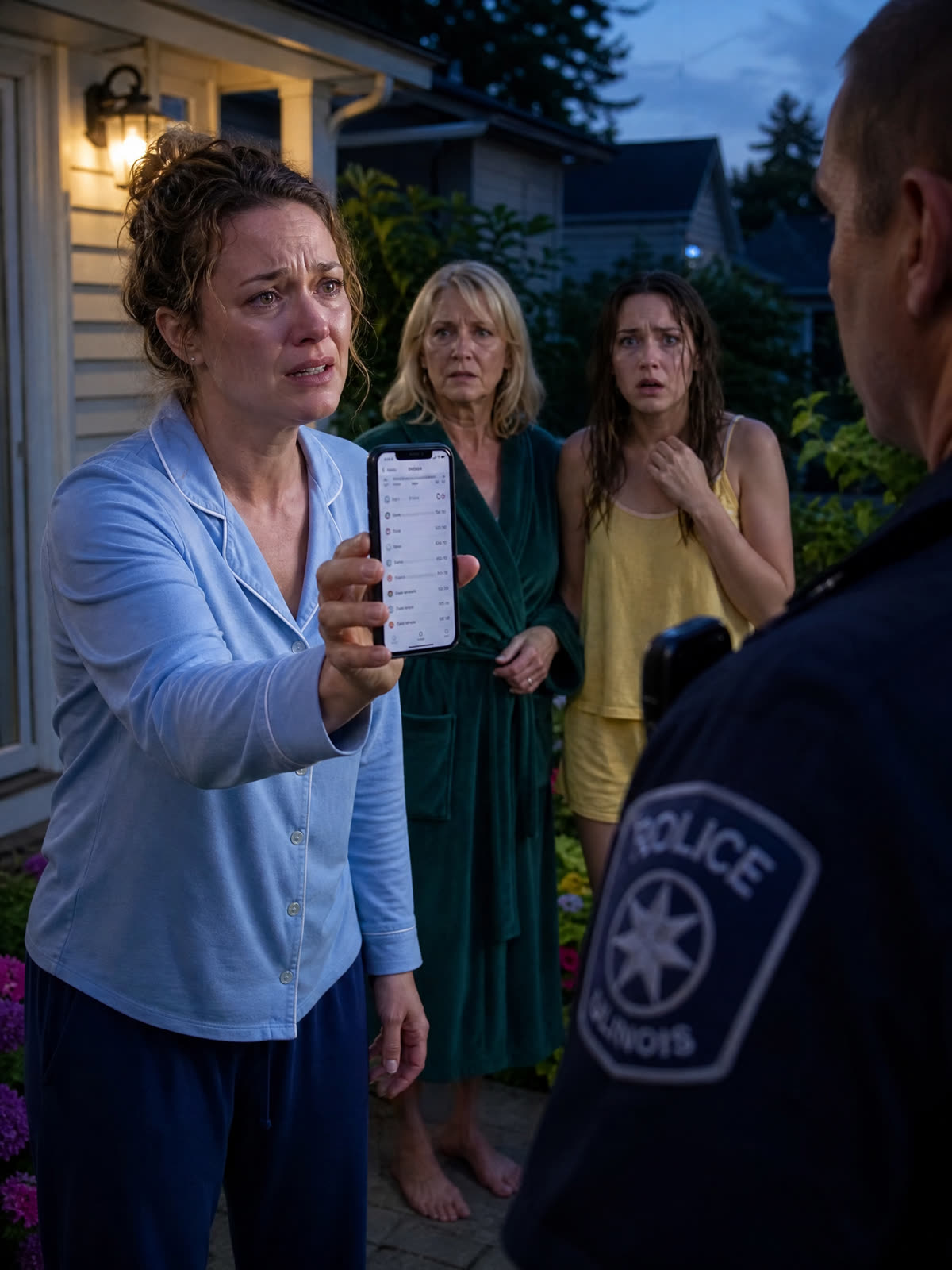
“Officer, may I show you something on my phone?” I asked. I opened the breast pump app and found the record from that morning. The session had begun at 1:58 a.m. and ended at 2:24 a.m. The amount expressed was 4.5 ounces. I had not entered those times to defend myself against anything; they were simply part of the feeding information I had been asked to keep. Now that ordinary record was the first thing I could put in front of the police that did not depend on my mother telling the truth.
I held out the screen. “The accident happened at 2:15,” I explained. “I was pumping milk in the guest bedroom.” The officer studied the entry. It could not conclusively prove my whereabouts on its own, but it gave him a specific period to investigate. He turned to Kenzie. “We need to establish who actually had access to that vehicle tonight.” Her expression shifted. Until then, she had avoided my eyes and let Mom do much of the talking. Now the questions were beginning to turn toward her.
The radio crackled again. After listening to the update, the officer looked back at us. “The parked car wasn’t empty,” he said. “A seventeen-year-old girl was inside when it was struck.” My stomach turned. He told us she had been taken to the hospital with critical injuries. Kenzie finally stopped staring down. For the first time that morning, genuine fear showed on her face. This was not merely damage to a mailbox and an unattended car. An innocent girl might die, and my mother had been prepared to make me answer for it.
Even after hearing how badly the girl was hurt, Mom continued trying to protect Kenzie. “Don’t ruin Kenzie’s future,” Mom whispered. I looked at her in disbelief. I was outside in sleepwear while my three-week-old son cried in the house, and she was still asking me to surrender my own future. The officer addressed my sister directly. “Have you driven your sister’s vehicle tonight?” Kenzie shook her head. “No. I told you, I was sleeping.” He followed with another question. “Then why did you initially identify yourself as Marisa when officers contacted you about the vehicle?”
Kenzie opened her mouth without answering. Mom stepped between them. “My younger daughter gets confused when she’s frightened. You shouldn’t pressure her.” The officer calmly directed her to move aside. I showed him the pump record once more and explained the session times. He asked where I kept the device and whether previous sessions remained in the app. “In the guest bedroom,” I said. “It records the start and end times automatically.” He recorded that information and, with my permission, asked another officer to look at the room.
When questioned about my keys, Kenzie said she had not touched them. But her expression changed when the officer asked whether she had been drinking. “I had a couple of drinks,” she admitted. Mom caught her arm immediately. “Kenzie, stop talking. You need a lawyer.” My sister started crying. “I didn’t know anyone was inside that car.” The officer went still. “What car?” Kenzie put a hand over her mouth, and Mom looked horrified. Then my sister whispered, “I only meant to drive around. I didn’t see the parked car until it was too late.”
My knees felt weak. She had known about the crash from the beginning. The officer stopped asking about the incident and explained her rights before continuing. Kenzie was taken into custody for further investigation, and arrangements were made to preserve evidence from my damaged car. Investigators still needed to establish who had been behind the wheel and whether alcohol had contributed. Her admission did not replace that work, but it changed the direction of the morning. I was finally permitted to go back to Arlo.
I held my son against my chest while another officer recorded my statement. My hands shook as I described Kenzie borrowing the car, the keys, and my mother’s accusation. When he asked whether Mom had actually watched me leave, I chose my answer carefully. “No. I was upstairs pumping milk. She knows that.” Mom stayed in the kitchen, unwilling to look at me. After the officers departed, she approached. “You didn’t have to let them take your sister away.” I stared at her. “She hit a car with a child inside.”
“It was an accident.” “And then she tried to blame me.” Mom crossed her arms. “You have a husband and a baby. Kenzie has her whole career ahead of her.” Arlo had fallen asleep against my shoulder. Looking down at him, I asked, “What about my life, Mom? What would have happened to my son if I’d been charged?” She offered no answer. That morning I called Ryan and explained everything. He immediately contacted his unit about coming home for the family emergency. I also spoke with an attorney, who advised me to retain my pump records, messages, and anything supporting my whereabouts.
A detective called that afternoon. Kenzie’s phone had been recovered from my vehicle, and investigators were examining the seat position, interior evidence, and nearby surveillance footage. The injured girl remained critical. Her name was Nyla. She had been waiting in her mother’s parked car while her mother completed a hospital shift. The impact had caused serious internal injuries and a head injury that required emergency surgery. After the call, I sat beside Arlo’s bassinet. My sister had left that wreck and come home to shower. My mother had tried to sacrifice me to protect her. Somewhere in a hospital, another mother was waiting to learn whether her daughter would survive—and no one could yet tell her.
PART 2: The Evidence My Mother Couldn’t Rewrite
Three days after Kenzie tried to pass her hit-and-run off as mine, a detective called about the evidence. “We’ve obtained surveillance footage from a business near the collision,” he said. “It shows someone matching your sister’s appearance leaving the vehicle.” I lowered myself into a seat beside Arlo’s bassinet. “Does that mean they know I wasn’t driving?” His answer remained careful. “The investigation is still ongoing, but the evidence supports your account.” For the first time since the officers arrived at four that morning, breathing felt easier.
I had nearly been blamed for a collision while still recovering from my son’s birth. Kenzie had taken my car without permission that night, struck a parked vehicle, and left. Nyla, seventeen, had been asleep inside. While she fought to survive, investigators were working through the evidence. The detective said Kenzie’s phone had been found beneath the driver’s seat. They were examining the interior and arranging laboratory testing where relevant. My pump records supported the timeline I had described; the footage and Kenzie’s own statements provided separate information they could assess.
Mom, meanwhile, had stopped speaking to me. In her view, I had failed Kenzie by allowing officers to question her instead of accepting responsibility myself. The evidence that supported me did not change the way she treated me. I was her daughter too, but she continued behaving as though my duty was to protect my sister from the consequences of what she had done. The girl in intensive care barely seemed to enter her argument. Neither did the newborn whose mother she had been willing to accuse.
On the fourth morning, I found her at the kitchen table. “Your sister could lose everything,” she said. I was holding Arlo, who had finally fallen asleep after a hard night. “Mom, a teenage girl is in intensive care.” “I know that.” “Then why are you only talking about Kenzie’s future?” She turned her eyes away. “Because she’s my daughter.” I waited. There was room for her to say that I was her daughter as well, that what had happened to me mattered too. She never said it.
Her silence stayed with me. I had agreed to come to her house because she said I needed someone to care for me while Ryan was away. Instead, the people sharing that house had made me defend myself against a serious accusation. I was trying to recover, feed my baby, and understand the harm done to Nyla while Mom kept returning to Kenzie’s future. By then, the difference between what she had promised and what she had done was impossible for me to ignore.
Ryan received permission to leave training early and returned that afternoon. He came into the house, saw my exhausted face, and pulled me into his arms. “We’re going home,” he said. There was no suggestion that I should stay and smooth things over, or that protecting Kenzie was more urgent than taking care of Arlo and me. After days of having to explain why I would not accept blame for someone else’s actions, his certainty was a relief.
Mom objected while we packed. “You can’t take my grandson away because of one misunderstanding.” Ryan stopped near the doorway. “Your daughter was nearly blamed for a serious crime while recovering from childbirth. That wasn’t a misunderstanding.” He did not let her turn the accusation into something small or accidental. She had told police that she had seen me drive away. Kenzie had given them my name. Calling that a misunderstanding did not change what either of them had done.
We left before dinner. I was going home with my husband and son, away from the house where my mother had asked me to risk my freedom. What should have been a temporary stay for help after childbirth had become something I could no longer trust. Mom’s objection focused on losing access to her grandson, but I could not make my decisions around preserving the appearance that everything between us was normal.
The investigation was still unfinished, and Nyla’s condition still weighed on me. Leaving did not undo the crash or make the accusation disappear from my memory. But Ryan was home, and I no longer had to remain under the same roof as the person who had insisted she watched me commit a crime. For the first time since that morning, I could concentrate on taking Arlo home rather than persuading my own family to stop lying.
Ryan brought us out of my mother’s house, and we returned to our own. That night, I slept in my bed without wondering whether someone would take my keys. The relief was real, but it was not complete. Whenever I thought of Nyla, I remembered that another family had no homecoming to celebrate yet. Her mother was still waiting at the hospital, and the outcome that mattered most remained uncertain.
Nyla’s mother, Denise, worked as a nursing aide at a nearby hospital. Nyla had been waiting for her shift to finish when Kenzie hit the car. Through the detective, I learned that Nyla had undergone emergency surgery and remained unconscious. I wanted to offer something, but I did not know whether hearing from the owner of the car would distress her family. I asked the hospital’s family liaison if I could leave a brief note expressing concern, making clear that I expected no reply.
A week after the collision, the detective called again. Investigators had assessed more footage, witness accounts, and evidence from the car, and the case against Kenzie was progressing. My mother’s statements were also under examination because she had repeatedly claimed she saw me driving. I remembered her on the porch, presenting my exhaustion as a reason not to believe me. She had not simply avoided correcting Kenzie. She had offered her own false account to make the accusation more convincing.
That evening, Aunt Patricia, Mom’s older sister, phoned. “Marisa, your mother says you turned Kenzie in because you’ve always resented her.” I closed my eyes. “Did she tell you about Nyla?” After a pause, she asked, “Who’s Nyla?” I explained the wreck, the injured teenager, and the attempt to blame me. By the end, my aunt sounded shaken. “Your mother never mentioned a girl was hurt.” Across the house, Ryan was rocking Arlo to sleep. Mom was still reshaping the story, but the truth no longer depended on her account.
She told relatives that jealousy had driven me to destroy Kenzie’s future, leaving out the teenager in the hospital and the name Kenzie had given police. Three weeks after the accident, Detective Harris called. “The prosecutor has approved charges against your sister,” he explained. “We may need you to testify about the vehicle and what happened that morning.” I was in our living room while Ryan fed Arlo. “What charges?” I asked. “Aggravated driving under the influence causing great bodily harm and leaving the scene of an injury accident. Additional charges are being reviewed.”
My stomach tightened. “Have they determined what happened?” He described the surveillance, witnesses, vehicle evidence, and Kenzie’s admissions supporting the case. Investigators had also examined her activities before the crash, including evidence about her drinking. Then he turned to Mom. “We’re reviewing the statements she gave officers. There are serious inconsistencies.” Her claim that she had watched me leave was no longer simply something she could repeat to relatives without challenge. Investigators were comparing it with the evidence.
Later that week, Aunt Patricia called again. “Your mother is telling everyone the police misunderstood her,” she said. “That’s not what happened.” “I know. I told her she needs to stop blaming you.” It was the first time someone in my family had openly refused to accept Mom’s explanation. Meanwhile, I kept asking after Nyla. Her injuries were severe, and she remained in the hospital. Doctors had begun reducing her sedation after difficult days, but her recovery was uncertain. I sent another message through the liaison, without asking Denise to respond.
Several days later, Denise contacted me and asked whether we could meet in the hospital’s family waiting area. Ryan offered to come, but I chose to go alone. She looked worn out when she approached. Her daughter had been unconscious for nearly a week, and Denise had spent most of that time at the hospital. “Are you Marisa?” she asked. I nodded. Sitting beside me, she said, “The detective told me your family tried to blame you.” My throat tightened. “I’m so sorry about what happened to Nyla.”
“You weren’t driving.” “I know. But it was my car.” Denise gently shook her head. “You didn’t cause this.” I looked at my hands. “I wish I could’ve prevented it.” For a moment, we sat without speaking. Then she reached for a tissue. “Nyla opened her eyes yesterday,” she said. I looked up. “She recognized me. She’s still very weak, but the doctors are encouraged.” Relief swept through me. With a small, tired smile, Denise added, “This morning, she asked whether she could have pancakes.” I laughed through my tears.
It was the first genuinely hopeful news I had heard since the collision. Before leaving, I promised Denise that I would cooperate fully with investigators. In the months that followed, Kenzie’s case advanced toward a plea hearing. Her lawyer negotiated with prosecutors, and she eventually agreed to plead guilty to serious charges arising from the crash. Her sentence still had to be decided. Mom’s position was worsening too. Investigators had documented her conflicting accounts, and prosecutors were considering charges over her efforts to mislead police.
Then Mom called for the first time in weeks. “Marisa, you need to tell them I was confused that morning.” My chest tightened. “Were you confused?” She hesitated. “Your sister was terrified.” “That’s not what I asked.” She began to cry. “If I get charged, I could lose my job.” I looked toward the nursery, where Arlo slept peacefully. She had nearly cost me my freedom, my reputation, and time with my newborn. Now she wanted me to protect her from her own choices. I ended the call without promising anything. The next morning, I sent my attorney a written account. I would not help conceal the truth—but the consequences for my mother and sister had yet to be decided.
PART 3: What Telling the Truth Cost Us
Six months after Mom tried to blame me for Kenzie’s drunk hit-and-run, she called from her attorney’s office. “Marisa, you destroyed this family,” she said. I was beside my son’s crib, listening to the same woman who had nearly cost me my freedom. “No, Mom. Kenzie injured an innocent girl. You lied to protect her. I told the truth.” Then I hung up. By then, months of investigation, court appearances, and negotiations had made the events of that morning far harder for her to rewrite. Still, she continued to place responsibility on me rather than on the decisions that had brought us there.
Kenzie had pleaded guilty to aggravated DUI causing great bodily harm and leaving the scene of an injury accident. The evidence included surveillance footage, witness accounts, records concerning her drinking, and information recovered from my damaged vehicle. Her effort to identify me as the driver also formed part of the prosecution’s account of what happened after the collision. The case was not based solely on my denial or on the pump record I had shown an officer outside Mom’s house. Investigators had gathered independent evidence and examined what Kenzie herself had said.
At sentencing, the judge weighed the severity of Nyla’s injuries, Kenzie’s choice to leave the scene, and her eventual guilty plea. My sister received a four-year prison sentence. Her plans for nursing were effectively derailed, and a criminal conviction presented substantial obstacles to professional licensure. For years, Mom had spoken as though Kenzie’s remarkable future was something everyone else needed to protect. Now that future had been changed by choices neither Mom nor I could undo. No accusation against me could remove the harm done to Nyla or erase Kenzie’s responsibility for it.
Mom also faced charges for deliberately misleading investigators. She ultimately accepted a plea agreement involving probation and community service. After reviewing the case, the local school district terminated her employment. Aunt Patricia told me that Mom spent weeks insisting all of it could have been avoided if I had cooperated. I understood exactly what she meant by cooperation. She wanted me to accept the account she had given police, spare Kenzie, and let the consequences fall somewhere else. Even after the evidence and the court proceedings, she continued treating my refusal as the decision that had caused the damage.
But accepting her version would have meant being accused of intoxicated driving, fleeing an accident, and seriously injuring a teenager. My son could have spent his earliest months without me while I fought to prove I had been home feeding him. I would not feel guilty for refusing that possibility. Having a husband and a baby did not make my life expendable. Nor did Kenzie’s plans for a career make the injured girl less important. Mom had framed the choice as protecting family, but the protection she demanded depended on making me responsible for something I had not done.
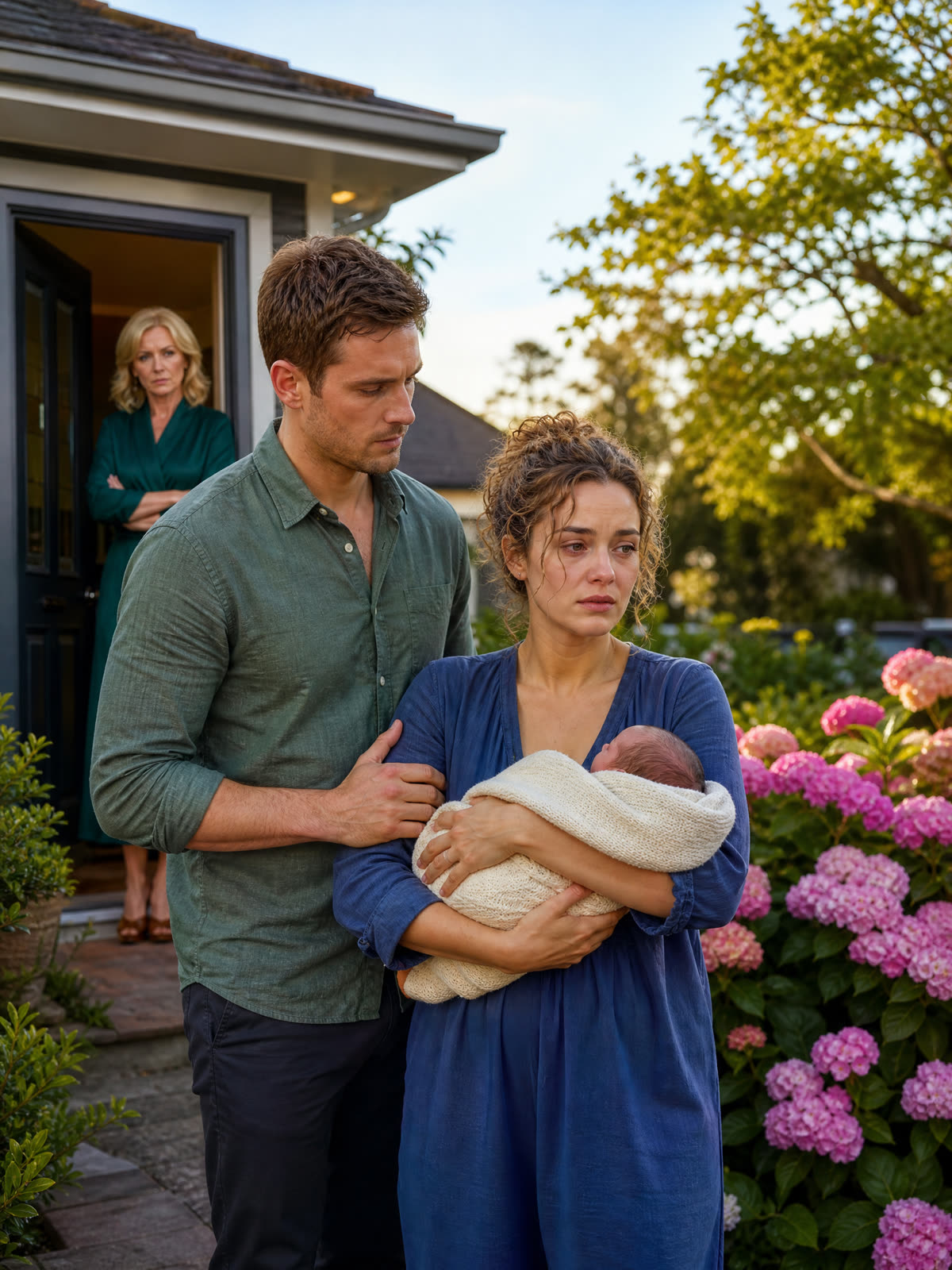
Ryan and I had returned to our own house as soon as he came home from training. We changed the locks because Mom still possessed a spare key, and I made certain Kenzie could no longer get access to my car. For a while, an unexpected knock was enough to unsettle me. I remembered the officers at the entrance, Arlo crying, and my mother insisting that she had watched me drive away. Ryan encouraged me to speak with a counselor. Gradually, those memories became easier to manage. They did not vanish, but they stopped carrying the same force every time something reminded me of that morning.
The news that mattered most came from Nyla’s family. She had awakened after six days unconscious, but waking was only the beginning of her recovery. Months of treatment were followed by intensive physical rehabilitation. Denise sometimes sent updates, and they were not uniformly hopeful. Some days brought progress; others brought pain and frustration. Nyla had to relearn movements that had once required no thought. Through it all, she kept working toward the possibility of returning to school. Her recovery was not a simple ending to the story of the crash. It was something she had to keep working through.
When Denise invited me, I visited, sometimes bringing Arlo. Over time, a friendship developed between us that neither of us could have imagined before the collision. I had first reached out without knowing whether she would want to hear from me. Now she shared moments from her daughter’s recovery. One afternoon, she showed me a video of Nyla taking several steps without help. I cried as I watched. Those steps meant more than a brief encouraging update. They showed how hard Nyla was working to regain things that had been taken from her in an instant.
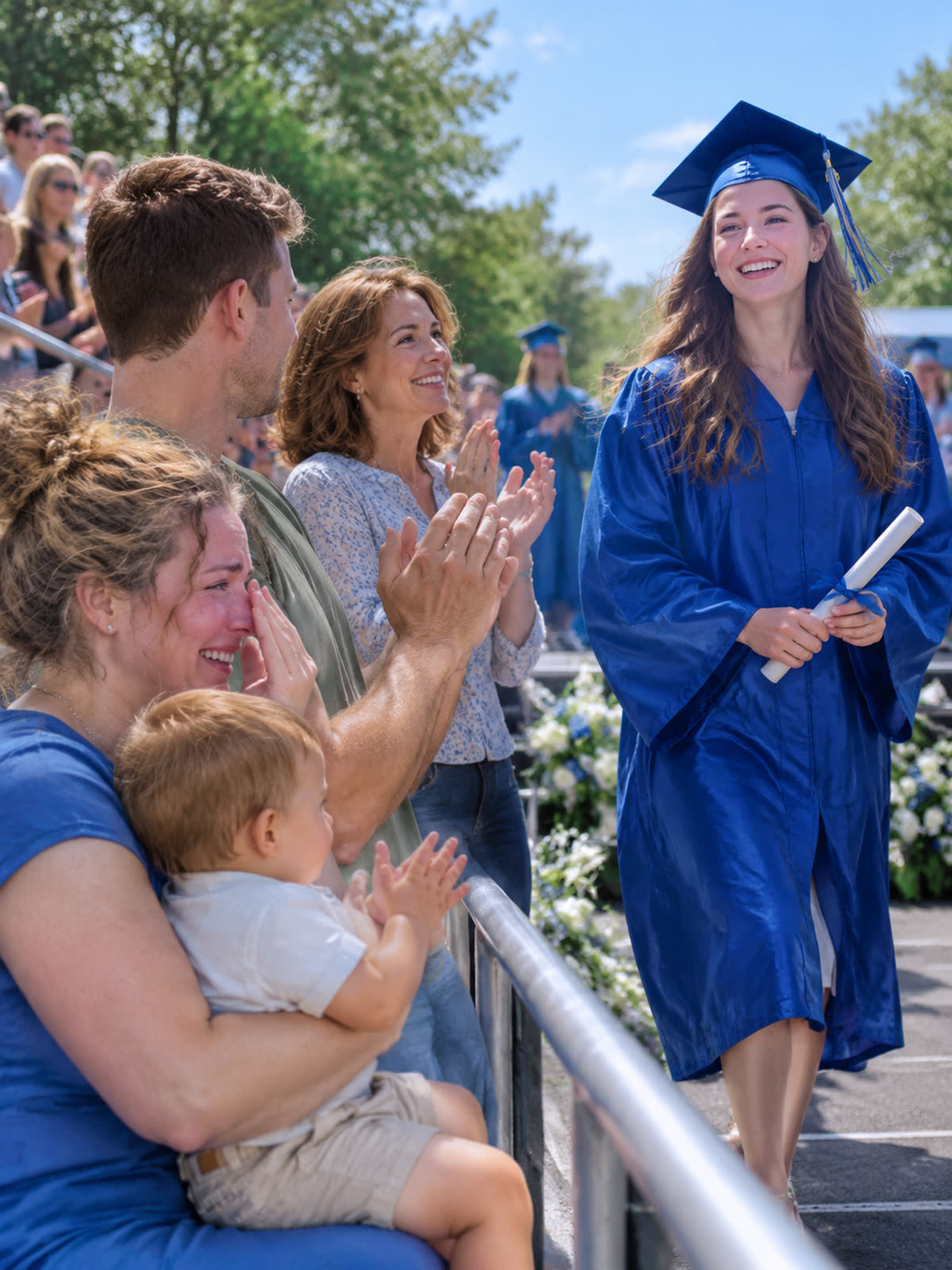
Months later, Denise sent another message: Nyla was graduating in June, and she wanted my family to attend. I accepted immediately. On graduation day, Ryan and I joined Denise in the bleachers, where she had saved seats for us. Arlo sat on my lap. We had followed the difficult updates and celebrated the small gains, and now we were there for something Nyla had continued working toward throughout her recovery. I thought about the uncertainty that had surrounded her in the hospital and about Denise waiting for her daughter to open her eyes.
When Nyla’s name was called, our entire section stood. She crossed the stage without a cane. Her steps were measured, but her smile was enormous. Arlo clapped his small hands along with everyone else. He was much too young to understand why I was crying, or why watching someone walk across a graduation stage could mean so much. I knew what those steps represented. They belonged to a girl who had survived critical injuries, endured months of recovery, and kept moving toward the life she wanted to return to.
Watching her, I thought back to the night Kenzie left the wreck and came home to conceal what she had done. I remembered Mom telling me that my sister’s nursing career had to be protected, as though my future could simply be handed over in exchange. I remembered standing outside while Arlo cried, knowing I had done nothing wrong but needing a way to make someone believe me. Then I thought of the record on my phone: one breast pump session lasting twenty-six minutes, with four and a half ounces expressed.
It was such an ordinary entry. I had kept it because I was feeding my newborn and following the advice I had been given, not because I imagined needing to establish an alibi. It had not resolved the investigation by itself. But it had helped give the officers a timeline to examine when the people closest to me were telling them something false. Alongside the other evidence, it helped me defend the truth of where I had been. Something routine in the first weeks of motherhood had mattered at a moment when my own mother refused to protect me.
I have not spoken to Kenzie since the court proceedings. My relationship with Mom remains broken. Perhaps that will change someday, but forgiveness would never mean pretending that what happened was harmless. Their actions had consequences for Nyla, for her mother, and for my family. I could not rebuild trust by calling a deliberate accusation a misunderstanding. Nor could I make peace by agreeing that telling the truth had been the real betrayal.
As Nyla returned to her seat holding her diploma, Denise reached over and squeezed my hand. I squeezed hers back. Mom had once insisted that protecting family meant taking responsibility for my sister’s actions. Watching Nyla celebrate, I understood protection differently. Sometimes it means refusing to take part in a lie, even when the people asking for silence are the ones who raised you. Nyla had reached a future that once hung in doubt. As for my own family, I still could not say whether the people who demanded that lie would ever let the truth bring us back together.
Disclaimer: This story is a work of fiction inspired by real-life themes. Names, characters, places and events are fictionalized, and any resemblance to real persons is purely coincidental. Images are for illustration purposes only.
