

PART 1: The Rooms They Thought Were Theirs
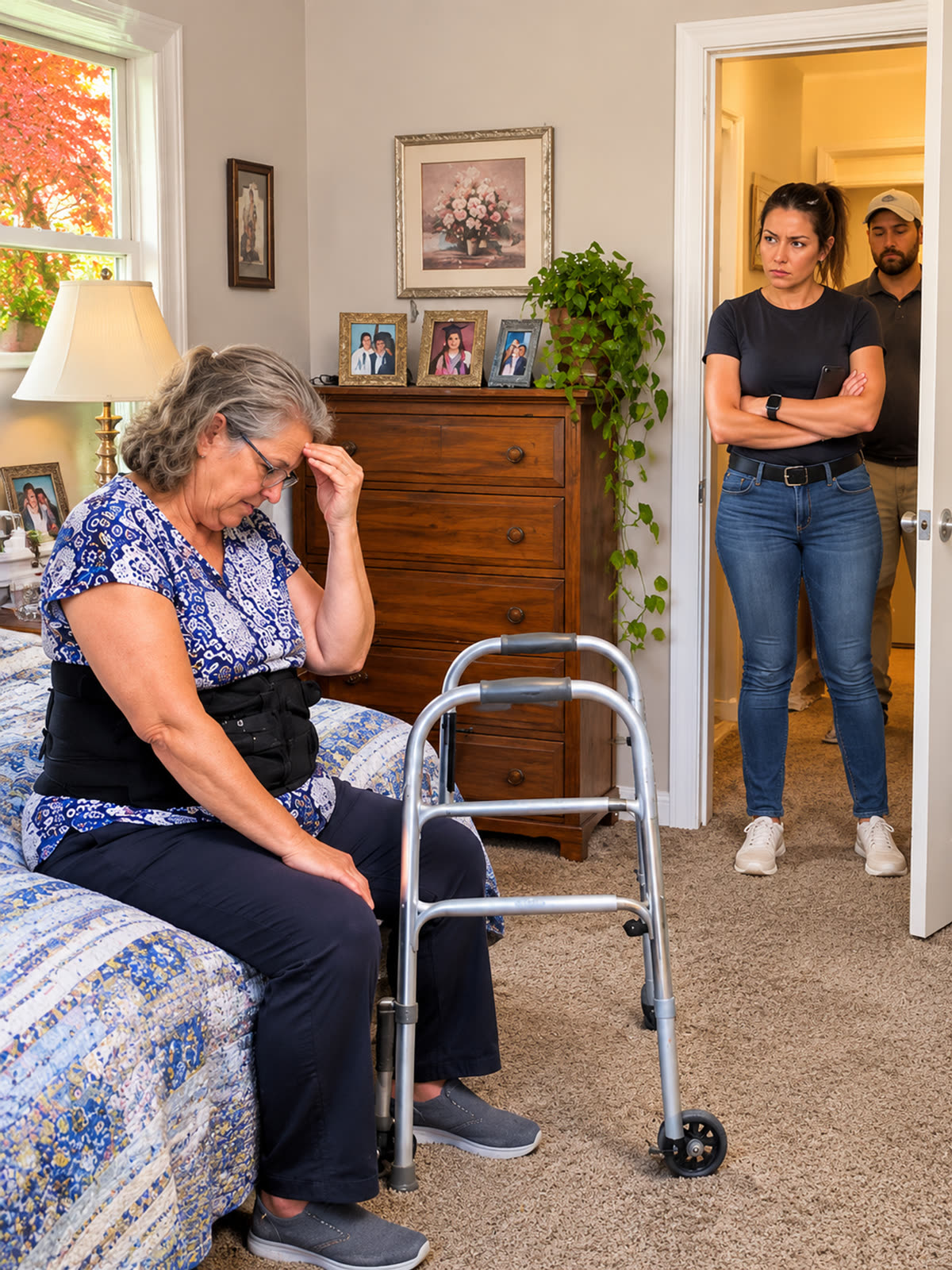
Megan appeared in my bedroom doorway with her phone in her hand while I struggled to sit upright without turning my spine. That small movement required more concentration than anyone watching might imagine. My surgeon’s directions were absolute: no bending, lifting, or twisting. First I had to roll onto my side, then raise myself with my arms and move both legs over the edge together. Nothing could happen carelessly. My walker waited beside the mattress. My brace rested on the other pillow, in the place where my husband once slept. Beside my water glass lay the discharge instructions Greg had brought home in a plastic folder: no lifting over ten pounds for six weeks, stairs only when necessary, and three short walks every day.
“This Sunday,” Megan said, “ten of my relatives are coming. They’ll be staying here for two weeks. We need the guest rooms ready.” Her announcement sounded as ordinary as a forecast. I waited for the rest—for a hotel reservation, perhaps, or a rental house. I waited for her to ask whether I needed help or whether visitors might interfere with my recovery. Instead, she checked her phone. “Megan,” I said carefully. “I had spine surgery five days ago. Please postpone.” She slid the phone into her jeans pocket. “We’re not postponing,” she said. “Just do as I say.”
A cabinet shut in the kitchen below us. Greg was downstairs, inside the house where he had grown up, lost his first tooth, learned to ride a bicycle, and cried over his first broken heart. He was near enough to hear if I raised my voice. He stayed where he was. “Greg already said it was fine,” Megan added. “Then Greg needs to change his answer,” I said. Her eyes moved from my walker to the brace and back to my face. “Everybody’s already arranged their time off, Judith,” she said. “My parents. My brother. My sister and her kids. It’s done.” I flattened my hand against the bed, working out how to shift without tugging at the incision. “So have I,” I said quietly. “Mine is for recovery.”
She released a short, weary sigh—the impatient kind reserved for someone making an easy task unnecessarily difficult—and went downstairs. Soon her voice drifted up from the kitchen. “She knows about Sunday,” she told Greg. Neither returned to my room before leaving. I listened to the front door, then Greg’s engine, then the car disappearing along Brookhaven Drive. They had forgotten the soup. Nancy had called that morning and asked them to collect chicken noodle soup from Panera. I had anticipated it for hours. Hospital meals had been miserable, and standing at my stove was beyond me. There was no lunch, only the likelihood of one of Greg’s empty coffee mugs on my counter. He had been leaving those behind since he was sixteen.
I settled against the pillows and followed the afternoon sunshine as it crept over the dresser. Thomas’s things remained on his side: his comb, his reading glasses, and the little brass dish where he had emptied his pockets each evening. Coins, keys, receipts, sometimes a stick of gum. He had died of a stroke three Februaries earlier, at sixty-eight. I was Judith Carver, sixty-seven, a retired English teacher who had spent thirty-one years teaching teenagers in Carmel, Indiana. Hamlet, The Great Gatsby, To Kill a Mockingbird—year after year, classroom after classroom. I had retired four years earlier. Thomas and I had intended to travel. We had written a list. We never reached anything on it.
We bought our four-bedroom colonial thirty years ago, on a quiet Carmel cul-de-sac. There was a generous backyard, a maple tree, and a basketball hoop mounted above the garage. The spare bedrooms were part of its appeal. We imagined Thanksgiving cousins, Greg’s friends staying overnight, and Thomas’s brother driving from Ohio for the Indianapolis 500 each Memorial Day. For twenty years, our house held exactly that sort of happy disorder, right down to abandoned shoes under the dining table. After Thomas died, everything became still. Greg and Megan, married five years before his death, lived twenty minutes away in Fishers. His brother stopped visiting after the funeral, and the cousins grew busy with their own lives. I closed the unused bedroom doors. Megan eventually decided what those rooms were for.
During the first summer without Thomas, she asked whether her relatives could come. Her parents, Dennis and Sharon, lived four hours away in eastern Kentucky. Her older brother, Kyle, lived with his wife in Lexington, and her younger sister, Ashley, was raising three children in Morehead. “They’ve never been to Indianapolis,” Megan said. “They’d love to see the Children’s Museum. And the zoo. And the Speedway. Could they stay with you? Just for a long weekend?” I agreed because I was lonely. Children racing through the hallways sounded better than silence. For that long weekend, it was lovely. The following summer, the visit became a week. “My family’s coming the third week of July. They’re so excited.” This time she supplied dates rather than asking permission. Again, I agreed.
The next visit lasted two weeks. In May, Megan texted the dates along with everyone’s dietary preferences. Dennis had diabetes, Sharon avoided red meat, and Ashley’s children were particular about food. I bought everything requested. Her parents occupied the blue room beneath my mother’s handmade quilt. Kyle and his wife took another bedroom, Ashley the third, and the children slept on air mattresses in the den. I drove to Kroger four, five, sometimes six times a week, washed towels daily, and kept coffee available from early morning until late evening. They chose outings—the zoo, the museum, the Edinburgh outlet mall—while I prepared packed lunches. I stayed behind because someone needed to begin dinner. Greg arrived after work, kissed Megan, surveyed the crowded house, and said, “You’re a lifesaver, Mom,” while I saved him a plate.
One evening the previous summer, I cooked chili and cornbread for fourteen. The dining table had twelve chairs, all occupied by Megan’s relatives. Greg squeezed a stool into a corner. I stood at the kitchen counter with my bowl. Halfway through dinner, he passed me without stopping. “Mom,” he said. “Where do you keep the extra ketchup?” I pointed toward the pantry. He collected it and returned to the table without noticing that I had nowhere to sit. Remembering that scene from bed was painfully clear. My back had already been troubling me then: first a persistent ache, then pain down my left leg, then numbness in my foot. I had dismissed it as age, arthritis, or too much gardening. By spring, I could not finish washing dishes without resting. During those two weeks of hosting, I had carried groceries, washed towels, and eaten standing while my leg went numb. I said nothing because I did not want to make trouble.
In September, Dr. Ravi Menon at IU Health studied my MRI. “Mrs. Carver,” he said. “You have severe spinal stenosis and a herniated disc at L4-L5. It’s pressing on the nerve. If we don’t fix it, you’re going to lose function in that leg.” The operation was a four-hour laminectomy and spinal fusion. I spent six days in the hospital before coming home on Tuesday. Nancy, my sixty-four-year-old sister, drove me. A retired nurse, divorced, she lived fifteen minutes away in a one-story Westfield house. She brought meals, helped me shower, and stayed when medication left me confused at night. Greg visited twice: once to wait through surgery and hold my hand in recovery, then again to carry my discharge folder home. Now my phone buzzed with Megan’s message: My mom needs gluten-free bread. Also, do you still have the big air mattress? I read it twice, put the phone down, picked it up again, and called Nancy.
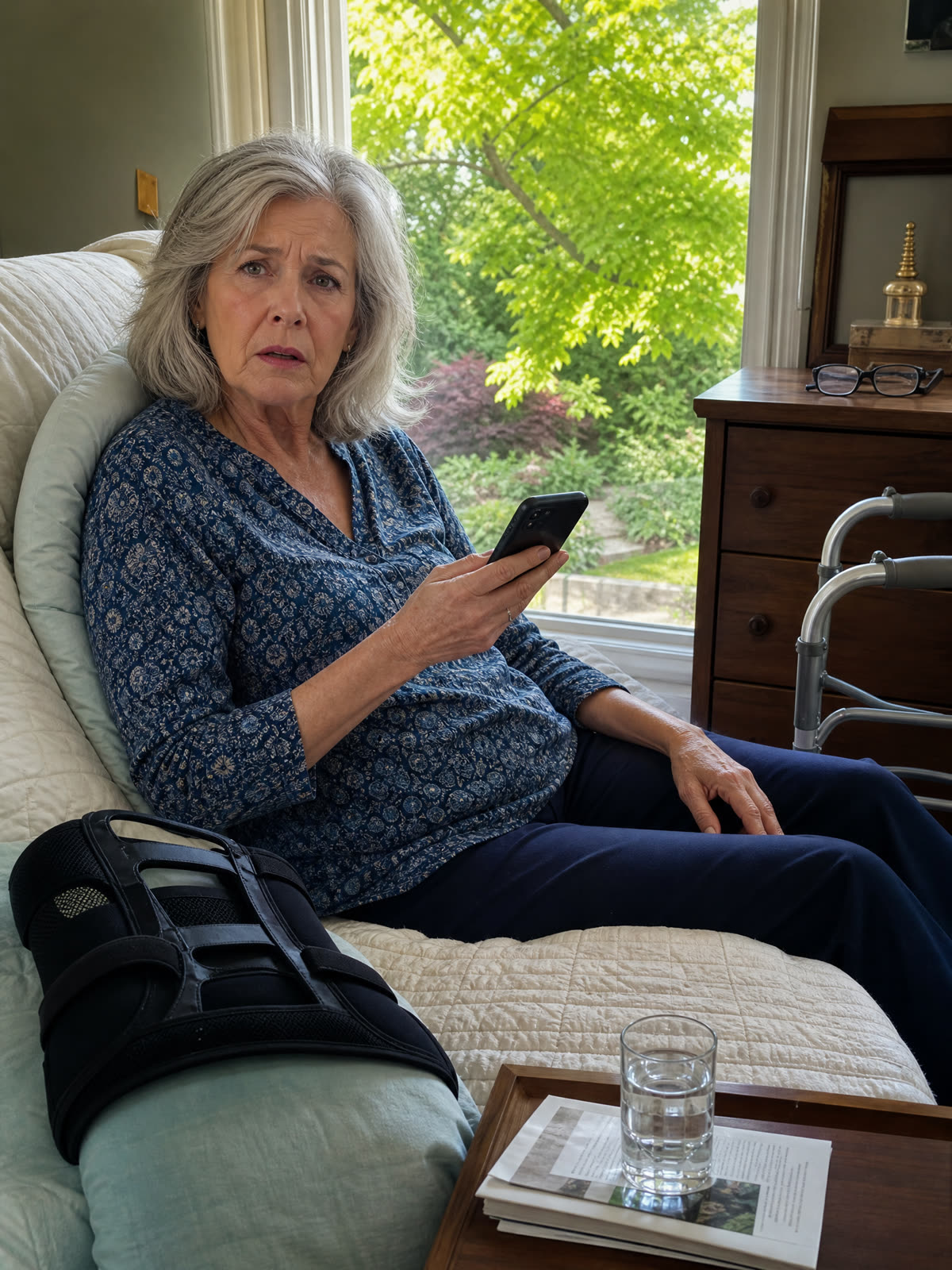
She answered immediately, as she always did. “Did they bring lunch?” she asked. “No,” I said. After a brief silence, she asked, “What happened?” I described Megan in the doorway, the Sunday announcement, the refusal to postpone, the order to obey, and Greg’s supposed permission. I told her about the cabinet closing downstairs and the request for gluten-free bread. For a while, a television game show was the only sound on the line, its audience applauding. Then Nancy switched it off. “Judith,” Nancy said. “Did you tell them no?” “Twice,” I said. “Twice,” Nancy repeated. “I said please postpone. Then I said Greg needs to change his answer.” She paused before answering. “Then don’t start explaining it a third time,” she said.
My gaze returned to the hospital instructions beside the water glass. For days I had carefully obeyed every direction about sleeping, standing, entering a car, and rolling out of bed. Yet refusing to serve ten houseguests somehow seemed more difficult than following any of those rules. “Nancy,” I said. “Can you come back this afternoon?” “Of course,” she said. “I’ll be there in twenty minutes.” “There’s a folder on my desk downstairs,” I said. “In the study. Would you bring it up?” “Which one?” I looked toward Thomas’s comb and glasses. “The one I keep putting off dealing with,” I said. She did not need another explanation.
Nancy arrived at three carrying a Panera bag: chicken noodle soup, a sourdough bread bowl, and an enormous chocolate chip cookie. She placed the food on my nightstand, helped me sit properly, and arranged a pillow behind my back just as the physical therapist had demonstrated. Only then did she pass me the folder. It was plain green, with MAPLE RIDGE written across the tab in my own handwriting. Inside were documents I had handled for eight months, repeatedly taking them from the drawer and returning them without making a decision. Seeing that familiar folder in bed made it harder to pretend it represented some distant possibility rather than a choice waiting for me.
Maple Ridge was a condominium community in Westfield, three blocks from Nancy. The homes were single-story, with two bedrooms, no stairs, and small back patios large enough for tomato plants. The clubhouse offered a pool, a library, and a Tuesday book club. Nancy had taken me to an open house in March, supposedly just to look. I spent twenty minutes inside Unit 14, noticing its bright kitchen and the patio facing a pond with a fountain. There was not a staircase anywhere. That afternoon, I put down two thousand dollars to reserve it. The deposit was refundable for a year, giving me time to decide. Eight months later, I still had not allowed myself to choose.
I had kept finding reasons to remain. Leaving the home Thomas and I bought felt impossible. Greg might be upset. Megan’s family counted on those bedrooms. Weren’t guest rooms meant for family? The folder also contained Carla Mendez’s business card from F.C. Tucker Company. She had visited in April to prepare a market analysis and penciled a number on the back. Alongside it lay a locksmith’s brochure Nancy gave me in July. That was after Megan’s relatives used Greg’s key to enter while I was at church. I returned to discover Ashley’s children jumping on my bed. Even then, I had tucked the brochure away rather than using it.
“Judith,” Nancy said gently. “Are you sure?” I considered the documents, the walker, the brace resting on Thomas’s pillow, and the discharge instructions. My phone still displayed the request for gluten-free bread. “No,” I said. “I’m not sure about anything.” I reached for the bedside pen. “But I’m sure I’m not going to stand at that kitchen counter again,” I said. “Not this summer. Not ever.” It was not certainty about every choice ahead. It was certainty about the one thing I could no longer keep doing. My back could not bear it, and neither could the part of me that remembered being passed on the way to the ketchup.
That evening I composed a message to Greg. I drafted it four times, wanting each word to be unmistakable. Thirty-one years of teaching English had not made this particular paragraph easy. Finally, I sent it: Greg, I need you to hear this clearly, because I don’t think I was heard this afternoon. I had spine surgery five days ago. I cannot host ten people. I cannot shop, cook, clean, wash towels, or climb stairs for two weeks. My surgeon has said so in writing. It’s in the folder you carried home from the hospital. Megan’s family cannot stay at my house this Sunday. Please let them know right away so they can make other plans. I love you. And I am asking you to take care of this. — Mom
There was no reply that night or the following morning. On Wednesday afternoon, five words appeared: We’ll figure something out. Nothing asking how I felt. Nothing apologizing. Nothing that clearly said he understood. I wanted very badly to trust those words. But I recognized what happened whenever my refusal inconvenienced someone. I had seen it with Thomas’s mother at Thanksgiving, with the PTA, with the principal who repeatedly wanted me to teach summer school, and with Megan every summer. People waited. They did not need an argument. They simply waited until they arrived anyway, and I supplied another chair, another towel, and another excuse for letting it happen.
By Friday, Megan was still sending requests. Dad needs sugar-free creamer. The hazelnut kind. Then: Ashley’s youngest is allergic to strawberries now, FYI. And finally: Can you put fresh sheets on all the beds Saturday? We’ll be there around 11 Sunday. I left every message unanswered. Instead, I wrote Greg once more: Greg, Megan is still sending me grocery lists. Have you told her family not to come? An hour passed before his response arrived. Working on it. I stared at those words, recognizing that they contained no actual answer. Sunday was almost here, and nothing in either of their messages suggested that my refusal had changed their plans.
Nancy called the locksmith that afternoon. Raymond arrived at four, a seventy-year-old man with a gray beard and an enormous toolbox. He changed the keys for every entrance: front, back, garage, and side. When he finished, he handed Nancy a ring holding four new keys. “Who gets copies?” he asked. Nancy turned to me. “Nobody,” I said. “Not yet.” There was no speech to accompany the decision. No announcement to the people who had treated access as something permanently guaranteed. There were simply new keys, and for once I would be the person deciding who received them.
Carla Mendez visited that evening and sat beside my bed with her clipboard. She explained the listing agreement carefully, turning each page with me. “We don’t have to list it right away,” she said. “We can wait until you’ve recovered. Spring is the best time to sell anyway.” “I know,” I said. “I just want you to be sure, Judith,” she said. I signed. The house would not be listed that week; March would give me time to heal and prepare. But the agreement was no longer unsigned in a drawer. Afterward, I completed the papers for Unit 14 at Maple Ridge. The closing date written there was March 15.
That night Nancy packed what I would need: nightgowns, toothbrush, medication, brace, walker, and the discharge folder. She also packed Thomas’s reading glasses. I could not explain why I wanted them close, only that I did. On Saturday morning, she took me to her house in Westfield. Her guest room had a large, comfortable bed and a window overlooking bird feeders. More importantly, there were no stairs between me and the rooms I needed. I would not have to treat every trip through the house as another problem to solve while recovering.
Before leaving, I stood in my own front hallway for a long moment. Above me were the stairs and the closed guest-room doors. I thought of the blue bedroom and my mother’s quilt, of the full house Thomas and I had wanted, and of the quiet that followed him. Then I turned away and made my slow trip to Nancy’s car with the walker. Behind me, she shut the front door and locked it with the new key.
The rooms were not prepared. The grocery requests remained unanswered. Greg still had his old key, and Megan had said they would arrive around eleven on Sunday. I had told them no in my bedroom and again in writing. Now the door itself would have to deliver the answer they had refused to hear.
PART 2: What My Son Had Promised
A little after eleven on Sunday, my phone rang. I was settled in Nancy’s recliner with my feet raised, a heating pad against my back, and tea within reach. A cooking program played on television while Nancy made scrambled eggs in the kitchen. GREG appeared on the screen. “Mom?” His breathless voice sounded frightened, as though he had been running. “We’re all standing outside your front door,” he said. Behind him came several voices, a crying child, Megan speaking loudly, and someone asking where the luggage should go. I recognized Dennis. “Is she home or not?” “Greg,” I said. “My key doesn’t work,” he said. “It goes in but it won’t turn. Did something happen to the lock? Is something broken?”
“No,” I said. “Nothing’s broken.” A pause followed. “Mom, where are you?” he said. “At Aunt Nancy’s,” I said. “At Aunt Nancy’s?” he repeated. “Why?” “Because I had spine surgery eleven days ago,” I said. “And Nancy’s house has no stairs.” He went silent. Megan’s voice rose behind him. “Is that her? Give me the phone. Greg, give me the phone.” Then Greg demanded, “Where are we supposed to stay now?” His voice broke on the last word. For a moment he sounded nine again, separated from me in a grocery store and expecting his mother to put everything right.
I looked at the phone and brought up his Wednesday message: We’ll figure something out. I drew a breath. “Greg,” I said. “Before you ask me for anything else, tell me exactly what you promised them.” For a long time, he said nothing. In the background I heard Ashley’s children, a slamming car door, and suitcase wheels crossing the driveway. “Mom,” Greg said. “Can we talk about this later? Everyone’s standing here. Megan’s dad is getting upset—” “No,” I said. “Now. Tell me what you promised them.” Footsteps followed, then a door, and the surrounding noise faded. He had moved away from the others, perhaps toward the garage.
“I told Megan it was fine,” he said quietly. “When?” “In April,” he said. “When she first started planning. She asked if her family could come for two weeks again this summer. I said sure. Mom loves having people. Mom always says yes.” He swallowed before continuing. “I didn’t ask you,” he said. “I just said yes.” “In April,” I said. “Before I knew I needed surgery.” “Yeah.” “And after I scheduled the surgery? In August? When I told you I’d be recovering through October?” There was another silence. “I forgot,” he said. “I mean, I didn’t forget. I just thought you’d be better by now. I thought it would be fine.”
“What else did you promise them?” I asked. “Nothing,” Greg said. “Greg.” He left me waiting for a long while. When he finally answered, he sounded small. “I told them you’d cook,” he said. “Like always. I told them you’d do the grocery shopping. I told Sharon you’d make that sweet potato casserole she likes. I told the kids you’d take them to the Children’s Museum.” He paused for breath. “I told them it was what you wanted,” he said. “I told them you’d be lonely if they didn’t come.” I shut my eyes. “You promised them my kitchen,” I said. “My guest rooms. My time. My body.” “Mom—” “You promised them things that weren’t yours to give, Greg,” I said.
He offered no answer. “And when I told you I couldn’t,” I said, “you texted me five words. We’ll figure something out. ” “I was going to,” he said. “When?” Again, he had nothing to say. “You waited,” I said quietly. “You waited because you thought I’d give in. That’s what I always do. I say no, and then I wait, and then everyone shows up anyway, and I find another chair and another towel.” Thomas’s reading glasses lay on Nancy’s side table. I looked at them as I finished. “I’m not finding another chair this time, Greg,” I said. Saying it did not require me to raise my voice. I had already spent years making the opposite choice.
A disturbance came through the phone, followed by Megan’s furious voice. “Judith? Judith, it’s Megan.” She had taken it from him. “Hello, Megan,” I said. “Do you have any idea what you’ve done?” she said. “My parents drove four hours. Ashley took a week off work. My brother took the kids out of school on Friday. Everybody’s standing on your driveway with their suitcases.” “I told you on Tuesday,” I said. “In my bedroom. I asked you to postpone.” “And I told you we weren’t,” Megan said. “I know,” I said. “And then I told Greg in writing. On Tuesday night. I asked him to let your family know they couldn’t come.”
She stopped. “What?” she said. “I texted Greg on Tuesday night,” I said. “I told him clearly. I asked him to tell your family to make other plans.” A considerable silence followed. “He didn’t tell me that,” Megan said. I closed my eyes again. Of course he had not. “Megan,” I said. “Can I ask you something?” She did not reply. “Do your parents know I had spine surgery?” I asked. “Eleven days ago?” The silence lasted so long that I wondered whether we had been disconnected. Then Sharon spoke nearby, close enough for me to hear every word. “Megan? What’s going on? What surgery?”
“Give me the phone, Megan,” Sharon said. “Mom, it’s fine—” “Give me the phone.” I heard a rustle before a softer, older voice replaced Megan’s. Her eastern Kentucky accent rounded the edges of her words. “Judith? Honey? It’s Sharon.” “Hi, Sharon,” I said. “Did you have surgery?” she asked. “Spinal fusion,” I said. “Eleven days ago. At IU Health. I’m staying with my sister because I can’t do stairs.” She was quiet for a moment. “Megan told us you invited us,” she said. Her voice trembled. “She said you’d been calling her all summer asking when we were coming. She said you were lonely since Thomas passed. She said you’d be hurt if we didn’t come.”
I said nothing. “Honey,” Sharon said. “Did you invite us?” For an instant, I considered protecting Megan. I could soften the truth, say something gracious, and spare her the embarrassment in front of her mother. I had been doing variations of that for three summers. “No,” I said. “I didn’t, Sharon. I’ve never invited anyone. Megan sends me the dates every spring, and I say okay.” I paused to breathe. “And this year,” I said, “I said no. Twice. In person and in writing.” The line fell silent. “Oh, Judith,” Sharon said. “Oh, honey. I’m so sorry.” Her voice turned away. “Dennis,” she said. “Put the suitcases back in the car.”
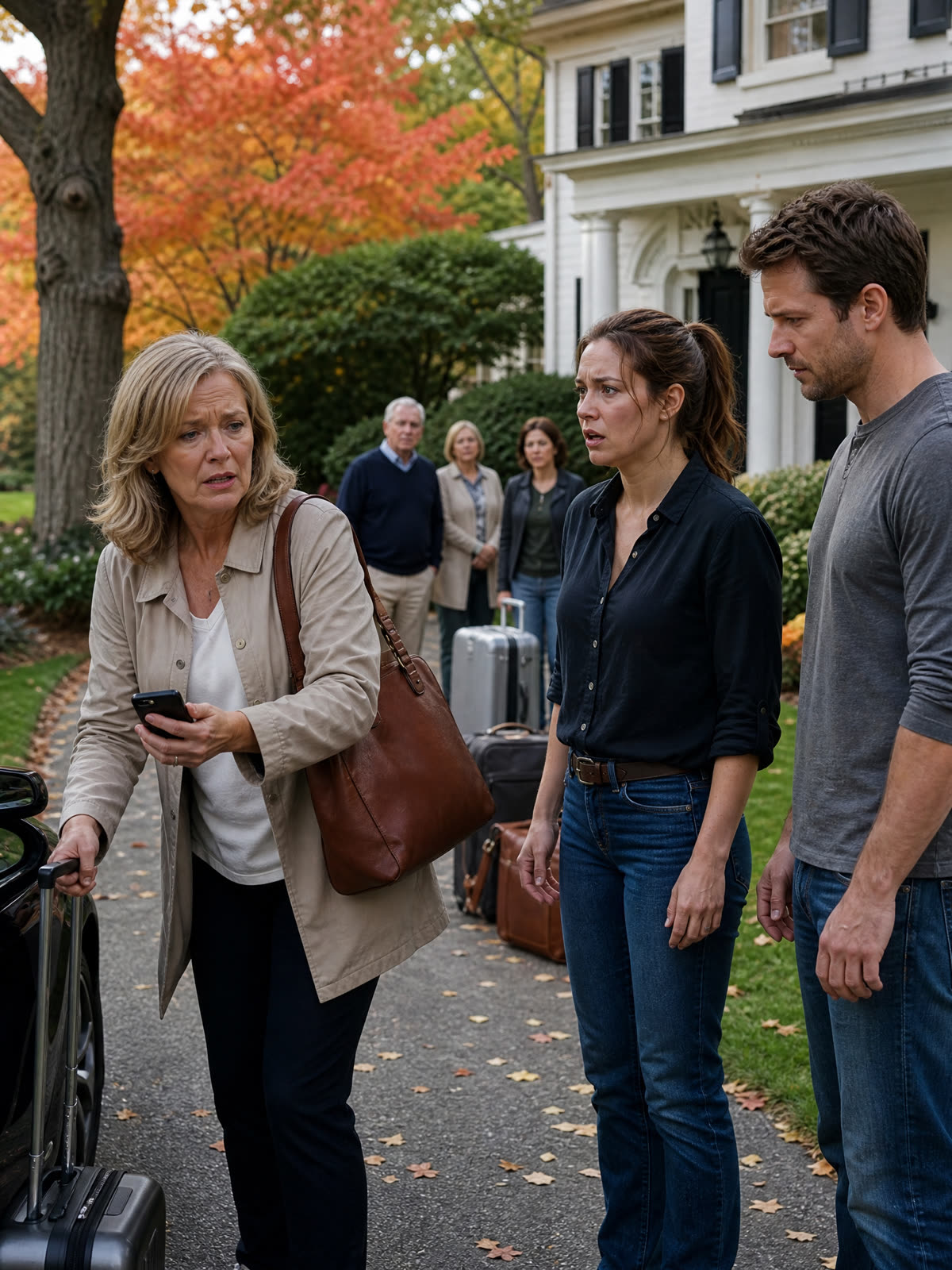
“What? Sharon, we just—” “Put them back in the car,” Sharon said. “We’re going to the Marriott. On Meridian. I saw it on the way in.” When she addressed me again, her concern was immediate and practical. “Judith,” she said. “Is there anything you need? Anything at all? We can bring you groceries. Ashley can pick up a prescription. Anything.” I had no ready response. Across three summers, not one of Megan’s relatives had asked whether I needed something. “I’m all right, Sharon,” I said. “My sister’s taking care of me.” “Well,” Sharon said. “You let me know.” Then she added, “And Judith,” she said. “When you’re better, I’d like to take you to lunch. Just the two of us. If that’s all right.” “I’d like that,” I said.
She returned the phone to Greg, and the family went to the Marriott on Meridian Street. He called again at six that evening, sounding exhausted. “They got four rooms,” he said. “Sharon paid for two of them. Kyle paid for one. I paid for one.” “Okay,” I said. “Megan’s not talking to me,” he said. “Okay,” I said. He remained quiet for a while before asking, “Mom,” he said. “Can I come see you?” He arrived after work on Monday. Nancy opened the door, regarded him without saying much, and stepped aside. There was no rushing to make him comfortable, no explanation on my behalf. She simply let him enter and see me for himself.
I sat in the recliner with my walker beside me and the heating pad behind my back. Greg stopped at the living-room doorway. His gaze moved over the walker, the brace over my nightgown, the row of medication bottles, and the hospital papers still inside their plastic folder. Finally, he looked at my face. I do not think he had really looked at me since the hospital. Something in his expression changed. “Mom,” he said. “You look—” “Like I had spine surgery,” I said. He did not smile. He sat across from me on Nancy’s couch, leaned forward, and buried his face in his hands. “I didn’t think it was this bad,” he said. “I told you it was this bad,” I said. “I know,” he said. “I know you did.”
We talked for a long time. Nancy made coffee and withdrew to the kitchen, where the clatter of pots did little to disguise her listening. Eventually Greg asked, “Mom,” Greg said finally. “Why didn’t you ever say anything? About the summers? About how much work it was?” I looked directly at him. “I did,” I said. “Last year. After the first week. I asked you if maybe Megan’s family could stay at a hotel for the second week. Do you remember what you said?” He shook his head. “You said, Mom, you love having people. Don’t make it weird. ” He closed his eyes. “And the summer before that,” I said. “I told you I was tired. I told you my back was hurting. You said, You’re a lifesaver, Mom, and went back to the dining room.”
He stayed silent. “Last summer,” I said, “I made chili for fourteen people. There were twelve chairs. You pulled up a stool.” He nodded slowly. “I ate standing at the kitchen counter,” I said. “Do you remember?” After a long pause, he answered, “No,” he said finally. “You came into the kitchen,” I said. “You walked right past me. You asked where I keep the extra ketchup.” His eyes filled as he raised his head. “I pointed to the pantry,” I said. “And you went back to the table. And I stood there eating chili out of a bowl with my leg going numb.” He covered his face again. “I didn’t see you,” he said. “I didn’t even see you.” “I know,” I said. “That’s what I’m telling you.”
After a while he looked up. “Dad would’ve seen you,” he said quietly. I let him continue. “Dad always did the dishes,” Greg said. “After Thanksgiving. Every year. He’d kick everybody out of the kitchen and make you sit down. He’d say, Judy cooked. Judy sits. ” I smiled at the memory I had somehow let slip away: Thomas at the sink, wearing the cartoon-turkey apron Greg made in third grade, his arms deep in suds while he sang Neil Diamond badly. Judy cooked. Judy sits. “Dad would’ve kicked Megan’s whole family out of the house,” Greg said. “The minute they made you stand at the counter.” He gave a small, pained laugh. “He’d have done it politely,” he said. “But he’d have done it.”
“Greg,” I said. “Can I tell you something about your father?” He nodded. “When we bought that house,” I said, “thirty years ago, your dad said something to me. On the day we moved in. We were standing in the empty living room.” I glanced at the reading glasses. “He said, Judy, the extra rooms are for family. But the house is for us. Don’t ever let anybody make you a guest in your own home. ” Greg was crying. “I let Megan make you a guest,” he said. “In your own house. For three summers.” “You did,” I said. “I’m sorry, Mom,” he said. “I’m so sorry.” I did not rush to tell him there was nothing to apologize for. There was, and we both knew it.
Then I explained the green folder: Maple Ridge, Unit 14, the March deposit, Friday’s signatures, and Carla’s listing agreement. He stared. “You’re selling the house?” he said. “In March,” I said. “When I’m healed.” “But it’s our house,” he said. “It’s where I grew up. It’s where Dad—” He stopped himself. “I know,” I said. “I know exactly what it is.” “Is this because of Megan?” he asked. “Because of Sunday?” I considered that before answering. “No,” I said. “I’ve been thinking about it since last spring. Since my back started getting bad. Since I stood at that kitchen counter.” I held his gaze. “Sunday just made me finally sign the papers,” I said.
“Mom,” Greg said. “You don’t have to do this. Megan’s family won’t come again. I promise. I’ll make sure. You can stay in the house.” I shook my head. “Greg,” I said. “Look at me.” When he did, I explained what the house actually required. “I can’t climb those stairs,” I said. “Not for six weeks. Maybe not ever, the way I used to. I can’t carry laundry from the basement. I can’t clean four bedrooms.” I reached for his hand. “That house was for a family of three and a lot of visiting cousins,” I said. “I’m one woman with a bad back. I need something that fits my life now. Not my life thirty years ago.”
For a long time, he did not respond. Then he asked, “Is there room for me?” he asked finally. “At the condo?” His voice had become small again. “There’s a guest room,” I said. “One. With a bed and a window looking out at a pond with a fountain.” I squeezed his hand. “You can come anytime you want,” I said. “As long as you call first.” He laughed through more tears. “As long as I call first,” he repeated. “And you ask,” I said. “Not tell. Ask.”
He had finally heard me, sitting across from the brace, the walker, and the papers he himself had carried from the hospital. But the words were the easy part now. I wanted to believe him, just as I had wanted to believe that Wednesday message. What I could not yet know was whether, once he left Nancy’s living room, he would remember to see me.
PART 3: The Chair With My Name
Greg returned on Wednesday, but first he called. “Mom,” he said. “Can I come over after work? Is that okay?” “Yes,” I said. At six, he arrived carrying a Panera bag. Inside were chicken noodle soup, a sourdough bread bowl, and an enormous chocolate chip cookie. He placed everything beside my recliner, laid out a napkin, and removed the soup lid. Steam rose between us. “I’m sorry I didn’t bring it last week,” he said. Then he went into Nancy’s kitchen. Soon I heard water flowing and dishes clinking. Nancy appeared in the living room with her eyebrows raised. “Your son,” she said, “is washing my dishes.”
He visited every day that week, calling before each visit. He brought meals, cleaned up, and accompanied me on slow walks around Nancy’s block, morning and evening, matching the walker’s careful pace. On Thursday, he collected my mail. On Friday, he watered the backyard tomato plants. Saturday, he sat beside me on Nancy’s couch while we watched Casablanca, his father’s favorite. His phone never drew his attention away. None of those things erased the summers, but they were things I could see rather than promises I was expected to trust. The soup was there. The dishes were washed. When I took another slow step, he remained beside me.
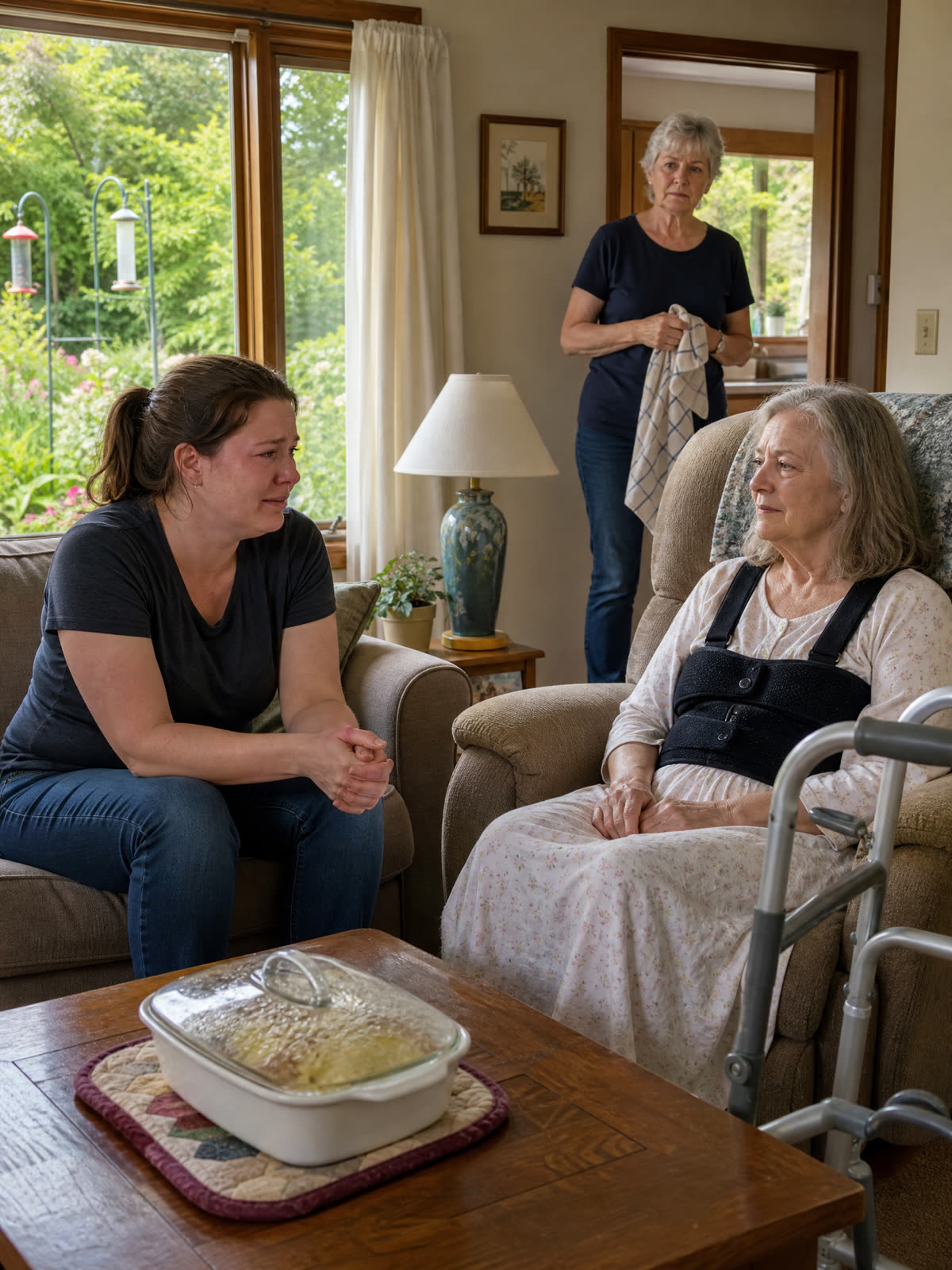
Megan came the following Sunday, a week after the scene in the driveway. She also called before arriving. Greg told me afterward that she had sat outside in her car for twenty minutes before approaching Nancy’s door. When she appeared in the living-room entrance, her hair was in a ponytail and she wore no makeup. She looked tired. A casserole dish wrapped in a towel rested in her hands. “Sweet potato casserole,” she said quietly. “My mom’s recipe. She said you like it.” I had never told anyone that I liked it; Sharon must have guessed. “Thank you, Megan,” I said. “Would you like to sit down?” She took the couch opposite me and placed the dish on the coffee table.
For a considerable while, she did not speak. “My mom hasn’t spoken to me in a week,” she said finally. “Not since the driveway.” I waited. “She found out I lied,” Megan said. “About you inviting us. About you wanting us to come. My dad’s not talking to me either. Ashley’s furious. She used three days of vacation.” She studied her hands. “Everybody’s mad at me,” she said. “Why did you tell them I invited them?” I asked. She did not answer immediately. This was not a question about the hotel bill or who had been inconvenienced. It was the question behind all those summers: why she had needed my agreement badly enough to invent it.
“Because I wanted them to think I had a nice family,” she said finally. “A rich mother-in-law. A big house in Carmel. Somebody who wanted us around.” She wiped at her eyes. “I grew up in a two-bedroom trailer in Paintsville, Kentucky,” she said. “Five of us. My mom cleaned motel rooms. My dad drove a coal truck until his back gave out.” Her gaze moved around Nancy’s small, tidy living room. “When I married Greg,” she said, “I’d never been in a house with four bedrooms. When I first walked into your house, I thought it was a mansion.”
“So I brought my family,” she said. “Every summer. So they could see it. So they could sleep in a real bed instead of a pull-out couch. So my nieces and nephews could go to the Children’s Museum.” She stopped for a breath. “I wanted to give them something,” she said. “Something I never had.” “And you gave them my kitchen,” I said quietly. “My guest rooms. My time.” Slowly, she nodded. “I didn’t think about what it cost you,” she said. “I just thought about what it gave them.” Then she looked toward the walker. “I didn’t think about you at all,” she said.
I remained quiet. Nancy stood at the kitchen entrance with a dish towel over one shoulder, openly listening now. At last I spoke. “Megan,” I said finally. “Can I tell you something?” She raised her eyes. “I grew up in a three-room house in Muncie,” I said. “My father worked at the Ball jar factory. My mother took in ironing. My sister and I shared a bed until I left for college.” Nancy nodded from the doorway. The life Megan imagined I had always possessed was not the life either of us had known as children. I understood crowded rooms, careful spending, and the astonishment of stepping into a home that seemed bigger than anything you once expected.
“When Thomas and I bought that house in Carmel,” I said, “I cried in the empty living room. I couldn’t believe it was mine.” I let that stand before continuing. “I understand wanting to give your family something,” I said. “I really do.” Tears gathered in Megan’s eyes. “But you can’t give people things that belong to someone else,” I said. “Not my house. Not my time. Not my back.” I looked straight at her. “If you want to give your family something,” I said, “you have to give them something that’s yours.” Understanding her longing did not make what she had done acceptable. Both things could be true without my surrendering either one.
She began to cry. “I’m sorry, Judith,” she said. “I’m so sorry. For Sunday. For the surgery. For three summers.” She looked at me again. “For telling you to do as I say, ” she said. “In your own bedroom. Five days after surgery.” “I know,” I said. This was not the impatient woman who had stood beside my doorway explaining that everyone had already arranged their time off. She was looking at the same walker now, but she was no longer treating it as something inconvenient to her plans. Still, an apology could acknowledge the hurt without making it disappear.
“Can you forgive me?” she asked. I considered the kitchen counter, the numbness in my leg, the gluten-free bread request, and that order delivered beside my bed. Just do as I say. Then I thought about a girl in a two-bedroom Paintsville trailer who had never entered a four-bedroom house. Neither image canceled the other. “I’m working on it,” I said honestly. Megan nodded. “That’s fair,” she said. I could give her an honest answer. I could not give her immediate forgiveness simply because that would make the room more comfortable.
The house went on the market March 15. Carla listed it on a Thursday, and by Sunday there were four offers. One came from a young family with three children and a dog. The father worked as a pediatrician at Riley Children’s Hospital; the mother was a teacher. They wanted bedrooms for their children and space for grandparents visiting from Ohio. I accepted their offer. Those extra rooms would be used again, much as Thomas and I had once hoped ours would be. Choosing that family did not remove the sadness of leaving, but it let me picture the house holding a full life after mine had moved somewhere else.
Greg took a week off to help me move. He packed the boxes, carried the furniture, and drove the U-Haul. Before packing anything, he asked what I wanted. “Mom, do you want to keep this?” he would say, holding a lamp, a picture frame, or Christmas decorations. “Mom, where do you want this to go?” And, “Mom, is this too heavy for you? Let me get it.” He no longer assumed that being helpful meant deciding for me. I could tell him what belonged in my next home, what I wanted near me, and where something should go. Each question was small, but together they sounded different from the way we had lived before.
On the final day, we stood in the empty living room. Thirty years earlier, Thomas and I had stood in that same space while I cried because I could scarcely believe it belonged to us. Now Greg studied the bare walls and empty rooms. In the kitchen doorway were the pencil marks where Thomas had measured him every birthday. “I’m going to miss it,” he said. “Me too,” I said. He photographed the marks with his phone: Greg at four, seven, twelve, sixteen. The house could be sold without pretending those years had not happened. We did not have to remain inside it to keep what had mattered there.
He turned toward me. “Mom,” he said. “Can I tell you something?” “Of course.” “I’ve been thinking about what Dad said,” he said. “On the day you moved in. Don’t ever let anybody make you a guest in your own home. ” He looked across the empty room. “I think I made you a guest in your own life,” he said quietly. “For a long time. Not just the summers. Everything.” Then his eyes returned to me. “I’m not going to do that anymore,” he said. There was nothing I needed to smooth over in that moment. He had named it himself.
I moved into Unit 14 on a bright Saturday in April. Two bedrooms, a sunny kitchen, a patio facing the fountain pond, and no stairs anywhere. Thomas’s reading glasses went on the kitchen windowsill. His comb and little brass dish found places on my bedroom dresser. I spread my mother’s blue quilt over the guest bed. I had not brought the entire house with me, but I had brought the things I wanted to see when I opened my eyes or walked into a room. The rooms were fewer, and they suited the life I was actually living.
Nancy lived three blocks away. We began walking around the pond each morning and having coffee at the clubhouse. I joined the book club, which planned to read Gatsby the following month. I already knew how that ended. My back improved, though it did not become perfect. I continued wearing the brace while gardening, but I could walk two miles. I could also stand long enough at the stove to make soup. After months of measuring movement against pain and instructions, those ordinary abilities mattered. I did not need four bedrooms to enjoy them. I needed rooms I could move through and a life with space for my own days.
Greg began visiting every Sunday. He called first, without exception, and brought lunch. At my small kitchen table, he asked how I was and stayed quiet long enough to hear the answer. After we ate, he washed the dishes. Sometimes Megan accompanied him. Not every week, but sometimes. She brought a casserole or pie and told me she was learning her mother’s recipes. She said she had never had time to learn before. Our visits did not require me to provide a crowded dining room or spend the morning preparing food. They sat with me in the home I had chosen, and the conversation no longer happened around the work I was doing for everyone else.
In May, Sharon came for a long weekend and stayed at the Marriott on Meridian, paying for her own room. Megan brought her over, and Sharon kept the promise she had made on the phone. We went to a little tea room in Zionsville, just the two of us. Over chicken salad and scones, we talked for three hours. She described twenty-two years of cleaning motel rooms in Paintsville. I told her about trying to make sixteen-year-olds care about Hamlet. We laughed so much that the waitress came to see whether we were all right. Without a houseful of people between us, we finally had a chance to discover each other.
“I always thought you were a rich lady,” Sharon said. “With that big house.” “I always thought you didn’t like me,” I said. “You never said much those summers.” Sharon looked at me. “I didn’t think it was my place,” she said. “In your house.” She reached across the table and patted my hand. “Next time,” she said, “you come to Kentucky. You stay with me. I’ll cook. You sit.” I had spent those summers interpreting her silence one way while she understood it another. At the tea-room table, neither of us had to guess what the other meant.
That summer, Megan’s family arranged a vacation at Lake Cumberland in Kentucky. They rented a cabin for two weeks and shared the expense: Dennis and Sharon, Kyle and his wife, Ashley and her children, Greg and Megan. Megan organized it, bought the groceries, and worked out whose turn it would be to cook each evening. They invited me too. In April, she had called rather than sending a text. “Judith,” she said. “We rented a cabin at Lake Cumberland for July. Would you like to come? For a few days? You’d have your own room on the first floor. No stairs.” She paused before adding, “You wouldn’t have to cook,” she said. “Or clean. Or shop. Or anything. You’d just be a guest.”
I went for four days. With a book and iced tea, I sat in a lawn chair on the dock while Ashley’s children jumped into the water. Dennis took me out on the boat, and I discovered how funny he could be when he relaxed. Each evening, someone else prepared dinner. I did not pack lunches before everyone left or remain behind to get the next meal started. I read, watched the lake, and spent time with people without having to keep the whole visit running. For once, being included did not mean being useful. I had been invited to come, and coming was enough.
On my last evening, Greg made chili. He had asked for my recipe—the same one I used the previous summer, when I cooked for fourteen and ate alone at the counter. Sixteen of us were at the cabin, but the long picnic table on the deck held fourteen. Greg put the chili pot in the middle. I was sitting near the railing in my lawn chair, watching the sun sink over the lake, when he approached and offered his hand. “Mom,” he said. “Come sit down.” He led me to the head of the table. A padded chair waited there, with a pillow positioned for my back. A small place card stood in front of it. In his handwriting was one word: Mom.
I took my seat. Everyone else settled around the table. There were still only fourteen chairs for sixteen people. Greg remained standing, and so did Megan. They carried their bowls inside and ate at the kitchen counter, visible through the screen door. No one asked me to make room by disappearing into the kitchen. No one assumed I would be more comfortable finishing something at the stove. I sat with my chili and cornbread, the pillow behind my back, and the lake stretching beyond the deck. The chair had been chosen before I reached the table, not remembered after everyone else had begun eating.
Halfway through dinner, Greg came outside and walked directly to me. “Mom,” he said. “Do you need anything?” I looked up at my son. “No, honey,” I said. “I have everything I need.” He smiled, then returned to the counter inside. Across the water, the last sunlight turned the lake gold. I thought of Thomas wearing his turkey apron at the sink, singing Neil Diamond out of tune. Judy cooked. Judy sits. This time Judy had not cooked. But Judy sat.
For the first time in a very long while, nobody needed to tell me where I belonged. My name was already waiting at the table. I had heard apologies and promises before; now I had a chair, a pillow, and a son who had noticed me. Whether they would keep remembering could only be answered after this evening, when the place card was put away.
Disclaimer: This story is a work of fiction inspired by real-life themes. Names, characters, places and events are fictionalized, and any resemblance to real persons is purely coincidental. Images are for illustration purposes only.
