


PART 1 — The Hand Beside Me
My husband left me at an isolated bus stop with no money, no phone, and no means of getting home. According to him, I needed to learn to value everything he supplied. I cried there for hours before an elderly blind woman approached and murmured, “Pretend you’re my granddaughter. My driver will arrive shortly.” Then she smiled. “Your husband has no idea who he’s dealing with. I’m one of the wealthiest women in this city, and he’s going to regret what he did.” Until that afternoon, I would never have imagined that a stranger could make me feel safer than my own husband.
My name is Olivia Henderson. Derek and I had been married for five years, although the man I lived with scarcely resembled the one I had fallen in love with. In the beginning, he had been thoughtful, generous, and charming. His attention made me feel as though nobody mattered more to him. After the wedding, however, that attention slowly became scrutiny. He watched what I spent, questioned my choices, and turned even small purchases into reasons for me to feel guilty. The change happened gradually enough that I kept trying to adjust instead of recognizing what it meant.
I worked part-time at a public library, and my earnings went straight into our shared account. Nevertheless, Derek behaved as though every dollar belonged exclusively to him. I clipped coupons for groceries, passed over things we did not need, and almost never bought anything for myself. No amount of caution satisfied him. One Tuesday morning, he came into our bedroom carrying a credit card statement. “Olivia, explain this.” I looked over the charges: groceries totaling $140, gasoline, and an $80 birthday gift for my mother, who was still recovering from surgery.
“Those are ordinary expenses,” I explained. “We needed groceries, and Mom’s been feeling terrible.” His glare did not soften. “Eighty dollars for a present? Do you have any idea how hard I work?” I tried to make him understand. “It was a blanket and a few books. She’s been stuck in bed for weeks.” Derek shook his head. “That’s your problem. You have absolutely no respect for money.” I wanted to point out that my wages helped pay our expenses, too. Instead, I said I was sorry. Experience had taught me that defending myself only intensified his anger.
That morning, apologizing did not settle anything. “Get dressed,” Derek ordered. “We’re going somewhere.” He said we would be visiting my mother. Since he generally found reasons not to spend time with her, the announcement surprised me. Still, I let myself hope his temper had passed. About twenty minutes into the drive, I realized the streets were unfamiliar and we were traveling in the wrong direction. “Derek, this isn’t the way to Mom’s house.” He answered without hesitation. “I know.” Something in the flatness of his voice made my stomach contract.
We continued through streets bordered by vacant buildings and deserted warehouses. Eventually, he stopped beside a neglected bus shelter. “Get out.” I stared across at him. “What?” He looked at me as though the explanation should have been obvious. “You need to learn what life is like without depending on my money.” Before I could answer, he reached into my purse. He took my wallet, my debit and credit cards, and the $32 I had managed to save. Then he confiscated my phone, leaving me without even a way to call someone.
“Derek, please. I don’t even know where we are.” My fear made no difference to him. “Then figure it out.” I tried again. “How am I supposed to get home?” His reply was merciless. “That’s your problem. When you’ve learned your lesson and are ready to apologize properly, maybe we can talk.” I begged him to change his mind, but he simply opened the passenger door and ordered me outside. The instant I stepped onto the pavement, he pulled away. I stood motionless, watching his taillights grow smaller until they vanished.
He had done it deliberately. My husband had driven me somewhere unfamiliar, stripped away every practical means of helping myself, and left. I had no money, no telephone, and no way to reach anybody I knew. Eventually, I made my way to the bench. Buses came and went as the afternoon dragged on, but I could not pay for a ticket. Walking seemed no more useful; I did not know which direction would take me home. Every option ended at the same helpless uncertainty, and I remained where he had abandoned me.
As daylight faded, the temperature began to drop. Strangers passing the shelter made me uneasy, and I folded my arms around myself. I could no longer keep the tears back. I kept returning to the same questions: how had my marriage brought me here, and when had I become frightened of the person who had promised to protect me? All the small apologies, all the careful explanations, all the efforts to avoid upsetting him had led to this bench. I sat there crying, unable to see what I was supposed to do next.
Then came the steady tap of a cane. An elderly woman in dark sunglasses approached, using a white cane to guide her careful steps. She settled beside me and turned toward the sound of my crying. “You’ve been crying for a long time, haven’t you, dear?” I hurriedly wiped my cheeks. “I’m fine.” Her smile was gentle rather than convinced. “My eyesight may be gone, but my hearing is excellent. And you certainly don’t sound fine.” That small kindness reached through the fear I had been struggling to contain, and I found myself unable to keep pretending.
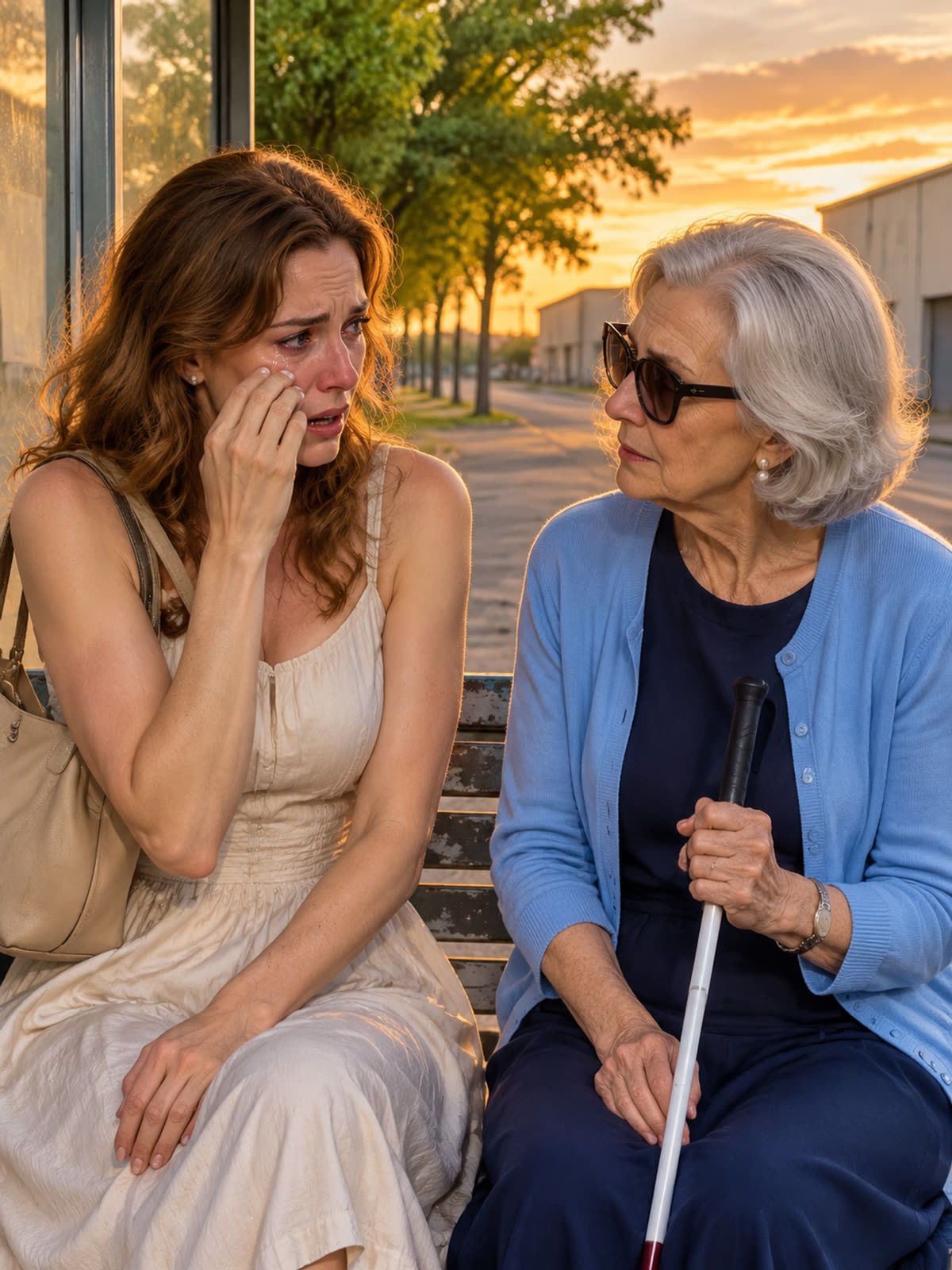
“My husband left me here,” I whispered. She went very still. “Left you here?” I looked down as I explained. “He took my money and my phone. He said I needed to learn a lesson.” Her expression tightened. “Did he deliberately abandon you?” I nodded. Then the rest began spilling out. I told her about the groceries, my mother’s birthday gift, and Derek’s insistence on controlling every part of our finances. I admitted that he had gradually separated me from friends and convinced me that every disagreement was somehow my fault.
She listened without cutting in or making excuses for him. When I finally stopped, she asked my name. “Olivia Henderson.” She introduced herself in return. “I’m Catherine Wilmington.” The name meant nothing to me then. “Olivia, what do you intend to do if your husband comes back?” I stared at my hands because the honest answer embarrassed me. “Probably apologize. Promise to be more careful.” Her face changed. “Apologize for what?” I gave the answer I had come to accept as normal. “For upsetting him.”
Catherine shook her head. “Buying food and a gift for your mother isn’t irresponsible. Taking away your money, isolating you, and abandoning you in a dangerous place is abuse.” The final word startled me. “But Derek doesn’t hit me.” She answered with quiet certainty. “Abuse isn’t always physical,” she replied. “Sometimes it’s making someone so frightened and dependent that they forget they’re allowed to make their own decisions.” I had no response. Beneath the excuses I had repeated for years, I recognized the truth of what she was saying.
“I don’t have anywhere else to go,” I admitted. Catherine reached for my hand. “Yes, you do.” Just then, a luxurious black car drew up at the curb. A distinguished man wearing a gray suit got out and opened the rear door. “Mrs. Wilmington,” he greeted her. Catherine smiled toward his voice. “Perfect timing, Thomas.” Then she leaned closer to me. “Olivia, I want you to pretend you’re my granddaughter.” I stared at her, uncertain I had understood. “Your granddaughter?” Her answer was simple. “Just for now.”
She lowered her voice before continuing. “Your husband thought he left you completely helpless. What he doesn’t realize is that he abandoned you beside one of the richest women in this city.” I could hardly take in what she was telling me. Catherine carefully rose, keeping hold of her cane. “Thomas, I’d like you to meet Alexandra, my granddaughter. She’ll be staying with us.” He appeared surprised for a moment, then accepted the introduction. “Of course, Mrs. Wilmington. Welcome, Miss Alexandra.” Catherine held out her hand, leaving the decision with me.
I glanced once more at the empty stretch of street where Derek’s car had disappeared. Then I accepted her hand. For the first time that afternoon, the fear loosened enough for me to feel safe. During the drive, unfamiliar streets gave way to increasingly beautiful neighborhoods. Eventually, Thomas stopped in front of enormous iron gates. Beyond them, a magnificent house stood within carefully landscaped gardens. I looked through the window, trying to reconcile the woman who had sat beside me at a broken-down bus stop with everything now surrounding us. “Catherine, who exactly are you?”
PART 2 — The Woman I Had Forgotten
Catherine chuckled. “I used to own Wilmington Industries.” My mouth fell open. The name was familiar, even if hers had not been. Wilmington Industries was among the largest manufacturing businesses in the state, a company I had heard mentioned countless times. Catherine had built it before retiring. She had lost her vision in an accident ten years earlier, yet there was nothing helpless about the woman beside me. The certainty I had heard at the bus stop belonged to someone accustomed to making her own decisions, regardless of what anyone assumed she could do.
The mansion was even more remarkable inside. Marble floors stretched beneath crystal chandeliers, and a sweeping staircase rose through the entrance. A housekeeper named Margaret greeted us and made a beautiful guest room ready for me. Everything was far removed from the bench where I had spent the afternoon wondering how to get home. Yet what affected me most was not the size of the house. It was the simple fact that nobody demanded an apology before allowing me to feel welcome. Catherine had offered somewhere safe, and the people around her treated that offer as entirely natural.
That evening, she invited me to dinner. “Olivia, you can stay here as long as you need,” she said. I struggled with the generosity of it. “I couldn’t possibly accept so much.” Catherine did not hesitate. “You’re not taking anything from me. I’m offering.” Then she spoke about the accident that had taken her sight. Afterward, people had begun acting as though she could no longer direct her own life. Some had even attempted to take advantage of her. She knew what it was to have others confuse vulnerability with a lack of worth.
“But blindness didn’t change my worth,” Catherine explained. “And your husband’s opinion doesn’t determine yours.” Tears rose again, though this time they came from being understood. Derek had spent years persuading me that I was foolish, careless, and incapable of managing without him. I had heard those judgments so often that they had begun to sound like facts. Now someone who had known me for only a few hours was speaking as though my dignity had never been in question. Her words did not erase what had happened, but they challenged the way I had learned to see myself.
The next morning, Catherine introduced me to Patricia, her personal attorney, who specialized in family law. After listening to my account, Patricia explained that Derek’s behavior formed a pattern of emotional abuse and financial control. She asked whether I wanted a divorce. The question frightened me. I had always believed marriage was meant to last, and even considering its end felt enormous. Then I remembered begging beside the car, the door opening, and Derek leaving me without a way to call for help. “I think I do,” I whispered. Patricia began examining our financial records.
What she uncovered made me feel sick. Over several months, Derek had quietly taken money out of our savings, including money earned through my library job. There were costly hotel stays and restaurant bills from evenings when he had claimed he was working late. Many of the charges appeared connected to another person. While he had interrogated me over food and a gift for my recovering mother, he had been using our shared money to support a hidden relationship. His control had never been the careful household management he insisted it was.
Catherine arranged appointments with a therapist, Dr. Chen, who helped me understand the manipulation I had lived with. Margaret continued treating me like a member of the household rather than an inconvenience. Thomas told me about his daughter, who had rebuilt her life after leaving a difficult marriage. Each kindness reached me differently. Together, they helped me begin recovering a sense of myself beyond Derek’s criticism. I was still frightened by what lay ahead, but I was no longer trying to make sense of everything alone. Slowly, I began to feel like myself again.
I contacted my mother as well. Derek had told her I was missing and claimed not to know where I had gone. When I explained the truth, she was horrified. “Come stay with me, sweetheart,” she pleaded. I reassured her that I was safe and had people helping me. I also asked her not to tell Derek where I was staying. She agreed. Hearing her concern reminded me how much his version of events had concealed. He had left me stranded, then presented himself as the husband who did not understand why I had disappeared.
Five days after Catherine found me, she introduced an unexpected subject over breakfast. “There’s a charity gala this Saturday.” I answered with a polite smile. “That sounds lovely.” She explained why she had mentioned it. “It’s a fundraiser for the children’s hospital. Nearly every important business figure in the city will attend.” Then she added something that made my stomach tighten. “And Derek’s car dealership is one of the sponsors.” Until that moment, the house had felt separate from him and everything he represented. Suddenly, I understood that she was suggesting a place where our paths could meet.
“You want me to go?” I asked. “I do.” The thought of seeing him undid some of the steadiness I had begun to recover. “Catherine, I can’t face him.” She reached across the breakfast table. “You’re not going there to beg him to take you back. You’re going there to remind yourself that he no longer controls you.” I hesitated, caught between the familiar instinct to avoid his anger and the possibility she was offering. Then Catherine smiled. “And you’ll be attending as my granddaughter.”
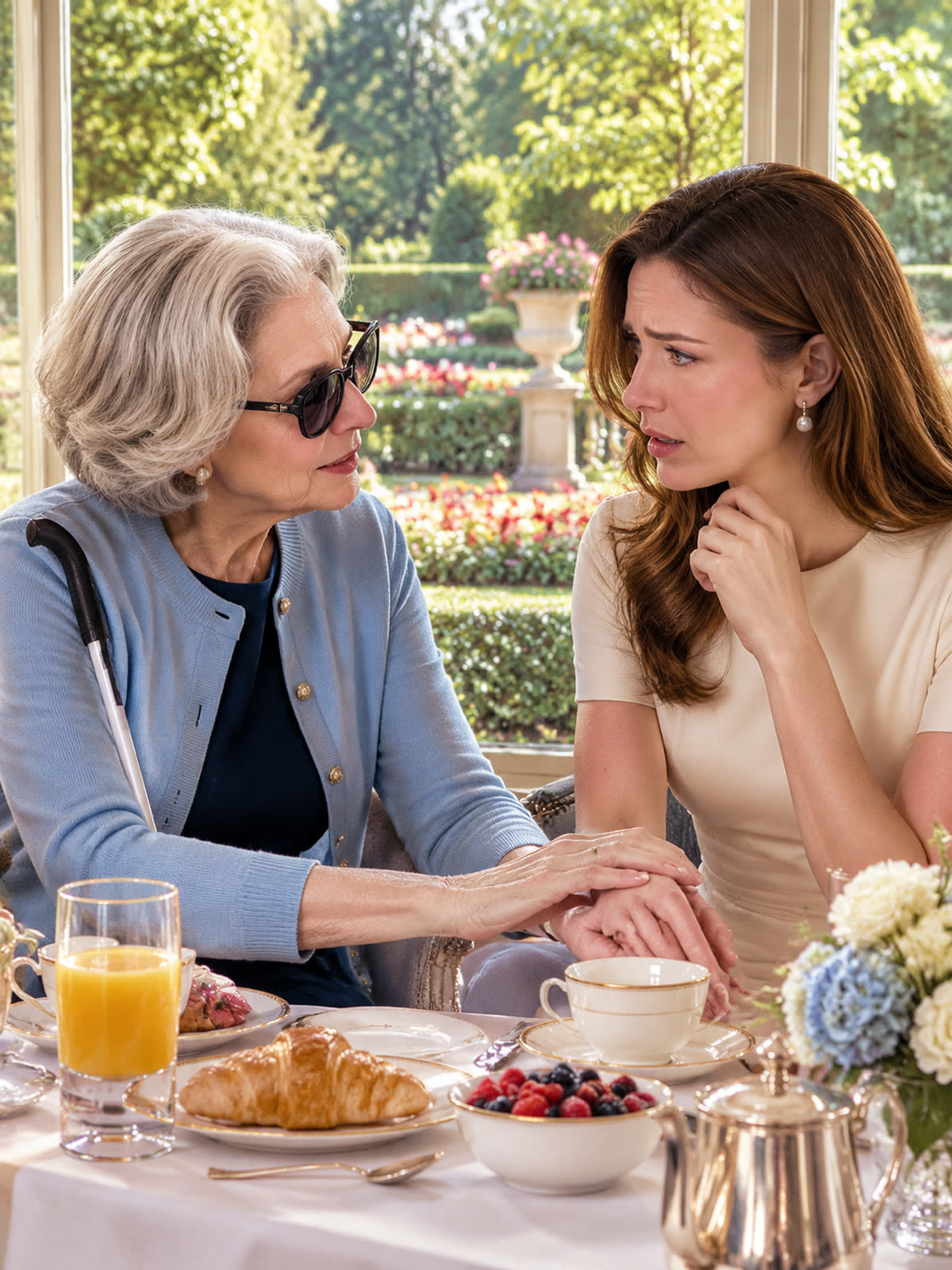
The invitation meant more than entering a ballroom. Derek had taught me to anticipate his displeasure before choosing what to say, what to buy, or where to go. Even away from him, I could feel that habit tugging at me. Catherine was asking me to appear without seeking his permission and without making myself smaller. I was not being asked to win him back or persuade him that I had behaved properly. I was being given the chance to stand somewhere he could see me and remember that my life was still mine.
The following day, a stylist arrived to help me get ready. Together, we chose an elegant emerald-green gown. My hair was arranged in soft curls, and my makeup was understated but beautiful. When I faced the mirror, I scarcely recognized the woman looking back. For years, Derek’s remarks had shaped the way I regarded my appearance. I had grown used to searching for whatever he might criticize. This time, I saw someone I had almost forgotten: not a collection of shortcomings, but a woman who could still look and feel beautiful.
The change in the mirror did not make the coming evening easy. I still remembered how quickly Derek’s expression could turn cold and how readily I used to retreat when it did. But the gown was not disguising me as somebody else. Beneath the curls and careful makeup, I was the same woman who worked at the library, loved her mother, and had tried for years to make a marriage work. Catherine’s kindness had not created that woman. It had helped me recognize that she had not disappeared simply because Derek had stopped treating her with respect.
On Saturday evening, Thomas drove us to the gala. Photographers crowded the entrance as we arrived. Catherine stepped from the car in a striking silver gown, holding my arm with confidence. People recognized her immediately. Their attention followed us through the doors, and whispers moved around the ballroom as we entered together. I felt overwhelmed by the room, by the people looking toward us, and by the knowledge that Derek might be somewhere among them. Catherine, however, did not hesitate. Beside her, I kept moving.
Then I saw him near the bar. Derek was laughing with a woman in a fitted red dress, looking entirely at ease. I recognized her: Brenda, his boss at the dealership. Nothing in his expression suggested a man distressed about a wife who had supposedly vanished five days earlier. His ease struck me almost as sharply as the bank records had. While I had been trying to understand what he had done, he had continued standing comfortably in the life he expected to keep. Then he turned in our direction.
Our eyes met. Whatever Derek had expected that evening, it had not been this: me standing beside Catherine Wilmington instead of waiting somewhere to apologize. The champagne glass slid from his fingers. It struck the floor and shattered. “Olivia?”
PART 3 — What One Act of Kindness Began
Derek forced his way through the gathering. “Where have you been? I’ve been worried sick!” Only days earlier, that tone might have pushed me straight into explaining myself. Now Catherine moved slightly in front of me. “Young man, there’s no need to speak to my granddaughter that way.” He stared at her, plainly struggling to understand what he was seeing. “Your granddaughter? Olivia, what is going on?” The confidence he had worn near the bar was gone, replaced by confusion he could not conceal.
Catherine tilted her head toward his voice. “You must be the husband who abandoned her at a bus stop without money or a phone.” Conversations around us faltered. People who had been speaking among themselves began listening instead. Derek’s face turned red. “That’s not what happened!” For so long, his denial would have been enough to make me question how to describe something I had experienced. This time, I remembered the empty street and the things he had taken from my purse. I did not need him to agree before I could tell the truth.
I found my voice. “You left me there because I bought groceries and a birthday present for my mother.” Derek responded as though his justification should settle the matter. “It was supposed to teach you responsibility!” I repeated the word back to him. “Responsibility?” As I continued, my voice became steadier. “I’ve seen the bank records, Derek. While you were criticizing me for spending eighty dollars, you were paying for expensive hotels and restaurants with another woman.” The explanation he had used against me could not hide what those records showed.
Brenda’s face suddenly lost its color. She turned toward him. “You told me you were separated.” Derek opened his mouth, but no words followed. The silence was unlike the ones I remembered from our arguments. At home, he had always found another criticism, another accusation, another reason I should apologize. Here, with Brenda waiting beside him and other guests listening, he had no answer ready. I stood still and let that silence remain his. For once, I did not rush to soften an uncomfortable moment he had created.
Patricia approached carrying a legal envelope. “Mr. Henderson, my client has retained legal representation. These documents concern the financial transactions under review and her intention to pursue divorce proceedings.” She placed the envelope in his hands. Derek looked stunned. The decision I had barely managed to whisper in Catherine’s house was no longer something he could pretend did not exist. Patricia’s presence made it unmistakable that I had help, that the finances were being examined, and that I intended to act rather than return to the arrangement he controlled.
Brenda stepped away from him. “You lied to me,” she said sharply. “And we’ll be discussing your position at the dealership on Monday.” She walked off, and several coworkers went with her. Derek watched his audience change. The people who had seen him laughing comfortably only moments earlier had now heard what he had done and seen the documents delivered. I had spent years absorbing the consequences of his moods in private. This time, his own choices were standing in front of him where other people could see them.
He turned back to me. “Olivia, please. We can fix this.” I studied his face and realized something that would once have seemed impossible: I was not afraid of him. “You had five years to treat me like your partner,” I said quietly. Derek tried again. “Don’t throw away our marriage over one mistake.” The words reduced everything to a single lapse, as though the abandoned bus stop had appeared without all the years that came before it. I could no longer accept that version of my own marriage.
“One mistake?” I repeated. “You’ve spent years making me feel worthless. You controlled our money, pushed away my friends, and abandoned me because I wouldn’t apologize for helping my mother.” Saying it plainly felt different from defending each individual expense. I was no longer arguing that a blanket or a few books had been reasonable purchases. I was naming the life I had been living and the way he had made me feel inside it. He could dispute a charge on a statement. He could not make me forget what I finally understood.
Derek stepped closer. “You can’t survive without me.” It was the same belief he had worked to establish throughout our marriage, stripped of every gentler disguise. He wanted me to see his control as something I needed. But I was standing there because other people had helped me discover choices he had insisted I did not have. There was a place where I could sleep safely. There was someone examining the money. There were people who listened without deciding in advance that I was wrong.
Before I answered, Catherine gave a soft laugh. “Young man, Olivia has excellent legal representation, a safe home, and people who genuinely care about her. I suggest you leave her alone.” Derek glanced around the room. Everyone was staring. Then he turned and hurried out of the ballroom. I watched him go, just as I had watched his car disappear from that unfamiliar street. This time, his departure did not leave me stranded. For the first time in years, I felt free.

Later that evening, Catherine and I sat in her study. “How do you feel?” she asked. I considered the question before answering. “Lighter,” I admitted. “Like I’ve finally put down something I’ve been carrying for years.” She smiled. “Then it’s time to think about your future.” Until then, so much of my attention had been fixed on escaping the past that the future still felt unfamiliar. Catherine spoke about it as though it belonged to me, something I could shape instead of something I merely had to endure.
I told her how much I had enjoyed working at the library, especially the programs that helped adults strengthen their reading skills. She listened carefully before surprising me again. “The Wilmington Foundation has been searching for someone to oversee our literacy and education projects.” I stared at her. “Are you offering me a job?” Catherine made a small correction. “I’m offering you an opportunity,” she corrected. “You’re passionate about education, you understand the community, and I believe you’d do wonderful work.” She was speaking about abilities Derek had made me overlook, not inventing qualities I had never possessed.
I started crying. “Catherine, you’ve already done so much.” She squeezed my hand. “Olivia, I didn’t rescue a helpless woman at that bus stop. I met a capable woman who’d forgotten how strong she was.” Her words stayed with me. The help she had offered had never required me to remain helpless so that she could feel generous. From the first evening, she had treated safety as a beginning rather than the limit of what I deserved. Now she was offering a chance to use the interests and experience that had always been mine.
Three months later, the divorce was final. With Patricia’s assistance, I received my fair share of our marital assets and reached a financial settlement. I moved into an apartment of my own and began working at the Wilmington Foundation. My first major project helped establish three literacy centers. For the first time in years, I woke looking forward to what the day might bring. My mother was proud of me, old friends returned to my life, and Catherine became the grandmother I had never had.
One afternoon, she came to my office. “Olivia, I’ve been thinking about something.” I smiled. “Should I be worried?” Her response was warm. “Not at all, dear.” She reached for my hand. “I’d like to update my will and officially include you as family. Not because we pretended you were my granddaughter that day, but because that’s what you’ve become to me.” I wrapped my arms around her. “Catherine, you’ve been my family since the moment you sat beside me.” What had begun as a hurried introduction beside a waiting car had become something neither of us needed to pretend.
That evening, on my drive home, I passed a bus stop. A young woman sat alone, looking worn out and frightened. I pulled over. “Excuse me. Are you okay?” She hesitated before answering. “I’m trying to get downtown.” I offered her a ride. As we drove, she told me she had recently left a controlling boyfriend and was struggling to begin again. I listened. I knew what it was to try to describe that kind of fear to someone who had not lived inside the relationship.
Then I gave her my business card. “The Wilmington Foundation offers employment training, financial education, and connections to legal assistance,” I explained. “Call us on Monday. We may be able to help.” Her eyes filled with tears. The offer did not mean that starting over would suddenly become easy. I knew from my own experience that understanding what had happened and rebuilding afterward took more than one conversation. But I also knew how different everything could feel once somebody made it clear that help existed.
“Why would you do this for someone you don’t even know?” she asked. I thought of that Tuesday afternoon: the neglected shelter, the empty street, and the woman whose white cane had tapped toward my bench. I remembered the fear of having nowhere to turn, and the hand Catherine had offered without asking me to prove I deserved it. I smiled. “Because once, when I had nowhere to go, a stranger stopped and helped me.” Then I looked at the young woman beside me. “And that single act of kindness changed my entire life.”
Disclaimer: This story is a work of fiction inspired by real-life themes. Names, characters, places and events are fictionalized, and any resemblance to real persons is purely coincidental. It does not represent any person or organization and does not encourage inappropriate behavior. Images are for illustration purposes only.
