


PART 1 — The Suitcase Beside the Door
My husband told our daughter that, now she had a job, she could pay rent or find somewhere else to live. Natalie’s entire answer was, "Okay." By the following morning, a packed suitcase stood near our front door. Ben initially took it as proof that his message had landed. Then our daughter grasped the handle, wheeled it into the kitchen, and prepared to remind him of a lesson he had spent years repeating. The evening before, however, she had arrived home with nothing more confrontational than a bakery box and the excitement of finishing her first week at work.
At twenty-one, Natalie was still discovering all the small things that came with having a job. After four years of studying, even an unreliable office printer gave her something to talk about at dinner. "It makes this awful grinding noise," she told us. "Sounds like our dishwasher," Ben said. "Exactly! Except the printer actually finishes its job." I laughed as I put the plates on the table. She had already learned everybody’s names, along with the details that made her new workplace feel less unfamiliar. Her supervisor, Marissa, apparently had six identical cardigans. A colleague named Josh had a habit of taking the good pens.
"And next Friday’s payday," Natalie announced. She lifted the lid of the bakery box to reveal three chocolate cupcakes. The icing flower on one leaned crookedly to the side. "I bought these to celebrate surviving week one." Ben selected the biggest cupcake. "That’s my girl." Natalie smiled at him. "I might finally buy proper work shoes." I asked, "What’s wrong with your current ones?" She answered, "They squeak whenever I walk past Marissa’s office." Ben chuckled, and for a little while the evening was exactly what she had intended: a small celebration of a beginning she had worked toward.
Then Ben settled back in his chair. "What will you do with all that money?" Natalie took a mouthful of cupcake before answering. "Some coworkers are going out after payday." His expression changed. "Not so fast." His fork paused beside his plate. "Now that you’re earning, it’s time you started contributing." I raised my eyes from dinner. Natalie stopped chewing. "What?" she asked. "Rent for your room, or our monthly grocery bills." The conversation ended so abruptly that the quiet seemed to spread across the table. Natalie lowered her cupcake. "Dad, I haven’t even gotten my first paycheck."
"And?" Ben crossed his arms. "You live under my roof." Natalie’s hand tightened around her napkin. "You eat my food and use my electricity." I tried to interrupt. "Ben," I said, but he continued before I could say anything else. "If you dislike my rules, find your own place." Natalie looked straight at him. I watched his face, waiting for the grin that sometimes followed one of his deliberately provocative remarks. There was no grin this time. He had made his demand, and he plainly expected her to accept the choice exactly as he had presented it.
"Honey, she’s only just started working," I said. "She’s old enough to earn money, Helen." He tapped a finger against the table. "She’s old enough to pay her way." Natalie glanced at me, and I tightened my grip on my fork. I recognized the direction the conversation was taking. Ben would defend himself, I would try to settle everybody down, and twenty minutes later we would still be circling the same disagreement. I decided I would speak to him alone the next day. Before I said anything more, Natalie moved her chair back. "Okay, Dad." Ben nodded. "Good. Glad we understand each other." She took her plate to the sink. Her cupcake stayed behind, unfinished. Of everything that had happened, that bothered me most.
Ben was not a cruel husband or father. He worked hard, paid the mortgage, and looked after the house. When our porch had started leaking, he had given up three weekends to repair it. But he believed firm rules kept problems from developing, and he trusted that belief especially strongly whenever money was involved. His father, Walter, had run a neighborhood hardware store, where Ben worked through his teenage years. Walter treated punctuality as something close to a religion. "Five minutes early means you’re on time," he used to say. Ben repeated those words so often that neither Natalie nor I needed reminding where they came from.
Walter had also believed that young people needed to learn financial discipline. On that point, I agreed with both him and Ben. What I had not expected was for a discussion about responsibility to become a threat about our daughter’s home, particularly before she had received any money. After dinner, Ben went to watch television. I stayed in the kitchen and found Natalie rinsing the dishes. "You don’t need to wash everything tonight, dear." She continued scrubbing. "It’s fine, Mom." I tried to explain him. "Your dad worries about responsibility." She answered, "I know." Then I added, "He doesn’t always express things well."
Natalie turned the faucet off. "Mom, did I do something wrong?" The question left me with nothing to hide behind. "No, sweetheart." She looked at me and asked, "Then why did getting a job make him angry?" I had no answer that would make the evening any easier to understand. I had gone into the kitchen prepared to soften what Ben had said. Instead, our daughter was asking whether the very achievement she had wanted to celebrate had somehow become a mistake. She dried her hands while I stood there, unable to give her an explanation.
"Can I ask you something?" she said. "Of course." Her next question was not the one I expected. "Where’s Grandpa Walter’s old cash box?" I blinked. "The wooden one?" Natalie nodded. "Probably in the garage." She asked, "With Dad’s old work things?" I thought about it. "I think so." "Thanks." She kissed my cheek and went upstairs. Later, I heard the garage door open. I nearly went to find out what she was doing, but I stayed where I was. She had asked for an old box, and I had told her where she might find it. I did not yet understand what she intended to do with it.

At about eleven, Ben came down for a glass of water. "Is Natalie still awake?" he asked. "Probably." He opened the refrigerator. "She’ll get over it." I turned to face him. "That isn’t really the point." He frowned at me. "What isn’t?" "You threatened to make her leave." His answer came without hesitation. "I told her she has choices." "Those aren’t the same thing." He shut the refrigerator door. "Helen, she’s twenty-one." "I know how old our daughter is." Nothing in that exchange suggested he had reconsidered the dinner conversation.
"Then you know she needs to learn responsibility," he said. "She just got her first job." "Exactly." He carried his water upstairs, leaving me in the kitchen. I had intended to wait until morning to speak to him, and even now we had barely spoken about what mattered. Natalie had asked whether she had done something wrong. Before telling her no, I had offered explanations for her father. I kept returning to that order of events. She had needed reassurance, and my first instinct had been to defend the person who had upset her. That thought stayed with me long after I should have been asleep.
Most mornings, I made breakfast before either of them appeared. Ben would watch the news, and Natalie would remain in bed until the latest possible moment. This morning, she was already dressed when I reached the kitchen. Then I noticed the suitcase beside the front door. I stopped in the doorway. Ben lowered his coffee cup. "So, you’ve decided to move out?" Natalie shook her head. "No, Dad." He looked from her to the case. "Then what’s that?" "Something you need to see." She took hold of the handle and began pulling it toward the kitchen.
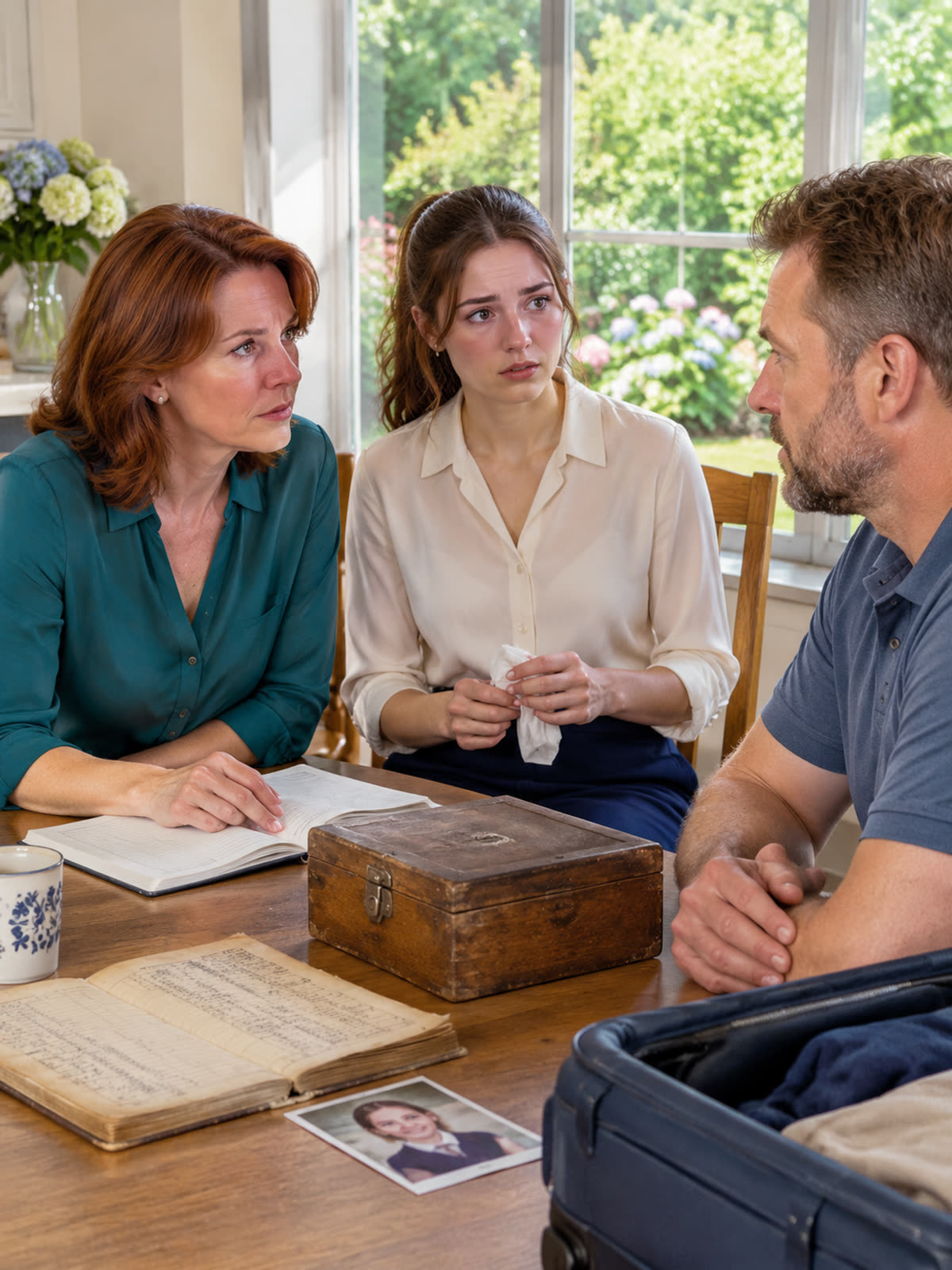
The wheels bumped over the tiles while Ben followed her with his eyes. "What’s going on?" "You’d better sit down, Dad." He gave a brief laugh. "I’m already sitting." "Good." Natalie lifted the suitcase onto the table. It was heavier than I had expected, and when she laid it flat, I still could not imagine why she had packed it. She reached for the zipper. Instead of clothing, there were old tools wrapped in dish towels: a hammer with a chipped wooden handle, two screwdrivers, and a yellow measuring tape. Several cardboard timecards had been tucked around the wooden box.
"I couldn’t carry everything loose," Natalie explained. Ben leaned toward the open case. "Where did you get those?" "From our garage." She carefully moved the tools aside. Underneath them sat Walter’s battered cash box, its brass latch dulled by age. A deep scratch ran across the lid. Ben put his thumb against it and fell silent. "Grandpa’s box," Natalie said. "I remember." He did not look up when he answered. The object between them had belonged to a part of his life he had described many times, but his expression was no longer the one he wore while telling those familiar stories.
I remembered that box beneath the counter in Walter’s hardware store. Years earlier, Ben had shown it to Natalie while explaining what his Saturdays there had been like. He had told her about sweeping the floors and counting nails into paper bags. He had even demonstrated Walter’s ancient time clock, which had fascinated her. But there had been something else in the box, something he had never explained to her: the savings envelope. Now Natalie lifted the box free of the suitcase and put it directly on the kitchen table, where all three of us could see it.
"Remember what Grandpa taught you?" she asked. Ben nodded. "Work hard. Save money." "And show up on time," she added. For a moment, he nearly smiled. "Especially that." Natalie opened the latch. Inside was a worn envelope bearing Walter’s handwriting. Across the front, he had written: BEN – SAVINGS. Ben’s almost-smile disappeared. Our daughter had not packed a suitcase because she was leaving. She had brought his father’s lessons back to the table, and she was about to ask why only some of them had survived.
PART 2 — The Lesson He Had Left Out
Natalie unfolded several old ledger pages with care. Walter’s handwriting ran down the columns, recording dates, hours worked, wages earned, and money deposited. Ben examined the first sheet. "Where did you find this?" "Inside the envelope." She set a photograph beside it. In the picture, a teenage Ben stood behind the hardware store counter with longer hair and the same crooked smile I saw so often on our daughter’s face. The tools, the timecards, the box, and now the photograph had brought his early working years into our kitchen. Natalie had arranged them where he could not dismiss them as a story somebody else had misunderstood.
"Grandpa paid you for working there, right?" she asked. "Of course." "And he expected you to save?" "Absolutely." Natalie turned over another page. "But he didn’t take your wages as rent." Ben shifted in his chair. "That was different." "How?" "I was working for him." "Exactly, Dad." She pointed to the figures Walter had written. "He taught you to earn money." "Yes." "And helped you keep some." Ben lowered his eyes to the ledger again. The distinction was simple, but it was not the one he had made when he demanded either rent or the grocery bill.
I recognized the photograph. Walter had framed it after Ben graduated, and Ben had told us that part of the story dozens of times. There was another part, though, one I had almost allowed myself to forget. Walter had helped him put money aside for his first apartment. He had not done it by giving Ben everything he wanted or freeing him from work. He had made sure his son had a starting point. The work and the savings had belonged to the same lesson. Ben remembered the hours behind the counter; Natalie was asking him to remember what those hours had made possible.
She touched the old envelope. "Why was that good parenting for Grandpa?" She waited before adding, "And bad parenting for you?" Ben leaned back in his chair. "Times have changed, Natalie." "I know, Dad." "Groceries cost more." "I know that too." "Electricity isn’t free." Natalie opened a notebook. "That’s why I made a budget." Ben leaned forward again. "A budget?" "You always tell me to plan ahead." She turned the notebook toward him. Instead of answering his demand with an argument about wanting to keep every dollar, she had written down what she proposed to do with her earnings.
The page listed an estimated monthly take-home income of $2,400. Underneath were $250 for transport and work expenses, $200 for personal essentials, $400 for emergency savings, and $800 toward moving out. She had allowed $300 as a household contribution and $450 for flexible spending. I followed the figures down the page and added them for myself. They balanced. This was not a promise to be responsible at some unspecified point. Natalie had taken the amount she expected to earn and given each part of it a purpose, including a contribution to the home where she was still living.
Ben studied the notebook. "You expect to save twelve hundred every month?" "That’s my goal." "And contribute only three hundred?" "For now." She brought out another sheet. "I’d like us to review everything after six months." Ben tapped the page in front of him. "You’re forgetting something." Natalie held her pen still. "What?" "Your car insurance." She blinked, then gave a nervous laugh. "You’re right." I leaned in to look again. "We can adjust your flexible spending." Natalie picked up her pen. "Okay." She began correcting the numbers. For the first time that morning, Ben seemed interested in working through what she had brought him.
His interest did not mean he was ready to accept it. "Three hundred won’t cover our groceries," he said. "Yeah, I know." "You said you wanted to contribute." "I do, Dad." "Then why not pay the grocery bill?" Natalie glanced at me before answering. "Because I want to move out eventually." Ben frowned. "You’re planning to leave?" "Not tomorrow." She indicated the savings figure. "But I’d like my own apartment someday." He warned her, "Rent isn’t cheap." "That’s exactly why I need savings." The money set aside for leaving was not a rejection of home. It was the beginning she was trying to prepare for.
Ben pressed two fingers against the bridge of his nose. "You’ve turned our family into an accounting exercise." Natalie raised her eyebrows. "You started the accounting, Dad." I almost laughed. He turned to me instead. "Helen, surely you understand." I placed both hands flat on the table. "Actually, I agree with Natalie." He put down his coffee. "You’re taking her side?" "I’m discussing our daughter’s future." He answered, "Someone has to teach her responsibility." "She brought you a budget, Ben." His eyes moved between the notebook and Walter’s cash box. I knew then that I could not retreat into silence again.
"Ben, I should’ve spoken up last night." Natalie turned toward me as I pulled out the chair beside her. "You pay the mortgage." He nodded. "But we both keep this house running." He frowned. "What’s that supposed to mean?" "Natalie already helps here." I counted the things on my fingers, not because they were unfamiliar to him, but because they had been absent from the discussion. "She shops when I’m working late." Ben slowly turned his coffee cup. "She cooks twice a week." His gaze flicked toward the suitcase. None of those things had begun with her first paycheck.
"She drives me to appointments when the car’s unavailable." Beside me, Natalie twisted her napkin. "Mom, it’s not a big deal." "It matters." I looked back at Ben. "And you contribute plenty too." His eyebrows rose. "This isn’t about deciding who’s worth more." I rested my hand on the notebook. "It’s about helping Natalie become independent." He waited for me to finish. "She deserves a conversation, not an ultimatum." The refrigerator hummed behind us. There was nothing unfamiliar in what I had said, either. What had changed was that I had finally said it while both of them were there to hear me.
Ben reached for the ledger again. This time he turned to the last page. Beside the final deposit, Walter had written four words: For your first home. Ben’s thumb stopped against his father’s handwriting. Then he closed the pages. All morning, he had been asked to remember what Walter had expected from him. Those four words also recorded what Walter had wanted for him. The envelope had not held savings without a purpose. It had held the possibility of a home of his own, built gradually from wages his father had helped him preserve.
"Your grandfather was a stubborn man," Ben said. Natalie gave a faint smile. "I’ve heard." "He made me work every Saturday." "Even during summer?" "Especially during summer." Ben touched the envelope. "But he wouldn’t let me waste those savings." He looked at the photograph of himself behind the counter. "I hated that sometimes." Natalie asked, "What changed?" He did not answer straightaway. The question remained between them while he looked at the things she had carried in from the garage. For once, he did not immediately turn his memory into advice for her.
Finally, Ben picked up the cash box and took it toward the counter. "I need to think." Natalie watched him go. She had prepared the notebook, found the envelope, and brought his father’s records downstairs, but she still had no agreement and no assurance that the threat from the night before had been withdrawn. When he had gone, she looked at me. "Did I make things worse, Mom?" I glanced down at the open budget, then at the cupcake she had left unfinished the previous evening. The celebration she had brought home still had not really happened.
"No, sweetheart." I squeezed her shoulder. "You finally gave us something worth discussing." I could not tell her what Ben would decide. What I could tell her was that she had brought more to the table than defiance. She had offered a contribution, a savings plan, and a time to reconsider it together. She had also asked her father to examine the standard he was using. Nothing in that deserved another apology from her. I had been too slow to make that clear the night before, and I did not intend to leave her alone with the question again.
From the hallway, I heard Ben call Frank. His cousin still ran Walter’s hardware store. I heard only the opening of the conversation. "Frank, do you remember Dad’s old savings box?" Then the kitchen was quiet again. Natalie’s notebook remained open in front of us. The suitcase was still there, along with the tools and timecards that had made Ben look backward instead of simply repeating his rules. Now he was asking someone else about the part of the story he had left out. We could not hear what Frank told him, and neither of us knew what Ben would bring back into the kitchen.
PART 3 — What the Savings Were Really For
Ben returned twenty minutes later with the cash box tucked beneath one arm. Natalie looked up. Nothing had been settled before he left, and the sight of the box did not tell us whether his conversation had changed anything. He placed it on the table again, bringing it back beside the budget. "Frank remembers Dad’s savings arrangement," he said. We waited. Until that morning, the box had been something stored away with his old working things. Now it sat at the center of a disagreement about what he owed his daughter and what he believed she owed him.
"He said Grandpa was strict about every penny." That much fitted everything Ben had ever told us about Walter. Then he continued. "But he wanted me to have choices." He opened the ledger. "That’s what Dad wrote here." His finger followed the handwriting. "I’d forgotten that part." Natalie did not smile or rush to make the moment easier for him. "You remembered everything he made you do." Ben looked at her. The sentence did not question whether Walter had been demanding. It asked him to acknowledge that being demanding had never been the whole story.
"Apparently, I forgot what he did for me." Ben sat down beside her. The notebook was still within reach, but he did not begin by challenging another number. "I handled last night badly." Natalie crossed her arms. "You threatened to kick me out." "I know." "Before I’d even been paid." He could no longer turn the discussion into a general lesson about adulthood. She was talking about what he had said to her, at dinner, while her first-week celebration sat on the table. And this time, he let her finish instead of insisting that his intention should settle the matter.
"I’m sorry, sweetheart. I should’ve celebrated your job first." Natalie lowered her eyes and folded the corner of the budget. "I don’t mind contributing, Dad." "I understand that now." Her position had not changed since she opened the notebook. She had never asked to earn a salary while pretending the household cost nothing to run. She wanted room to begin saving and a chance to discuss an amount she could manage. Ben’s apology did not require her to abandon that distinction, and she did not. The conversation could finally continue without treating her future as an excuse.
The three of us went back over the budget together. Ben returned to the missing car insurance, but now it was an expense to account for rather than a reason to dismiss the plan. Natalie crossed out the $450 she had assigned to flexible spending. In its place, she wrote $350, then added a separate $100 allowance for insurance. The total still came to the same amount. Her household contribution could remain, the essential expenses could remain, and the savings she wanted to build did not have to be the first thing sacrificed to correct an oversight.
We agreed that she would contribute $300 a month. She would continue aiming to save $1,200, divided between her emergency fund and the money for moving out. After six months, we would review the arrangement together. It was the same review Natalie had proposed before Ben left the kitchen, but now it belonged to all of us rather than remaining a request he had not answered. He looked toward me. "Are you comfortable with that?" The question was so ordinary that its effect caught me off guard. I could not remember when he had last asked me something like it.
"Yes," I said. "Then we have a plan." There was no demand that Natalie give up wanting an apartment, and no suggestion that contributing to the household meant taking responsibility for an entire bill regardless of her other needs. We had figures we could look at again and a date for doing so. More importantly, she had been allowed to take part in deciding what responsibility would look like. Walter’s ledger and Natalie’s notebook were no longer being used against each other. They had helped us reach the conversation we should have had before the cupcake went unfinished.
Friday brought Natalie’s first paycheck. She went out with the coworkers she had mentioned at dinner, just as she had hoped to do before the discussion went wrong. Ben did not bring up the grocery bill. When she came home, he asked whether she had enjoyed herself. It was a small change in the way he approached her, but it mattered. Her first payday did not have to become another test she could only pass by surrendering whatever plans she had made. He gave her the chance to tell him about it.
"Josh lost another pen," she reported. "Tragic," Ben said. "And Marissa wore a blue cardigan." "Call the newspapers." Natalie laughed. The people she had described during her first-week dinner had returned to our conversation without becoming a prelude to an argument about money. There was Josh and his pens, Marissa and her cardigans, and our daughter finding stories in a workplace that was still new to her. Ben listened and joked with her. That was what she had come home hoping for when she first carried the bakery box through the door.
That Sunday, Ben took us out to dinner. When the check came, Natalie reached for her purse. He put his hand over it. "Not tonight." She looked at him. "Dad, I can pay." "I know." He smiled at her. "I’m celebrating my daughter." He did not need to pretend that she had no money of her own in order to treat her. Nor did she need to insist on paying to prove that the new arrangement meant something. He knew she could contribute. This meal was about recognizing what she had achieved, something he admitted he should have done in the first place.

Later, I found Walter’s cash box on our bookshelf. The brass latch had been polished. Inside was a new envelope, and the name across its front was different: NATALIE – SAVINGS. Ben came to stand beside me. "She’ll need this someday," he said. "Probably sooner than we think." He nodded. The box had come out of the garage carrying evidence of the help he had received. Now it held an acknowledgment that our daughter would have a beginning of her own. The old envelope had reminded him that earning money and being supported had never been opposites.
Then he reached for my hand. "I owe you an apology too." "You do." There was no point making that part easier by pretending otherwise. "I should’ve listened before making that demand." "And I should’ve spoken sooner." He nodded. "We both should have." I thought again of Natalie beside the sink, asking whether getting a job had somehow been the wrong thing to do. Ben had made the threat, but I had hesitated when she looked to me. Our agreement at the table did not erase that hesitation. I needed to acknowledge my part as plainly as he had acknowledged his.
He squeezed my fingers, and I squeezed his in return. We had not changed what Natalie earned or made the cost of living disappear. She would still need to plan, pay her agreed share, and build the savings that would eventually let her leave. What had changed was whether those tasks would begin with an ultimatum or with support. Ben had once benefited from a father who expected effort and still wanted his son to have choices. With the fresh envelope inside Walter’s box, he had finally remembered both halves of that lesson.
The next morning, Natalie picked up the cash box and carried it upstairs. Ben watched from the kitchen doorway. The savings were hers to build, the future was hers to prepare for, and the box was going with her. This time, he did not tell her where to put it.
Disclaimer: This story is a work of fiction inspired by real-life themes. Names, characters, places and events are fictionalized, and any resemblance to real persons is purely coincidental. Images are for illustration purposes only.
