

PART 2: THE COLONEL AND THE EMPIRE HE NEVER OWNED
Claire approached the bench with the sealed folder.
“Your Honor, before proceeding, I’d like to address the confidentiality of certain employment information.”
Judge Calder examined the documents.
“Counsel has indicated that portions of your client’s professional history require restricted handling.”
“That’s correct. We are not asking the court to accept unsupported claims. We have provided official verification, income documentation, and a statement concerning Mrs. Lane’s current availability. Opposing counsel has received the appropriate unclassified materials.”
Bellamy stood.
“We acknowledge receipt, Your Honor. We reserve the right to question Mrs. Lane about the practical effects of her employment on the children.”
“Of course.”
The judge looked at me.
“Mrs. Lane, please take the witness stand.”
I stood.
For an instant, my knees felt strangely weak.
Not because I feared testifying.
I had given briefings to senior military leaders. I had sat across from people whose decisions affected entire organizations. I had delivered difficult information under intense pressure.
But those moments had belonged to my professional life.
This was different.
I was about to expose a part of myself I had kept separate from my marriage for years.
And I could already imagine what Adrian would say.
That I had lied.
That I had deceived him.
That I had made him look foolish.
The last accusation would hurt his pride more than all the others.
I raised my right hand and took the oath.
Then I sat.
Claire approached.
“Please state your full name for the record.”
“Evelyn Catherine Lane.”
“Mrs. Lane, are you currently employed?”
“Yes.”
“Who is your employer?”
“The United States Army.”
Adrian shifted.
It was a small movement.
Almost nothing.
Claire continued.
“Are you a civilian employee?”
“No.”
“Are you a member of the Army Reserve?”
“No.”
“Then please clarify your status.”
“I am a commissioned officer serving on active duty.”
A whisper moved through the gallery.
Adrian leaned forward.
Claire didn’t pause.
“What is your current rank?”
I looked directly at Judge Calder.
“Colonel, United States Army.”
For a moment, the courtroom went completely silent.
Then Adrian laughed.
Not loudly.
Just one sharp, disbelieving sound.
“That’s absurd.”
Judge Calder looked at him.
“Mr. Hollis.”
“Your Honor, my wife is not a colonel.”
“Mr. Hollis, I will not warn you again.”
Adrian turned toward Bellamy.
“Tell him.”
Bellamy didn’t move.
I watched his expression and understood that he had read the records during the recess.
He knew.
Adrian simply hadn’t listened.
Judge Calder examined the verification letter.
“Mrs. Lane, this document confirms your service status and rank as of the date indicated.”
“Yes, Your Honor.”
“And it confirms that your current assignment is located primarily within the Washington metropolitan area?”
“That’s correct.”
“Are you permitted to discuss your duties?”
“Some aspects, yes. Other aspects are restricted.”
“Can you discuss your general working arrangements?”
“Yes.”
Claire took over.
“Colonel Lane, how long have you served in the Army?”
“More than twenty years.”
“Where did you receive your commission?”
“The United States Military Academy at West Point.”
“Did you leave the Army when you married Mr. Hollis?”
“No.”
“Did you leave when your sons were born?”
“No.”
“Have you continued serving throughout your marriage?”
“Yes.”
Adrian stared at me.
His face had lost its color.
For twelve years, he had introduced me to strangers as a woman who had sacrificed her career so he could build his.
Now the official record contradicted every word.
Claire asked me about my responsibilities.
I explained what I could.
My assignment was based mainly in the Washington area, although travel was sometimes required.
My schedule included periods of ordinary office work and periods of unpredictable duty.
I had approved leave arrangements.
I had established childcare plans.
I had maintained regular communication with the boys whenever authorized and possible.
Claire presented records showing that my absences had been duty-related.
The sensitive details were not discussed publicly.
The court had no need to know them.
It needed to know whether I was employed, whether the absences had been legitimate, and how those absences affected my ability to parent.
“During your periods of travel,” Claire asked, “who cared for Samuel and Owen?”
“Usually Margaret Ellis, when their father was unavailable. She has been part of their lives since they were infants.”
“Did you arrange that care?”
“Yes.”
“Did you communicate with their teachers and doctors while away?”
“Whenever needed.”
“Have you ever left the boys without appropriate supervision?”
“No.”
“Do you receive a salary?”
“Yes.”
“Are you financially capable of maintaining a residence for your sons?”
“Yes.”
Claire submitted the permitted financial documents.
They showed regular military compensation and longstanding personal assets.
They didn’t reveal everything about my finances.
That would come later.
But they answered the immediate accusation.
I was not unemployed.
I was not financially dependent on Adrian.
And I had not abandoned my children.
Judge Calder studied the records.
Then he looked at me.
“Colonel Lane, why did your husband believe you were no longer serving?”
There it was.
The question I had dreaded.
I took a breath.
“Your Honor, I kept certain aspects of my career private because of the nature of my assignments. My husband knew I had served in the military and that my work involved government responsibilities. He also knew I continued to travel for professional obligations.”
“Did you explicitly tell him your current rank?”
“No.”
“Why not?”
I looked at Adrian.
He was staring at me as if I had become a stranger.
“At first, I believed the separation was necessary for professional reasons. Over time, I allowed that separation to become a habit. My husband preferred presenting me publicly as a homemaker, and I stopped correcting the impression.”
“Do you believe that was a mistake?”
“Yes.”
The answer came immediately.
“I should have insisted on an honest understanding of my professional life within my marriage. I should not have allowed silence to replace communication.”
Judge Calder nodded.
“And your children?”
“They know I serve the country in a government role. I’ve never discussed restricted details with them. They know that I work, and they know I always arrange for them to be cared for when I leave.”
I swallowed.
“They also know that sometimes my job means I miss things I desperately want to attend.”
My voice changed.
Only slightly.
“I don’t pretend I’ve been a perfect mother. I’ve missed school performances. I’ve had to leave birthday parties early. I’ve made promises about being home at certain times and then had to call and explain why I couldn’t make it.”
I looked down.
“But I have never stopped being their mother. Not for one day.”
Bellamy rose for cross-examination.
To his credit, he didn’t behave as though military service automatically settled the custody question.
Instead, he focused on the issues that genuinely mattered.
“Colonel Lane, you acknowledge that your work sometimes requires unexpected travel?”
“Yes.”
“And you cannot always disclose where you’re going?”
“Correct.”
“Can you guarantee that you won’t be reassigned?”
“No military officer can guarantee that.”
“So you cannot promise the court that your current schedule will remain unchanged.”
“No. I can provide the court with accurate information about my present assignment and my existing care arrangements. If those circumstances change, I will address them through the appropriate process.”
“Isn’t it true that your sons have sometimes been upset by your absences?”
“Yes.”
“Isn’t it true that Mr. Hollis has been present on occasions when you could not be?”
“Yes.”
Adrian straightened.
For a moment, I could almost see him recovering.
Then Bellamy asked another question.
“Would you agree that your professional obligations sometimes compete with your parenting responsibilities?”
“Yes.”
He looked satisfied.
“Then isn’t my client’s concern reasonable?”
I met his eyes.
“Concern about how my work affects the children is reasonable. Telling them that I abandoned them is not.”
Bellamy paused.
I continued.
“Discussing a realistic childcare schedule is reasonable. Telling them they won’t see me after court, before any judge has made that decision, is not.”
“Colonel Lane—”
“And asking whether my assignment might change is reasonable. Telling the court I have no job because he doesn’t understand my job is not.”
“Please confine yourself to the question.”
“I am.”
Judge Calder intervened.
“I understand the distinction Mrs. Lane is making. Mr. Bellamy, please proceed.”
Bellamy adjusted his glasses.
“Why didn’t you simply tell your husband the truth?”
I was silent for a moment.
Then I answered.
“Because every time I tried to explain that my work mattered, he treated it as an inconvenience.”
Adrian shook his head.
I kept speaking.
“He knew I had professional obligations. He knew I was required to travel. He knew there were limits to what I could discuss. But he preferred believing I had nothing important to do.”
“That doesn’t explain concealing your rank.”
“No. It doesn’t excuse every choice I made.”
I took another breath.
“But I did not conceal my employment to avoid caring for my children. And I did not stop being employed because my husband found it convenient to describe me that way.”
Bellamy returned to his table.
“No further questions.”
Adrian requested permission to speak.
Judge Calder allowed him to return briefly to the witness stand.
He looked furious.
“Your Honor, I have been married to this woman for twelve years. She’s now claiming she’s a colonel in the United States Army. How could I possibly not know that?”
The judge regarded him calmly.
“Mr. Hollis, your personal surprise does not alter the authenticity of the employment records.”
“But she lied to me.”
“Your wife’s decision not to disclose her rank may be relevant to the history of your marriage. It does not establish that she is unemployed.”
Adrian’s jaw tightened.
Judge Calder continued.
“And it does not establish that she abandoned your children.”
I watched Adrian grip the edge of the witness stand.
He seemed unable to accept that two things could be true at once.
I had concealed information from him.
And he had made false statements about me.
His anger at discovering the first did not erase the second.
Then the judge turned to Claire.
“Ms. Bennett, do you have additional witnesses concerning the children’s routine?”
“Yes, Your Honor.”
Margaret Ellis entered the courtroom.
She was sixty-one, with short gray hair and the kind of calm presence that made frightened children feel safe.
She had helped me care for Samuel and Owen since they were babies.
When Owen was sick, he asked for me first.
Then Margaret.
She was family in every way that mattered.
After taking the oath, she described our household routines.
She spoke about breakfast.
Homework.
School pickups.
Bedtime stories.
She described the detailed instructions I left whenever duty required me to travel.
She also described Adrian’s involvement fairly.
“He loves the boys,” she said. “I believe that.”
Claire nodded.
“And who normally organizes their daily schedules?”
“Evelyn.”
“Who coordinates with you when she travels?”
“Evelyn.”
“Have you ever known her to leave without making arrangements?”
“No.”
“What happened after Mr. Hollis told the boys they would be living with him?”
Margaret’s eyes filled.
“Samuel started asking whether I would be allowed to visit him. Owen asked me if mothers could stop being mothers when a judge told them to.”
I pressed my lips together.
Margaret looked toward Adrian.
“I don’t think anyone should have put those ideas into their heads.”
Adrian looked away.
By lunchtime, the atmosphere in the courtroom had changed.
Adrian’s attorneys no longer exchanged confident smiles.
Paige sat rigidly behind them.
The people who had arrived expecting to watch a powerful businessman defeat his supposedly dependent wife now knew that much of the story they had heard was incomplete.
But my military rank wasn’t a weapon.
I hadn’t revealed it to make Adrian look small.
I had revealed it because the truth was necessary to defend my ability to care for our children.
Judge Calder made that point unmistakably.
“Being a colonel does not automatically make Mrs. Lane the more suitable custodial parent,” he said. “Nor does being a CEO automatically make Mr. Hollis the more suitable parent. The court must examine the children’s actual needs, the parents’ conduct, and the practical circumstances.”
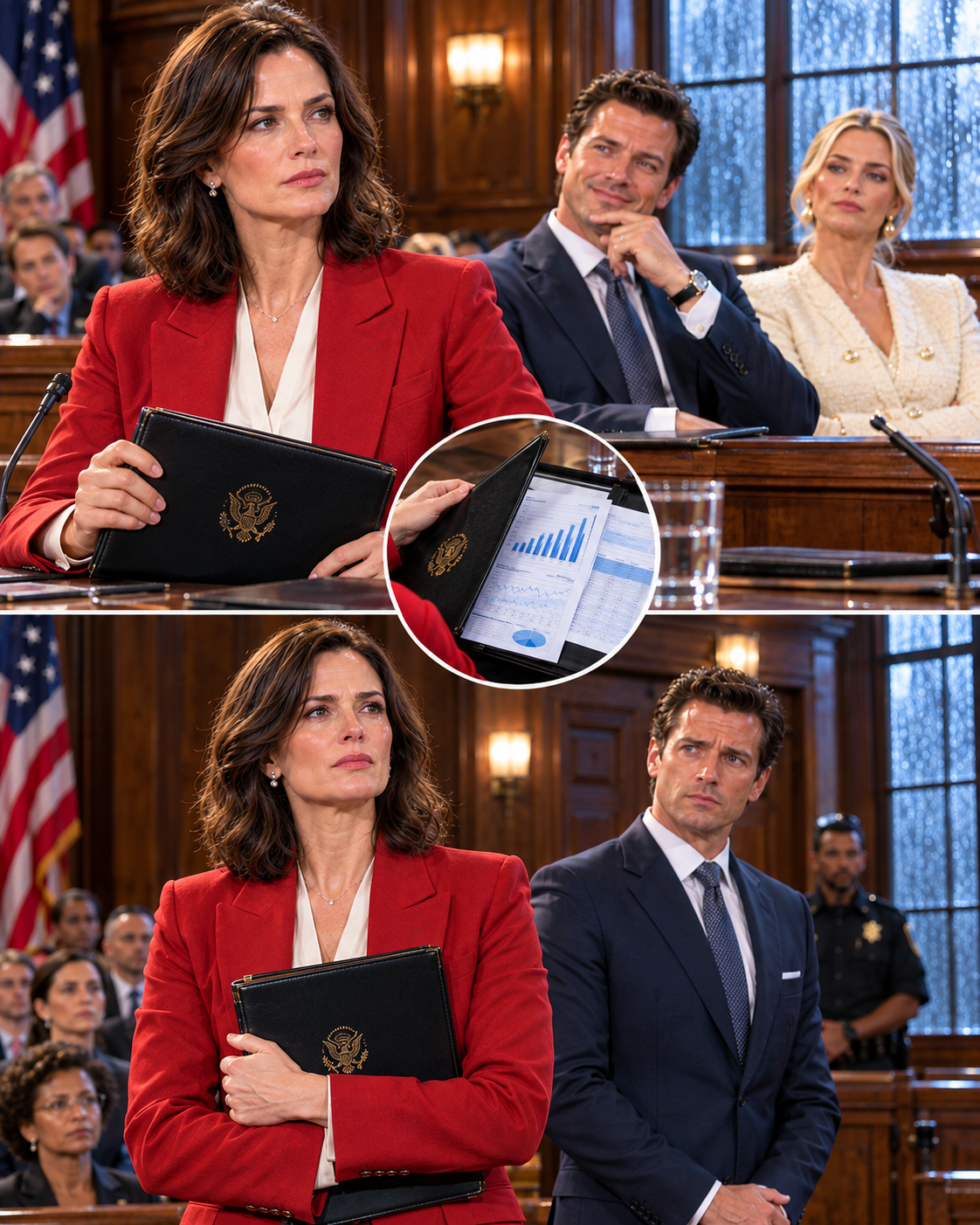
I was grateful for that.
I didn’t want Samuel and Owen awarded to me as a reward for my service.
I wanted the court to see who had been raising them.
And what Adrian had done to make them afraid.
Then Judge Calder turned a page in his file.
“Before we address the proposed interim parenting arrangement, I need clarification regarding the financial representations. The parties appear to have submitted substantially different descriptions of their ownership interests.”
Adrian sat upright.
Finally, a subject he understood.
Money.
The company.
His empire.
Bellamy spoke cautiously.
“Your Honor, there are certain corporate-structure issues that may require separate proceedings.”
“I understand that. But your client’s custody argument relies partly on the assertion that Mrs. Lane lacks independent resources. I want the record to reflect the accurate position.”
Claire stood.
“We can clarify that now.”
Adrian shook his head.
“No. Absolutely not.”
The judge looked at him.
“Mr. Hollis?”
“The company is mine. Whatever she’s trying to do, she’s not getting half of it.”
Claire remained standing.
“Your Honor, my client isn’t asking for half of Mr. Hollis’s company.”
Adrian gave a bitter laugh.
“Of course she is.”
Claire turned toward him.
“No, Mr. Hollis.”
Then she opened the second folder.
“She’s asking the court to recognize that the controlling ownership interest was hers before this marriage ever began.”
And I watched my husband’s face change for the second time that morning.
This time, there was no anger.
Only confusion.
Because the secret he was about to discover was much bigger than my military rank.
For several seconds, nobody spoke.
Then Adrian turned toward Richard Bellamy.
“What is she talking about?”
Bellamy lowered his voice.
“We discussed this during the recess.”
“No. You said there was paperwork.”
“Adrian—”
“I own Hollis Transit.”
Judge Calder raised his hand.
“Mr. Hollis, your attorney will speak for you.”
Adrian fell silent.
But the expression on his face told me he wasn’t listening anymore.
He was searching his memory.
Trying to understand which piece of the world he believed he controlled had suddenly moved beneath his feet.
Claire placed the first document on the evidence table.
“Your Honor, this is the formation record for Lane Capital Holdings, a privately held investment company established by my client approximately two years before her marriage to Mr. Hollis.”
The judge examined it.
“And Mrs. Lane’s ownership?”
“Documented in the accompanying operating agreement and financial disclosures.”
Claire continued.
“Lane Capital was formed using assets Mrs. Lane had accumulated before the marriage. The company subsequently became the principal investor in the transportation business now operating as Hollis Transit Systems.”
Adrian leaned toward Bellamy.
“That’s just the holding company.”
Bellamy didn’t answer.
Claire presented the next document.
“This is the original capitalization agreement for Hollis Transit Systems.”
The judge looked at it.
“Go on.”
“Lane Capital provided the initial investment and acquired the controlling equity interest. Subsequent corporate records show that the holding company continues to own eighty-two percent of Hollis Transit.”
A murmur swept through the courtroom.
I kept my eyes on the judge.
Claire placed another document beside the first.
“And this establishes that Mrs. Lane is the sole beneficial owner of Lane Capital Holdings.”
Adrian stood so abruptly that his chair scraped against the floor.
“That’s impossible!”
“Mr. Hollis,” Judge Calder said sharply.
“Your Honor, I founded that company!”
“Sit down.”
“I built it!”
“Mr. Hollis!”
The judge’s voice cut through the room.
Adrian slowly lowered himself into his chair.
Paige stared at him.
For the first time that morning, she looked genuinely confused.
Claire waited until the courtroom settled.
Then she spoke again.
“Mr. Hollis has served as the company’s chief executive officer and has made substantial contributions to its growth. My client does not dispute that.”
I looked at Adrian.
For all his cruelty, that part was true.
He had worked hard.
He had negotiated difficult contracts.
He had expanded the fleet.
He had built relationships with suppliers and customers.
He had spent long nights reviewing financial statements and planning acquisitions.
I had never wanted to erase any of that.
But building a company and owning a company were not the same thing.
And Adrian had spent twelve years pretending they were.
The truth began fourteen years earlier.
I had been serving in the Army for several years when I became interested in the transportation industry.
It wasn’t a sudden whim.
My experience had taught me how important reliable logistics could be.
I understood the consequences of delays, poor planning, and weak infrastructure.
I also understood that the commercial transportation sector offered opportunities for disciplined long-term investment.
I began studying the industry privately.
I saved.
I invested.
I worked with financial and legal professionals to establish Lane Capital Holdings, keeping the investment separate from my military responsibilities and subject to the applicable ethics requirements.
It was never intended to become my second full-time job.
I needed a structure that could operate independently while I continued my service.
Then I met Adrian.
He was charismatic.
Ambitious.
A talented businessman who could walk into a room full of skeptical investors and leave with three new contacts and a dinner invitation.
He was working in transportation management at the time.
He had ideas.
I had capital.
And we discovered that we shared the same vision.
Our earliest conversations weren’t about mansions or expensive cars.
They were about regional freight networks.
Smaller carriers.
Distribution inefficiencies.
Ways to build a transportation company capable of competing with much larger operators.
I fell in love with his enthusiasm.
He fell in love with the possibilities.
When we decided to start a business, Lane Capital supplied the founding investment.
The transportation company was organized as a separate operating business.
Adrian became its chief executive.
I remained the controlling investor through Lane Capital.
The arrangements were documented.
The ownership records were maintained.
Independent legal advisers handled the corporate formalities.
Adrian received executive compensation and the opportunity to earn a minority equity interest.
I gave him substantial authority to manage the company.
And when we married, we signed a prenuptial agreement identifying our existing separate property.
Including Lane Capital.
Including its ownership interests.
Including provisions governing investments traceable to those assets.
Adrian had insisted on the agreement.
I hadn’t objected.
At the time, I believed clear financial boundaries would protect both of us.
I never imagined that one day he would use that same agreement to try to make me homeless and take our children.
The first few years were good.
Not perfect.
But good.
We lived in a modest house.
Adrian worked long hours.
I continued serving.
When he closed his first major contract, we celebrated with takeout pizza and a bottle of sparkling cider because I had an early departure the next morning.
He lifted his glass.
“To our company.”
I smiled.
“To our company.”
He kissed me.
And I believed he meant it.
When the business expanded, we began appearing together at industry events.
At first, reporters introduced Adrian as the CEO.
That was accurate.
Then they began calling him the founder.
That was an oversimplification.
Soon, magazines referred to him as the sole visionary behind Hollis Transit.
That was false.
The company bore his name because he was its public face and chief executive.
My name appeared in corporate ownership documents, not magazine profiles.
I didn’t mind.
I had no desire to become a celebrity.
I wanted to serve my country, raise our children, and help build something that could provide lasting security for our family.
Then the language inside our home began to change.
Our company became my company.
Our investment became my money.
Our future became my empire.
At first, I thought it was harmless shorthand.
Then one night, during a dinner with several executives, Adrian introduced me as his wife and added, “Evelyn never really understood the business side. She was smart enough to leave that to me.”
Everyone laughed.
I didn’t.
When we got home, I confronted him.
“Why would you say that?”
He loosened his tie.
“Say what?”
“That I don’t understand the business.”
“Evelyn, it was a joke.”
“It wasn’t funny.”
He sighed.
“You’re being overly sensitive. Nobody wants to hear about ownership structures at a dinner party.”
“I’m not asking you to discuss ownership structures. I’m asking you not to belittle me.”
His expression hardened.
“Do you have any idea how hard I work?”
“Yes.”
“Then maybe you could show a little appreciation.”
I remembered staring at him.
Wondering how a simple request for respect had become an accusation that I was ungrateful.
That conversation ended without an apology.
There were many like it.
Over time, I stopped attending some events.
I stopped correcting introductions.
I stopped trying to explain that my professional life hadn’t ended when we married.
And Adrian grew more comfortable inside the legend he had created.
He had built everything.
He owned everything.
He supported everyone.
I was simply the woman who lived in his house.
Claire’s voice brought me back to the courtroom.
“Your Honor, the public branding of Hollis Transit does not determine its equity ownership.”
Judge Calder nodded.
“I’m familiar with that distinction.”
Claire continued.
“Mr. Hollis manages the business as its chief executive. He has significant management authority under his employment agreement and the company’s governance documents. But that authority is not equivalent to ownership of the controlling shares.”
Bellamy stood.
“We acknowledge that the current records identify Lane Capital as the majority shareholder. We do not concede the ultimate characterization or valuation of every financial interest for purposes of equitable distribution.”
“Understood,” the judge replied.
Claire nodded.
“We are not asking this court to resolve every property issue during this custody hearing. We are correcting the assertion that Mrs. Lane has no financial resources and that Mr. Hollis is the sole owner of the enterprise.”
The judge examined the prenuptial agreement.
“Is this the same agreement Mr. Hollis relies upon to argue that the business should be excluded from marital distribution?”
“Yes, Your Honor.”
“Does it specifically identify Lane Capital?”
“It does.”
Judge Calder turned several pages.
Then another.
The silence seemed to stretch forever.
Finally, he looked up.
“Mr. Bellamy, the agreement schedules Lane Capital among Mrs. Lane’s separate assets.”
Bellamy rose.
“Yes, Your Honor.”
“And the corporate records identify that entity as the controlling shareholder of Hollis Transit Systems.”
“That is what the documents reflect.”
“Then the petitioner’s statement that he personally owns the entire business requires substantial clarification.”
“Agreed, Your Honor.”
Adrian stared at Bellamy.
“Agreed?”
Bellamy turned toward him.
“Adrian, please.”
“No. You told me the prenup protected the company.”
“It may protect separate property interests. It does not change who holds legal title to the shares.”
Adrian blinked.
I could see the moment his mind reached for the explanation he had relied on for years.
“But I have voting authority.”
Claire answered before he could continue.
“You have a management role and were granted certain voting authority through a proxy, Mr. Hollis. You were not given ownership of my client’s shares.”
She presented another page.
“The proxy was subject to specific conditions and did not constitute a transfer of equity. The parties’ separation also triggered provisions requiring its termination according to the corporate agreement.”
Adrian looked down at the document.
He recognized it.
I knew he did.
He had signed it years earlier.
The authority had made sense when we were partners.
I was frequently occupied with military responsibilities.
He needed the ability to make timely operational decisions.
I had trusted him to act in the interests of the company and our family.
He had gradually mistaken delegated power for permanent ownership.
And now he was discovering the difference.
“Why didn’t you tell me?” Adrian demanded.
The question came out almost as a whisper.
I stared at him.
“Tell you what?”
“That you still owned it.”
The word still made something inside me ache.
“I never transferred my ownership to you.”
“You let me believe—”
“I let you run it.”
He looked at me as though I had struck him.
I continued.
“I trusted you with the company. I gave you authority to make decisions. I supported you when you wanted to expand. I agreed to keep my name out of the public story because it suited both of us.”
His eyes narrowed.
“You told me we were building it together.”
“We were.”
“Then how can you sit there and say it’s yours?”
“Because building something together doesn’t mean the legal ownership disappears.”
My voice trembled for the first time that morning.
“And because you were perfectly happy calling it ours when you needed my support. You only started calling it yours when you decided you didn’t need me anymore.”
Adrian looked away.
I could feel everyone watching.
I hated it.
Even after everything he had done, there was a part of me that hated seeing him humiliated.
I remembered the man who had once sat beside me on the floor of our first home, surrounded by invoices and pizza boxes, insisting that we could make the business work.
I remembered the joy on his face when the first fleet of trucks carried the Hollis name.
I remembered believing that success would make our marriage stronger.
Instead, it had given him an audience.
And somewhere along the way, he had fallen in love with being the only person on the stage.
Judge Calder brought the discussion back under control.
“This court is not making a final determination of the parties’ property rights today. There may be questions concerning valuation, contributions during the marriage, and the application of the prenuptial agreement. Those matters require appropriate proceedings.”
He looked toward Adrian.
“But the present record does not support the assertion that Mrs. Lane is a financially dependent spouse without independent resources.”
“No, Your Honor,” Bellamy said.
The judge continued.
“Nor can the court simply accept Mr. Hollis’s description of himself as the sole owner of Hollis Transit.”
Bellamy nodded.
Adrian remained motionless.
Paige slowly withdrew the hand she had placed on his shoulder.
I noticed because it was the first time all morning she had moved away from him.
She looked at the documents.
Then at Adrian.
Then at me.
For eleven months, she had believed she was having an affair with a wealthy CEO whose wife was a powerless homemaker.
I wondered what Adrian had told her.
That I was jealous?
That I was lazy?
That I wanted his money?
That he had built everything from nothing?
Whatever she believed, she now knew that the story had another side.
I didn’t feel triumphant.
I felt exhausted.
Because the man I had married was sitting ten feet away, looking less devastated by the end of our family than by the possibility that he did not own the empire bearing his name.
Then he said something I would remember for the rest of my life.
“You can’t take my company away from me.”
I turned toward him.
“I’m not taking your company away, Adrian.”
My voice was quiet.
“I’m telling the truth about whose company it is.”
His face hardened again.
“You planned this.”
I shook my head.
“No. I planned to build a life with you.”
I looked at the documents spread across the table.
“You planned to end it by taking our children and leaving me with nothing.”
He opened his mouth.
But nothing came out.
And for the first time since the hearing began, I realized that Adrian had run out of explanations.
The judge called a short recess before addressing the temporary custody arrangement.
As soon as he left the bench, Adrian moved toward me.
Claire immediately stepped beside my chair.
“Mr. Hollis, this isn’t the time.”
He ignored her.
“Evelyn.”
I looked up.
His voice was low and furious.
“Do you understand what you’ve done?”
I stood.
“Yes.”
“You’ve destroyed my reputation.”
“Your reputation hasn’t been decided in this courtroom.”
“You made me look like a liar.”
I held his gaze.
“You told the court I had no job.”
He said nothing.
“You told our sons I abandoned them.”
His face changed.
Only for a moment.
But I saw it.
I stepped closer.
“You can be angry about the company. You can be angry that I didn’t tell you my rank. You can be angry about every mistake I made in our marriage.”
My voice broke.
“But you do not get to frighten Samuel and Owen just because you want to punish me.”
Adrian looked past me toward the courtroom door.
Paige was standing there.
Watching.
“Those are my sons too,” he said.
“I know.”
“You’re trying to turn them against me.”
“No.”
I swallowed.
“I’m trying to stop you from turning them against their mother.”
He stared at me.
Then Bellamy approached.
“Adrian, we need to speak privately.”
Adrian didn’t move.
Bellamy repeated himself.
“Now.”
Finally, my husband turned and walked away.
Claire watched him leave.
Then she looked at me.
“You handled that well.”
I shook my head.
“No.”
My hands had started trembling.
I sat down before she could see how badly.
For years, I had imagined what it might feel like to stop hiding.
I had expected relief.
Maybe vindication.
Maybe freedom.
Instead, I felt as though I had opened a door to a room that had been filling with smoke for twelve years.
The fire was finally visible.
But the house was still burning.
And I still didn’t know whether the judge would let me take my children somewhere safe.
