

PART 1
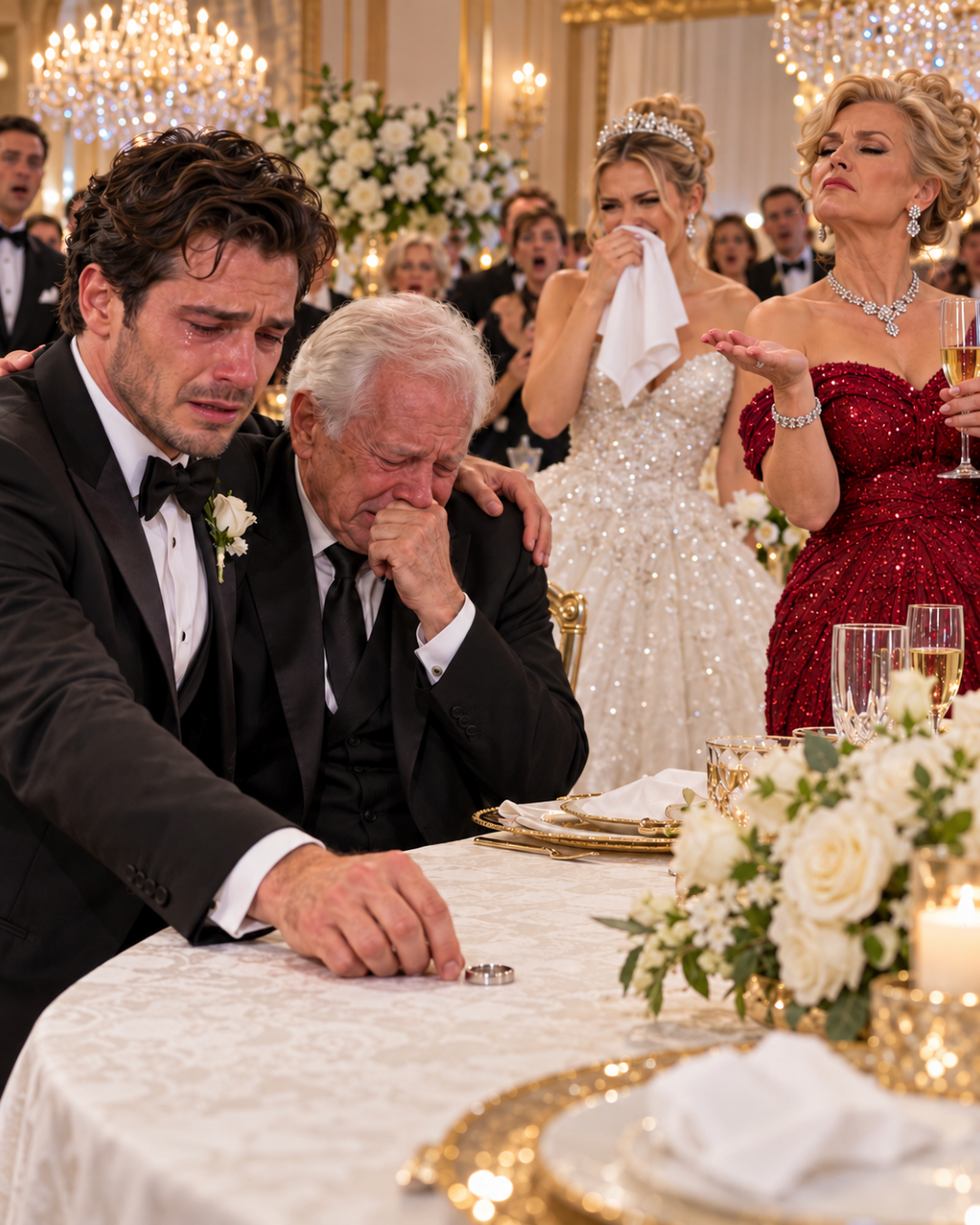
Five hundred guests witnessed my future mother-in-law publicly humiliate my father, reducing a hardworking man to someone she believed belonged in the gutter.
But it wasn’t her cruelty that ended my wedding.
It was the sound of my fiancée laughing beside me.
“Some people can wear expensive suits,” Victoria Ashford announced, lifting her champagne glass, “but you can never wash the gutter out of their blood.”
Her voice carried across the magnificent ballroom of the Grand Belmont Hotel.
A handful of guests laughed nervously.
Others lowered their eyes, suddenly fascinated by their champagne glasses.
Nobody intervened.
Nobody told her to stop.
My father stood near the head table, his rough hands clasped in front of him.
Thomas Bennett had spent thirty-seven years repairing elevators.
He’d worked double shifts, taken emergency calls in the middle of the night, and raised me alone after my mother passed away.
His hands carried the evidence of decades of hard labor.
His back had begun to bend slightly with age.
But he had never once complained about the sacrifices he’d made for me.
For my wedding, he’d purchased the first custom-tailored suit of his life.
He’d been almost embarrassed by how much it cost.
When I told him he looked handsome, he’d smiled like a boy.
Now, standing beneath the hotel’s enormous crystal chandeliers, he looked smaller than I’d ever seen him.
I turned toward Victoria.
“Victoria,” I said quietly. “Apologize.”
She didn’t appear embarrassed.
Instead, she smiled as though she’d just delivered a clever joke.
“Oh, Ethan, don’t be sensitive. We’re simply acknowledging that Fiona is marrying beneath her station.”
A few more guests chuckled.
My jaw tightened.
I turned toward Fiona.
She stood beside me in an exquisite ivory silk wedding gown.
Diamonds sparkled around her neck.
Her hair had been styled perfectly, and the soft lighting made her look almost unreal.
For a moment, I waited.
Surely she would say something.
Surely the woman I’d planned to spend my life with would defend the man who’d raised me.
She knew what my father had sacrificed.
She knew how hard he’d worked.
She knew my mother had died when I was young.
And she knew how much this day meant to him.
But Fiona didn’t defend him.
She lifted a silk napkin to her mouth.
And laughed.
“Mom,” she whispered, “you’re terrible.”
Then she leaned toward me.
“Don’t make a scene, darling. Daddy invited important investors.”
Something inside me went completely still.
The orchestra continued playing.
Servers moved between the tables.
Hundreds of people watched us, waiting to see whether I’d swallow the insult and continue with the celebration.
I looked at Fiona.
Then at Victoria.
Then at my father.
His eyes were lowered.
He looked as though he wanted to disappear.
That was the moment I understood what marrying into the Ashford family would mean.
My father’s dignity would always come second to their reputation.
My feelings would always matter less than their investors.
And whenever they hurt someone I loved, I’d be expected to smile and remain silent.
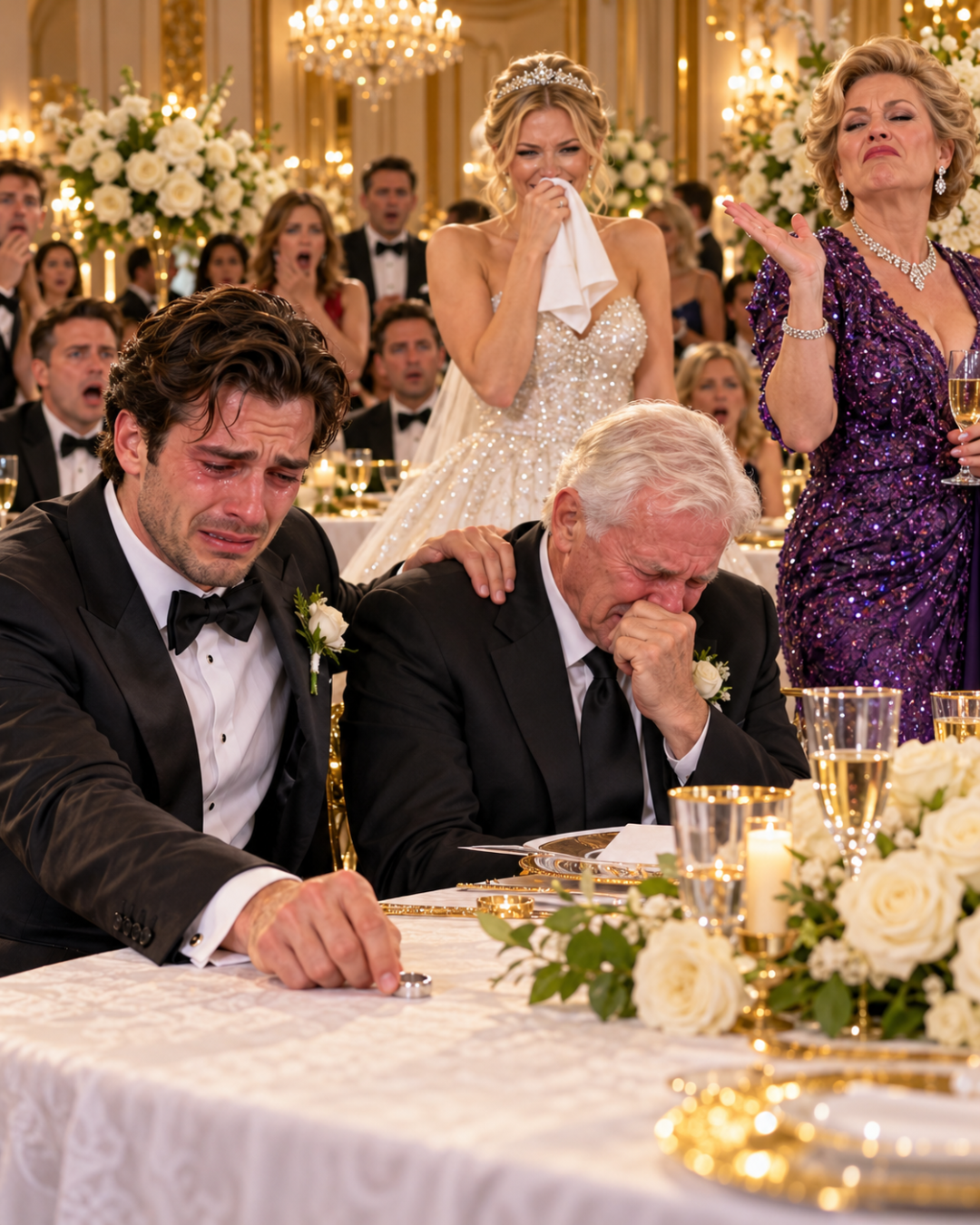
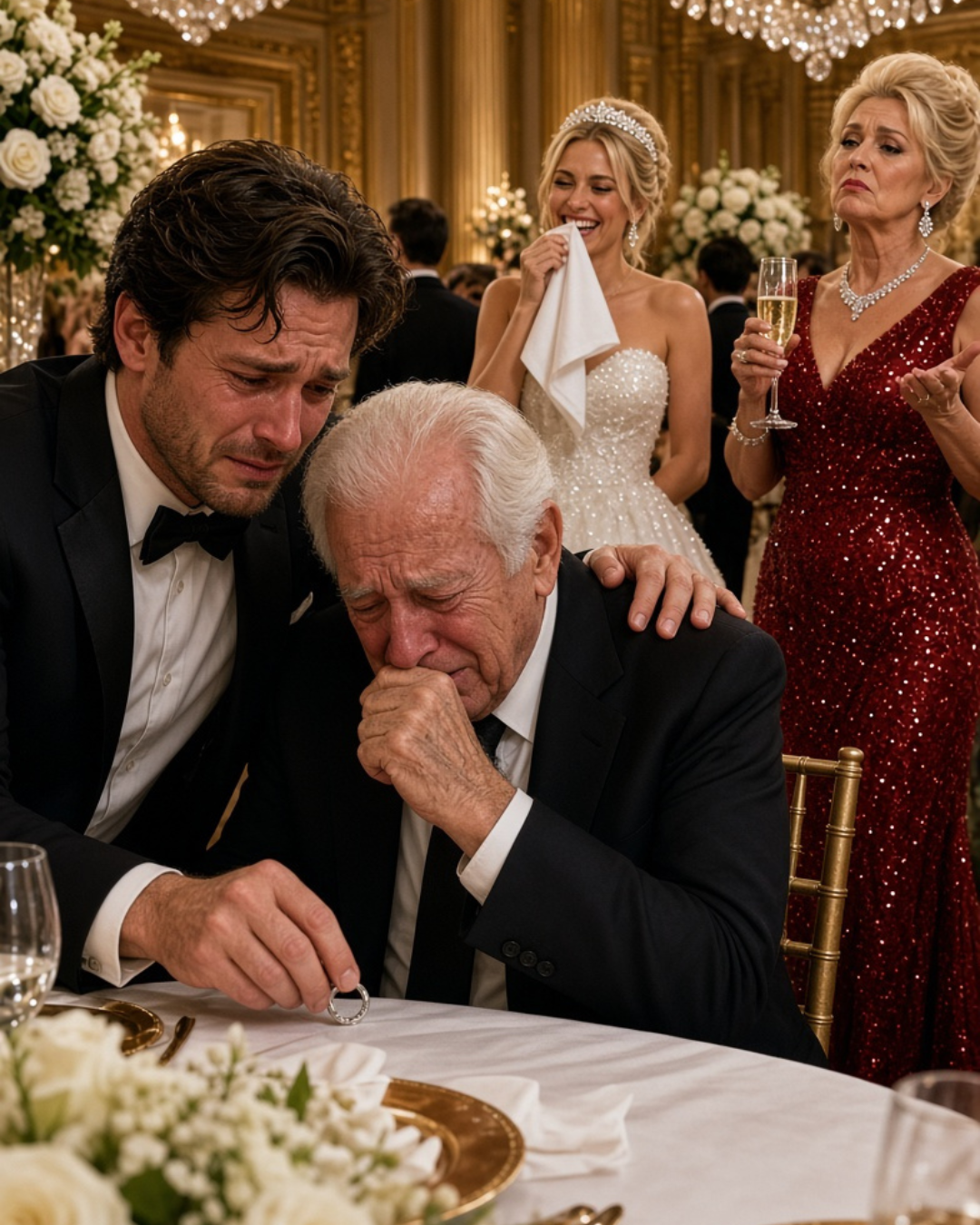
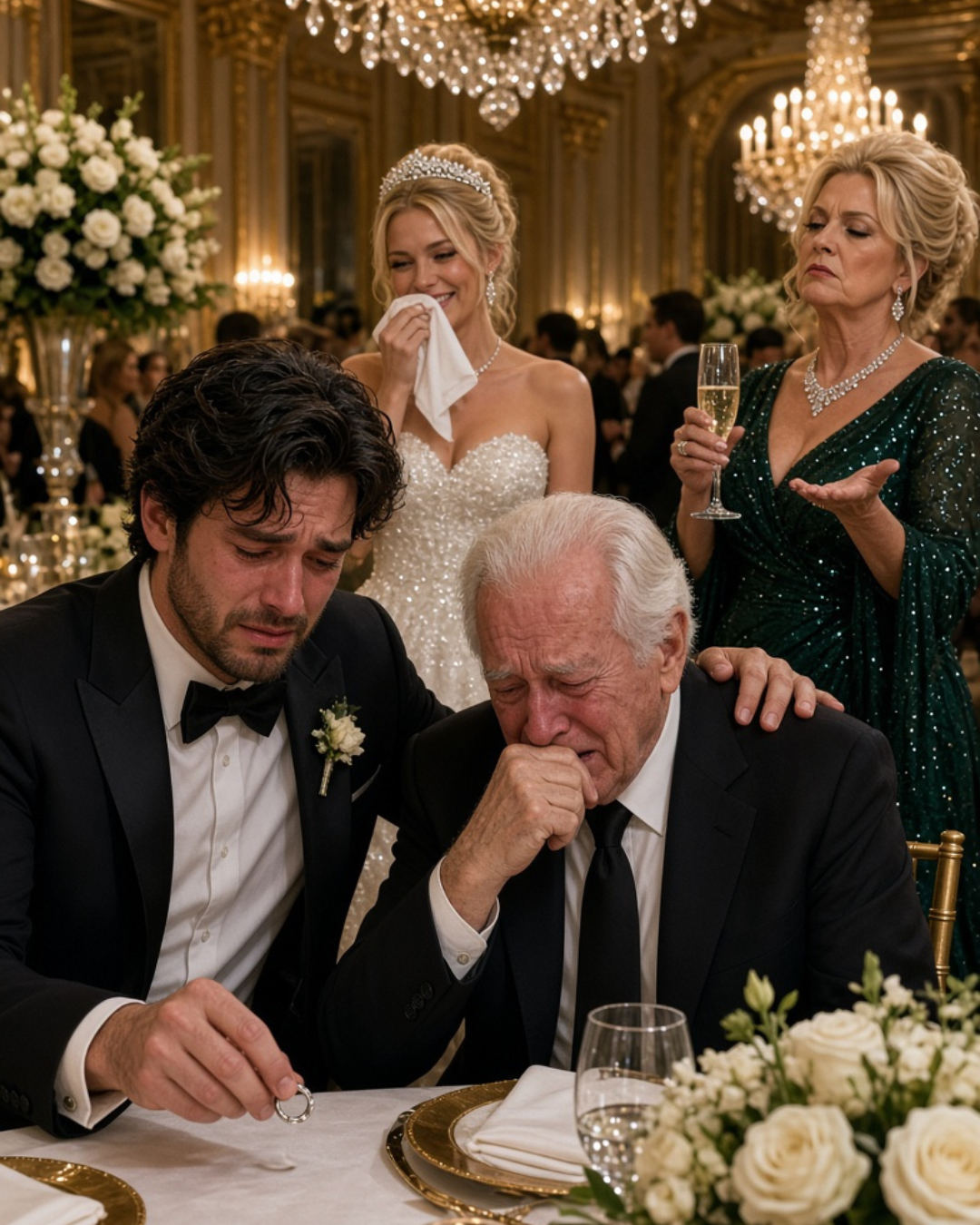
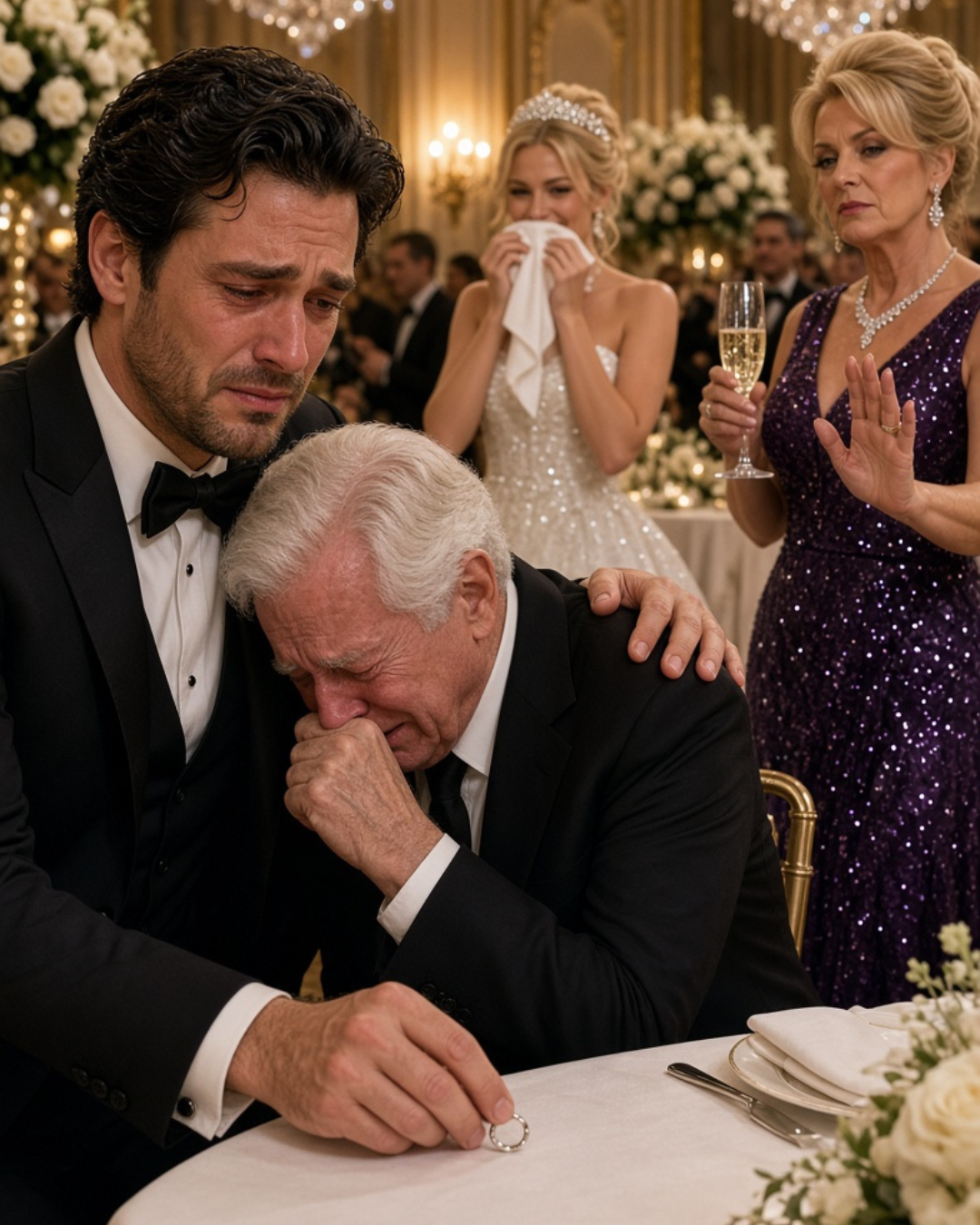
I looked down at the platinum wedding band on my finger.
Slowly, I removed it.
Then I placed it beside my untouched dinner plate.
The faint metallic sound seemed louder than the music.
“Then your investors can enjoy the reception without me.”
Fiona blinked.
“What?”
I looked directly at her.
“The wedding is over.”
Her smile vanished.
“Ethan, stop being ridiculous.”
I stood.
Then I extended my hand toward my father.
“Dad, we’re leaving.”
He looked up in confusion.
Victoria burst into laughter.
“Wonderful. Perhaps now Fiona can marry someone appropriate.”
I turned toward her.
“You have no idea what you’ve just done.”
She dismissed me with a wave of her hand.
“Please. You’re a glorified engineer who got lucky with a consulting contract.”
I didn’t respond immediately.
The Ashfords believed they knew everything about me.
They knew I’d founded a technical consulting business called Bennett Systems.
They knew my income was substantial enough to purchase Fiona’s engagement ring and contribute to our expensive wedding.
They knew I had engineering experience and worked with industrial clients.
But they had never asked many questions about my company.
To them, I was a successful professional who’d been fortunate enough to attract the daughter of a wealthy industrial family.
They considered me acceptable.
But never equal.
What they didn’t know was that Bennett Systems belonged to a holding company.
And that holding company owned intellectual property essential to a major part of the Ashford industrial empire.
They didn’t know their family company was approaching a critical financial deadline.
And they certainly didn’t know I’d spent the previous six months investigating serious inconsistencies between their official financial statements and their internal reports.
My father touched my shoulder.
“Son, don’t throw away your future because of me.”
I took his hand.
“I’m not throwing away my future, Dad.”
Then I looked toward Fiona.
“I’m saving it.”
Together, we walked out of the ballroom.
Five hundred people watched us leave.
Nobody stopped us.
The orchestra gradually fell silent.
Behind us, I heard Fiona calling my name.
But I didn’t turn around.
Outside, the evening air felt cold against my face.
My father stood beside me in his new suit.
For several moments, neither of us spoke.
Then he looked at me.
“Ethan, are you sure?”
I looked back toward the hotel entrance.
I thought about Fiona laughing.
About Victoria raising her champagne glass.
About my father standing alone while strangers mocked him.
“Yes,” I said. “I’m sure.”
We went home.
Not to the luxury suite Fiona and I had reserved.
Not to the expensive house where we’d planned to begin married life.
I went to my father’s modest home.
The same house where I’d grown up.
The same kitchen where he’d helped me with homework after working twelve-hour shifts.
The same table where we’d eaten countless inexpensive dinners together.
By midnight, Fiona had called twenty-three times.
I ignored every call.
At 12:17 a.m., another message appeared.
You humiliated my family. Mom says you need to apologize publicly before we even discuss fixing this.
I stared at the screen.
Even now, Fiona believed I was the one who owed an apology.
My father was standing at the kitchen counter, preparing coffee.
He still wore his expensive wedding suit.
“Ethan,” he said, “you loved her.”
I placed my phone on the table.
“I loved who I thought she was.”
He looked down.
“Maybe she was nervous. Maybe she laughed because she didn’t know what else to do.”
I shook my head.
“She knew exactly what she was doing.”
He didn’t argue.
That was one of the things I admired most about my father.
He never tried to force his opinions on me.
Even when he was hurting, he worried about my happiness.
A few minutes later, my phone rang again.
This time, the caller wasn’t Fiona.
It was Arthur Ashford.
Fiona’s father.
Chairman of Ashford Industrial Group.
I answered.
“Listen carefully, Bennett,” he growled. “You’ve embarrassed my daughter. You’ll issue an apology tomorrow, or I’ll personally destroy your consulting business.”
I leaned back in my chair.
“Is that a threat, Arthur?”
“It’s a promise.”
I glanced toward my father.
He was quietly pouring coffee into two mugs.
“Interesting.”
Arthur paused.
“What’s interesting?”
I opened the financial folder I’d brought home from my office.
Then I spoke calmly.
“That you’re threatening someone who knows what happened to the Meridian acquisition funds.”
Silence.
For the first time since I’d met Arthur Ashford, he had nothing to say.
And I knew the conversation had just changed.
PART 2
Three years before my disastrous wedding, Ashford Industrial Group had completed an ambitious acquisition.
The company borrowed heavily to purchase Meridian Automation, a manufacturer of specialized industrial control systems.
Arthur had celebrated the transaction publicly.
He described it as the beginning of a new era for the family business.
Investors were told Meridian’s technology would strengthen Ashford Industrial’s manufacturing operations and generate substantial future revenue.
There was only one problem.
Meridian didn’t actually own its most valuable intellectual property.
The critical technology was licensed from Bennett Technologies Holdings.
My company.
When Ashford Industrial acquired Meridian, it inherited an existing licensing arrangement.
Their attorneys had reviewed the contracts with my legal representatives.
But nobody in the Ashford family had taken the time to investigate the ultimate beneficial owner of the holding company.
They simply assumed they were dealing with another outside technology supplier.
I never corrected that assumption.
There was no reason to.
The licensing arrangement generated millions of dollars each year.
It also contained strict financial-reporting requirements.
And the renewal deadline was approaching.
Six months before the wedding, my independent auditors began examining discrepancies between Ashford Industrial’s internal records and the financial statements it had supplied under our agreement.
The deeper they looked, the more troubling the inconsistencies became.
There were related-party transfers that hadn’t been properly disclosed.
Invoices with questionable supporting documentation.
And millions of dollars routed through businesses connected to Arthur’s brother.
I didn’t immediately accuse anyone of fraud.
Instead, I instructed our attorneys to preserve the relevant evidence and request an independent forensic review.
Arthur’s response had been to deny access to documents the licensing agreement required him to provide.
Now, after publicly humiliating my father, he was threatening to destroy my business.
“You don’t know what you’re talking about,” he finally said.
I looked down at the figures in front of me.
“Then you won’t mind explaining the missing seventeen million dollars.”
The call ended.
I remained seated for several seconds.
My father looked toward me.
“Everything alright?”
I set the phone down.
“Not exactly.”
He didn’t ask for details.
He simply placed a cup of coffee in front of me.
The next morning, the Ashfords decided to take their version of the wedding disaster public.
Victoria uploaded photographs from the reception.
Her statement portrayed me as an unstable opportunist who’d tried to manipulate their family.
Fiona shared the post.
Within hours, people were discussing the abandoned wedding.
Some supported the Ashfords.
Others questioned why I’d walked out.
But Victoria’s statement made one thing clear.
They had no intention of apologizing.
Instead, they wanted to damage my reputation until I surrendered.
Then Fiona’s attorney sent a formal demand.
The letter accused me of deliberately sabotaging the ceremony and demanded reimbursement for the wedding expenses.
Attached was an invoice.
$480,000.
I read it once.
Then forwarded everything to my attorney, Rebecca Sloan.
She called fifteen minutes later.
“Are you ready?”
I stood beside my father’s kitchen window.
Outside, he was helping our elderly neighbor repair a damaged fence.
He’d already changed out of his wedding suit.
His sleeves were rolled up.
His old work gloves covered his hands.
After everything that had happened, he was still helping someone who needed him.
“Yes.”
Rebecca paused.
“Then we proceed strictly by the contracts. No surprises, no shortcuts.”
That afternoon, Bennett Technologies issued a formal notice to Ashford Industrial.
The notice identified deficiencies in the company’s financial disclosures.
It demanded access to the audit materials required by our licensing agreement.
Our legal team also informed Meridian’s lenders about potential covenant issues through the reporting procedures permitted by our contracts.
We didn’t fabricate allegations.
We didn’t interfere with their operations.
We didn’t attempt to punish anyone for what happened at the wedding.
We enforced the agreement.
And the agreement was something Arthur Ashford couldn’t simply dismiss.
Within forty-eight hours, his accountants began requesting emergency meetings.
His attorneys called Rebecca repeatedly.
Senior executives suddenly wanted to discuss documents they’d refused to provide for months.
By Friday, Fiona appeared at my office without an appointment.
She wore the same diamond necklace she’d worn at our wedding.
Her expression suggested she expected me to apologize.
“Ethan, this has gone far enough.”
I remained seated behind my desk.
“Has it?”
She folded her arms.
“Daddy says you’re interfering with a major financing transaction.”
“I’m enforcing an agreement.”
She looked irritated.
“You’re doing this because Mom embarrassed your father.”
I shook my head.
“No, Fiona. I’m doing this because your family may have concealed material financial information.”
She stepped closer.
Her voice became sharper.
“You’re a contractor. Daddy owns factories, shipping terminals, entire buildings. Who do you think you are?”
I opened a folder.
Inside was a corporate ownership chart.
I slid it across the desk.
Fiona glanced down.
Then looked again.
Her expression changed.
At the top of the chart was Bennett Technologies Holdings.
Beneath it were the patents, software rights, and licensing agreements supporting Meridian’s primary manufacturing systems.
And at the bottom was a single name.
Ethan Thomas Bennett — Sole Shareholder.
Fiona stared at the document.
Her lips parted.
“That’s impossible.”
I leaned back.
“It was public information, Fiona. Your family simply never thought I mattered enough to investigate.”
She looked at the chart again.
For years, the Ashfords had treated my business as a modest consulting operation.
They’d never considered the possibility that I controlled intellectual property their industrial group depended upon.
And now Fiona was beginning to understand what her father had failed to discover.
Her phone rang.
She glanced at the screen.
Arthur.
I nodded toward it.
“You should answer.”
She hesitated.
Then accepted the call.
Her father’s voice erupted through the speaker.
“FIONA! WHAT THE HELL DID YOUR FIANCÉ JUST DO?”
Fiona looked at me.
For the first time since we’d met, she seemed completely speechless.
I didn’t raise my voice.
I didn’t celebrate.
I simply watched her realize that the man her family had dismissed as a fortunate engineer was also the person whose company controlled essential rights supporting one of their most important acquisitions.
And this time, her father’s money couldn’t make the problem disappear.
The following Monday, Ashford Industrial scheduled an emergency board meeting.
Rebecca and I attended.
Arthur sat at the head of the conference table.
Around him were directors, attorneys, accountants, and senior executives.
Several looked visibly worried.
Victoria was there as well.
Although she held no formal position in the company, she behaved as though the boardroom belonged to her.
She entered wearing an expensive crimson suit.
Her expression was the same one she’d worn when she insulted my father.
“Get this over with,” she snapped. “My husband has a business to run.”
Rebecca placed a thick file on the conference table.
“Then perhaps your husband should explain these transfers.”
The first screen displayed invoices totaling seventeen million dollars.
The second showed payments made to three shell companies.
The third connected those companies to Arthur’s brother.
Arthur slammed his palm against the table.
“Confidential information! You have no right!”
Rebecca didn’t react.
“These records were obtained through the contractual audit process and independently verified. Your own financial controller supplied the supporting ledgers.”
One of the directors leaned forward.
“Arthur, you told us those payments were for modernization equipment.”
Arthur answered immediately.
“They were!”
Rebecca changed the display.
Delivery records appeared on the screen.
“Then where is the equipment?”
Arthur said nothing.
The room became quiet.
I looked toward the directors.
“Three years ago, your company purchased Meridian because you believed its technology would save Ashford Industrial.”
Victoria interrupted.
“What’s your point?”
I turned toward her.
“My company owns the core intellectual property. Ashford Industrial holds a license, contingent upon compliance with specific financial and reporting obligations.”
Victoria gave a contemptuous laugh.
“Then we’ll buy your little company.”
I met her gaze.
“You could have made an offer.”
Then I looked toward Arthur.
“Instead, you threatened to destroy it.”
Rebecca continued her presentation.
“Due to unresolved financial-reporting breaches, Bennett Technologies has issued notice of default and initiated the contractual cure process. Any suspension or termination remains subject to the agreement’s notice and cure provisions.”
Nobody spoke.
One director slowly removed his glasses.
“Arthur, if the license is terminated, Meridian loses its primary product line.”
I nodded.
“Correct. Which is why I offered three separate opportunities to resolve the discrepancies privately.”
Another director turned toward Arthur.
“You told us Bennett was being unreasonable.”
Arthur’s jaw tightened.
Victoria suddenly stood.
“This is blackmail! He’s punishing us because I made one harmless joke!”
I looked directly at her.
“Mrs. Ashford, humiliating my father was cruel. But it didn’t create these invoices, conceal these payments, or cause your husband to violate a licensing agreement.”
Her face hardened.
But she had no answer.
I turned back toward the independent directors.
“I’m willing to maintain the license under a supervised compliance arrangement, provided an independent forensic audit is completed, the company cooperates with appropriate authorities, and conflicted executives are removed from decisions concerning the investigation.”
Arthur pushed back his chair so violently that it struck the wall.
“You can’t remove me!”
The board’s lead independent director looked at him.
“No, Arthur. But we can.”
And in that moment, the balance of power inside the Ashford empire shifted.
PART 3
An emergency resolution was placed before the board.
Arthur Ashford immediately began protesting.
He argued that the directors were overreacting.
He accused Bennett Technologies of attempting to interfere with his leadership.
He threatened lawsuits.
And when none of those arguments worked, he raised his voice.
But the documents were already on the table.
The invoices.
The payments.
The related-party connections.
The financial disclosures that didn’t match the internal records.
The board could no longer pretend the discrepancies didn’t exist.
The independent directors voted to suspend Arthur pending the outcome of the investigation.
His brother was placed on administrative leave.
The decision didn’t resolve every issue.
It didn’t prove every allegation.
But it removed the men most closely connected to the questionable transactions from decisions about the investigation.
Arthur looked stunned.
For years, he’d been accustomed to issuing orders and watching people obey.
Now his own board had voted to suspend him.
Victoria stared at the directors.
She looked as though she expected someone to reverse the decision.
Nobody did.
Rebecca gathered her documents.
I remained seated until the meeting was formally concluded.
Then I stood.
I hadn’t gone there to humiliate Arthur.
I hadn’t demanded that the company collapse.
In fact, my proposal had offered a way for Ashford Industrial to maintain access to the technology it needed.
But that arrangement required accountability.
An independent forensic audit.
Cooperation with the relevant authorities.
And proper oversight.
The directors understood what was at stake.
If the licensing agreement were terminated, Meridian could lose access to the intellectual property supporting its primary product line.
That would create serious consequences for the entire industrial group.
And the company’s financial problems were already becoming more difficult.
After the board meeting, Meridian’s lenders froze additional advances while the financial disclosures were reviewed.
The company faced intense pressure.
Its executives had to explain the inconsistencies.
Its accountants began examining the disputed transactions.
And its directors were forced to confront problems that Arthur had insisted were insignificant.
Within weeks, forensic accountants substantiated extensive related-party misconduct.
The audit committee referred its findings to federal authorities.
Arthur and his brother were later indicted on fraud-related charges.
The scandal damaged the reputation of the Ashford family.
The industrial group underwent an expensive restructuring.
Several luxury assets were sold.
The company installed new leadership.
And the board introduced stronger oversight procedures.
Ashford Industrial survived.
But the family no longer controlled it in the way they once had.
Arthur’s position was gone.
His brother was out of the company.
And the financial practices that had been concealed for so long were now under formal scrutiny.
Victoria’s social standing changed almost as quickly.
Before the scandal, she had been treated as an influential figure whose approval mattered.
She attended expensive charity events.
Hosted elaborate dinners.
And spoke as though wealth gave her the right to decide which people deserved respect.
After the investigation became public, that influence began disappearing.
The same people who’d once competed for invitations to her gatherings became less eager to associate with the Ashford name.
The scandal overshadowed the family’s carefully maintained image.
And the woman who had publicly mocked my father was suddenly confronting the consequences of decisions made inside her own family.
I didn’t celebrate her embarrassment.
I had no interest in watching her suffer.
What happened to the Ashfords was the result of their own actions.
The financial discrepancies existed before the wedding.
The questionable transactions existed before Victoria insulted my father.
And the contractual violations had been under review for months.
The wedding didn’t create those problems.
It simply ended my willingness to overlook the way the family treated people.
Fiona eventually came to see me.
It was a rainy afternoon.
I was at my father’s house when someone knocked on the front door.
I opened it.
Fiona stood outside holding a cheap umbrella.
She wasn’t wearing her usual diamonds.
There was no designer coat.
Her expression was exhausted.
For a moment, we simply looked at each other.
Then she spoke.
“Ethan,” she whispered, “I made a mistake.”
I remained in the doorway.
“You laughed at my father.”
Her eyes filled with tears.
“I was afraid of my mother.”
I studied her.
I remembered the wedding.
The crystal chandeliers.
The five hundred guests.
Victoria’s champagne glass.
My father standing near the head table.
And Fiona hiding her laughter behind a napkin.
“You were thirty-two years old, Fiona. You had a choice.”
She began crying.
“I still love you.”
For a moment, I remembered the woman I’d believed I was going to marry.
The dinners we’d shared.
The plans we’d made.
The future I’d imagined.
But I also remembered what she’d said after her mother humiliated my father.
“Don’t make a scene, darling. Daddy invited important investors.”
That sentence told me more about our relationship than all the romantic promises we’d exchanged.
I looked at her.
“You loved the version of me you thought your family could control.”
She wiped her face.
“Please. We can start over.”
I shook my head.
“No.”
It was a simple answer.
One word.
There was no anger in my voice.
No hesitation.
I had already made my decision.
I gently closed the door.
For a while, I stood in the hallway.
I didn’t feel victorious.
Ending the relationship had been painful.
I’d genuinely loved Fiona.
I’d believed we would build a life together.
But love couldn’t survive without respect.
And I could no longer pretend that the woman I’d nearly married respected the people who mattered most to me.
My father was sitting in the kitchen.
He looked up when I returned.
He didn’t ask what Fiona wanted.
He didn’t tell me what I should have done.
He simply offered me a cup of coffee.
I sat beside him.
And for the first time in a long while, I felt certain I was exactly where I belonged.
Six months later, we stood together inside the first vocational training center established by the Bennett Foundation.
The building was bright and spacious.
Workshops had been equipped for students learning skilled trades.
There were training areas for electrical work, industrial maintenance, and elevator mechanics.
We’d funded scholarships for young people who wanted to enter those professions.
Some came from families who couldn’t afford expensive education.
Others had struggled to find opportunities.
Many simply wanted to learn practical skills and build stable careers.
My father walked slowly through the training center.
He studied the equipment.
Looked at the workshops.
Spoke with instructors.
And asked the kinds of technical questions only someone with decades of experience would think to ask.
He’d spent thirty-seven years repairing elevators.
He understood the work.
He knew how much skill it required.
And he knew how often people underestimated those who performed it.
On opening day, I asked him to cut the ribbon.
He immediately protested.
“Son, I’m nobody special.”
I placed the scissors in his hands.
“You’re the man who taught me that dignity isn’t something wealthy people get to distribute.”
His eyes filled with tears.
For a moment, he looked down at the scissors.
Then he smiled.
I watched his hands.
The same hands Victoria Ashford had mocked.
Rough hands.
Marked by years of labor.
Hands that had repaired machines carrying strangers to offices, apartments, and hospitals.
Hands that had prepared my meals when I was a child.
Helped me with school projects.
Fixed broken appliances.
And worked overtime so I could have opportunities he never had.
Those hands had never been something to be ashamed of.
They were the reason I’d become the man I was.
Now they were opening a training center that would help hundreds of young people begin their careers.
My father cut the ribbon.
The room filled with applause.
I stood beside him, feeling prouder than I had during any business negotiation or professional achievement.
Because this moment wasn’t about proving we were wealthier than the Ashfords.
It wasn’t about humiliating anyone.
It was about honoring work that deserved respect.
That evening, my father and I went to his favorite roadside diner.
We ordered hamburgers.
The tables were ordinary.
The lighting was simple.
There were no chandeliers.
No champagne.
No influential investors watching us.
Just two men sharing dinner.
My father lifted his coffee cup.
“To better beginnings.”
I raised mine.
“To never confusing money with worth.”
He laughed.
And I laughed with him.
It was the first time in months that laughter felt completely uncomplicated.
For years, the Ashfords had behaved as though wealth gave them the authority to make other people feel small.
They believed their social position placed them above ordinary workers.
They treated my father as though his decades of honest labor were something shameful.
But when their company came under scrutiny, their money couldn’t erase the documents.
Their influence couldn’t make the missing funds disappear.
And their social connections couldn’t prevent the board from examining the evidence.
They lost their power because their own decisions finally caught up with them.
I hadn’t needed to destroy anyone for insulting my father.
I simply stopped protecting people who believed they could hurt him without consequences.
The wedding ring remained in my possession.
After leaving the Grand Belmont Hotel, I’d placed it in a small velvet box.
I kept that box inside my desk.
Sometimes, when I opened the drawer, I saw it.
A platinum band.
A reminder of the future I’d once imagined.
But I no longer looked at it with regret.
It reminded me of the moment I’d finally understood something important.
I could love someone deeply.
I could plan a future with her.
I could stand before five hundred guests, ready to promise her the rest of my life.
But if that future required me to remain silent while she laughed at my father’s humiliation, it wasn’t a future worth having.
My father had given me everything he could.
He’d worked double shifts.
Raised me alone.
Made sacrifices I didn’t fully understand until I was older.
And he’d never asked for recognition.
He’d simply loved me.
When Victoria insulted him, he didn’t demand revenge.
He didn’t tell me to leave.
He actually asked me not to sacrifice my happiness for his sake.
“Son, don’t throw away your future because of me.”
Those words stayed with me.
Because he was still putting me first.
Even while being humiliated.
But I’d finally learned that protecting the people you love doesn’t mean allowing others to mistreat them.
Sometimes it means walking away.
Even when walking away costs you something.
Even when hundreds of people are watching.
Even when the person you thought you’d marry is standing beside you.
I didn’t lose my future that night.
I walked away from a future built on the wrong values.
And in doing so, I found something far more important than a prestigious marriage or a place inside a wealthy family.
I found the freedom to live according to the principles my father had taught me.
The platinum ring stayed in its velvet box.
Not as a reminder of the woman I’d lost.
But as a reminder of the exact moment I understood what I would never sacrifice for love.
My father’s dignity. Or my own.
