

PART 1: The Music That Started Everything
“Turn it off.”
“No. We got complaints.”
“It’s low volume. I have a permit. I’m not breaking the law.”
“Don’t argue with me. Stand up. ID, right now.”
“Your order isn’t lawful without a crime. Look at my credentials.”
“Don’t reach. Hands up. Turn around. Do it.”
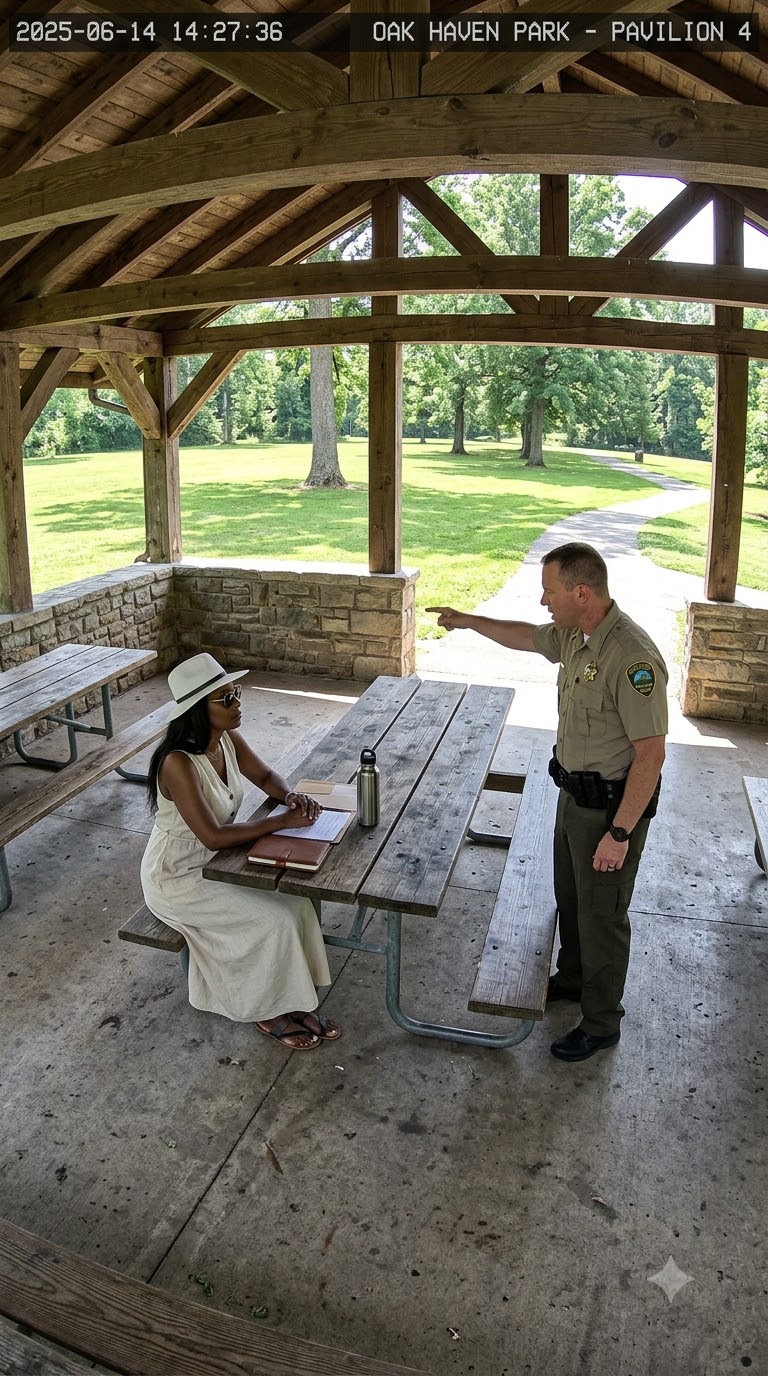
Officer Derek Miller believed he was about to teach an uncooperative woman a lesson about respecting police authority.
He had no idea that the woman sitting beneath the shade of a park pavilion was one of the most powerful federal prosecutors in the city.
He didn’t know she had spent fifteen years building criminal cases against organized crime networks, violent offenders, and domestic terrorists.
And he certainly didn’t realize that the handcuffs he was about to place around her wrists would eventually cost his department $4.8 million.
By the time he discovered her identity, the evidence against him would already be overwhelming.
But that realization wouldn’t come until he marched her into the Twelfth Precinct and the desk sergeant looked up from his paperwork.
What happened next would change all their lives.
 Oak Haven Park was one of Metro City’s most beautiful public spaces.
Located on the north side, it stretched across acres of carefully maintained lawns, ancient oak trees, walking trails, and limestone pavilions.
Families gathered there for birthday parties.
Children chased Frisbees across the grass.
Joggers followed the perimeter paths while parents pushed strollers beneath the trees.
On warm weekends, the scent of charcoal grills mingled with blooming magnolia.
It was the kind of place where people went to escape the pressure of everyday life.
And on a sunny Saturday afternoon in May, Elena Ross had come there for exactly that reason.
The time was two o’clock.
The sky was brilliantly blue.
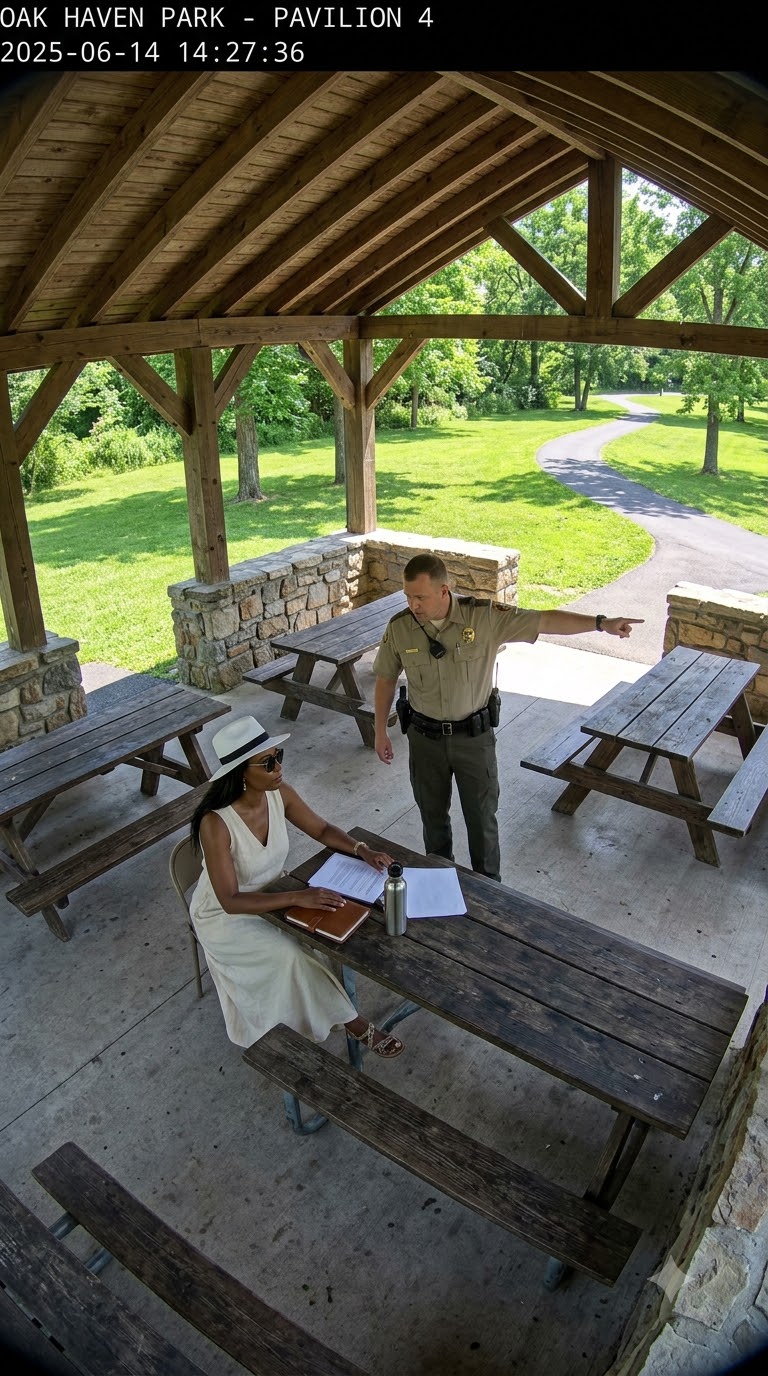
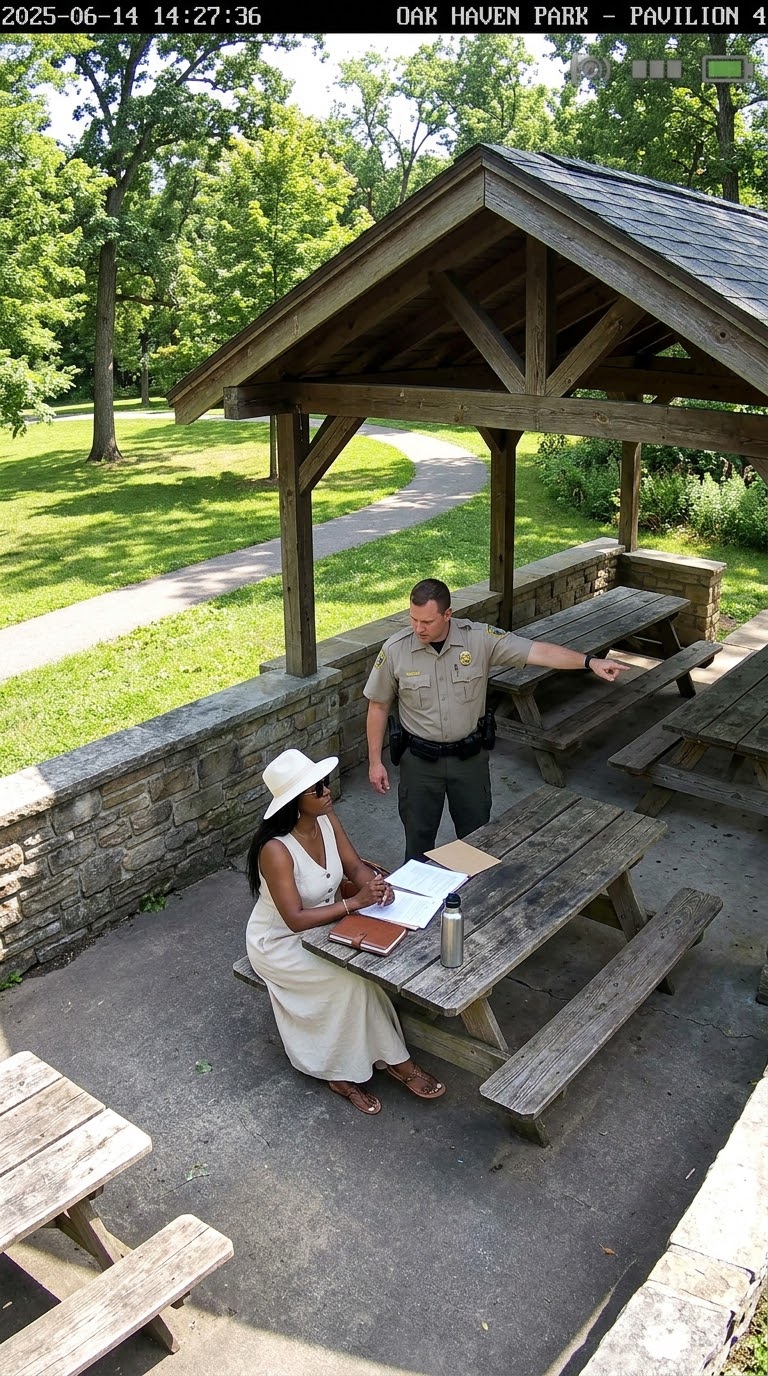
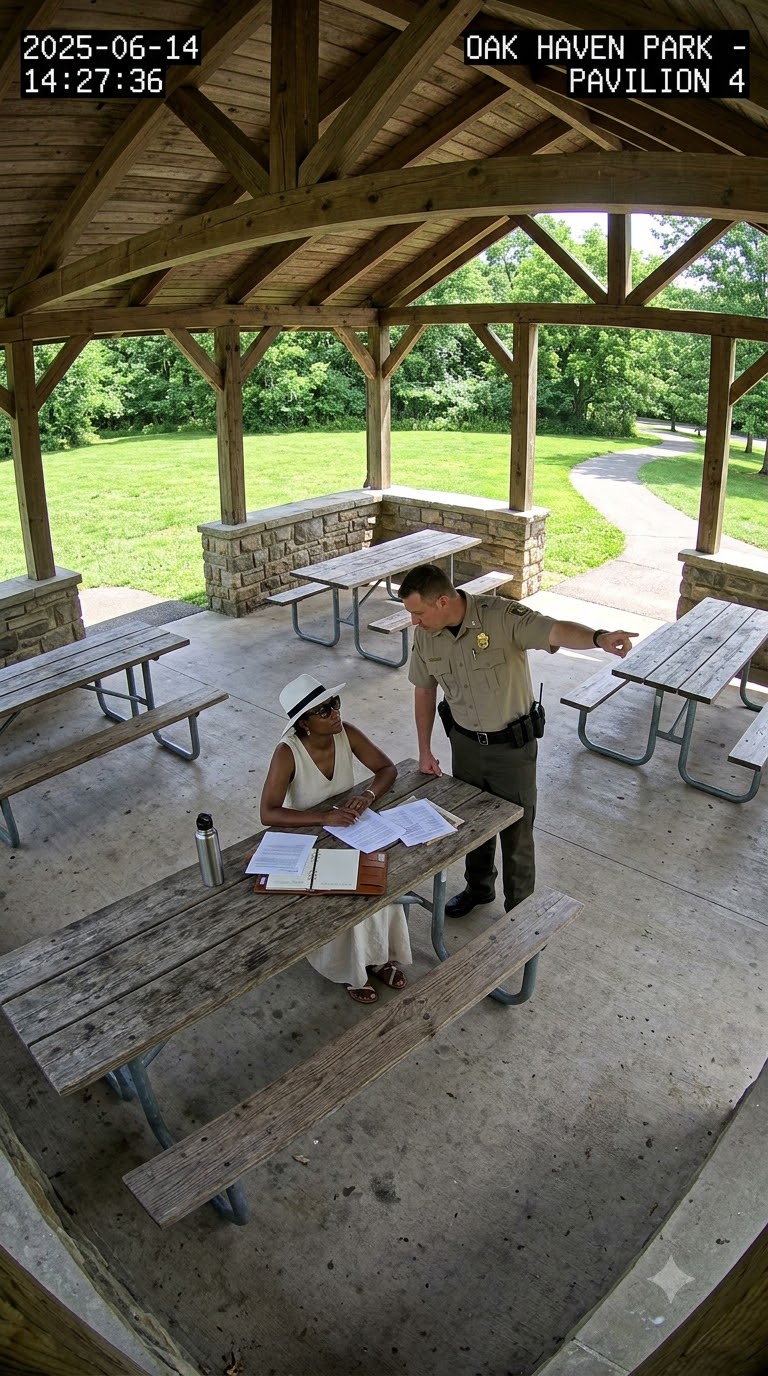
A gentle breeze moved through the oak branches surrounding Pavilion 4, a quiet stone shelter near the duck pond.
Elena sat alone at a picnic table.
She was fifty-three years old, dressed in a light linen sundress, a wide-brimmed sun hat, and oversized sunglasses.
A hardcover biography lay open before her.
Beside it stood a thermos filled with iced tea.
A compact Bluetooth speaker played soft jazz.
Miles Davis.
Kind of Blue.
The music drifted gently through the pavilion, barely audible beyond the edge of the concrete floor.
Elena had reserved the space weeks earlier through the city’s parks department.
She had deliberately selected a pavilion away from the playgrounds and busier picnic areas.
She wanted a quiet afternoon.
No phone calls.
No legal arguments.
No urgent emails.
And absolutely no courtroom confrontations.
She had spent the previous two weeks in a heavily secured federal courthouse, prosecuting members of a multi-state racketeering organization.
The trial had demanded nearly every waking hour.
Witness preparation.
Evidence review.
Cross-examinations.
Late-night strategy meetings.
For months, Elena had barely experienced a Saturday that didn’t involve work.
Today was supposed to be different.
She turned another page of her book and listened to the music.
For the first time in weeks, she felt herself relaxing.
To most people, Elena looked like an ordinary woman enjoying a peaceful afternoon.
But in federal law enforcement circles, her name carried considerable weight.
She was the deputy chief of the Criminal Division at the United States Attorney’s Office for the Southern District.
Her career had included major prosecutions involving organized crime, cartel operations, and domestic terrorism.
She was known for her precise questioning and extraordinary preparation.
Colleagues sometimes called her the Iron Lady of the Federal Courthouse.
Elena understood constitutional protections, criminal procedure, and search-and-seizure law in extraordinary detail.
She had even helped develop training materials for federal agents on proper investigative procedures.
She knew what police officers could legally demand.
She knew what they couldn’t.
And she knew how to recognize an unlawful detention.
But on that Saturday afternoon, none of those professional accomplishments mattered to the man watching her from the walking path.
His name was Brad Sterling.
Brad was thirty-nine years old and lived in a condominium overlooking part of Oak Haven Park.
He had appointed himself an unofficial guardian of the neighborhood.
He regularly complained about improperly parked cars, untidy lawns, and minor violations of community rules.
He watched the park almost daily, searching for behavior he considered suspicious.
That afternoon, he heard the faint sound of a trumpet.
He stopped walking.
Turned his head.
And followed the music toward Pavilion 4.
There, he saw Elena sitting alone.
He noticed the speaker.
The book.
The thermos.
And the empty tables surrounding her.
Brad immediately decided that something was wrong.
In his mind, the pavilion should have been available to local families.
He didn’t know Elena had reserved it.
And he didn’t bother checking.
Instead, he stood approximately fifty feet away, staring at her.
The music was quiet.
But Brad chose to treat it as an intolerable disturbance.
He checked his watch.
Elena had already been there for some time.
He decided she had stayed long enough.
Brad pulled out his phone.
He considered recording her.
Then he opened the dialer instead.
He could have walked over and politely asked about the music.
He could have contacted the parks department to verify the reservation.
But he wanted something more dramatic.
He wanted the police to remove her.
“Yes, this is Brad Sterling. I’m at Oak Haven Park.”
He spoke rapidly into the non-emergency line.
“There is a woman here blasting music, absolutely blasting it. It’s vibrating the windows of the nearby condos.”
The nearest condominium buildings were roughly three hundred yards away.
The music wasn’t loud enough to reach them.
But Brad continued.
“She’s screaming at people who walk by. I think she’s intoxicated or on drugs. It’s creating a very hostile environment for the children.”
The dispatcher asked the standard questions.
“Is she armed? Is she violent?”
“She’s aggressive,” Brad replied.
He lowered his voice.
“She looks like she could be armed. She’s staring me down right now.”
Elena hadn’t even looked up from her book.
“I don’t feel safe. You need to send someone before this gets out of hand. It’s gang-related music.”
The dispatcher recorded the complaint.
A call involving a suspicious person and possible public disturbance was entered into the system.
Three streets away, Officer Derek Miller saw the notification appear on his patrol-car computer.
Miller was thirty-two years old.
He had served with the Metro City Police Department for six years.
He was physically fit, confident, and deeply attached to the authority of his uniform.
But his professional record was far from spotless.
During the previous two years, four formal complaints had been filed against him.
One involved profane language directed at an elderly woman during a traffic stop.
Two concerned verbal confrontations that escalated into physical shoving.
Another involved an unlawful vehicle search that caused evidence to be excluded from court.
His personnel file also contained counseling memoranda about his temper.
Only a week earlier, his sergeant had warned him.
“Miller, you need to learn to talk to people. You’re a hammer, and you think everything is a nail. Dial it back.”
Miller hadn’t taken the advice seriously.
He believed establishing control was the most important part of policing.
When someone challenged him, he saw defiance.
When someone asked a question, he heard disrespect.
And when he read the dispatch report from Oak Haven Park, he immediately accepted the caller’s accusations.
A person was supposedly playing loud music.
Shouting at pedestrians.
Possibly intoxicated.
Making someone feel threatened.
Miller didn’t consider that the complaint might be exaggerated.
He didn’t question the phrase “gang-related music.”
He simply decided there was a dangerous person in a respectable neighborhood.
And he was going to handle it.
He drove toward the park.
Instead of using the parking lot, he steered his cruiser onto the grass near the pavilion path.
He wanted his arrival to make an impression.
The emergency lights flashed as he stopped.
Miller climbed out, adjusted his duty belt, checked that his body camera was recording, and marched toward Pavilion 4.
The first thing he noticed was the quiet.
There was no shouting.
No booming music.
No confrontation.
Only the wind moving through the trees and a faint jazz melody drifting from the pavilion.
But Miller had already decided what he expected to find.
If the music was quiet now, he reasoned, perhaps the woman had lowered it when she saw his patrol car.
He approached Elena.
She remained seated.
She didn’t jump.
She didn’t appear nervous.
She simply continued reading.
That irritated him.
He stepped onto the pavilion’s concrete floor.
His shadow fell across her book.
“Turn it off.”
Elena paused.
She placed a bookmark between the pages.
Then she slowly raised her head.
“Excuse me?”
“The music,” Miller snapped. “Turn it off now. We got complaints. You’re disturbing the peace.”
Elena glanced at the speaker.
Then at the officer’s nameplate.
“Officer Miller,” she said calmly, “this is a public park.”
She gestured toward the speaker.
“The city ordinance for noise in public spaces, specifically Section 14B, allows for amplified sound as long as it does not exceed 60 decibels at a distance of 50 feet.”
Miller stared at her.
“As you can hear, or perhaps fail to hear, this music is barely audible at 10 feet. I am not disturbing the peace.”
He hadn’t expected a precise reference to municipal regulations.
He had expected an apology.
Or perhaps an argument he could silence.
Instead, the woman was calmly explaining the law.
“I don’t care about the decibels,” he snapped.
“I have a complainant who says you’re screaming at people and acting aggressive, and right now arguing with police is exactly the kind of attitude that gets you in trouble.”
Elena’s expression hardened slightly.
“So, I’m telling you again, turn the music off or I’m seizing the equipment.”
She closed her book.
Then she stood.
At five feet seven inches, she wasn’t especially tall.
But her posture conveyed the confidence of someone accustomed to standing before federal judges.
“Officer, the complainant lied to you.”
Miller’s jaw tightened.
“I have been sitting here reading for 2 hours. I haven’t spoken to a soul.”
She pointed toward the printed reservation attached to the table.
“I have a permit for this pavilion.”
The document confirmed that the space was reserved until five o’clock.
“If you would like to see my identification and the permit, I am happy to provide them, but I will not be turning off my music because I am not violating any laws.”
Miller’s face reddened.
“You think you’re a lawyer or something?”
“I am a lawyer, actually,” Elena replied.
“And I know that you are currently detaining me without reasonable suspicion of a crime. A false noise complaint does not give you the authority to harass a citizen complying with the law.”
Miller took a step backward.
He reached toward his radio.
“Okay, you want to play it that way? You’re refusing a lawful order.”
“An unlawful order is not a lawful order just because a police officer says it,” Elena answered.
“And you haven’t identified what crime I’m committing.”
“Disorderly conduct.”
He said the words quickly.
“Creating a public nuisance and now failure to obey.”
“Failure to obey an order that has no legal standing is not a crime, Officer Miller.”
Elena reached slowly toward her purse.
“I am going to show you my credentials. I suggest you look at them very carefully before you take another step.”
Miller suddenly shouted.
“Don’t reach for anything!”
His hand moved toward his holster.
“Put the bag down. Hands where I can see them.”
Elena froze.
She understood the danger of the moment.
She had prosecuted enough cases to know how quickly an encounter could become violent.
Slowly, she moved her hands away from the purse.
She held them open.
“I am a federal prosecutor,” she said clearly.
Several people on the nearby jogging path turned toward the pavilion.
“My credentials are in that bag. I am identifying myself as a deputy chief of the United States Attorney’s Office.”
She looked directly at him.
“You are making a mistake that will end your career.”
Miller laughed.
“Yeah, right. And I’m the police commissioner.”
He shook his head.
“You’re a federal prosecutor sitting in a park listening to gang music. I don’t buy it. You’re probably carrying a fake badge you bought online.”
Elena didn’t respond immediately.
The officer was refusing to verify information that could resolve the encounter in seconds.
Instead, he was becoming more aggressive.
“Turn around,” Miller ordered.
“You’re under arrest.”
Elena stared at him.
“For what?”
“Disorderly conduct, resisting arrest, and failure to identify.”
“I am not resisting,” Elena said loudly.
People were gathering near the path.
“I am complying under duress. I am informing you that you are violating my Fourth Amendment rights. You have no probable cause.”
Miller stepped closer.
“You are arresting me based on a fraudulent 911 call and your own racial bias.”
“Turn around.”
Before Elena could fully comply, Miller grabbed her arm.
He spun her toward a stone pillar.
Her right shoulder twisted painfully as he pulled her wrist behind her back.
She winced.
But she refused to scream.
Near the walking path, Brad Sterling had moved closer.
He was recording the encounter with his phone.
He looked pleased.
“That’s right, officer!” he shouted. “Take her in. She’s been threatening everyone.”
Elena turned her head toward his camera.
“My name is Elena Ross. I am a U.S. attorney. This man filed a false police report. This officer is arresting me without cause.”
Miller pushed her against the pillar.
“Shut up. You have the right to remain silent, so use it.”
“I know my rights better than you do, officer,” Elena replied.
“And I know you are required to verify credentials when they are offered. You are willfully ignoring exculpatory evidence.”
The handcuffs closed around her wrists.
Click.
Click.
Click.
Miller tightened them until the metal pressed painfully into her skin.
Then he marched her toward the patrol car.
A woman pushing a stroller shouted from the path.
“She wasn’t doing anything. We’ve been here for an hour. She was just reading.”
“Back up! Police business!” Miller yelled.
He forced Elena into the rear seat.
The handcuffs dug into her wrists and lower back.
Miller climbed behind the steering wheel.
He glanced at her through the rearview mirror.
“You really stepped in it now.”
Elena said nothing.
“Impersonating a federal officer. That’s a felony. I’m going to book you for that, too.”
She looked directly into the mirror.
“Officer Miller, I want you to remember this moment.”
He smirked.
“I want you to remember the feeling of power you have right now because it is the last time you will ever feel it.”
Miller laughed.
“We’ll see what the sergeant says about your fake badge.”
He shifted into drive.
And fifteen minutes later, he would discover that the woman he had handcuffed was someone his own desk sergeant knew very well.
PART 2: The Sergeant Who Knew Her Name
The ride to the Twelfth Precinct lasted approximately fifteen minutes.
Officer Derek Miller drove with the satisfaction of a man convinced he had made an important arrest.
He believed he had removed a disruptive person from a public park.
In his mind, the woman in the back seat was arrogant, dishonest, and determined to challenge his authority.
He was already considering how to describe the encounter in his official report.
Belligerent behavior.
Refusal to comply.
Possible impersonation of a federal officer.
Perhaps he could even describe her movement toward the purse as threatening.
He had no intention of admitting that she had offered to show identification.
Or that the music had been barely audible.
Or that multiple witnesses had said she was doing nothing wrong.
Elena, meanwhile, sat upright in the back seat.
Her wrists throbbed.
Her shoulder ached.
Miller hadn’t secured her with a seat belt.
Each sudden turn and abrupt stop shifted her against the hard plastic seat.
She said very little.
Instead, she mentally documented the encounter.
The time of the arrest.
The officer’s statements.
His refusal to inspect her credentials.
The force used against her.
The absence of reasonable grounds for the charges.
She considered the possible legal consequences.
False arrest.
Assault and battery.
Constitutional violations.
Potential deprivation of rights under color of law, including issues arising under 18 U.S.C. Section 242.
Elena had spent years building criminal cases from evidence.
Now she was doing the same thing from the back of a police cruiser.
Only this time, she was the person whose rights had been violated.
 The patrol car entered the precinct’s secured vehicle area.
Miller stopped the engine and opened the rear door.
He pulled Elena out and marched her through the intake entrance.
They passed the holding cells.
Then they entered the booking area.
Behind the desk sat Sergeant Thomas Reynolds.
Reynolds was fifty-eight years old and had served in law enforcement for thirty-five years.
He was approaching retirement.
He had seen countless arrests and difficult situations.
He was tired, experienced, and generally difficult to surprise.
That afternoon, he was reviewing paperwork when Miller entered with Elena in handcuffs.
Miller approached the counter with a satisfied expression.
Reynolds looked up.
First, he saw the young officer.
Then he looked at the woman beside him.
His pen slipped from his fingers.
He stared.
For a moment, he seemed unable to believe what he was seeing.
Three months earlier, Reynolds had testified in a federal racketeering case.
The prosecutor involved had been Elena Ross.
He remembered her questions.
Her preparation.
The way she commanded the courtroom.
He knew her position in the United States Attorney’s Office.
And now she was standing in his precinct with handcuffs around her wrists.
“Miller.”
His voice sounded unusually strained.
“Why is the deputy chief of the Criminal Division in handcuffs?”
Miller’s smile faltered.
“The who?”
Reynolds stood.
“Elena Ross.”
He pointed toward her.
“She is the U.S. attorney for the Southern District. She is the highest ranking federal prosecutor in this city.”
His voice rose.
“Miller, what did you do?”
Elena looked at the sergeant.
“I tried to tell him, Sergeant.”
She raised her cuffed wrists slightly.
“He told me my badge was fake and refused to look at it.”
Reynolds hurried around the desk.
“Unlock her now. Right now.”
Miller hesitated.
“Sarge, she was playing loud music. She refused to identify herself.”
“Unlock her!”
The command echoed through the booking area.
Nearby officers stopped what they were doing.
Miller reached for his keys.
His fingers trembled.
The confidence that had carried him through the arrest vanished.
He suddenly understood that he had brought a senior federal prosecutor into the precinct on charges she had repeatedly challenged as unlawful.
And he had refused to examine the credentials that would have confirmed her identity.
He struggled with the handcuffs.
Finally, they opened.
Elena brought her hands forward.
Deep red marks circled her wrists.
She rubbed them carefully.
Then she turned toward Reynolds.
“Sergeant Reynolds, good to see you again. I wish the circumstances were different.”
Reynolds looked devastated.
“Ms. Ross, I—I don’t know what to say.”
He glanced at her wrists.
“I’m so sorry. Are you injured?”
“My shoulder is strained. My wrists are bruised,” Elena replied.
She paused.
“But my civil rights are the primary casualty today.”
Captain Harris appeared from his office.
He had heard the shouting.
“What is going on out here?”
Reynolds turned toward him.
“Miller arrested Elena Ross.”
The captain stopped.
He looked at Elena.
Then at Miller.
Then at the handcuffs resting on the counter.
“For noise violation,” Reynolds added.
Harris’s expression darkened.
He knew who Elena was.
He understood her position.
And he immediately recognized the seriousness of what had happened.
“Officer Miller.”
His voice was quiet.
“Give me your badge and your gun. Place them on the counter.”
Miller stared at him.
“Captain, I didn’t know.”
Elena spoke before Harris could answer.
“You didn’t verify.”
Miller turned toward her.
“You assumed,” she continued.
“You saw a woman in a park and decided she was a criminal.”
Her voice remained controlled.
“You escalated a non-existent noise complaint into a false arrest. You ignored my identification. You used excessive force.”
Captain Harris held out his hand.
“Badge and gun. Now.”
Miller’s face had gone pale.
He slowly unbuckled his holster.
He removed his Glock 17 and placed it on the counter mat.
Then he unpinned his badge.
For years, that badge had been a symbol of authority to him.
He had relied on it to command strangers.
To demand obedience.
To silence questions.
Now he placed it beside his weapon.
“You are relieved of duty pending an internal investigation,” Harris said.
He pointed toward the exit.
“Get out of my station.”
Miller stood motionless.
Then he turned.
He walked toward the front entrance, removing the Velcro insignia from his uniform.
The other officers watched in silence.
The man who had marched Elena through the station as a criminal was now leaving without his badge or weapon.
And the legal consequences had only begun.
Brad Sterling believed the arrest had been a victory.
He had watched Miller force Elena into the patrol car.
He had recorded the confrontation.
And he had uploaded the footage to a neighborhood watch group before the encounter was even over.
In his mind, the video proved that he had protected Oak Haven Park from a troublesome visitor.
He expected congratulations.
Instead, the recording became evidence of the false accusations that had started the confrontation.
By Monday morning, copies had spread far beyond the neighborhood group.
The footage appeared across social media.
News outlets began reporting on the incident.
A headline gained enormous attention:
Officer Arrests U.S. Attorney for Listening to Jazz.
The recording showed the quiet park.
The small speaker.
Elena’s book and thermos.
The printed pavilion reservation.
And the officer’s increasingly aggressive behavior.
Viewers heard Elena calmly explain the noise ordinance.
They heard her identify herself as a federal prosecutor.
They watched Miller refuse to inspect her credentials.
They saw him twist her arm and place her in handcuffs.
They also heard Brad encouraging the arrest.
His own recording undermined his accusations.
There was no visible disturbance.
No shouting from Elena before the confrontation.
No evidence that she had threatened passersby.
And no indication that her music was causing the disruption Brad had described.
People began asking why the police had accepted his complaint without verifying the facts.
Others questioned why Miller had ignored the obvious inconsistencies.
The department faced intense public scrutiny.
And Elena Ross was preparing to take legal action.
On Tuesday, a lawsuit was filed.
Elena Ross v. the City of Metro, Derek Miller, and Brad Sterling.
The complaint described the events at Oak Haven Park in detail.
It alleged that Miller had unlawfully detained and arrested Elena.
It addressed the physical force used against her.
It challenged the false accusations and the refusal to verify her identity.
And it identified Brad’s knowingly inaccurate complaint as the event that triggered the encounter.
Elena worked with a team of civil rights attorneys while remaining closely involved in the case.
The evidence was extensive.
Miller’s body-camera recording.
Brad’s phone video.
Witness statements.
The pavilion reservation.
The dispatch recording.
Medical documentation of Elena’s injuries.
And the officer’s disciplinary history.
The city reviewed the material.
Its attorneys understood the risks of prolonged litigation.
The Department of Justice also raised the possibility of examining broader practices within the police department.
The case was no longer simply about a disagreement over music.
It concerned the conduct of an officer with previous complaints, a false civilian report, and an arrest that had escalated despite multiple opportunities to resolve the situation peacefully.
The city chose to settle.
The amount was extraordinary.
$4.8 million.
One of the largest wrongful-arrest settlements in the state’s history.
But the financial settlement was not the end of the matter.
For Derek Miller, the consequences were becoming far more personal.
Five days after the incident, Miller was formally fired from the police department.
His career in law enforcement was over.
But Elena did not consider termination sufficient.
The investigation had revealed conduct she believed required criminal accountability.
The case moved beyond internal discipline.
Miller was indicted on charges involving deprivation of rights under color of law and assault.
The man who had once dismissed Elena’s constitutional arguments was now facing the federal legal system she understood so well.
He could no longer rely on his uniform.
He could no longer command witnesses to stop speaking.
He could no longer decide which evidence deserved attention.
His conduct would be examined through recordings, testimony, and legal proceedings.
Facing the possibility of a lengthy federal prison sentence, Miller entered a guilty plea.
The outcome included three years of probation.
He was also permanently barred from employment in law enforcement or security under the terms described in the case.
The badge he had valued so highly was gone.
So was the career he had built around it.
Eventually, he found work in a warehouse packing boxes.
There, he no longer held authority over the public.
The consequences of that Saturday afternoon had followed him far beyond Oak Haven Park.
And he wasn’t the only person whose life had changed.
Brad Sterling, the man who made the false complaint, was about to face a reckoning of his own.
PART 3: The Price of a False Complaint
Brad Sterling had expected to become a neighborhood hero.
When he called the police, he imagined Elena being removed from Pavilion 4.
He believed his neighbors would appreciate his intervention.
He thought the video he recorded would prove that he had acted responsibly.
Instead, the footage became one of the most damaging pieces of evidence against him.
His voice could be heard encouraging Officer Miller.
His original allegations were compared with the video.
And the difference between his claims and the actual scene was impossible to ignore.
He had reported music so loud it supposedly shook condominium windows.
But the recording showed a quiet pavilion and faint jazz.
He had claimed Elena was screaming at people.
Yet the video showed her calmly reading before Miller approached.
He had suggested she was dangerous and possibly armed.
But there was no evidence supporting those suspicions.
He had claimed the situation was threatening children.
The people nearby appeared to be enjoying an ordinary afternoon.
The call had been exaggerated to produce a police response.
And that response had resulted in an unlawful arrest.
Brad faced legal action for defamation and filing a false police report.
The civil proceedings also examined his role in initiating the encounter through knowingly misleading accusations.
The consequences were severe.
Although he avoided jail time, the civil judgment against him for malicious prosecution devastated his finances.
He lost the condominium overlooking Oak Haven Park.
The home from which he had spent years monitoring his neighbors was no longer his.
At forty years old, he moved back in with his parents.
His name became widely associated with the misuse of police reporting systems to target people who had done nothing wrong.
The man who had wanted Elena removed from a public pavilion had ultimately lost his own home.
But Elena didn’t celebrate his financial collapse.
For her, the case had exposed something more serious than one man’s hostility.
A civilian had made false allegations.
An officer had accepted them without adequate scrutiny.
And a peaceful afternoon had become an unlawful arrest.
The chain of events was disturbingly simple.
One person decided a woman didn’t belong.
Another person with legal authority acted on that assumption.
And the person doing nothing wrong was the one placed in handcuffs.
Elena wanted that lesson to remain visible.
 After the settlement, Elena made another important decision.
She donated a substantial portion of the $4.8 million to the Legal Aid Society.
The contribution established a fund dedicated to assisting victims of racial profiling who could not afford experienced legal representation.
Elena knew how much a strong legal team could accomplish.
She had spent years working inside the justice system.
She understood the importance of evidence preservation.
She knew how to challenge an unlawful arrest.
She knew which questions to ask and which documents to demand.
And when Miller ignored her credentials, she knew exactly what constitutional issues his conduct raised.
Most people didn’t have that knowledge.
They didn’t have teams of attorneys ready to help.
They didn’t know how to request body-camera footage.
They might not know how to identify procedural violations or pursue a civil rights claim.
And even when they did understand that something unlawful had happened, they might not have the money to challenge it.
Elena wanted the fund to help close that gap.
Her own case had drawn attention because of her position.
But she knew that an ordinary person could experience the same treatment without generating national headlines.
A student sitting in a park.
A parent waiting outside a school.
A worker driving through an unfamiliar neighborhood.
Someone listening to music in a public place.
Their rights were no less important because their names weren’t recognizable.
And Elena wanted them to have access to legal assistance when those rights were violated.
Two weeks after the arrest, Elena returned to work.
The federal courthouse was familiar territory.
She walked through its halls with the same purposeful stride her colleagues remembered.
She resumed reviewing cases.
Meeting with attorneys.
Preparing evidence.
And carrying out the responsibilities of her office.
The incident at Oak Haven Park hadn’t ended her career.
It had reinforced her commitment to the principles she spent her professional life defending.
But she didn’t pretend the experience had been insignificant.
She remembered the handcuffs.
The pain in her shoulder.
The officer’s refusal to listen.
And the moment she realized that her professional identity might not protect her from an officer determined to see her as a criminal.
She had been able to secure accountability.
But that didn’t erase what happened.
Nor did it change the fact that the encounter could have ended very differently.
She knew that the officer’s conduct had placed her in danger.
She also knew that the evidence had been unusually clear.
Multiple recordings existed.
Witnesses had spoken.
The false caller had documented his own involvement.
And the desk sergeant had immediately recognized her.
Without those circumstances, proving the truth might have been far more difficult.
That understanding stayed with her.
As the months passed, life in Oak Haven Park returned to normal.
Families gathered beneath the trees.
Joggers followed the same paths.
Children played near the open lawns.
The duck pond reflected the changing seasons.
Pavilion 4 remained available for reservations.
And Elena Ross continued visiting on Saturdays.
She didn’t abandon the park.
She didn’t stop reading outdoors.
And she didn’t give up the music that had helped her relax after difficult weeks in court.
On sunny afternoons, she still arrived wearing comfortable clothes.
She still brought her thermos.
Her books.
And her small Bluetooth speaker.
She still chose Pavilion 4 when it was available.
And she still listened to Miles Davis.
The soft trumpet melodies drifted through the pavilion just as they had before.
But something had changed.
When police cruisers passed nearby, officers sometimes slowed down.
They recognized her.
They waved politely.
Then they continued on their way.
Nobody ordered her to turn off the speaker.
Nobody demanded that she explain why she was sitting there.
Nobody threatened to arrest her for enjoying a quiet afternoon.
Elena appreciated the peace.
But she also understood the uncomfortable irony.
She was now treated with particular respect because the officers knew who she was.
That was never supposed to be the point.
She hadn’t fought the case because she believed federal prosecutors deserved privileges ordinary citizens didn’t.
She had fought because ordinary citizens deserved the same basic constitutional protections.
The right to enjoy public spaces lawfully.
The right not to be detained without proper justification.
The right to have evidence considered.
And the right not to be punished simply for questioning an officer’s authority.
One Saturday, Elena sat beneath the pavilion roof as sunlight moved slowly across the picnic table.
Her book lay open.
Her iced tea rested beside it.
The familiar notes of Kind of Blue floated gently from the speaker.
A family walked past on the nearby path.
A child laughed.
A couple stopped to watch the ducks.
For a moment, everything felt as peaceful as it had on the afternoon before Miller arrived.
Elena turned a page.
She thought briefly about the people whose cases would now be supported through the legal aid fund.
People she might never meet.
People whose names would never appear in national headlines.
People who needed someone willing to challenge an abuse of authority.
That was the part of the outcome that mattered most to her.
Derek Miller had lost his badge.
Brad Sterling had faced financial consequences.
The city had paid a substantial settlement.
Those were results of the legal process.
But the legal aid fund offered something that could continue long after the public stopped discussing the arrest.
An opportunity for other people to be heard.
Elena took a sip of iced tea.
The music continued.
A police cruiser moved slowly along the park road.
The officer inside glanced toward Pavilion 4.
Recognizing Elena, he raised a hand in greeting.
She returned the gesture.
The cruiser drove on.
And Elena went back to her book.
She was still the same woman who had entered Oak Haven Park hoping for a quiet afternoon.
Still a federal prosecutor.
Still someone who understood the law.
Still someone who believed authority carried responsibilities rather than unlimited power.
But now she carried an experience that no courtroom training could have fully prepared her for.
She knew what it felt like to explain the law and be ignored.
To offer identification and have it dismissed.
To be restrained despite having committed no crime.
And to discover that the truth only became important to an officer after someone recognized her title.
That was the lesson she wanted the city to remember.
Respect for constitutional rights should never depend on a person’s profession, wealth, or connections.
A badge doesn’t make every command lawful.
A complaint doesn’t automatically make someone guilty.
And a person exercising their rights shouldn’t have to prove they are powerful before an officer treats them fairly.
Elena looked across the green lawn.
The park was full of ordinary people enjoying an ordinary Saturday.
That was exactly what she had wanted from the beginning.
She adjusted her sunglasses, turned another page, and allowed the jazz to play.
This time, nobody interrupted her.
THE END.
