

PART 1
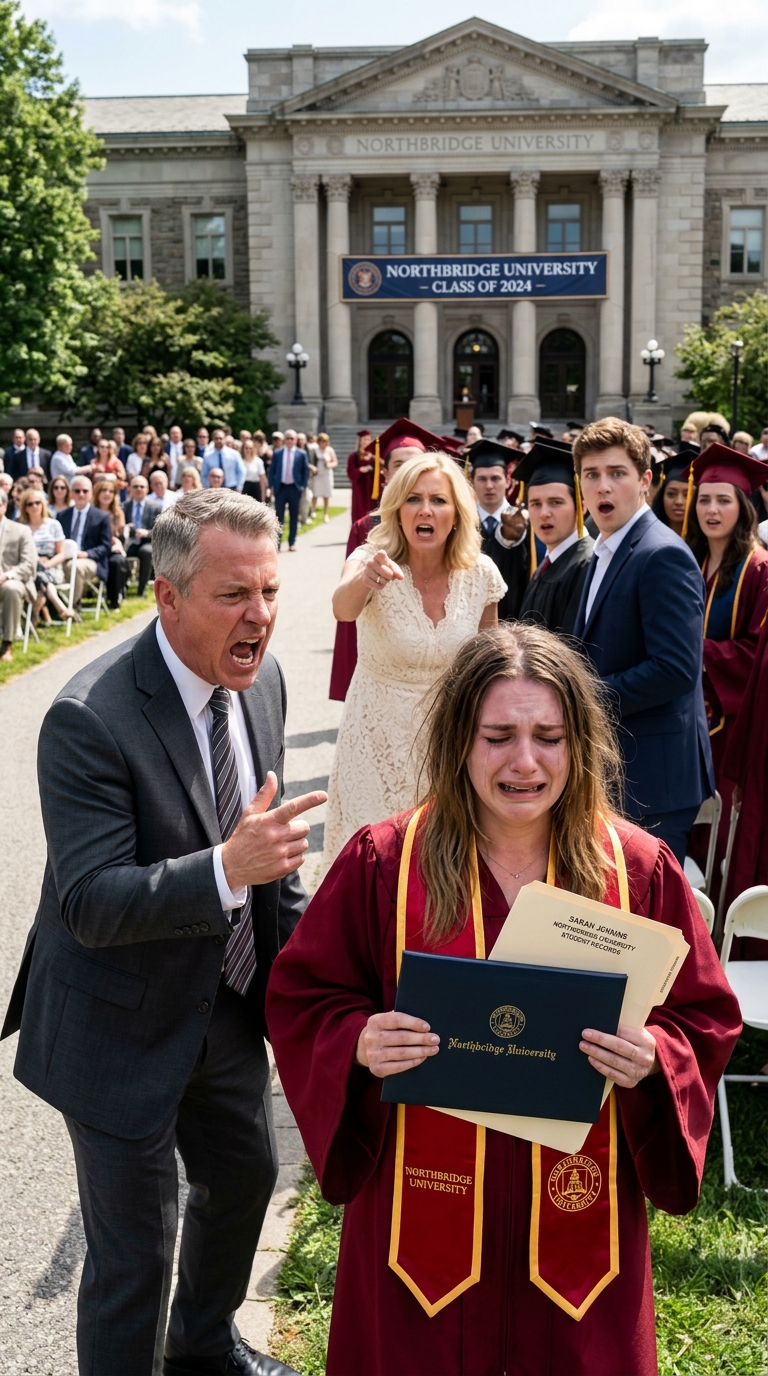
“You don’t deserve that degree,” my father spat, moments after striking me so hard that my maroon graduation cap flew off and landed across the university’s main quad.
The sound of the slap cut through the courtyard of Hudson Valley University. It wasn’t just a simple noise; it was the kind of shocking sound that stopped conversations instantly and froze hundreds of people in place, as if the entire ceremony had suddenly been paused.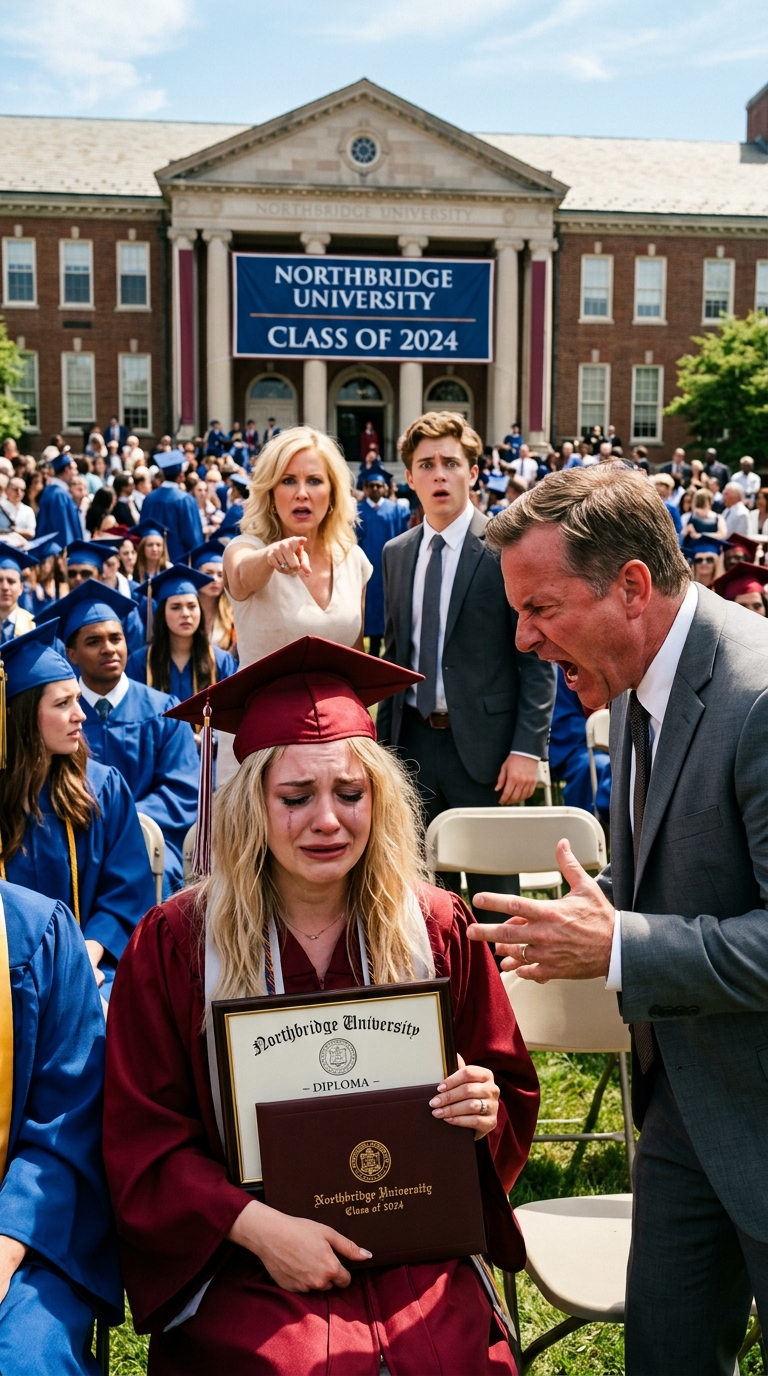
My cap fell beside the polished leather case holding my diploma, spinning across the stone ground. I stood there, my left cheek burning, my hand shaking uncontrollably as I stared directly at the man who had just humiliated me in front of hundreds of graduates, professors, photographers, and families.
My father, Arthur Vance, was completely consumed by anger.
“You are an absolute embarrassment,” he muttered, moving closer. “Standing up on that stage acting as if you actually engineered something worth celebrating.”
Before I could even respond, my mother, Victoria, stepped forward, her face twisted with cruelty.
“A failure in a graduation gown, that’s exactly what you are!” she screamed. “Stop making this family look bad in public!”
A wave of shocked whispers spread through the nearby parents. A senior professor lowered his camera, his mouth slightly open. A campus security officer adjusted his belt and immediately began moving toward us, but I calmly raised my left hand, keeping my eyes on my parents.
“No,” I said, my voice dropping into a frighteningly calm tone. “Let him finish his thesis.”
My best friend, Paige, standing only a few steps away in her own graduation gown, rushed toward me with a pale face.
“Audrey, are you okay? What is happening?”
I didn’t answer her. Not because I couldn’t hear her, but because I had spent four exhausting years preparing for this exact moment. Maybe I hadn’t expected the physical attack or the way the crowd’s attention would make my soul feel crushed beneath the pressure, but I had always known the day would come when my parents would finally have nowhere left to hide.
For years, Arthur and Victoria had carefully spread a false story throughout our entire family. They told everyone I had abandoned my education. They claimed I was lazy, that I had surrounded myself with the wrong people, and that I lacked the discipline to earn my degree. They portrayed themselves as heartbroken parents who had tried everything to save an ungrateful daughter.
But the truth was completely different.
I had earned a highly competitive partial academic scholarship. Every morning, I worked exhausting double shifts at a local diner near the historic district. Every afternoon, I handled private tutoring jobs. Every night, I studied until the early hours of the morning.
There were weeks when I survived on only three hours of sleep. Weeks when I carefully reduced my meals to coffee and stale bread just to protect my tuition payments. There were nights when I hid inside library bathrooms, crying quietly in the darkness because I couldn’t let anyone see how close I was to breaking.
Yet that morning, when the clinical dean announced my name with Summa Cum Laude honors, the entire courtyard exploded with applause.
And that was the exact moment my younger brother, Julian, stopped smiling.
Julian stood behind our parents, looking flawless in a designer suit, an expensive watch, and brand-new leather shoes. He had always been labeled the “pride of the legacy,” even though he had failed out of the institute twice and completely destroyed a logistics startup I had warned him was unstable.
His life always had endless financial support—extra classes, gas money, expensive phones, and European vacations.
For me, they always claimed there was nothing left.
When Arthur watched his independent daughter walk across the stage to receive her honors diploma, his expression completely changed. It wasn’t pride. It was pure anger—as if every cheer from the audience was an attack on his authority.
That was why he pushed through the crowd to confront me.
That was why he hit me.
I slowly bent down, picked up my fallen cap, and brushed the dust from my diploma case. My cheek still hurt, but my mind remained completely steady.
“You’re entirely correct, Dad,” I said, my voice carrying clearly across the brick courtyard. “Everyone here deserves to hear the absolute truth.”
My mother’s eyes widened with sudden fear.
“Audrey, don’t you dare create a scene.”
But I was already walking toward the main podium.
The university president stood beside the microphone, looking completely stunned, unsure whether to call security or stop the broadcast.
I reached beneath the hidden silk lining of my graduation gown and pulled out a thick, wax-sealed manila folder. I had carried it against my chest all afternoon, like a silent weapon waiting for the perfect moment.
“Dr. Sterling,” I said as I stepped toward the live microphone, my voice filling the university’s entire PA system. “Before I officially leave this institution, I need to submit a formal compliance report against the individuals who systematically misused my tuition funds, forged federal signatures under my identity, and attempted to erase me from my own family records.”
From the center aisle, Arthur shouted desperately:
“Shut your mouth, Audrey!”
But the microphone was already active.
And everyone was listening.
PART 2
The entire multi-acre courtyard fell into complete silence.
The university president, Dr. Sterling, looked at the thick legal file I placed into his hands, then looked toward my parents, whose expressions had instantly shifted from confidence to fear.
“Ms. Crestwood,” Dr. Sterling said, his voice becoming careful and professional through the microphone. “Are you submitting a formal administrative and legal affidavit for the record?”
“I am,” I answered calmly. “And I have complete forensic verification.”
My mother released a sharp, dramatic laugh—the kind of polished social laugh meant to dismiss an accusation before anyone had the chance to examine the evidence. “Do not entertain this absolute nonsense, Dr. Sterling,” Victoria declared loudly to the surrounding parents. “Audrey has been severely unstable since childhood. She manufactures these grand, dramatic crises simply to force the family’s focus onto herself.”
I slowly turned my head and looked down at her from the podium.
“Did I also manufacture the three federal student loans that were cleared utilizing my social security number, my electronic footprint, and a systematically forged authorization signature?”
The fake laughter disappeared instantly from her voice.
A wave of whispers swept through the audience. The media photographers, who had lowered their cameras as the ceremony was coming to an end, suddenly raised their lenses again—not to capture an ordinary graduation, but to record the complete collapse of a respected family reputation in real time.
I inhaled slowly, feeling the crisp morning air fill my lungs.
“Four years ago, I entered this university on a partial merit scholarship. The remaining financial balance was my independent responsibility. I pulled double shifts from my very first semester to secure the tuition. I never requested a single cent of capital from my parents’ estate. But during the audit of my junior year, I uncovered three high-interest educational credit lines active under my legal identity. I had never executed those applications. The capital had been routed straight into a secondary banking vault controlled exclusively by my parents.”
Arthur stepped forward aggressively toward the platform stairs.
“This is a confidential family matter! Turn off that PA system!”
Two campus security officers in uniform immediately moved into his path, stopping him with complete precision.
“Sir, maintain your current coordinate marker and step back immediately.”
Julian’s eyes dropped toward his expensive shoes. The arrogant golden-boy confidence vanished completely from his face, leaving him looking like a child caught reaching into a locked vault.
I opened the manila folder and handed the documents to Dr. Sterling. Inside were certified bank records, altered routing histories, forged signature comparisons, electronic IP tracking files, and the official summary prepared by a consumer protection attorney who had quietly helped me build this archive over the past six months.
“When I forensically confronted them with the data,” I continued, my voice steady and firm through the speakers, “my father stated that I owed them the equity for the cost of my upbringing. My mother informed me that no court would ever validate my word over hers because she had spent months telling our social circles that I was mentally incompetent. I was nineteen years old, completely isolated, terrified, and devoid of independent capital. So I executed the only logical strategy: I stayed silent, I finished the coursework, and I preserved every single receipt.”
Paige stepped onto the platform beside me, tightly holding my hand.
“Finish the audit, Audrey,” she whispered.
I swallowed against the lingering pain in my throat.
“They didn’t merely skim my identity for capital. They systematically informed my extended family that I had dropped out due to substance abuse. They claimed I refused to maintain employment. They actively utilized my legal credit score to float the debt liabilities of Julian’s liquidated startup, while I was literally forced to sleep on a wooden bench at the transit terminal after locking up the diner at 3:00 a.m.”
A shocked gasp came from the VIP section.
An elegant older woman pushed through the security line, her face filled with pure horror. It was Aunt Beatrice, my mother’s older sister. Her eyes widened with sudden, devastating realization as she stared directly at Victoria.
“Victoria… you explicitly swore to the estate trustees that Audrey refused to attend family functions because she was institutionalized!”
A sharp pain struck my chest.
That information had not been included in my files. They had used my name to prevent me from accessing the generational trust as well.
My mother hurried toward the stage, real tears finally breaking through her makeup—but they were not tears of maternal regret. They were the desperate, terrified tears of someone who had just been completely exposed.
“Audrey,” she pleaded, her voice lowering into a desperate whisper. “Please, think of your brother’s future. Think of Julian.”
I looked down at Julian.
He gave no apology. No denial. No defense.
His calculated silence answered every question that remained in the courtyard.
Arthur grabbed Victoria’s arm, his expression twisted with panic.
“We are clearing the perimeter. Move.”
Dr. Sterling’s voice boomed through the secondary microphone with enough authority to freeze the entire area.
“You are not clearing the perimeter, Mr. Vance. The municipal police detail has already blocked the exit gates.”
And just when I thought reality could not become more painful, Julian finally lifted his chin and looked up at the podium with a cold, shocking selfishness.
“She knew the capital parameters were designated for my startup, Dr. Sterling,” Julian announced flatly. “She was always fully aware of the math.”
PART 3
I felt the foundation beneath the podium shift under my heels.
It wasn’t the memory of my father’s rage, the burning pain across my cheek, or the endless lies my mother had spread that finally shattered the last piece of my childhood.
It was hearing Julian justify the theft with such effortless entitlement—as if my identity, my credit, and my future were nothing more than another account created to finance his failures.
“What did you just log into the record, Julian?” I asked, my voice carrying through the PA speakers.
Julian clenched his jaw, his undeserved corporate arrogance returning.
“I said you knew the parameters. Everyone in the household understood that capital was required to stabilize my logistics platform. It was going to clear a massive return. I simply required a minor operational injection.”
“An operational injection?”
I released a short, trembling laugh that echoed across the quad.
“I worked sixteen-hour split shifts. I liquidated my own father’s vintage watch just to pay the remaining balance on my sophomore semester. I lived out of the back seat of my sedan for three consecutive weeks because I lacked the capital to clear a rental security deposit. And you have the sheer audacity to define my life as your personal injection?”
Arthur made a sudden move toward the stairs.
“That is quite enough of this performance!”
But the world no longer followed his commands.
Not the campus security officers. Not the university president. And certainly not the rows of families who had arrived carrying flowers and balloons to celebrate their own children, only to witness a complete corporate exposure of the truth.
Aunt Beatrice stepped directly toward my mother, her posture firm and unshaken.
“You swore to me on your life that Audrey was a disgrace to the Crestwood name.”
Victoria lowered her head completely, unable to hold her gaze.
“I did what was required to protect my son’s legacy.”
That single sentence hurt more deeply than the physical blow.
Standing there on the stage, I finally accepted a truth that had taken years to understand: my mother had not simply made a mistake. She had willingly sacrificed her daughter to protect her son’s entitlement.
The municipal police vehicles entered the central plaza before the graduation ceremony could officially conclude.
There was no triumphant music. No celebration of thrown caps.
The graduating class received their diplomas in stunned silence, while families slowly moved toward the parking areas, keeping a wide distance from us as though they were avoiding the aftermath of something toxic.
Arthur, Victoria, and Julian were escorted into the administration building for formal processing.
Julian initially tried to argue that his name was not attached to the loan documents, but the compliance officers did not allow him any opportunity to interfere.
I remained outside, sitting on a concrete bench beneath the shade of the quad, my graduation gown still closed around my neck, holding a chemical ice pack against my left cheek.
Paige lowered herself onto the bench beside me, placing an arm around my shoulders.
“You successfully completed the audit, Audrey.”
I stared down at the gold-embossed words on my diploma case.
“I didn’t want the graduation to look like this, Paige.”
“I know,” she whispered. “But they chose the parameters.”
And she was completely right.
No one creates a dream where they expose their own family on the afternoon of their graduation. No one puts on a cap and gown expecting to spend the final hours of the day giving official statements to investigators.
Claiming your freedom does not always feel like a triumphant victory. Sometimes, it arrives with the deep, painful grief of finally letting go of the last hope that the people who brought you into this world would ever learn how to love you the way you deserved.
Within one business week, the financial fraud investigation moved forward into a formal grand jury indictment.
The identity theft records, the carefully arranged wire transfers, the intercepted tuition reimbursement checks, the signatures copied from my old high school documents—every piece of evidence came together with painful precision.
Arthur attempted to claim officially that I had verbally approved the credit lines. Victoria submitted an affidavit stating she was only managing the funds because her daughter was “emotionally unstable.” Julian insisted he had no knowledge of where the investment money for his company came from.
But the digital records told the real story.
Our attorneys recovered archived messages from their private server accounts.
In one conversation, Victoria wrote to Arthur:
“As long as Audrey doesn’t pull a certified credit report, the distribution line remains entirely invisible to her.”
In another thread, Julian directly asked:
“When does the next tuition allocation check clear from Audrey’s school account? My office lease is past due.”
Reading those exact words in the evidence file was the moment I stopped crying for good.
Not because the pain had disappeared, but because I finally stopped questioning myself.
For four unbearable years, I had wondered if I was simply too sensitive. If maybe my parents had some understandable reason for treating me like a stranger. If being a good daughter meant silently carrying the burden, smiling through family gatherings, and allowing myself to be pushed aside so everyone else could protect the image of a perfect household.
But a respectable family does not destroy one child’s future to support another child’s entitlement.
Six months later, Arthur and Victoria entered a formal plea agreement with state prosecutors.
They avoided a lengthy sentence in a maximum-security facility, but they faced significant civil judgments and were required to repay the stolen funds. The fraudulent student loans attached to my identity were completely removed from federal records after an expedited judicial review.
Julian was found legally responsible for receiving the misused company funds, and his technology company—that fragile illusion built entirely on stolen resources—was officially dissolved by court order before the fiscal year ended.
The extended family divided exactly as expected.
Some older relatives admitted that I had done what was necessary to protect myself. Others whispered privately that I should have resolved the financial issues “within the family perimeter.”
They insisted that family loyalty should always come before legal consequences.
Aunt Beatrice was the only one who came to my new apartment, carrying a box of kitchen supplies, a warm wool blanket, and eyes swollen from tears.
“Forgive me, Audrey,” she said, her voice breaking as she stepped inside. “Forgive me for trusting their narrative without ever looking for you on that bench.”
I didn’t rush to comfort her with a lie.
It was the first apology from a member of the Crestwood family that did not come with an expectation attached.
Using my remaining academic stipend, a junior analyst role at a corporate consulting firm, and Paige’s constant support, I rented a small, peaceful apartment near the park district.
It had nothing extravagant—just a folding work table, two chairs, a vintage espresso machine, and a large window overlooking a beautiful jacaranda tree in full bloom.
To me, it felt like a palace.
Two months later, my official framed degree arrived through secure delivery.
I carefully removed the certificate, holding it as if it were something precious and alive.
I placed it above my workspace—not because it needed to prove my intelligence to anyone else, and not because it represented surviving my parents’ cruelty.
I hung it there because it represented the courage it took to tell the truth.
Behind the frame’s mounting wire, hidden away, I placed a small photograph Paige had taken in the administration lounge moments after everything happened.
In the picture, my left cheek was still bright red, tears filled my eyes, and my honors diploma was held tightly against my chest.
I looked completely broken by what had happened.
But I also looked completely, undeniably free.
Late one evening, my father sent a private message to my phone.
“One day in the future, Audrey, you are going to deeply regret destroying the structural integrity of this family.”
I read the words three times in the quiet room.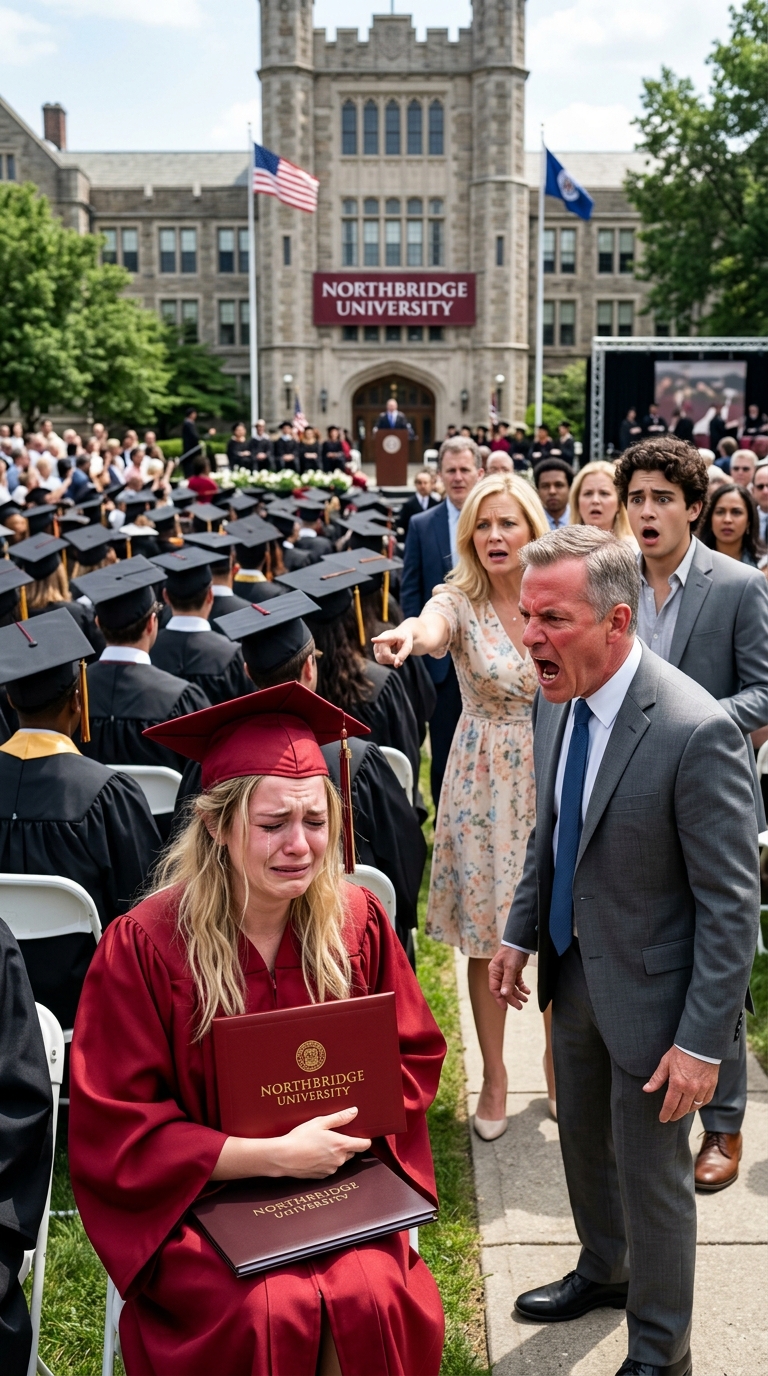
Then I looked at my degree, my organized desk, my open window, and the small but beautiful life I was finally creating with my own hands.
I replied with one simple message:
“I didn’t destroy the family structure, Arthur. I simply stopped hiding what you executed in the dark.”
Then I blocked him permanently.
That graduation morning was supposed to be the day my parents publicly humiliated me.
They wanted everyone in our city’s elite circles to remember Audrey Crestwood as the unstable dropout, the ungrateful failure in a graduation gown, the daughter who never deserved to stand on that stage.
But reality changed the outcome completely.
It became the day the world finally saw who they truly were.
And it became the moment I learned something no one had ever taught me inside that brownstone home:
Sometimes, honoring your name does not mean protecting the silence of people who harmed you.
Sometimes, it means having the courage to be the first person in the room willing to stand up and call the truth exactly what it is.
