

PART 1 — The Seat They Wouldn’t Give Her
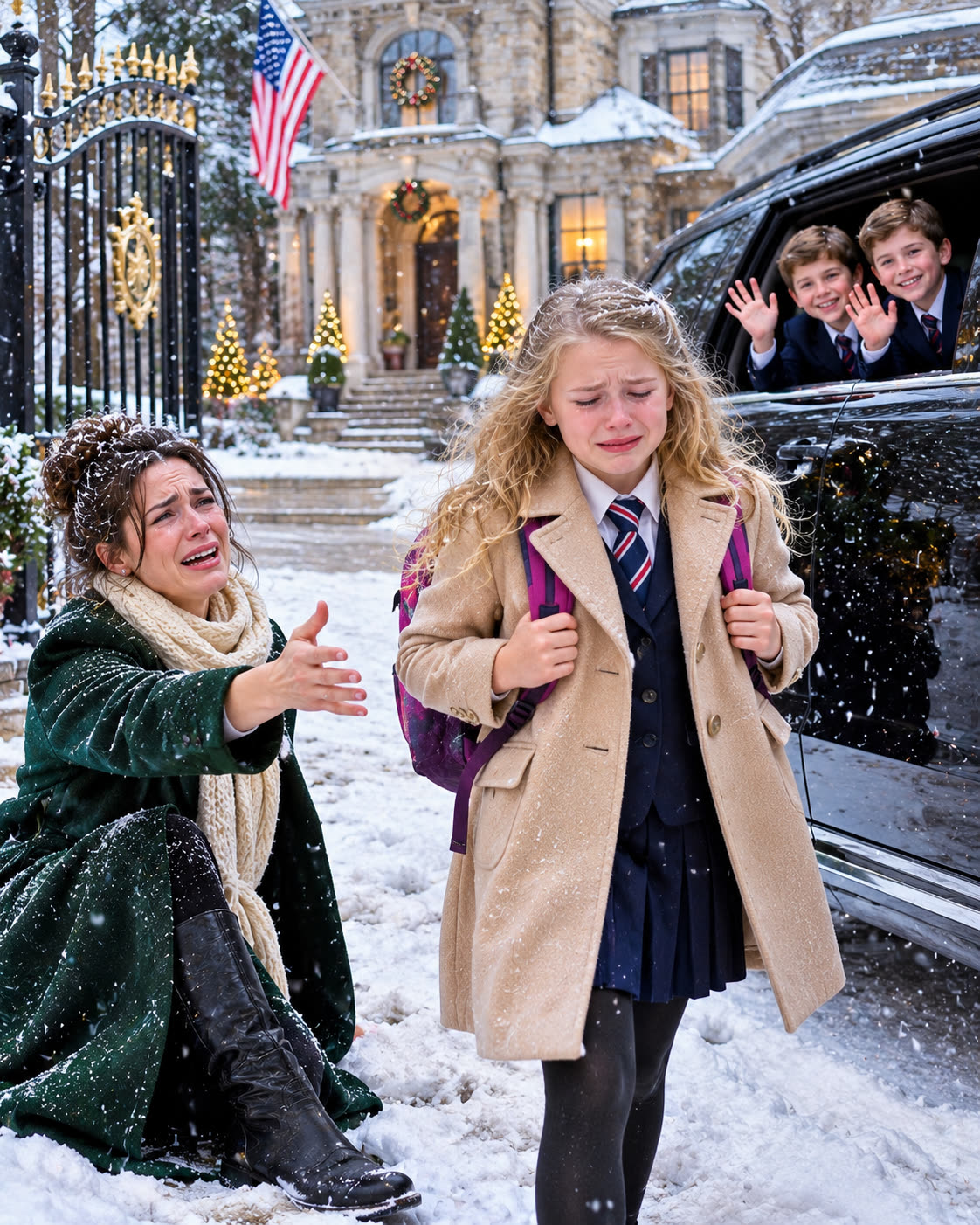
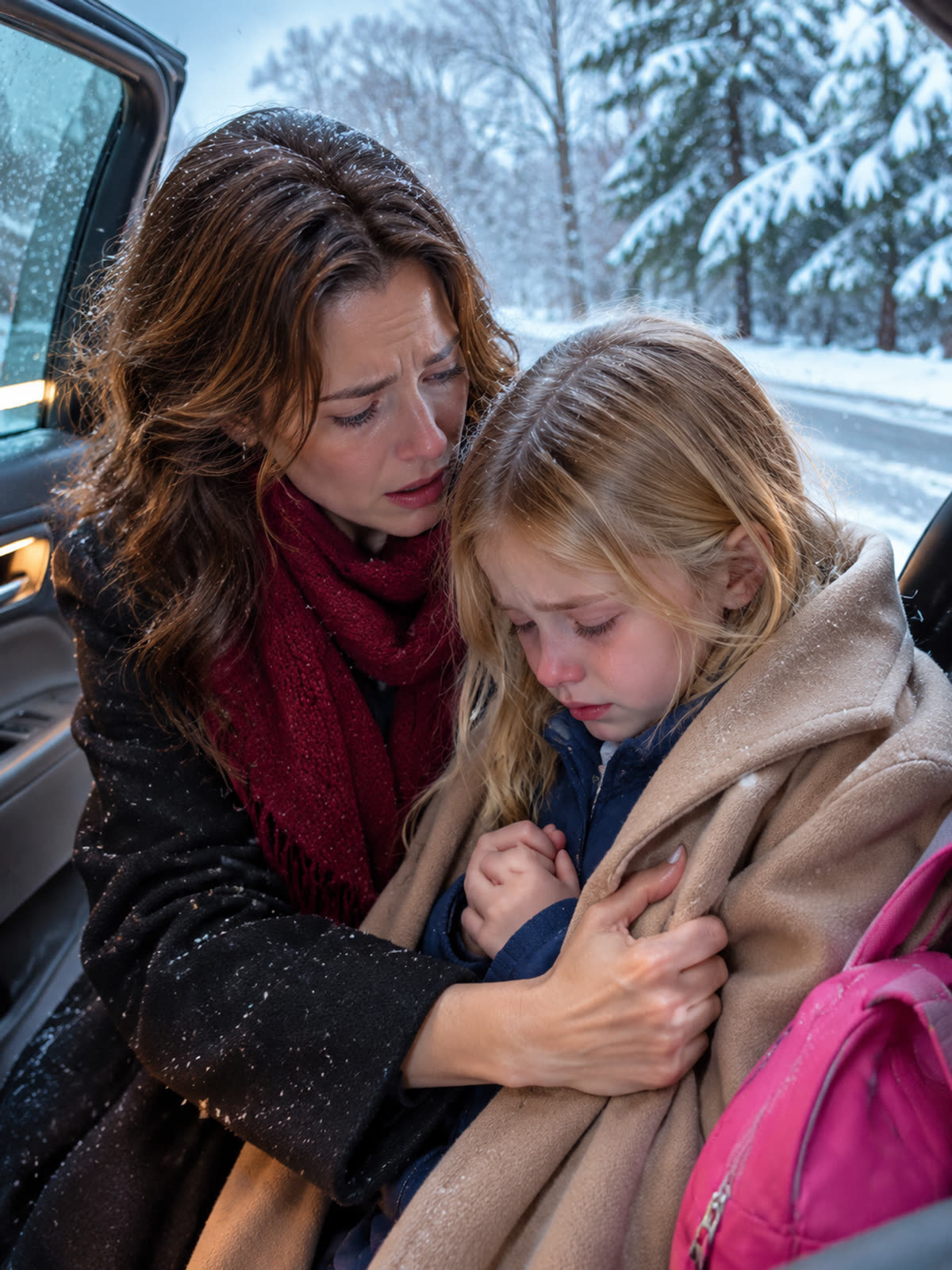
What caught my attention first was the bright pink backpack making its slow way through the falling snow. Then I recognized the face beneath it. My daughter, Harper, was walking beside a quiet road outside Columbus, Ohio. She was only nine. Her cheeks had gone pale, and she held her small hands tightly against her chest. The winter coat she wore offered too little protection against the cold. Snow clung to her boots, and moisture glistened on her eyelashes.
I stopped the car immediately. “Harper? Sweetheart, what are you doing out here?” She lifted her head, startled by my voice, and made an effort to smile. “Hi, Mom. I was just walking home.” For a moment, those words seemed impossible to understand. Walking home, in weather like this? She should never have been beside that road in the first place.
My parents’ house stood almost three miles from her school. I had left Harper with them the night before because an important meeting had kept me at work. My father had assured me he would take her to school that morning. Instead, I had found my little girl making her way through the snow, trying desperately to stay warm. The arrangement I had trusted to keep her safe had left her out in the freezing weather.
I took off my coat, wrapped it around her shoulders, and helped her into the car. “Honey, where’s Grandpa?” She hesitated before answering, and that small pause made the moment even harder to bear. “He drove Mason and Oliver to school.” Mason and Oliver were the sons of my older brother, Trevor. They had been given the ride my father had promised Harper.
“Why didn’t you go with them?” Tears gathered in her eyes. “I asked if I could sit in the back. Grandpa said there wasn’t room.” My father owned a large luxury SUV with three rows of seating. There had been more than enough space for another child. This had not been a question of finding room. There was room, and she had still been left behind.
Harper lowered her gaze to her cold fingers. “Uncle Trevor laughed. He said we should stop expecting everyone to do things for us.” I listened to my daughter repeat the words of a grown man who had watched her ask for a seat and had decided to laugh instead. My stomach tightened as the meaning of what had happened became impossible to avoid.
“And what did Grandpa say?” She swallowed before she answered. “He told me to know my place.” For a moment, I could not find anything to say. My father had not merely failed to help her. He had made her feel that asking for ordinary kindness was asking for something she had no right to expect.
The people who should have protected my daughter had treated her as a burden. She had needed warmth, a safe ride, and the reassurance that she belonged with her family. Instead, she had been left to walk through freezing weather while her cousins rode comfortably to school. Nothing about that was a lesson in independence. It was a child being made to feel unwanted.
What made it worse was something neither Harper nor the men who had hurt her fully understood. For years, I had been quietly protecting my father and brother from the consequences of their own decisions. They were comfortable dismissing us because they had never been required to face what their lives would look like without my help.
Beside me, Harper was still trembling beneath the coat I had wrapped around her. I could not stop thinking about her request to sit in the back of that nearly empty vehicle. My daughter had asked for so little. The people who had refused her had no idea how much I had sacrificed for them—or how completely that snowy afternoon had changed what I was willing to tolerate.
My name is Natalie Whitcomb. At thirty-seven, I was a divorced mother working as a corporate restructuring attorney. For six years, I had also been the largely invisible financial support behind my father’s construction company. Whitcomb Construction had survived difficulties that most people in our family knew little about, because I had continued stepping in whenever its finances threatened to collapse.
The business had originally been my mother Rebecca’s achievement. She had started with two employees, a small office, and a determination that seemed impossible to wear down. Through hard work and fair treatment of other people, she turned it into a respected company. After her death, my father, Walter, assumed control and soon made Trevor vice president.
My brother enjoyed the outward signs of success: costly vehicles, country club memberships, and opportunities to tell people how well he was doing. Managing the money behind that appearance interested him far less. Within two years, suppliers were pursuing late payments, equipment loans were becoming harder to service, and important contracts were in danger. I stepped in because watching my mother’s work disappear felt unbearable.
Every month, I put $8,700 toward the company’s loan obligations. I also supplied financial guarantees that helped preserve its access to credit. My father never acknowledged that support publicly. At family gatherings, Trevor received the praise for keeping the business alive. If someone asked about me, my father generally dismissed the subject with a shrug. “Natalie has a decent office job, but Trevor is the one with real business instincts.”
For a long time, I let those remarks pass. Keeping my mother’s company intact seemed more important than being recognized for what I contributed. But that afternoon, beside my shivering daughter, I saw the arrangement clearly. My father did more than take my assistance for granted. He believed he could keep depending on my money while treating my child without basic respect. I would not let that continue.
At home, I ran Harper a warm bath and prepared her favorite hot chocolate. Afterward, she curled up on the couch under a thick blanket, her stuffed rabbit in her arms. Then she asked something that almost made me cry. “Mom, did I do something wrong?” I sat down beside her. “Of course not, sweetheart.” Her next question hurt just as much. “Then why doesn’t Grandpa like me as much as Mason and Oliver?”
I drew her close. “You deserve the same kindness and respect as anyone else. What happened today was wrong, and you didn’t cause it.” She settled her head against my shoulder. “I just wanted to ride with them.” There was nothing extravagant in what she had wanted, nothing unreasonable to explain away. I held her until she drifted to sleep.
Later that night, my phone vibrated with a message from my father: You’re making too much of this. Children need to learn independence. Trevor followed with another: Harper is fine. Stop being dramatic. Neither of them asked whether she had been frightened. Neither asked whether she was warm or safe. I read the messages twice, then opened my laptop.
I began by canceling the automatic monthly transfer of $8,700. After that, I contacted the commercial bank and formally withdrew my voluntary financial support, subject to the terms of the existing loan agreements. Then I opened the folder of financial records I had retained over the previous three years. The company’s position had concerned me for a long time. Questionable expenses, unusual equipment transactions, and several loans all warranted closer scrutiny.
At 1:15 a.m., I called Benjamin, my longtime banking adviser. “Natalie? Is everything all right?” I gave him the answer I had finally reached. “I need to stop supporting Whitcomb Construction.” He went quiet. “Are you certain? Without your assistance, the bank may review the company’s entire credit arrangement.” I looked toward my daughter’s bedroom. “I’m certain. I can’t keep protecting people who refuse to treat my daughter with basic kindness.”
Benjamin sighed. “Then we’ll make sure everything is handled properly.” When I shut the laptop that night, something had shifted. For the first time in years, I did not feel that preventing my father’s next mistake was my responsibility. By seven the following morning, he had called fourteen times.
The fifteenth call came while I was making Harper’s breakfast. This time, I picked up. “Natalie! What have you done?” His voice was louder than I had ever heard it. “Good morning, Dad.” He rushed on. “The bank called! They’re reviewing our credit facilities, and they’ve suspended access to part of our financing!” I poured orange juice into Harper’s glass. “I withdrew my financial support.” His answer came immediately. “You can’t do that! This is a family business!”
PART 2 — The Business My Mother Built
“Then perhaps you should have treated my daughter like family.” My father paused, but the silence brought no understanding. “This is about yesterday? You’re putting an entire company at risk because a child had to walk?” I shut my eyes. Even after everything that had happened, he was still reducing Harper’s experience to an inconvenience I should have overlooked.
“Harper walked almost three miles in freezing weather because you refused to give her a seat in a nearly empty vehicle.” He offered the same excuse. “She needed to learn a lesson.” I answered him without softening what he had done. “She did learn something, Dad. Unfortunately, it was something no child should have to learn from her grandfather.”
His manner changed. “Natalie, listen. We can discuss this later. Just restore the payment.” “No.” The word left an immediate silence behind it. “What do you mean, no?” I made myself clear. “I mean I’m finished financing a business while you and Trevor treat us as though we don’t matter.” When he began arguing again, I ended the call.
Harper came into the kitchen in her school uniform. “Was that Grandpa?” I gave her a gentle smile. “Yes, sweetheart.” She watched me. “Is he angry?” I would not allow his problems to become another burden for her to carry. “He has some problems to work through, but those problems are not yours.” She nodded and reached for her toast. This time, I meant to keep that promise completely.
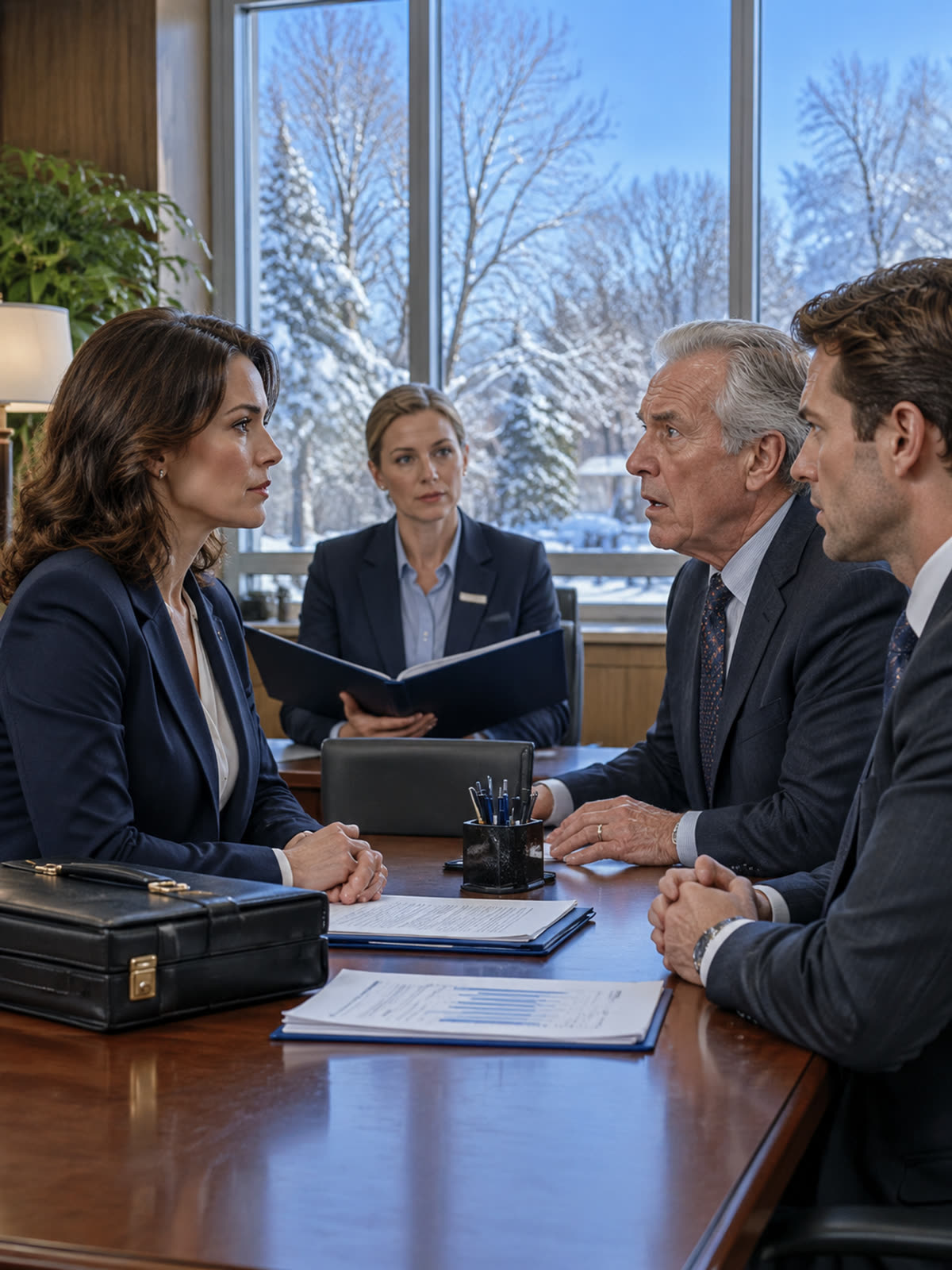
Three days later, I went to an emergency meeting at the bank. My father and Trevor were seated when I arrived. Trevor’s anger was plain. “You really think you can walk in here and take over?” I set my briefcase on the table. “I’m here because the bank requested my attendance as a guarantor and creditor.” Whatever he wanted to make of my presence, there was a reason I had been asked to attend.
Mrs. Ellison, the senior lending officer, opened a folder. The bank had identified inconsistencies in several loan applications. Equipment had been listed as collateral despite already being tied to other financial obligations. Income figures in other applications did not agree with the accounting records. These were not simply the overdue bills I had spent years helping the company manage. The underlying documents themselves raised serious questions.
Trevor moved uneasily in his seat. “Those are accounting errors.” Mrs. Ellison did not lose her composure. “They are significant discrepancies, Mr. Whitcomb. We need a complete explanation.” My father turned to me as though I could still make the difficulty disappear. “Natalie, tell them we can fix this.” I looked at the man who had dismissed my work for years.
“We may be able to save the company, but not by pretending these problems don’t exist.” I explained that Whitcomb Construction still possessed things worth protecting: valuable contracts, experienced employees, and customers who trusted the quality of its work. Its weakness was not the people doing those jobs. It was the absence of responsible financial management at the top.
I proposed an independent review, a restructuring plan, and a change in leadership. Trevor laughed at the suggestion. “You think you can run a construction company better than I can?” I did not need to answer him with a boast. “I think the financial records speak for themselves.” The same records that had brought us to that meeting made the need for change painfully clear.
My father stared at me. “You’re trying to take away everything I’ve built.” I answered quietly. “Mom built this company, Dad. I’m trying to make sure the people who work here don’t lose their livelihoods.” For once, he had no ready response. The business was not simply his pride or Trevor’s position. It was my mother’s work, and it supported people who had played no part in creating this crisis.
The weeks that followed were exhausting. Independent accountants went through the books while attorneys examined supplier contracts, loan agreements, and equipment records. With each review, the situation became harder to dismiss. What emerged was worse than I had anticipated when I first opened my own folder of records. The company’s financial problems extended beyond carelessness and bills that had been allowed to fall behind.
Trevor had obtained personal loans using misleading financial information. He had also drawn on company resources to support an expensive restaurant investment, Cedar & Ember. While money and attention went toward that venture, necessary business expenses were neglected. The bank passed the questionable personal loan applications to the appropriate investigators. Soon, the troubles my brother had concealed behind the appearance of success became public.
His expensive pickup truck was repossessed, followed by his speedboat. With no continuing financial support to sustain it, the restaurant investment failed. Eventually, Trevor entered bankruptcy proceedings and faced several civil claims. The things that had helped him look successful could not protect him from the obligations underneath them. My father watched the future he had imagined for his son come apart.
He was devastated. For years, he had treated Trevor as the future of Whitcomb Construction. Now the damage from that confidence was impossible to ignore. But my attention could not remain on their losses. Eighty-three employees relied on the company, including people who had been there when my mother was alive. Their mortgages, children, and families depended on wages from work they had continued doing.
I refused to make those employees bear the cost of decisions they had never made. Working with the bank, we put together a restructuring agreement. My father sold most of his remaining shares back to the company at a substantially reduced price to help satisfy creditors. He also made significant repayments and settlements connected with the company’s financial obligations.
Eventually, he left the six-bedroom house he had proudly displayed for twenty years. I took no pleasure in watching him lose it. There was no celebration in seeing the life he had valued become smaller. I had simply stopped placing myself between him and the consequences of his choices. Refusing to rescue him again was not the same as enjoying what happened afterward.
Taking responsibility for Whitcomb Construction felt nothing like being handed a prize. There were long evenings, difficult discussions, and financial reports that seemed endless. We sold luxury assets the company did not need and renegotiated contracts with suppliers. We also hired experienced executives who understood both construction operations and sound financial planning. Saving the business required competent management, not another quiet payment to postpone the next crisis.
Some choices were unpopular, and others were painful. Their purpose remained the same: keeping the company operating without making employees pay for someone else’s mistakes. At my first company-wide meeting, I told the staff exactly what I could offer. “I can’t promise that every day will be easy. But I can promise that your work matters, your paychecks matter, and your families matter. We’re going to rebuild this business the right way.”
Afterward, Patrick, a longtime site supervisor, came over to me. “Your mother would have been proud to hear that.” I nearly cried. For years, I had worried that I was failing her memory. Now I was beginning to see the difference between preserving her legacy and defending everything my father did. Honoring her meant protecting the values that had made the company worth saving.
Ten months into the restructuring, we had brought the losses under control. By the end of the twelfth month, Whitcomb Construction was profitable again. Expensive vehicles had not accomplished that. Neither had grand speeches about business instincts. The improvement came because capable people were finally able to do their work properly, supported by decisions intended to keep the business healthy rather than maintain appearances.
During that first year, my father tried to call Harper twice. Both times, he left emotional voicemails. In one, he said he missed her. In the other, he apologized and asked if she would visit. I let her listen to the messages once. She sat on her bed with her stuffed rabbit in her arms, quietly hearing the voice of the grandfather who had left her in the snow.
When the messages finished, Harper turned toward me. “Mom, do I have to call him back?”
PART 3 — Where She Belonged
“No, sweetheart. You don’t have to.” Harper had listened to her grandfather’s messages, but hearing an apology did not create an obligation to respond before she was ready. She looked at me and said, “I don’t want to talk to him right now.” I nodded. “Then you don’t have to. If you ever change your mind, we can talk about it together.” Her feelings were not something she needed to set aside for someone else’s comfort.
She put her arms around me. “Thank you for listening.” Those words mattered more to me than any success I could measure in a financial report. I had spent too much of my adult life hoping to win my father’s approval. I would not let Harper grow up thinking that kindness was a reward she had to earn, or that being loved required her to ignore being hurt.
I saved the messages privately in case she ever wished to hear them again, but blocked further direct calls to her phone. If my father wanted to pursue reconciliation, he could come through me when he was prepared to respect her boundaries. There was room for her feelings to change someday. Until then, preserving her peace mattered more than making a reunion happen.
Eighteen months after the emergency bank meeting, Whitcomb Construction posted its strongest quarterly performance in more than ten years. I sat in my office studying the report. Revenue had risen, debt was manageable, and throughout the restructuring, employees had received their wages on time. The company my mother had built was no longer being kept upright by the same cycle of hidden support and neglected problems.
For the first time in years, I could look at my mother’s photograph without feeling that I had let her down. I touched the wooden frame on my desk. “We did it, Mom,” I whispered. Saving her company had required me to stop protecting the people who were damaging it. What remained was a business with a chance to move forward on steadier ground.
That afternoon, I left the office early. Harper had entered a robotics project in her school’s science fair. For weeks, she had worked on a small machine capable of recognizing objects and moving them into different containers. Our dining room had been covered each evening with plastic pieces, wires, and notes she had written by hand. She had devoted herself to making the project work.
That morning, she had been nervous about what would happen when the judges saw it. “What if the judges don’t like it?” I had kissed her forehead. “Then you’ll still be the girl who worked hard, learned something new, and finished something she believed in.” Whatever the result, the work she had done and everything she had learned would still belong to her.
Now I waited outside the school in my black SUV. Light snow was falling. The doors opened, and children began hurrying toward the parents waiting to collect them. There was nothing unusual about the winter weather, yet seeing the snow brought back the image I could never entirely forget: a pink backpack, pale cheeks, and my daughter trying to walk home without enough protection from the cold.
Then Harper appeared. This time, she wore a bright red winter coat. In her hands was a gleaming gold trophy. She saw me and broke into a run. “Mom! Mom, I won!” I got out of the SUV just in time to catch her as she reached me. The frightened child I had found beside the road was nowhere in her face.
“You won?” She could hardly contain her happiness. “First place! The judges loved my robot!” I wrapped her tightly in my arms. “Oh, sweetheart, I’m so proud of you!” She laughed against my shoulder. “Mom, you’re squeezing me!” I loosened my hold, smiling through tears that had arrived without warning. Her face shone with happiness, so different from the little girl trembling in the snow eighteen months before.

We got into the SUV and turned up the heater. Harper carefully set the trophy between her feet. Beyond the windshield, snowflakes drifted through the afternoon. We drove without speaking for several minutes, comfortable in the silence. She was warm beside me, carrying home something she had worked hard to achieve. Then she broke the quiet. “Mom?” “Yes, honey?”
She drew a little circle on the fogged passenger window. “Do you remember when Grandpa told me I needed to know my place?” My grip tightened slightly on the steering wheel. “I remember.” Even after all the changes in our lives, those words could still bring back the hurt of that afternoon. Harper watched the snow beyond the glass. “I used to think he meant I wasn’t important.”
The familiar ache returned to my chest. “Harper, you have always been important.” She answered with a certainty I had wanted so much for her to feel. “I know that now.” Then she smiled. “I think I finally figured out where my place is.” I glanced toward her. “Where is it, sweetheart?” When she turned to me, her eyes were bright and peaceful. “Right here, Mom. With you.”
For a moment, I could not answer. I reached across the center console and squeezed her hand. The road ahead lay beneath a fresh covering of snow. She no longer had to compete for affection or wonder whether she was welcome in her own home. Her value would not be determined by someone else’s money, status, or belief in their own importance. I looked at her and smiled. “You’re exactly where you belong, sweetheart.”
Harper settled back in her seat with the trophy held close. As we continued through the quiet winter afternoon, I understood that saving my mother’s business was not my greatest accomplishment. That was sitting beside me. My daughter was warm. She was happy. She knew she was loved. Nothing I had earned, inherited, or lost could be worth more than that.
Family had taught me something I had resisted learning for years. Sharing a name does not guarantee kindness, and promises mean little without respectful actions behind them. Sometimes the very people we expect to protect us are the ones who make those truths most painful to recognize. Love cannot be measured simply by the roles people hold or the loyalty they believe those roles entitle them to receive.
No child should be left wondering whether there is a place for them at the family table. Being welcomed, protected, and valued should never depend on proving that they deserve it. A child does not need to be more useful, less sensitive, or easier to overlook before being entitled to care. The kindness Harper had asked for had always been hers to expect.
Generosity toward the people we love can be a beautiful thing. But it loses that meaning when it becomes an obligation that permits them to dismiss our feelings or exploit our compassion. Helping someone should not require surrendering the right to be treated with respect. Continuing to give is not always the kindest choice, especially when the giving allows harmful behavior to continue without consequence.
Strength is not demonstrated through control, money, or the appearance of success. It is shown in protecting the people who depend on us, including when that protection requires difficult decisions. There comes a point when preserving peace with people who repeatedly disrespect us causes more harm than setting a boundary. Recognizing that point can be the beginning of a healthier life rather than the destruction of a family.
Parents cannot spare their children every disappointment. What we can do is make home a place where their feelings are heard and where respect does not disappear when they are hurt. They should know that love is not conditional on keeping adults comfortable. Being listened to, understood, and supported can offer a security that no impressive house or bank balance will ever replace.
Financial stability brings opportunities and comfort, but it cannot substitute for someone who consistently shows up. Children remember who listens, who believes them, and who stands beside them when doing so becomes inconvenient. The safety of that bond does not come from grand declarations. It comes from knowing that their pain will matter to the person they turn to for help.
Forgiveness may become meaningful when responsibility is accepted and genuine change follows. Reconciliation, however, should never demand that someone sacrifice their well-being or their child’s sense of safety. An apology does not erase the need for boundaries. Respecting those boundaries is part of showing that the apology means something beyond wanting the consequences of the past to disappear.
The most valuable inheritance is not necessarily a business, a beautiful home, or money left in an account. It is the example we create through our choices and the care we show when someone needs us. My mother’s legacy had lived in the way she treated people. Protecting that legacy meant carrying those values forward, not preserving every arrangement that had grown around the company after she was gone.
Sometimes victory has little to do with proving another person wrong or recovering what was taken from us. It is watching someone we love discover that dignity, kindness, and belonging were never rewards they needed to win. Harper had reached that understanding. She was beside me, holding her trophy, certain at last that she had a place where she was wanted.
Behind us lay a family history of disappointment, difficult decisions, and lessons neither of us had chosen to learn. But ahead of us was something different.
Disclaimer: This story is a work of fiction inspired by real-life themes. Names, characters, places and events are fictionalized, and any resemblance to real persons is purely coincidental. Images are for illustration purposes only.
