

PART 1: The Jar That Would Not Break
Most people who have worn olive drab never battered through a reinforced doorway or searched a dark stairwell. We replaced broken leaf springs, brewed coffee in enormous urns, and hauled fuel over washboard roads that punished every bone. We counted supplies on oil-smeared clipboards so somebody else could pull a trigger. There is no shame in that work. It keeps an army alive. Every aging veteran waiting at a Midwestern hardware counter understands, whatever distant desert is stitched across their cap. So when a nervous gunman spotted my faded Desert Storm hat across a bank’s marble floor and sneered, “What’d you do over there, old woman? Wash windshields and grease axles?” —his guess wasn’t entirely mistaken. I had carried a twenty-four-millimeter wrench through my deployment, coaxing two-and-a-half-ton trucks across the dunes. “Two-and-a-halfs, mostly,” I told him, keeping my voice as level as an Iowa highway. “Some five-ton haulers when the transfer cases tore out.”
He gave a brittle chuckle, the sound of a man confusing a correct guess with complete understanding. To him, I was a tired grandmother with oil buried in her knuckles, harmless and easy to frighten. He considered the matter settled. What lay beneath the brim of my cap no longer interested him. He certainly never imagined what had happened after I came home. My name is Martha Hardy, although people around Kettle Ford have called me Marty since childhood. That Friday started much like the other mornings of my fifty-nine years: at five-forty, in our dim farmhouse kitchen, waiting beside an electric percolator whose rust outshone its finish. Beyond the frost-whitened gravel stood Hardy Diesel & Transmission. Farmers from four counties brought their machinery to that steel building because I charged for work actually done, and because I listened to a troublesome engine before reaching for a wrench.
At six, my husband, Adam, came downstairs wearing his navy Cedar Bend County Emergency Communications polo. He was forty-seven, twelve years younger than me, with steady gray eyes and the reassuring quiet of an anchor. Nearly twenty years behind a 911 console had taught him to hear danger underneath an apparently ordinary sentence. He stole a sip of my coffee and rested his forehead against my temple. “Ethan’s already awake,” Adam murmured. “He’s been sitting on the edge of his mattress since five.” Then he called toward the stairs. “Ethan! Don’t you leave that room without the glass!” Our son’s answer rang down immediately. “I’ve got both hands on it, Dad!” Then: “The jar doesn’t leave my sight!” The glass was a one-gallon pickle jar, its label scoured away, which had guarded Ethan’s savings for three years.
Every allowance quarter, abandoned nickel, and dime recovered from the sofa had gone into that jar. Ethan was eleven, skinny and all elbows, with questioning eyes and a consuming fascination with the sky. He wanted an equatorial refractor telescope on a weighted steel tripod, powerful enough to show Saturn’s pale rings like a clean brim around a golden ball. It cost three hundred and eighty-nine dollars. He believed he had saved about two hundred, and I had promised to match the machine’s count. Every other Friday I kept the shop closed until noon. Since Ethan was four, those mornings had belonged to us: the automatic wash on Fourth Street, a deposit at First Prairie Bank, then blueberry flapjacks at the diner. This time we were carrying three years of his patience along with the shop receipts.
The car wash mattered because it had once terrified him. At four, the swinging blue brushes seemed like river monsters, and the red and blue soap swallowing the windshield had sent him gasping. I had pulled him across the bench seat against my canvas jacket and whispered: “Look at me, buddy. When I give you the wink, you clamp your eyes shut. You hold your breath, and you count to ten inside your head. By the time you reach ten, the scary part is dead and gone. I promise you.” He had squeezed his eyes closed at my wink, and by ten we were always beneath the warm light of the dryers. That morning, red foam spread across the windshield while Ethan caught my eye in the mirror. I winked extravagantly. He rolled his eyes, then closed them anyway, silently counting.
“You’re ridiculous, Mom,” he announced when the dryers came into view. “Did the monsters get you?” I asked. He hugged the jar. “I was four,” he grumbled. “I’m practically in middle school.” Smiling, I steered toward Main Street. Adam and I had planned a different conversation for Ethan’s thirteenth birthday. Its carefully chosen sentences were written on yellow legal paper and locked in our bureau. He needed to hear the truth from me at our kitchen table, not receive a warped version from somebody talking over a fence. I had no idea those two remaining years were about to disappear. First Prairie Bank stood at Main and Third, a squat limestone building dating to 1961. Two narrow gray pedestals flanked the inside entrance. Most customers assumed they were ordinary antitheft gates.
A green coin-counting machine hummed near the windows. Three brass-framed teller stations lined the back wall, with the immense round vault door standing open behind them on its timed interlock. Gale Butler occupied window two. At sixty-one, her hair was silver, and her bifocals hung from a beaded chain. Nobody else in Kettle Ford still insisted on Martha. “Morning, Martha,” she said warmly. Her eyes creased when she saw Ethan. “And good day to you, astronomer. Is this the day Saturn comes to town?” He lifted his precious jar onto the counter. “Today’s the day, Miss Gale,” Ethan beamed. “Step right up, then,” she said. “The sorter’s purring.” He carried his savings toward the machine while I joined the line behind an elderly grain farmer and a young mother holding a toddler.
Forty feet separated us. At twelve minutes past nine, the entrance rattled, and heavy boots struck the tile. Someone drew a sharp breath. Then coins crashed over the stone with the hard, scattered noise of hail. I turned. A lean man in an oil-stained chore coat had twisted one fist into Ethan’s flannel collar and hauled him backward. A black semiautomatic pistol was pressed against my son’s head, just above his left ear. Beneath the radiator, the pickle jar lay on its side on a rubber mat, spilling a bright stream of quarters. The thick glass had survived its fall. Even now, I remember the thought that crossed my mind: that was the first thing to go right.
“Nobody twitch!” the gunman shouted. His dilated eyes flicked around the room. “Down on the floor! On your bellies right now, or this kid’s done!” Another figure slipped through the vestibule behind him, a teenager with a thin, uneven beard and hands shaking violently. He locked the glass doors and raised a short pump shotgun toward the ceiling. The young mother folded herself over her child. The farmer lowered his aching knees with a groan. I went down slowly, palms spread against the cold marble, keeping my chin high enough to watch the man holding Ethan. Tight skin stretched over his cheekbones. Beneath one ragged cuff I saw a faded tattoo, stylized wings flanked by numbers. His name, we would learn, was Brett Brannon.
“Tellers!” Brannon roared. “Clear those drawers! Green money only into the duffel! Johnny, drop the canvas!” The teenager lurched toward the counter and slapped down a black gym bag with a metallic rattle. Gale neither screamed nor ducked toward a concealed alarm. Her hands moved with thirty-one years of practiced economy, sweeping wrapped tens and twenties into the bag. Then her fingers passed beneath the lower tray of drawer two. She brought out a strapped bundle of twenties that looked ordinary except for its slightly greater thickness. Across the lobby, over the velvet ropes and the scattered coins, she looked directly at me. Thirty-one years passed between us in that single glance. Without hesitation, she placed the thicker bundle at the bottom of the duffel.
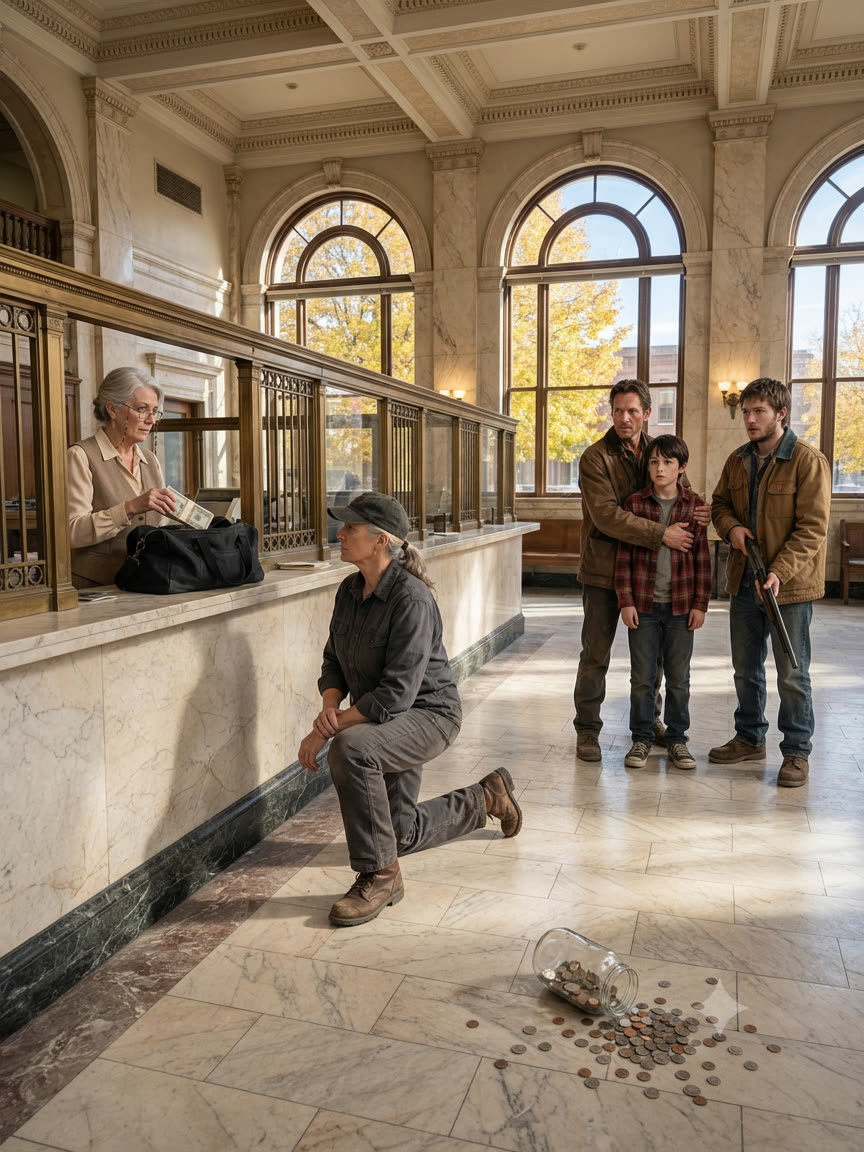
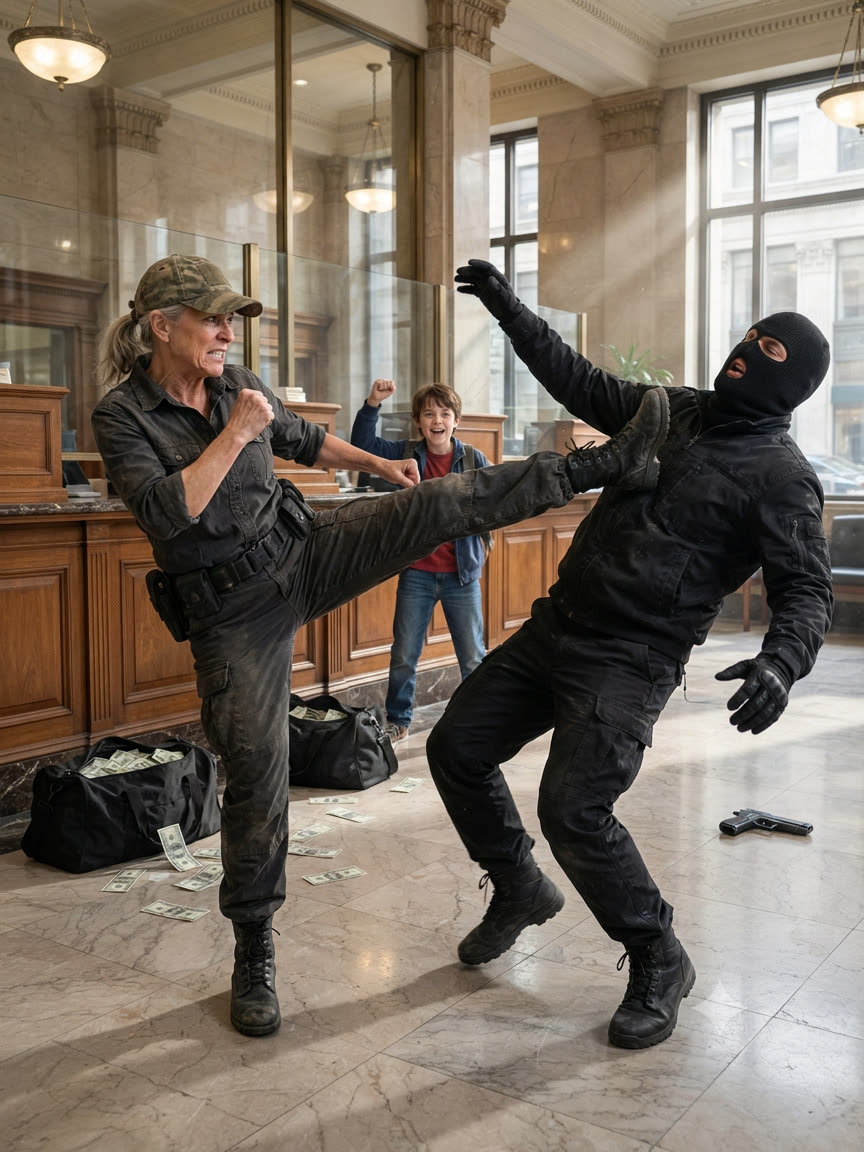
I gave her nothing in return that Johnny might notice—not a nod, not a raised eyebrow. But an old, cold strength stirred inside my chest. I recognized that package. In the damp spring of 1995, I had seen what the same chemical bait could do to skin. I remembered the burned-copper smell that clung to my cousin’s damaged hands. Brannon surveyed the people on the floor until his attention caught on the dull gold lettering of my cap. “Well, look at that,” he mocked, pulling Ethan tighter until pain crossed the boy’s face. “Desert Storm. What did you do, old woman? Wash windshields?” I kept my voice steady. “Two-and-a-halfs, mostly,” I answered. “Some five-ton haulers.” His contempt landed without moving me.
Brannon laughed sharply. “You hear that, Johnny? She adjusted carburetors while real soldiers took shrapnel in the dirt. Every small town’s crawling with you people. Wrenches and parade ribbons.” He advanced, dragging Ethan by his collar. His finger settled farther inside the trigger guard. At that moment, a county siren rose from the river bluff, two miles away, and his gaze snapped toward the windows. Arrogance gave way to the startled fury of an animal discovering the walls around it. Across town, in the enclosed quiet of the Emergency Operations Center, Adam adjusted his headset as Deputy Miller’s voice broke through the monitors. “Unit 12 to Dispatch. Running a 10-28 on a gray pickup parked on the south curb of First Prairie. Iowa tag: Echo-Bravo-Niner-Four-Two.”
Adam typed without stumbling. Nineteen years of fires, wrecks, and frightened strangers had trained his hands to keep moving. The registration appeared in 1.4 seconds. He pressed the transmit switch. “Unit 12, that tag returns to a 2019 Ford F-250, stone gray, registered to Martha Hardy, rural Kettle Ford.” He released the switch without telling the deputy that Martha was his wife, or that his eleven-year-old son was inside with a jar of coins. Then he removed his headset and faced his watch commander. “Take my board, Ray. My family is under the gun.” A block from the bank, beneath the Methodist steeple’s shadow, the sheriff’s department had turned a utility truck into a command post. Sergeant Clay Medley was bent over a clipboard when my name came through.
Clay stopped moving. Forty-four and heavyset, he had spent twelve years making his low, musical voice a dependable tool in a crisis. He lowered his pencil with extraordinary care. My name had carried him back thirty-one years, to an April night when he was thirteen. His father, Detective Herb Medley, had stood over their kitchen sink, scouring someone else’s blood from his arms with pumice. Exhausted and red-eyed, Herb had told him: “Son, tonight I watched an ordinary woman tear an armed lunatic apart from the inside using nothing but her bare voice and an old wrench. You give a woman like that room to breathe, or you end up burying everybody in the room.” Clay remembered the warning. Outside our bank, he would soon have to decide whether to trust it.
PART 2: The Name on the Radio
In 1995, I returned from the Persian Gulf to discover that our family homestead had been foreclosed. My father had died in a rented duplex while I was repairing trucks in the desert. Grief had hollowed me out, and anger filled the empty places. Eighty years of work had been reduced to entries in somebody’s ledger. Broke and furious, I allowed my cousin Nelson Pierce to persuade me to drive a flatbed getaway truck during a robbery at First Prairie Bank. He promised nobody would be injured. Inside, another man panicked and pressed a cocked revolver against the head of a twenty-four-year-old teller. Her name was Gale Butler. I was outside with the engine running. I could have released the clutch and disappeared toward the county line. Instead, I shut off the truck.
I entered with my empty, grease-stained hands raised and sat on the marble ten feet from the screaming gunman. For twenty-six minutes I kept talking. His mother’s vegetable garden. The miserable meals in the county jail. Anything that might keep him listening until exhaustion lowered his arm. When it finally did, I moved in, clamped my mechanic’s grip around the revolver’s cylinder, and carefully took the weapon away. Then I sat beside Gale and held her trembling hand until officers fastened cuffs around my own wrists. I refused a plea bargain and accepted eight years at the women’s prison in Mitchellville. Gale attended every parole hearing to ask for my release. Herb Medley visited monthly, bringing heavy-diesel transmission manuals. When I walked free in 2003, he had arranged a starting position at an engine shop.
Two winters before the bank robbery with Ethan, I had helped carry Herb’s cedar coffin through the frost. Those were the things his son remembered inside the command truck. The metal door banged open, and Lieutenant Kurt Cox climbed in smelling of fresh tactical nylon and gun oil, impatient to act. “We have two suspects, minimum six hostages,” he announced, spreading a building plan across the table. “My breachers stage at the rear service entrance. Linear shaped charges on the hinges, diversionary flash-grenades through the drive-up teller tube. We hit them in under fifteen minutes before the primary suspect consolidates.” Clay’s answer was cold. “No,” he said. Cox stared. “Excuse me?”
Clay lifted the radio. “All units on the perimeter, this is Medley. Hold your positions. Do not deploy charges on those entryways. You will only get in her way.” Cox’s patience broke. “In whose way?” he snapped. “The woman on the floor? Martha Hardy? You’re telling me to compromise an assault for an elderly female hostage?” Clay did not retreat. “She isn’t an obstacle, Lieutenant,” he replied. “She is the only person in that room who knows how to defuse this bomb without setting it off.” Cox jabbed at a department tablet, searching my record. Within seconds, an amber entry filled the screen: ARMED BANK ROBBERY – CONVICTED 1995.
An unpleasant smile spread over Cox’s face. “Are you out of your mind, Medley? She robbed this exact bank! For all we know, she’s orchestrating this entire circus from the inside!” Before Clay could reach him across the table, Cox raised his lapel microphone. He selected an unencrypted regional frequency, one the county had repeatedly warned him against using. “All tactical elements, be advised. Hostage identified as Martha Hardy is a convicted felon with a 1995 armed robbery at this specific target. Treat the subject as an active co-conspirator until fully cleared.” Inside First Prairie, Brannon’s phone lay face-up near the coin machine. Its scanner application was tuned to local emergency traffic.
The little speaker delivered every word with terrible clarity: “…Martha Hardy is a convicted felon with a 1995 armed robbery at this specific target…” Silence swallowed the lobby. Brannon stopped, then slowly turned toward me with a smile that made my stomach tighten. “Well, well, well,” he whispered. “A grease monkey? You’re a bank robber, Grandma. You’re one of us.” He dragged Ethan until they stood scarcely six feet from my knees. The pistol stayed buried against my boy’s dark hair. Ethan’s face had gone colorless, his mouth trembling with a bewilderment that hurt worse than any weapon. “Go on,” Brannon taunted, pushing his head with the sights. “Ask her, kid. Ask your mother what she really fixes.”
I looked past the pistol into Ethan’s eyes. The thirteenth birthday, the kitchen table, our carefully written yellow pages—all of it was gone. “Ethan,” I said, keeping my breathing even. “When I was twenty-eight years old, I made a terrible, cowardly choice. I drove a truck for my cousin while he and another man walked in here with weapons. Someone got hurt because of what I helped do. I served eight years in a state prison cell for it. Your father knows every detail. Miss Gale knows. We wanted to tell you when you were older. I am so deeply sorry you have to hear it like this.” His chest jerked. Tears tracked down his dusty cheeks. “Mom… is that true?”
“It’s true, Ethan,” I said softly. Brannon tipped his head back and barked out a laugh. “Hear that, boy? Your sweet old mama is a crook! She’s no better than me!” I interrupted without giving him a reason to tighten his finger. “I was a fool,” I said. “And I wasn’t nearly as thorough as you. I didn’t think to bring a scanner.” His expression faltered. His shoulders eased a little. Praise offered him something he could not resist. “Damn straight,” he sneered. “So you’re going to keep me from making your mistakes. How’d you drop the ball, old woman?” I gave him a smooth lie. “We panicked,” I said. “We tried to hurry. A man lost his nerve, grabbed a hostage, and stopped listening to the room. The money isn’t worth a damn if you leave in a pine box.”
He considered that, then pointed toward the round vault entrance. “The vault,” he snapped. “Why isn’t that pig behind the glass opening the inner cage?” I indicated the flashing keypad with my stained thumb. “Because it’s locked on an electronic delay,” I told him. “Ten minutes minimum. You can put a hole through the manager’s lung and that door won’t budge one second faster. It was designed specifically to run out a thief’s clock.” Brannon swore and pulled Ethan toward the counter. He struck Rich Lamb, the manager, across the ear with his pistol, making the sobbing man enter the override. The red indicator changed to a slow amber blink. Then the brass counter telephone rang.
Brannon tore up the receiver. “Yeah?” A calm voice came through loudly enough to carry across the room. “This is Sergeant Clay Medley,” it said. “I’m here to ensure everyone walks out of this alive. Who am I speaking with?” Brannon stiffened. “You’re talking to the man holding the cards,” he snapped. “And here’s my terms: you get that gray Ford pickup out front fueled up. Hardy drives. If I see a single sniper on the rooftops between here and the bridge, I drop the boy right through the plate glass.” Clay answered immediately. “Let me talk to Martha,” he said. Brannon shoved the receiver toward me while keeping his gun trained against Ethan. “Say your piece, Grandma. Make it quick.”
I accepted the warm plastic. “Clay.” His voice softened. “Marty,” Clay breathed. “We hear you. Adam is right here beside me. What do you need?” I measured every word. “Tell Adam the pickle jar didn’t break,” I said. “Tell him Ethan’s savings are safe on the rug.” Silence stretched between us. “I’ll tell him,” Clay replied softly. I continued before Brannon lost patience. “And Clay? Miss Gale did her bookkeeping this morning. Just like she always does. Everything’s in the canvas. Give us room at the threshold. Lots of room.” Clay understood. “Understood, Marty. Lots of room.” Brannon snatched the telephone away and slammed it into its cradle.
Johnny stood near the teller gate with the shotgun clutched like a floating board in deep water. His whole body trembled. “Johnny, bag the vault boxes the minute that timer trips,” Brannon ordered. “I’m checking the alley.” He shoved Ethan against the teenager and vanished down the rear corridor. As soon as his boots reached the utility tiles, I turned my attention to Johnny. He breathed through his teeth, eyes glassy with fear. “Johnny,” I whispered. The muzzle swung uncertainly toward me. “Don’t you talk to me! Shut up!” I used the same low, steady voice I used beside Ethan’s bed when fever frightened him. “How old are you, son?” I asked. “Nineteen? Twenty?” His throat moved. “Nineteen.”
“My cousin Nelson was twenty-two when he stood in this bank,” I told him, watching his hands. “He told our friend Terry Kendrick that we’d all be drinking cold beers across the state line by sundown. When the deputies arrived, Nelson crawled out a coal chute and left Terry alone in this lobby. Terry did twenty-two years in Fort Madison. He died six months after his release in a boarding house. Nelson didn’t even send flowers.” Johnny’s chin shook. A tear slid from his lashes onto his denim collar. I leaned forward only an inch. Brannon was still out of sight, but every moment of that absence belonged to a clock I could not stop.
“Brannon’s on his mobile back there,” I whispered. “He’s talking to the woman in the green pickup who drove off ten minutes ago. He isn’t planning on you riding in my truck, Johnny. There are only two seats in an F-250 cab that matter today. The driver and the man holding the shield.” His answer came strangled with emotion. “He’s my blood,” Johnny choked out. “Terry was my blood too,” I said. “Look at me, son. I’m not asking you to fight him. I’m asking you to make a choice that lets you see your mother again. That pump-gun has three rounds in the magazine. You can ease that slide back, drop the brass into your coat pocket, and nobody in this room will ever know but you and me. You can be the scared kid who made a mistake, or you can be the monster who pulled a trigger on an eleven-year-old. Decide.”
Brannon’s footsteps sounded in the corridor. Johnny froze, his expression emptied by terror. Then his hands began to move with desperate care. He covered the shotgun’s ejection port, worked the fore-end, and slipped the heavy red shells into his coat pocket. One escaped his shaking fingers and fell into the dark soil of the rubber tree beside the counter. The boy closed the action. Brannon returned, his jaw rigid. “Vault’s green! Pack it, Johnny! It’s twelve-twenty-nine. We move right now!” Ethan was back in his grip. My son looked down at me, his face drawn with an anguish no child should have to carry.
“Mom,” he whispered, his voice breaking. “Are you going to let him take me?” I rose from the marble. At six feet tall, with my heavy boots firmly planted, I finally stood at my full height before the man who had mistaken quiet for weakness. I looked directly into Ethan’s eyes. There was no room left for our prepared explanations, no chance to promise him that every part of what came next would work. I did not speak. Instead, I gave my son one slow, deliberate wink.
PART 3: Ten Seconds and a Red Quarter
Ethan closed his eyes at once. His face tightened exactly as it had beneath the car wash brushes when he was four. He drew a great breath, held it, and began moving his lips in silence: One… two… three… Across Main Street, Adam crouched behind a patrol cruiser’s steel fender and lowered his binoculars. His breath snagged. “He did it,” Adam rasped into the command van’s microphone. “She gave him the signal. Medley, hold your people! Hold them for ten seconds!” Cox seized Clay’s shoulder. “What the hell are you talking about? The door is opening! Marksmen, take your—” Adam shouted over him. “Clay!” he roared. “Give her the ten!” Clay keyed the priority frequency. “All tactical units, stand down! Hold fire! Count with me! One!”
Inside the entrance, I closed my fingers around the exterior door’s brass handle. Brannon stood directly behind me, his pistol tucked below Ethan’s ear. The black duffel hung high on his right shoulder, close against his collarbone, while his left arm locked around my son’s neck. Johnny followed two steps behind with the unchambered shotgun lowered and his eyes on the floor. Two. We passed through the doorway. The nylon bag moved between the slender gray pedestals. Those posts were not clothing-store security gates. They transmitted a radio signal linked to the bank’s security system. Lifting the bait bundle from its magnetic tray had armed its circuitry. Passing between the posts supplied the signal for its chemical fuse to begin.
Three. I stepped onto the sidewalk. Cold autumn air struck my face, smelling of dry cornfields beneath the low rumble of sixteen police cruisers blocking Main Street. One long stride brought me clear of the doorway. Then I stopped, heels planted hard against the concrete. “Keep moving, you old bat!” Brannon snarled near my neck. Four. I held my ground, widening my stance and settling my weight. Behind me, he began screaming toward the barricades. “You back those rigs up right now! You clear this street or I swear to God I’ll paint this whole sidewalk with the kid’s—”
Five. The duffel erupted. This was not a conventional explosive. Tear gas and scarlet dye burst from the bag around a fiercely hot ignition pellet. A red plume blasted through the zipper inches from Brannon’s open mouth, and he inhaled in the middle of his threat. Chemical smoke struck his eyes. Heat burned through his coat at the shoulder. His words vanished into a choking howl as the dye blinded him. Six. His gun hand jerked. Instead of turning toward Ethan, it moved toward his own face. I had already begun to turn.
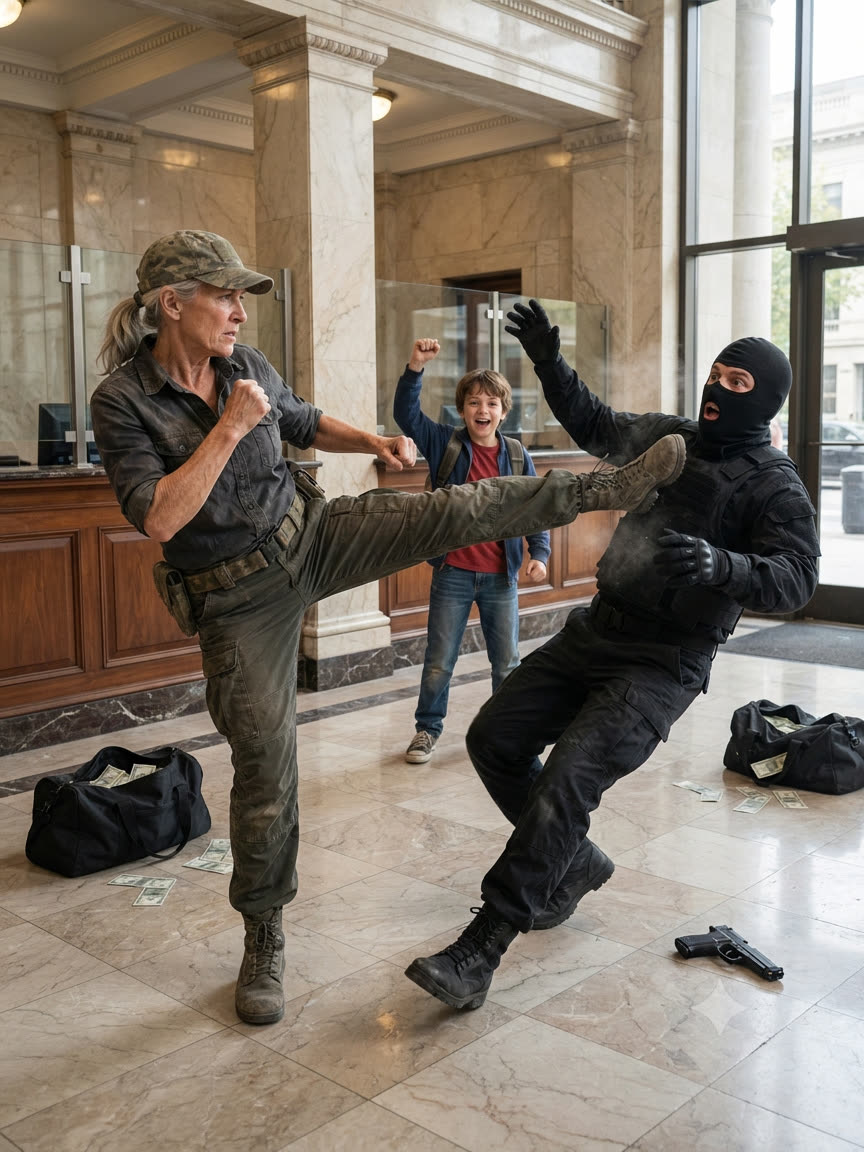
Decades of freeing seized bolts and frozen combine fittings went into my grip. I pivoted on my left boot, drove both palms upward, caught his right forearm, and forced it away from Ethan. The pistol fired with a deafening CRACK. The bullet struck the bottom concrete step. I kept moving, pulling his arm down across the open door’s steel push-bar with all one hundred and eighty pounds behind the motion. Bone broke. The pistol fell from his hand and clattered onto the pavement.
Seven. Shock loosened Brannon’s other arm. Ethan slid down against his hip and landed on his knees on the welcome mat, still holding his breath, still keeping his eyes tightly shut. His lips continued their little movements: …seven… eight… I swept my boot behind him and drew him back behind my legs. My body stood between my son and the man who had carried him toward the street. Red smoke rolled around the doorway, obscuring the glass and spilling into the clean autumn air.
Eight. Brannon lunged blindly, dye running down his face, his uninjured hand scraping through the air. I stayed where I was. My right elbow rose from my hip with the same committed strength I used on a stubborn tractor hub. It caught the hinge of his jaw. His head snapped sideways. His eyes rolled upward, and he fell face-first across the stained threshold, suddenly loose and empty. I dropped my knee between his shoulder blades and held him against the stone.
Nine. Behind us, Johnny threw the shotgun onto the vestibule floor. He interlaced his fingers over his head and lowered himself onto his stomach beside the potted tree. The nineteen-year-old who had entered carrying a weapon was crying openly into the dust. Ten. Ethan opened his eyes. Scarlet smoke drifted through the sunlight over Main Street. The man who had held him lay helpless beneath me. And my son saw my hands, stained red to the elbows. Thirty-one years earlier, that same color had covered them.
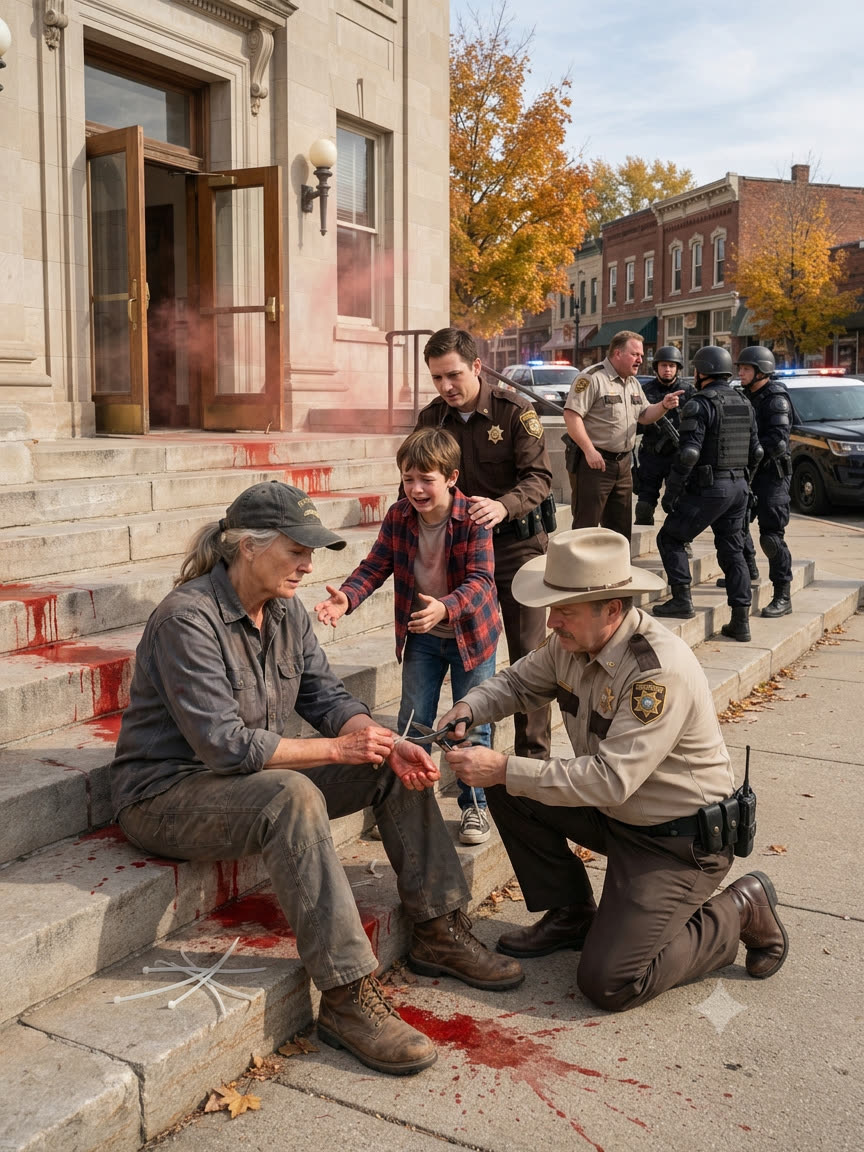
“Ethan,” I breathed, my chest laboring, tear gas sharp above the grease on my collar. “The scary part is over.” Before the smoke could disperse, six tactical officers rushed the steps in black armor, weapons raised, their overlapping commands drowning the street. Two struck me from the side and drove me off Brannon onto the slick concrete. A boot pressed into my ribs. My arms were pulled behind me, and plastic restraints cut into my wrists. For the second time in my life, officers had pinned me to the steps of First Prairie Bank.
Ethan screamed and struggled against the deputy lifting him from the pavement. “Let her go! She stopped him! Mom!” Clay charged across Main Street with a speed that seemed impossible for his size. “Get those cuffs off her!” he roared. He shoved an armored officer backward by the chest plate. “Cut those damn ties right now!” Clay bellowed. “That woman just saved every life in this facility! Cut them!” Sheriff Alan Duncan reached the curb with fury draining the color from his face. He opened his pocketknife and sliced through the straps. Slowly, I sat up and rubbed my raw, red wrists.
The hostages emerged through the thinning haze. Rachel Little held her sleeping child. The elderly farmer leaned on the delivery driver. Rich Lamb pressed a bloodied cloth to his injured ear. Gale came last, her bifocals still hanging safely from their beads. She descended the steps without speaking and sat beside me on the curb. Her clean, lined fingers closed over my stained hand. Shoulder to shoulder on the concrete, we were back in an April afternoon in 1995. A moment later Adam broke through the perimeter tape. He gathered Ethan with one arm, dropped to his knees, and pulled both of us against him. His heart beat so hard I felt it through my collarbone.
Ethan buried his face against my shoulder. When he finally drew back, his eyes searched mine with questions he could not yet ask. He looked at my crimson palms. He held my hand, but he said nothing. That silence followed us home and stayed for nine days. He ate his oatmeal, answered with small polite sounds, rode his bicycle to school, and withdrew to his room. He lay there staring at the ceiling. Adam told me to give him space. I did, although leaving that space open hurt more than any labor I had known. It was harder than prison. Harder, in its own way, than bringing an armed man down.
On the ninth evening, the sun sank over the western bean fields like a copper coin. Long shadows lay across the gravel outside Hardy Diesel. I sat on the lowered tailgate of my truck, cleaning soot from a valve cover, when sneakers crunched toward me. Ethan climbed up beside me, hands deep in his coat pockets. For ten minutes, we watched dust drifting over the county road. “Why didn’t you tell me, Mom?” he asked, scarcely louder than the crickets. I put the rag down. “Because I was ashamed, Ethan. And because I wanted you to know who I was now before you knew what I had broken back then. I wanted you to have eleven years of love to weigh against one terrible, stupid afternoon.”
Then I told him everything, without excuses and without sanding down the ugly edges. I described the farm crisis of the eighties, the foreclosure that had taken his grandfather’s land while I drove convoys in Iraq, and the bare rented room where my father had died. I explained how anger can spoil judgment until a robbery begins to sound like fairness. I told him about Nelson, about the wild fear in Terry Kendrick’s eyes, and about Gale with a gun against her head. I spoke about prison laundry and the passing Sundays I had counted from a steel bed. Ethan listened without looking away from the horizon.
When I finished, he lowered his eyes to his boots. “Were you scared? At the door?” I gave him the truth. “I was more terrified than I have ever been in my entire life,” I confessed. He nodded, then met my eyes with his gray ones. “When you winked at me… did you know the plan would work?” Pink dye still clung around my cuticles when I reached over and brushed the hair from his forehead. “No, Ethan,” I whispered. “I didn’t know if the smoke would fire. I didn’t know if the gun would jam. But I knew you would count to ten.” His breath escaped unevenly. For the first time in nine days, he rested his head against my shoulder.
Brannon spent nine weeks with his jaw wired shut. Federal charges for armed robbery, kidnapping, and firearm offenses ended in a plea agreement: thirty-eight years without parole. Johnny Stokes received five years in a minimum-security prison. His sentence was reduced after the judge read my four handwritten pages describing a frightened teenager who had chosen to empty his gun into a plant rather than shoot my son. I could not erase his part in what happened. I could tell the court about the moment when, with every reason to be afraid, he had made a different choice.
Cox received a thirty-day unpaid suspension for broadcasting over the open channel. In late June, he appeared at Hardy Diesel in civilian clothes. For five awkward minutes he stood beside my tool chest before finding his words. “I misjudged you, Mrs. Hardy.” I threw him an oily rag. “You judged me by 1995, Lieutenant. You weren’t wrong. You were just thirty years late.” There was no version of my life in which the conviction disappeared. There was only everything that had happened since, the work and the years that no database entry could make room for.
The bank had to replace its coin sorter. Red dye had fouled its internal gears beyond repair. The pickle jar, however, had not acquired so much as a scratch. In late May, Ethan and I carried it through the double doors again, past the two gray posts, and placed it on Gale’s counter. She counted the coins herself, smiling as she worked. Two hundred and seventeen dollars and sixty-three cents. I matched the total immediately. That afternoon, an envelope arrived from the county seat. An anonymous seed dealer had enclosed a check and asked to cover the rest.
The telescope came during June’s second week. On the first cloudless evening, Ethan and I set its steel tripod behind the shop bays. We aimed the brass-trimmed tube southward and adjusted the little screws until the pale golden planet sharpened. Saturn’s rings were there, bright and clean, a magnificent unbroken brim. For three years, that was what the jar had promised him. Now the glass was empty, and the thing he had imagined lay clear before his eye.
After he fell asleep, I went into his room to straighten his quilt. A different jar stood on the dresser: a small peanut butter jar with its label washed away. At the bottom rested one quarter. Its surface carried a permanent red stain, the color of the smoke that had opened our path out of the bank. When my fingers touched the glass, the coin shifted and rang against it like a tiny bell. He had saved that one. After all the counting, all the silence, and all the questions, that was the coin he had chosen to keep.
I still wear my faded Desert Storm cap beneath the lift. The chemical smoke never quite washed out of its brim. People like to believe a title explains an old soldier, but a label usually records only what somebody thought they understood. An unbroken jar, ten seconds counted with closed eyes, and thirty years spent answering for one afternoon tell a fuller story. Yet standing beside Ethan’s dresser, looking at the red quarter, I could not know which part of mine he would remember—and which question he would ask me next.
Disclaimer: This story is a work of fiction inspired by real-life themes. Names, characters, places and events are fictionalized, and any resemblance to real persons is purely coincidental. Images are for illustration purposes only.
