

The message arrived while I was stuck in traffic on I-25.
The Denver afternoon sun was blazing off the windshield in a harsh glare. My hands stayed on the steering wheel. On the passenger seat sat a small gift bag with silver seashell earrings inside.
I had picked them out for my mother to wear on the cruise.
The cruise I paid for.
The cruise I organized for half a year.
The cruise I funded with my bonus because I believed one perfect family trip might finally make me feel like I belonged.
Then my phone buzzed.
Mom.
I smiled before opening it.
Then I read seven words that turned my blood cold.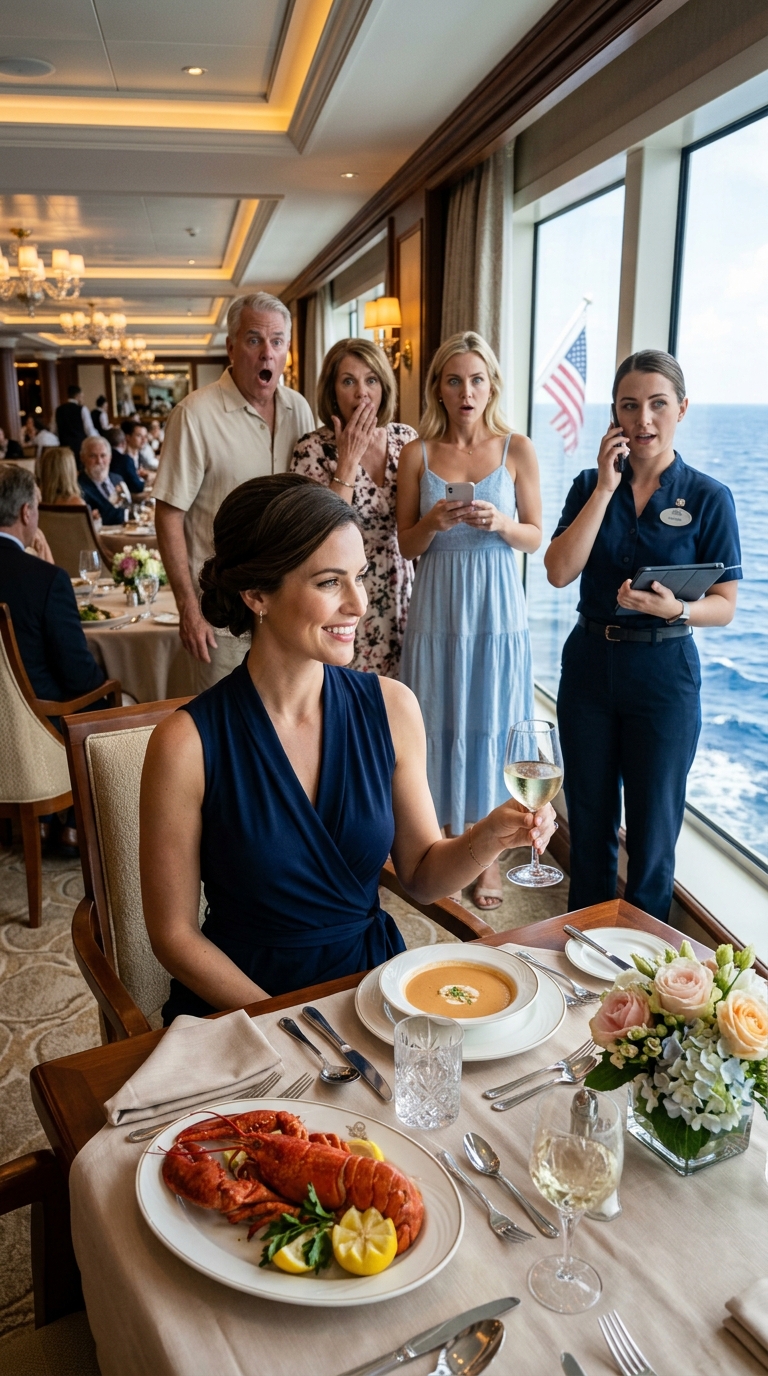
“You’re not coming. Dad wants just family.”
That was all.
No apology.
No call.
No explanation.
Just a short sentence that erased me from the trip I had paid for.
I stared at the screen until a horn blared behind me. The light had already changed. I pressed the gas, but my hands were trembling so badly I could barely hold the wheel steady.
Dad wants just family.
Just family.
So I wasn’t family when everything had already been booked.
My name is Millie Miller. I’m thirty-three, and for most of my life I believed being loved meant being useful.
I was the dependable one.
That’s what they always called me.
When my younger sister Vanessa needed tuition after dropping out, I covered it.
When Dad’s construction company failed, I paid the bills.
When Mom sat at the kitchen table crying over overdue notices, I drained my savings before I even understood what resentment felt like.
Every crisis became mine.
Every mistake somehow landed on me.
And every time I helped, they told me I was “good with money,” like exhaustion was a personality trait and not survival.
So when Mom casually mentioned over dinner that she’d always wanted a real family cruise, I gave in.
Of course I did.
Dad said cruises were too expensive while staring at his plate.
Vanessa said it would be nice to “escape stress.”
Stress, apparently, meant avoiding job applications and watching TV.
I knew what it was.
Some part of me always knew.
But the version of me that still hoped for a family ignored it.
So I said, “Let me handle it.”
And the atmosphere changed instantly.
Mom smiled.
Dad patted my shoulder.
Vanessa called me the best sister ever.
For that one night, I felt like I mattered.
I should’ve recognized it.
It was a receipt.
The total came to $21,840.
Six tickets. Balcony rooms. Dining upgrades. Wi-Fi. Drink packages. Excursions across the Bahamas, Mexico, and Jamaica.
I booked everything.
I paid for everything.
I even ordered matching navy polos that said Miller Family Cruise 2025 because I pictured a single ridiculous photo on the deck.
A real family picture.
Something I could frame.
Something that would prove I wasn’t imagining all my effort.
Then Mom texted me that I wasn’t invited.
When I called, she sent me to voicemail.
Dad did the same.
Vanessa too.
Then I noticed the group chat was gone.
Not muted.
Deleted.
They had made a new one without me.
Later that night, my cousin Sarah sent a screenshot.
Miller Cruise Crew.
Vanessa was wearing one of the shirts I had paid for.
Her caption read, “Got our cruise swag. So excited for a drama-free trip. Thank God Millie decided she was too busy with work to come.”
Too busy.
That was the story.
They hadn’t excluded me.
I had simply “opted out.”
They were taking the vacation I funded and rewriting me as the problem before the ship even left.
I stayed up until sunrise with every booking confirmation open on my laptop.
Billed to Millie Miller.
Cardholder: Millie Miller.
Email: Millie Miller.
Every balcony room.
Every upgrade.
Every detail.
My name was everywhere.
That was when something shifted.
They thought I stopped mattering after payment.
They forgot the payment still belonged to me.
At 8:01 the next morning, I called the travel agency.
Brenda answered.
“Thank you for calling Oceanic Getaways. How can I help?”
I gave her the confirmation number.
She pulled up the file.
“Looks like a beautiful family cruise,” she said.
I nearly laughed.
“It was supposed to be,” I said. “I need to make changes.”
First, I canceled the dining packages.
All of them.
Then the drink packages.
Then Wi-Fi.
Then excursions.
Snorkeling. Ziplining. Private beach cabanas.
Canceled.
Refunded.
Removed.
Then Brenda asked if I needed anything else.
“Yes,” I said. “I need to reassign cabins.”
A pause.
“What kind of reassignment?”
“The five balcony rooms under Richard Miller, Susan Miller, Vanessa Miller, Brandon Smith, and the other guests. Move them to the cheapest interior cabins available.”
Another pause.
“The lowest category?”
“Yes.”
“I have deck two available,” she said carefully. “No windows. Near the engine section.”
“That works.”
“And your suite, Miss Miller?” she asked. “Should I cancel it?”
I looked out at the sunrise.
“No,” I said. “Keep mine.”
For the first time in a day, I smiled.
“I’ll still be going.”
Two weeks later, I boarded the ship alone.
Not hiding.
Not ashamed.
Alone.
My penthouse suite was larger than my first apartment. Marble bathroom. Private balcony. Champagne waiting. A welcome note addressed to Miss Miller.
For the first time, something I paid for belonged entirely to me.
I didn’t see them the first day.
But on the second night, I walked into the buffet and spotted them near the dessert station.
They looked drained.
Dad’s jaw was tight.
Mom looked exhausted.
Vanessa was complaining under her breath.
Then Mom saw me.
She froze with a fork halfway to her plate.
Dad followed her gaze.
Then Vanessa turned.
For once, no one spoke.
I sat by the window, ate slowly, and smiled.
They approached like a storm building.
Dad spoke first.
“What are you doing here?”
I wiped my mouth.
“I’m on vacation.”
Vanessa’s eyes dropped to my wrist.
My gold suite band.
Then to her cheap blue one.
Understanding hit her face.
I stood up calmly.
“Well,” I said, picking up my plate, “enjoy your dinner.”
That night, they tried the steakhouse.
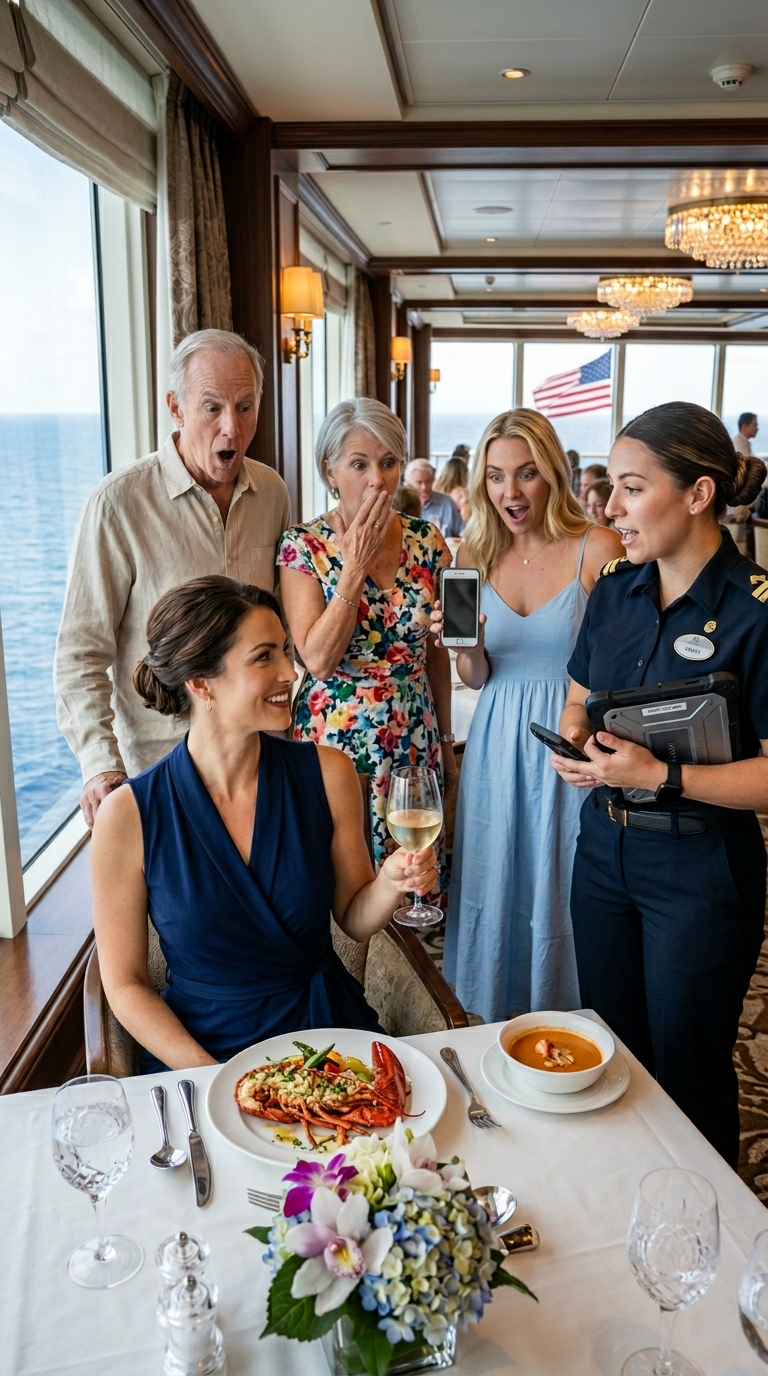
I was already inside, eating lobster bisque with wine.
The hostess asked for their reservation.
Dad gave his name. Nothing.
Mom insisted, “Our daughter booked it for us.”
The hostess checked their cabin numbers.
Then her expression changed.
“I’m sorry,” she said politely. “Your cabins do not include specialty dining access.”
Vanessa’s voice carried through the entrance.
“You said Millie paid for everything.”
I lifted my glass and took a sip.
Moments later, my waiter leaned in. “They’re asking if Miss Miller from the penthouse can upgrade their dining access.”
I looked toward the door where my family stood.
“No,” I said quietly. “They’ll manage.”
And for the first time, I meant it. “My mom told me I wasn’t invited to their cruise — after I bought them a $400K house. So I sold it while they were away. You won’t believe what happened when they came back…” The text came The text arrived while I was stuck in traffic on I-25.
The afternoon sun was glaring off the car ahead of me.
On the passenger seat sat a small, neatly wrapped gift bag. Inside were silver seashell earrings, delicate hooks holding tiny pearly cowries. I had chosen them for my mother to wear on the cruise. They looked like something someone would wear standing on a balcony, breathing in the ocean air.
I could already imagine her smiling, touching one of them, maybe even saying I finally had good taste. My phone buzzed against the console. I glanced down, expecting a work reminder or a message from a friend. It was my mom.
I smiled before I even opened it. Then I read it.
You’re not coming. Dad wants just family.
That was it. Seven words. No apology, no explanation, just a cold, final dismissal.
My smile disappeared. My breath caught in my chest.
I read it again, thinking I had misread it. Maybe it was a mistake. Maybe it was meant for someone else. But it wasn’t. It sat there under her name like a clean, deliberate cut.
The cruise I had paid for. The one I had spent six months planning down to the last dinner reservation. The one I had fully funded with my bonus from work. The one I had worked endless nights to afford.
My family’s dream trip, paid for by me—and I was no longer included.
The car behind me honked. I looked up. The light had turned green. My hands shook on the steering wheel.
I pressed the gas, my foot feeling strangely heavy, disconnected from me. The gift bag beside me suddenly felt ridiculous. The earrings looked like a bad joke.
I drove without knowing where I was going, just following traffic, my mind repeating those seven words over and over.
Dad wants just family.
The meaning was unmistakable. I wasn’t family. Not in the way that mattered. I was the provider. The backup plan. The account they could access when needed. Not someone who belonged.
I’m Millie Miller. I’m 33 years old. I live in a condo in Denver that I bought on my own. And my whole life, I tried to be a good daughter, a good sister, a good person.
I believed goodness meant giving. I believed love was proven through sacrifice, effort, and support. But sitting there with that message burning on my screen, I finally understood that wasn’t love.
It was a transaction. And the transaction was over. They had what they wanted. They no longer needed me.
That was the moment the fog I had lived in for thirty years started to lift. The moment I realized my parents didn’t see me as a daughter, but as a resource.
I was their emergency fund, their safety net, their shortcut to a better life. And now that everything was paid for, my presence was unnecessary. Worse than unnecessary—it was inconvenient.
Growing up, I thought love was spelled R-E-S-C-U-E. My entire childhood was shaped around being the fixer, the responsible one, the child who cleaned up messes she didn’t create.
It started small. My younger sister, Vanessa, would break something, and I would take the blame because I knew my parents were already overwhelmed, and her tears always won faster than mine.
I learned early that silence was safer than conflict. The first major rescue came when I was 16. Dad’s small construction business, the one he built his life around, collapsed.
The 2008 recession hit us hard. I remember the silence that filled the house. The phone would ring, and my parents would just stare at it.
The air felt thick, heavy. Dad spent his days on the couch watching TV with no sound while Mom tried to stretch pasta into enough meals.
I worked two part-time jobs after school—one at a diner, one stocking shelves at a grocery store. My paychecks weren’t much, but to me they were everything.
They were my way out. My chance at a car, at college applications, at something beyond our small town.
One night, I came home late, smelling like dish soap and cleaning chemicals, and found my mom crying at the kitchen table over a stack of bills.
The final notices glowed under the dim light. Without thinking, I went to my room, took the money I had saved, and placed it beside her.
It was over $500. It was everything I had.
She looked at the money, then at me. Her face wasn’t grateful. It was something heavier—relief mixed with guilt.
“Oh, Millie,” she whispered. “You shouldn’t have to.”
But she took it. She never paid me back. That became the pattern. I was the backup plan.
When Vanessa decided she wanted a private college we couldn’t afford, I co-signed the loans. I was in my first real marketing job, barely covering rent and debt.
But Vanessa had a dream. She wanted the college experience.
She lasted one semester. Then she dropped out, citing “creative differences,” and came home with debt and no plan.
My parents panicked. This will ruin her credit. Dad said she’ll never recover from this. So I fixed it.
I worked nights and weekends doing freelance marketing copy until my eyes burned. It took two years, but I paid off all her student loans.
My thank you was Vanessa telling me I was “lucky to be good with money,” as if it were a personality trait instead of survival.
She never got a full-time job. She drifted from one idea to another, supported by my parents—who were, in turn, supported by me.
Every family emergency became my emergency. Every bill found its way to me. And every time I helped, the “thank you” always arrived with another request already hanging off it. They didn’t call me Millie. They called me the responsible one.
For years, I wore that label like it meant something admirable. Like it proved they trusted me, valued me, saw me as strong. I didn’t realize “responsible” was just their polite word for convenient.
I was the family ATM, and my PIN was guilt. After college, I worked nonstop, throwing myself into a career in marketing analytics with everything I had.
I was good at it. I saw patterns in data other people missed. I moved up quickly, earned promotions, collected bonuses, and at 29 I bought my first condo.
I had a 401(k). Savings. A life I built from nothing. And I thought they would finally be proud of me for it. Instead, my success seemed to irritate them.
My stability only made their instability more obvious, and they resented me for it. At Sunday dinners, my mom would look around my clean, modern condo and say things like, “Money changes people, Millie. It can make them cold.”
My dad would nod and add, “Don’t forget where you came from.”
As if I ever could.
That was the problem—I never forgot. I never forgot my mother crying at that kitchen table. I never forgot my father sitting silent on the couch. I never forgot the feeling that if I didn’t hold everything together, everything would collapse.
So when the idea of a family cruise came up, I didn’t hesitate.
It felt like another chance to fix things. To rescue them again. To buy happiness, and maybe, finally, buy love.
It started as a casual comment over dinner at my place.
I’d made pot roast—my dad’s favorite. We were sitting around the dining table I had saved for months to afford, and for once, things felt almost normal.
Then my mom let out one of her practiced, wistful sighs and stared out at the Denver skyline.
“You know,” she said softly, “your father and I have always dreamed of seeing the Caribbean. A real family vacation on one of those big ships.”
My dad followed instantly with his role in the script. A heavier sigh. A burdened tone.
“But cruises are expensive, honey. Way out of our league.”
Vanessa, scrolling her phone without looking up, added, “Yeah, it would be nice to get away from all this stress.”
Stress. I never quite knew what she meant by that.
I looked at them—my mother’s hopeful expression, my father’s rehearsed disappointment, my sister’s effortless entitlement. A performance. And I was the audience.
Years ago, I would’ve believed it. Now I could see the strings. But the part of me that was still that 16-year-old girl who just wanted to be enough… still wanted it to be real.
So I smiled.
“Let me handle it,” I said. “I just got my bonus. It was a good quarter.”
They protested, of course. Softly. Carefully. The kind of protest that really means please don’t stop.
“Oh no, Millie, we couldn’t ask you to do that,” my mom said, already glancing at my dad. “That’s your money. You worked hard for it.”
“It’s for the family,” I said. “It would make me happy. We should all go.”
And that was it. The switch flipped. The room warmed. I was the hero again.
For the rest of dinner, they praised me. The pot roast was perfect. My condo was beautiful. I was so responsible. So generous.
I believed them.
I wanted to believe them.
The following weeks blurred into planning. I spent nights comparing cruises, reading reviews, building what I thought would be the perfect trip.
Not just tickets—the best tickets. Six in total: my parents, Vanessa, her on-and-off boyfriend Brandon, and my aunt and uncle, because my mom insisted they “couldn’t be left out.”
I upgraded everything. Balcony cabins. Shore excursions in the Bahamas, Mexico, Jamaica. Snorkeling, ziplining, private beach days. Premium dining. Drink packages. Wi-Fi.
Every detail, chosen carefully.
Perfectly.
The total came to $21,840.
I stared at it longer than I should have before clicking “confirm.”
It was more than I’d ever spent on anything except my condo. A huge portion of my savings. But I told myself it was worth it.
An investment in my family.
A way to finally belong.
I sent the confirmations into the group chat and waited for excitement. Gratitude. Something.
A few minutes later, my phone buzzed.
A single red heart emoji from my mom.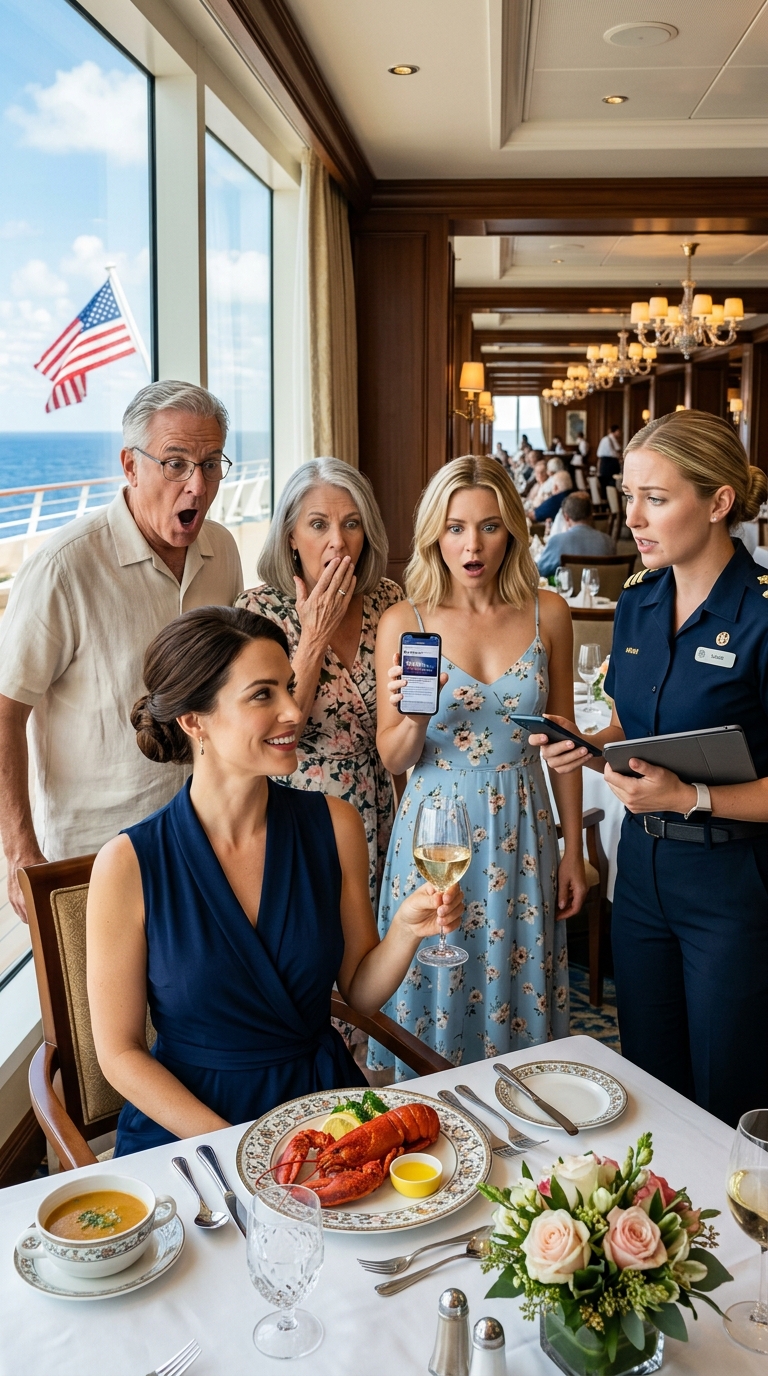
That was it.
That was my thank you.
And somehow, I convinced myself it was enough.
A month before the cruise, I sent them matching navy polo shirts. “Miller Family Cruise 2025” embroidered in white. Cheesy, yes—but I imagined the photo on the ship deck. Smiling. Together. Real.
I mailed the box.
Then I waited.
Silence.
A quiet knot formed in my stomach.
I checked tracking. Delivered two days ago.
Still nothing.
Then the message came.
You’re not coming. Dad wants just family.
At first, I thought it was a mistake.
Then my mom followed up.
It’ll be less awkward this way. Vanessa deserves a break.
A break from what?
My hands went cold. My chest tightened. Vanessa hadn’t worked in years. Her entire life was a break I funded.
I called them. Voicemail. Voicemail. Voicemail.
Then I opened the group chat.
Gone.
I searched again. Nothing.
I tried adding Vanessa to a new one. Error.
Removed.
Blocked.
Erased.
And just like that, I wasn’t part of the family anymore.
That night, my cousin Sarah sent me a screenshot.
A new group chat: Miller Cruise Crew.
Vanessa holding up the shirts I bought.
Her caption: “Got our cruise swag. So excited for a drama-free trip. Thank God Millie decided she was too busy with work to come.”
The winky face did it.
That was the moment everything inside me went still.
They weren’t excluding me.
They were rewriting me.
I wasn’t uninvited. I was “too busy.”
I sat there all night staring at invoice after invoice.
Every charge. Every booking. Every receipt.
Billed to me. Under my name. Funded by me.
And for the first time, I didn’t feel sadness.
I felt something colder.
Clearer.
They thought I was disposable.
What they forgot was that I still controlled everything.
And that realization changed everything.
I didn’t sleep.
I just waited for morning.
And when it came, I already knew what I was going to do. At 8:01 a.m., I made coffee, sat down at my laptop, and opened the cruise confirmation email. I found the customer service number for the travel agency I had booked through and dialed it.
I took a slow breath, sipped my coffee, and waited.
A cheerful voice answered.
“Thank you for calling Oceanic Getaways. This is Brenda. How can I help you today?”
I kept my tone calm. Even. Carefully controlled, with none of the anger still burning in my chest.
“Hi, Brenda. My name is Millie Miller. I’m calling regarding a reservation I made for the Miller family cruise. Confirmation number 74B3982.”
I heard typing on the other end.
“Yes, Miss Miller, I see it here. A party of six sailing to the Eastern Caribbean on the Starlight Serenity. It looks like a wonderful trip. How can I help you?”
“I need to make some adjustments to the booking,” I said.
“Of course,” she replied. “What would you like to change?”
This was it—the point of no return.
I opened the list of add-ons I had paid for. “I need to cancel the premium dining packages for all guests.”
“All six, Miss Miller?” Brenda asked, a flicker of surprise breaking through her professional tone.
“All six,” I said firmly. “They can use the buffet and the standard dining options.”
A few clicks on her keyboard followed.
“Alright, that’s processed. A refund of $1,880 will be returned to your card within three to five business days.”
A small, sharp satisfaction settled in my chest.
“Good. Next, I need to cancel the unlimited Wi-Fi packages and the premium drink passes for all guests.”
“Understood,” Brenda replied, now fully businesslike. “That comes to a refund of $2,460.”
“Perfect,” I said.
I kept going down the list.
The snorkeling trip. The zipline excursion. The private beach cabana I had reserved. One by one—canceled, removed, refunded.
With each confirmation click I heard through the phone, something inside me steadied. I wasn’t giving anything away anymore. I was taking it back.
Then I reached the part that mattered most.
“Brenda, I need to change the cabin assignments.”
“Alright… what kind of change?”
“The five balcony suites under Richard Miller, Susan Miller, Vanessa Miller, Brandon Smith, and the other family members. I want to downgrade them.”
A pause.
“Downgrade them, ma’am?”
“Yes,” I said evenly. “Move them to the cheapest interior cabins available. Lowest deck if possible. Near the engine section is fine.”
The silence stretched just a little longer this time.
“I can place them on deck two,” she said carefully. “They’re interior rooms with no windows. Would that work?”
“That’s perfect,” I said, and for the first time in twenty-four hours, I actually smiled.
“And your reservation, Miss Miller?” she asked. “The penthouse master suite—would you like to cancel it as well?”
That was the turning point. The difference between reaction and control.
“No,” I said. “Keep mine.”
A pause.
“I’ll be there,” I added.
Then, after a beat—
“Just not with them.”
The two weeks that followed were strangely quiet.
No calls. No questions. No outrage.
Nothing.
It was as if removing me from their cruise had also removed me from their awareness entirely. They had no idea anything had changed.
They were still living inside the version of the trip I had built for them—completely unaware I had rewritten it.
And I let them stay there.
Boarding the ship in Miami felt almost unreal.
I walked up the gangway alone, watching families around me laughing, arguing, posing for photos—life in motion everywhere but me.
For a moment, I felt something like absence.
Then it passed.
Because what replaced it was sharper.
Freedom.
My name was on the manifest for the penthouse master suite. A porter took my single suitcase and guided me toward a private elevator. The suite was stunning. It was larger than my first apartment, with a sprawling living area, a king-sized bed, a marble bathroom featuring a jacuzzi tub, and an expansive private balcony that curved around the ship’s corner, giving a 180° view of the ocean.
A bottle of champagne sat cooling in an ice bucket beside a welcome note addressed to Miss Miller. I stood out on the balcony, the warm sea breeze brushing my face, and felt a level of peace I hadn’t experienced in years.
This was my space, my sanctuary, a place they could never reach. I already knew confrontation was inevitable. The ship, although enormous, was still a closed environment.
It was simply a matter of time. I spent the first day settling in, intentionally savoring the solitude. I arranged my clothes in the walk-in closet. I took a long bath.
I ordered room service and ate on my balcony while watching Miami fade into the distance. I felt like a spy, an observer in a self-created social experiment.
I kept wondering where they were. I pictured them arriving at the port, handing their luggage to a porter, and being sent not to the grand suites on the upper decks, but down to the cramped, windowless cabins on deck 2.
I imagined their confusion shifting into outrage as they opened a door barely bigger than a closet. The constant low hum of the ship’s engines vibrating through the floor.
I never saw them on that first day or night. I ate dinner alone at a quiet restaurant reserved for suite guests, a benefit I hadn’t even known existed when I booked.
I was beginning to think we might actually avoid each other for the entire week. The following evening, I chose to go down to the main buffet for dinner.
It was loud and chaotic, a mix of clattering plates, overlapping conversations, and the smell of countless dishes. I filled my plate and found a small table for two by the window, and that’s when I saw them.
They were in the dessert line, and they looked miserable. My dad’s face was dark with anger. My mom looked drained and overwhelmed, her shoulders drooping.
Vanessa was complaining, her hands moving sharply as she spoke. Her expression showed pure disgust. Even from across the room, I could feel the heavy cloud of their disappointment.
My mom noticed me first. Her eyes scanned the room and locked onto mine. She froze completely, her hand hovering over a slice of chocolate cake.
Her face drained of color, frozen in shock. She nudged my father, who followed her gaze, his eyes narrowing, his jaw tightening.
He looked less surprised and more enraged, as if my presence itself was an insult. Finally, Vanessa noticed their stares and turned.
Her face, unlike my mother’s, flushed a deep, angry red. It wasn’t shock. It was the burning humiliation of being caught.
I didn’t look away. I didn’t hide. I simply took a bite of my salad and met their eyes with a steady, neutral expression. They held a hurried whispered discussion.
Then, abandoning the dessert line, they walked toward my table as a united front of frustration and indignation. My dad spoke first, his voice low and rough.
“What are you doing here?”
I swallowed and gave them a small, pleasant smile.
“What do you mean? I’m on vacation.”
I looked from him to my mom, then to Vanessa.
“You said the trip was for just family, and I’m family, so here I am.”
My words, simple and direct, seemed to leave them speechless. They had no reply.
Vanessa’s eyes dropped to my wrist, where the gold-colored wristband, the suite key, was clearly visible. It stood in sharp contrast to their cheap blue plastic bands.
Her eyes narrowed as understanding—and anger—set in. Before they could react, I stood up and picked up my plate.
“Well, this has been lovely,” I said cheerfully. “I’m off to see the show. Enjoy the buffet.”
I walked away without looking back, feeling their stares burning into me. Later that evening, the real consequences arrived.
I had a reservation at the ship’s finest restaurant, the Ocean Prime Steakhouse. I was seated at a cozy table with a clear view of the entrance.
About thirty minutes into my meal, while enjoying lobster bisque, I saw them arrive at the hostess stand. They were dressed up, clearly trying to salvage their ruined vacation.
My dad wore a blazer, and Vanessa had a dress that looked like it had been bought on credit she couldn’t afford. The hostess greeted them politely.
“Good evening. Do you have a reservation?”
“Miller. Party of six,” my dad said gruffly.
The hostess typed into her computer, her smile fading slightly.
“I’m sorry, sir. I don’t see a reservation under that name.”
“Well, we’re part of the Miller party,” my mom interjected, her voice tight. “Our daughter booked it for us.”
The hostess typed again.
“I see. And what is your cabin number?”
My dad gave it. Her expression shifted from confusion to apology.
“Oh, I see. I’m very sorry, but the steakhouse is a specialty dining venue. The dining privileges for your cabins only include the main dining rooms and the buffet.”
The color drained from my mom’s face. Vanessa, however, snapped immediately. She leaned toward her mother and hissed, her voice cutting through the quiet restaurant.
“You said Millie paid for everything. You said it was all inclusive.”
The hostess looked deeply uncomfortable. Other diners were starting to stare.
“I’m terribly sorry,” she said. “But there are no premium packages on your account.”
They stood there in humiliating silence for another moment, whispering angrily before turning and storming away. I took a slow sip of my wine.
A few minutes later, my waiter Marco, who had witnessed everything, approached my table. He leaned in slightly, a faint smirk on his face.
“Your family at the hostess stand,” he said quietly. “They asked if the guest in the penthouse suite, Miss Miller, would be willing to upgrade their dining plan for them.”
I looked at him, thinking about every time I had upgraded their lives, paid for their comfort, and carried their choices.
“No,” I said calmly but firmly. “I don’t think I will. They’ll manage.”
Marco nodded with quiet respect.
“Very good, Miss Miller,” he said, then walked away.
I was left alone with my steak, my wine, and the quiet satisfaction of a boundary finally being set. The day after the steakhouse incident, an uneasy truce settled over the ship.
We were in the Bahamas, and I spent the day on my own excursion—the one I had kept for myself—swimming with dolphins. I moved through the day in a calm bubble, deliberately pushing thoughts of them away.
For a few hours, I wasn’t a daughter or a sister. I was just Millie, a woman on vacation. The feeling was new and almost surreal, and I nearly forgot the tension beneath it all.
The avoidance continued into the next day. I would catch glimpses of them from afar: my dad’s tense profile in the casino.
Vanessa’s head at the crowded Lido deck bar. My mom slumped in a lounge chair. We moved like magnets with the same pole, constantly repelling each other across the ship.
They clearly avoided me, and I was more than willing to let it stay that way. I even started to think, maybe foolishly, that the worst had passed.
On day three, I found a quiet spot at the adults-only serenity pool at the back of the ship. It was a peaceful escape from the noisy main pools.
I had a comfortable lounge chair, a thick novel, and a tall glass of iced tea. The sun warmed my skin, and the gentle rocking of the ship left me deeply relaxed.
For the first time, I felt truly happy—and of course, that was when they struck. I sensed them before I saw them. A shadow fell across my book, blocking the sun.
I looked up and saw all three of them standing over me: my mother, my father, and my sister. They weren’t shouting. Their silence was worse.
Their expressions were a mix of fury and shame, like a tribunal ready to pass judgment. My mother spoke for them.
She stood in the center, arms tightly crossed, knuckles white, her voice a low trembling whisper that felt more threatening than any shout.
“How could you do this to us, Millie?”
I took a slow sip of iced tea, my heart beginning to race. I carefully placed the glass down, marked my page, and closed my book.
I refused to show any reaction.
“I’m not sure what you mean,” I said evenly. “I’m just sitting here reading my book.”
“Don’t play dumb,” Vanessa snapped, stepping forward, her face flushed with anger. “You know exactly what you did. Downgrading our rooms, cancelling our dinners. We are the laughingstock of this entire ship.”
“People are looking at us,” my mom added, her voice breaking with self-pity. “They see our blue wristbands. They know we’re in the cheap cabins. We look ridiculous.”
And there it was—the truth beneath it all.
It wasn’t betrayal that mattered to them.
It was embarrassment. Their pride had been bruised. They were humiliated—and in their minds, it was my fault.
A final clarity settled over me. They couldn’t see what they had done. Only what had been done to them.
I looked at my mother’s face, twisted with anger and shame, and felt nothing but a quiet emptiness.
“You look ridiculous,” I repeated softly, my voice carrying across the serene deck.
People nearby began to turn and watch.
“Let me see if I have this straight. You took a $21,000 vacation that I paid for. Then you uninvited me from it via text message because my presence would be awkward. You told the rest of the family that I was too busy with work to come. You kicked me out of the family group chat. You did all of that and you think you’re the ones who look ridiculous?”
My mom flinched, her face turning pale. She had no response.
“You’re petty, Millie,” Vanessa sneered, switching tactics. “This is all about money with you. It always is. Well, let me tell you something. Money doesn’t buy class.” The hypocrisy of that statement, coming from a woman who hadn’t earned her own money in years and was currently standing on a cruise ship entirely paid for by me, was so extreme I almost laughed.
Instead, I held her gaze without blinking.
“You’re right, Vanessa. It doesn’t,” I said, my tone cold and razor-sharp. “But it does buy tickets. It buys balcony suites and steak dinners and snorkeling trips.”
I let the silence stretch.
“And I’m done buying yours.”
That was the end of it. The final hit landed. Vanessa’s face twisted in fury. My dad, who had been silent the entire time, simply glowering behind my mother, finally muttered, “You ungrateful brat,” before turning away sharply.
My mom looked at me one last time, her eyes carrying a strange mix of hatred and almost pleading desperation, like she still expected me to repair everything. Then she turned and followed my dad.
Vanessa shot me a final look of pure venom before storming after them. They were gone.
The confrontation I had been dreading for days ended in under five minutes. I was left sitting in the sudden quiet, the sunlight warm against my skin again.
I was aware that many people on the deck had witnessed everything. I could feel their attention on me.
In the past, that kind of public scrutiny would have overwhelmed me. I would have burned with shame and wished I could disappear.
But sitting there, I felt something completely different. I felt light. A heavy, suffocating weight I had carried my entire life had finally been lifted.
I picked up my iced tea, my hand perfectly steady. I opened my book back to my marked page and kept reading, completely unbothered by who was watching.
For the first time, I was entirely, completely, and peacefully alone.
The rest of the cruise unfolded in a strange, quiet détente.
After the breakdown by the pool, my family seemed to accept that confrontation no longer worked. Their anger had become currency I no longer accepted.
So they fell back on their only remaining tactic: avoidance. They treated me like I didn’t exist. If I entered a space, they left it.
If we crossed paths in a hallway, they stared fixedly at anything but me. I became something invisible to them, a presence they refused to acknowledge. It was almost absurd.
I would spot them in the buffet line, piling their plates high with free food, their expressions tight with resentment. My dad moved like he was heading into battle just to get pizza.
My mom wore a permanently wounded expression, like a tragic heroine trapped in her own story. Vanessa looked bored and irritated, slumped in a chair, endlessly scrolling her phone, likely angry she couldn’t post about the trip without proper Wi-Fi.
Meanwhile, I enjoyed myself. I took a cooking class. I attended every show.
I spent hours on my balcony watching the endless ocean, feeling a deeper peace than simple relaxation. It was the calm that comes after something finally ends.
The drama was over. I had made it through. Each time I saw them looking miserable, I felt a small, quiet ache that wasn’t quite guilt, but an understanding of finality.
These were the consequences of their choices. I was just witnessing them.
On the final morning, the ship docked back in Miami. The festive energy of the week was replaced by the tense shuffle of disembarkation.
I ate an early breakfast in the suite lounge, then stayed in my room until my time was called, avoiding the crowds. Standing on my balcony one last time, looking down at the port, everything felt clear.
The vacation was over, but my work wasn’t quite finished. It wasn’t about revenge anymore. It was about shutting every door, closing every account, and making sure the old dynamic could never return.
It was about a clean break. After disembarking, I found a quiet café in the terminal, ordered coffee, and opened my laptop.
First, I called the cruise line’s billing department.
“Hello,” I said, my voice calm and professional. “My name is Millie Miller. I’m calling about my recent cruise booking number 74B3982. I need to dispute several charges on my final invoice.”
The agent responded politely.
“Of course, Miss Miller, can you please specify which charges you are referring to?”
“Certainly,” I said, scanning the invoice. “I am disputing the charges for five shore excursions in the Bahamas, Jamaica, and San Juan. The guests for whom these were booked did not attend.”
I didn’t need to elaborate. Their system would already show I was the only one who checked in.
“I see that here,” the agent said after a pause. “I can process a refund for those.” “Thank you,” I continued. “I am also disputing the pro-rated charges for the premium amenities that were part of the original booking but were cancelled prior to the voyage. According to my records, several of the guests were denied access to services that were still partially billed to my account.”
The agent placed me on a brief hold. When he returned, his tone had shifted into apology.
“You are correct, Miss Miller. It appears there was a billing error. Due to the significant changes in your booking and the issues you’ve raised, I’ve been authorized to issue a substantial refund to your account for all non-rendered services, along with an apology for the inconvenience.”
He read out a number. Nearly $6,000. The final repayment for a gift that had never been accepted.
“Thank you,” I said evenly. “I appreciate you resolving this.”
I closed the laptop and took a slow sip of coffee. The refund wasn’t just money. It was confirmation.
It was official proof that they had not participated in the experience I had paid for. But I still wasn’t finished. The cruise had only been one piece of the system I had built to support them.
I opened my email and searched for the remaining confirmations. I found the reservation for the airport hotel in Miami where they were supposed to stay the night before flying home.
It was a comfortable hotel, with a pool and restaurant, meant as a soft landing after the cruise. It had been booked under my name, using my credit card.
I clicked the link. One button appeared on the screen.
Cancel reservation.
I clicked it without hesitation. A confirmation appeared.
Your reservation has been successfully cancelled.
Next, I opened the email for the black car service I had arranged to collect them from the port, take them to the hotel, and then to the airport the following morning.
I had wanted everything smooth, easy, and comfortable for them until the very end. I called the dispatch line.
“Hi,” I said. “I need to cancel a booking for this afternoon. The name is Miller.”
I provided the confirmation number. A moment later, the operator responded, “Okay, the car service for the Miller party has been revoked.”
Revoked. The word landed cleanly. Final. Decisive. Everything tied to my name, my card, my generosity—gone.
They were on their own. They would leave the cruise terminal expecting a driver holding a sign and find no one.
They would arrive at a hotel expecting a room and be turned away. They would be stranded in a city they hadn’t planned for, with no arrangements and no backup.
A younger version of me would have panicked at the thought. I would have pictured their confusion and felt responsible for it.
But sitting there in the café, I felt only calm. I hadn’t stranded them. They had stepped away from the system that supported them.
I was simply reflecting reality. You can’t cut someone out of your life and still expect them to fund your logistics.
You can’t declare someone unnecessary and still rely on them for transportation and shelter. This wasn’t revenge. It was consequence.
The final financial thread had been cut, cleanly and completely.
The week after I returned to Denver was quieter than anything I could remember. The silence that once felt heavy now felt like relief.
I waited for the backlash—the calls, the anger, the blame. I expected them to twist everything back onto me.
But nothing came. No messages. No confrontation.
At some point, I understood why. To call me would mean admitting they had expected me to keep providing even after rejecting me.
Their pride wouldn’t allow that. So they stayed silent. And in that silence, I began to recover.
I went to work. I met friends. I spent time in my condo, which finally felt like mine alone.
Life started to feel steady again. Controlled. Quiet in a good way.
Then one evening, a week after I returned, someone knocked on my door.
Not the lobby call. A direct knock.
My chest tightened. I looked through the peephole.
My mother stood in the hallway alone, shoulders slumped, looking older and smaller than I remembered.
For a moment, I considered not opening the door. Letting it pass.
But I knew this wasn’t something that would disappear. It was the last piece that needed to be resolved.
I opened the door just enough to stand in the frame. I didn’t step aside.
I didn’t invite her in.
She looked up at me with red, swollen eyes. Exhaustion had replaced everything else.
“Millie,” she said quietly.
“Mom,” I replied.
Silence stretched between us. She waited, expecting entry, expectation, familiarity.
I gave her none of it.
Finally, she looked down at her hands.
“We went too far,” she said. “On the cruise, the text… we thought, we just thought…”
Her voice broke. She couldn’t finish.
I didn’t interrupt her immediately. I let the silence hang until it stopped being comfortable.
Then I spoke.
“You thought I would keep paying,” I said. “You thought you could remove me and still keep what I provided. You thought you could have the trip without me. That’s what happened.”
Her eyes widened slightly. The explanation she had prepared didn’t fit anymore.
Slowly, she nodded. A tear slid down her cheek.
In that moment, everything became clear. My father’s absence wasn’t apology—it was pride. Vanessa’s absence wasn’t reflection—it was entitlement.
Only my mother had come, not to fix what she had done, but to salvage what she had lost access to.
She wasn’t grieving me. She was grieving the structure.
I didn’t feel anger anymore. I didn’t feel the need to punish her further.
Just a deep, quiet sadness.
“It’s over, Mom,” I said. “The bank is closed. The rescues are finished.”
I met her eyes.
“You’ll have to learn to afford your own vacations.”
Her face broke, but I didn’t change my stance. That pain belonged to the situation, not to me anymore.
Then I closed the door.
Not sharply. Not dramatically.
Just firmly, until the latch clicked.
A boundary made real.
I leaned my forehead against the wood and listened to her footsteps fade away.
And for the first time, my home felt entirely safe.
Six months later, I went on another cruise—this time alone, to the Greek Isles.
The sea was not Caribbean blue. It was deeper, richer, endless.
I spent my days walking through Santorini, my evenings watching the horizon dissolve into orange and violet.
I kept a journal, filling it with thoughts instead of anger.
Peace, I realized, doesn’t come from apologies or explanations.
It comes from distance. From acceptance. From letting people live their own choices.
My worth had never been tied to what I gave.
It came from what I no longer allowed.
When I returned to Denver, there was a postcard waiting in my mailbox.
A faded image of the mountains.
On the back, my mother’s handwriting:
We’re sorry, Millie. We miss you.
A year ago, it would have pulled me straight back into everything.
But standing there, I only felt calm.
Not anger. Not triumph.
Just closure.
I kept the postcard, not as a wound, but as a record of something finished.
Then I packed for my next trip to Moab.
No rescue missions. No expectations.
Just my life—finally, fully mine.
