


PART 1: The Name Beneath Their Fortune
The message severing our relationship arrived at exactly 7:42 on Tuesday morning. My phone vibrated twice against the quartz kitchen counter, breaking the silence. My mother had never possessed much talent for subtlety. Her text read: You have disgraced this family for the last time. Consider yourself permanently cut off from our lives, our name, and our home. Do not call Gary. Do not attempt to contact Chelsea. You are dead to us. Standing inside my third-floor condo in Dilworth, the Charlotte neighborhood I had selected for its old willow oaks and unpretentious atmosphere, I watched steam rise from my oatmeal. My spoon remained steady. My heartbeat never changed.
Unexpected revelations do not frighten people in my profession. They demand verification. I am Kelsey Mitchell, thirty-four years old. For seven years, I had worked as a senior forensic accountant at Boyd Consulting, occupying the upper floors of a glass tower on Tryon Street. I spent my days examining the financial debris left by powerful men who assumed numbers could be persuaded to accommodate their ambitions. Diverted receivables, nonexistent employees, transactions executives denied under oath—I followed them all. I understood how shortfalls disappeared beneath polished presentations. More importantly, I understood what happened when the money supporting an illusion finally stopped arriving.
I lifted my phone, typed my four-letter answer—Okay.—and sent it. Then I finished another mouthful of oatmeal, washed the bowl, and collected my wool coat from the entryway closet. The break had begun the previous evening at a South Park steakhouse, beneath amber lighting and above linen expensive enough to disguise almost anything. A bone-in ribeye cost ninety dollars there. Outside, the parking lot displayed an impressive collection of imported upholstery and monthly lease obligations. Marilyn had arranged the evening as a “family dinner.” For more than a decade, those words had described an ambush dressed for respectable company.
Gary, my father, occupied the head of the booth. His silver hair was slicked back, and his belly pressed against the lapels of his tailored houndstooth blazer. My younger sister, Chelsea, sat beside him, thirty years old and surrounded by expensive sandalwood perfume and unquestioned entitlement. Her adult employment history had avoided anything ordinary. There had been a boutique that survived eight months, a motivational podcast that lasted five episodes, and a wellness business offering three extravagantly priced candles. Our parents had paid for every collapse and rewritten each one as an unfortunate misunderstanding. Beside her sat her husband, Hunter Vaughn, looking as immaculate as the financial fantasy he sold.
Hunter described himself as a private wealth advisor. His Italian jackets stopped just short enough at the wrists to display his stainless-steel chronograph, which he liked to tap while discussing markets. His Range Rover was pearl white, its wheels matte black. His townhouse featured glass railings and the determined architecture of borrowed importance. Unfortunately for him, Marilyn had once asked me to review an unsecured equity line, giving me a glimpse of his liabilities. The watch was financed. The SUV carried an expensive commercial lease. His available cash would not have covered his country club drinking habits through the third quarter.
Between the salads and steaks, Hunter leaned toward me with a practiced smile and pushed a thick navy presentation folder across the table. “Kelsey,” he had purred, sliding a thick, navy-blue presentation folder across the salt cellar. “Take a look at the future.” Gold lettering announced The Meadows at North Hills: A Premier Mixed-Use Opportunity. Beneath the prospectus sat an application for a four-point-five-million-dollar loan. A yellow tab marked the secondary signature line with my initials: K.M., Co-Borrower / Personal Guarantor. I opened the projections and traced a finger down the figures. Within forty seconds, disgust had settled coldly in my stomach.
“Year-one retail occupancy projected at ninety-four percent?” I asked, looking up over the rim of the page. “In an undeveloped secondary corridor forty minutes outside Raleigh?” Hunter reclined and crossed an ankle over his knee. “The growth trajectory in Wake County is unprecedented,” Hunter said smoothly, leaning back and resting an ankle over his knee. “The anchor tenants are practically lined up.” I turned another page. “There are no letters of intent attached here, Hunter,” I countered, flipping another sheet. “Your construction costs are projected flat over a thirty-six-month build phase during a historic inflationary cycle. And your debt-service coverage ratio is 1.08. A first-year analyst at a regional credit union would shred this before it cleared the scanner.”
I shut the folder with a controlled thump and returned it to his side of the table. “This isn’t a prospectus,” I said, sliding it back into his space. “It’s a catastrophic liquidity trap. The answer is no.” Conversation stopped. Laughter from a nearby private party suddenly sounded painfully distinct. Marilyn brought her wine glass down hard enough to spill cabernet across the cloth. “You haven’t changed one bit, Kelsey,” she hissed, her voice trembling with an ancient, venomous resentment. “Always the cold, arrogant little technician. You sit in your cubicle with your little spreadsheets, looking down your nose at people who actually have the vision to build something. Your sister has an opportunity to secure her family’s future, and you can’t stand it. You’ve always resented her.”
“Marilyn,” I warned quietly. Gary leaned across the table, redness climbing above his collar. “Listen to your mother. Family helps family. That’s the rule in this house. It’s always been the rule. Hunter has done the legwork. He needs your balance sheet to clear the institutional threshold. You pick up that pen, Kelsey, or you are telling me that ten years of our sacrifices mean nothing to you.” Hunter remained silent. His small, condescending smile suggested complete confidence that someone else would eventually surrender. Nobody mentioned the arrangement that had first taught my parents to regard my balance sheet as family property.
Ten years earlier, when I was twenty-four and preparing for professional certifications while living on instant ramen, Gary’s logistics business, Ferguson Freight, had collapsed. Forty Peterbilt trucks, eighteen cross-dock facilities, and the reputation my grandfather had built disappeared beneath state tax warrants, labor grievances, and unprotected diesel contracts. Gary feared losing the Myers Park colonial and the golf membership that confirmed his importance. He and Marilyn summoned me into their wood-paneled study, served sweet tea, cried, and asked me to become their “clean name.” Their desperation that evening bore little resemblance to the righteous indignation facing me across the steakhouse table.

They established The Ferguson Holding Company LLC. My lack of debt, untarnished student credit, and absence of business failures made me its sole legal member and equity owner. Gary appeared only as operational manager. I signed the equipment guarantees and personal credit facilities that kept seventy commercial vehicles moving. It’s just a formality, baby, Gary had choked out through his tears that evening. Just a temporary bridge until your old man gets his footing back. A decade later, that bridge supported their entire existence. The company owned the fleet, held the revolving operating facility, and carried the commercial notes on Gary’s dually, Marilyn’s luxury crossover, and the accounts paying their club assessments.
Over time, my parents revised the story. They forgot that the daughter they belittled at Thanksgiving had supplied the credit supporting their house and habits. In their version, they were generous providers and I was the dependent who failed to look grateful in photographs. At dinner, I did not argue. I removed two twenty-dollar bills from my bag and placed them beneath the brass pepper mill. “Enjoy your dinner,” I had said, standing up. Twelve hours later, I stepped into Dilworth’s January air and felt sunlight against my face. Marilyn believed her message had cast me out. She had no idea she had released me.
At 8:30 AM, I entered the uptown First Citizens branch through heavy brass-and-glass doors, brushing frost from my coat. The spacious banking floor smelled of mahogany polish, wax, and warm circulating air. Robin Campbell, the commercial division manager who had administered Ferguson’s revolving facilities since Gary brought her the refinanced debt six years earlier, looked up behind her glass partition. One glance at my expression brought her to her feet. She dismissed an associate carrying deposit files and invited me into her office. “Kelsey,” she said, shutting the door behind me. “You didn’t have an appointment. Has Gary—”
“I’m not here on Gary’s behalf, Robin,” I said, setting my briefcase onto the leather chair across from her desk. I opened it and removed a tabbed blue folder. “I’m here on my own.” Before her, I arranged my government identification, the original LLC operating agreement, and a two-page document dated that morning. “This is my formal, irrevocable revocation of my personal continuing guarantee on the eight-hundred-thousand-dollar commercial revolver,” I said, speaking with the measured tempo I used when testifying in deposition rooms. “Furthermore, under Section 14-B of the operating agreement, I am exercising my absolute authority as the sole hundred-percent equity member to instantly suspend all secondary signing privileges, debit allocations, and operational managerial authorities currently held by Gary Mitchell.”
Robin removed her tortoiseshell glasses, her hand suspended above the documents. “Kelsey… do you have any idea what this protocol does the moment I enter it into the core system?” I met her gaze. “I wrote the initial compliance analysis on that very line of credit when we renegotiated the covenants in 2018, Robin. I know precisely what it does.” Her voice fell. “The moment the sole guarantor pulls out,” Robin murmured, her voice dropping into an anxious whisper, “the entire credit facility defaults to an immediate administrative freeze. Every subsidiary card tied to the treasury accounts goes dark. The operating drafts freeze. The bank will initiate an underwriting audit within sixty minutes.” “I am aware.”
She glanced toward the banking floor. “Your parents are scheduled to execute a dry closing on a vacation property at Lake Norman at two o’clock this afternoon. A one-point-one-million-dollar cash-and-note transaction. The private lender verified their liquidity through Ferguson Holding’s primary treasury reserve yesterday afternoon.” Nothing in my voice changed. “Then the timing is exceptionally fortunate,” I said, my voice dead level. “Please enter the codes.” Robin sat and drew her keyboard closer. Reflected in her lenses, green account indicators filled the monitor: master account, vehicle facility, payroll card, executive debit access. She entered a sixteen-character administrative override. One after another, green became amber, then solid red.
Access Suspended. Card Authority Terminated. Line of Credit: Under Special Assets Review. The click of the enter key was almost absurdly small for what it had accomplished. Somewhere inside the invisible systems supporting North Carolina commerce, my family’s financial structure had fractured at its foundation. “It is done,” Robin said softly, looking up at me with an expression that bordered on reverence. “Thank you, Robin. Have a productive Tuesday.” I returned to the hard winter brightness of Tryon Street and walked toward Boyd Consulting. Before I passed through the office tower’s revolving doors, my phone began vibrating against my leg. I left it in my pocket.
Other people later reconstructed the next three hours for me with evident pleasure. At 9:45 AM, Gary sat in a Mercedes-Benz delivery lounge in Ballantyne, entertaining the sales director and two junior employees with stories about Quail Hollow. He was arranging a new metallic-gray AMG GLE Coupe for Hunter, a celebratory gift for the loan they assumed I would sign before the week ended. He tossed his Ferguson Visa Platinum onto the desk. “Run the twenty-five-thousand-dollar drive-off deposit on that,” Gary announced. “Let’s get the ribbon on the hood.” The terminal paused, chimed, and displayed DECLINED — CONTACT ISSUER.
The finance director offered a diplomatic laugh. “Looks like your corporate anti-fraud algorithm didn’t like the sudden retail hit, Mr. Mitchell. Happens all the time on high-ticket authorizations.” Gary laughed too. “Morons at the regional branch. Here, use the secondary fleet card.” The second card produced DECLINED — CODE 04: PICK UP CARD. His smile tightened as nearby customers began watching. “Run it manually,” Gary ordered, his baritone sharpening into an abrasive bark. “Punch the numbers in. I’ve carried accounts with this dealership for twelve years. I don’t have time for your machine’s domestic problems.” Six seconds passed after the numbers were entered. Three harsh beeps followed: TRANSACTION VOIDED — CARD REVOKED.
Typing stopped at reception. The director’s accommodating manner disappeared. “Mr. Mitchell,” the director said, his tone shedding every ounce of its former servility, replacing it with the crisp, defensive chill of retail management. “Both corporate instruments have been hard-flagged by First Citizens Special Assets. I’m going to have to ask you to step into the side office, or provide an alternate, personal form of payment that can clear the clearinghouse.” Gary stood so abruptly that his espresso spilled across a brochure. “Do you know who the hell I am?” he roared, his face turning the color of an overripe plum. “I will have this entire franchise under audit by three o’clock! I will have your job on my desk by sunset!”
The general manager emerged with two security employees. “Sir,” the general manager said, voice ice-cold. “You need to lower your voice, and you need to vacate our floor. Now. Before we call the county sheriff to assist you out of the lot.” Gary Mitchell, self-appointed industrial titan of Myers Park, was escorted out before an amused audience. Inside his old Buick, the only car registered personally to him, his shaking hands dropped his keys into the footwell. His phone displayed revoked treasury access, a bounced Lake Norman closing wire, eight missed calls from Marilyn, and five from Hunter. On my nineteenth-floor desk, my own phone vibrated facedown, creeping across the lacquer like a trapped insect.
By eleven, Gary had called forty-one times, Marilyn nineteen, and Hunter fourteen. Their messages charted the collapse of their certainty. Marilyn demanded: Why was my card declined at the fitness studio? The receptionist had to ask me for a check! Call the bank immediately and correct this clerical error! Gary followed with: Kelsey. There is an administrative hold on the fleet lines. You need to call Robin Campbell this minute. The dealership had an issue. Call me. We need to handle this as a family. At 10:58, he changed tactics: My chest is incredibly tight. The pressure you are putting on this family is becoming a physical liability. If something happens to me today, that burden is yours to carry. I drank my green tea without lifting the phone.
At 11:20, an unfamiliar local number appeared: Kelsey. This is Patrick Ford. We have an acute structural problem with the holding company filings and the real estate closing. Call my cell immediately. Patrick had spent fifteen years preparing my parents’ corporate camouflage and obscuring Gary’s liens. I opened his message long enough to mark it Read, then locked the screen. Their emergencies had dictated my life for a decade. This time, the people who designed the disaster could confront it themselves. At 11:40, my frosted-glass office door opened without a knock. Dana, our senior corporate compliance coordinator, stood there pale-faced, holding a security keycard and a gray transfer bin.
“Kelsey,” she said, her voice dropping to an anxious whisper that barely cleared the carpet. “Aaron Simmons wants you in the main executive boardroom immediately. You need to close your active spreadsheets, surrender your firm laptop, and hand over your security credentials before you step into the hallway.”
PART 2: The Evidence They Never Expected
In an elite advisory firm, that procedure meant one thing: execution. Requiring an accountant’s computer and credentials before allowing her into the corridor signaled an ethical or regulatory explosion beneath her career. I remained still. Then I squared three vendor audit reports, closed my dual monitors, safely ejected the local drive, and placed my ThinkPad inside Dana’s bin. My photo identification followed. “Lead the way, Dana,” I said smoothly. As we moved through the nineteenth floor’s hushed corridors, colleagues found urgent reasons to stare at their spreadsheets rather than meet my eyes.
I knew my family well enough to narrow the possibilities. Marilyn’s emotions were too uncontrolled for an institutional attack assembled within four hours. Gary was occupied with his public humiliation. Chelsea was probably breathing into an expensive pillow. Only Hunter possessed both the financial access and tactical arrogance to aim directly at my professional standing. He would understand what the frozen accounts meant. He would also understand that an accountant who withdrew her guarantee might have examined the transactions moving beneath it. His preferred protection would be to destroy the credibility of the person holding the records.
Inside Boardroom Alpha, Aaron Simmons sat at the head of a twenty-seat mahogany table. The managing partner of Boyd Consulting’s Carolinas division had silver eyebrows permanently compressed by responsibility for enormous balance sheets. Regulatory counsel Mark Vance sat on his left; the regional human resources director occupied his right. Aaron did not offer me a chair. He pushed a bound sixty-page dossier across the table. “Twenty minutes ago,” Aaron began, his voice rumbling like distant thunder, “a certified formal grievance was submitted to the ethics committee of this firm, simultaneously cc’d to the State Board of Accountancy and the regional compliance desk of the Securities and Exchange Commission .”
The first page carried Vaughn Capital Asset Management’s embossed letterhead. According to its allegations, I had exploited privileged access to corporate accounting systems to intercept and steal money belonging to Hunter’s clients. It accused me of freezing legitimate businesses in retaliation while concealing domestic embezzlement. The requested remedy was immediate, uncredited suspension from every commercial audit assignment while law enforcement investigated. The document was polished. Its dates accounted for bank holidays, its terminology sounded authoritative, and its references to state administrative rules had been selected with calculated malice. Hunter had recognized the freeze as deliberate and tried to turn his exposure into my misconduct.
His plan was to burn down my reputation before I could organize the evidence. Aaron watched me with an expression that offered no reassurance. “Do you have a preliminary response to these claims, Kelsey?” Aaron asked, his eyes hard as flint. “Because if even ten percent of these allegations hold water, you aren’t just terminated; you will be walking out of this building in federal custody.” I did not plead, cry, or deliver a wounded speech. In forensic work, emotional declarations do not replace proof. Figures have no feelings. Their accuracy does not depend on how persuasively someone insists on being innocent.
From the inside breast pocket of my charcoal blazer, I removed an encrypted metal thumb drive and placed it on the glass. Its sharp little click interrupted the room’s silence. “Aaron,” I said calmly. “May I access the room’s display array?” He looked briefly toward Mark, then nodded. I inserted the drive into the presentation console. The eighty-inch screen activated, dividing into four panels of authenticated information. Instead of Hunter’s carefully chosen accusations, the room now faced transaction records, terminal logs, and the digital trail that had survived every attempt to dress it as ordinary business.
“For twenty-four months,” I began, using the boardroom pointer with the steady hand of a surgeon, “I have served as the sole legal and equity owner of The Ferguson Holding Company. Because my personal guarantee secured that entity’s four-million-dollar revolving capacity, I maintained a passive, continuous forensic log of every automated clearinghouse transfer flowing through its treasury accounts.” I enlarged the upper-right panel. Wire confirmations filled the display. Nobody interrupted. I had spent my career separating the appearance of financial legitimacy from the evidence required to establish it. Hunter had supplied an appearance. I had brought the underlying records.
“In August of last year, I flagged an anomaly. Substantial transfers—ranging from forty thousand to one hundred and eighty thousand dollars—began arriving from an unlisted omnibus clearing account belonging to Vaughn Capital Asset Management . The funds would sit in the Ferguson commercial buffer for less than thirty-six hours. Then, they would be routed out to an offshore margin brokerage designated as Apex Equities Ltd. ” Mark leaned closer, his glasses sliding down his nose. “Apex Equities? That’s an unregulated retail derivative platform operating out of Cyprus.” The recognition in his voice changed the atmosphere more effectively than any protest I could have offered.
“Precisely,” I said. “Hunter Vaughn wasn’t just managing private portfolios. He was running an aggressive, unsanctioned personal options deficit. He was facing rolling margin calls he couldn’t cover. So he established a digital laundromat: he stole money from his discretionary client retirement accounts, washed it through my family’s transport company under the guise of ‘logistical asset leases,’ and used the washed capital to plug his speculative trading losses.” I advanced the presentation. An internal terminal record replaced the wire receipts, showing digital fingerprints, IP addresses traced to Hunter’s workstation, and the cryptographic key tied to his employee credentials.
“He filed this complaint against me today for one reason,” I said, looking Aaron Simmons dead in the eye. “At eight-forty this morning, when I revoked my guarantee and suspended the holding company accounts, the laundromat’s washing cycle was interrupted mid-spin. He currently has a six-hundred-thousand-dollar margin deficit due to settle at Apex by five o’clock. He doesn’t have the cash. He filed this to paint me as a rogue embezzler before his institutional clients discover that their retirement balances are sitting in a Mediterranean black hole.” Silence settled heavily over the conference table. The human resources director sat with her mouth slightly open.
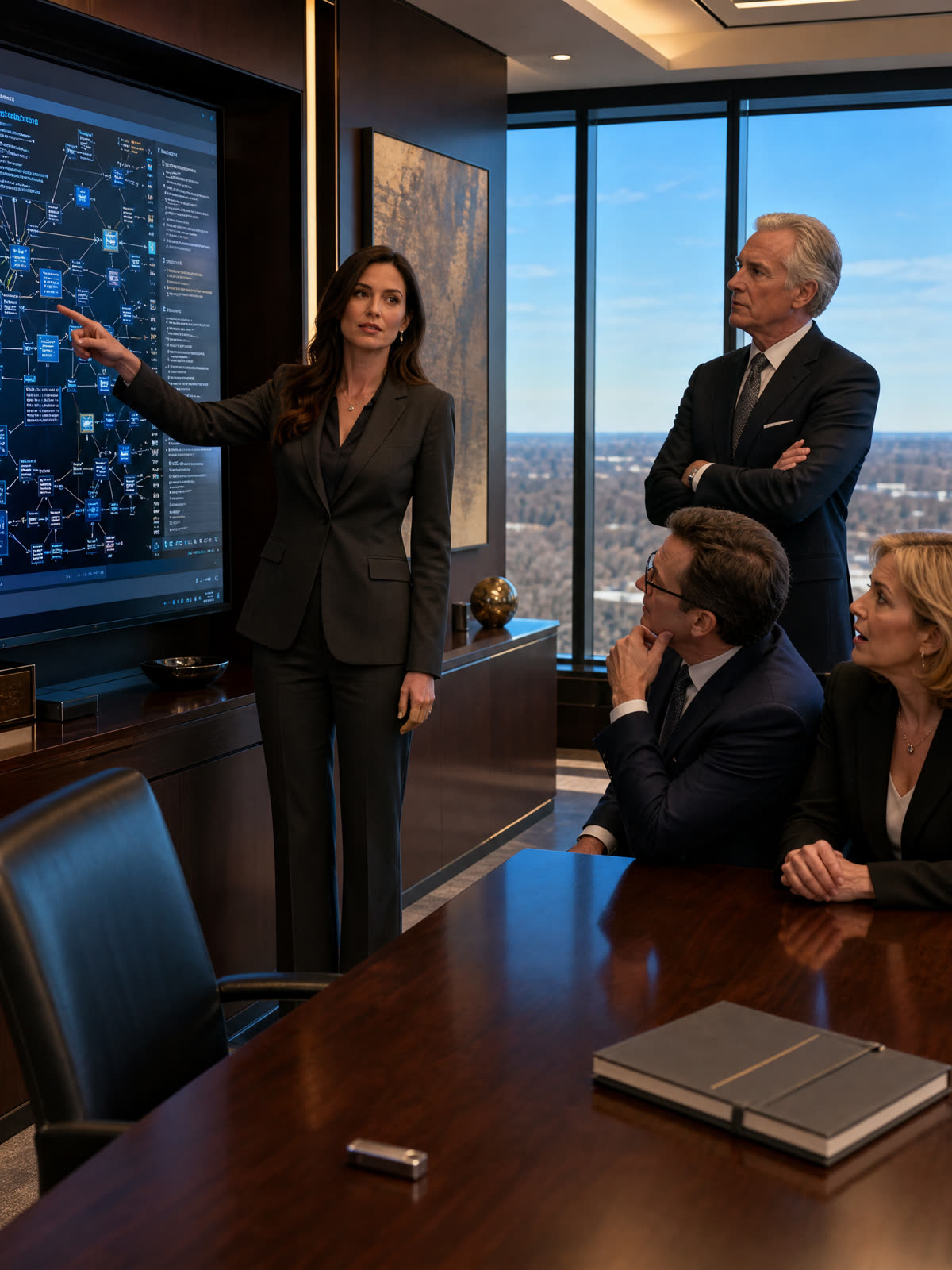
Mark lifted the bound complaint, inspected its opening page, and shook his head with slow disgust. “The IP routing is authenticated. This isn’t just malicious filing, Aaron. This is an admission of grand larceny and systemic wire fraud.” Aaron rose without speaking. He crossed to the service credenza, where an industrial cross-cut shredder stood in the corner. He guided the bottom edge of Hunter’s sixty-page accusation into its intake and watched the machine consume it. For ten years I had listened to demands disguised as obligations. The grinding of those pages was the most soothing sound I had heard in all that time.
Aaron turned back, straightening his cuffs. “We protect our people,” Aaron said, his baritone cold and decisive. “And when an idiot hands us proof of a federal felony on a silver platter, we do not hesitate. Mark, contact the regional director of the SEC. Copy the United States Attorney for the Western District of North Carolina. Deliver everything on Kelsey’s drive.” The faintest approving smile touched his face when he looked at me. “Take your badge, Kelsey. Take your laptop. Go have lunch. And take the rest of the week off—you’re going to need clean calendar space to watch this burn.”
I collected my credentials, fastened my identification to my lapel again, and returned to the corridor. Another vibration came from my phone. Dana had sent an Instagram screen recording accompanied by four words: You need to see this. I opened it inside the elevator. Chelsea appeared on the polished herringbone floor of her walk-in closet, wrapped in an eight-hundred-dollar cream cashmere set. Her blonde hair had been arranged into the appearance of distress. She performed tearful devastation for forty-five thousand followers, her manicured composure surviving every carefully timed break in her voice.
“I never thought… I never thought I would have to share something this painful,” she sobbed into the lens, her voice catching with dramatic precision. “My own sister… Kelsey Mitchell, who works as an auditor at Boyd Consulting … has systematically drained our family’s life savings. She manipulated our aging, vulnerable parents into signing over their business, locked them out of their accounts today, and is attempting to throw us out of our home out of pure, jealous spite. Please… if you believe in justice… make sure her firm knows what kind of monster they are employing.” Boyd Consulting was tagged beneath the video. The responses already included Sociopath! Report her to the board! Call the police!
I felt neither surprise nor anger. I recorded the screen, exported the high-resolution file to my personal cloud, and created a directory labeled Mitchell-Vaughn Defamation and Tortious Interference. An investigator does not interrupt someone who is voluntarily preserving proof of their own liability. At 3:15 PM, I drove into my condo building’s underground garage. The development was quiet and discreet: four floors of reclaimed brick, copper gutters, and private terraces. Kenneth, the former Marine sergeant who had supervised its front desk for seven years, knew faces with remarkable precision and considered disorder in his lobby a personal affront.
As I came through the interior garage entrance, Kenneth caught my eye and tipped his chin toward the seating area. “Afternoon, Miss Mitchell,” he said, stepping from behind the desk with military posture. “Your family arrived forty minutes ago. I informed them of the building protocols, but your mother… well, she declined to abide by traditional guest etiquette.” Marilyn occupied the emerald velvet banquette with her designer tote clutched against her like protective equipment. Her camel-hair coat hung open over a silk blouse darkened with perspiration at the collar. Chelsea sat beside her, almost unrecognizable from the immaculate victim in the video.
Mascara streaked Chelsea’s cheeks. Her expensive sneakers were scuffed, and both hands shook around an iced latte. Marilyn sprang up when she saw me, her heels striking the marble. “You sociopathic little ingrate!” she shrieked, her voice echoing off the twelve-foot ceilings. “Look at me! Look at what you’ve done to your sister! Look at what you’ve done to your father!” Kenneth moved forward three deliberate steps, positioning his broad frame four feet from my shoulder. “Keep your voice modulated, ma’am,” Kenneth said, his baritone dropping an octave. “This is your final administrative warning.” My mother acted as though he had not spoken.
She aimed a trembling, manicured finger at my face. “Hunter’s clearing terminals were frozen an hour ago! The regional compliance board is at his firm right now! He called Chelsea hysterical! You call your bank, Kelsey! You call them this second and restore the holding company lines, or so help me God, I will dismantle your entire existence!” I kept my hands in my coat pockets. “Hunter’s terminals weren’t frozen because of a domestic disagreement, Marilyn,” I said, my tone as flat as an iron plate. “They were frozen because your son-in-law is a common thief who ran out of other people’s money to steal.”
Chelsea gasped and covered her face. “You’re lying! You’ve always hated him because he’s brilliant! Because he built something real while you sit with your sad little numbers!” Marilyn moved closer, bringing a suffocating cloud of perfume with her. Rage had failed to shift me, so she reached for the threat she considered final. Her expression twisted into triumphant contempt. “You think you’re clever, Kelsey?” Marilyn whispered, her face twisting into a hideous, triumphant sneer. “You think you’re safe in this little ivory tower? Who do you think paid the seventy-thousand-dollar down payment on this condo five years ago? That check came straight from the Ferguson treasury account! You are living in a property bought with our sweat! You are a parasite! And I swear on my life, I will have Patrick Ford file an ejectment order by Friday morning! You will be sleeping on the sidewalk where you belong!”
PART 3: The Last Reserve
For five long seconds, I looked at my mother. There was no anger in me, no desire to raise my voice. What I felt was a heavy, sorrowful pity for someone who believed she had won a game without noticing the cards already exposed across the table. I opened my leather document folio and removed a notarized instrument backed in blue. The gold seal of the Mecklenburg County Register of Deeds caught the lobby light. I held the paper four inches from her face. “Read the grantor line, Marilyn,” I commanded quietly. Her eyes moved across the legal language despite herself.
“Five years ago,” I said, the words falling like lead sinkers, “the down payment draft did indeed come from the Ferguson treasury account. An account belonging exclusively to an LLC whose sole, hundred-percent equity owner is Kelsey Mitchell. Legally, that was an equity dividend paid to myself. Last March, using my senior performance bonus from Boyd Consulting, I wired the remaining four hundred and twenty thousand dollars to settle the primary mortgage.” I turned the sheet and touched the certified registry stamp. My mother’s ownership claim rested on the same convenient omission that had supported ten years of demands: she had forgotten whose company it was.
“There is exactly one name on this master fee-simple deed. It is mine. My father has no interest. The company has no interest. And if Patrick Ford attempts to file an encumbrance on this parcel, I will have him disbarred for filing fraudulent instruments before the ink on his signature is dry.” Marilyn’s complexion changed in stages. Furious red gave way to an uneven gray of confusion, then to the drained whiteness of complete shock. Chelsea lowered her hands. Her sniffling stopped as she stared at the seal with the alarm she might have reserved for something poisonous appearing between us.
Kenneth stepped between my mother and me, facing her with the unmistakable finality of a closed gate. “Ladies,” Kenneth said, gesturing toward the brass revolving doors. “You are neither registered residents nor invited guests. The property manager has authorized me to direct you to the sidewalk. If your heels do not cross the threshold within thirty seconds, the Charlotte-Mecklenburg Police Department will assist you into the patrol cars currently idling on the corner.” Two security officers in dark blazers appeared beside the elevator alcove, hands folded behind their backs. My mother opened her mouth, apparently searching for a name, an address, or an inherited distinction powerful enough to reverse the situation.
Nothing came. The law she had threatened to use against me offered her no shelter. “You will burn in hell for this, Kelsey,” she whispered, her voice cracking into a dry, broken husk. I adjusted my collar. “Perhaps,” I replied, adjusting my collar. “But I will own my condo while I do.” I walked away. As the elevator doors closed, I watched my mother and sister being escorted down the front steps into the sharp January wind. There would be no entry to my home, no restoration of their access, and no surrender of the document in my hand.
Chelsea’s remaining afternoon came to me later through bank records and discovery materials. It gathered speed with the dreadful inevitability of a derailment. After leaving my building, she took an Uber to South Park. Shopping was the remedy she knew for any injury to her social standing, and she went to an exclusive boutique whose employees had served her champagne for three years. She chose a calfskin handbag, two silk evening dresses, and a cashmere wrap. Together, they cost slightly more than nineteen thousand dollars. At the marble register, she positioned her phone to film a “spontaneous haul” for her followers and dropped her personal platinum card onto the counter.
DECLINED. She gave a nervous laugh, blamed a banking mistake, and offered another card. DECLINED. Her third attempt produced ACCOUNT CLOSED BY ISSUER. Two women from her Pilates circle watched from behind a display of wool coats, whispering behind polished hands. The manager quietly removed the merchandise and asked, with careful courtesy, whether a relative could settle the balance. Chelsea left without a single purchase. Another ride-share carried her back to the three-story townhouse she shared with Hunter. She burst through its entrance screaming, bringing the humiliation from the boutique into a house already occupied by a much larger disaster.
Hunter was pacing through the open living room. His designer tie lay across the leather sofa, and sweat soaked his white shirt. A half-finished bourbon rested on the marble kitchen island. His corporate laptop stood open on the dining table, displaying an emergency compliance summons from FINRA. Chelsea hurled her handbag against his chest and shrieked that he had embarrassed her before her friends. She demanded an explanation for the dead cards. He offered neither apology nor comfort. He seized her wrists, shoved her backward against the sofa, and shouted that his firm had taken his credentials. The SEC had imposed an emergency preservation order on their domestic accounts.
Federal agents, he told her, would arrive within seventy-two hours. “I need cash, Chelsea!” he roared, veins bulging in his temples. “I need fifty thousand dollars in paper currency for a white-collar defense retainer before the grand jury convenes tomorrow morning!” He stormed into his home office, opened a lower filing drawer, and retrieved an encrypted iron-key drive. It contained his private emergency cushion: two hundred and forty thousand dollars in speculative cryptocurrency assets and shell-account balances. For three years, he had concealed that money from creditors, business partners, and his wife. He inserted the drive and signed into the primary ledger.
One unmistakable figure filled the screen: $0.00. Hunter refreshed the page three times. His breathing caught, turning into a rough, wet gasp. Then he opened the transaction history. Beginning eight months earlier, thirty-two consecutive withdrawals appeared in the records—orderly twenty-thousand-dollar transfers sent into an unlinked regional checking account. His last reserve had not disappeared in the bank freeze. It had been leaving for months. Hunter turned toward the doorway. Chelsea stood there, no longer crying. Her expression had become blank with the absolute panic of someone who could no longer find a way out.

She broke before he even lifted his hand to ask. The businesses she advertised had not financed the lifestyle she displayed. Her launches, business-class holidays in Tulum, designer purchases, and five-thousand-dollar styling appointments had required money that her ventures never earned. Two years earlier, Gary had stopped her personal allowances while trying to keep Ferguson Freight operating. Chelsea had then found Hunter’s iron-key recovery phrase written inside an old passport in his desk. The hidden reserve he trusted more than any person had been accessible to the person living down the hall.
Whenever her credit limits tightened, she had transferred money out of his secret accounts. Quietly and repeatedly, she used those reserves to keep presenting herself as a success. The expensive travel, the luxury shopping, the carefully framed proof of prosperity—all of it had continued while the balance he believed untouchable dwindled behind his back. Hunter had stolen from clients to conceal his trading losses, moved money through the company bearing my name, and tried to destroy my career when the route closed. Meanwhile, the wife beside whom he had performed wealth had been draining the cushion he expected to save him.
The man who treated everyone else’s money as available capital had been systematically emptied out by the very person he had never thought to suspect. His polished financial persona had survived on concealed deficits, borrowed status, and an emergency account he had not checked closely enough. Chelsea’s equally polished public life had survived by feeding on that same account. Now the cards were closed, the company lines were frozen, the evidence had reached regulators, and the screen offered neither of them anything beyond the balance already displayed. The neighbors across the courtyard later told police that the screaming was followed by the crash of a five-thousand-dollar Italian glass dining table shattering against the hardwood floor.
Disclaimer: This story is a work of fiction inspired by real-life themes. Names, characters, places and events are fictionalized, and any resemblance to real persons is purely coincidental. Images are for illustration purposes only.
