

PART 1 — The Locked Door
For 31 mornings, I secretly carried apples to a starving donkey tied up behind my neighbor’s barn. On the thirty-first morning, he caught me and aimed a shotgun straight at my chest. “Touch my animal again, old woman, and I’ll bury you both.” At 2 a.m. the following night, that donkey began screaming just outside my bedroom window.
My name is Bev Loomis. I’m sixty-seven years old, and I live by myself on twelve acres in the Missouri Ozarks.
My husband, Lyman, died three winters ago. We used to have apple trees, a vegetable garden, and two elderly cats. These days, it’s only me and the cats.
My closest neighbor is Vernon Crisp. His farm sits a quarter mile down the gravel road.
Vernon is seventy years old and a difficult man. He never waves. He never attends church. When Lyman passed away, everyone along our road brought us a casserole. Vernon didn’t even bother sending a card.
Last summer, his daughter left for an overseas Army deployment. She entrusted her two children to his care. Abel is seven, and Sunny is four.
Every so often, I’d notice them playing in the dirt near his porch. They were barefoot and dirty, with no one keeping an eye on them.
In September, I was walking along the fence when I noticed something behind Vernon’s barn.
A donkey.
He was gray with a white nose, fastened to a post by a short, rusty chain. He couldn’t get to the shade or reach any grass. His water bucket was empty and lying on its side. His hooves had grown so long that they curled upward like slippers.
He was so skinny that every rib showed.
When he noticed me, he let out a quiet, sorrowful sound. Almost as if he were asking me something.
I went back home and cried. Afterward, I filled a bucket with water and gathered a bag of apples from Lyman’s trees.
Then I slipped through the fence and offered them to him.
He ate so carefully and softly. Once he had finished, he gently pushed his nose against my hand.
I decided to call him Moses.
From that morning on, I returned every day before sunrise, carrying water and apples along the fence line. Moses was always there waiting for me. The moment he spotted me, he’d make that same quiet little sound.
He began putting on weight. His eyes started looking brighter.
On the thirty-first morning, Vernon caught me.
I heard the screen door bang shut. When I turned, he was standing there in his boots and undershirt, with a shotgun in his hands.
He aimed it directly at my chest.
“What do you think you’re doing on my land?”
“Vernon, he’s starving. He doesn’t have water.”
“He’s my animal. I’ll take care of him how I want.”
“You’re not taking care of him at all.”
His face turned a deep shade of red.
“You think you’re better than me? You and your dead husband, with your church and your casseroles. You’ve always looked down on me.”
“I’ve never looked down on you, Vernon.”
“Touch my animal again, old woman,” he said, “and I’ll bury you both.”
Behind him, Abel and Sunny stood on the porch in their pajamas, watching everything.
Sunny was crying.
I glanced at the children, then at the gun. I made up my mind that fighting him wasn’t worth it.
All I said was, “Okay.”
I set my bucket of apples down, went back through the fence, and returned home.
I didn’t contact the sheriff that day. Perhaps I should have. But I was frightened, and my thoughts kept returning to those children. If Vernon were arrested, who would look after them?
That night, I barely slept. I couldn’t stop imagining Moses waiting for me in the darkness.
At 2:07 a.m., I woke to the most awful sound I had ever heard.
A donkey braying. It was loud and frantic, again and again, like a siren.
The sound was coming from right outside my bedroom window.
I snatched up my flashlight and hurried onto the porch.
Moses stood in my front yard. A broken length of rusty chain dangled from his neck. He had snapped it. His sides rose and fell heavily, and his eyes looked wild.
When he spotted me, he turned and ran in the direction of Vernon’s farm. Then he stopped, looked back at me, and brayed.
He was trying to get me to follow him.
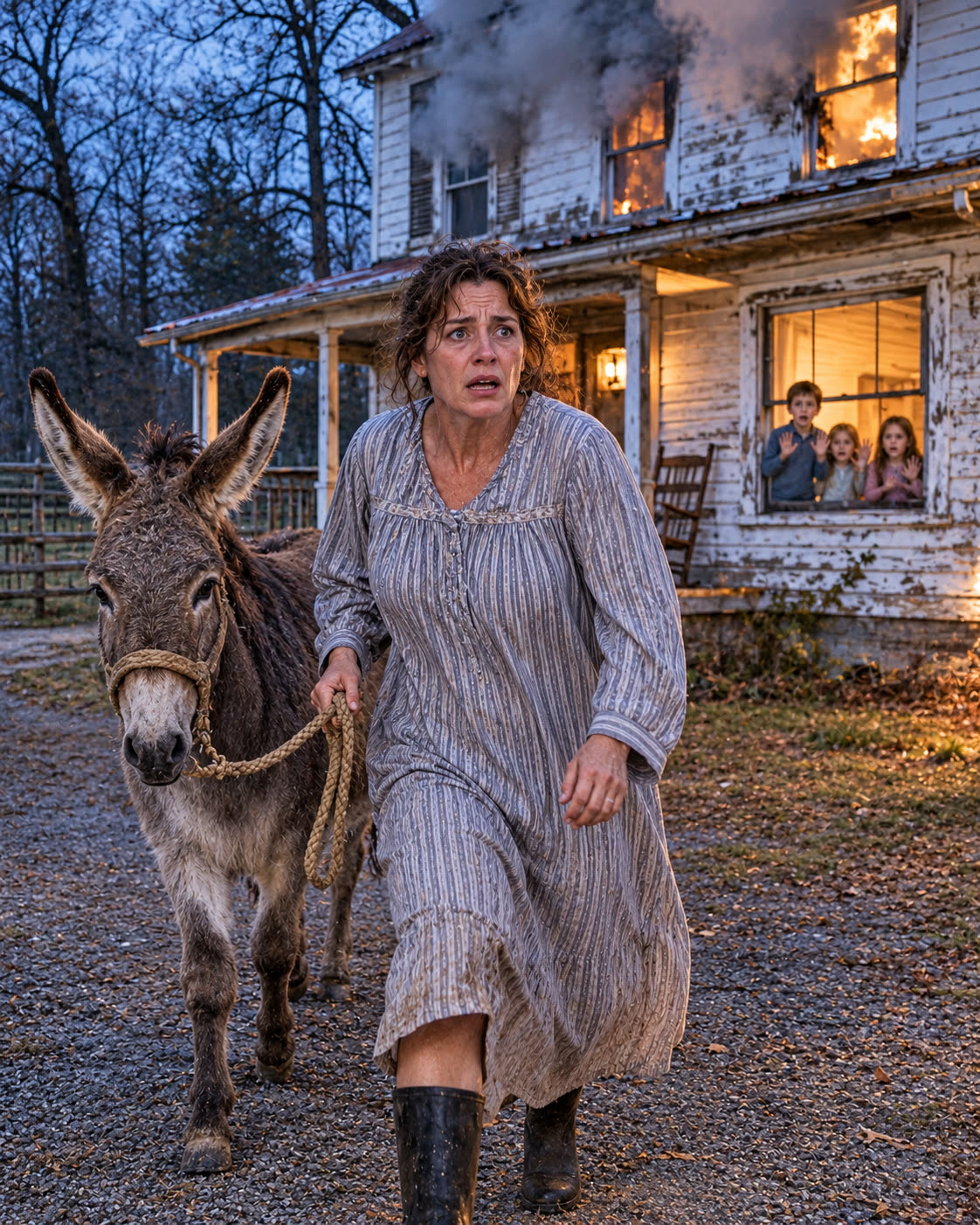
I pulled on my boots and ran down the gravel road in my nightgown.
Halfway there, I noticed the smell.
Smoke.
As I rounded the bend, orange light flickered through the downstairs windows of Vernon’s house. Smoke was streaming from beneath the eaves.
His truck was sitting in the driveway. Its lights were off.
No one was coming outside.
Then, upstairs, behind the bedroom window, I saw two tiny hands pressed against the glass.
I dialed 911 as I ran. The closest fire station was fourteen miles from us.
Fourteen miles of gravel roads, in the middle of the night.
Those babies couldn’t wait that long.
I raced onto the porch and tugged at the front door. Locked, as always. Vernon never left it unlocked.
I hammered against it with both fists. “Vernon! VERNON! Wake up!”
No answer. I hurried around the house to the kitchen entrance. That door was locked too—thick, old oak.
I slammed my shoulder into it, but it wouldn’t budge. At sixty-seven, I simply wasn’t strong enough.
Then Moses shouldered his way past me.
He went straight to the back door, turned his body, and struck it with both hind legs. The first kick split the frame.
With the second kick, the door burst inward and slammed against the wall.
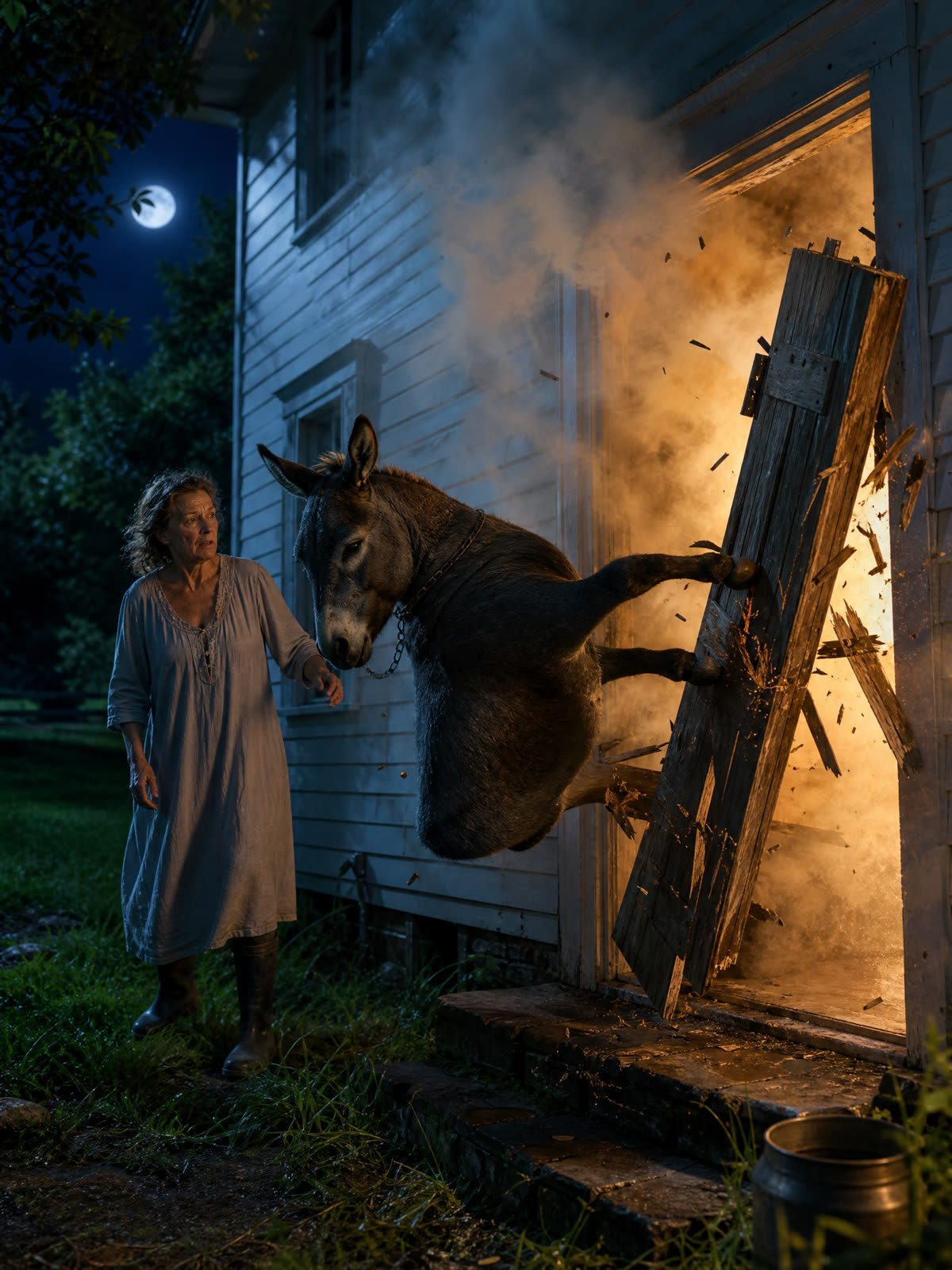
I will remember that for the rest of my life. Smoke billowed through the opening. Holding my nightgown over my mouth, I stepped inside.
The living room was burning. An old extension cord behind the television had sparked, setting the curtains alight.
Vernon sat in his recliner beside the flames. He wasn’t moving.
PART 2 — Through the Smoke
I hooked my hands beneath his arms and pulled.
He’s a large man. Even now, I can’t explain how I managed it.
Somehow, I dragged him across the kitchen and outside onto the grass.
He began coughing. He was still alive.
I turned and rushed back into the house, then climbed the stairs.
Abel and Sunny were beneath the bed in the back bedroom, clinging to each other. Abel had covered his little sister’s face with a wet T-shirt, exactly as he had learned at school.
“Come on, babies. Hold my hand. Don’t let go.”
We reached the bottom of the stairs and escaped through the kitchen door just as the living room ceiling began collapsing.
The fire engines arrived twenty minutes afterward. By that point, the downstairs was lost.
We sat together on the grass in the darkness, watching: me in my smoke-blackened nightgown, Vernon beneath a blanket with an oxygen mask covering his face, and both children in my lap.
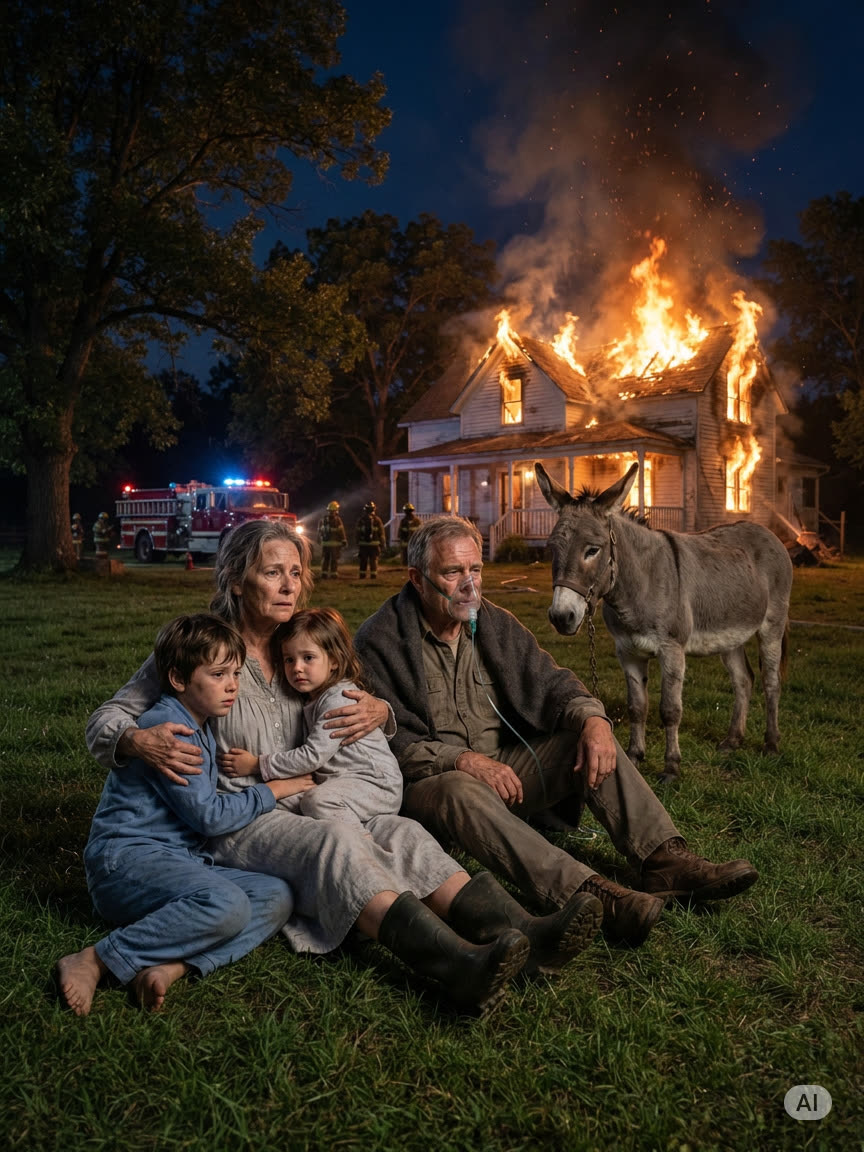
Moses stood beside us, the broken chain still dangling from his neck.
After the paramedics finished examining Vernon, he removed his oxygen mask.
For a long while, he looked at me. Then his eyes moved to the donkey.
PART 3 — The Gate Between Us
“I left him with no water,” he whispered. “I put a gun on you. And you both came back for me.”
Then he cried. There on the grass was a seventy-year-old man who had never even waved to anyone, weeping.
“I’m sorry, Bev,” he said. “I’m so sorry.”
While his house was being rebuilt, Vernon and the children lived with me. They stayed four months.
I learned that he wasn’t cruel. He was drowning. His wife had died four years before, and his daughter was overseas. Alone with two children and a farm, he didn’t know how to manage, but pride had kept him from asking for help.
The church ladies brought their casseroles. This time, he thanked them.
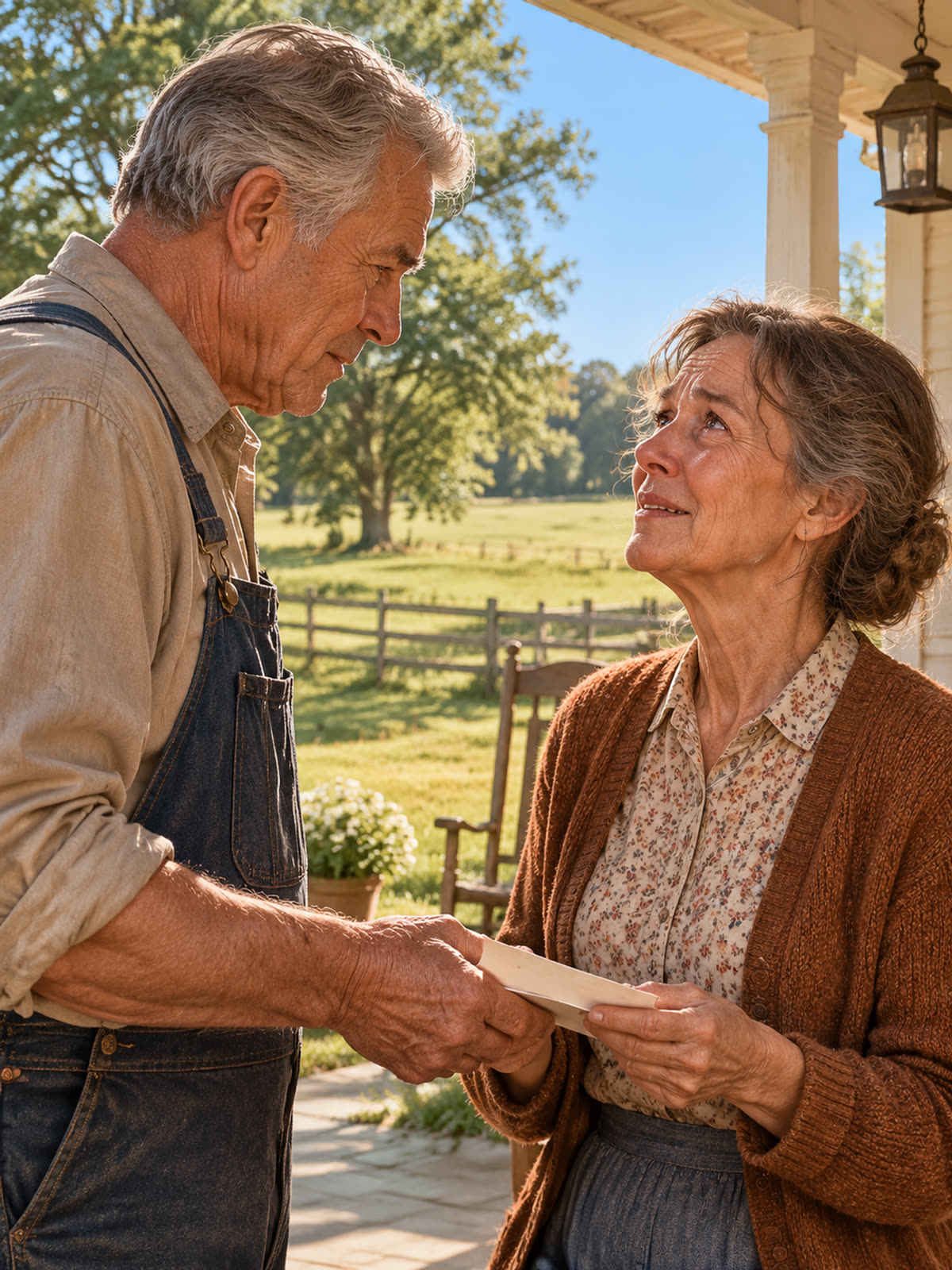
Once his new house was ready, Vernon came to my porch carrying a sheet of paper.
It was the bill of sale for Moses.
He had transferred ownership to me.
“He’s yours,” Vernon said. “He always was, really.”
Afterward, he and Abel put a gate into the fence separating our farms.
These days, Abel and Sunny pass through that gate every morning before school.
They carry a bag of apples.
Moses is always there waiting.
Kindness shown to an animal is never wasted. Sometimes, that very kindness returns to save our lives.
Do you believe animals know who loves them? Tell us in the replies.
Disclaimer: This story is a work of fiction inspired by real-life themes. Names, characters, places and events are fictionalized, and any resemblance to real persons is purely coincidental. Images are for illustration purposes only.
