

PART 1 — The Envelope His Mother Feared
Leaving the notary’s office with my little boy in my arms, I watched my former husband’s face drain of color as his mother declared that the home his father had left belonged to their family. “You are no longer part of this family,” she snapped. I would not argue with her. Instead, I directed their attention to the envelope my former father-in-law had prepared. It contained a signed document dated May 7, and what it revealed would overturn everything they thought they knew.
“That woman doesn’t deserve a chair in this office! She divorced my son, and now she’s come to take my husband’s money!” Marguerite Prescott shouted, pointing at Eleanor Hayes before everyone gathered there. Eleanor, thirty-three, stood near the doorway with a small handbag held against her dark green dress. She had not come looking for a confrontation. Thomas Prescott, the only person in that family who had consistently treated her like a daughter, had expressly asked that she attend.
Thomas had died in Charleston three weeks before, aged seventy-one, after a cardiac complication. His death had left Eleanor heartbroken. No one present understood that the instructions he had left behind would also uncover secrets powerful enough to unsettle one of Charleston’s most established families. In the elegant downtown office, Marguerite had chosen the most commanding chair. Her cream suit and pearls were immaculate. Warren Prescott, her thirty-six-year-old son and Eleanor’s former husband, sat beside her. His new wife, Camille, whose family was wealthy, looked distinctly uncomfortable with Eleanor there.
“I don’t understand why my father insisted on inviting you,” Warren murmured. “You don’t belong to this family anymore.” Eleanor looked directly at him, showing no anger. “I didn’t come for you.” Her calmness disturbed him more than an argument might have. Their marriage had endured four years. They had met while Eleanor was restoring antique fittings in a hotel belonging to his family. She had grown up in a modest North Charleston house, where her mother’s sewing supported the children. Warren had known a different world: the family’s pecan distribution company, valuable properties, and their historic estate in Summerville.
Marguerite had never concealed her disapproval. “A girl without an important last name always ends up wanting something,” she would remark within earshot of visitors. Thomas had offered Eleanor the affection his wife withheld. He brought meals when work kept her late and celebrated her first important professional contract. “A person’s worth isn’t in her bank account, honey. It’s in what she does when nobody’s watching.” Warren seldom stood between his wife and his mother’s disdain. In time, Eleanor could no longer endure the recurring humiliations, and she left the marriage. Their divorce had become final twenty-two months earlier. Warren then married Camille, the woman Marguerite had preferred all along.
The divorce had not ended Eleanor’s relationship with Thomas. He still visited, arrived with treats from a bakery in Summerville, and called her “honey.” To him, she had never been merely his son’s wife. Now Gerald Whitaker, the attorney, began presenting the will. Warren was to receive his father’s shares in the company and a considerable portion of the estate. Marguerite kept her marital property rights, along with the further provisions Thomas had made for her. Then Gerald read a name that neither of them expected.
“To Ms. Eleanor Hayes, from the portion of the estate subject to the testator’s free disposition, I bequeath the house in Summerville known as Magnolia Hollow and the sum of $142,000.” Marguerite shot to her feet. “That’s impossible! That house is worth a fortune!” Warren had gone pale. “My father was sick. She must have talked him into it.” Gerald cut through their accusations. “Mr. Prescott made a record of his capacity and his wishes. He also left a letter that was to be opened in your presence.”
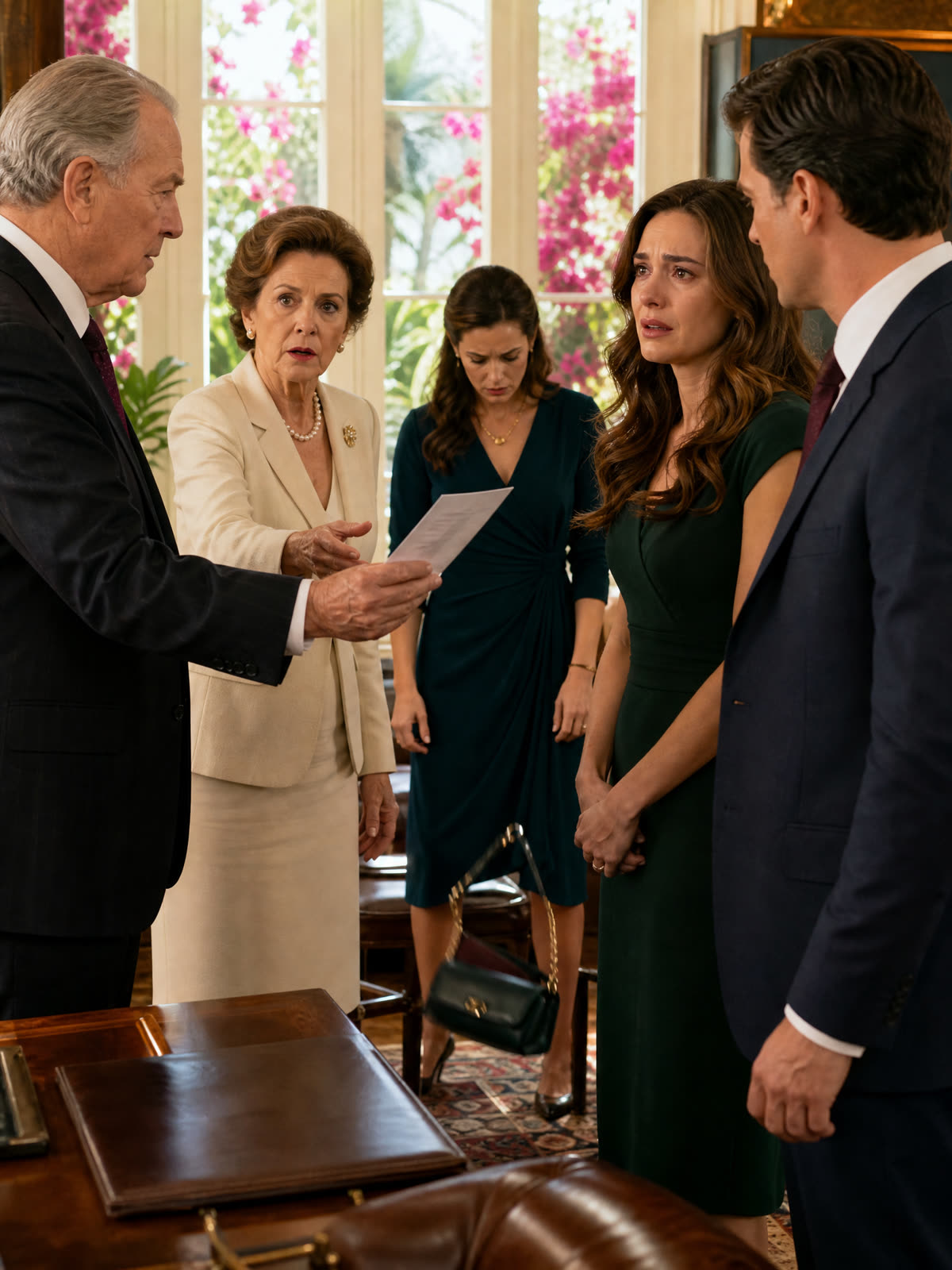
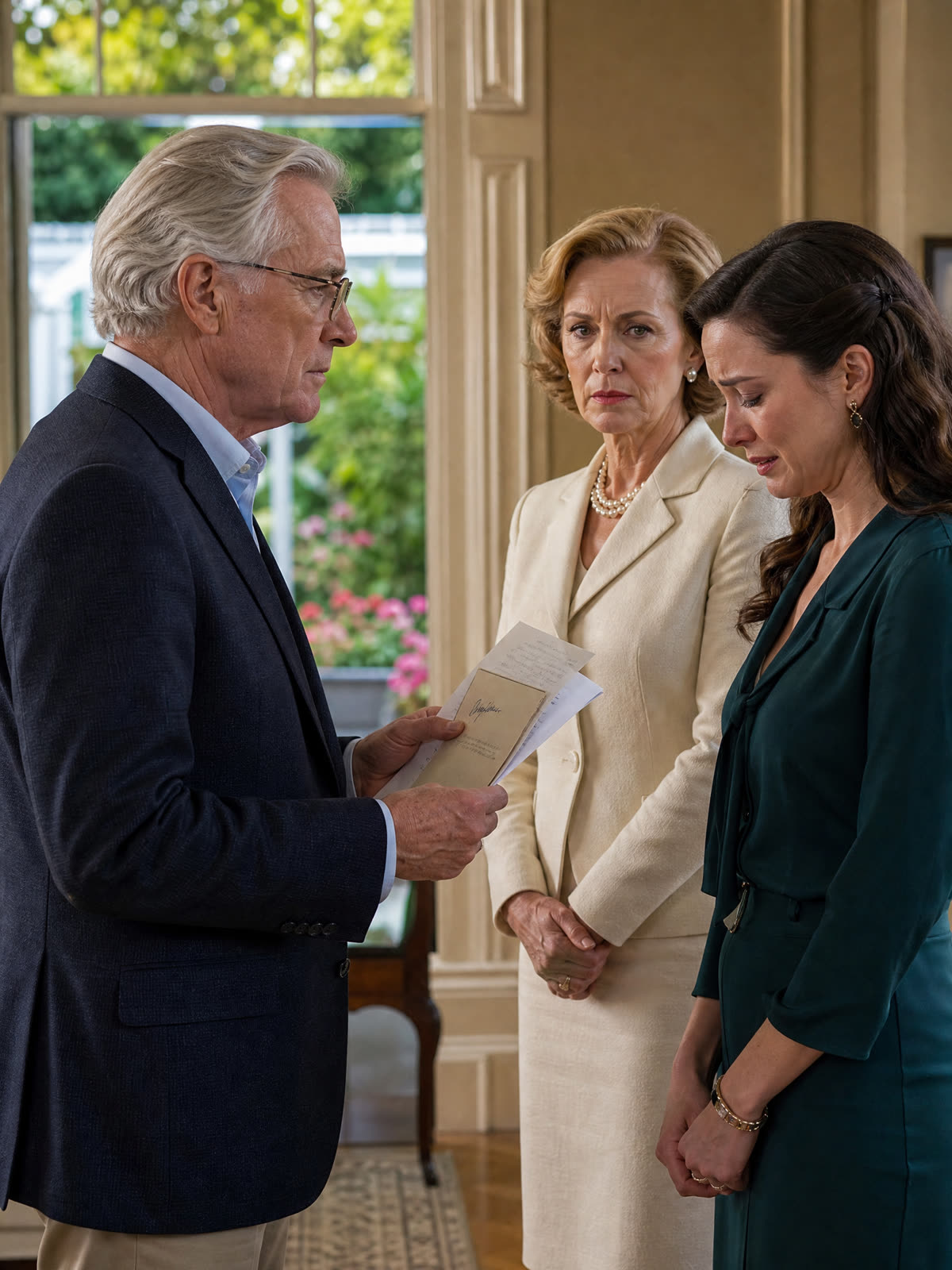
Gerald took a cream envelope from the file. Across it was Thomas’s unmistakable handwriting: “If Marguerite accuses Eleanor of deceiving me, read first what happened on May 7.” Marguerite’s protests stopped. That date meant something to her, something she had spent more than a year keeping concealed. Warren noticed how carefully she avoided the envelope. “What happened that day, Mother?” he asked. “Nothing of any importance. Your father was confused.” Gerald opened the letter.
“For years I let my wife look down on Eleanor because she was born into a humble family. My son allowed those humiliations too. But neither of them knows the true price of their decisions.” Warren leaned forward. Gerald continued: “On May 7, Eleanor tried to tell my son news that would have changed his life. She sent a notice to the family offices. Marguerite signed the delivery receipt. Warren never received that document.” “Lies!” Marguerite cried. Gerald was already holding a duplicate receipt carrying her signature.
Eleanor felt lightheaded. For months, she had believed Warren had received her news and deliberately rejected it. After she sent the notice, a vicious message had arrived from a device linked to his number, telling her to stop contacting him. Now the certainty she had lived with was falling apart. “What news?” Warren asked. Marguerite reached abruptly for the document, but Gerald moved it beyond her grasp. “That letter informed him that Eleanor was pregnant. And the child she was carrying was Warren’s.” Silence filled the room. Camille’s purse slid from her hands.
Warren turned slowly toward Eleanor. “You were pregnant?” Tears rose in her eyes. “Yes.” “And where is that child?” Eleanor looked toward the courtyard. “Very close.” Gerald explained that Thomas had met his grandson shortly after the birth. He had also retained the evidence supporting his wishes, determined that Eleanor would not face unjust accusations over the inheritance. Marguerite began to cry, though her tears brought no admission of wrongdoing. “You hid our own grandson from us!” “I tried to tell his father,” Eleanor answered. “You received that letter.” Warren faced his mother. “Mother, tell me you didn’t do that.” She said nothing.
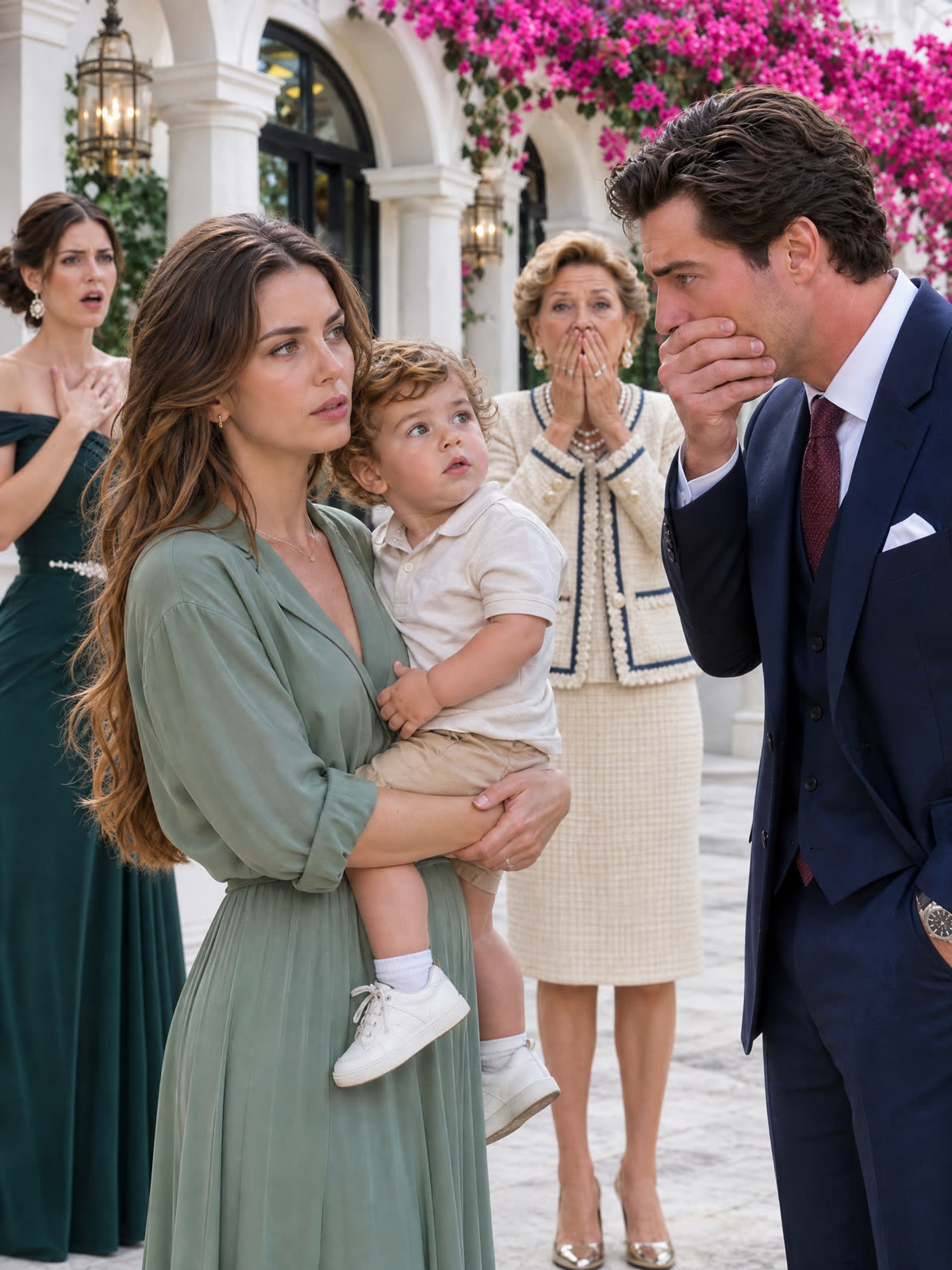
Eleanor needed air. She asked to fetch her son from the courtyard, where her mother, Nancy, was caring for him. Outside, antique lanterns and white arches framed a small garden bright with fuchsia bougainvillea. Nancy carefully placed the child in her daughter’s arms. He was fifteen months old, with soft chestnut curls and eyes that strikingly resembled Warren’s. Eleanor had named him Thomas. Warren followed her outside and stopped at the sight of him. Holding her son against her sage-green blouse and matching long skirt, Eleanor watched Warren raise a hand over his mouth.
“My God… He has my eyes.” Marguerite stood behind him without speaking. Camille had stayed farther back in the corridor. Warren took a cautious step closer. “Eleanor, why did you tell me you never wanted to see me again?” Eleanor stared, bewildered. “I never said that. You’re the one who wrote me that you wanted nothing to do with us.” “I never got your letter. And I never sent you any such message.” The words left the space between them charged with a truth neither had understood.
Camille suddenly began to cry. “Warren… there’s something you need to know.” Marguerite wheeled around. “Camille, be quiet!” This time, Camille would not obey. “Your mother hid the letter, it’s true. But the message Eleanor got that night…” Her gaze moved from the little boy to her husband. “I wrote it. From your tablet. And your father found out what we did before he died.”
PART 2 — The Months They Could Never Return
Warren stepped backward, unable to look at Camille. Instead, he watched the child playing innocently with a button on Eleanor’s blouse, unaware of the revelations breaking around him. “Did you know I had a son?” he asked. Camille nodded through her tears. “Your mother told me Eleanor was pregnant. I thought if you knew, you’d go back to her.” “And you decided to keep me from knowing my own child?” She dropped her eyes. “I was afraid of losing you.” Warren gave a joyless laugh. “Well, you’ve just accomplished exactly that.”
Marguerite hurried to intervene. “Son, Camille only wanted to protect your marriage.” “Protect it from what, Mother? From a baby who hadn’t even been born yet?” She had nothing to say. Nancy moved to Eleanor’s side. “Let’s go, sweetheart. Thomas needs to eat.” Marguerite immediately recognized the woman whose occupation she had spent years belittling. “Mrs. Hayes, wait. I need to meet my grandson.” Nancy’s answer was restrained and dignified. “He’s been in this world fifteen months, Mrs. Prescott. He hasn’t missed out on anything because his mother is poor. He’s missed out because you decided my daughter didn’t deserve to be part of your family.”
Marguerite looked down. Nobody defended her. Eleanor settled Thomas more securely against her hip and turned to Warren. “Warren, our son isn’t to blame for anything. But today I won’t let him witness another fight.” He nodded. “I just want to know why my father knew him and I didn’t.” The explanation reached back to the period soon after their divorce, when Eleanor had been restoring an old mansion on South Battery. Persistent nausea had worried a coworker enough to accompany her to a clinic. There, just as Warren was publicly announcing his engagement to Camille, Eleanor learned she was pregnant.
She had spent that night awake, studying the ultrasound image she had brought home. The marriage had hurt her deeply, but their child should not suffer for either parent’s choices. Eventually, she wrote Warren a letter. She explained the pregnancy and made it clear she was not asking to reconcile; they needed to discuss their responsibilities as parents. Her calls had gone unanswered, so she sent a formal notice to the family offices and retained proof of delivery. Marguerite signed for it on May 7.
That evening, a message arrived from the tablet Warren regularly used for business. “Don’t look for me again. You’ve already gotten too much from this family. Solve your problems and let me live in peace.” The words crushed Eleanor. She read them over and over before giving up her efforts to reach him. As far as she knew, Warren understood that she was carrying his child and wanted neither of them. Months afterward, Thomas Prescott appeared at her little North Charleston apartment with boxes of books she had left at the marital home. By then, she was nearly six months pregnant.
Thomas saw her stomach at once. “Eleanor… is that baby Warren’s?” Her tears gave him his answer. He came inside, set down the boxes, and listened as she described the pregnancy, the registered letter, and the reply she believed Warren had sent. He studied the documents before speaking. “My son has made many mistakes,” he said at last. “But I find it hard to believe he wrote this.” Eleanor explained that the message had come from Warren’s usual device. Thomas asked for a chance to investigate when she was ready. “That child deserves to know who his father is. And Warren will have to answer for him, whether he likes it or not.”
Eleanor did not rule it out. But she was exhausted, frightened of being drawn back into the Prescott family’s conflicts, and desperate to finish her pregnancy in peace. Thomas respected her request for time, although he remained convinced Warren would eventually have to learn the truth. After that, he visited every week. He helped her buy a secondhand crib, devoted almost two hours to figuring out a stroller, and playfully rivaled Nancy over whose crab cakes were better. His presence brought support without the humiliating conditions Eleanor had once learned to expect from his family.
When Eleanor discovered she was expecting a boy, she asked Thomas whether she could give the baby his name. He took off his glasses. “You want to name him after me?” “I want him to have the name of a good man.” Thomas wept as she put her arms around him. On the day Eleanor gave birth, he went with Nancy to MUSC. He waited anxiously until a nurse told them both mother and child were well. When he held his grandson for the first time, he whispered: “Welcome, little one. Your grandfather took a lifetime to find you.”
From then on, Thomas was a constant in the little boy’s life. Every Tuesday, he came with fruit, diapers, and gifts he jokingly insisted were necessities. He helped the baby learn to clap and wave, and together they watched birds outside the window. All the while, he quietly pursued the mystery surrounding Eleanor’s letter and the message. Several weeks before his death, he searched archived business records and discovered the delivery receipt with Marguerite’s signature. He also traced the message to a tablet account Camille had used while preparing for her wedding.
Thomas confronted both women. Marguerite admitted keeping the letter from Warren, and Camille acknowledged sending the message. He demanded that they tell Warren everything immediately. They begged him to wait, but he refused. Before he could bring the family together, however, the cardiac complication took his life. He had already gathered the evidence and written his final letter. In it, he accepted responsibility for his own silence: “I believed I could find the right moment to talk to my son without causing Eleanor more pain. I was wrong. Silence, even when it comes from love, can end up doing harm.”
When Eleanor finished telling him what had happened, Warren sat on a courtyard bench with his face in his hands. “My father was there when he was born…” She nodded. “He was the one who held him while I recovered.” “And I was on my honeymoon with Camille.” His voice had dwindled almost to a whisper. Eleanor did not answer. Warren looked at the boy. “I missed his first steps.” “He’s still learning to walk,” she replied. “You can be there for the next ones.” At that, Warren broke down.
“I don’t know if you’ll ever be able to forgive me.” Eleanor drew a steadying breath. “It wasn’t all your mother’s fault, Warren. When we were married, you never defended me. You let them treat me as if I were worth less than everyone else. That was your choice too.” He bowed his head. “I know.” “And I made a mistake too, by not finding another way to confirm that you’d received the news. But I was scared, and I thought protecting our son meant keeping him away from all of you.” Thomas reached toward her face, and she kissed his small fingers. “What matters now is that he never pays for our mistakes again.”
Warren approached. “Can I hold him?” Eleanor paused before looking at their son. “First let him get to know you.” Warren crouched until he was level with the little boy. “Hi, Thomas. I’m…” His voice caught. He did not know how to introduce himself to a child who was his son but had never known him. Thomas inspected Warren’s burgundy tie, then stretched out a hand and touched it. Warren smiled through his tears. “I’m your daddy.” The boy giggled, and his father was overcome.
Marguerite had been watching from the corridor, looking suddenly older. When she started toward them, Warren stopped her. “Not now, Mother.” “But he’s my grandson…” “That’s exactly why. If you want to be part of his life, you’ll have to learn to respect his mother.” Marguerite remained where she was. For the first time, Warren had drawn a firm line without waiting for her permission. But the house Thomas had left Eleanor was not yet securely hers, and Marguerite would still have to decide whether to respect his wishes—or challenge them.
PART 3 — The Home Nobody Could Take From Her
Over the following days, the Prescott family began to change in ways none of them had foreseen. Warren moved out of the home he shared with Camille for the time being. He was not trying to punish her; he needed distance to comprehend how his wife could knowingly hide his child from him. Camille accepted that she was responsible. She admitted that fear had led her to cooperate with Marguerite and let her mother-in-law influence something she should never have controlled. “I thought I’d lose our future,” she confessed. “And I ended up stealing a piece of your past.”
Warren could not promise their marriage would survive. The injury ran deeper than an apology could reach. He turned instead to the responsibilities he owed Thomas and contacted Eleanor. A paternity test confirmed he was the boy’s biological father, and they began the process of formally establishing paternity and arranging their parental responsibilities. Eleanor wanted their son to become familiar with Warren slowly. Warren accepted that arriving abruptly in the child’s life would answer his own guilt rather than the boy’s needs.
Their first visits were held at a park near Waterfront Park. Nancy came with Eleanor, while Warren sat on a blanket and played with Thomas. At first, the toddler repeatedly reached for his mother. Gradually, he relaxed around the dark-haired man who always greeted him affectionately and crouched to meet him at his own level. Warren learned his son’s routine, his preferred foods, and the song he liked at bedtime. He also began discovering the effort ordinary childcare demanded.
One afternoon, while trying to dress a thoroughly wriggling Thomas, Warren looked at Eleanor. “How did you manage to do all of it alone?” Her smile was tinged with sorrow. “I wasn’t completely alone. My mother and your father helped me enormously. But there were nights I would have given anything for someone to tell me I could rest.” Warren looked away. There was no explanation that could excuse all the nights he had not been there.
The inheritance, meanwhile, moved toward a resolution. Marguerite initially sought legal advice about challenging the will, alleging that Thomas had lacked mental capacity. The medical evidence, Gerald’s records, and the exactness of Thomas’s instructions offered no support for that claim. The assets left to Eleanor had been his to distribute, and he had still made fair provision for his wife and son. He had not disinherited them. He had chosen to protect people he believed needed protection. Eventually, Marguerite dropped the challenge.
Administering the estate took several months, but the threats against Eleanor ended. Magnolia Hollow passed formally into her name, along with the $142,000. Her first visit as its owner stirred feelings she had not anticipated. The white house had green shutters, pots of plants gathered around the courtyard, and an old fig tree beside the well. Thomas had spent childhood summers there. In the main bedroom, a small box waited on the desk. Inside were receipts, family photographs, and a personal letter addressed to Eleanor in handwriting she recognized immediately.
“Dear Eleanor,
I know some will think I’m leaving you this house because you’re the mother of my grandson. But I want you to know I would have wanted to help you even if Thomas had never been born.
I watched you get back on your feet after losing your marriage. I watched you work without rest. I watched you care for your mother and rebuild your life without asking anyone for anything.
When everyone treated you like a stranger, you kept asking about my health. You never asked me for property. You never asked me for money. You only gave me something I had missed for years in my own home: the peace of being loved for who I am.
I want this house to be a place where my grandson grows up happy and where you never have to ask permission to feel at home.
And remember, daughter: you don’t have to go back to a place that made you small to prove you’ve learned to be strong.”
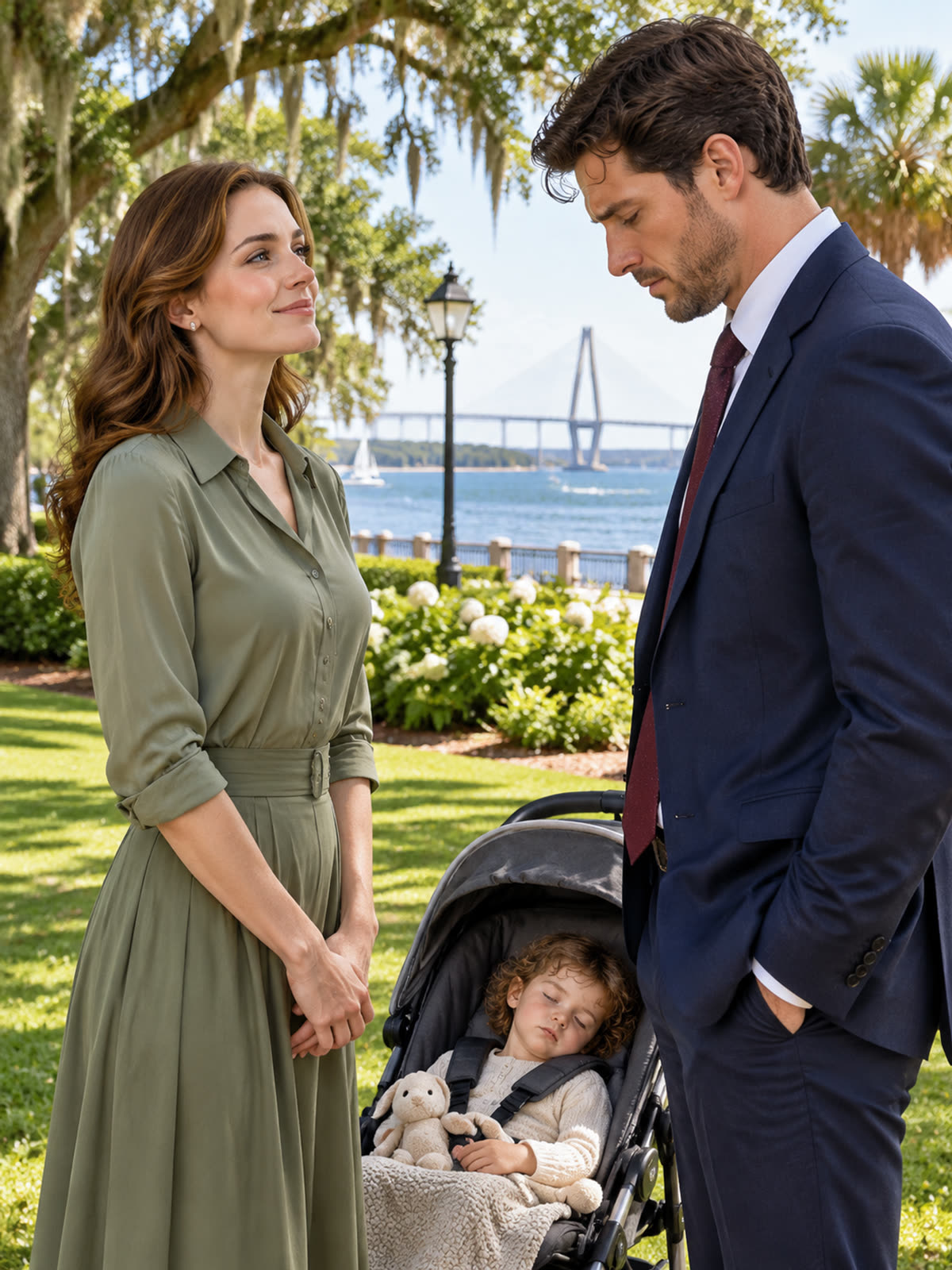
Eleanor sat at the window and cried for a long time. The value of the property was not what undid her. Thomas had seen a pain she had never managed to explain. Several months later, Warren asked to speak with her privately. They had brought Thomas to the park, and he was sleeping in his stroller. “Eleanor, I’ve changed a lot of things,” Warren began. “I don’t let my mother decide for me anymore. I’m trying to be a good father. And I know it may be too late, but I need to ask you.”
Eleanor waited. “What do you want to ask me?” “Do you think someday we could be together again?” She was quiet for a moment. There had been a time when she had ached to hear those words, imagining Warren at last understanding how deeply his indifference had wounded her. Now, faced with the possibility she had once wanted, she knew she did not want their marriage back. “No, Warren.” He closed his eyes. “I figured.”
“I’m glad you’re changing. Thomas needs a father who loves and respects him. But I don’t need to be your wife again for our son to have a family.” Warren nodded. “You’re right.” Eleanor smiled gently. “We can give him something we never had: two adults who can respect each other, even if they’re no longer in love.” He accepted her answer without arguing. This time, he did not call his mother to ask what he should do.
His relationship with Marguerite had changed, too. It took her a long while to understand that an apology could not erase years of cruelty. Eventually, she came to Magnolia Hollow carrying a small wooden box. It held an antique watch that had belonged to Thomas. “I want my grandson to have it when he’s older,” she explained. Eleanor agreed to keep it for the boy. Then Marguerite noticed Nancy playing with Thomas in the garden and approached the woman she had once looked down on.
“Nancy, I want to ask your forgiveness. I spoke about your work as though it were something shameful.” Nancy set down the toy. “Working to raise my daughter has never made me ashamed, Mrs. Prescott.” “I know.” “The shame belongs to whoever uses money to make other people feel inferior.” Marguerite bowed her head. “You’re right.” There was no embrace and no sudden friendship. Still, their conversation began a more respectful relationship, supported by boundaries that had not existed before.
Over time, Marguerite was allowed to visit Thomas within the arrangements they had agreed upon. She had to respect Eleanor’s independence and refrain from interfering with her choices. The boy grew surrounded by adults who were learning not to let their differences injure him. For his second birthday, Eleanor arranged a small celebration at Magnolia Hollow. Garlands hung beneath the fig tree, and the table held sweets, deviled eggs, and a cake decorated with little animals.
Warren came early to help. Nancy brought homemade crab cakes. Marguerite arrived with a modest gift and asked politely whether she could assist before coming inside. For once, the family spent time together without an argument. Nothing between them had become perfect, but they were beginning to understand that loving someone did not confer the right to control that person’s life.
After the party, Eleanor found Thomas beside a photograph of his grandfather. He pointed to it. “Grandpa Thomas.” She knelt next to him. “Yes, sweetheart. That’s your grandpa.” He brushed the glass with his fingers. “Where is he?” Tears gathered in her eyes. She glanced toward the fig tree his grandfather had planted before answering: “Your grandpa can’t come play with you anymore, my love. But he loved you very, very much. And this house is full of things he did thinking of you.”
Thomas drew the photograph against his little chest, and Eleanor wrapped him in her arms. Warren watched quietly from the doorway. At last, he understood that his father had not left the house to shame Marguerite or punish him. He had been trying to remedy an injustice the whole family had permitted. The inheritance had done more than transfer money and property. It had made the Prescotts face what their decisions had cost.
That evening, once the guests had gone, Eleanor set Thomas’s photograph on the mantelpiece and placed the private letter beside it. Before turning out the lights, she read its final sentence again: “Family isn’t the one who lets you sit at their table when it suits them, but the one who keeps a seat for you even when you can no longer offer them anything.”
Eleanor looked toward the room where her son slept. She had survived the end of her marriage, years of humiliation, and nights spent questioning her own worth. Yet Thomas Prescott, who had shared no blood with her, had given her something neither his wife nor his son could remove: the certainty that she had always deserved dignity. As a light breeze moved through the old fig tree, she understood that belonging did not depend on a wealthy family’s approval. Sometimes, true family consisted of the people who restored what others had tried to strip away. And Thomas’s greatest gift—the one that had finally made her free—had never appeared among the formal provisions of his will.
Disclaimer: This story is a work of fiction inspired by real-life themes. Names, characters, places and events are fictionalized, and any resemblance to real persons is purely coincidental. Images are for illustration purposes only.
