

PART 1 — The Father Who Came Back
For eleven years, I brought up my granddaughter after her father left her with me as a baby. Then he returned with money, an attorney, and a determination to remove her from the only home she remembered. I was afraid family court would hand her over to him—until she reached into her backpack for two things that drained the color from his face. Two days before that hearing, however, neither of us knew how our lives would unfold. “Grandma, what is going to happen to me if the judge makes me go live with him?” Nora stood at my bedroom entrance, pressing her battered stuffed bear against her chest. I had been folding the navy dress I intended to wear to court, but the fear on her face stopped my hands. “Come sit over here with me, sweetheart, and let us talk about it.” She crossed the squeaking floor and settled on the edge of my old bed. “Will I have to leave my elementary school and say goodbye to all my friends?” “I honestly do not know what the judge will decide, honey, though I am praying everything stays the same.” Then she asked, “And what about you, Grandma, who is going to take care of you if I leave?” My throat tightened. I could not think of an answer that would comfort her.
Nora was eleven, and I was the only parent she had truly known. Her father had disappeared soon after her mother died, yet now he wanted to take her from our home in Cedar Rapids. In two days, a judge would determine whether she could remain beside me or leave with a man who was practically a stranger. My daughter, Hannah, had died from unexpected complications when Nora was four months old. I could still remember cradling that little baby during the memorial service, listening to rain strike the church windows. People approached throughout the afternoon to express their sympathy. I heard their words, but one devastating thought drowned out everything else: my granddaughter would grow up without remembering her mother’s voice. Hannah was my only child. Losing her had broken my heart, and holding her baby was the one responsibility that kept me moving through those first terrible days.
Gavin barely said anything at Hannah’s funeral. One week afterward, he appeared on my porch with a diaper bag that looked only half full. He kept it in his right hand and avoided looking directly at me. “I am still way too young to handle all of this responsibility on my own, Dorothy,” he told me. “I have my entire life ahead of me, and raising a baby right now would only be a massive burden.” For a moment, I simply stared at him. He shifted uneasily on the steps while I tried to understand how he could speak about his own daughter that way. “She is your own flesh and blood, Gavin, and she just lost her mother.” “I know that, Dorothy, which is why this is so hard for me to say out loud.” His answer did nothing to make his meaning clearer or less cruel. “Then what exactly are you trying to tell me right now?”
He lowered the faded bag beside my porch chair. It contained two plastic bottles and a small package of newborn diapers that had already been opened. “I am saying that I simply cannot do this, so I am leaving her here with you.” Then he turned toward the driveway. He did not kiss Nora goodbye. He did not linger over her or offer any promise to return. He walked to his car and left me standing there with the consequences of his decision. I was sixty-four. I had raised my daughter years before and never imagined beginning motherhood again. But that quiet Iowa afternoon changed the shape of the rest of my life. Hannah’s baby needed someone who would stay, and there was no question about whether I would be that person. Whatever my age, whatever the difficulty, Nora was not going to be left without a home.
The early years demanded more strength than I had known I possessed. In the mornings, I cleaned other people’s houses. Afternoons brought alterations and whatever sewing work I could find. When the bakery needed someone for an extra shift, I accepted whenever I could. Long hours on unforgiving floors left my knees aching. Sometimes, after Nora had been awake much of the night, I drifted off upright in my armchair. Raising a baby at my age was exhausting in ways I had never experienced before. Yet she would look at me and smile, and the weariness would become something I could bear. I never confused the difficulty of caring for her with regretting that she was there. Every tired morning and every aching evening belonged to the life we were building together.
Little by little, I learned everything that made her feel secure. I discovered which quiet lullabies soothed her when she could not settle. I carried her through nighttime fevers and sat patiently beside her while she struggled with shoelaces before kindergarten. On her first morning at school, I stayed outside the classroom until her crying stopped. We never had much money. Every dollar needed a purpose, and there was rarely anything left after the necessities. Repairs waited on our small house, and the same wool coat carried me through almost ten winters. Still, Nora always had something to eat and someone to hold her. Our circumstances were modest, but I made certain she never had reason to doubt that she was loved.
Each birthday, I made her favorite chocolate cake from scratch. Each December, we brought a small pine tree into the living room and hung it with the paper decorations Hannah had made as a child. Those ornaments gave Nora a way to know her mother through ordinary, happy stories. “Did Mommy really make this little star ornament all by herself, Grandma?” she would ask, handling the delicate paper with care. “Yes, sweetheart, she made that in third grade and insisted on putting it right at the top of the tree.” “Was she actually any good at drawing and coloring pictures?” “Not particularly, honey, though she always put her whole heart into every picture she drew.” Nora would laugh and ask for another memory. Those evenings beside our little Christmas tree became my favorite part of the year. For a while, grief and joy could sit together without either one driving the other away.
Through all those years, Gavin never called to ask about his daughter. No birthday card arrived. He never checked whether she needed groceries, school things, or a warm coat. Eventually, I stopped waiting for him to become interested. I completed the county paperwork that made me Nora’s legal guardian and arranged our lives around the fact that he was absent. She knew her father was somewhere in the world, although she seldom mentioned him. When she did ask why he never visited, finding a truthful answer that would not wound her was difficult. “Sometimes grown-ups make selfish choices that they really should not make, sweetheart.” “Did I do something wrong when I was a baby to make him leave?” I pulled her close immediately and kissed her hair. “Absolutely not, Nora, because you were the sweetest baby anyone could ever ask for.” As she grew, those questions became less frequent. Our routines gave her security, and for a long time, I believed we had found a peaceful way forward.
Then, on a sunny Saturday morning, someone knocked hard on our front door while I was making blueberry pancakes. I wiped my hands on my apron and went to answer. A tall man in a fitted charcoal suit stood outside. Behind him, a polished black luxury sedan waited at the curb. Recognition took several seconds. “Gavin, is that really you standing on my porch?” He adjusted his silk tie and gave me a smooth, assured smile. “Hello, Dorothy, it certainly has been a very long time since we last spoke.” I caught the doorframe to steady myself. “What on earth are you doing showing up here after eleven years?” “I have come back to finally bring my daughter home with me.” I blinked, certain for an instant that I had misunderstood. “Excuse me, did I hear you correctly just now?” His eyes moved past me into the living room. “I recently married a wonderful, very wealthy woman, so things in my life are completely different now.”
“Well, I am glad to hear that you are doing well for yourself, Gavin.” “That means I can finally give Nora the proper, comfortable home she deserves.” I kept my place in the doorway. “She already has a warm, loving home right here with me.” His gaze lingered on our faded couch and the worn rug beneath it. “Come on, Dorothy, just take a good look around this place.” Embarrassment and anger heated my face. He smiled as if taking Nora would be an act of generosity toward me. “Well, I am taking Nora to live with me in Minneapolis, because I am her biological father and I have every legal right to raise her.” I moved fully into the entrance, blocking his view. “I am sorry, Gavin, but Nora is not some forgotten toy you can throw away and then come back for whenever you feel like it, especially since she does not even know you.” Before he could answer, she appeared behind me. “Grandma, are the blueberry pancakes ready yet because I am starving?” His face changed at once. “Sweetheart, look how big and grown up you have gotten!” He stepped past me and gathered her into an awkward embrace. Nora went rigid, her arms motionless at her sides.
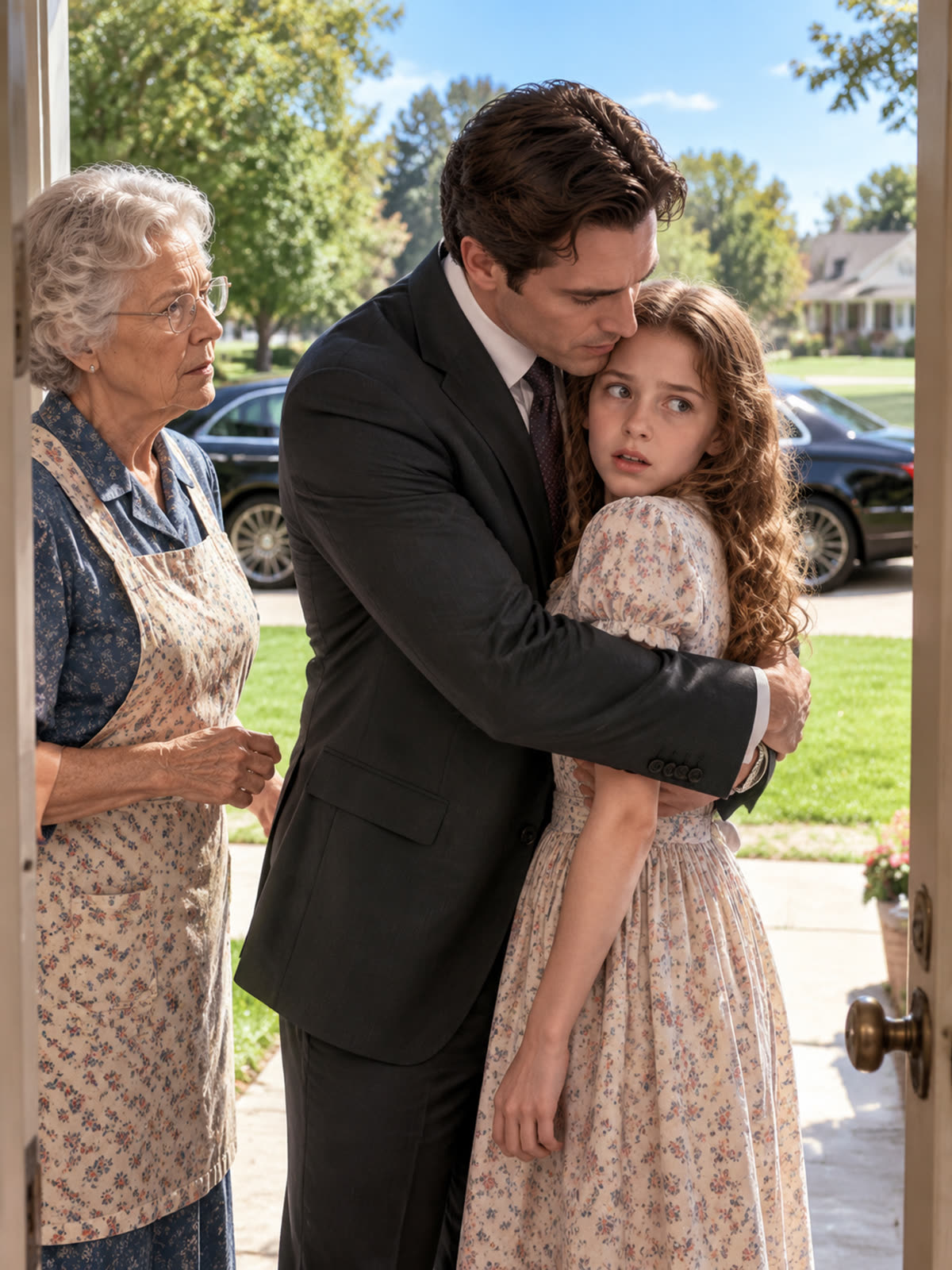
“I am your dad, Nora,” he announced when he released her. “I am going to take you home with me very soon, and you will get to live in a much better house instead of this old dump.” She drew away and backed toward me. “Grandma, who is this man and why is he talking like that?” I put an arm around her shoulders and brought her against my side. “Go back inside the kitchen, sweetheart, and I will be right there in a minute.” She went down the hall while Gavin watched with a deep frown. “She deserves to know who I am and what I can offer her, Dorothy.” His words only made me hold my ground more firmly. “She deserves much better than a complete stranger standing on her porch and insulting her home.”
The practiced smile vanished. In its place was a hard, determined expression I had not seen during his cheerful introduction. “You will be hearing from my attorney very soon, Dorothy.” He went down the steps, returned to the expensive car, and drove away. Back in the kitchen, I served the blueberry pancakes, but Nora scarcely ate. The breakfast that had begun so normally now sat between us while she tried to understand what had happened. “Was that man really my biological dad, Grandma?” “Yes, sweetheart, that was Gavin.” She looked at me and asked the question I could not answer. “Why does he suddenly want me to live with him now after all this time?” I sat beside her, wishing I understood his motives well enough to explain them.
Three weeks later, an envelope arrived by certified mail. Inside were court documents stating that Gavin wanted my guardianship terminated so Nora could move to Minneapolis with him. I read them at the kitchen table, then went back to the beginning and read them again. After the third time, tears made the printed lines difficult to see. His threat was no longer something spoken on the porch. It had become an official request that required an answer, and the possibility of losing Nora suddenly felt much closer. I remained at the table holding the thick envelope, crying as quietly as I could. I had meant to gather myself before she came into the room, but she found me before I managed it.
“What is wrong, Grandma, and why are you crying over those papers?” I tried to slip the envelope beneath the newspaper. It was too late; she had already noticed Gavin’s name. “Is he really trying to take me away from you?” There was no kind way to disguise what the documents meant. “He is asking a family court judge to let him take custody of you, honey.” Nora began crying and wrapped both arms around my neck. “I do not want to go live with him, Grandma, because I belong here with you!” I held her tightly, stroking her hair while her shoulders shook. “I promise you that I am going to do everything within my power to keep us together.” It was the only promise I could honestly make. I could not control the court, but I could refuse to stop trying.
Once Nora was asleep that evening, I began looking for a family attorney. The retainer amounts I heard over the telephone frightened me almost as much as the papers themselves. My retirement income could not stretch far enough to cover them. I collected the guardianship documents I had kept over the years and went to the public library to learn about local hearings. Representing myself was not a choice I made because I felt prepared. It was the only option I could afford. I studied the procedures as carefully as possible, trying to understand how to explain eleven years of ordinary, faithful parenting to a judge. The love between us felt obvious inside our home. I had no idea how to make it sound strong enough in a courtroom.
Meanwhile, Gavin made little effort to know the child whose custody he wanted. He did not spend those weeks building trust or learning about her everyday life. Instead, another thick envelope arrived, this one packed with shiny photographs of his Minnesota house. There was a swimming pool behind it, a bedroom arranged like something from a decorating magazine, and an immaculate lawn that seemed larger than our whole block. Among the photographs was a handwritten message: “You could have all of this if you come live with me.” He had sent pictures of possessions where I had hoped, for Nora’s sake, he might offer some sign of interest in who she actually was.
Nora spread the pictures across the dining table and examined them without speaking. After several minutes, she looked up. “Where would you be living if I moved into this big house?” Her question had nothing to do with the pool or the bedroom. “I would stay right here in Cedar Rapids, sweetheart, taking care of our house.” She brought the photographs into a single pile and slid them toward me. “Then I do not want any of it, Grandma.” I looked at the glossy images between us. All the things Gavin considered persuasive had failed to answer the one question that mattered most to her. She was not deciding which building she liked better. She was thinking about the person she would have to leave behind.
A few days afterward, the house telephone rang during dinner. Gavin was calling, and I switched on the speaker so Nora could hear. “Hey there, sweetheart,” he said brightly. “Are you getting excited about seeing your brand-new bedroom?” She kept her eyes on the kitchen table. “Can you tell me what my favorite color is?” He gave an uncertain little laugh. “What kind of question is that, Nora?” She did not laugh with him. “Just tell me what my favorite color is.” There was nothing complicated about what she was asking, but he did not know the answer. “I do not know, is it bright pink?” “No, my favorite color is forest green.”
Gavin quickly turned her answer into another promise about the room. “Well, that is an easy fix because we can paint your new bedroom green before you arrive.” Nora frowned and moved a little nearer the telephone. “What is my dog’s name?” This time, his uncertainty was impossible to miss. “Wait a second, do you actually have a pet dog?” “No, I do not have a dog at all.” She had asked two simple questions about her own life. In answering them, he had revealed how little he knew without seeming to understand what she was trying to show him.
Nothing came from the other end of the line. Nora reached across the table and gently pushed the telephone toward me. A man who could describe every luxury waiting in Minnesota could not tell her the simplest things about herself. Yet he still intended to stand before a judge and argue that she belonged with him. I looked from the silent telephone to my granddaughter, knowing that neither her fear nor my eleven years beside her would keep us out of that courtroom. The man who did not even know whether she had a dog was asking the court to decide her future.
PART 2 — What He Needed to Hide
“I do not want to talk to him anymore, Grandma.” After I ended the call, Nora quietly asked whether the law required her to answer whenever he rang. I told her she could choose when she felt ready to speak with him. Even as I said it, I worried. I did not know whether Gavin’s attorney might twist her reluctance into an accusation against me. Everything felt capable of becoming evidence, including a frightened child’s wish to stop an upsetting conversation. I wanted to protect her without making our position in court any harder, and I had no lawyer to tell me where that line might be.
As the hearing grew closer, Gavin became harsher during our short telephone exchanges. He spoke confidently about the expensive attorney who, according to him, would have no difficulty proving Nora deserved more than I could provide. “You are getting much older now, Dorothy, and you have to be realistic about the future.” “I am fully aware of how old I am, Gavin, and I am still perfectly capable of caring for her.” “She is going to need expensive things and opportunities that you simply cannot provide on your budget.” I answered with the truth I had lived every day since he left. “A growing child needs people who genuinely love her and show up every single day.” He brushed that aside. “Love does not pay for college tuition or medical bills, Dorothy.”
My eyes went to the flaking white paint beside the kitchen window. His words settled painfully in my chest because he knew which fears were already there. I was seventy-five now. Some mornings, rising from bed required more time than it once had. I worried about my health, even when I kept those thoughts to myself. I also wondered whether Nora might one day resent everything our limited means had placed beyond her reach. Gavin did not have to invent those doubts. He merely pressed on the places where they already hurt. I could defend the home I had given her and still be afraid that someone else would see only its shortcomings.
One evening, I passed the living room and saw her looking at the house photographs again. “Do you think his house looks really nice, sweetheart?” She gave a small shrug without lifting her eyes. “It looks pretty, I guess, like a hotel.” I did not want her to feel guilty for seeing what was attractive in those pictures. “There is nothing wrong with liking nice things, Nora, and I would never blame you for wanting a bigger room.” She finally looked up, her expression serious. “Would you be really sad if the judge made me go live there?” “I would miss you more than words could ever say, sweetheart.” She put the photographs on the coffee table and climbed into my lap. “Then I am staying right here with you no matter what happens.” I held her and wished that loving each other could make the decision that simple.
A week before the hearing, Gavin came to the house without warning again. This time, his wife was with him. Her name was Brenda, and she wore an elegant cashmere sweater. After I let them inside, she addressed Nora with a gentle warmth that was very different from Gavin’s manner. “I have heard so much about you from your father, Nora.” My granddaughter looked surprised. “Really, what did he tell you about me?” Brenda answered easily. “Your father says that you are an absolute superstar at school.” Nora glanced toward Gavin, plainly skeptical. He had not been present for the years that might have allowed him to speak naturally about her schoolwork.
Brenda continued smiling. “He has told me countless times how deeply he has missed you over the years.” Anger rose sharply inside me. Eleven years had passed without a single inquiry about his daughter, and now his wife was standing in my living room describing a devoted father. I stayed silent, though doing so took effort. Brenda brought out her telephone and showed Nora photographs of a bedroom that had recently been decorated for her. Nora looked, then stepped back politely. “Thank you, ma’am, but I am really happy living here with my grandma.” Brenda’s smile gave way to genuine confusion. She turned toward her husband, trying to reconcile what she was hearing with whatever he had told her.
“Wait a minute, Gavin, because you told me that Nora was eager to come live with us.” Nora answered before he could smooth it over. “I really do not want to move away,” she said clearly. Gavin interrupted at once. “She is just feeling a little nervous today because moving to a new city is a big change.” Brenda nodded sympathetically. “Of course, that makes complete sense for a girl her age.” I watched the exchange without saying what I wanted to say. Nora had expressed herself plainly, but Gavin had turned her refusal into ordinary nervousness. His wife seemed willing to believe the explanation because she had no reason yet to know how much of his story was untrue.
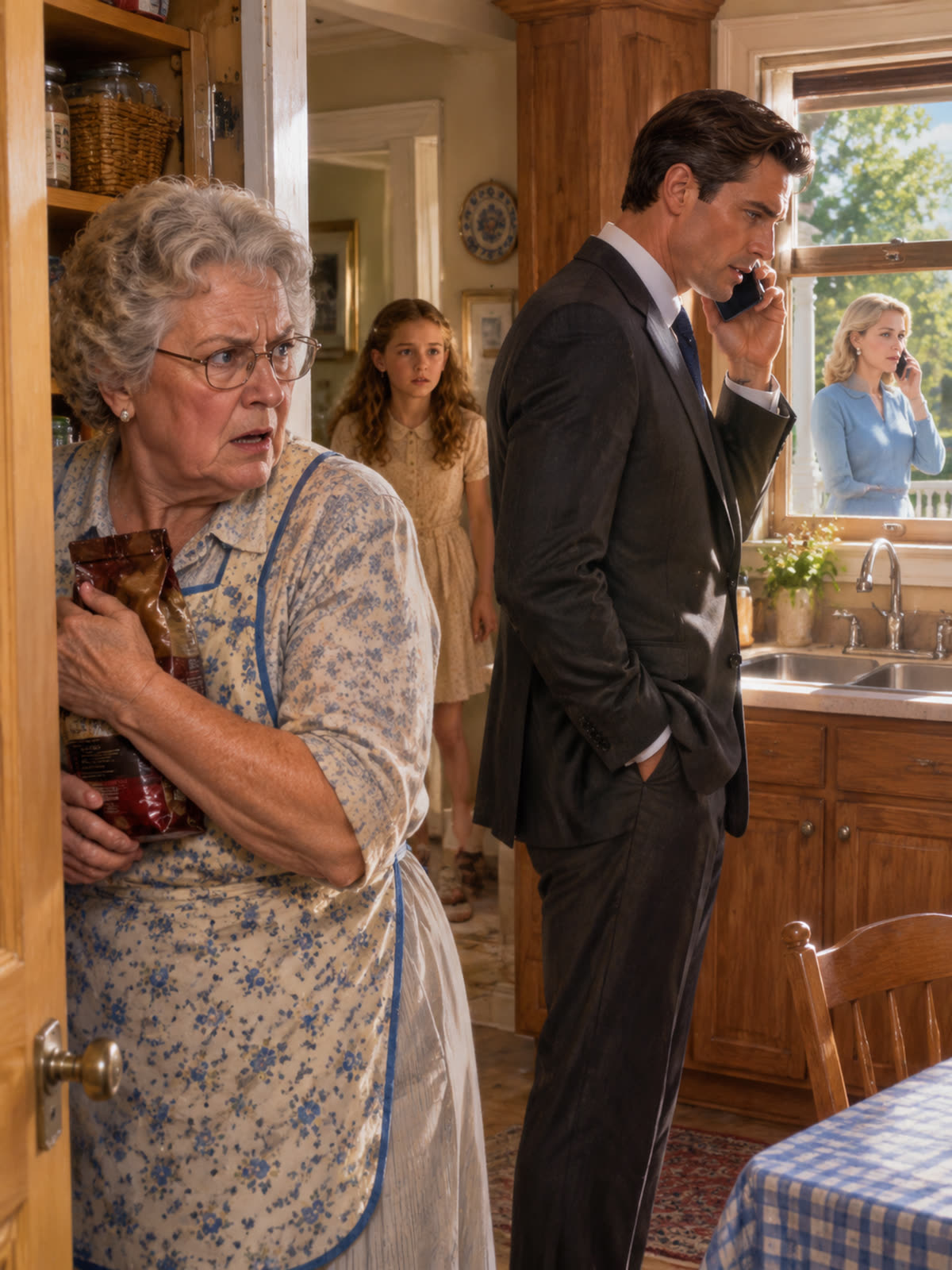
Gavin then asked whether I would make coffee. I sent Nora to her bedroom so the adults could talk, unaware that she soon returned quietly to the hallway. A few minutes later, Brenda went onto the front porch to answer a business call. I began filling the coffee maker while Gavin stood near the kitchen counter. His own telephone rang inside his jacket, and he answered in a lowered voice. I stepped into the narrow pantry for the ground coffee, leaving the door partly open behind me. From where he stood, he apparently assumed I was no longer listening.
“No, she definitely does not want to come live with us,” he muttered. He waited while the person on the telephone replied. “No, Brenda does not know anything about that at all.” Another pause followed. I remained in the pantry with the coffee in my hand. Until that moment, I had heard him dismiss Nora’s feelings in front of his wife. Now he was admitting privately that he understood them perfectly. He knew she did not want to leave. His next sentence explained why he had been so eager to cover that fact. “I told Brenda that Dorothy intentionally kept us apart all these years so I could not see my daughter.”
I went completely still. Gavin moved near the sink and dropped his voice even further, keeping it from carrying toward the porch. “Look, if Brenda ever finds out that I willingly walked away from my own baby, everything in my marriage changes overnight.” I clutched the coffee bag against my apron. All those years of silence had become, in his telling, years of being unfairly shut out. I opened the pantry door and stepped into the kitchen. He startled, then immediately disconnected. “Who were you just talking to on the phone, Gavin?” “I was just speaking with my attorney about Tuesday’s hearing.” I looked directly at him. “What did you mean just now when you claimed that I kept you apart from Nora?” He put the telephone back into his suit and would not meet my eyes. “It is nothing that you need to worry yourself about, Dorothy.”
He did not wait for the coffee. Instead, he called to Brenda and hurried out with her. I remained in the kitchen, trembling with anger. He had made me the obstacle in a story designed to protect his marriage. According to that version, I was the person who had denied a loving father access to his child. The reality was that I had spent eleven years caring for the baby he voluntarily left behind. I wanted to go straight outside and tell Brenda everything. But I had overheard a conversation, and he could deny it. In that moment, I did not believe I had anything solid enough to prove what he had just admitted.
At dinner that night, Nora barely spoke. She moved her green beans around the plate while I watched her quietly. “Are you feeling worried about the court hearing on Tuesday, sweetheart?” She nodded without looking up. “Remember that whatever happens in that courtroom, none of this is your fault.” When she raised her face, there was a thoughtful determination in it. “Grandma, did my dad ever write a letter to us after he left?” The question caught me completely off guard. “Why are you asking about a letter all of a sudden?” “I was just wondering if he ever wrote anything down.” I hesitated, then decided not to lie to her. “He did write one short letter a very long time ago, right after your mother passed away.”
“What did he say inside that letter?” My eyes moved before I could stop them, toward the wooden cabinet where I stored Hannah’s belongings. “He wrote things that I truly wish he had never said, honey.” Nora followed my glance. “Do you still have that old letter saved somewhere?” “Yes, I kept it tucked away in a box.” She asked carefully, “Can I please see it and read what he wrote?” I reached across the table and touched her hand. “Not tonight, sweetheart, because it is way too upsetting to read right now.” Disappointment crossed her face, but she did not argue. I assumed the approaching hearing had made her curious about the past. I did not yet understand why she had suddenly become so interested in something her father had written eleven years earlier.
Two days before court, she came into my bedroom carrying Hannah’s framed photograph. “Was Mom scared when I was first born, Grandma?” “Just a little bit, sweetheart, because most brand-new mothers feel a little nervous at first.” She studied her mother’s smiling face. “Did she really love me a whole lot?” “She loved you more than anything else in the entire world, Nora.” For several seconds, she said nothing. Then she asked, “Do you think Mom would have wanted me to stay living here with you?” I wanted my answer to honor Hannah without placing another burden on her daughter. “Your mother trusted me completely, though more than anything she would want you to be safe and happy.”
Nora nodded as she took that in. Her next question was even harder. “Grandma, do you think my dad actually loves me at all?” I searched for an answer that would be gentle without pretending to know what I could not know. “I honestly do not know what he feels in his heart, honey.” She lowered her eyes to the floor and let out a quiet sigh. “I just wish he would stop lying and tell everybody the truth.” I brought her into my arms. “So do I, sweetheart, more than you know.” I could not repair the pain behind her question. I could only hold her and let her know that, whatever her father felt or claimed, she did not have to face that pain alone.
Late that night, after she should have been asleep, I heard soft movement in her room. I opened the door a little and found her putting papers into her school backpack. She was carefully closing the zipper when I spoke. “Are you finishing up some last-minute homework, honey?” “Just getting something ready for tomorrow, Grandma.” I thought she meant a fifth-grade assignment. With everything else weighing on us, there seemed no reason to question an ordinary explanation about school. I left it there, unaware that the papers she was arranging had anything to do with the hearing or the conversation we had shared at dinner.
On the morning we went to court, Nora put on her favorite forest-green sweater. I wore the neat navy dress I had set aside. A taxi was beyond what I could afford, so we rode the city bus downtown to the Linn County Courthouse. She held my hand all the way. Gavin was waiting in the corridor with his sharply dressed lawyer, and Brenda stood nearby. When she saw us, Brenda offered Nora a kind smile. “Good morning, sweetheart, it is nice to see you again.” Nora acknowledged her politely but did not speak. Gavin looked at my worn dress and smirked. “Are you ready to finally get this whole thing over with, Dorothy?” I did not answer. I took Nora through the heavy courtroom doors.
The room seemed enormous, with its high ceiling and rows of polished benches. We took our places while Gavin’s lawyer began describing the life his client could offer. He spoke about the executive position, the large Minnesota home, and the stability of Gavin’s marriage. He listed private schooling and opportunities my income could never purchase. Then he handed photographs to the bailiff for the judge to inspect. Again, there was the pool, the spacious bedroom, and the immaculate kitchen. I stared at my hands on the table. Our house needed paint. Our furniture had belonged to other people before it belonged to us. For a brief, painful moment, shame overcame me. Then I looked at Nora. She was watching me with fierce loyalty, paying no attention to the photographs being displayed as evidence of a better life.
The attorney finished by arguing that a child deserved to grow up with her biological father. He acknowledged the eleven-year absence, but presented it as something Gavin had outgrown. His client, he said, was mature now and prepared to assume responsibility. The judge adjusted her glasses and began asking her own questions. “How often did you visit your daughter during the past eleven years, Mr. Vance?” I caught the mistaken name and kept the account straight: she addressed him as Mr. Miller. “How often did you visit your daughter during the past eleven years, Mr. Miller?” The question stripped away the photographs, the house, and the polished description of his circumstances. It asked only where he had been.
Gavin shifted in his leather chair. The easy assurance he had shown on my porch was suddenly less visible. “Not nearly as often as I should have, Your Honor.” I sat beside Nora and listened to the careful way he had phrased it. Not nearly as often could mean many things. It could leave room for missed weekends, infrequent holidays, or a relationship weakened by distance. It did not tell the judge what those eleven years had actually contained. His answer hung in the courtroom, and the question of what he would admit next remained.
PART 3 — The Two Things in Her Backpack
The judge did not accept the vague answer. “Please give me an exact number of visits over those eleven years.” Gavin waited before answering quietly. “None, Your Honor.” She made a note and looked up again. “And what specific steps have you taken to establish a bond with her since returning last month?” “I have called her on the phone and sent her pictures of her new home.” “Have you spent any actual quality time together in person?” “She has been quite reluctant to spend time with me so far, Your Honor.” I wanted to explain that reluctance immediately. I wanted to describe the stranger who had come into our house and insulted it, then announced that he would take her away. Instead, I waited until the judge turned toward me. “Mrs. Miller, since you are representing yourself today, you may stand and share whatever you wish the court to know.”
I rose carefully, holding the table’s edge. My voice shook despite my efforts to steady it. “Your Honor, I have been right there beside Nora for every single birthday, every time she was sick with a fever, and every time she scraped her knees on the sidewalk.” Nora squeezed my hand. I looked down at her, then back toward the bench. “She is my entire world, Your Honor, so please do not take her away from the only home she knows.” I explained how Gavin had left her with a diaper bag and how frightened she was about being made to move. When I sat down, I was sure I had failed to say enough. His attorney had presented a carefully arranged argument. I had offered the simple truth of our life, and I did not know whether that would be sufficient.
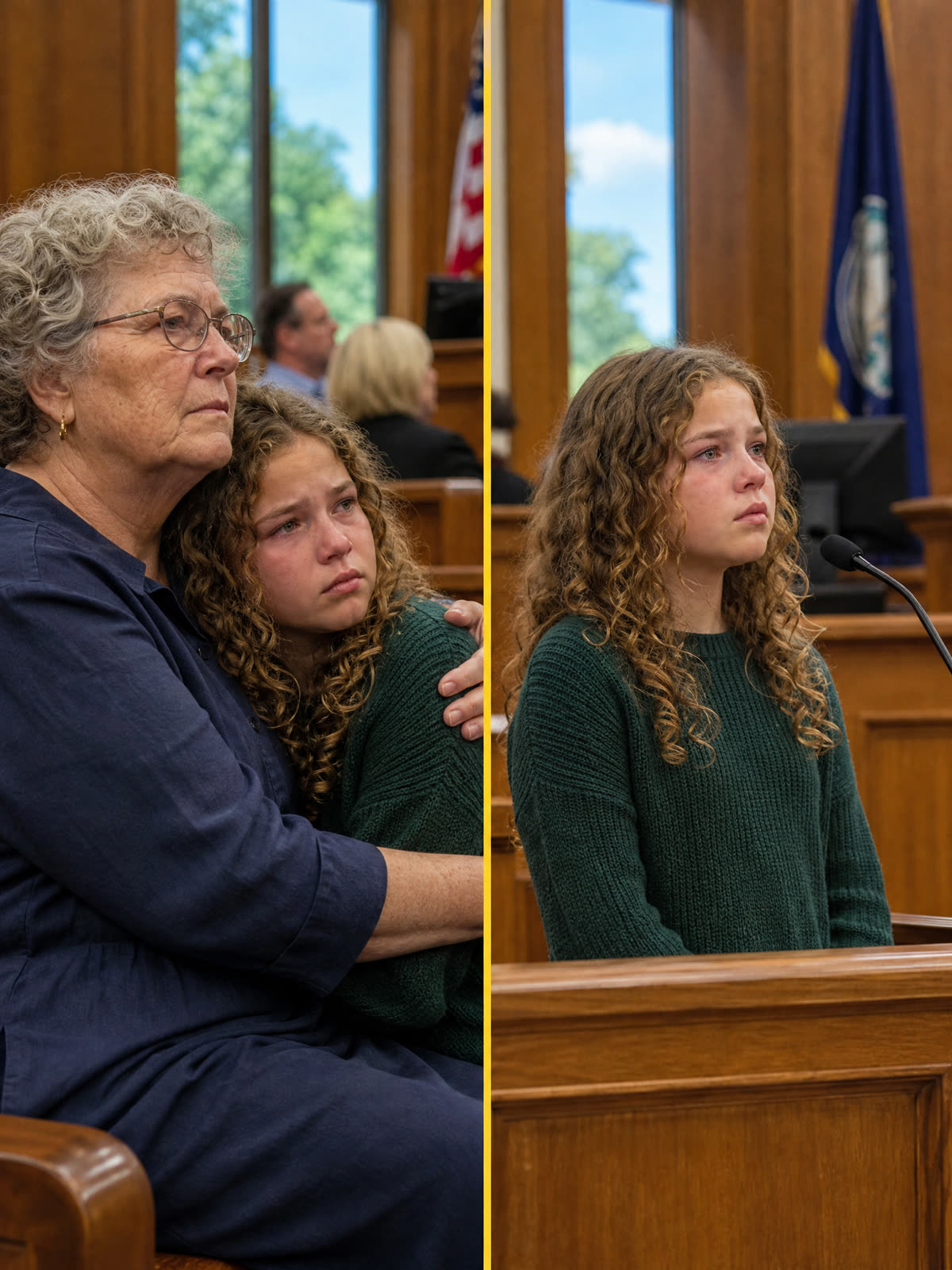
Before the judge responded, Nora slipped her hand out of mine and stood beside her chair. “Your Honor, may I please say something to the court?” The judge regarded her with patience and kindness. “Of course you may speak, young lady, though first you must promise me to tell the whole truth, so do you promise?” “I promise to tell the truth, Your Honor,” Nora said softly but distinctly. She was asked to come forward and sit in the wooden witness chair. Her sneakers barely reached its footrest. She straightened her back and took a slow breath. “Your Honor, just a few days ago, I accidentally overheard my father talking to his lawyer on the phone inside our kitchen, and I know the real reason why he suddenly wants custody of me.” Gavin’s face lost its color. Around the room, people turned toward him.
The judge leaned forward. “What exactly did you overhear your father say during that phone call, Nora?” My granddaughter answered directly. “He told his lawyer that his new wife thinks Grandma intentionally kept him away from me all these years.” She glanced toward Brenda in the front row behind Gavin. “He said that if his wife ever found out the truth about him leaving me, everything in his marriage would change.” His attorney stood to object. The judge raised a hand before he could interrupt her account. “Let the child finish speaking, counselor, because I want to hear everything she has to say.” I watched Nora from our table, realizing that she had heard the conversation I thought had passed only between Gavin and me.
She bent toward the canvas backpack beside the witness chair and opened it. From inside, she took a neatly folded sheet of old stationery. “Grandma saved this letter for eleven years, Your Honor.” I recognized Hannah’s floral writing paper and gasped. Gavin had written on it two weeks after the funeral. I had kept the letter with my daughter’s belongings because it was the only written explanation he had ever given for abandoning his child. Until that moment, I had not known Nora had gone into the corner cabinet and found it the night before. She held the folded page toward the bench. “May I please show this letter to you, Your Honor?” The judge nodded and directed the clerk to bring it to her. Gavin stared at the paper as though he could not look away.
Brenda leaned forward, visibly shocked. “Gavin, what on earth is that letter she just handed the judge?” she whispered. He kept his eyes on the table and gave no answer. The judge carefully unfolded the stationery and read it in silence. I waited while the words I had hidden away for eleven years were read by someone who could finally weigh them against his claims. When she finished, she looked at him over her glasses. “Mr. Miller, did you write and sign this letter eleven years ago?” His reply was barely audible. “Yes, Your Honor, I wrote it.” “Do you dispute any of the contents written on this page today?” “No, Your Honor, I do not.” There was no explanation about being kept away, no accusation against me. He had acknowledged the words as his own.
Nora looked toward the judge, her voice trembling slightly. “May I tell everyone in the room what he wrote in that letter, Your Honor?” After receiving permission, she turned toward her father. “He wrote that he was way too young to raise a baby by himself, and that he did not want me ruining his future plans.” Brenda covered her mouth. Tears gathered in her eyes as Nora continued. “He also asked Grandma never to contact him again unless it was an absolute emergency.” The quiet in the room became complete except for the faint sound of the overhead lights. The judge fixed Gavin with an unyielding look. “Is what your daughter just summarized accurate, Mr. Miller?” He nodded without lifting his head. “I was young and scared back then, Your Honor, and I made a terrible mistake.”
Nora’s voice became steadier. “That may be true, Dad, except you lied and told Brenda that Grandma refused to let you see me.” Gavin turned toward his wife and reached for her. “Brenda, please let me explain everything to you after we leave here.” She moved her arm away and stood in the aisle. “You looked me in the eye and told me you spent years searching for your daughter, Gavin!” “I was ashamed to tell you the truth about what I did back then.” Brenda looked at him with heartbreak and disgust, then stepped toward the back of the courtroom. The judge brought her gavel down lightly to restore order. Gavin’s story had not merely omitted what happened. It had replaced his choice with an accusation against the person who had stayed.
Once the room settled, the judge returned her attention to Nora. “Nora, is there anything else inside your backpack that you would like me to see today?” Nora nodded and reached into the bag again. I watched her small hands disappear below the edge of the witness chair, wondering what else she had brought from home. The letter had shown why her father left. It had contradicted the explanation he gave Brenda and the implication that I had interfered with their relationship. But Nora had not finished explaining the life he was trying to remove her from.
This time, she brought out a small photograph album with a worn blue fabric cover. I recognized the scrapbook we had assembled together at our dining table over the years. Inside were photographs of her first birthday, her cheeks smeared with chocolate frosting. There were pictures from the first morning of kindergarten, taken on our front porch, and photographs of our little Christmas tree with Hannah’s paper ornaments. There was even a picture of me running behind her bicycle while she learned to ride. Nora opened the album across her lap. “These are all the things Grandma did with me while you were gone, Dad.” She turned a page. “Grandma came to every single one of my school choir concerts, even when her knees hurt really bad.” The album did not show a swimming pool or an enormous bedroom. It held the life we had actually shared.
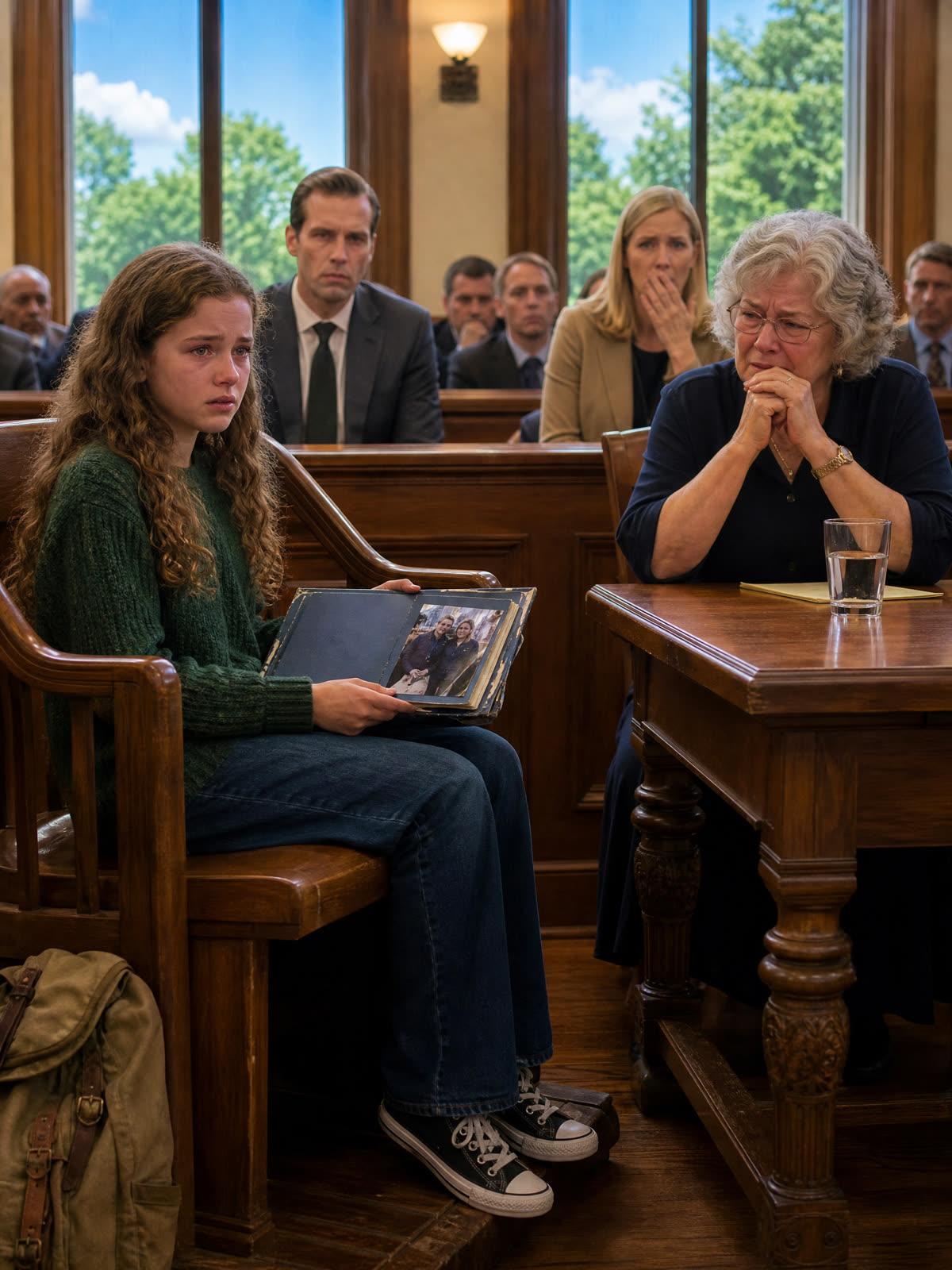
She moved to another page and brushed a tear away with her green sweater sleeve. “She stayed awake all night holding my hand whenever I was sick with the flu.” Her voice caught as she looked toward the bench. “Grandma is the person who actually knows me, Your Honor.” The judge gave her time to wipe her eyes and breathe. I sat motionless, watching a child explain what I had struggled to put into words. The ordinary things I had done because she needed me had become the evidence she wanted everyone to see. When Nora was ready, the judge leaned forward gently. “What would you like to happen today, Nora?”
Nora found me across the courtroom and smiled through her tears. “I want to stay living right where I am with my grandma.” Then she drew another breath and glanced toward Gavin. “I know my dad has a huge, beautiful house with a swimming pool and everything.” She slowly shook her head. “Yet he does not even know my favorite color, he does not know any of my friends, and he does not even know what I like to eat for breakfast.” I pressed a hand over my mouth, trying to contain a sob. Pride rose through the fear I had carried into the room. She was not confused by the photographs or tempted into pretending that expensive things could make a stranger familiar. She understood the difference between being offered possessions and being known.
“Grandma knows every single one of those things about me by heart.” Her voice was quiet, but there was dignity in the way she spoke. Then she said the sentence I will remember for the rest of my life. “My dad says he can give me a much better life, Your Honor, yet Grandma has already given me my whole life.” I could no longer keep myself from crying. I wiped my cheeks with a tissue while Nora sat in that oversized chair with the blue album in her lap. For years, I had worried about everything beyond my means. She had brought a record of what had never been missing.
She faced the judge again to finish. “I do not want to hurt my dad’s feelings, Your Honor, yet I should not have to leave the only real home I have ever known just because he suddenly changed his mind.” The judge nodded, plainly moved by her honesty and courage. “Thank you very much for sharing your heart with us today, Nora, and you may step down now.” Nora returned to the table and sat beside me. The hearing continued, but only for a few more minutes. I had entered the courthouse feeling that I would have to defend every sign of age in our home and every limitation in my bank account. My granddaughter had asked the court to look instead at who had been there.
The judge considered the eleven years Gavin had been absent, the roots Nora had put down in Cedar Rapids, and the clear wishes she had expressed. She also reprimanded him sharply for inventing a story intended to mislead his wife and the court. When it was time for the ruling, I could scarcely draw a full breath. Gavin’s petition was denied. Nora would remain permanently under my guardianship and in my care. Any later request for visits, the judge added, would have to respect Nora’s consent and place her emotional welfare first. I shut my eyes and released a long, unsteady breath. The fear that had followed us through those weeks finally loosened its grip.
Nora flung her arms around my neck. “Does this mean we are really staying together forever, Grandma?” “Yes, sweetheart, nobody is ever going to separate us again.” I held her as tightly as she held me. Across the aisle, Gavin stood next to his attorney with his head lowered. Brenda went straight past him toward the doors. She did not speak to him or look back. I collected my papers, took Nora’s hand, and left the courtroom without turning in his direction. I had no wish to study his reaction. The person whose future had mattered through every frightening moment was walking out beside me.
Sunlight met us on the courthouse steps. Nora slipped her hand firmly into mine as we began making our way down. “Grandma, are you mad at me for taking that old letter out of the cabinet without asking?” “No, sweetheart, I could never be mad at you, though I do wish you had not carried such a heavy secret all by yourself.” She considered that while we walked toward the bus stop. “I was just so scared that the judge was going to make me leave you.” “I was terrified of losing you too, honey.” There was no reason now to hide that truth from her. We had both been afraid, and neither of us had known until the ruling whether the life we loved would remain ours.
Then her expression brightened. “Can we please make blueberry pancakes when we get back home?” I laughed through the tears still on my face and squeezed her hand. “Of course we can, sweetheart, as many pancakes as you want.” She had another request ready. “Can we put extra chocolate chips inside them too?” “Extra chocolate chips and whipped cream on top, just to celebrate.” After all the talk of spacious rooms, private schooling, and gleaming kitchens, she wanted to go back to our own kitchen. She wanted the breakfast interrupted by the man who had arrived on our porch and announced that our home was not enough.
We took the city bus back through Cedar Rapids to our quiet neighborhood. Nothing about the house had changed while we were gone. The white paint still needed attention, and the furniture inside was as old and worn as it had been that morning. Nora hurried up the driveway and onto the porch. When she opened the front door, she turned toward me with a radiant smile. “Come on inside, Grandma, because we are finally home!” I followed her into the familiar living room. There was no grand entrance waiting for us, no spotless mansion that looked as though it belonged in a magazine. There was simply the place where we had spent her childhood together.
For eleven years, I had carried the private fear that I could never give Nora all the expensive things she deserved. That afternoon, she had shown me something I had been too frightened to see clearly. I had given her a safe home, a loving home, and the certainty that she was wanted without reservation. No mansion could replace the years inside those walls or the person who had stayed through them. Yet everything we had built had come so close to being measured against photographs of somebody else’s house. Two things in a school backpack had brought the truth into the open—and how much might we have lost if that truth had stayed inside the cabinet?
Disclaimer: This story is a work of fiction inspired by real-life themes. Names, characters, places and events are fictionalized, and any resemblance to real persons is purely coincidental. Images are for illustration purposes only.
