

Part 1 — The Empty Refrigerator
When my father arrived to pick up Ben for their weekend together, he did what grandfathers do.
He walked straight into my kitchen to see whether his grandson needed snacks for the road.
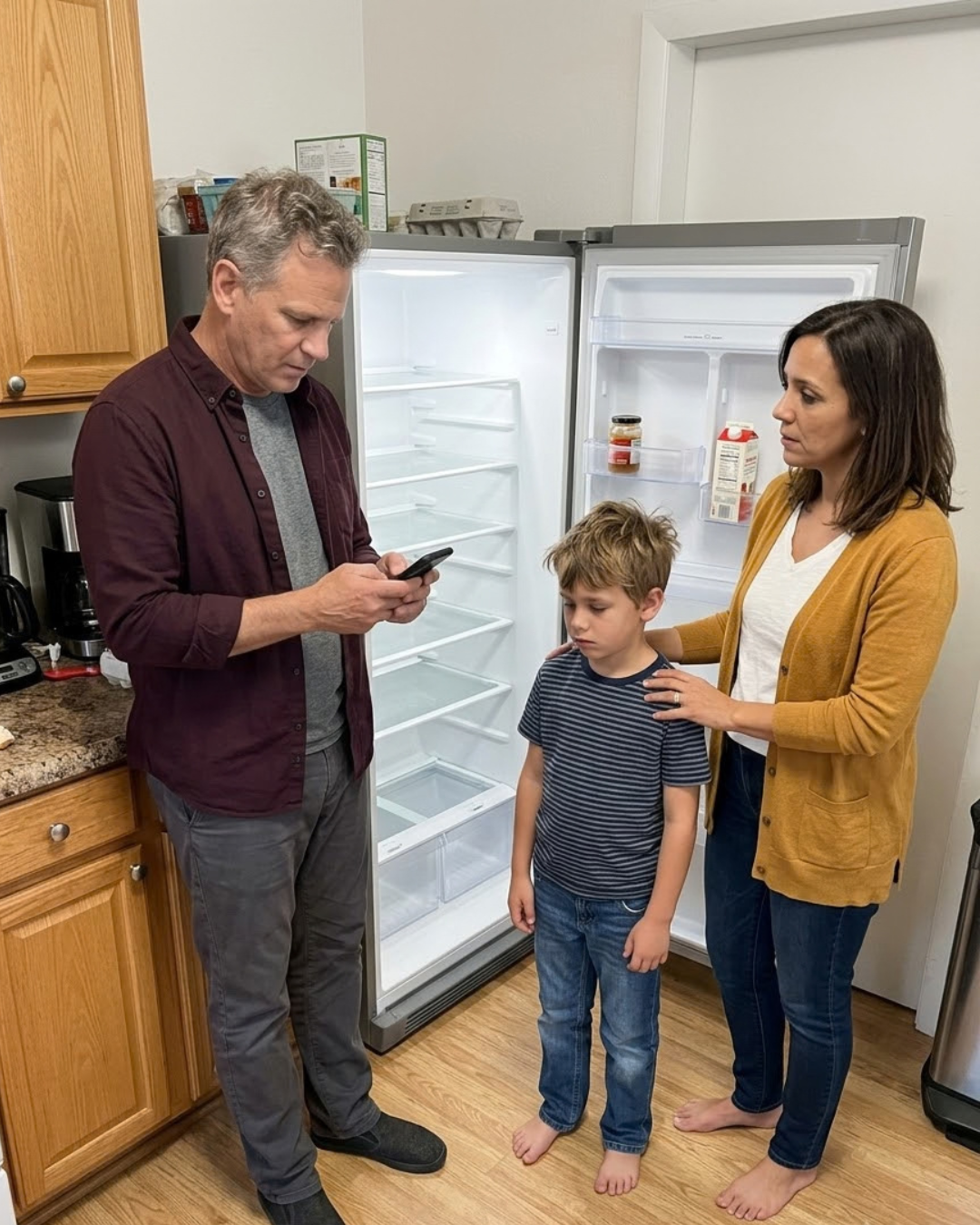
I stood in the doorway as he opened the refrigerator.
Then he stopped.
Completely.
The refrigerator light illuminated almost nothing.
Half a bottle of milk.
A jar of mustard with dried yellow crust around the rim.
A plastic container holding one spoonful of rice.
And a bruised apple that rolled against the back wall whenever the compressor started.
That was it.
Cold air and everything I’d been pretending not to see.
It looked like the refrigerator in an abandoned office breakroom, not a home where a four-year-old boy lived.
My son, Ben, still believed in magic.
He also still asked for the cereal shaped like stars that I could no longer afford to buy.
My father, Marcus Carter, had been a police officer for twenty-seven years before retiring.
He had seen domestic violence.
Neglect.
Financial exploitation.
Children living inside homes where adults had failed them.
Over the years, he’d developed a particular silence for moments when what he saw disturbed him more than he wanted to admit.
That silence filled my kitchen.
His hand remained wrapped around the refrigerator door.
Finally, he spoke.
“Laya.”
I swallowed.
“You earn three thousand dollars every month.”
He turned toward me.
“Why is your child hungry?”
The question shattered something.
I opened my mouth.
Rent.
Daycare.
Gas.
Inflation.
I’d rehearsed every excuse.
But none of them explained that refrigerator.
Before I could answer, footsteps sounded behind me.
My husband walked into the kitchen.

His hair was messy from an afternoon nap while I’d spent the week working more than forty hours.
He looked at Dad.
Then at the open refrigerator.
And smiled.
“I gave her salary to my mother,” he said.
I stared at him.
He actually sounded proud.
“She needed it more.”
Then he shrugged.
“Family takes care of family.”
That single sentence changed everything.
Not because I didn’t know where the money had gone.
I did.
But until that moment, I’d allowed myself to think of it as temporary.
A rough patch.
Helping family.
A disagreement between spouses.
But he hadn’t said, “We gave her money.”
He hadn’t said, “Laya agreed.”
He said:
“I gave her salary to my mother.”
My salary.
The money I’d earned under fluorescent office lights answering emails, preparing financial reports, surviving deadlines, and spending forty-five hours a week away from my child.
In his mind, it belonged to him.
My name is Laya Carter.
I was thirty-one years old, a financial analyst, a wife, and the mother of a four-year-old boy.
And standing in that kitchen, I finally understood that the bars around me had been built from my own paycheck.
The night before, I’d cooked half a cup of rice with the last frozen peas in the freezer.
Ben had stood on his toes beside the stove.
“Do we still have the yogurt?”
I knew exactly which one he meant.
The strawberry yogurt with the cartoon cow.
“The store was out, baby.”
It was a lie.
He shrugged.
“Maybe they’ll have it next time, Mommy.”
That sentence had stayed with me all night.
Now Dad was staring into my empty refrigerator.
And my husband was bragging about why it was empty.
Dad slowly closed the door.
Click.
Then he turned toward my husband.
“You took her paycheck?”
My husband waved dismissively.
“She’s exaggerating. My mother needed help with some bills.”
“All of it?”
“Not all.”
He shrugged.
“Most of it.”
Dad’s expression didn’t change.
“My mom is family too.”
“Your son isn’t?”
The smile disappeared from my husband’s face.
“You wouldn’t understand.”
His voice sharpened.
“Some of us actually respect our parents.”
Dad’s jaw tightened.
“Respect isn’t obedience.”
He stepped closer.
“And it sure as hell isn’t letting your child go hungry so you can play the dutiful son.”
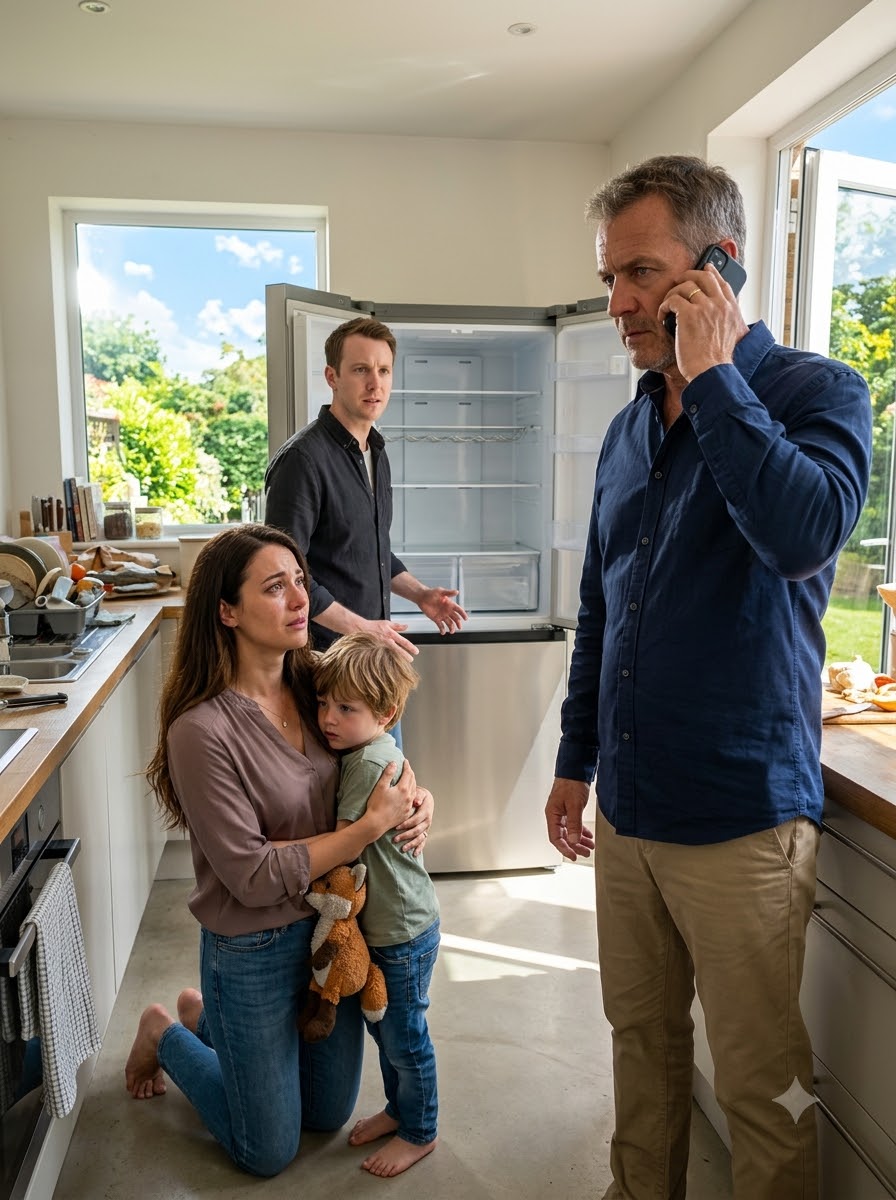
Ben appeared beside me, holding his stuffed fox by the tail.
Without thinking, I moved slightly in front of him.
Dad noticed.
His eyes traveled over my face.
The dark circles.
The exhaustion.
The way my shoulders curved inward.
Then he looked at Ben.
Something changed in him.
“Pack Ben’s bag.”
I blinked.
“What?”
“Enough clothes for a week.”
Dad’s voice was calm.
“He’s staying with me until we figure this out.”
My husband laughed.
“You’re not taking him anywhere.”
Dad looked at him.
“This is Laya’s apartment.”
Then he pointed toward the refrigerator.
“Paid for with Laya’s paycheck.”
He pulled out his phone.
My stomach tightened.
“Dad?”
He dialed.
“Yeah, it’s Carter. I need an officer at my daughter’s address for a welfare check and documentation of possible financial exploitation. There’s also a four-year-old in the home and almost no food.”
He listened.
“No immediate violence.”
His eyes settled on my husband.
“Not at the moment.”
Then he hung up.
My husband stared at him.
“You called the police?”
Dad put the phone back into his pocket.
“Yes.”
“For helping my mother?”
“For taking your wife’s wages without her permission while your child doesn’t have enough food.”
He paused.
“Those aren’t the same thing.”
Ben looked up at me.
“Mommy?”
I knelt.
“Are we in trouble?”
His voice was barely a whisper.
I tucked his hair behind his ear.
“No, baby.”
Then, for perhaps the first time in years, I said exactly what was true.
“You’re not in trouble.”
I looked toward my husband.
“The grown-ups are.”
