

People spent years telling Noah that no woman would ever truly choose him. They laughed at the body he had never grown out of, pitied him when he didn’t want sympathy, and judged our relationship long before they knew the truth. But the deepest wound came when my own family claimed I was throwing my future away for him. On our wedding day, Noah tried to let me go, and that was when I finally told everyone what had been in my heart all along.
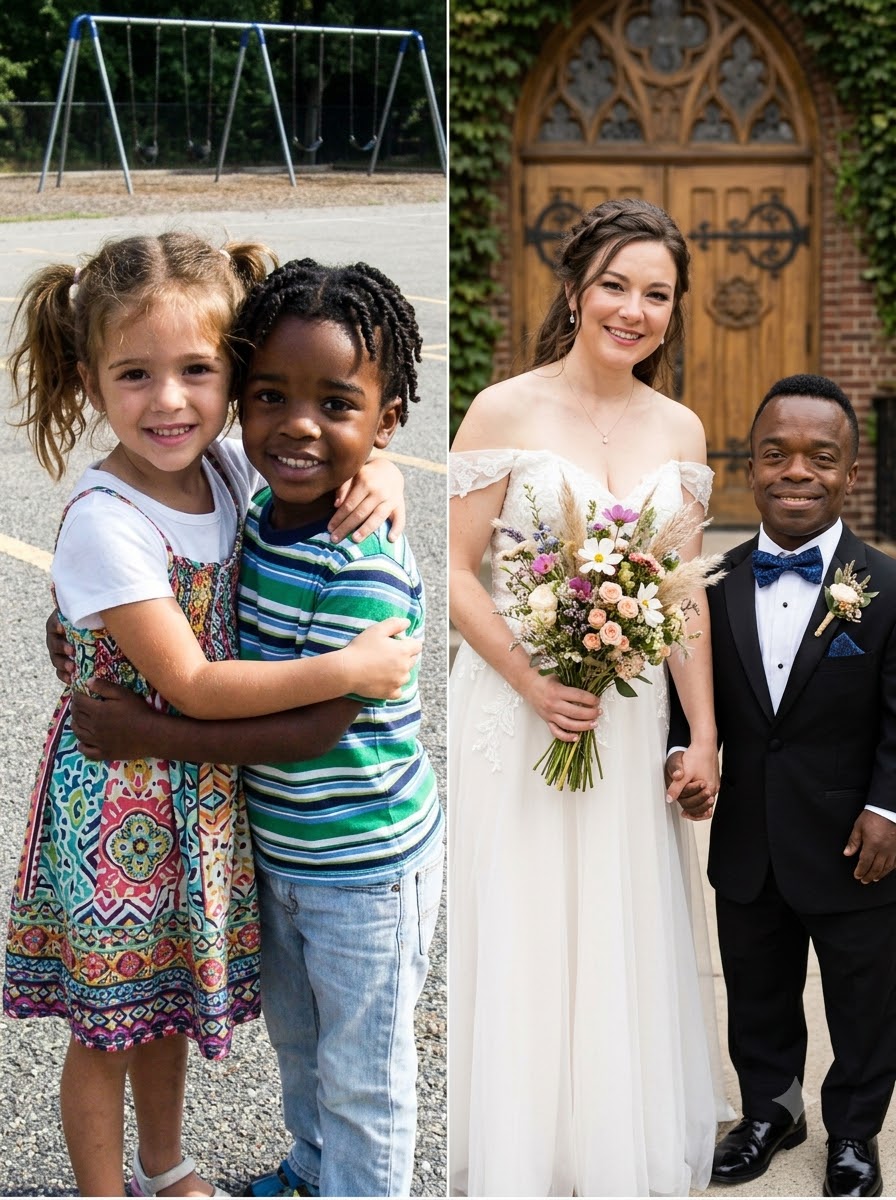
When Noah and I were six years old, we made a promise behind the monkey bars at school.
The agreement was written in purple crayon on a torn sheet from my spelling notebook.
“If we are both still single when we are 30,” I read proudly, “we promise to marry each other.”
Noah studied the page with a serious expression.
“You spelled promise wrong.”
“I did not.”
“You wrote promiss.”
“You know what I meant.”
He sighed with the dramatic exhaustion of a tiny attorney before signing his name beneath mine.
Afterward, we bought two plastic rings from the vending machine outside the grocery store.
Mine had a fake purple jewel.
His had a crooked silver star.
We hooked our pinkies together.
“Thirty is ancient,” I declared.
“Basically dead,” Noah agreed.
Then we raced back to school and forgot all about it.
Two years later, Noah stopped growing.
At first, no one understood why.
He had always been one of the smaller kids, but by fourth grade the difference became impossible to ignore.
Everyone around him kept getting taller.
Their faces matured.
Their voices deepened.
Noah barely changed.
Doctors ordered test after test, searching for answers.
Eventually, specialists diagnosed him with an exceptionally rare growth disorder affecting both his bones and his body’s hormone response.
His mind matured normally.
His body never did.
By middle school, strangers assumed he was eight years old.
By high school, people thought I was looking after a younger sibling.
As adults, most people either treated him like a child or looked at him with heartbreaking pity.
Noah hated both reactions equally.
He was brilliant.
Funny.
Sharp-witted.
Stubborn.
Far more capable than many people who underestimated him.
He built websites before most people even knew what a domain name was.
He repaired electronics that everyone else had given up on.
He read political biographies because he genuinely enjoyed them.
And when we played cards, he cheated with absolutely no shame.
More than anything, he refused to let pity define him.
He never pretended the world was fair.
He simply refused to allow cruel people to determine his worth.
Even so, I saw the price he paid.
Teenagers pointed at him in shopping malls.
Adults whispered in restaurants.
Cashiers automatically handed him children’s menus.
Security guards questioned his identification because they couldn’t believe he was an adult.
Dating was the hardest part.
Many women treated him like entertainment, a curiosity, or someone too delicate to reject honestly.
He rarely talked about how much that hurt.
Throughout childhood, we were inseparable.
Then adulthood happened.
I left our hometown to attend college.
Noah stayed behind, completed an online computer science degree, and accepted a job with a software company.
We still kept in touch.
Daily conversations became weekly ones.
Weekly calls slowly turned into monthly check-ins.
Life moved forward.
I dated.
He dated occasionally too, although none of those relationships lasted very long.
When I was twenty-six, I became engaged to a man named Evan.
Noah congratulated me immediately.
He never once mentioned our childhood pact.
By then, that purple-crayon promise felt like nothing more than a funny memory from kindergarten.
My wedding to Evan was scheduled for early June.
Three weeks before the ceremony, everything changed.
I was crossing legally at an intersection when a driver ignored a red light.
I remember hearing the horn.
I remember the impact.
I remember staring up at the sky as it spun above me.
Then everything disappeared.
When I woke up in the hospital, doctors explained that I had suffered a shattered pelvis, a fractured leg, and nerve damage that left my left foot feeling almost disconnected from my body.
The surgeons were careful.
They believed I would probably walk again.
They simply couldn’t guarantee how well.
Evan visited twice.
During the first visit, he brought flowers but spent most of the time staring uneasily at the machines surrounding my bed.
The second time, he asked how long rehabilitation would take.
“Months,” I answered.
He became quiet.
A week later, he ended our engagement over the phone.
“I am not strong enough for this.”
I listened from my hospital bed while metal pins still held part of my pelvis together.
The man I had planned to marry calmly explained that my future had become too uncertain.
“Are you saying you cannot marry me because I might use a cane?” I asked.
“It is not only that.”
“What else is there?”
“The care. The appointments. Everything will be different.”
He continued apologizing.
I ended the call before he finished.
When I finally told Noah what had happened, he arrived the following morning.
We hadn’t seen each other in almost a year.
For several seconds, neither of us spoke.
Then he quietly pulled a chair beside my bed and took my hand.
“You will not have to do this alone,” he said.
I burst into tears.
He never called Evan a coward.
He never told me everything would magically work out.
He never promised I would fully recover.
He simply stayed.
And he kept staying.
Over the next seven months, Noah reorganized his work schedule around my rehabilitation.
He drove me to physical therapy three times every week.
Years earlier, he had modified his own vehicle with hand controls and adjustable seating because traditional cars weren’t comfortable for him.
Now he added additional equipment so I could transfer safely.
He installed support rails in my bathroom.
He lowered shelves throughout my kitchen so I could reach them from my wheelchair.
He cooked whenever standing became too painful.
Most importantly, he understood the difference between helping me and taking over my life.
Whenever I snapped, “I can do it myself,” he usually stepped back.
“Then do it yourself.”
If I failed, he never looked satisfied.
He simply asked,
“Do you want help now?”
Some days I hated him for being endlessly patient.
Some days he hated me for refusing to make anything easy.
We argued over pain medication.
Missed appointments.
My refusal to ask for help until I was physically exhausted.
One afternoon I slipped while trying to get into the shower alone.
Instead of scolding me, Noah quietly sat down beside me on the bathroom floor.
“You do not get extra points for suffering privately,” he said.
“I do not want to be a burden.”
His expression changed immediately.
“Do not use that word with me.”
I looked away.
He continued.
“You are injured. That is not the same as being a burden.”
“You do not know what this feels like.”
“I do,” he answered softly. “I know what it feels like when people decide your body makes your life inconvenient.”
He was right.
I had spent years defending Noah whenever strangers underestimated him.
Yet the moment my own body changed, I started measuring my value by how independent I could appear.
He recognized my hypocrisy long before I did.
The day I finally walked across the rehabilitation room without assistance, Noah waited at the opposite end.
My therapist stood beside me.
“Slow steps,” she reminded me. “Do not rush.”
It was only twenty feet.
It felt like twenty miles.
One careful step.
Then another.
My injured leg trembled.
Sweat soaked my back.
Halfway there, I almost stopped.
Noah lifted both hands toward me, silently encouraging me forward.
When I finally reached him, tears streamed down his face.
He hurriedly adjusted his glasses.
“You are terrible at pretending,” I said.
“So are you.”
Then he reached into the inside pocket of his jacket.
He unfolded a piece of paper whose edges had softened with age.
Purple crayon covered the center.
I stared.
“No.”
He carefully unfolded our kindergarten marriage pact.
“You kept that?”
“For 23 years.”
I laughed so hard that tears filled my eyes.
At the bottom of the page, our childish signatures still rested beside two badly drawn rings.
Noah looked at me differently than he ever had before.
“I need to say something.”
My heartbeat quickened.
“I do not want you to choose me because Evan left,” he said.
I nodded.
“I do not want gratitude mistaken for love. And I definitely do not want a promise made by two six-year-olds turned into a debt.”
“Noah.”
“Let me finish.”
I nodded again.
“I love you,” he said. “I have loved you for years. But I only want you if you know the difference between needing someone and choosing them.”
I lowered my eyes to the faded paper.
For months I had convinced myself that whatever I felt was simply gratitude.
He had stayed when Evan disappeared.
He had rebuilt my apartment.
He had rearranged his entire life for mine.
But gratitude couldn’t explain why I recognized his footsteps before anyone else’s.
It couldn’t explain why his laugh could pull me through my darkest days.
It couldn’t explain why imagining him loving another woman hurt more than any injury I had suffered.
“I know the difference,” I whispered.
He looked terrified.
“I love you too.”
He closed his eyes.
“Are you sure?”
“No.”
His face fell.
Then I smiled.
“I am sure I love you. I am just not sure how we turn twenty-three years of friendship into something more without breaking it.”
“That is a separate problem.”
“So we go slowly.”
“Very slowly.”
Our first real date took place at the same little restaurant where we’d shared countless meals as best friends.
Nothing about it felt ordinary anymore.
I changed my outfit four different times before leaving the house.
Noah showed up carrying flowers, then immediately admitted that buying them had made him feel like an awkward teenager.
For nearly thirty minutes, we talked about whether calling it an actual date had somehow made us forget how to speak to each other.
After that, everything became surprisingly natural.
Being together felt easier than either of us expected.
The world, however, wasn’t nearly as comfortable.
People stared.
Some assumed I was Noah’s caregiver.
Others became visibly uneasy the moment they realized we were a couple.
Noah quietly worried that one day I would grow tired of defending our relationship.
I worried that he would never fully believe I had chosen him completely on my own.
Our biggest fight came about six months later.
By then, I had returned to work part-time and was walking with a cane.
When Noah offered to drive me to an event, I lost my temper.
“You are turning into my nurse,” I said.
His expression immediately hardened.
“I have never treated you like a patient.”
“You check whether I took my medication.”
“Because you forget.”
“I do not need you managing me.”
“And I do not need you proving your independence by rejecting every act of care.”
Neither of us spoke for two full days.
Finally, I went to his apartment.
“I do not want to love you because you helped me,” I said. “I want to love you because you are you.”
Noah looked at me carefully.
“Then stop treating care and pity as if they are the same thing.”
That conversation changed everything.
From then on, we learned to ask instead of assuming.
He stopped stepping in before I actually wanted help.
I stopped seeing every offer of kindness as an attack on my independence.
One year after my accident, Noah proposed.
He chose the small footbridge in the park where we had ridden bicycles together as children.
I said yes before he could even finish asking.
We were both twenty-nine.
Our families weren’t celebrating.
Noah’s parents cared deeply about me, but they quietly worried I had mistaken loyalty for love.
My own mother reacted far worse.
During our engagement dinner, she pulled me into the kitchen and shut the door.
“You cannot be serious,” she said.
“I am.”
“You are sacrificing your youth for a childhood joke.”
“This has nothing to do with the pact.”
“You almost married Evan.”
“I am aware.”
“Then the accident happened, Noah took care of you, and now you think you owe him your life.”
“I do not owe him anything.”
Tears filled her eyes, but they came from frustration rather than sadness.
“What kind of future can he give you?”
Her question left me feeling cold.
“The kind built on respect.”
“You will spend your whole life explaining him.”
“He is not a difficult concept.”
“You know what I mean.”
“No, Mom. Say it clearly.”
She lowered her voice.
“He looks like a child.”
Outside the kitchen, I heard a chair scrape across the floor.
Noah had heard every word.
I opened the door.
He was already walking toward the porch.
I followed him outside, but he quietly said he just needed some air.
After that evening, the comments became impossible to ignore.
One cousin asked whether we had truly considered “all the practical issues.”
A former friend joked that our wedding photos would confuse people.
Someone even told Noah he was fortunate to find a woman “willing to look past everything.”
Every careless remark chipped away at him.
He stopped talking about wedding plans.
He avoided looking in mirrors during his suit fittings.
Whenever I asked what was wrong, he simply answered that he was tired.
Then our wedding day arrived.
And Noah disappeared.
My maid of honor, Zahara, rushed into the bridal suite while my stylist was pinning my hair.
“Noah locked himself in the dressing room.”
I stood up so quickly the stylist nearly dropped the curling iron.
Outside the dressing room, I knocked firmly.
“Noah?”
Silence.
I tried the handle.
Locked.
“Open the door.”
“I need a minute.”
“You have had several.”
Zahara found the venue manager, who unlocked the door.
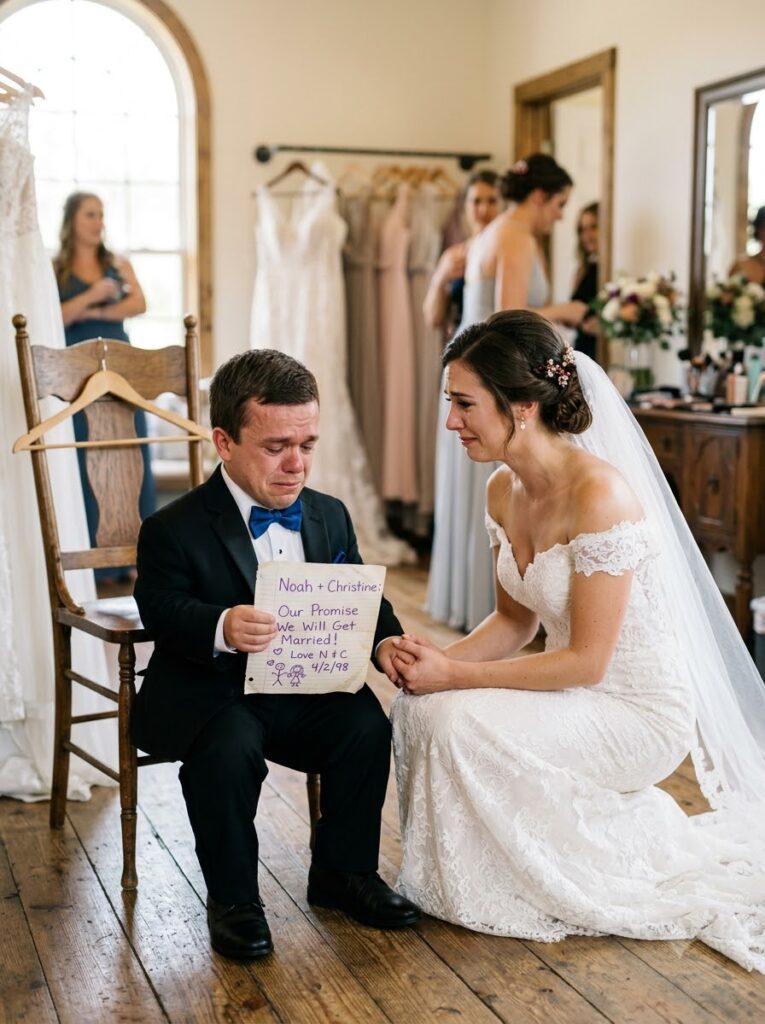
When it swung open, Noah was sitting on the floor in his wedding suit.
The old purple-crayon marriage pact rested in his hands.
His eyes were red.
“I am releasing you from it,” he said.
My heart broke.
“What?”
“You do not have to carry me as your burden anymore.”
I knelt in front of him.
“You are not a burden.”
“You have spent your whole life protecting me.”
“I spent my childhood punching boys who deserved it.”
“I am serious.”
“So am I.”
He looked toward the doorway.
“Your mother is right about one thing. You will always have to explain us.”
“Noah.”
“People will stare. They will insult you. They will question your motives.”
“They already do.”
“I can stop it.”
“By humiliating me at our wedding?”
His face crumpled.
“I am trying to save you.”
“From what? Loving you?”
“From waking up in ten years and realizing pity became your whole life.”
I gently took the old paper from his hands.
“There is something I never told you.”
He became completely still.
“I knew I loved you before I ever walked across that therapy room.”
“Christine.”
“I knew the night I fell in the bathroom.”
He frowned.
“That was a terrible night.”
“It was. I was half dressed, furious, and crying on the bathroom floor. You never rushed in to rescue me. You simply sat beside me until I decided how much help I wanted.”
His eyes filled with tears again.
“Evan saw my body change and decided my life had become too difficult. You saw me at my absolute worst and never once made me feel smaller.”
I reached up and gently touched his face.
“You did not carry me until I could walk again.”
“You stood beside me until I remembered who I already was.”
He lowered his eyes.
“I still do not want gratitude.”
“Good.”
I smiled through my tears.
“Because gratitude is not why I get jealous when women flirt with you.”
A small laugh escaped him.
“Gratitude is not why I know exactly how you like your coffee.”
“It is not why I miss you after one night apart.”
“And it is definitely not why I want to spend the next fifty years arguing with you.”
I stood and held out my hand.
Together, we walked into the ceremony room before the guests had taken their seats.
My mother looked completely stunned.
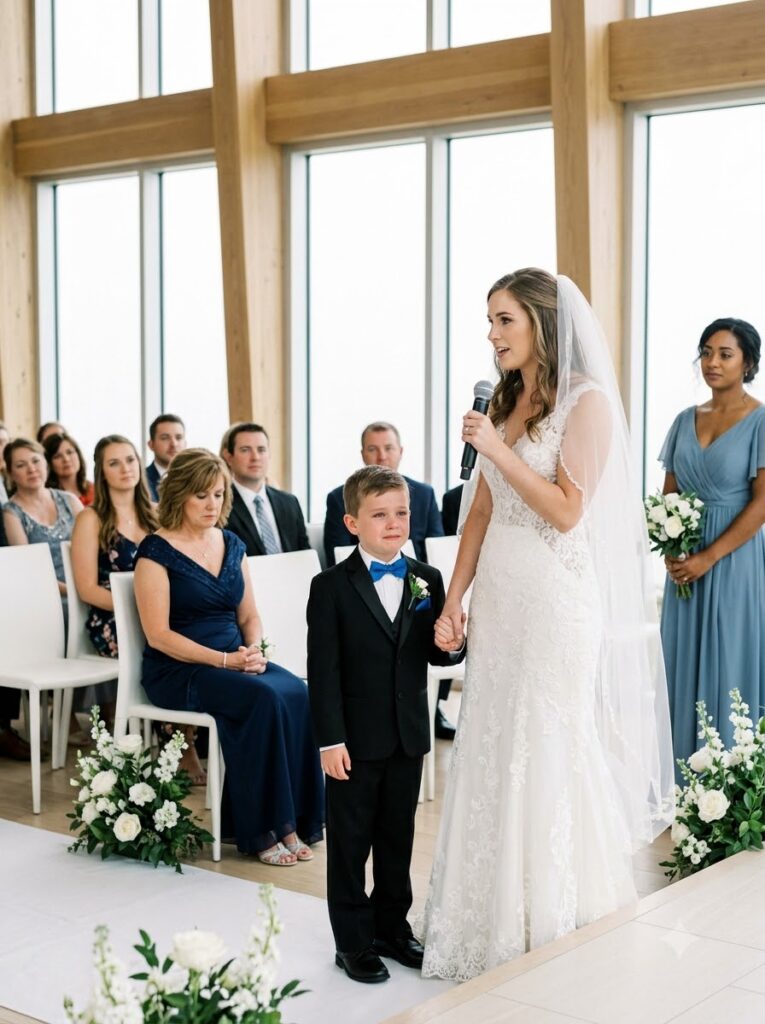
I turned to face everyone gathered there.
“I need to make something clear before we begin.”
The room fell silent.
“Noah is not a child.”
“He is not my charity project.”
“He is not a promise I feel trapped into keeping.”
My mother’s face turned pale.
“I am marrying him because I love him.”
“If anyone believes he is less of a man because of his body, you are welcome to leave right now.”
No one moved.
Then Zahara stepped forward beside us.
“You heard her.”
One guest quietly picked up her purse and walked out.
My mother remained seated.
She lowered her eyes without another word.
Ten minutes later, the ceremony finally began.
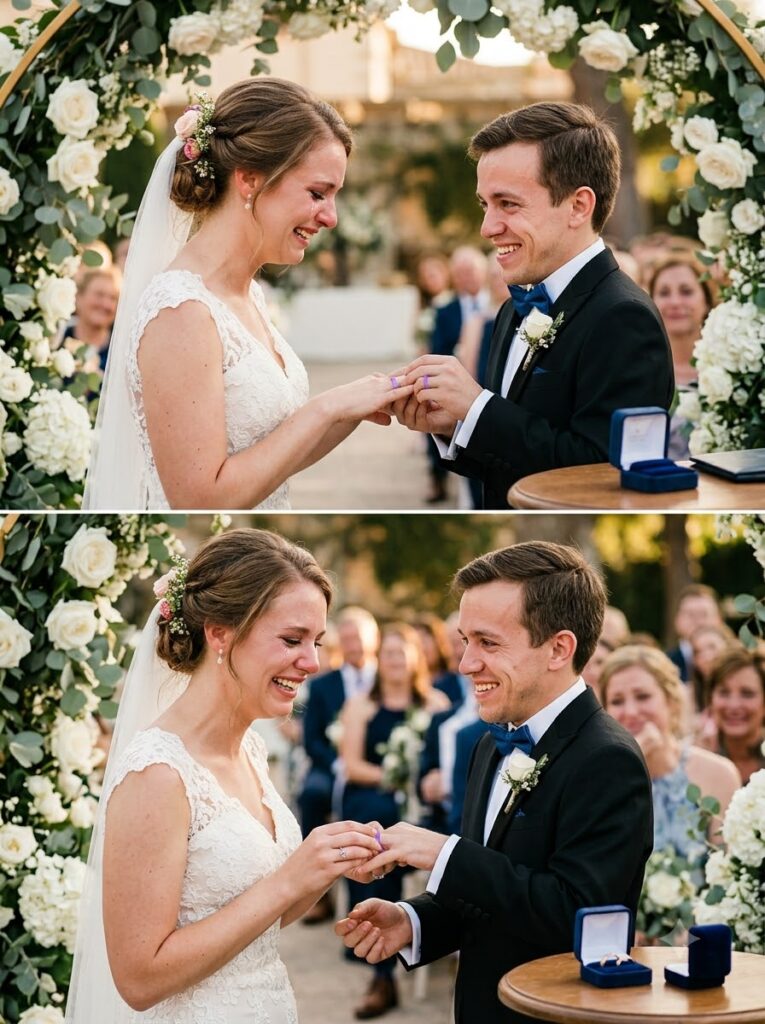
When it came time to exchange rings, Noah opened the ring box.
Inside were our wedding bands.
Beneath them rested two tiny plastic rings.
My purple gem was scratched.
His silver star was still crooked.
I laughed through my tears.
“You kept those too?”
“For 23 years.”
First we exchanged our wedding bands.
The officiant pronounced us husband and wife.
Then Noah carefully slipped the tiny plastic ring onto the tip of my little finger.
I placed the matching one onto his.
That childhood promise hadn’t brought us to the altar.
It hadn’t survived because we were lonely.
Or because we couldn’t find anyone else.
It survived because, somehow, two children had recognized the safest place they would ever know long before either of them understood what love truly meant.
Noah’s body stopped growing when he was eight years old.
His courage never did.
His sense of humor never did.
And neither did his heart.
It grew large enough to hold both of us.
I didn’t marry Noah because everyone believed he would never find love.
I married him because I had already found mine.
Do you think their childhood promise strengthened the bond they eventually built together, or did it plant the very doubt that almost convinced Noah he wasn’t worthy of Christine’s love?
