

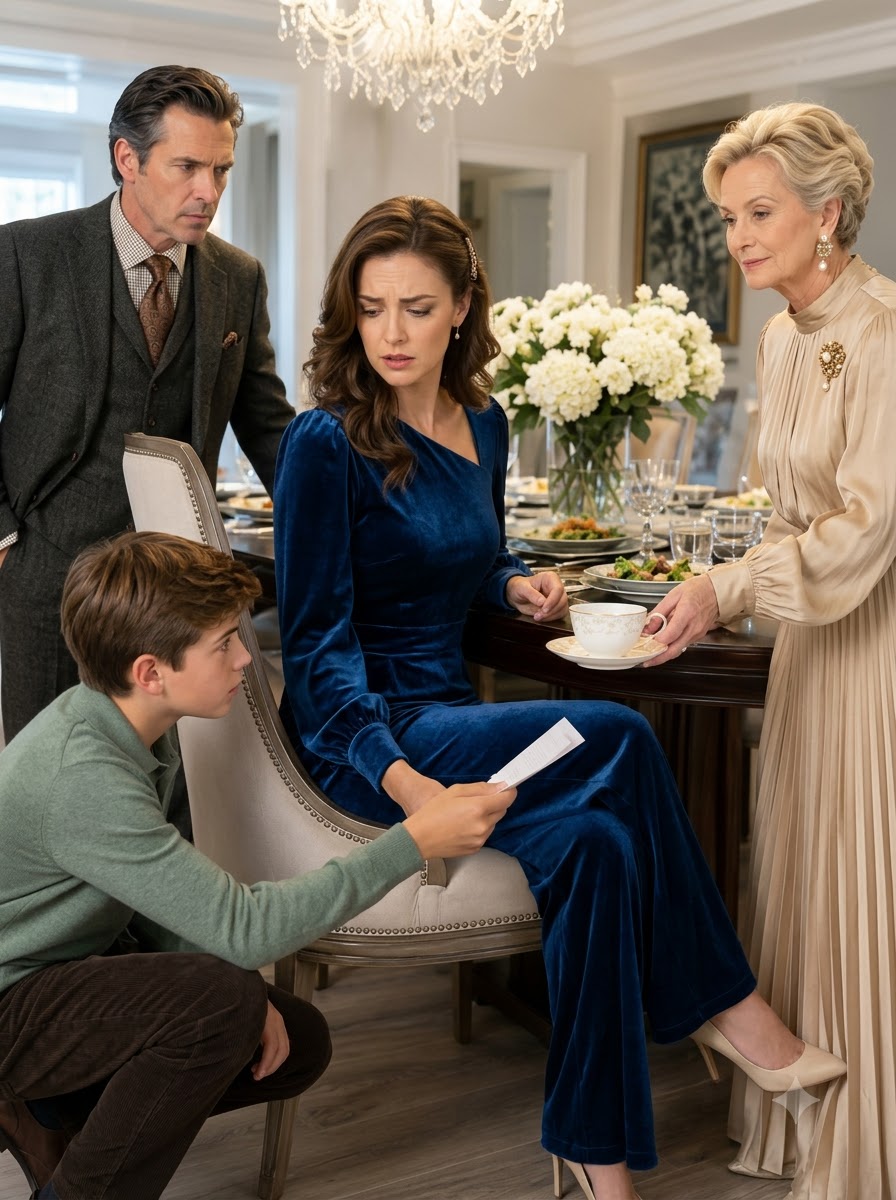
“Mom, don’t drink it. We need to leave.”
Those seven words were scribbled in shaky blue ink across the corner of a paper napkin.
My eleven-year-old son, Owen, quietly pushed it beneath the dinner table without even glancing at me.
For a few seconds, I completely forgot how to breathe.
Across from me, my husband, Nathan Marlowe, casually checked something on his phone. Next to him, his mother, Judith, calmly arranged roasted vegetables on her plate as though we were simply enjoying another peaceful Sunday dinner.
We were spending the weekend at Judith’s mountain vacation home outside Greenville, South Carolina.
The dining room felt warm and inviting. Rain gently tapped against the windows. A fire crackled inside the stone fireplace.
Everything appeared perfectly peaceful.
Then my eyes moved to the blue ceramic cup sitting directly in front of me.
Judith smiled.
“Claire, drink your tea before it gets cold. I made it especially for you.”
I made myself smile in return.
“What kind is it?”
“Just an herbal blend. You’ve been working too much lately. Nathan says you barely sleep.”
I was thirty-five and worked as a pediatric nurse practitioner at a children’s clinic in Greenville. Long shifts were simply part of my routine, and Judith frequently reminded me that I needed to “slow down.”
Under normal circumstances, I would have appreciated the thought.
But beneath the table, Owen’s hand was shaking.
I slowly pushed my chair backward.
“Actually, I’m feeling a little lightheaded. I think I need some air.”
Nathan finally lifted his eyes.
“You were fine five minutes ago.”
“I know. Maybe I stood up too quickly earlier.”
Owen instantly stood from his chair.
“I’ll go with Mom.”
Nathan’s expression hardened.
“Sit down, Owen.”
Judith gave a quiet laugh.
“Nathan, let him go. He worries about his mother.”
I took Owen’s hand and headed toward the hallway without hurrying.
As soon as we turned the corner, I crouched down beside him.
WHAT MY SON HEARD
“Tell me what’s happening.”
Owen’s face looked completely pale.
“Thursday night, I couldn’t sleep. I went downstairs to get water, and Nathan and Grandma Judith were in the kitchen.”
He swallowed hard.
“They were talking about you.”
My stomach clenched.
“What did they say?”
Owen glanced back toward the dining room.
“Nathan said you had to drink something at dinner. He said afterward everyone would think you suddenly got very sick. Grandma asked how long they should wait before calling for help.”
For several seconds, the only sound I could hear was the rain outside.
I wanted to tell him that he had misunderstood.
I wanted to believe there had to be another explanation.
Then several memories came rushing back.
Three months after Nathan and I married, he asked me to put his name on the deed to the townhouse my father had left me.
He described it as a practical choice.
Six months later, he convinced me to increase my life insurance coverage because, according to him, “responsible couples plan ahead.”
I also remembered catching him photographing financial statements on my desk.
At the time, he claimed he was simply helping organize our tax documents.
Most troubling of all, Owen had never felt comfortable around him.
I had brushed it aside.
I told Owen that blended families needed patience.
Standing there in the hallway, I suddenly wondered how many times my son had tried to warn me about something I refused to hear.
“Is there anything else?” I whispered.
Owen nodded.
“Nathan has a yellow paper in his office. I saw him writing times on it.”
I glanced toward the dining room.
Judith was calling for me.
I stood upright.
“We’re going back in. Act normal.”
Owen nodded.
“Are you going to drink the tea?”
“No.”
THE YELLOW SHEET
When we walked back in, Nathan was standing beside my chair.
“Feeling better?”
“A little.”
Judith nudged the cup closer to me.
“Then have a sip.”
I touched my forehead.
“I left my headache medicine in my purse. Judith, would you mind helping me find some water?”
She paused before heading toward the kitchen.
Nathan settled back into his chair.
I looked at Owen, then quickly toward the hallway that led to Nathan’s small home office.
My son understood immediately.
A few minutes later, he came back with his phone concealed beneath his sweatshirt.
Nathan never noticed.
When Judith stepped outside to take a call, Owen quietly showed me three photographs.
The first showed a small brown bottle hidden behind several folders.
The second showed financial papers with my name highlighted.
The third photograph made my hands turn cold.
On a yellow legal pad were three handwritten lines:
7:30 — tea.
7:50 — symptoms.
8:15 — call.
I stared at the writing.
There was no longer any way to explain it away.
I stood and glanced toward the windows.
“Judith, you mentioned your hydrangeas were finally blooming. Can you show them to me?”
She smiled, obviously pleased.
“Of course.”
As we stepped onto the covered porch, I sent Owen a single text message.
BACKPACK. SIDE DOOR. NOW.
Five minutes later, we came back inside.
Owen was waiting near the hallway, his backpack already strapped on.
Nathan noticed immediately.
“Where are you going?”
Owen grabbed his forehead.
“My head really hurts.”
I reached for his hand.
“I’m taking him back to Greenville.”
Nathan stood up.
“You can’t just leave in the middle of dinner.”
“He doesn’t feel well.” Nathan moved nearer.
“Claire, you haven’t touched your tea.”
Something in the way he said those words wiped away every last doubt.
I pulled Owen toward the side entrance.
Nathan called out behind us.
I refused to look back.
THE CUP IN OWEN’S BACKPACK
The vacation house sat several miles from town, and the cell signal was weak.
Owen and I hurried down the lengthy driveway until we reached the main road.
My hands were trembling as I requested a rideshare.
Twenty minutes later, a car finally pulled up.
Only when we were safely inside did Owen open his backpack.
He took out something wrapped in two dish towels.
The blue ceramic cup.
I stared at him.
“Owen, why do you have that?”
“I poured the tea into the sink when nobody was looking.”
He held the cup with care.
“But I thought someone might need to test what was left in it.”
I looked at my son, feeling tears well in my eyes.
At eleven, he had been more observant than every adult in that house.
We went straight to a local sheriff’s office, where I contacted my older cousin’s friend, Rebecca Lane, an attorney who handled complicated family and financial matters.
Rebecca arrived soon after and helped us present everything.
The cup, Owen’s photographs, and his account of the conversation were documented.
Nathan arrived later with Judith.
His performance was astonishing.
He hurried toward me with the face of a terrified husband.
“Claire, what are you doing? Mom and I have been worried sick.”
Rebecca stepped in front of us.
Nathan stopped.
For less than a second, his expression shifted.
Then the worried husband returned.
He told investigators I had been under too much pressure at work.
He insisted Owen had misunderstood an innocent conversation.
According to Nathan, Judith had only put a strong herbal supplement into my tea because I had complained about being tired.
“My wife needs rest,” he said quietly. “She doesn’t need people turning a misunderstanding into something terrible.”
Judith started crying.
“I love Claire like my own daughter.”
Owen remained completely still beside me.
Then he spoke.
“Nathan said they were supposed to wait before calling anyone.”
Nathan shook his head.
“That never happened.”
Owen continued.
“He also said I would stay with a woman named Denise afterward.”
Nathan gave a brief laugh.
“I don’t know anyone named Denise.”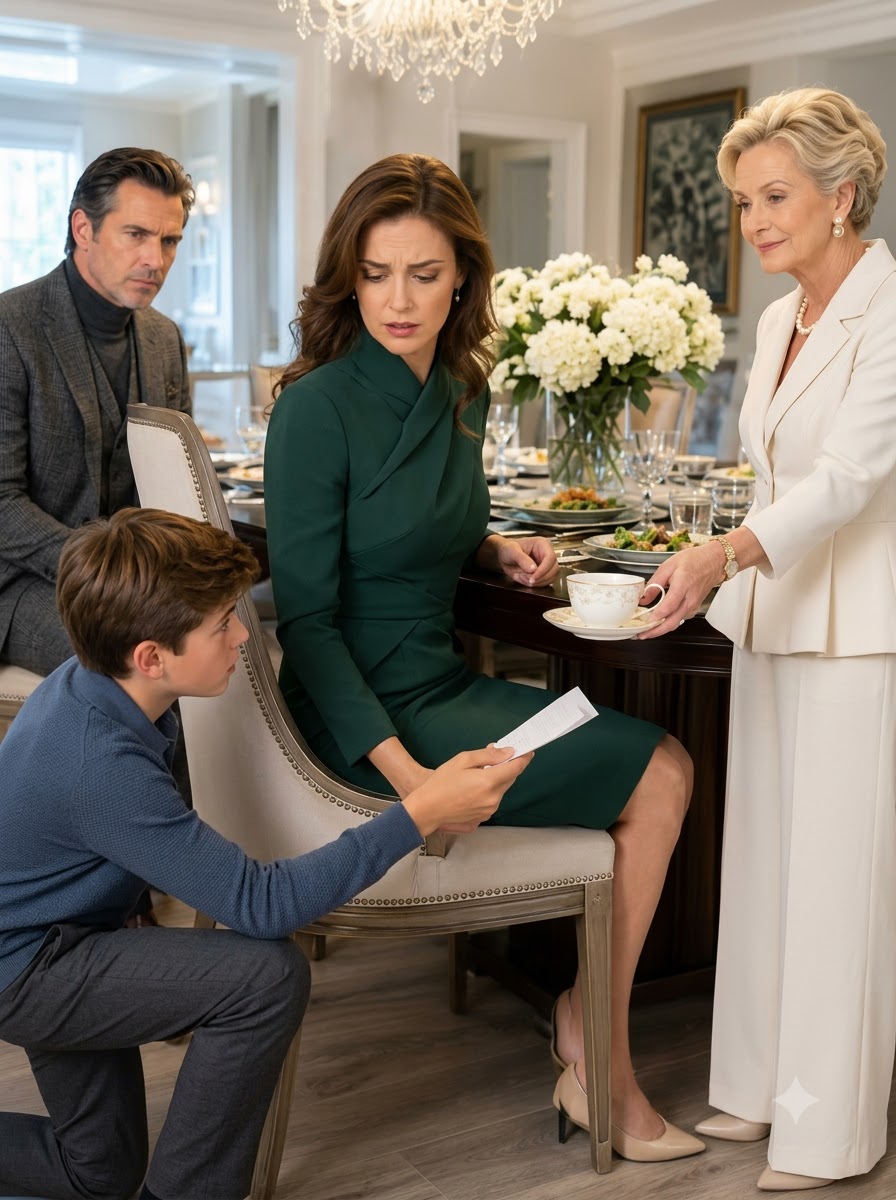
Owen looked straight at him.
“You took me to her house in March. You said I should get used to it because I might be staying there someday.”
Nathan’s smile disappeared.
TWO WOMEN I HAD NEVER HEARD ABOUT
The next morning, investigators received permission to search Judith’s vacation house.
They found the brown bottle, the yellow legal pad, financial documents, and Nathan’s laptop.
The preliminary testing of the cup indicated that it contained a prescription heart medication at an amount that had no reasonable connection to herbal tea.
Rebecca came into the waiting room several hours later with an expression I would never forget.
“Claire, Nathan was married before.”
I slowly nodded.
“He told me he had one short marriage in his twenties.”
Rebecca sat down beside me.
“There were two.”
The first woman was Allison Price.
She died unexpectedly five years earlier after becoming sick at home.
Nathan later received property and investment accounts from her estate.
His second wife, Melanie Cross, suffered a sudden medical emergency nearly two years afterward.
Nathan collected a substantial insurance payment and became the owner of her lake property.
My throat tightened.
“Why didn’t I know any of this?”
“Because he apparently worked very hard to make sure you didn’t.”
The laptop contained folders.
ALLISON.
MELANIE.
CLAIRE.
Inside my folder were copies of my medical records, work schedule, property details, retirement accounts, and insurance information.
There was also a timeline.
First meeting.
Relationship.
Marriage.
Insurance.
Property access.
Final stage.
But one sentence hurt more than everything else.
“Strong candidate. Stable career. Own property. One child — arrangements required.”
I read it three times.
My marriage had not started because Nathan simply happened to fall in love with me.
I had been assessed.
Chosen.
And planned around.
JUDITH FINALLY TALKS
Two days later, Judith requested to speak with me through her attorney.
Rebecca advised me that I was not obligated to give her anything.
But I wanted answers.
Without her carefully styled hair, pearls, and polished smile, Judith looked completely different.
She seemed smaller.
Exhausted.
“I’m going to cooperate,” she said.
I said nothing.
“I know you don’t want an apology.”
“An apology would not explain any of this.”
Judith stared down at the table.
“Nathan made terrible financial decisions years ago. He lost almost everything in a private medical investment. Allison had family money. When she was gone, what he received kept him from losing his business.”
I felt nauseated.
“And then you decided to repeat it.”
Judith closed her eyes.
She explained that she had helped Nathan meet women who seemed financially secure, independent, and somewhat isolated.
She attended charity dinners, medical fundraisers, and community events.
She established trust first.
Then Nathan appeared. That was exactly how I met him. Three years earlier, Judith had approached me at a fundraiser for a children’s hospital foundation.
She complimented my work.
We spoke for nearly an hour.
Then she introduced me to her charming, successful son.
I had assumed it was simply coincidence.
It wasn’t.
“What about Owen?” I asked.
Judith looked away.
“You were the first woman with a child.”
That sentence caused my hands to curl into fists.
“So what was supposed to happen to him?”
Judith explained that Nathan intended to tell people he was too overwhelmed to raise another man’s child on his own.
Owen would temporarily stay with Denise, an acquaintance of Judith’s, while Nathan handled the house, insurance, and accounts.
“My son is not paperwork you move out of the way.”
Judith lowered her head.
“I understand that now.”
“No. You understand it because Owen stopped you.”
I walked away.
THE STORY NATHAN COULD NO LONGER CONTROL
Judith’s cooperation transformed the entire investigation.
Authorities revisited questions surrounding Nathan’s previous marriages.
Financial records, insurance policies, archived medical documents, and phone records were examined.
A former physician who had worked for one of Nathan’s businesses also came forward.
Months earlier, Nathan had asked him to create a misleading mental-health assessment claiming I was experiencing paranoia and instability.
The physician refused.
He had kept the messages.
Nathan had apparently wanted an explanation prepared in case I became suspicious.
That evidence made his version of events much harder to defend.
Eight months later, the court proceedings began.
Nathan arrived in an expensive suit accompanied by a team of attorneys.
He looked exactly like the man I had married: composed, polished, and completely convinced he could explain everything.
But this time, I recognized the performance.
Judith testified.
The financial records were introduced.
The yellow legal pad was presented.
The laptop’s contents were examined.
Owen’s photographs established what had been inside Nathan’s office before anyone knew an investigation was coming.
The families of Allison and Melanie attended several hearings.
During one recess, Allison’s mother quietly approached me.
She took my hand.
“Your boy spoke for women who never got the chance.”
I could not respond.
Nathan was ultimately convicted on multiple serious charges connected to the scheme and received a sentence that meant he would spend the foreseeable future behind bars.
Judith also received a lengthy sentence for helping him plan and conceal what he had done.
Nathan’s claim to my home was overturned.
The house my father had left me was mine again.
Yet strangely, reclaiming the house did not feel like the greatest victory.
Owen did.
STARTING AGAIN
After everything was over, Owen and I moved into a smaller home outside Charleston.
I took a position at a pediatric clinic.
He began middle school and joined the robotics club.
For the first few months, neither of us slept particularly well.
Owen repeatedly checked the locks.
I sometimes woke during the night because I thought I heard movement in the kitchen.
We went to counseling.
Little by little, our house started to feel like a home again instead of somewhere we needed to protect.
One Saturday afternoon, I was clearing out an old backpack when I discovered the napkin.
The ink had faded a little.
“Mom, don’t drink it. We need to leave.”
I sat on the floor with it held between both hands.
Seven words.
That was all it had taken.
Later that evening, Owen returned from robotics club excitedly describing a small rover his team was building.
He stopped when he noticed me looking at him.
“What?”
I smiled.
“I was just thinking about how brave you were.”
He shrugged.
“I wasn’t trying to be brave.”
“Then what were you trying to do?”
His expression turned serious.
“I just needed you to believe me.”
That answer remained with me.
For months before that Sunday dinner, Owen had felt uneasy around Nathan.
I had noticed it.
I had heard it.
But I kept finding explanations for it because I wanted my new marriage to succeed.
I thought maintaining peace meant being patient.
Sometimes maintaining peace only means refusing to acknowledge what is already wrong.
I reached across the table and held my son’s hand.
“I should have listened sooner.”
Owen squeezed my fingers.
“But you listened when it mattered most.”
That night, after he went upstairs, I prepared myself a cup of chamomile tea.
For a moment, I simply looked at it.
Then I carried it to the window and watched the lights in neighboring houses appear one after another.
I used to believe that surviving something frightening would teach me never to trust anyone again.
It didn’t.
It taught me something more valuable.
Trust should never demand that we silence our instincts.
Love should never ask children to disregard their fear.
And when someone vulnerable finds the courage to tell us something feels wrong, listening may be the most important thing we ever do.
Sometimes the warning that transforms an entire life does not arrive dramatically; it comes quietly from someone who has been observing, listening, and hoping that the person they love will finally believe what they are trying to say.
Children may not always have the words to explain why someone or something makes them uncomfortable, but their uncertainty deserves attention rather than dismissal simply because adults prefer an easier explanation.
Wanting a family, a marriage, or a peaceful home can cause us to overlook small warning signs, yet protecting the appearance of happiness should never matter more than asking difficult questions.
Real love does not ask us to surrender our judgment, independence, or ability to recognize when someone keeps pushing further into our finances, decisions, and personal boundaries.
Courage does not always appear fearless, because sometimes courage is an eleven-year-old child with trembling hands writing a few words on a napkin because he knows remaining silent feels more dangerous than speaking.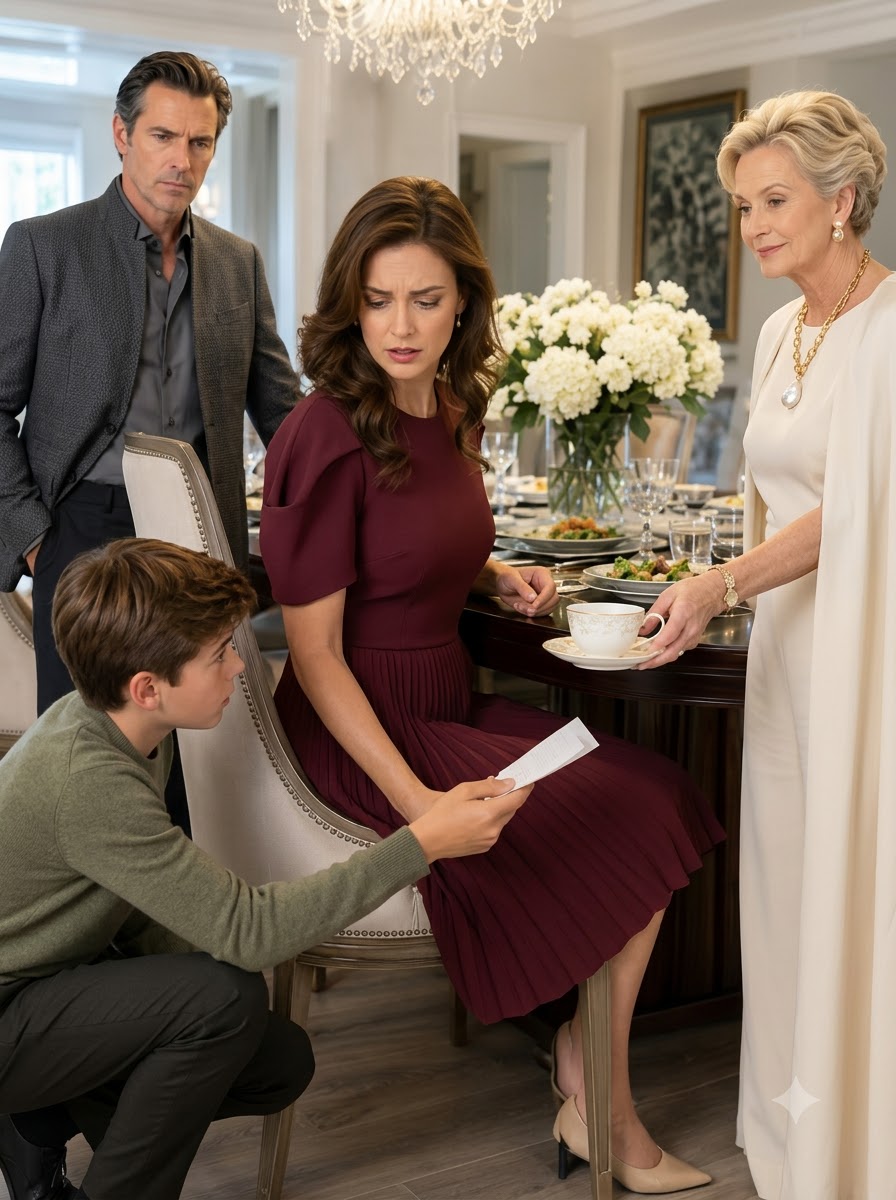
Listening does not mean accepting every fear without thinking; it means taking someone seriously enough to pause, investigate, and ensure that comfort and convenience are not preventing us from seeing something important.
A polished appearance, respected career, charming personality, or caring family image can never reveal everything about someone, because character is ultimately exposed through patterns, choices, and how a person behaves when they believe nobody is watching.
Starting over after betrayal is rarely dramatic or perfect; sometimes healing simply means sleeping a little better, laughing over dinner again, making new friends, and gradually realizing that fear no longer controls every room in the house.
Parents spend years believing their role is to protect their children, but sometimes a child notices what the adults have missed and reminds us that love can move in both directions when trust is strong enough.
The greatest lesson Claire carried forward was not to fear everyone she encountered, but to trust her instincts, respect her son’s voice, and remember that believing someone at the right moment can change the course of an entire life.
