

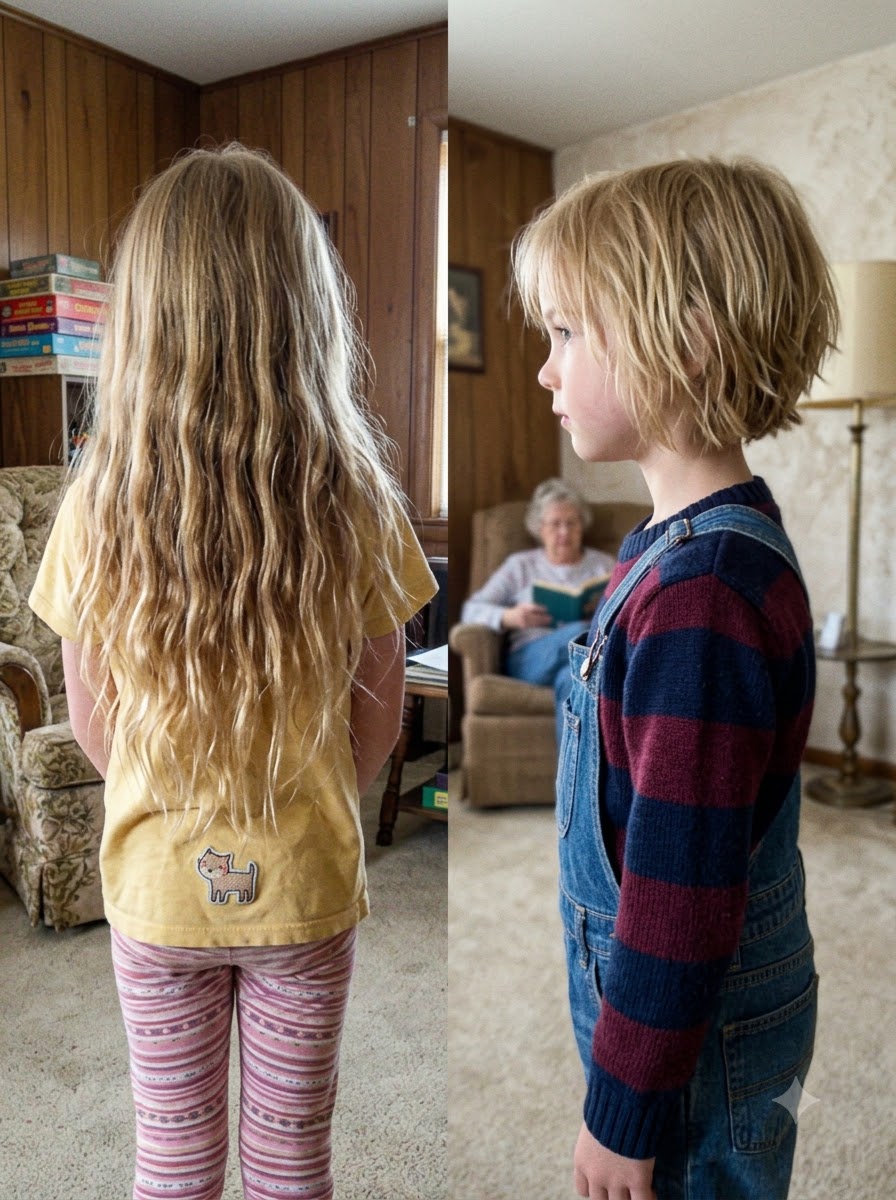
My daughter had refused to cut her hair for years.
So when she walked through the front door with it hacked off above her shoulders, I was ready to call the police.
Until the heartbreaking truth changed everything.
Ever since Maya was little, she had refused to cut her hair.
She only allowed me to trim the ends every few months.
Even then, she sat completely still in the kitchen chair, watching every movement of the scissors in the mirror as if I might suddenly cut away six inches instead of half an inch.
By the time she turned ten, her hair reached far below her waist.
It was thick, dark, and beautiful.
It was also incredibly difficult to manage on humid mornings.
Washing it took forever.
Drying it took even longer.
Every night, Maya sat between my knees while I carefully worked through the knots, always starting from the bottom and slowly moving upward.
At home, Felix and I called her Rapunzel.
“Rapunzel, come eat your breakfast.”
“Rapunzel, your tower needs cleaning.”
“Rapunzel, please stop leaving wet towels on the floor.”
She always rolled her eyes.
But she loved it.
I knew because one morning, when Felix called her Maya instead, she immediately corrected him.
“You forgot the Rapunzel part.”
Her hair wasn’t just something that grew from her head.
It was part of how she saw herself.
It was part of who she was.
But school had never been as gentle with her as we were.
Maya was quiet.
She kept to herself.
She only raised her hand when she was completely certain of her answer.
During recess, she usually sat near the edge of the playground reading.
A few children in her grade had teased her before.
They called her hair a curtain.
One child told her she looked like she was hiding behind it.
Another pulled her braid whenever the teacher wasn’t looking.
The school knew.
Felix and I had met with Maya’s teacher twice.
We had also spoken with Principal Susan.
Every time, we heard the same promises.
The students had been warned.
The staff would monitor the situation.
The behavior would be addressed.
And for a while, it seemed like things improved.
Maya stopped coming home with her braid half undone.
She stopped asking to stay home on days when those same children had physical education with her.
I convinced myself the problem was finally over.
I should have known better.
Children don’t always tell adults when cruelty changes forms.
Yesterday afternoon, I was in the kitchen preparing dinner when I heard the front door open.
“Maya?” I called.
No answer.
I placed the knife down.
Usually, she announced herself the moment she walked inside.
“Mom, what are we having for dinner?”
“Mom, can I have a snack?”
“Mom, I forgot my math folder.”
But that afternoon, there was only the quiet sound of her backpack hitting the hallway floor.
“Maya?”
Still nothing.
I dried my hands and walked into the living room.
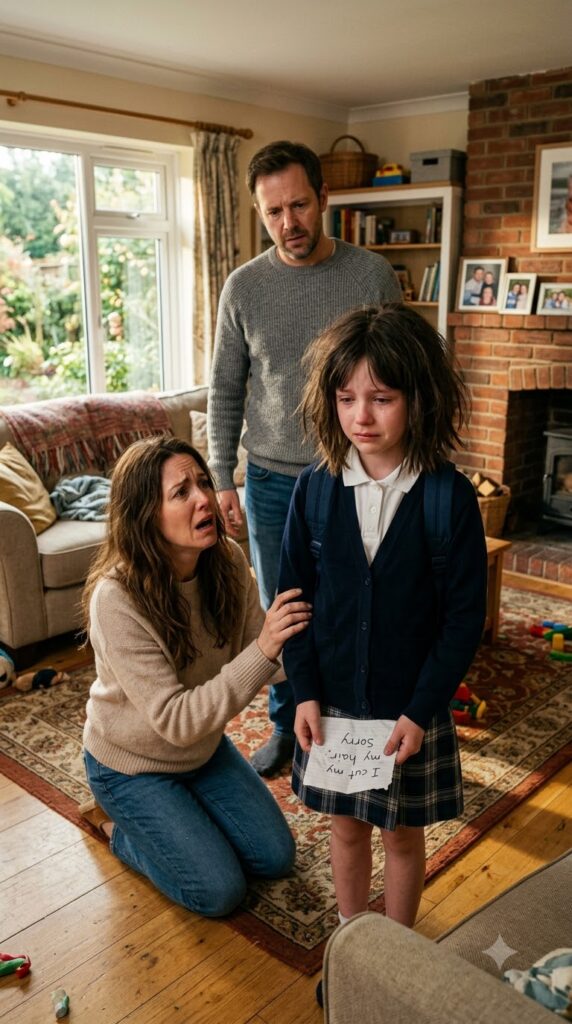
She stood beside the couch.
Her coat was zipped all the way up.
Her hood was pulled tightly over her head.
Her backpack was still hanging from both shoulders.
Immediately, I knew something was wrong.
“Sweetheart?”
She lowered her eyes.
I stepped closer.
“Did something happen at school?”
She shook her head slightly.
“Maya, look at me.”
Slowly, she did.
Her eyes were red.
I reached toward the edge of her hood.
She flinched.
“What happened?”
She said nothing.
I gently pulled the hood back.
And for a moment…
I couldn’t understand what I was seeing.
Then my knees gave out.
Her hair was gone.
The long hair I had brushed that morning had been cut into uneven, jagged pieces just above her shoulders.
One side was shorter than the other.
Large sections stuck out awkwardly near the back.
The ends looked torn.
Not trimmed.
Not styled.
Destroyed.
I dropped to the floor.
“Oh my God.”
Maya immediately started crying.
I reached toward her hair but stopped before touching it.
“Who did this?”
She stared at the carpet.
“Who did this to you?”
My voice became louder.
That was when Felix heard me from upstairs.
He rushed down so quickly he nearly missed the last step.
“What happened?”
Then he saw Maya.
His expression changed instantly.
He looked at me.
Then at her hair.
“Who cut it?”
Maya didn’t answer.
Felix grabbed his car keys.
“I’m going to the school.”
“The school is closed,” I said.
“Then I’m calling Susan.”
He pulled out his phone.
“No.”
I stopped him.
“Wait. We need names first.”
I turned back to Maya and held her shoulders gently.
“Tell us who did this.”
Her lower lip trembled.
“Was it the same kids who pulled your braid?”
She shook her head.
“Did they corner you?”
Nothing.
“Did someone hold you down?”
Felix cursed quietly.
“I’m calling the police.”
That finally made Maya look up.
“No.”
Her voice was barely a whisper.
“Then tell us who did it,” Felix said.
His anger scared her.
I saw it.
But I was angry too.
Every moment from the last year came rushing back.
The braid pulling.
The teasing.
The whispers.
The days she begged not to go to school.
The meetings where adults told us everything was being handled.
I imagined my daughter trapped somewhere while someone cut away the hair she had protected her entire life.
“Names, Maya,” I said.
“We need names.”
Tears filled her eyes.
Then she slowly reached into her backpack.
From the front pocket, she pulled out a crumpled piece of paper folded twice.
My hands shook as she handed it to me.
I expected a note from the school.
An apology.
A name.
Instead, I saw handwriting that clearly belonged to another child.
Before I could read the first sentence, Maya whispered four words.
“He shouldn’t feel alone.”
Felix lowered his phone.
“Who shouldn’t feel alone?”
I unfolded the paper.
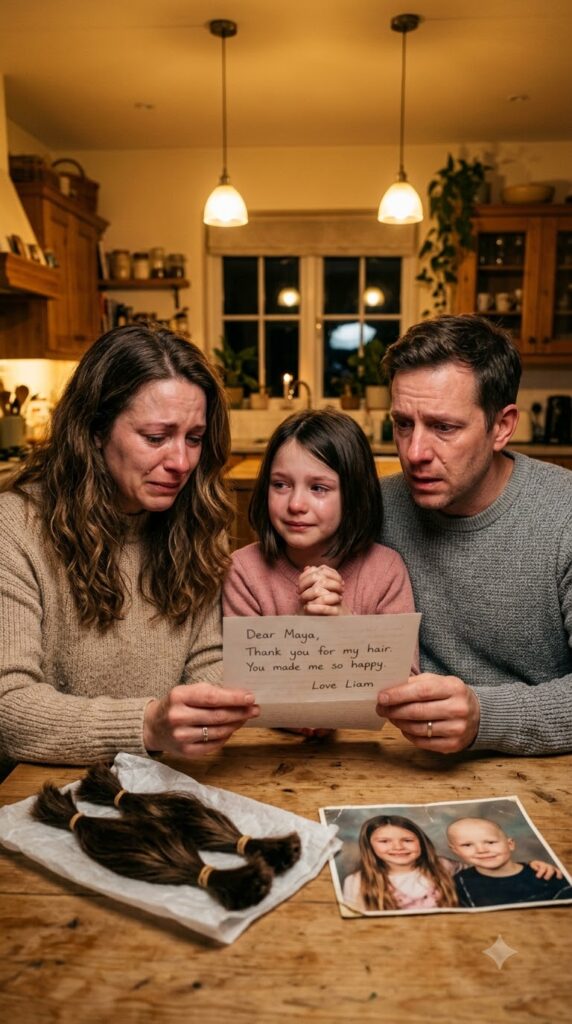
“To Maya’s parents,”
“My name is Liam. I am new in Maya’s class.”
“I wanted to thank you for your daughter.”
“I had cancer, and the medicine made all my hair fall out.”
“Some kids make jokes about my head.”
My eyes moved down the page.
“Maya is the only person who sits with me every day and tells them to stop.”
“Today I told her my mom and dad are trying to collect enough hair so I can get a real-hair wig.”
“They do not have enough hairpieces yet.”
“Maya said she wanted to give me hers.”
“I told her she didn’t have to.”
“She said she wanted to help.”
“Please don’t be mad at her.”
“She is the kindest person in our class.”
“Liam.”
I read the note twice.
By the second time, the words blurred.
Felix took the paper from my hands.
The anger slowly disappeared from his face.
Maya stood between us, tears running down her cheeks.
I looked at her uneven haircut.
“You did this yourself?”
She nodded.
“At school?”
Another nod.
“Why didn’t you tell us?”
“I thought you’d say no.”
Felix swallowed hard.
“We might have asked questions.”
“We might have taken you to a salon.”
“I wanted to do it today.”
“Why today?” I asked.
Her eyes moved toward Liam’s note.
“Because they made him cry again.”
And then she finally told us everything.
Liam had joined Maya’s class six weeks earlier.
He had recently finished chemotherapy.
His hair had not grown back yet.
Every day, his bald head was visible.
At first, most of the children only stared.
Then the comments started.
Some of the same students who had previously teased Maya began targeting Liam too.
They asked if he polished his head.
They called him an egg.
One boy pretended the sunlight was bouncing off him.
Another child asked if cancer was contagious and moved away from him during lunch.
Maya understood something those children didn’t.
She knew what it felt like to walk into a room and wonder what someone might say next.
She knew what it felt like to become the person everyone laughed at.
So she sat beside Liam.
At first, they barely talked.
Then one day, he noticed the fantasy novel she was reading and told her he loved the same series.
That was how it started.
Soon, they ate lunch together every day.
When someone pulled Maya’s braid, Liam spoke up.
“Leave her alone.”
When someone laughed at Liam’s head, Maya moved closer to him instead of looking away.
She knew what it felt like to be abandoned by everyone else.
She refused to let him experience that.
The day before everything happened, Liam told her about the wig.
He explained that his parents, Noella and Duncan, knew about an organization that created custom real-hair wigs for children who lost their hair during chemotherapy.
But the process required specific donations.
The hair had to meet certain standards.
And there still weren’t enough matching donations available for Liam.
Maya looked at her own braid.
And made a decision.
That morning before school, she took the large kitchen scissors from the junk drawer and secretly placed them in her backpack.
During lunch, she went into a bathroom stall.
She separated her hair into two thick sections.
Then she started cutting.
The scissors weren’t sharp.
The first ponytail took so long that her hand began hurting.
The second one slipped while she was cutting, leaving one side shorter than the other.
She tried fixing it.
But every attempt made it worse.
When she finally looked into the mirror, she panicked.
She wrapped the two long sections of hair in paper towels and placed them inside her backpack.
Then she pulled up her hood and returned to class.
No teacher noticed.
At dismissal, Liam saw her.
When Maya explained what she had done, he wrote the note for us before they left school.
“I didn’t want him to continue being bullied. I know how it feels.”
That was the moment Felix finally broke.
He pulled Maya into a hug.
He sat down on the edge of the couch and held her the same way he had when she was five years old.
She climbed into his lap.
I sat beside them.
For several minutes, none of us spoke.
I felt so many things at once.
I was proud of my daughter.
I was terrified by the way she had handled it.
And I felt ashamed that my first reaction had been demanding names instead of asking what happened.
All three feelings existed together.
Finally, Felix kissed the top of her head.
“What you did for Liam was kind,” he said softly.
“Taking scissors to school and cutting your own hair in a bathroom was dangerous.”
Maya nodded against his chest.
“You could have hurt yourself.”
“I’m sorry. I won’t do it again.”
“You should have told us.”
“I know.”
“But I understand why you wanted to help.”
She looked up.
“Are you mad?”
“Yes,” Felix answered.
Her face fell.
“And proud,” he added.
“Parents can feel both things at the same time.”
That made her laugh quietly through her tears.
I opened her backpack and found the cut hair beneath two folders.
The ponytails were wrapped carefully in paper towels and secured with elastic bands.
The ends were uneven.
But most of the length was still there.
I placed them gently on the table.
That evening, we took Maya to a salon.
The stylist stared when we explained what happened.
She said she couldn’t make every section perfectly even without cutting Maya’s hair much shorter.
Instead, she shaped it into a layered bob.
The front reached her jaw.
The back brushed the top of her neck.
Maya watched herself in the mirror.
When the stylist finished, she touched the ends.
“I look different.”
“You do,” I said.
“Bad different?”
I shook my head.
“No. You are beautiful no matter how long your hair is.”
The next morning, Felix and I took Maya back to school.
We were no longer planning to call the police.
But we still needed answers.
Principal Susan looked stunned when we explained everything.
“No one reported this to me,” she said.
“No one knew,” I replied.
“She hid it until she came home.”
Susan turned toward Maya.
She asked her to explain what happened.
Then she listened.
She didn’t interrupt once.
When Maya finished, Susan folded her hands on the desk.
“Bringing scissors to school was unsafe,” she said.
“You could have injured yourself or someone else.”
Maya lowered her head.
“I’m sorry.”
Felix leaned forward.
“We understand that.”
“But we need answers about the bullying happening at this school and how the school plans to stop it.”
Susan looked at him.
“Not just the children who targeted Maya.”
“Not just Liam.”
“How many children are being hurt while adults call it teasing?”
The room went silent.
I told Susan about every incident Maya had previously mentioned.
Every time she came home upset.
Every time she asked not to go to school.
Maya explained what children had said to Liam.
Susan wrote everything down.
She didn’t defend the school.
She didn’t say children were just being children.
She didn’t claim staff couldn’t see everything.
“This is bullying,” she said.
“I will discuss this with the teachers and create stricter measures to address it.”
She looked directly at us.
“It will not be dismissed at this school anymore.”
Then she asked if she could contact Liam’s parents.
That afternoon, we met Noella and Duncan in the same office.
Liam sat between them.
The first thing I noticed wasn’t his bald head.
It was the way he watched every person who walked past the open doorway.
Like he was always waiting to see if someone would say something hurtful.
Noella immediately walked over and hugged Maya.
Duncan held the note his son had written in his hands.
He cleared his throat several times before he was finally able to speak.
“Liam has talked about you every day,” he said.
Noella nodded.
“We knew you were his friend. We didn’t know how much you had been protecting him.”
Maya looked down.
“I didn’t really protect him,” she said quietly.
“They still said things.”
Liam looked at her.
“You stayed by my side.”
Maya reached into her bag and handed the two ponytails to Noella.
“We don’t know if the organization can use them,” I explained.
Noella held the wrapped hair against her chest.
“Even if they can’t, what she did matters.”
Later, the organization examined Maya’s donation.
They confirmed that much of her hair met their requirements.
It wasn’t enough to create an entire wig by itself.
But it could become part of one.
And that was enough to inspire something bigger.
A few days later, I requested another meeting with Principal Susan.
I looked at Maya’s short hair and said:
“If one child was willing to give up something she had treasured for years, adults should be willing to do more than just talk about the problem.”
That conversation became the beginning of the school’s hair donation drive.
The school partnered with the wig organization and two licensed salons.
Every family received information explaining exactly how donated hair would be collected and used.
No child could participate without written permission from their parents.
Students who didn’t want to cut their hair could still help by raising money to cover the cost of creating and fitting wigs.
Three weeks later, the drive was held in the school gym.
Parents arrived.
Teachers came.
Older siblings joined too.
A father who had been growing his hair for years donated several inches.
One teacher donated part of the hair she had kept since her college days.
Students created cards for Liam and other children receiving wigs.
Maya didn’t donate again.
Instead, she stood beside Liam at the labeling table.
She carefully checked that every bundle had the donor’s information attached.
By the end of the day, the organization had collected enough suitable hair donations to begin making Liam’s wig.
The process took almost two months.
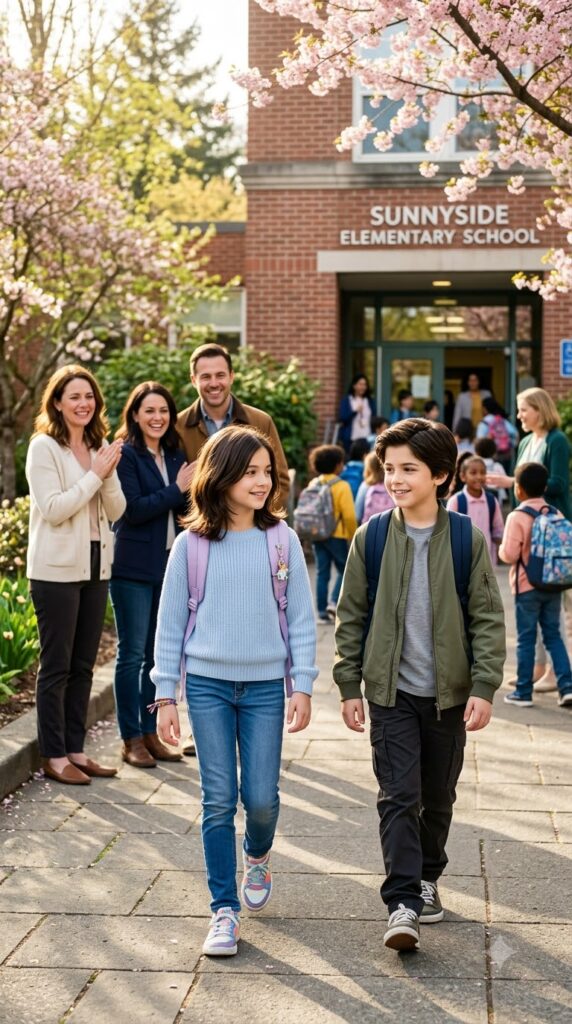
Then, one morning, Noella invited us to meet them outside the school.
Liam was wearing his wig for the first time.
It was dark brown.
Neatly cut above his ears.
He kept touching it.
Maya’s own hair had already grown past her chin again.
The two of them stood together at the entrance.
“Do I look strange?” Liam asked.
Maya studied him carefully.
Then she shook her head.
“You look like the Liam I spend every day with.”
He smiled.
Then they walked into school together.
Side by side.
Some children looked.
But nobody laughed.
Principal Susan had kept her promise.
The school started documenting complaints instead of dismissing them as isolated jokes.
Teachers received training about appearance-based bullying and exclusion.
Students were taught something important:
Staying silent when someone is being hurt can allow the cruelty to continue.
The school didn’t transform overnight.
Problems didn’t disappear completely.
But adults were finally paying attention.
That evening, Maya sat between my knees while I brushed her short hair.
It no longer took twenty minutes.
There were no endless tangles.
The entire process was finished in less than a minute.
For years, I believed her hair was one of the most beautiful things about her.
I was wrong.
The most beautiful thing was the reason she was willing to give it away.
Her compassion.
Her courage.
Her ability to see someone else’s pain and decide they shouldn’t face it alone.
When Maya came home with her hair chopped off, I thought someone had stolen something precious from my daughter.
The truth was much different.
She had chosen to give something precious away.
Not because she hated her hair.
Not because it didn’t matter.
But because it mattered enough to make the sacrifice meaningful.
Have you ever judged a situation too quickly, only to discover the truth was completely different from what you believed?
