

PART 3
One was labeled MOM.
One was labeled LILY.
The third said NATHAN.
Not DAD.
Nathan.
I kept the drawing in my office.
It reminded me that a title could not be claimed simply because I wanted it.
I had to earn it.
Thomas eventually traveled to Arizona and returned with two boxes of documents.
The contents were worse than I had imagined.
There were copies of payments to intermediaries, letters written by my father, and records showing that money had been moved through shell companies connected to our businesses.
Some of the transactions were old enough that the people involved were dead. Others appeared to have been legitimate transfers that my father had concealed for reasons that were still unclear.
But the documents concerning Sarah were unmistakable.
One letter instructed Vincent to ensure that she believed I had died.
Another authorized payment to the man who delivered the forged letter.
A third contained a handwritten note from my father.
She must remain away from Nathan. If the child is his, that makes the matter more important, not less.
I read that sentence until the words blurred.
My father had known.
He had known Sarah was carrying my child.
And he had deliberately ensured that I would never meet her.
I took the papers to Thomas.
“Can any of this be verified?”
“Some of it. The bank records are strong evidence. The letters will require authentication, and we’ll need to be careful about what we disclose.”
“Then do it properly.”
Thomas watched me.
“Are you sure you want to open this up? Some of the companies involved are still connected to your businesses.”
“I don’t care.”
“You could lose contracts. People may start asking questions about your other operations.”
I looked at the documents.
For most of my adult life, I had treated the family name as something sacred, something that had to be protected at any cost.
Now I understood that the name itself meant nothing if it was built on lies.
“Anything illegal gets turned over to the authorities,” I said. “Anything that belongs to someone else gets returned. I want an independent review of the accounts.”
Thomas nodded slowly.
“And the family records?”
“Give Sarah copies of everything that concerns her. Lily deserves to know the truth when she’s old enough to understand it.”
He gathered the papers.
“What about Vincent?”
I considered that.
“I won’t protect him from the consequences. But I won’t pretend he was the only person responsible, either.”
My father had made the original decision.
Vincent had helped him.
And I had spent years benefiting from a system that rewarded silence.
If I wanted to become a different man, I had to stop choosing which truths were convenient.
The first public consequence came two months later.
An independent audit uncovered financial irregularities in several businesses my father had controlled. Some transactions required further investigation, and I cooperated with the authorities rather than using my lawyers to delay the process.
I sold two nightclubs that had become liabilities and closed a company whose accounts could not be adequately explained.
People called me reckless.
Others said I was trying to clean up my image.
I didn’t bother correcting them.
For the first time, I understood that being feared and being respected were not the same thing.
Fear made people obey.
Respect gave them a reason to trust.
I had spent thirty years building the first.
I was beginning to learn the second.
Vincent eventually agreed to give a formal statement about his role in Sarah’s disappearance. He apologized to her directly, although she did not forgive him.
She listened, thanked him for telling the truth, and asked him not to contact her again.
That was her decision.
I respected it.
There were no dramatic confrontations, no sudden reconciliation, and no convenient speech that made everything right.
Some damage could be acknowledged without being undone.
I was learning to live with that.
Six months after I first knocked on Apartment 4B, Sarah invited me to dinner.
Not at a restaurant.
Not in one of my expensive dining rooms.
In the apartment where she and Lily now lived, with a kitchen table that had a slight wobble and curtains Lily had helped choose.
When I arrived, a small paper sign was taped to the door.
WELCOME HOME.
I stared at it for several seconds.
Lily opened the door.
“You came!”
“I said I would.”
She grabbed my hand and pulled me inside.
Sarah stood by the stove, looking healthier than she had in months. Treatment had been difficult, and there were still days when she needed rest, but the color had returned to her face.
The smell of roasted chicken filled the apartment.
A bowl of potatoes sat on the counter beside a plate of vegetables.
There was even a small cake.
I looked at Lily.
“What’s the occasion?”
She shrugged.
“Mom said we should celebrate.”
“Celebrate what?”
Sarah glanced at our daughter.
“That we’re still here.”
We sat down together.
Lily talked about school, her favorite teacher, and a classmate who had tried to convince everyone that the moon was made of cheese.
Sarah laughed so hard that she had to put down her fork.
I watched them and felt a strange ache in my chest.
This was what I had missed.
Not the birthdays or the photographs or the first steps, although those mattered.
It was the ordinary moments.
The conversations that didn’t need to be recorded.
The arguments about vegetables.
The way a family could occupy a small room and somehow make it feel larger than any mansion.
After dinner, Lily brought out a piece of blue fabric.
“I made something for you.”
She handed it to me.
It was a simple handkerchief, stitched along the edges with uneven blue thread.
My initials were embroidered in one corner.
N.M.
The letters leaned slightly to the right.
I held it carefully.
“You made this?”
“With Mom’s help.”
“It’s beautiful.”
She looked pleased, then suddenly shy.
“Can I ask you something?”
“Anything.”
She lowered her eyes.
“Why didn’t you come find us before?”
The room became quiet.
Sarah set down her cup.
I could have given Lily the easy answer.
I could have told her that I didn’t know she existed, that other people had lied to me, and that none of it had been my fault.
Those things were true.
But they were not the whole truth.
“I didn’t know about you,” I said. “And I believed lies about your mother. I was young, and I trusted people I shouldn’t have trusted.”
Lily listened without interrupting.
“But even after I learned the truth, I can’t change what happened before. I can’t give you back the birthdays I missed or the nights you were frightened. I can’t make your mother healthy overnight, and I can’t promise that life will always be easy.”
I swallowed.
“What I can promise is that I’ll keep showing up. I’ll tell you the truth, even when it’s difficult. And if I make a mistake, I’ll do my best to fix it instead of pretending it never happened.”
She considered that.
“Even when I’m mad at you?”
“Especially then.”
“Even if I don’t call you Dad?”
I felt my throat tighten.
“Even then.”
Lily looked toward Sarah.
Her mother gave her a small nod.
Then Lily turned back to me.
“Okay.”
It was one word.
But it was the first time she had looked at me without the careful distance she had carried since the day we met.
After a moment, she leaned against my arm.
I stayed perfectly still.
I was afraid that if I moved too quickly, the moment might disappear.
Then she whispered something so softly I almost missed it.
“Maybe someday.”
I looked down at her.
“Maybe someday what?”
She smiled.
“Maybe someday I’ll call you Dad.”
I nodded, unable to trust my voice.
“Whenever you’re ready, sweetheart.”
She returned to her cake as though she had merely asked for another piece of bread.
Sarah met my eyes across the table.
Neither of us spoke.
We didn’t need to.
For the first time in thirty years, the past had stopped dictating every moment of our future.
A year later, I returned to the building where everything had begun.
Apartment 4B had been renovated, along with several other units in the building. The broken heating system had been replaced, the plumbing repaired, and the worst structural problems addressed.
I had originally intended to raise the rents after the improvements.
Instead, I created a maintenance fund and revised the management policies across my residential properties.
Tenants who fell behind would still have to communicate with the management office. Bills still had to be paid, and buildings still required maintenance.
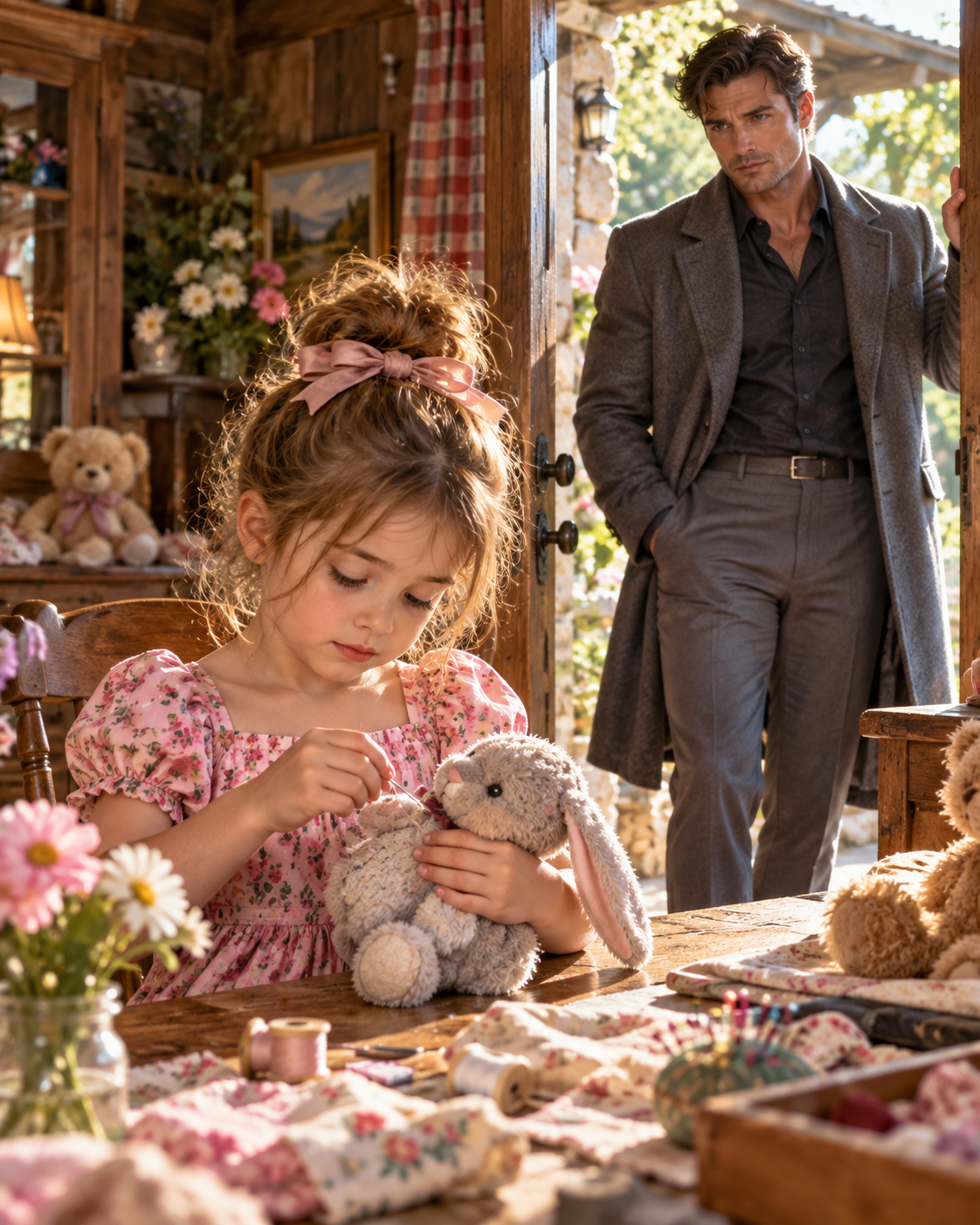
But no child would ever be expected to sew her way out of eviction while a sick parent lay in the next room.
We established a hardship program that connected struggling tenants with social workers, emergency assistance, and temporary payment arrangements where appropriate.
I also made it a policy that eviction notices involving families with young children would be reviewed by someone trained to identify urgent housing needs before the process advanced.
Some of my managers complained that it would cost money.
They were right.
It did.
But I had spent decades measuring the success of a business by what it could extract from people.
I was beginning to measure it by what it could provide without destroying them.
Standing in the renovated hallway, I remembered the little girl who had opened the door with blood on her fingers.
I remembered the forty-three dollars in the crumpled envelope.
I remembered the sound of Sarah saying my name.
Nate.
Not Mr. Moretti.
Not the man whose signature could make people tremble.
Just Nate.
I had come to Apartment 4B intending to collect a debt.
Instead, I had discovered the debt I owed to the people I loved.
And I had finally understood that money could pay for medicine, shelter, education, and comfort.
It could not purchase trust.
Trust had to be earned, one ordinary day at a time.
On Lily’s eighth birthday, I arrived carrying a modest gift wrapped in yellow paper.
She was waiting at the apartment door.
“You remembered!”
“Of course I remembered.”
She threw her arms around me.
I hugged her carefully, then handed her the package.
Inside was a sewing kit filled with colorful thread, fabric scraps, and child-safe tools. Beside it was a small wooden box.
Lily opened the box and found a silver rose.
It was a replica of the carving on the old sewing machine.
“I thought you might like this,” I said. “Your grandmother carved the original. My mother.”
Lily traced the rose with one finger.
“Did she teach you to sew?”
“She tried. I wasn’t very good at listening.”
“Well, you have to listen now.”
I laughed.
“Yes, ma’am.”
Sarah appeared in the doorway, watching us.
She was still recovering, but she had returned to part-time work and was taking a few sewing commissions again. Her doctors remained cautious, and there were difficult days, but she no longer faced them alone.
We had not returned to the romance we once shared.
That part of our story remained complicated, filled with years that could never be reclaimed and wounds that had not entirely healed.
We were learning to build something new.
Some days, that meant talking about the past.
Other days, it meant discussing Lily’s homework, buying groceries, or arguing about whether I was allowed to bring work calls to the dinner table.
It was not the life I had imagined when I was twenty-two.
It was better in ways I was still learning to understand.
That evening, we celebrated with cake and candles.
Lily made a wish before blowing them out.
I didn’t ask what it was.
Later, as I helped her clear the table, she slipped her small hand into mine.
“Dad?”
I stopped moving.
She looked up at me.
“Can you come to my school next Friday? We have a family day.”
For a moment, I could not speak.
Then I crouched beside her.
“I’d be honored.”
She smiled and ran back to help her mother.
I remained there, holding a paper plate, feeling something in my chest that had nothing to do with fear or power.
I had once believed my name was the most important thing I possessed.
Nathan Moretti.
A name that opened doors.
A name that made people pay.
A name that had been feared in rooms I had never entered.
But none of it mattered as much as the small word my daughter had finally chosen to give me.
Dad.
It was not a debt she owed.
It was a gift.
And for the first time in my life, I understood the difference.
I had gone to Apartment 4B to evict a woman who owed me three months of rent.
I left with the chance to become the father my daughter deserved.
The woman from my past had whispered a name only my old life knew.
But it was the little girl with bleeding fingers who taught me what that name should mean.
Not fear.
Not power.
Not the debts other people owed me.
A promise to show up.
A promise to tell the truth.
And a promise that, no matter how difficult the world became, my daughter would never have to earn her place in my life one painful stitch at a time.
