

PART 2
Sarah had never wanted to be rescued. She had wanted a partner, someone who would stand beside her without making her feel small.
I lowered my voice.
“Then don’t take my money as charity. Take it as something I should have given you thirty years ago. Let me make sure Lily is safe. Let me get you treatment. You can hate me afterward if that’s what you need.”
She looked at me for a long time.
“I never hated you, Nate.”
Those words nearly brought me to my knees.
“Then why did you stay away?”
She glanced toward Lily.
“Because I was afraid that if I found you, your father would take her away from me.”
Before I could respond, she began coughing.
At first, it was a dry, shallow cough. Then it became violent enough that she doubled over, struggling to breathe.
Lily rushed into the bedroom.
“Mom?”
Sarah tried to wave her away, but her hand trembled uncontrollably.
I reached for my phone.
“Call an ambulance?” my driver asked when I spoke to him.
“Yes. Now.”
Then I turned to Lily.
“Get your mother’s coat.”
The girl hurried to the closet.
While we waited, I noticed a small photograph taped to the wall beside the bed.
It showed Sarah holding a newborn wrapped in a pale yellow blanket.
Her face was exhausted but radiant.
I stood before it, unable to look away.
On the back, in Sarah’s handwriting, were four words.
Your daughter, Lily. October.
I touched the edge of the photograph.
For seven years, my child had existed somewhere in this city while I went about my life believing my past was buried.
She had taken her first steps without me.
Said her first words without me.
Lost her first tooth, celebrated birthdays, and learned to thread a needle without me.
I had missed everything.
And there was no amount of money that could buy those years back.
When the paramedics arrived, Sarah was barely conscious.
Lily refused to let go of her hand.
“I’ll be right behind you,” I promised.
She looked up at me.
“Are you going to leave us?”
The question was quiet.
It was also the most devastating thing anyone had ever asked me.
“No,” I said. “I won’t.”
I had made promises before and broken them.
This time, I intended to prove it.
At the hospital, Sarah was taken into an examination room while a nurse brought Lily to a waiting area.
I sat beside my daughter.
She kept her hands folded in her lap, hiding the injured fingers beneath her sleeves.
A nurse eventually returned with antiseptic, bandages, and a small packet of crackers.
Lily accepted the food but didn’t eat immediately.
“Can I take some to Mom?”
“Your mother will have food,” I assured her.
“But what if she gets hungry later?”
“We’ll make sure she has everything she needs.”
She studied me with an expression that was far too serious for her age.
“People always say that.”
I had no answer.
So I took off my jacket, folded it across the back of her chair, and sat down beside her without speaking.
For once, I understood that words were not enough.
An hour later, a physician came to speak with me.
Sarah had a severe infection and was dangerously dehydrated. Her underlying condition needed further testing, and the doctors wanted to admit her for treatment.
“Will she be all right?” I asked.
“We need to see how she responds. But bringing her in when you did was important.”
I nodded and arranged for the hospital to receive whatever payment and authorization it required.
Then I called my attorney, Thomas Bell.
“I need you to find everything you can about Sarah’s disappearance thirty years ago. Every document, every bank record, every person who spoke to her on behalf of my father.”
“How far do you want me to go?”
“Until there’s nothing left to find.”
I paused.
“And Thomas?”
“Yes?”
“Find Vincent Moretti.”
There was a long silence.
“I thought he was dead.”
“So did I.”
After ending the call, I returned to the waiting room.
Lily had fallen asleep in the chair, her head tilted awkwardly against the wall. One hand rested on the packet of crackers, and the other was still wrapped in fresh bandages.
I lifted her carefully and carried her to a small family room the hospital had offered us.
She stirred when I laid her on the couch.
“Mom?”
“She’s getting help.”
“Promise?”
“I promise.”
She closed her eyes again.
I sat beside her until morning.
For the first time in thirty years, I did not think about money, territory, or the men who waited for my instructions.
I thought about a little girl who had never known her father.
And I wondered whether she would ever forgive me for being absent from a life I hadn’t even known existed.
The following morning, Sarah was awake.
Her color had improved slightly, although she still looked terribly weak.
I entered her room carrying two cups of coffee and a small bag of pastries.
She looked at the bag.
“You always did think food could solve everything.”
“Usually works better than apologies.”
“Not this time.”
“No,” I admitted. “Probably not.”
I set the coffee on the table.
For several minutes, we sat in silence.
Then she asked the question I had been dreading.
“What’s going to happen now?”
I looked through the glass partition at Lily, who was drawing pictures with a nurse.
“That’s up to you.”
She gave a bitter little laugh.
“You used to say that when you wanted someone to think they had a choice.”
The accusation landed exactly where it was meant to.
I had become a man who gave orders and expected obedience. Somewhere along the way, I had convinced myself that control was the same thing as safety.
“I won’t force you to do anything,” I said. “I’ll arrange for your treatment. I’ll make sure you and Lily have a safe place to stay. After that, you decide what you want.”
“And if I want you to leave?”
“I’ll leave.”
She searched my face.
“Even if Lily is your daughter?”
I swallowed.
“Especially then. She deserves a mother who feels safe.”
For the first time, Sarah’s expression softened.
Not into forgiveness.
Just recognition.
“You’ve changed,” she said.
“I don’t know if I have.”
“At least you’re finally admitting it.”
I leaned forward.
“Sarah, I need to know what happened after you received that letter.”
She stared at the ceiling for a long time before answering.
“I believed you had rejected me. But I didn’t believe you’d written those words. Not at first.”
She told me that she had gone to my father’s office the next day.
He had received her in a private room, listened to her explanation, and then told her she had misunderstood the situation.
He claimed I had accepted a position out of state and wanted to begin a new life without complications.
When Sarah mentioned the pregnancy, he offered her money.
She refused it.
He then told her that if she truly loved me, she would leave me alone.
He said my future depended on separating myself from people who might drag me down.
“I told him you would never abandon your child,” Sarah said.
Her voice grew weaker.
“He looked me in the eye and said that a child raised outside our family would be safer than one raised inside it.”
I frowned.
“What did he mean?”
Sarah shook her head.
“I don’t know. I was young. I was frightened. And he made it clear that he had people who could make my life very difficult.”
She had left his office convinced that I was either dead or had willingly turned my back on her.
For years, she kept hoping I would find her.
Eventually, hope became another burden she could not afford to carry.
“I didn’t stay away because I stopped loving you,” she whispered. “I stayed away because I was afraid that loving you would put Lily in danger.”
I looked down at my hands.
My father had been a hard man, but I had never believed he would deliberately separate me from my child.
Now I wasn’t sure I knew anything about him.
Before I could ask another question, my phone vibrated.
Thomas.
I answered immediately.
“I found something,” he said.
“What?”
“The man who delivered the letter to Sarah was paid through a company controlled by Vincent Moretti. I traced several payments through old accounting records.”
My jaw tightened.
“And Vincent?”
“I located an address in Arizona. He’s alive. He’s been living under his own name, and he appears to have kept records from the old family business.”
“Get him on the phone.”
“I’ve already tried. He refused to speak to me.”
I looked at Sarah.
“Then I’ll speak to him myself.”
Vincent answered on the fourth attempt.
His voice was older than I remembered, but the guarded tone remained unchanged.
“Nathan.”
“Uncle Vincent.”
A pause.
“I wondered when you’d call.”
“You knew I’d eventually find out?”
“I knew the truth had a way of surviving longer than the people who tried to bury it.”
I gripped the phone.
“Did you help my father keep Sarah away from me?”
He exhaled slowly.
“Yes.”
The simplicity of the answer made my anger flare.
“Why?”
“Because I was a coward.”
I had expected excuses. A denial. Perhaps a carefully rehearsed story about family loyalty.
I hadn’t expected that.
Vincent continued.
“Your father told me that Sarah was a distraction. He said you were about to inherit responsibilities that would require your complete attention. He believed you would eventually thank him for removing the problem.”
“She was pregnant.”
“I know.”
“You knew?”
“I learned the truth a few days after she disappeared. Your father told me she had been paid to leave. He said the child wasn’t yours.”
“And you believed him?”
“No.”
The word hung between us.
“Then why did you help him?”
“Because I had spent my entire life afraid of your father. I told myself I was protecting the family. I told myself that what he was doing was cruel but necessary.”
Vincent’s breathing sounded rough.
“Those were lies, Nathan. I knew they were lies even then.”
I wanted to scream at him.
Instead, I asked, “Do you have proof?”
“I kept copies of the payments. Letters. Instructions. Your father was meticulous, but he trusted me to destroy the records. I couldn’t bring myself to burn them.”
“Where are they?”
“In a storage unit in Phoenix. I’ve kept them for thirty years.”
“Why?”
“Because every time I thought about destroying them, I imagined the child who might have been born. I imagined you discovering the truth one day.”
His voice broke.
“I told myself I was saving something that could still be used to make things right.”
I closed my eyes.
“Why didn’t you contact me?”
“Because by the time I found the courage, your father had convinced you that Sarah had stolen from him. I knew you would see me as an accomplice, because I was one.”
He was right.
I would have.
“I want those records,” I said.
“They’re yours.”
“No. They’re Sarah’s. And Lily’s. I’ll collect them, but I won’t bury them again.”
Vincent was silent.
Then he said something that changed the direction of my anger.
“There’s another thing you need to know. Your father didn’t just want Sarah gone. He was afraid of what she knew about him.”
“What did she know?”
“Not enough to understand it herself. But your father believed she’d overheard a conversation about money being moved through several of his businesses. He thought she might tell you.”
I remembered Sarah’s brief visits to my father’s office. She had sometimes brought him documents I needed signed when I was working late.
She had never been interested in the business.
But she had been observant.
“What money?”
“I don’t know all the details. That’s in the records.”
I ended the call with a promise to contact Vincent again after reviewing the documents.
Then I returned to Sarah’s room.
She was sitting upright, looking out the window.
I told her what Vincent had said.
When I finished, she stared at me.
“I remember something,” she whispered.
“What?”
“The night I disappeared, your father called me to his office. He said he needed me to deliver a package to you. I refused because I was already on my way home.”
She frowned, searching her memory.
“He became furious. He told me that some things were more important than love, and that I had no idea what I was interfering with.”
“What was in the package?”
“I never saw it.”
She rubbed her forehead.
“But when I left the building, I noticed two men waiting beside a black car. One of them was Vincent.”
That meant Vincent had been there when my father made his decision.
The truth was no longer a private family tragedy.
It was a chain of deliberate choices, each one made by someone who had decided my life belonged to them.
I had spent decades continuing the very legacy that had destroyed my chance at a family.
And now I had to decide what kind of man would raise the daughter I had just discovered.
Three days later, Sarah was stable enough to leave the hospital.
The doctors had developed a treatment plan, and a specialist would continue evaluating her condition. Her recovery would take time, but for the first time in months, she had access to consistent medical care.
I arranged a furnished apartment in a quiet building I owned near the hospital.
It had two bedrooms, a proper kitchen, working heat, and windows that looked out over a small courtyard.
When Sarah saw it, she stopped in the doorway.
“I can’t live here.”
“Why not?”
“Because I can’t repay you.”
“You don’t owe me anything.”
She gave me a tired look.
“You still don’t understand, do you?”
I remained silent.
“I spent thirty years trying to build a life without you. I worked until my hands hurt. I learned how to stretch a dollar until there was nothing left to stretch. I raised Lily while telling her that we would be all right.”
Her voice trembled.
“I don’t want her to grow up thinking that everything can be solved by someone rich arriving with a check.”
I looked around the apartment.
She was right.
I had tried to fix the situation the only way I knew how: by paying for it.
But Lily didn’t need a father who treated her life like another debt to settle.
She needed someone who would show up.
Someone who would listen.
Someone who would remain when the novelty of guilt had worn off.
“I understand,” I said slowly. “Then let me offer you a choice. You can stay here while you recover, and we’ll put everything in writing. No conditions. No demands. You won’t owe me rent, and you won’t owe me gratitude.”
Sarah considered that.
“And Lily?”
“I’ll be there when she wants me. If she doesn’t, I’ll wait until she’s ready.”
She looked toward the bedroom, where Lily was arranging her few belongings in a drawer.
“I can’t promise she’ll trust you.”
“I don’t expect her to.”
“And I can’t promise I’ll forgive you for the things you did before you knew the truth.”
“I wouldn’t ask you to.”
For a long moment, Sarah simply watched me.
Then she nodded.
“We’ll try.”
It was not forgiveness.
But it was a beginning.
Lily took longer to trust me.
At first, she called me Mr. Moretti.
She thanked me whenever I brought groceries, as though politeness could protect her from disappointment.
She refused expensive clothes and became visibly uncomfortable whenever I mentioned buying her toys.
So I stopped.
Instead, I learned what she liked.
She loved drawing. She liked pancakes without syrup and hated peas. She collected smooth stones from the courtyard and kept them in a glass jar beside her bed.
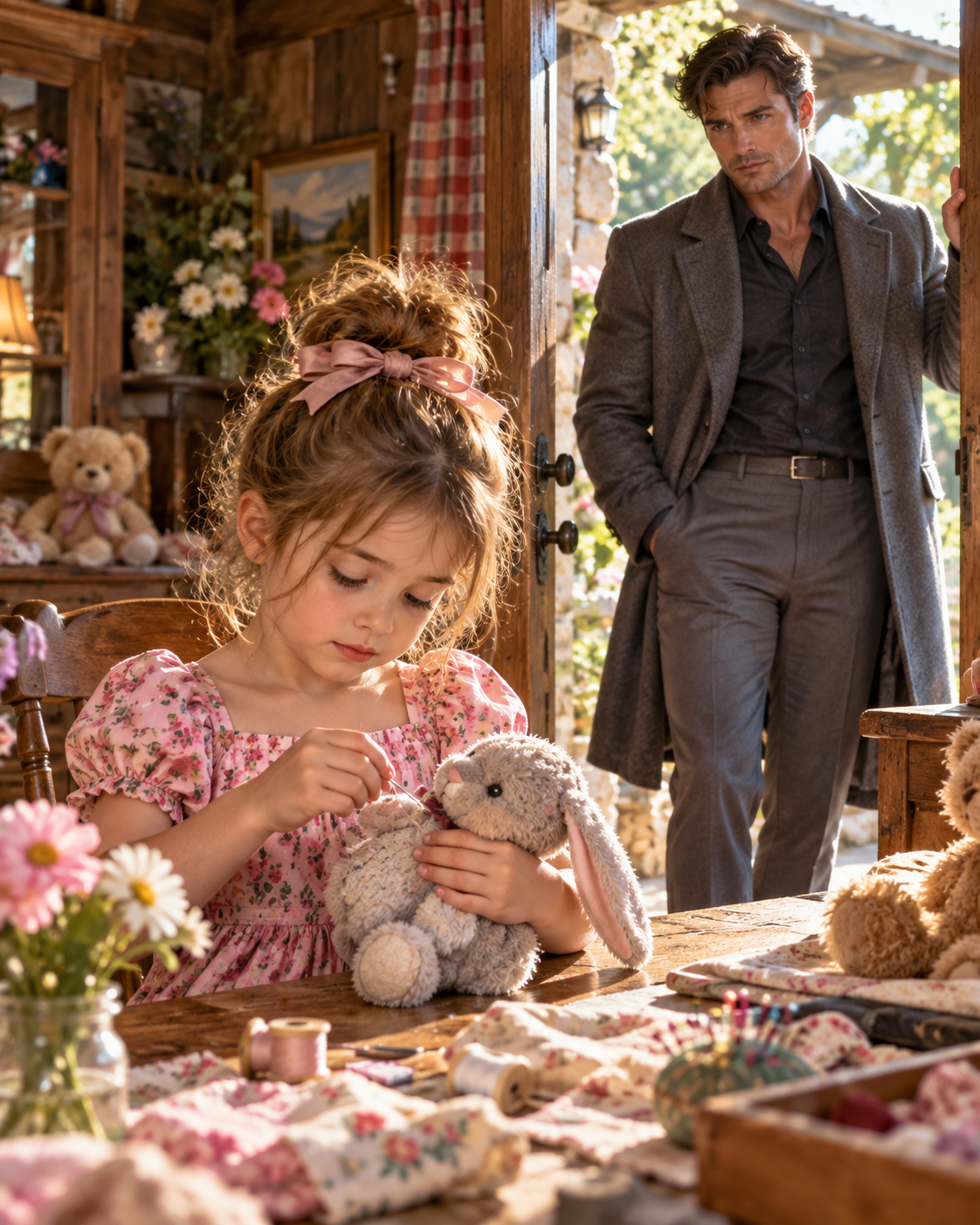
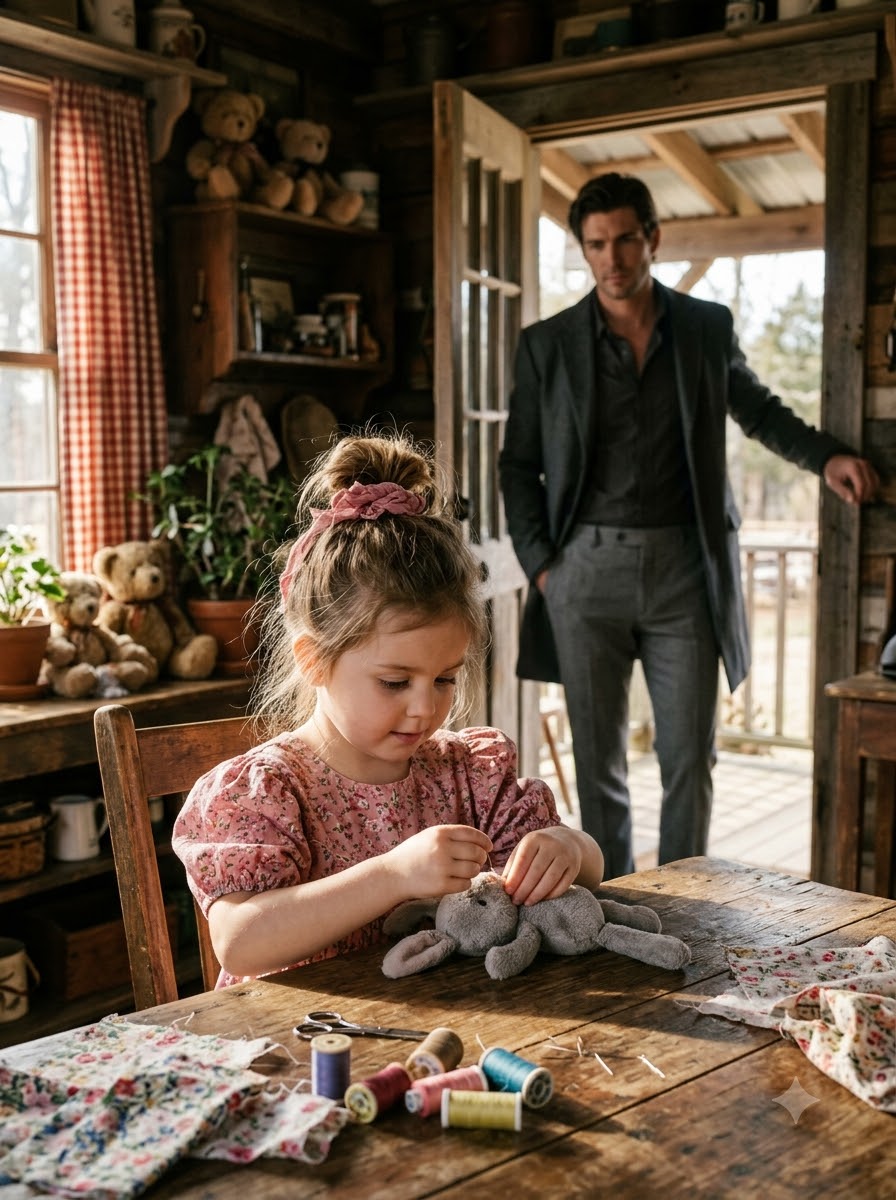
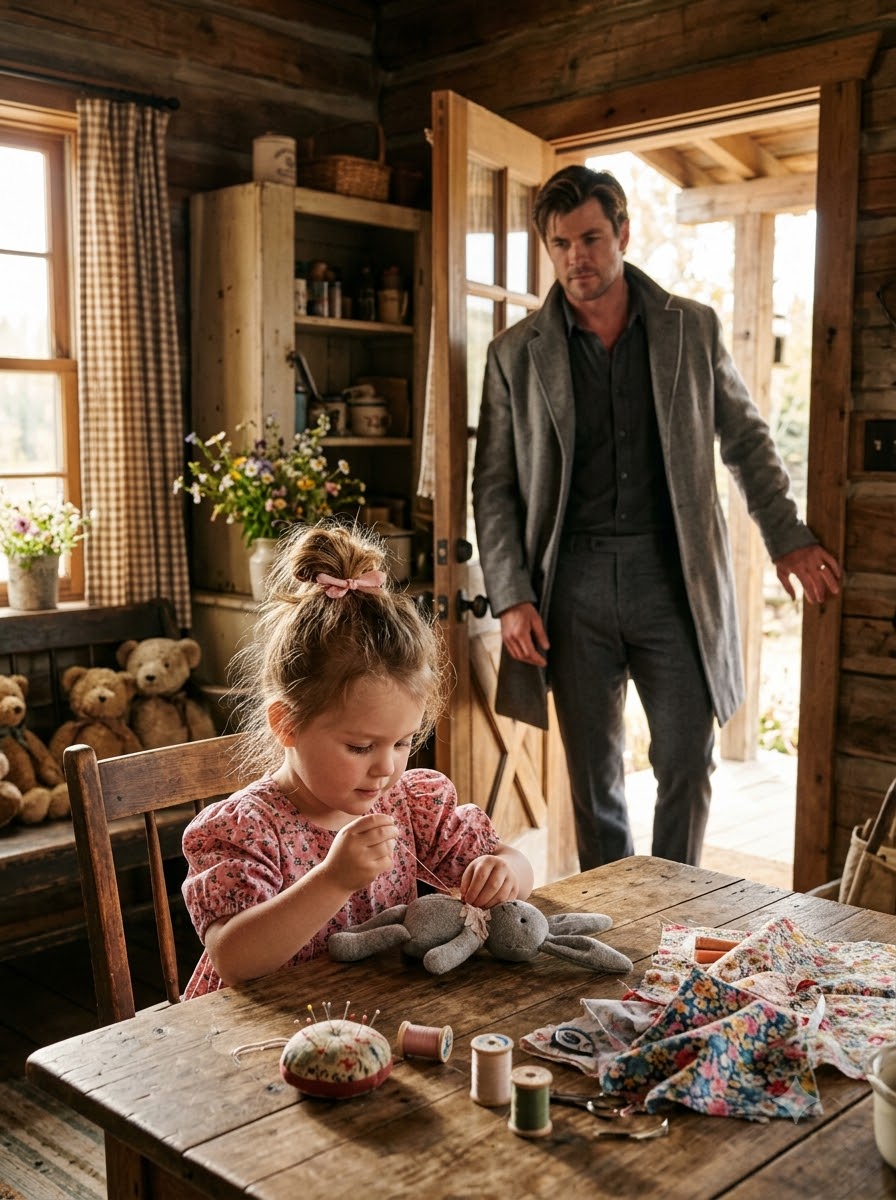
She also loved sewing.
Not because she wanted to earn money, but because Sarah had taught her that making something with her hands could turn an ordinary piece of fabric into something beautiful.
I bought a new sewing machine for the apartment, but I left it in its box until Sarah said she was ready.
Then I asked Lily if she would show me how it worked.
She looked at me as though I had suggested teaching a fish to ride a bicycle.
“You don’t know how to sew?”
“No.”
“Didn’t your mother teach you?”
I smiled sadly.
“She tried.”
Lily thought about that.
Then she pulled a chair beside hers.
“Okay. But you have to listen.”
“I will.”
She showed me how to thread the needle, how to guide the cloth, and how to keep my fingers away from the moving parts.
My first attempt produced a crooked line that looked like a road after an earthquake.
Lily stared at it.
Then she laughed.
It was a small sound, uncertain at first, but genuine.
I had heard men laugh at my jokes, women laugh at my stories, and business partners laugh because they were afraid not to.
I had never heard anything quite like my daughter’s laughter.
I wanted to preserve it forever.
Instead, I asked her to show me again.
Over the next few weeks, I visited regularly.
Sometimes we sewed.
Sometimes we read books together.
Sometimes Lily sat at the kitchen table doing homework while I worked through business documents nearby.
She began leaving drawings for me on the counter.
The first showed three stick figures beneath a yellow sun.
