

PART 1 — The Lawn He Thought He Owned
The crane operator studied the Mercedes imprisoned behind my concrete barriers, then faced my furious neighbor. “Sir, this is extremely risky. The lifting angle is terrible. I strongly recommend against it.” Richard’s response carried across the street. “JUST DO IT!” Richard shouted. “I’LL PAY WHATEVER IT COSTS!” From my porch, I struggled to hide a smile. Half of Maple Hollow Drive had assembled opposite my house. Mrs. Patterson stood outside in her bathrobe, the Delgado children straddled their bicycles, and someone had unfolded a lawn chair. Another person was recording everything. They had come to see the wealthiest man on our street retrieve his treasured car from my front yard. I had brought out a chair myself, along with a glass of iced tea. I believed the finest afternoon of my life was about to begin.
My name is Robert, and I’m forty-eight. Six months before that afternoon, the idea that an argument over parking could summon a forty-ton crane to my house would have seemed ridiculous. I’m not someone who usually makes a scene. For twenty-two years, I’ve worked as a groundskeeper at Pine Ridge Golf Club, cutting fairways, repairing divots, and riding a little green cart with a thermos of coffee and a rake. I spend my mornings making grass look flawless for people who seldom give it much thought. I enjoy the work. I enjoy grass, strange as that may sound. There’s an honesty to growing things: care for them and they respond; neglect them and the evidence appears. Grass never pretends otherwise. My own lawn had become my particular pride, and I won’t deny it.
Three years earlier, my wife, Carla, and I had separated. She took the furniture and the dog and went to Tucson to live with her sister. I kept the house, the mortgage, and evenings that seemed far too quiet. Not knowing what else to do, I poured my energy into the yard. I removed the thin, patchy turf and planted Kentucky bluegrass. I filled the low places, installed the sprinklers myself, maintained the edges, and aerated twice a year. Emma, my daughter and a junior at the state university, teased me during our calls. “Dad, are you still talking to your grass?” “I don’t talk to it.” “Mrs. Patterson says she’s seen you.” “Mrs. Patterson needs a hobby.” By the second summer, mine was the finest lawn on the block—dense, level, and green enough to seem artificial. Drivers slowed to admire it. Two strangers came to the door asking about fertilizer. In my life, it was the one thing that looked exactly as I wanted.
Then Richard Vance bought the large corner house. The retired couple who had lived there moved to Florida, leaving him the biggest property on Maple Hollow Drive: a three-car garage, a circular driveway, and a stone fountain nobody ever seemed to switch on. Richard was in his fifties, silver-haired, and tanned in a way that made me think of boats. He owned a trucking and logistics business, laughed loudly, shook hands firmly, and wore a watch that probably exceeded the value of my car. His collection included a black Range Rover, a red Porsche, and a silver Mercedes S-Class sedan. During his first week, he approached while I was edging the sidewalk. “You must be the lawn guy,” he said, holding out his hand. “Everybody on this street talks about your grass.” “Robert,” I said, shaking his hand. “I’m just a guy who likes his lawn.” “Well, it’s beautiful.” He surveyed it as though assessing real estate. “Really beautiful.” That day, I liked him. A little impressed with himself, perhaps, but friendly.
Three weeks afterward, I returned from work to find the Mercedes in the center of my front lawn. Because it was Saturday and several extra vehicles occupied his driveway, I assumed a guest had made a mistake. Music drifted from his backyard. At first, I didn’t even realize the Mercedes belonged to him, so I ignored it. Sunday morning, it remained. Going outside for my newspaper, I discovered two deep tracks where the tires had crossed the turf. Friday’s rain had softened the ground, and long, dark strips of torn grass marked the entrance. Standing there in my slippers, I felt my chest tighten. The second incident came two weeks later, on a Wednesday evening. The car sat about ten feet from my steps while Richard talked on his phone in his driveway. I waited until he finished. “Richard,” I said, “sorry to bother you. Is that your Mercedes on my lawn?” He glanced toward it as though surprised. “Oh. Yeah. Sorry about that.”
“Could you move it? The ground’s soft, and it’s leaving ruts.” “Sure thing,” he said. Twenty minutes passed before he moved it. By the following Saturday, it was back. After the fifth visit, tracks scarred the lawn I had spent years tending. Two ruts led from the street, another pair crossed at an angle where he had reversed, and an oval of flattened, yellowing grass showed where the Mercedes remained for days. One Sunday, I found him washing the Porsche, sunglasses on, polo shirt neat, music playing from a speaker on its hood. “Richard,” I said. “Could you please move your car? You’re destroying my grass.” He looked from me to the Mercedes and laughed. “Relax, old man,” he said. “It’s just grass.” Water splashed over a hubcap. “You should be grateful there’s an expensive car decorating your yard. Probably raises your property value.” I waited for a grin or a wink that might make it a joke. Nothing came. He simply resumed washing.
People always ask why he couldn’t use his own driveway. I asked myself the same thing endlessly. The Porsche and Range Rover occupied two garage bays, leaving the third empty, and the circular drive could easily accommodate six cars. There was no sensible reason for the Mercedes to be on my property. Once, he offered an explanation. “The driveway’s on a slope,” he said. “I don’t like the Mercedes sitting on an angle. It’s bad for the suspension.” My lawn was level because I had made it level, but even Richard sounded as though he were inventing the excuse without caring whether I believed him. Over the following months, I complained dozens of times. Sometimes he moved the car and returned it the next day; sometimes he ignored me. I stayed calm, tried friendliness, and even carried over a six-pack as a peace offering. “Thanks, Robert. You’re a good neighbor.” He accepted the beer. The Mercedes remained another four days.
I left requests on the windshield: Richard, please don’t park on my lawn. The grass is damaged. Thanks. — Robert, next door. He dropped the first note on the lawn, put the second in my mailbox with a smiley face on its reverse, and left the third to blow down the street. I even took a tape measure and paper over one Saturday and showed him how moving the decorative planters and changing the Range Rover’s angle would provide space for all three cars and two visitors. After four seconds with my drawing, he dismissed it. “Robert,” he said, “I appreciate the effort. I really do. But I’m not moving my planters. My decorator picked those.” He returned the paper and went indoors. In July, I called the police. Officer Tran, a young man, inspected the Mercedes and the damaged turf before knocking next door. Richard emerged smiling, shook his hand, apologized for a misunderstanding, and said a hectic week must have made him park absentmindedly. He moved the Mercedes under the officer’s supervision.
“He moved it,” Officer Tran told me. “He’ll be back tomorrow.” He sighed. “Then you can call again tomorrow,” he said. “But honestly, Mr. Holcomb, this is mostly a civil matter. We can ask him to move it. If you want damages for your lawn, you’d have to take him to small claims court.” “And how long does that take?” “A few months, usually.” “And what if he keeps doing it in the meantime?” Sympathy showed in his face, along with the pressure of other calls. “You could try towing,” he said. “Private property. You’re within your rights.” In early August, I tried. A tow driver had attached one chain when Richard appeared, smiled, and showed him something on his phone. The chain came off. “Sorry, man,” the driver told me. “He says he’s moving it right now. And he’s got a contract with our company for his trucks. My boss would kill me.” Richard reversed through my flower bed, parked in his own drive, and waved through the windshield. The next morning, the Mercedes was back.
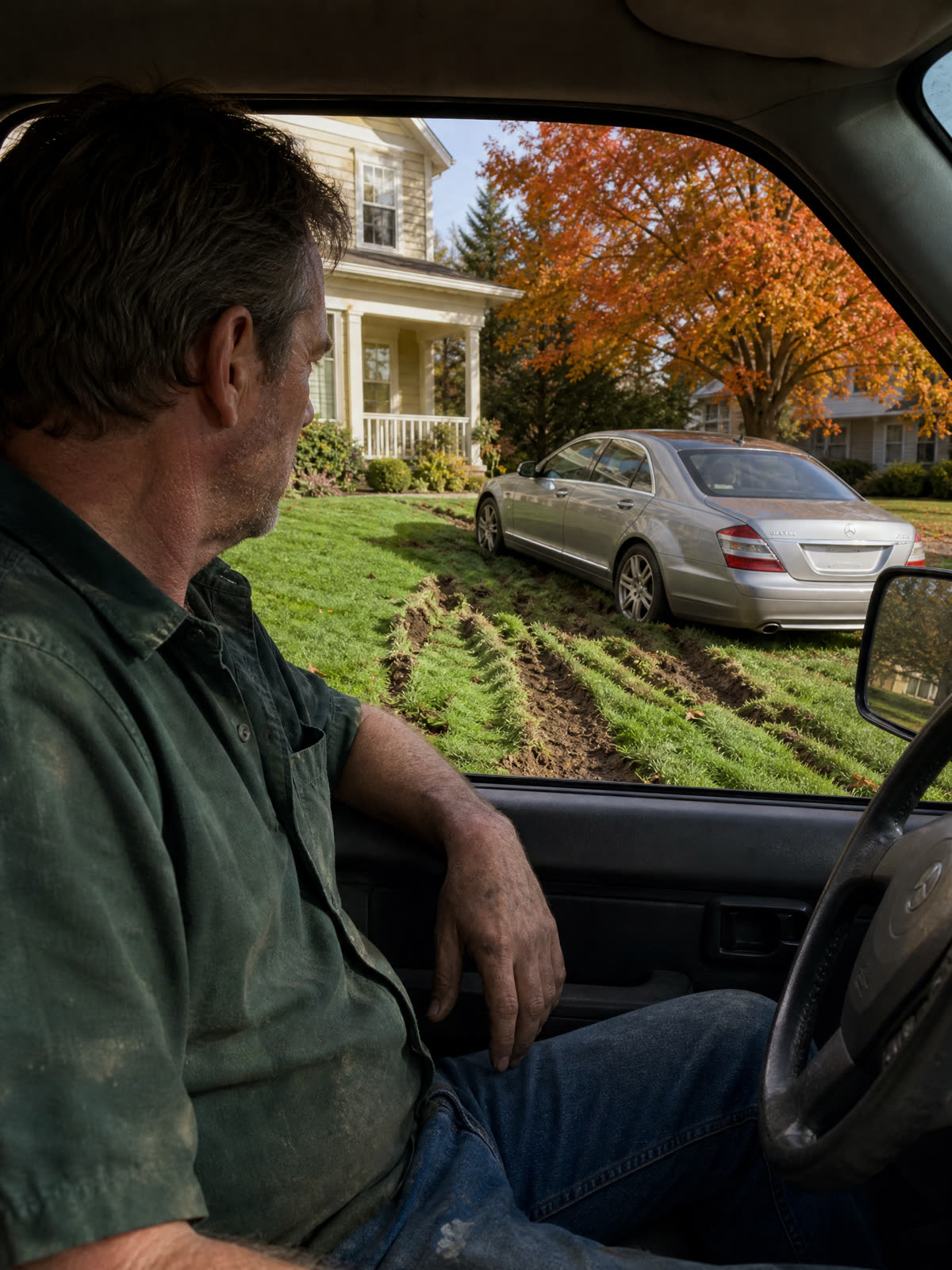
Eventually, I understood that space had nothing to do with it. Richard liked knowing I couldn’t stop him. Sometimes he watched from his front window, coffee in hand, and raised the cup toward me while I stood on my porch. I began dreaming about the Mercedes and waking at three with my jaw painfully clenched. Emma noticed. “Dad, you sound weird,” she said. “Are you okay?” “I’m fine.” “Is this about the car guy again?” “He’s not the car guy. His name’s Richard.” “Dad. You’ve mentioned him every single time we’ve talked since May.” After a pause, she added, “Maybe you should just let it go. It’s grass. It’ll grow back.” “It’s not about the grass,” I said. “Then what’s it about?” I couldn’t answer. In September, I devoted a Saturday to repairs, filling tracks with topsoil, smoothing the ground, and replacing the dead oval with sod. Three weeks of watering restored it. Early October brought a sunset when I stood admiring the green lawn and felt almost happy. Two weeks later, I came home on Friday to the Mercedes planted across that new sod. Fresh ruts had peeled the turf back like carpet. I sat in my truck for a long time. That was when I chose something I would regret.
My friend Fletcher was a foreman for a small construction company out on the county road. We had known each other since high school. Big, gray-bearded, and slow to speak, he had hands like shovels and usually considered a question for a full ten seconds before answering. His company’s yard held precast highway barriers, each eight feet long, three feet high, and weighing roughly four thousand pounds. I telephoned him that night. “Fletch,” I said, “I need to borrow some concrete barriers.” Silence stretched between us. “What for?” I explained. At first, he laughed. Then the laughter stopped. “You’re joking.” “I’m not joking.” “You want to surround his car?” “Exactly. Box it in. On my lawn. So he can’t drive it out.” Fletcher took his time responding. “Robert,” Fletcher said slowly, “that’s a terrible idea.”
“He’s had six months to move it.” “I know. I know he has. And he’s a jerk. I’ve heard you complain about him enough to know that. But trapping somebody’s car is a whole different thing. That could get really ugly, really fast.” I wasn’t interested in that possibility. “It’s on my property. I can put whatever I want on my property.” “Sure. But you’re also putting his car in a cage. How’s he supposed to get it out?” “He’s supposed to ask me nicely,” I said. “For once in his life.” Another long silence followed. “I’m telling you,” he said, “this could cause problems way worse than some dead grass.” I refused to hear him. For a week, I asked every day. On the fifth day, while he changed his truck’s oil, I stood in his driveway repeating the history: fresh sod, unanswered notes, police, the tow truck, that little coffee-cup salute. Fletcher cleaned his hands on a rag and studied me.
“You’re not going to let this go, are you?” he said. “No.” With a sigh, he gave in. “Then I’d rather I was there to make sure it’s done safe than have you renting a forklift and dropping four thousand pounds of concrete on your own foot.” He would help, along with Danny, a young crew member who considered the scheme hilarious. But Fletcher set conditions. “We leave clearance,” he said. “At least two feet all the way around. Nobody touches his car. Nobody scratches it. Nobody so much as breathes on it. We’re not damaging his property. We’re just putting a wall on yours.” “Fine.” “And I’m getting permission from my boss for the equipment. Above board. You’re paying for the rental.” “Fine.” “And if this goes sideways, Robert, I’m going to say I told you so.” “Fine.” His boss approved, largely because he had met Richard at a Chamber of Commerce dinner and disliked him too.
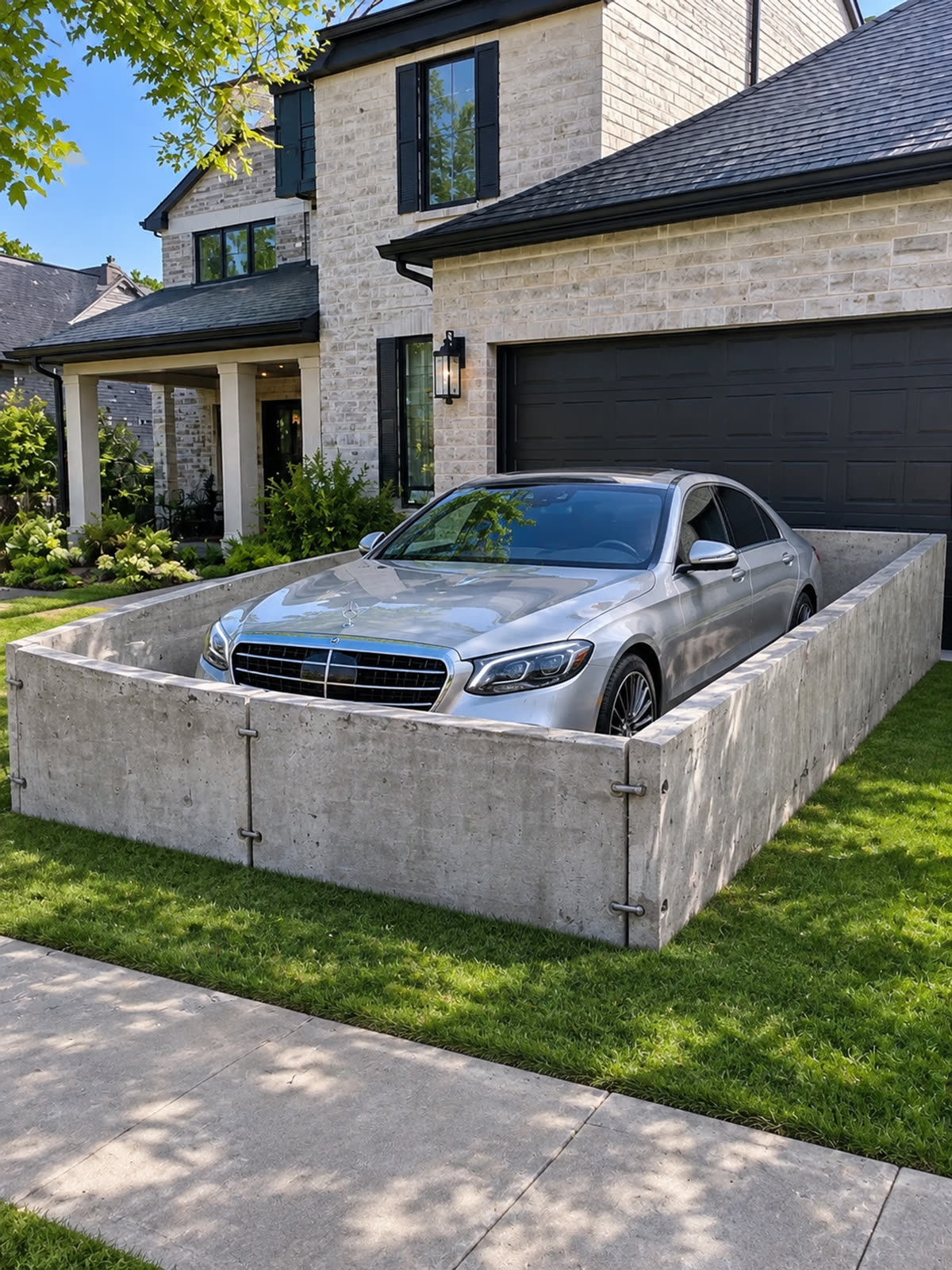
We began on a Saturday night in late October. Fletcher arrived with six barrier sections on a flatbed and a small skid steer equipped with forks. Danny supplied energy drinks and a speaker that Fletcher wouldn’t let him turn on. At eleven, after Richard’s house went dark, we got to work. Moving the enormous sections proved harder than I expected. The machine had to creep along to avoid worsening the damage, and Fletcher laid plywood beneath its path. He positioned the concrete himself, advancing it inch by inch and checking every space with a tape measure. “Two feet,” he kept saying. “Two feet all the way around. I’m not having anybody say we touched his car.” Steel pins joined the sections just as they did along highways. Six pieces formed a rough rectangle, closed on every side. By the time we finished, it was nearly four in the morning.
Fletcher stepped back and examined the enclosure without smiling. “Well,” he said. “It’s done.” Danny photographed it about forty times. When daylight arrived, the silver Mercedes gleamed inside a solid concrete pen. It could neither drive forward nor reverse, and there wasn’t room to turn. Three feet of gray highway barrier surrounded it in the middle of my wounded lawn. At six-thirty, I carried coffee onto the porch and settled into my chair. For the first time in six months, I felt powerful. The feeling survived perhaps twenty minutes. At ten to seven, Richard emerged in his bathrobe and slippers to collect his newspaper. He bent, picked it up, straightened, and noticed the Mercedes. For a long time, he stood motionless with the paper in his hand. Then he let it fall.
He stormed across his lawn onto mine, his face astonishingly red and his robe flapping over silk pajama pants. “WHAT THE HELL DID YOU DO TO MY CAR?!” I put my coffee on the porch railing and rose. “Good morning, Richard.” “I’M TEARING THIS WALL DOWN!” Smiling, I moved to the top step. “Touch my wall,” I said, “and I’ll call the police. It’s on my property, remember? You’ve been telling me for six months it’s no big deal what sits on a person’s lawn.” He threatened a lawsuit, arrest, and the loss of my house. He described lawyers who would devour me and cursed loudly enough that the Delgado children probably expanded their vocabulary from their bedroom window. Above all, he demanded immediate removal. I waited until he needed air.
“How many times did I ask you to move it, Richard?” “That’s not the…” “How many times? I’ll tell you. I counted. Twenty-three. Twenty-three times. Plus four notes, one six-pack, one police officer, and one tow truck.” Crossing my arms, I continued. “And you laughed at me. Every single time.” He stared. “You’re going to regret this,” he said. “Funny,” I said. “I’ve been saying something similar for six months.” He inspected the enclosure, pressed both hands against one section, and pushed. Nothing happened. Kicking it with a slipper earned him a yelp and a backward hop while he grabbed his foot. The concrete remained unmoved. He circled the rectangle, searching for an opening, then tugged at a connecting pin. It wouldn’t shift. Finally, he stood breathing hard, staring at his car behind the wall.
Fletcher arrived around then, apparently intending to check on things first thing in the morning. He climbed slowly from his truck, took in Richard’s bathrobe and my position on the porch, and approached with his hands in his jacket pockets. “Morning,” he said to Richard. “I’m Fletcher. I helped put this up.” Richard wheeled toward him. “Then you can take it down!” “I can,” Fletcher said calmly. “I can arrange a crew to pull out one section. Takes about an hour. We can have your car out safely, no damage to anything.” He paused. “But you’d need to work it out with Robert first. It’s his lawn. His wall.” Richard looked straight at me. I waited. All he needed to do was ask. That was what I wanted: one request, offered as though I were another human being.
“Absolutely not,” Richard said. “I’m not asking him for permission to get my own property back.” He turned and marched home, bathrobe still flapping. Instead of speaking to me, he started calling people. Through his front window, I watched him pace with the phone against his ear for much of the morning. Around ten, a police car stopped outside. Officer Tran had returned. He contemplated the enclosure for a considerable time before approaching me. “Mr. Holcomb,” he said. “Did you build this?” “It’s on my property.” “I can see that.” He walked around it, crouched to inspect the two-foot clearance, and straightened with a sigh. “He wants me to arrest you,” he said. “For what?”
“That’s what I asked him.” Officer Tran rubbed his neck. “Look. Technically, his car’s on your land without your permission. Technically, you’ve put barriers on your own land. Technically, nobody’s touched his vehicle.” His gaze settled on me. “But technically isn’t the same as smart, Mr. Holcomb. This is a mess. You know it’s a mess.” “He’s been parking here for six months.” “I know. I was here in July.” He glanced toward Richard’s house. “I told him the same thing I’m telling you. This is a civil matter. Talk to each other, or talk to lawyers. Just don’t do anything stupid.” He left in the patrol car. Richard, meanwhile, found a specialized crane truck capable of lifting the Mercedes over the wall from the street without bringing its wheels or outriggers onto my property.
I learned about that plan when the truck arrived that afternoon. Enormous and bright yellow, with a folded boom and four hydraulic legs, it occupied the street’s entire width. The driver reversed three times before settling into position outside my house. Neighbors began emerging from their doors. I fetched my chair, carried it onto the porch, then went back inside for iced tea. The concrete had held. Richard had refused the simple way out. Now he had brought an enormous machine to prove he didn’t need my permission. As the crowd gathered and the operator climbed down, I settled into my seat, certain I was about to witness the greatest victory of my life.
PART 2 — The Victory That Hit My House
The operator’s name was Orson. Broad through the shoulders and in his sixties, he wore a hard hat and a reflective vest beneath a white mustache and an unsmiling expression. After shaking Richard’s hand, he approached the enclosure and studied it. He circled the concrete, measured the clearance, and examined the Mercedes. Then he looked toward my house, my porch, the big maple at the yard’s corner, and the power lines beside the street. He crouched to consider the ground. Every check seemed to deepen his concern. Returning to Richard, he said, “Mr. Vance,” he said, “I’ll be straight with you. I don’t love this.” “What’s the problem?” Richard asked. Orson pointed across the lawn.
“I’m lifting from the street, over a three-foot barrier, onto a lawn that slopes slightly toward the house. My boom angle’s going to be terrible. That car’s not designed to be lifted like this. I’ll have to rig it underneath, through the wheels. It’s heavy in the front because of the engine, so it’s going to want to tip.” He indicated the house. “And that house is twelve feet away.” “So do it carefully.” “I always do it carefully,” Orson said. “That’s not the issue.” Fletcher stood beside my porch steps, hands in his pockets. Orson nodded toward him. “Removing one section of that barrier is the sensible option. That man’s already offered. One hour, no risk, done.” Richard pointed at me. “That man,” he said, “isn’t touching another thing on my car. Find a way.”
Orson studied Richard for a long moment, then glanced toward me. I raised my iced tea. He didn’t return the gesture with a smile. “Fine,” Orson said. “But here’s how this is going to work. I’m going to inspect every piece of rigging. I’m going to reposition my truck. I’m going to set up a safety perimeter. And if I don’t like what I see at any point, I’m calling it off. I’ll attempt a limited test lift. A few feet. If it doesn’t feel right, it’s coming back down. No arguments.” Richard dismissed the caution with impatience. “Fine. Whatever. Just do it.” Orson worked without hurrying. For almost an hour, he adjusted the setup, moved the truck twice, positioned thick wooden pads beneath all four hydraulic legs, and checked the screens inside his cab.
His assistant, a skinny young man carrying a clipboard, stretched yellow caution tape along the opposite sidewalk to hold back the spectators. Orson slid beneath the Mercedes with a flashlight, lying on his back to inspect the underside. He fed heavy nylon straps around the front and rear wheels, connected them to a steel spreader bar, and attached that to the crane hook. Every fitting received an inspection, followed by another. Richard complained throughout. “How long is this going to take?” “As long as it takes.” “I’m paying you by the hour, you know.” “I know,” Orson said, without looking up. Nothing in his method changed. Across the street, the audience continued to grow, their attention moving between the suspended rigging, Richard, and me on my porch.
Eventually, about thirty people stood behind the tape. Mrs. Patterson still wore her bathrobe. The Delgados had gathered, along with the young couple from the blue house and their baby’s stroller. Old Mr. Kowalski leaned on his cane. Several faces were unfamiliar, people who apparently heard what was happening and drove over. Conversations carried fragments toward me: crazy, lawsuit, disbelief that I had actually built the wall. Other people were laughing at Richard, now in an expensive jacket and sunglasses, arguing into his phone from the street. A woman I thought was Mrs. Patterson announced, “Maybe he’ll finally learn to park in his own driveway.” Laughter followed, then a little applause. I agreed completely and took another sip.
Fletcher came to the bottom of the steps and watched the crew in silence. Finally, he spoke so quietly that only I could hear. “You should tell them to stop,” he said quietly. I looked down at him. “Richard hired them,” I said. “It’s his decision.” “You built the wall.” “Because he kept parking on my lawn.” Fletcher didn’t press the argument. He turned instead toward the railing, the porch posts, the steps, and the large window behind me. “I hope this ends the way you think it will,” he said. I offered no reply, only another mouthful of tea. For the first time that day, it seemed less sweet. I had heard the operator’s warnings and Fletcher’s concern, but I still watched Richard more closely than I watched the house.
At four o’clock, Orson climbed into the cab. “Everybody stay back!” he shouted out the window. “Test lift! Nobody inside the tape!” The engine roared, and the boom moved slowly above my lawn and across the barrier until the hook hung over the Mercedes. Cables tightened. The wheel straps drew taut. Gradually, the tires separated from the grass—an inch, then two, then six. Pieces of torn sod clung to the tread before falling back. The whole sedan rose beneath the hook, two feet, three, then four, its tires approaching the height of the concrete. Sunlight struck the silver finish. Someone across the road gasped. Richard stood at the tape with both hands on his head, his mouth open. For once, he had nothing to say. I folded my arms and savored it.
Then the Mercedes shifted. I still can’t explain exactly why. Later, Orson tried to show me with diagrams, talking about the front-heavy engine, the ground’s slope, and the boom angle. What I saw was the car beginning to rotate, nose drifting one way and rear drifting the other. The movement was slow but continuous, like a weathervane finding the wind. Orson stopped the lift at once. Hydraulics hissed. For one dreadful instant, the sedan appeared perfectly motionless, hanging five feet above my yard. Then it started swinging toward the house. “EVERYBODY BACK!” Orson shouted. I rushed away from the railing, overturning my chair. My glass struck the porch boards and shattered as I stumbled toward the front door.
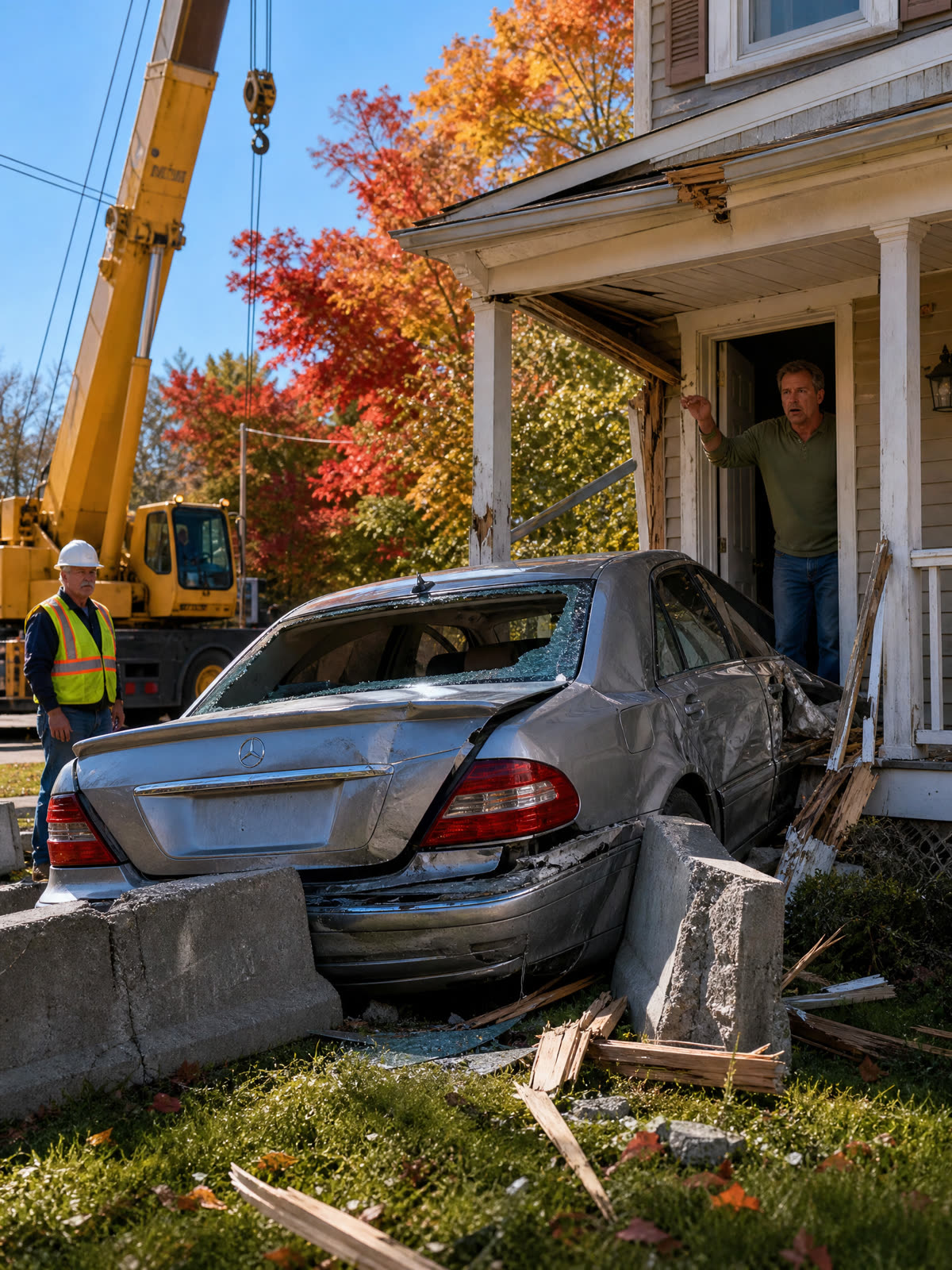
Through the cab window, I could see Orson’s grim concentration as he worked the controls, trying to counter the swing with the boom. But the car had traveled too far. Rear end first, it crossed my lawn like a two-ton pendulum. The crash that followed turned the afternoon sickening. A rear corner ripped through the porch railing as though the wood were matchsticks, then struck the large six-by-six support post at the corner—the post carrying the roof. It cracked with a report like a gunshot. The Mercedes’s rear window burst, sending glass over the boards, steps, and grass. As the car swung back, its underside caught the concrete barrier, knocking away a heavy chunk and throwing gray dust into the air. Someone across the street screamed.
Orson regained control. I couldn’t tell you how. Working the controls with painstaking care, he reduced the swing until the Mercedes hung turning gently a few feet above the grass. Inch by inch, he lowered it into the very enclosure it had left. When the tires touched down, the engine settled to an idle. Silence spread across the street. Thirty people stood watching, and for several seconds I heard none of them. Then I looked at my porch. An eight-foot length of railing had vanished into splinters. Broken boards lay down the steps and across the yard. The corner support was split through its middle and leaning at an angle that sickened me. Above it, the roof sagged away from the house, leaving a gap where the paint had separated. My chair lay overturned beside the shattered glass. The Mercedes had a crushed bumper, a V-shaped trunk dent, a broken rear window, and a gouged side panel, but I hardly noticed. My house had been struck. Standing beneath that damaged roof, I whispered, “What have you done?” I wasn’t sure whom I meant.
Richard ran across the street, ducking beneath the tape despite the assistant’s warning. At the barrier, he shouted, “My car!” he shouted. “Look at my car! Look at it!” I descended the steps over the splintered wood. “Your car just smashed into my house!” He spun toward me, pointing at the enclosure. “None of this would’ve happened if you hadn’t built that ridiculous wall!” “And none of it would’ve happened if you’d stayed off my property!” “You trapped my car like a lunatic!” “You used my lawn like a parking lot for six months!” “It’s GRASS!” “It’s MY GRASS!” We stood almost nose to nose, red-faced and shouting, spit flying between us. Two men in their forties and fifties were screaming on a ruined lawn while their entire neighborhood watched.
“ENOUGH!” Orson had left the crane and walked directly between us. He didn’t shove either man. He simply stood there, broad and solid in his safety vest, until we both stepped backward. “Enough,” he said again, quieter. “Both of you. Look around.” We did. The Delgado children watched. Mrs. Patterson held a hand over her mouth. The young mother pressed her baby to her chest. “Nobody’s hurt,” Orson said. “Nobody. And we’re keeping it that way. Do you understand me?” He turned to Richard. “That vehicle isn’t being lifted again today.” “I’m paying you to…” “I don’t care what you’re paying me, Mr. Vance. You could pay me a million dollars. That car’s not going back up in the air today. Not by me. Not by anybody I know.” Looking toward the broken support, he added, “And that porch needs to be looked at before anybody walks on it. I’m not kidding. Nobody goes up those steps.”
Richard started to respond, then closed his mouth. Even his money had reached a limit. The spectators gradually dispersed in small groups, speaking softly and looking back. Someone continued filming. Mrs. Patterson shook her head before going inside, and I couldn’t tell whether the gesture meant pity or disappointment. Packing the crane took Orson and his assistant almost an hour. Before leaving, he approached me. “I’m going to have to file an incident report,” he said. “My company’s insurance will be in touch. Probably his too.” He looked at the barriers. “And probably yours.” “Okay.” He studied me. “For what it’s worth,” he said, “I’ve been running cranes for thirty-one years. I’ve seen a lot of stupid. Most of it starts the same way.” At the cab, he added, “Two people who both think they’re right.” Then he drove away.
After dark, I stood outside studying what remained. The corner streetlight cast long shadows over the damaged lawn. Glass surrounded the Mercedes inside its concrete cage. Splintered railing littered the ground, and the cracked post leaned beneath the roof like a drunk against a wall. I couldn’t safely use the front entrance anymore; the side door by the garage became my way in and out. For six months, I had imagined Richard meeting the consequences of his arrogance. Awake at night, I pictured him humiliated, helpless, finally learning what it meant when somebody took what wasn’t theirs. Now those consequences rested against my house. I went to the kitchen and sat at the table without switching on a light. My phone buzzed with Emma’s message: Dad. Somebody from my high school just sent me a video. Is that YOUR HOUSE??? I stared at it. I didn’t reply.
Fletcher returned the next morning and moved slowly around the porch, hands in his pockets. He crouched beside the support, studied the sagging roofline, and nudged the wood with one finger. It creaked. Shaking his head, he said, “This is worse than it looks,” he said. “I know.” “That post’s carrying the whole corner. And it’s cracked through. If it goes, the roof’s coming down.” He straightened. “You need somebody out here today. A real contractor. Not tomorrow. Today.” “I’ve got a call in.” “Good.” He watched me for a moment. “Then why are you acting like Richard’s going to pay for everything?” he asked. “Because his car hit my porch.” Fletcher folded his arms. “Robert,” he said. “I told you this could get dangerous.” I turned my gaze toward the street and the caged Mercedes.
His voice softened. “You had every right to be angry about your lawn. I mean that. He treated you like dirt for six months. Anybody would’ve been angry.” After a pause, he continued. “But you didn’t build that wall to protect your grass. You built it to embarrass him. In front of everybody. You sat out here with a glass of iced tea like it was the Fourth of July.” Anger rose in me precisely because some part of me recognized the truth. I still refused to acknowledge it. “He deserved it,” I said. “Maybe,” Fletcher said. “But your porch didn’t.” Two days later, Mr. Abernathy arrived to assess the damage. Old, thin, and deliberate, he spent nearly an hour beneath the porch with a flashlight before emerging dirty and cobweb-covered, his face long and unhappy.
At my kitchen table, he described the work. “The corner post needs to be replaced,” he said. “That’s the easy part. But when the car hit it, it pushed the whole frame out of square. I need to open up the roof and check the framing on that corner. Probably need to sister in some new joists. Replace the header. Then the railing’s gone. The steps took a hit, two treads are cracked. And there’s some damage to your siding where the porch roof pulled away from the wall.” “How much?” He consulted his clipboard. “Hard to say until I open it up,” he said. “But could be fourteen thousand. Could be more.” I stared. Fourteen thousand dollars. My yearly pay for maintaining fairways was forty-six thousand. Savings amounted to about nine thousand, and Emma’s tuition came due in January.
That afternoon, I called my insurer. Brenda, the woman handling the claim, remained polite while asking detailed questions. When I reached the concrete barriers, she fell silent. “I’m sorry, Mr. Holcomb, could you repeat that? You placed concrete highway barriers around your neighbor’s vehicle?” “On my property.” “On your property. I see.” Typing filled another pause. “And then your neighbor hired a crane to remove the vehicle. And the vehicle struck your porch.” “Yes.” “I see,” Brenda said again. Because of the “unusual circumstances surrounding the incident,” further review would be necessary. An adjuster needed to inspect the house. Both the crane company’s insurer and Richard’s auto insurer were investigating too. They would have to determine responsibility and each party’s contribution to the damage.
“How long will that take?” I asked. “It’s difficult to say, sir. Several weeks at a minimum. Possibly longer.” “And in the meantime?” “In the meantime,” Brenda said carefully, “please take any necessary steps to prevent further damage to your property.” Nobody could tell me who would ultimately pay. The damaged Mercedes remained on my lawn. Richard no longer shouted, but he no longer spoke to me either. The silence between the houses wasn’t restful; it left my shoulders tight. Every morning, I saw him beside the wall, wearing the same jacket, carrying the same coffee cup, talking into his phone. He didn’t toast me anymore. Instead, he rubbed his forehead and spoke quietly. He seemed tired now, more tired than furious. I insisted to myself that I didn’t care.
By Wednesday, Mr. Abernathy delivered another problem. “I took another look at the photos,” he said. “Mr. Holcomb, I really don’t think you should wait on the insurance companies to stabilize that corner. If we get a heavy rain or snow on that roof, that post could give. And then you’re looking at a whole lot more than fourteen thousand.” “How soon?” “This week. I can put in a temporary support and shore up the frame. Then we wait for the insurance to sort out the rest.” “How much for the temporary part?” Twenty-eight hundred dollars. I would need to provide it upfront, with no guarantee of reimbursement. After the call, I sat staring at the estimate. Building my revenge had required one night. Clearing up its consequences might take months, perhaps years.
Someone knocked at the side door that afternoon. Richard stood outside without his sunglasses or his smile, looking short of sleep and holding a business card. I braced for another quarrel, almost relieved to face something familiar. Instead, he offered the card. “I know a contractor who does structural repairs,” he said. “Hal Moreno. He’s good. Did the foundation work on my warehouse. He can look at your porch tomorrow.” I looked between him and the card. “What’s the catch?” “There isn’t one.” “You expect me to believe you’re suddenly worried about my house?” He glanced toward the damaged porch. “I’m not offering to pretend this was all my fault,” he said. “It wasn’t. But I’m offering to help get it fixed.”
My laugh sounded bitter and ugly. “So now you’re going to show me how easily your money fixes things?” I said. “That’s it, right? Big man writes a check, everybody’s happy, and you get to feel like the good guy?” “Not everything can be fixed with money, Robert,” he said quietly. For the first time, I heard exhaustion instead of superiority in his voice. Still, I refused the card. “No, thanks,” I said. He waited, nodded once, and returned home. That evening, Fletcher brought pizza, and we ate at the kitchen table. After hearing about the visit, he chewed thoughtfully. “Can I ask you something?” he said. “You’re going to anyway.” “If Richard was actually trying to solve a problem,” Fletcher said, “instead of starting another fight, would you even recognize the difference?” I set down my pizza. I couldn’t answer. All night, the question stayed with me.
PART 3 — What Was Left When Nobody Won
The next morning, I called Richard. He answered on the first ring. “I’ll meet your contractor,” I said. “But I’m making it clear right now. I choose who does the work. Not you. If I don’t like him, I’m not using him. And this doesn’t mean I’m letting you off the hook for anything.” A short silence followed. “That’s fair,” Richard said. “I’ll have him call you.” No argument, no pressure, no attempt to secure the final word. That restraint surprised me even more than his offer had. I had spent months preparing for Richard to turn every exchange into another contest. This time, he simply accepted what I said.
Hal Moreno arrived that afternoon. He was short, broad, and cheerful, with a pencil tucked behind each ear. Like Mr. Abernathy, he crawled beneath the porch. He climbed a ladder to examine the roofline and took what seemed like a hundred photographs. At the kitchen table afterward, he described essentially the same repairs: the support post, the framing, the header. His estimate was a few hundred dollars lower, but otherwise there was little difference. “Your other guy knows what he’s talking about,” Hal said. “I’d trust him. If you want to stick with him, I won’t be offended.” I studied him. “Richard didn’t tell you to say something different?” Hal seemed sincerely puzzled. “Richard told me to give you an honest look and leave it at that,” he said. “That’s all he said.”
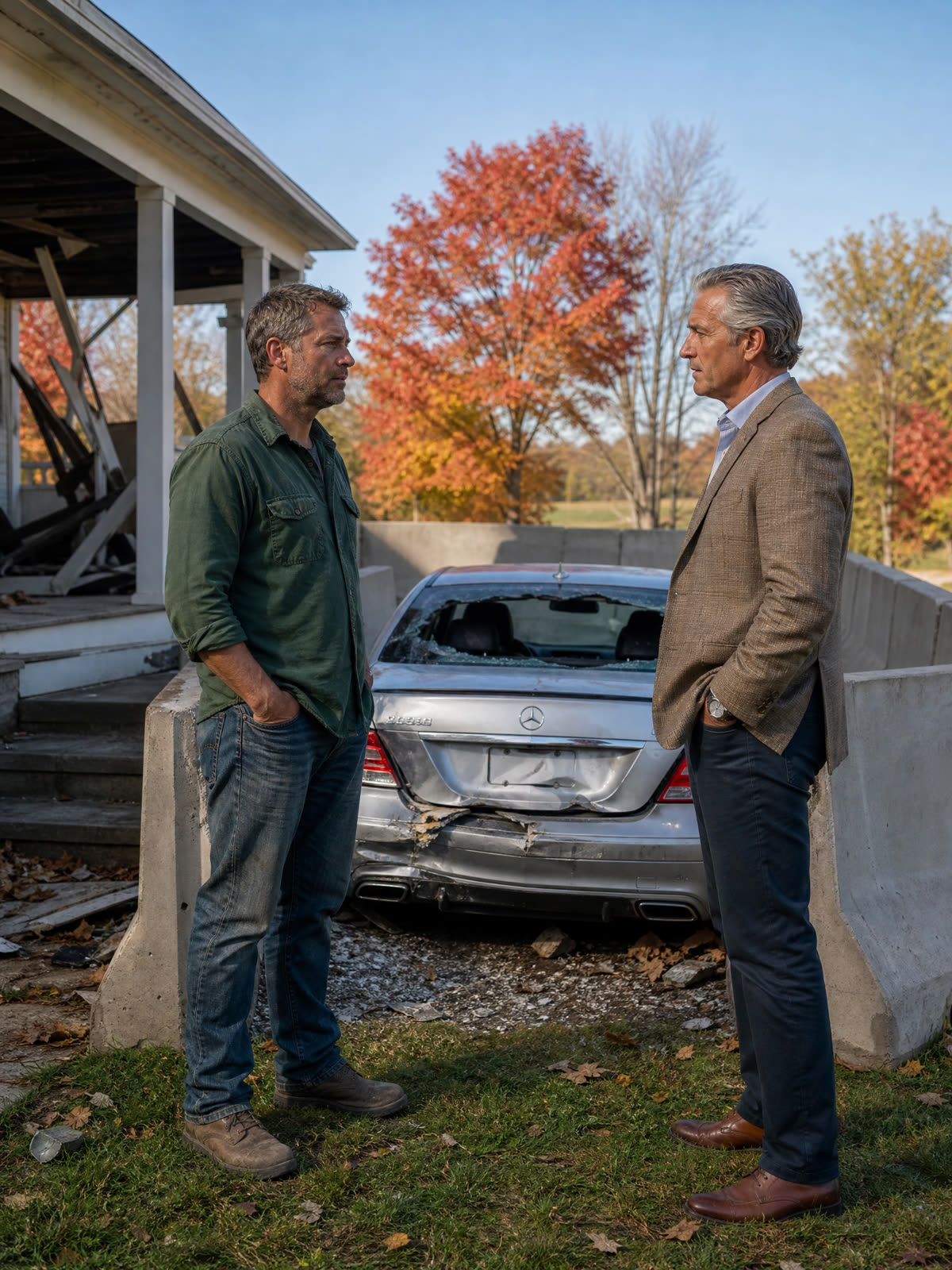
Later, Richard approached while I stood outside reading Hal’s estimate. He stopped on the sidewalk at the boundary of my lawn, keeping his shoes off the grass. “Can we talk?” he asked. After watching him for a moment, I nodded. We stood beside the barriers, with the damaged Mercedes between us. Its rear glass was gone, the bumper crushed, and fragments still lay among the blades of grass. Neither of us spoke at first. Then Richard said, “I owe you an apology.” I waited. “I shouldn’t have parked here,” he said. “Not once. You asked me to stop. Over and over. Nicely. And I treated it like a joke.” “You treated me like a joke.” He nodded slowly. “Yes,” he said. “I did.”
For six months, I had imagined hearing that admission. In those fantasies, he begged or cried or knelt while I stood victorious with some perfect remark ready. Yet when he finally said it, beside his wrecked Mercedes and my wrecked yard, no clever reply came. Richard looked toward the car. “Something like this happened to me before,” he said. I frowned. “Another concrete wall?” Something close to a smile crossed his face. “No,” he said. “A driveway.” Before moving here, he explained, he had lived outside Minneapolis beside Gary Lindell. They had met at college, worked together for a time, and deliberately bought neighboring houses. Gary hadn’t merely been a neighbor. He had been Richard’s best friend.
“Our kids grew up together,” Richard said. “Our wives were friends. We had barbecues every Sunday. We went fishing every summer up in Canada. Twenty years.” Their driveways shared an entrance—the first twenty feet from the street. As Richard’s business prospered, he bought more cars and began leaving them in that common section. Not enough to block it entirely, but enough that Gary had to ease his truck around them every morning. “He asked me to stop,” Richard said. “Nicely, at first. Like you did.” “What did you do?” “I told him it was no big deal. That he was being uptight. That there was plenty of room.” His gaze dropped to his shoes. “He kept asking. And I kept doing it. It got worse. We started arguing about it. Then we started arguing about other things. Our wives stopped talking. The barbecues stopped.”
“All that over parking?” “About two years later,” Richard said, “Gary sold his house and moved to Arizona. I found out from a real estate sign on his lawn. He didn’t even tell me.” He fell silent for a long time. “I never apologized,” he said. “Never called him. Never said anything. I just let him go.” “All that over parking,” I said again, quietly. Richard lowered his eyes. “It wasn’t really about parking,” he said. “It never is. I just couldn’t stand him telling me what to do. I couldn’t stand anybody telling me what to do. I built my company from nothing. Started with one truck. Everything I have, I have because I didn’t let anybody push me around.” He shook his head. “Somewhere along the line, I stopped being able to tell the difference between somebody pushing me around and somebody asking me to be decent.”
The confession quieted me unexpectedly. For months, I had reduced him to a caricature: a wealthy bully in a polo shirt. It hadn’t occurred to me that he could be lonely, or that he might have lost his closest friend without understanding what he had done. Richard continued. “When you built that wall,” he said, “I was furious. But not about the car. You made me look foolish. In front of the whole street. I didn’t care what that crane cost. I didn’t care about the risk. Orson told me, three times, to let your friend pull out one section. I knew he was right.” He met my eyes. “But I wanted everybody to see that I could get my car out without your help. Without asking you for anything.” “And look where that got us,” I said. He nodded. For once, regret had displaced the arrogance in his face.
That didn’t mean I could excuse him yet. “Richard,” I said, “you made my life miserable for six months.” “I know.” “You laughed in my face.” “I know.” “You called me old man . You drove through my flower bed. You stuck my note in my mailbox with a smiley face on it.” “I know,” he said. “I remember.” “And I shouldn’t have needed to build anything to make you respect my property.” “You’re right,” he said. His agreement disarmed me. I had six months of arguments stored away, and I had arrived ready to use them. Instead, he kept admitting that I was right. Then his eyes moved to the broken porch. “But you shouldn’t have built it,” he said.
I wanted to argue. My mouth opened, and a hundred justifications crowded forward: twenty-three requests, the police visit, the tow truck, the notes, the ruined sod. But Fletcher’s words returned instead. You didn’t build that wall to protect your grass. You built it to embarrass him. I remembered myself with the iced tea, smiling as the Mercedes left the ground, arms folded in satisfaction. I hadn’t been thinking about safety. Not for a moment. Orson had warned us. Fletcher had asked me to stop the attempt. I had heard both of them and ignored them because Richard’s humiliation felt too good. “You’re right about that too,” I finally said. I hadn’t spoken a harder sentence in years.
We remained beside the concrete for a long time without saying anything. A passing car slowed, its driver craning to see the trapped Mercedes. Since somebody uploaded the crane footage, strangers had been doing that for days. The car, the wall, the ruined grass, and the damaged porch were all still there. Richard and I stood among the consequences, neither of us looking much like a winner. Finally, he broke the silence. “How do we fix this?” It was the first question either of us had asked in six months that wasn’t really about defeating the other man.
Over the following days, we began finding an answer. It wasn’t pleasant or simple. For three evenings, we sat at my kitchen table with legal pads, calculators, and plenty of coffee. We argued, grew frustrated, and revisited details neither wanted to concede. Once, Richard stood up and left. I assumed the effort had collapsed, but twenty minutes later he returned carrying donuts and sat down without speaking. Gradually, we separated what each of us could reasonably accept from what we merely wanted the other to suffer. Richard agreed to restore the lawn completely: the six months of ruts and dead turf, the replacement sod, the flower bed, the topsoil, and the seed.
I accepted responsibility for my concrete enclosure. Fletcher’s company would receive payment from me for the rental, its removal, and the section damaged by the car. We photographed everything affected by the failed lift—the Mercedes, the porch, and the barrier. Together, we recorded the sequence of events and signed the account. That same report would go to my insurer, Richard’s insurer, and the crane company’s insurer. Neither of us wanted to invent claims about responsibility we couldn’t support. The insurance companies could determine the remaining shares. It was less satisfying than demanding that Richard pay for everything, but it was also more honest.
Then Richard offered to contribute toward the urgent stabilization of the porch while the insurers deliberated. The temporary support and related work would cost twenty-eight hundred dollars. At first, I refused. “I’m not taking your money, Richard.” “It’s not charity,” he said. “It’s my car that hit your porch. Whatever the insurance decides, some of this is on me.” “And some of it’s on me.” “Then we’ll split it,” he said. “Half and half. And if the insurance pays you back later, you pay me back. Put it in writing.” I considered the offer and eventually accepted, but only after we wrote it down. On my laptop, we prepared a one-page agreement, printed it, and signed at the kitchen table. Fletcher witnessed our signatures and appeared to enjoy that role more than necessary. Neither Richard nor I felt entirely satisfied. Perhaps that explained why the arrangement seemed fairer than our earlier demands.
The following Monday, Fletcher’s crew returned to dismantle the wall. This time, everything followed the sensible order. A professional towing company arrived first, secured the damaged Mercedes, and checked whether it could be moved safely. Fletcher laid plywood over the turf, then used the skid steer to raise one barrier section slowly out of place. The tow truck backed toward the opening. Its winch drew the Mercedes through the gap, across the plywood, and onto a flatbed. Forty minutes passed. Nobody was injured, and nothing else broke. Richard watched from the sidewalk while the crew chained down his car, its crushed bumper, missing window, and long side gouge visible in the daylight.
There was no audience cheering this time, no cameras held aloft, no folding chairs. Just two exhausted neighbors stood on opposite sides of a lawn they had both helped destroy. When the flatbed departed, Richard came toward me and stopped once more at the edge of the grass. “I won’t park here again,” he said. “I know.” He hesitated. “How do you know?” he asked. I indicated the peeled sod, the ruts, and the rectangle of dead, crushed grass where the concrete had rested for ten days. “Because next time, I’ll just ask you to move,” I said. “And I expect you to listen.” He considered me for a moment, then nodded. “Fair enough,” he said.
The porch repairs required several weeks. In the end, I hired Mr. Abernathy. I liked Hal Moreno, but Mr. Abernathy had come first, and I felt I owed him the job. Richard offered no objection. The replacement corner support was a substantial pressure-treated eight-by-eight. Mr. Abernathy opened the roof, sistered in three joists, and replaced the header. He rebuilt the missing railing, changed the two cracked stair treads, and repaired the siding where the roof had pulled away. When he finished, the damage was almost impossible to detect. Only the slightly brighter new railing—and my knowledge of precisely where everything had broken—gave it away.
Insurance took far longer. For months, the three companies exchanged questions, letters, and calls. Adjusters inspected the damage, and documents arrived containing language I barely understood. Eventually, the crane company’s insurer paid part of the porch bill because Orson’s report described the swinging car as “a foreseeable risk of an unadvisable lift.” Richard’s insurer covered another portion, and mine contributed a little. Richard and I divided the unpaid remainder according to our agreement. I paid every expense tied to the wall. He covered the lawn damage. Neither tried to force the entire cost onto the other. Both of us lost a considerable amount of money. We surrendered even more pride than either cared to confess.
Emma came home for Thanksgiving and stood on the sidewalk studying the new railing and the bare earth where my lawn had been. “Dad,” she said. “That video has two million views.” “I know.” “My roommate showed it to her parents. Her dad said, ‘That guy’s a hero.’ Her mom said, ‘That guy’s an idiot.’” “They’re both a little right,” I said. She gave me a sideways look. “You’re different,” she said. “Different how?” After considering, she answered. “You used to talk about Richard like he was a supervillain,” she said. “Now you just talk about him like he’s a guy.” “He is just a guy,” I said. “That’s kind of the problem. So am I.”
When spring arrived, Fletcher helped me repair the lawn. We spent an entire Saturday breaking up dead areas, adding topsoil, and raking everything level. New sod covered the large rectangle left by the barriers and the long tire channels that marked six months of Mercedes visits. Richard paid for every piece of sod and every bit of soil and seed. He offered to help with the work too. I said we were fine, and he seemed a little disappointed. Around three, Fletcher propped his shovel against the fence, wiped his face, and looked toward Richard’s driveway. A different Mercedes sat there now, dark blue and parked neatly in front of the garage, where a car belonged.
“Well,” Fletcher said, “at least you’ve finally got your grass back.” I laughed. “Most expensive grass I’ve ever grown.” He smiled, then grew serious. “Would you do it again?” he asked. For a moment, I considered lying. Richard had deserved a lesson. He had spent half a year treating me as though I didn’t matter. Online, plenty of people called me a hero. Strangers still stopped me in the grocery store to shake my hand. But their approval couldn’t silence the memory of the crash, the gunshot crack of the post, or the sight of that support leaning toward my doorway. I remembered the young mother clutching her baby. If Orson had reacted a little more slowly, if his experience had been less, if I had stood just a few feet to the left—
“No,” I said. “I wouldn’t do it again. I’d find another way.” “What way?” “I don’t know,” I said honestly. “Small claims court, maybe. Or a fence. Or I’d just keep calling the police every single morning until he got sick of it.” I looked at the dirt blackening my hands. “Anything where I wasn’t sitting on my porch with a glass of iced tea, hoping a man would be humiliated.” Fletcher nodded slowly. “That’s what I figured,” he said. Then he took up his shovel again. We returned to the work in front of us, restoring the ground instead of trying to settle another argument.
A few evenings later, I stood in the front yard with a hose, watering the new sod. The pieces were beginning to join. Their seams remained visible if you looked closely, but green was already spreading across them. Richard arrived in the blue Mercedes and parked before his garage. Getting out with his briefcase, he noticed me and raised a hand. I returned the wave. Instead of heading straight inside, he walked down to the sidewalk beside my lawn and stopped without stepping onto it. “It’s looking good,” he said. “Give it a month.” He nodded and watched the grass for a while. Then he said, “I called Gary,” he said. I shut off the hose.
“Your old friend? In Arizona?” “Took me three weeks to find his number,” Richard said. “I called him on Sunday. I told him I was sorry. For the driveway. For all of it. For not saying it twelve years ago.” “What did he say?” Richard waited a long moment. “He didn’t say anything for a while,” he said. “I thought maybe he’d hung up. Then he said, ‘Took you long enough, Rich.’” A near-smile appeared. “We talked for two hours. He’s got grandkids now. He invited me down in the fall. Fishing.” “Are you going to go?” “I think so,” Richard said. “Yeah. I think I’m going to go.” He looked at me. “I wouldn’t have called him,” he said, “if not for all this. If not for you and your stupid wall.” “It was a pretty stupid wall,” I agreed. “It was a really stupid wall.” We laughed together. It wasn’t a big laugh, but it was genuine.
Richard and I aren’t friends. Perhaps we never will be. We are very different men. He remains loud, still wears that watch, and talks about his trucks longer than necessary at the block party. But we wave every morning and evening. During January’s big snowstorm, he appeared at my door with a snowblower without being asked. When his garage-door opener failed in February, I repaired it because I know how and he doesn’t. The contempt between us has disappeared. Seeing him no longer makes me feel obliged to prove my worth. I don’t stand at the window in the middle of the night with my teeth clenched.
For six months, I wanted him to understand that my land wasn’t his to use. Eventually, he did. Getting there required a concrete wall, a wrecked Mercedes, a damaged porch, a crane, thirty neighbors, two million online spectators, three insurance companies, and more money than either of us likes discussing. We both learned something. I had been right about the original problem from the beginning: he had no business parking on my lawn. But having the right complaint didn’t make every possible response right. That lesson reached me in my own doorway, with broken glass beneath my feet.
The lawn is green again. It is dense, level, and beautiful—the best stretch of grass on Maple Hollow Drive. Cars still slow outside. Some drivers recognize the house from the video; others simply admire the turf. Near the porch corner, beside the replacement post, one patch grows differently. It is darker and thicker than the rest, marking the place where the ground suffered the most and the topsoil went deepest. I could make it match. After twenty-two years of repairing grass, I know exactly how.
I leave it untouched. Each morning, when I step outside for the newspaper, I look at that darker patch beside the porch. It brings back the chair, the iced tea, and the afternoon I waited eagerly to watch another man be humiliated. And it reminds me how close I came to losing something that could never have grown back.
Disclaimer: This story is a work of fiction inspired by real-life themes. Names, characters, places and events are fictionalized, and any resemblance to real persons is purely coincidental. Images are for illustration purposes only.
