

Alejandro barely remembered the drive to the hospital. Later, only scattered images remained in his mind: Sofia’s head leaning against the passenger seat, her lips pale and dry, baby Mateo crying uncontrollably in the back seat, and his own hands clamped around the steering wheel so tightly that his knuckles had turned white. The Texas sun blazed against the windshield, yet Alejandro felt a deep cold settling into his bones.
He pulled into the emergency entrance of a private hospital in Dallas and yelled for help before the vehicle had even come to a complete stop. Two nurses hurried outside with a wheelchair, and the moment they saw Sofia, their expressions changed. One nurse lifted Mateo from the car seat while the other checked Sofia’s pulse and called for a doctor.
“She had a C-section three weeks ago,” Alejandro said, his voice breaking. “She collapsed. She hasn’t been sleeping. She barely eats. Please, help her.”
The doctor began asking questions Alejandro struggled to answer. How long had she been unconscious? Had there been any bleeding? Was she taking pain medication? Had she been lifting heavy things, cleaning with chemicals, skipping meals, or showing symptoms of infection?
Every question felt like a blade cutting deeper.
Because Alejandro already knew the answer before he spoke.
Yes.
Yes, she had been cleaning. Yes, she had been carrying laundry baskets. Yes, she had been cooking, scrubbing floors, washing dishes, and caring for a newborn while his mother sat comfortably in the living room pretending to help. And Alejandro had believed the smiles. He had trusted the gentle voice. He had chosen to believe the woman who raised him instead of the woman who loved him.
Two hours later, a doctor stepped into the waiting area with a grave expression.
“Your wife is severely dehydrated, dangerously exhausted, and showing signs of postpartum complications,” he said. “Her incision is irritated. Her body has been under extreme stress. She needs rest, monitoring, and absolutely no physical strain.”
Alejandro closed his eyes.
“How bad is it?” he whispered.
The doctor did not soften the reality. “If you had brought her in later, this could have become life-threatening.”
Alejandro dropped heavily into a chair in the waiting room.
Life-threatening.
That single phrase shattered the final excuse he had been holding onto. His mother had not simply been strict. She had not merely been old-fashioned. She had not been trying to teach Sofia resilience.
She had almost killed her.
When Alejandro was finally allowed into Sofia’s room, she was awake but weak. Mateo slept peacefully in a hospital bassinet beside her after a nurse had fed and changed him. Sofia looked at Alejandro with exhausted eyes, and somehow that hurt far more than if she had shouted at him.
“I’m sorry,” he said before she could speak.
Sofia slowly turned her face toward the window.
“I didn’t know,” he continued, his voice trembling. “I swear I didn’t know it was this bad.”
She laughed softly, but there was no humor in it.
“I told you.”
Those words landed softly.
That was what made them hurt the most.
She had told him. Not through shouting. Not through dramatic confrontations. Not in any way he could dismiss as an argument. She had told him in quiet comments late at night while feeding Mateo at three in the morning. She had told him through shaking hands, untouched meals, and tears she quickly wiped away before his mother could notice.
And every time, he had answered, “My mom is just trying to help.”
Sofia looked at him again. “You didn’t want to know.”
Alejandro had no defense.
Because she was right.
He had not wanted to choose between his wife and his mother. So he had chosen what was easier. He had chosen denial. He had chosen the version of reality that demanded the least courage from him.
“I’m going to fix this,” he said.
Tears gathered in Sofia’s eyes. “Alejandro, fixing it would have meant protecting me before I ended up here.”
He lowered his head.
For the first time in his life, Alejandro realized that an apology could be sincere and still come too late.
That night, while Sofia slept beneath the watch of hospital monitors, Alejandro sat in a corner chair with Mateo resting against his chest. The baby was so tiny, so warm, so innocent that Alejandro felt unworthy even to hold him. He thought about how Mateo had been screaming in his car seat while his grandmother sat nearby eating lunch.
Then something came back to him.
The cameras.
Three months earlier, after a package had been stolen from their neighborhood, Alejandro had installed security cameras throughout the house. One near the front entrance. One facing the living room. One in the kitchen. Sofia had questioned whether they were necessary, and Alejandro had brushed it off as a precaution.
Now the word safety meant something entirely different.
He opened the security app on his phone.
For a moment, his thumb hovered over the screen. Part of him did not want to know. A frightened, childish part of him wanted to preserve the image of the mother he thought he knew.
Then Mateo shifted in his arms, and Alejandro pressed play.
The first recording was timestamped 6:12 a.m.
Sofia stood in the kitchen wearing loose pajamas, one hand pressed against her incision. Mateo cried against her shoulder while she tried to prepare a bottle. Doña Rosa entered wearing a floral robe, glanced at the crying baby, and sighed in annoyance.
“You hold him too much,” Rosa said. “That’s why he’s spoiled already.”
Sofia’s voice was barely audible. “He’s three weeks old.”
Rosa rolled her eyes. “And you’re already letting him run the house.”
Alejandro felt his stomach knot.
He skipped ahead.
At 8:04 a.m., Sofia sat at the dining table folding towels. Every movement looked slow and painful. Rosa lounged on the couch drinking coffee and watching television.
“You missed a spot near the baseboards,” Rosa called.
Sofia looked up, puzzled. “I cleaned the floors yesterday.”
“And they’re dirty again,” Rosa replied. “A home with a baby should be spotless. Unless you want my son coming home to a pigsty.”
Sofia said nothing.
She simply folded another towel.
Alejandro felt nausea rise inside him.
At 10:37 a.m., Rosa stood in the kitchen pointing toward a large pot sitting in the sink.
“Wash that properly,” she said. “Not the lazy way.”
Sofia balanced Mateo in one arm. “Can I do it after I feed him?”
Rosa stepped closer. Her voice dropped, but the microphone captured every word.
“You think having a baby makes you queen of this house? I had three children and still cooked, cleaned, and respected my elders. You modern girls think one scar on your belly makes you special.”
Sofia’s expression changed.
Not anger.
Pain.
A deep, bone-weary hurt Alejandro had never truly seen because he had never watched her in the moments when she believed nobody was coming to help her.
At 12:19 p.m., Sofia finally sat down with a bowl of soup. Before she could lift the first spoon, Rosa walked over and took the bowl away.
“That’s for later,” Rosa said.
Sofia stared at her. “I haven’t eaten today.”
Rosa smiled coldly. “Then maybe you’ll lose the baby weight faster.”
Alejandro shot to his feet so suddenly that Mateo startled in his arms.
“No,” he whispered.
His voice sounded foreign in the quiet hospital room.
He watched Rosa pour the soup back into the pot before turning off the stove. Sofia remained seated at the table with nothing in front of her, too exhausted to argue.
At 1:46 p.m., the final recording began.
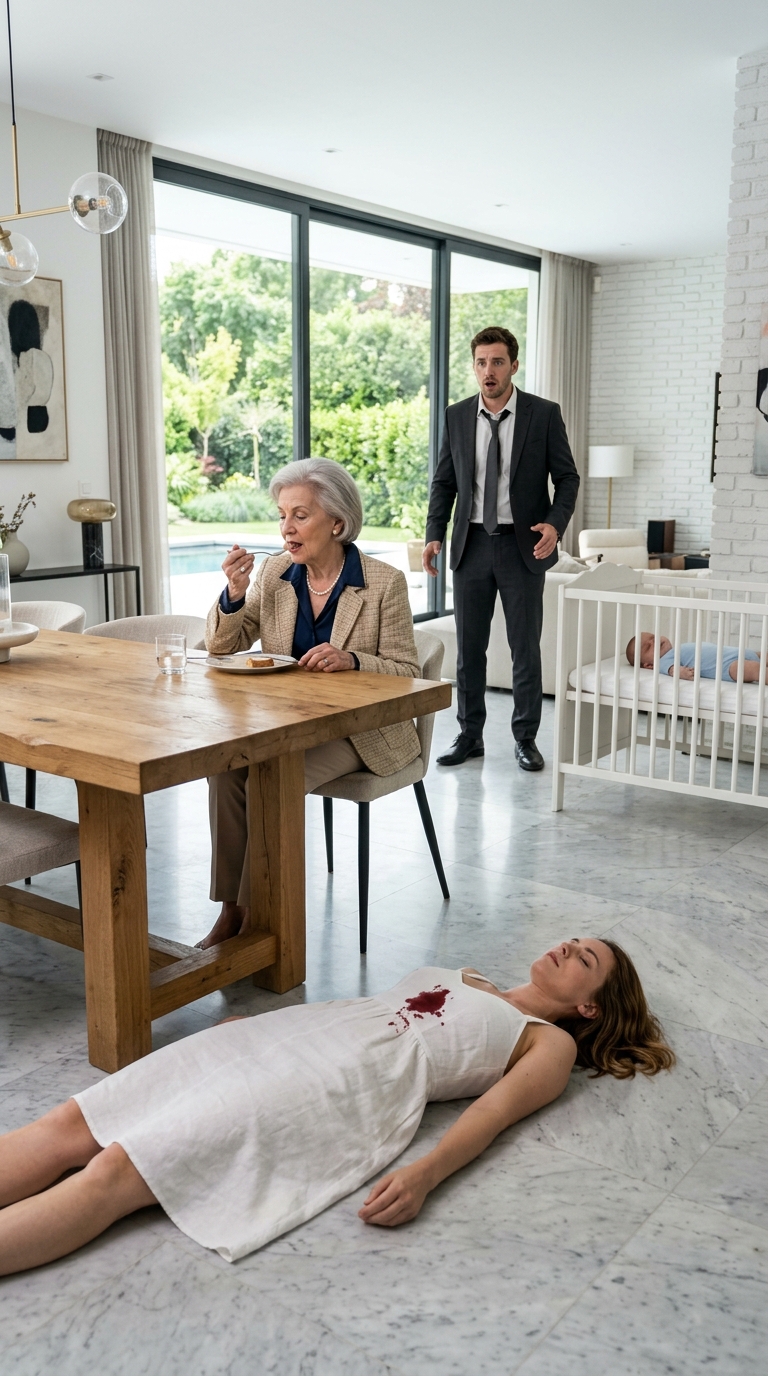
Sofia was kneeling on the living room floor, scrubbing a stain from the rug while Mateo cried from his carrier. Her movements were slow, shaky, and weak. Rosa sat at the dining table eating lunch—the same lunch Alejandro had smelled when he came through the door.
“Please,” Sofia said, her voice cracking. “Can you pick him up for one minute? I feel dizzy.”
Rosa never looked up. “Finish the rug first.”
“I can’t breathe.”
“You’re not dying.”
Sofia tried to rise to her feet. Her knees gave out beneath her. She reached toward the coffee table for support but missed.
Then her body crumpled onto the carpet.
Alejandro stopped breathing.
On the screen, Mateo’s cries grew louder.
Rosa turned her head and looked over.
She watched Sofia lying motionless on the floor.
Then she calmly took another bite of her meal.
For twenty-seven seconds, she did absolutely nothing.
Twenty-seven seconds.
Alejandro counted every one of them without even realizing it.
Then Rosa muttered, “Ridiculous,” and continued eating.
The phone slipped from Alejandro’s fingers and hit the hospital floor.
He doubled over, one arm still wrapped around Mateo, and for the first time since he was a little boy, Alejandro cried.
Not quietly.
Not with restraint.
He shattered.
A nurse rushed into the room. “Sir? Are you okay?”
Alejandro lifted his head, tears streaming down his face.
“My mother,” he whispered. “My mother watched my wife collapse and did nothing.”
The nurse’s expression changed from concern to something far colder.
“Do you have the footage?” she asked.
Alejandro nodded.
“Save it,” she said. “Save everything.”
By dawn, Alejandro had downloaded and preserved every recording from the previous three weeks.
And the truth was far worse than a single afternoon.
Rosa had been starving Sofia little by little. Not enough to be immediately obvious, but enough to wear her down. She threw away meals neighbors delivered. She convinced Sofia that Alejandro hated coming home to disorder. She mocked her appearance, her pain, her parenting, her family, and her value.
Worst of all, she used Alejandro’s name as a weapon.
“My son works hard because you are useless.”
“My son deserves a wife, not a patient.”
“My son should have married a stronger woman.”
“My son will get tired of you if you keep looking like this.”
Every sentence was poison.
And Sofia had swallowed it alone.
At 7:30 that morning, Alejandro called his older sister, Carmen.
She answered sleepily. “What’s wrong?”
“I need you to come to the hospital,” Alejandro said.
“Is Sofia okay?”
“No,” he replied. “And Mom is the reason.”
A long silence followed.
Then Carmen whispered, “What did she do?”
Alejandro closed his eyes. “Everything you warned me about.”
Carmen arrived an hour later, her eyes swollen and her expression hard. She had always had a difficult relationship with their mother. Alejandro used to think she was ungrateful. Overly dramatic. Too sensitive.
Now he understood.
Carmen watched the footage in the hospital hallway.
By the end of the final clip, her entire body was trembling.
“She did it again,” Carmen said.
Alejandro turned toward her. “Again?”
Carmen stared at him, shocked by how little he knew. “You really don’t know, do you?”
“Know what?”
She glanced toward Sofia’s room before looking back at him. “Mom did the same thing to me after my miscarriage.”
Alejandro felt the color leave his face.
“What?”
Carmen’s voice shook, but she continued.
“When I lost the baby, she told everyone she was staying with me to help. Instead, she made me cook for her. She said grief was selfish. She told me my husband would leave if I didn’t start acting normal again. When I finally told you, you said Mom was just worried.”
Alejandro remembered.
He remembered the phone call.
He remembered Carmen crying.
He remembered saying, “You know how Mom is.”
The shame hit him so hard he had to lean against the wall.
Carmen wiped her eyes.
“‘You know how Mom is.’ That sentence protected her for thirty years.”
Alejandro could not find words.
Carmen looked at him, her eyes full of both anger and pain.
“You were her favorite, Alejandro. So you never saw the monster. You only saw the mother she performed for you.”
That sentence stayed with him.
The mother she performed for you.
By noon, Alejandro had contacted a lawyer. He also spoke with the hospital social worker and filed an official report documenting neglect and emotional abuse. Sofia was still too weak to process everything, so he made one decision without placing that burden on her shoulders.
Doña Rosa would never enter their home again.
At 2:15 p.m., Alejandro returned to the house with Carmen and two police officers.
Rosa answered the door wearing a neatly pressed dress, her hair perfectly styled, her lipstick flawless. The moment she noticed the officers, her expression changed.
Not into guilt.
Into offense.
“What is this?” she demanded. “Alejandro, why are these people at your house?”
Alejandro stepped forward.
“Our house. Mine and Sofia’s.”
Rosa laughed sharply. “Please. That girl can barely wash a dish.”
Carmen flinched.
Alejandro did not.
“I saw the cameras,” he said.
Rosa froze.
Only for a second.
But it was enough.
Then she recovered.
“Good. Then you saw how lazy she is.”
One officer tightened his jaw.
Alejandro stared at his mother.
“I saw you take food away from her.”
Rosa lifted her chin. “She needed discipline.”
“I saw you force her to scrub floors three weeks after surgery.”
“She needed movement.”
“I saw her ask for help before she collapsed.”
Rosa’s eyes became cold. “She was acting.”
Alejandro’s voice cracked.
“She almost died.”
For the first time, Rosa completely lost control.
“She ruined you!” she screamed. “Before her, you respected me. Before her, this family had order. Then she came in with her soft voice and her college degree and her little opinions, and suddenly you forgot who raised you.”
Alejandro looked at her as though he were seeing her clearly for the first time.
“This was never about helping,” he said.
Rosa’s breathing became heavier.
“It was about control,” he continued. “You wanted Sofia weak because a weak wife would need you. You wanted me blind because a blind son would obey you.”
Rosa pointed a shaking finger at him.
“I gave you life.”
“And you nearly took hers.”
The words hit the room like thunder.
For a moment, even Carmen looked stunned.
Rosa opened her mouth.
Nothing came out.
Alejandro stepped aside while the officers supervised the removal of her belongings. Carmen packed Rosa’s clothes into two suitcases while Rosa shouted about betrayal, disrespect, and “American women turning sons against mothers.”
Alejandro said nothing.
He had spent his entire life responding.
Now he was done.
When Rosa tried to enter the nursery, Alejandro stepped in front of the doorway.
“No,” he said.
Her eyes widened.
“That is my grandson.”
“You lost the right to call him that when you let him scream beside his unconscious mother.”
Rosa slapped him.
Just as Teresa had once slapped her son in another life, another story, another family broken apart by pride.
Alejandro did not move.
The officers stepped forward, but he raised a hand slightly.
Rosa stared at the red mark forming on his cheek as if she expected him to apologize.
He didn’t.
“You need to leave,” he said.
Rosa’s face twisted with fury.
“You will regret this when she leaves you.”
Alejandro looked at his mother with a sadness far deeper than anger.
“No,” he said. “I will regret that I didn’t choose her sooner.”
That evening, Sofia woke in her hospital room and found Alejandro sitting beside her bed. His eyes were red, his face drawn, and something about him had changed.
Not just guilt.
Guilt can still be selfish.
This looked like a man finally standing among the ruins he had helped create.
“She’s gone,” he said quietly.
Sofia blinked. “Who?”
“My mother. From the house. From our lives, unless you decide otherwise someday.”
Sofia stared at him.
He set his phone on the table beside her.
“I watched the footage.”
Her body immediately tensed.
“I’m sorry,” he said quickly. “I should have asked before watching. But I needed to understand. I needed to know what happened.”
Sofia turned her face away as tears rolled down her cheeks.
“I didn’t want you to see me like that,” she whispered.
Alejandro felt his heart break.
“Sofia,” he said, “I am not ashamed of you. I am ashamed of myself.”
She cried then, silently, covering her eyes with one hand.
He did not reach for her.
He did not touch her without permission.
He simply remained there—close enough to stay, far enough not to demand forgiveness.
“I believed her over you,” he said. “I let you suffer because facing the truth would have made my life harder. I failed you.”
Sofia wiped away her tears.
“Yes.”
He nodded.
“I know.”
“I begged you,” she said.
“I know.”
“She told me you would hate me if the house wasn’t perfect.”
Alejandro closed his eyes.
“I never cared about the house.”
“But you cared about peace,” Sofia said. “And your mother made sure peace meant my silence.”
That sentence shattered him more completely than any scream ever could.
Because it was true.
Over the following days, Sofia’s recovery came slowly. Doctors kept her under close observation, adjusted her medications, treated her incision, and arranged sessions with a postpartum counselor. Mateo remained close to her, and this time, whenever he cried, Alejandro was there before those cries could become desperate.
He learned quickly.
He learned how to change diapers without expecting praise. He learned how to warm bottles, clean pump parts, manage medication schedules, and hold Sofia’s hand when nightmares woke her in the middle of the night. He learned that love was not simply earning a paycheck while someone else struggled alone at home.
Love was paying attention.
Love was listening.
Love was believing the person who had nothing to gain from lying.
On the fifth day, Sofia finally asked to watch the footage.
Alejandro hesitated. “Are you sure?”
She nodded. “I need to know how much you know.”
So they watched it together.
Not all of it.
Just enough.
Sofia sat motionless as scenes of her own suffering replayed across the screen. She did not cry when Rosa insulted her. She did not cry when Rosa took away her food. But when the footage showed Mateo screaming while Sofia lay unconscious on the floor, a sound escaped her that Alejandro would remember for the rest of his life.
It was not a sob.
It was the sound of a mother realizing her child had been abandoned too.
“She heard him cry,” Sofia whispered.
Alejandro nodded, tears filling his eyes. “Yes.”
“And she kept eating.”
His voice barely worked. “Yes.”
Something changed inside Sofia then.
Not cruelty.
Not revenge.
A boundary.
“I don’t want her near my son,” she said.
“She won’t be.”
“I don’t want her in our house.”
“She won’t be.”
“I don’t want you making excuses for her anymore.”
Alejandro met her gaze directly. “I won’t.”
Sofia studied him for a long time.
“You understand,” she said carefully, “that this doesn’t fix us.”
“I know.”
“You understand that I don’t know if I can trust you.”
His voice remained quiet. “I know.”
“And you understand that protecting me now does not erase the fact that you ignored me then.”
Alejandro nodded. “Yes.”
That was where their real marriage began.
Not on their wedding day.
Not when their son was born.
That hospital room—with monitors beeping softly and painful truths hanging between them—became the first truly honest room they had ever shared.
Two weeks later, Rosa tried to regain control.
She started by calling relatives. She cried to cousins in Houston, aunts in San Antonio, church friends, former neighbors—anyone willing to listen. Her version of events was polished and tragic. Sofia was unstable after childbirth. Alejandro was being manipulated. Rosa had been thrown out after “devoting herself” to helping the family.
At first, many people believed her.
Rosa had spent decades building the image of a saint.
Then Alejandro did something nobody expected.
He shared the footage.
Not publicly.
Not online.
Not to embarrass Sofia.
Only with the relatives who had called his wife lazy, ungrateful, or dramatic because they believed Rosa’s lies.
Along with the videos, he sent a single message:
Before you speak about my wife again, watch what my mother did while Sofia was recovering from surgery and caring for a newborn. Then decide who deserves your sympathy.
The family group chat went silent.
For eleven minutes, nobody responded.
Then Carmen wrote one sentence.
I told you all years ago. Nobody believed me either.
After that, everything poured out.
One cousin admitted Rosa had treated his wife terribly after their second child. An aunt confessed Rosa often hid control behind religion. A former neighbor revealed she had once heard Sofia crying through the kitchen window while Rosa sat outside laughing on the phone.
The family did not break because of one video.
The video simply revealed cracks that had existed for years.
Rosa called Alejandro seventy-three times in a single day.
He never answered.
Then she showed up at the house.
Alejandro saw her through the doorbell camera. She stood on the porch wearing a black dress, holding a Bible in one hand and a baby blanket in the other. Rain fell softly behind her, but her expression was sharp with anger.
“Open this door,” she said into the camera. “I am your mother.”
Alejandro watched from inside while Sofia stood upstairs holding Mateo.
He pressed the speaker button.
“You need to leave.”
Rosa’s expression changed instantly.
“Mijo, please. I made mistakes. I was tired. I was trying to help.”
Alejandro felt the familiar pull in his chest.
That old childhood instinct.
Comfort her.
Obey her.
End the conflict.
Then he glanced toward the staircase, where Sofia stood quietly holding Mateo and watching him make a choice.
Alejandro turned back to the camera.
“You watched my wife collapse.”
Rosa’s face hardened.
“She turned you against me.”
“No,” Alejandro said. “The cameras showed me who you are.”
Rosa stepped closer to the door.
“If you abandon your mother, God will punish you.”
Alejandro’s voice remained steady.
“God saw the cameras too.”
For once, Rosa had no response.
She left the blanket on the porch and walked away.
Alejandro threw it in the trash.
Months passed.
Healing was not beautiful in the beginning. It was slow, uncomfortable, and messy. Sofia had good days when she laughed at Mateo’s tiny sounds and bad days when the smell of bleach made her flinch because it reminded her of scrubbing floors while her incision burned.
Alejandro started therapy.
At first, he believed therapy would teach him how to deal with his mother.
Instead, it taught him how deeply he had been conditioned to protect her feelings at everyone else’s expense. He learned that being a good son did not require sacrificing his wife. He learned that neutrality in abuse always benefits the abuser.
Sofia began therapy too.
She learned how to speak openly without apologizing first. She learned that exhaustion had made her question her own reality. She learned that motherhood did not require martyrdom and marriage did not require silent suffering.
Their marriage did not suddenly become perfect.
Some nights, Sofia still remembered Alejandro saying, “My mom means well.”
Some mornings, Alejandro woke before sunrise and checked on her because guilt had become an alarm clock inside his blood.
But slowly, painfully, they built healthier habits where old wounds once lived.
He came home earlier.
He hired a postpartum nurse and later a housekeeper, paying from his own savings without presenting it as a favor. He informed his boss that he was taking paternity leave even when coworkers joked about men who did. He learned to cook, though badly at first. He burned rice twice, oversalted chicken, and once used dish soap in the dishwasher so incorrectly that foam spilled across the kitchen floor.
For the first time in weeks, Sofia laughed.
A real laugh.
Alejandro stood barefoot in the bubbles, embarrassed and helpless, and that laugh nearly brought him to his knees.
One year later, Mateo’s first birthday was celebrated in their backyard on a warm spring afternoon. Blue balloons floated overhead, a small cake sat on the table, food covered a folding buffet, and friends who had earned the title of family filled the yard. Carmen arrived early with presents and cried when Mateo took three wobbly steps toward her.
Rosa was not invited.
Some relatives called that cruel.
Alejandro no longer cared.
During the celebration, Sofia stood beside the kitchen window, watching Alejandro hold Mateo while pretending the little boy had stolen his piece of cake. Mateo squealed with delight, frosting smeared across both hands. Alejandro looked exhausted, joyful, and fully engaged in the moment.
Carmen walked over and stopped beside Sofia.
“How are you?” she asked.
Sofia gave a small smile. “Better.”
“Do you forgive him?”
Sofia watched Alejandro press a kiss to Mateo’s hair.
“I’m learning what forgiveness means,” she said. “It doesn’t mean forgetting. It doesn’t mean pretending it didn’t happen. It means deciding whether the person who hurt you is willing to become someone safer.”
Carmen nodded.
“And is he?” she asked.
Sofia’s expression softened.
“He’s trying every day.”
Across the yard, Alejandro glanced up and caught Sofia’s eye. He did not wave her over or make a grand gesture. He simply smiled gently, as though asking permission to enjoy the life they were rebuilding together.
Sofia smiled back.
That was enough.
Later that night, after the guests had gone home and Mateo was asleep, Alejandro and Sofia sat together on the back porch beneath strings of lights. The house behind them was quiet. Not the dangerous silence created by swallowed pain, but the peaceful silence of a home where nobody had to pretend.
Alejandro took a breath.
“I have something to tell you,” he said.
Sofia looked at him carefully.
He reached into his pocket and pulled out a folded document. “It’s from my mother’s lawyer.”
Sofia immediately tensed. “What does she want?”
“Grandparent visitation.”
Sofia froze.
Alejandro quickly shook his head. “She won’t get it. My lawyer already responded. The footage, the hospital records, the reports, everything is documented.”
Sofia stared out into the yard.
“I should have told you sooner,” he said. “But I didn’t want to ruin Mateo’s birthday.”
She turned toward him.
“No more protecting me from information, Alejandro.”
He nodded immediately. “You’re right. I’m sorry.”
Sofia accepted the paper and read it carefully. Rosa claimed she had been unfairly separated from her grandson. She claimed Sofia was emotionally unstable. She claimed Alejandro was under his wife’s control.
For a moment, the old fear returned.
Then Mateo’s baby monitor crackled softly from inside the house.
The fear turned into fire.
“No,” Sofia said.
Alejandro looked at her.
Sofia folded the document neatly and handed it back. “This time, we don’t hide. This time, we don’t let her control the story.”
And they didn’t.
The hearing took place six weeks later in a Dallas family courtroom.
Rosa arrived dressed like a grieving saint. A small cross hung around her neck, and a tissue rested in her hand. She greeted people softly. She looked fragile, wounded, misunderstood. If Alejandro had never watched the footage, he might have believed her performance.
But Sofia entered beside him with her head held high.
She wore a navy dress, simple makeup, and no sign of fear.
When Rosa saw her, her eyes narrowed for a brief second.
The judge listened patiently while Rosa’s attorney described her as a devoted grandmother who had been “cruelly cut off” after a misunderstanding during a difficult postpartum period. Rosa dabbed her eyes at all the right moments. She claimed she loved Mateo. She claimed she loved Sofia like a daughter.
Then Alejandro’s attorney played the footage.
The entire courtroom changed.
No speech could compete with the image of Sofia collapsing while Mateo screamed and Rosa continued eating.
Rosa’s lawyer no longer looked confident.
The judge watched in silence, jaw tight.
Sofia never looked away.
When the footage ended, the room became so quiet that even the rustle of paper sounded loud.
The judge turned toward Rosa.
“Ma’am,” he said, “do you have an explanation for why you failed to assist your postpartum daughter-in-law or comfort the crying infant?”
Rosa opened her mouth.
For the first time, there was no audience willing to be manipulated.
No son rushing to soften reality.
No family group chat she could twist to her advantage.
Only facts.
“She was being dramatic,” Rosa said weakly.
The judge’s expression hardened.
That sentence ended everything.
Rosa’s request was denied.
The court ordered no unsupervised contact and recommended that any future request be reviewed only after documented counseling and evidence of behavioral change. Rosa left the courtroom without speaking to Alejandro. At the doorway, she turned once and looked at him with hatred disguised as heartbreak.
Alejandro did not go after her.
Instead, he reached for Sofia’s hand.
She allowed him to hold it.
Two years later, Mateo had grown into a bright, stubborn toddler with Sofia’s serious eyes and Alejandro’s booming laugh. Their home looked different now. Toys covered the floor. Dishes sometimes sat in the sink. Laundry baskets existed without determining anyone’s value. And a family rule was written on a small chalkboard near the kitchen:
People matter more than appearances.
Sofia had written it.
Alejandro had framed it.
On a quiet Sunday morning, Mateo ran through the kitchen in dinosaur pajamas while Alejandro flipped pancakes. Sofia sat at the table with a cup of coffee, reading an email from a local women’s center where she had begun volunteering with mothers recovering from traumatic births and family abuse.
She had transformed pain into purpose.
Not because pain was beautiful.
But because surviving it made her unwilling to let other women suffer alone.
Alejandro placed a pancake on her plate.
One side was slightly burned.
Sofia looked at it.
He sighed. “I know.”
She smiled. “Progress.”
Mateo climbed into her lap with sticky hands and all, pressing his face against her neck.
“Mommy,” he said sleepily.
Sofia closed her eyes and wrapped her arms around him.
There had once been a day when he screamed beside her unconscious body while nobody came.
Now he lived in a home where someone always came.
Alejandro watched them from across the table, his throat tightening. He knew he could never erase what happened. He knew love did not give him the right to demand forgiveness on his own schedule. But every day, he chose differently from the man he used to be.
And that mattered.
Not as some grand redemption.
As daily evidence.
Years later, whenever people asked why Alejandro no longer spoke to his mother, he always gave the same answer:
“Because the family I created needed protection from the family that raised me.”
Some people understood.
Some judged.
Some insisted blood was blood.
Alejandro no longer argued.
He had learned the hard way that blood could connect people, but it could not excuse cruelty. A mother’s title did not make her sacred. A wife’s silence did not mean she was safe. And a man who waited for disaster before defending his family would spend the rest of his life proving he had finally opened his eyes.
As for Sofia, she never became the same woman she had been before that day.
She became stronger, but not in the way Rosa once demanded.
Not the strength of suffering quietly.
Not the strength of scrubbing floors through pain.
Not the strength of smiling while breaking inside.
Her strength was saying no.
Her strength was resting without guilt.
Her strength was raising her son in a home where love did not sound like control.
And in the end, the cameras did more than expose Rosa.
They exposed every lie that had been holding the family together.
Because sometimes a family is not destroyed by the truth.
Sometimes the truth simply reveals it was already broken.
And sometimes, the bravest thing a man can do is stop protecting the person who raised him and start protecting the people who trusted him to be different.
