

PART 1
The family filled out a mail-order bride application using Elena’s name as a mockery, but when the rancher replied with money for the trip and a formal proposal, no one laughed harder inside than she did.
Until that day, Elena Robles had been the silent shame of the house in San Miguel el Alto, Jalisco. She was not as pretty as her sisters, she didn’t know how to flirt at the town festivals, she didn’t have a queen’s waist for the fair or a sweet voice to convince anyone. At 24 years old, her father introduced her as “the one who helps around the house,” while Marisol, Jimena, and Renata were dressed in lace, ribbons, and promises of good marriages.
Elena kept the books for her father’s dairy ranch, mended other people’s dresses, prepared hot chocolate for visitors who never asked about her, and listened from the kitchen as her family talked about her future as if she were a broken chair.
“No one is going to ask for Elena,” Marisol would say, laughing with that pretty cruelty everyone forgave because it came wrapped in expensive perfume.
“Maybe a blind widower,” Jimena would reply.
Renata, the youngest, was not as cruel, but she didn’t defend Elena either. She would lower her gaze, bite her lips, and let the others continue.
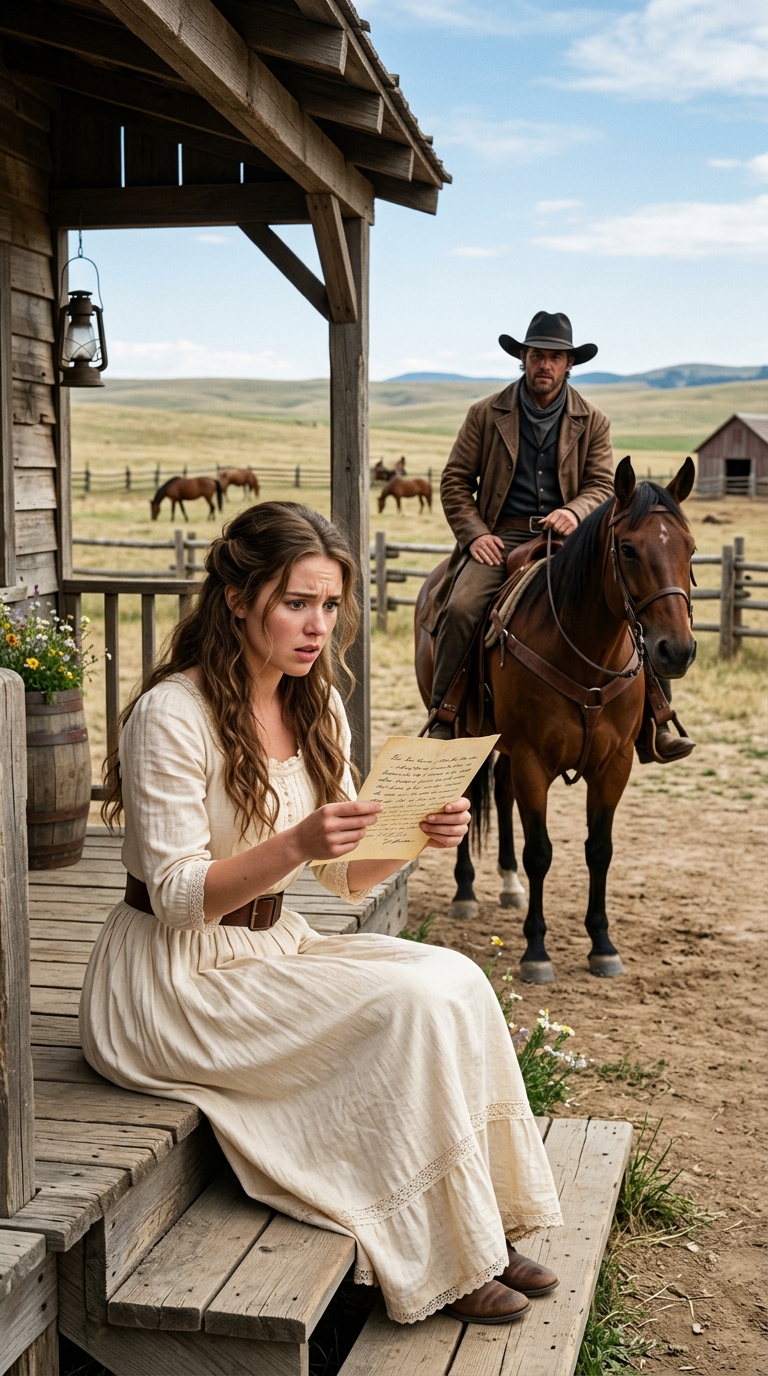
One August afternoon, while Elena was taking sheets off the clothesline, she heard laughter in the living room. She hadn’t planned to approach. She already knew that tone: it always announced a humiliation. But then she heard her name.
“Read the ad again,” Marisol asked.
Jimena cleared her throat theatrically.
“‘Widower rancher, 36 years old, owner of Rancho La Cañada in Sonora. Seeks a wife with a calm character, firm heart, and willingness to live far from the city. I have one small child. I am not looking for novel romance, but respect, work, and honest companionship. Only serious replies.’”
The three burst into laughter.
“It’s perfect,” Marisol said. “He wants a simple woman. Who is simpler than Elena?”
“And if he sees her photo, he’ll regret it before she even gets off the train,” Jimena added.
Elena clutched the sheets to her chest. She felt shame, rage, and an old sadness so familiar it almost seemed part of her body. She should have gone in, snatched the paper from them, and shouted that they had no right. But something stopped her. Maybe exhaustion. Maybe a small spark she didn’t dare call hope.
From the window, she watched them write a letter in her name. They used words that sounded humble, invented virtues to mock her, and sent a photograph where Elena looked serious, with her hair pulled back without grace and a brown dress that Marisol had already discarded.
That night, while everyone was having dinner, Elena said nothing. Her father, Don Aurelio Robles, barely looked at her.
“Bring more tortillas, Elena.”
She obeyed. As always.
Six weeks later, a thick letter with a Sonora seal arrived.
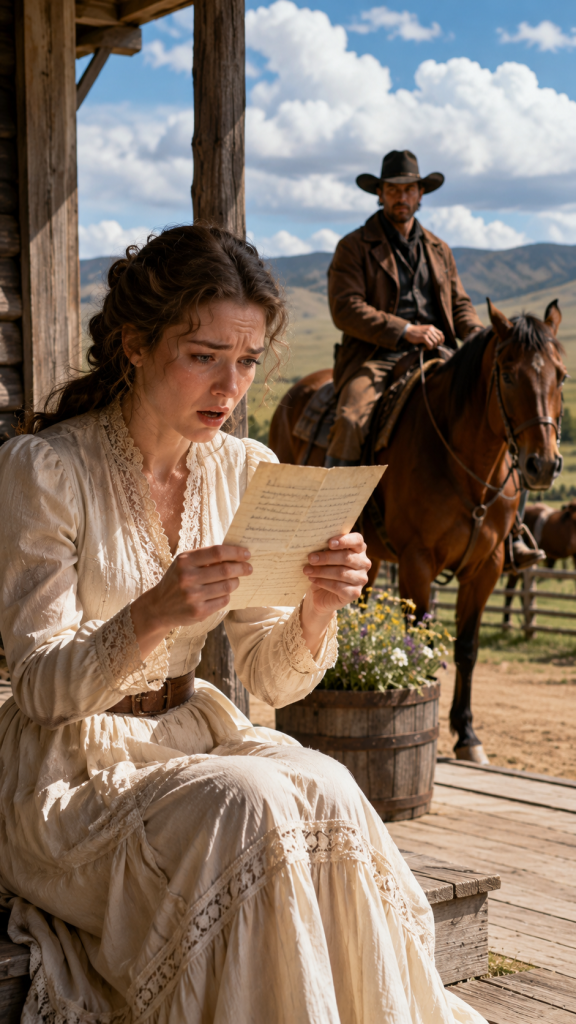
Marisol opened it at the table, expecting another reason to mock. But as she read, her smile faded. Jimena snatched the paper from her. Don Aurelio rose slowly from his chair.
“What’s going on?” Elena asked, though she already felt the air changing.
Marisol threw the letter at her as if it burned.
“Your rancher accepted.”
Elena picked it up with trembling hands. The handwriting was firm and direct.
The man’s name was Mateo Cárdenas. He said he had read her letter carefully, that he was not interested in embellishments or false promises. He offered marriage, a roof, respect, and a life of work at Rancho La Cañada. He also explained that he had a 4-year-old son, Tomás, whose mother had died in childbirth. He did not promise love. He did not ask for beauty. He asked for honesty. At the end, there was a phrase Elena read three times: “The decision is completely yours.”
Don Aurelio slammed the table.
“What did you do?”
The sisters turned pale. Renata began to cry.
“It was a joke,” Jimena murmured.
“A very dirty joke,” Don Aurelio said.
Marisol, cornered, looked at Elena with contempt.
“You’re not going, are you? Don’t be ridiculous. That man is going to mock you as soon as he sees you.”
Elena raised her eyes. For the first time in years, she did not feel like hiding.
“I’m going.”
The room fell silent.
“What did you say?” her father asked.
“That I’m going. He made an honest proposal. You made a mockery. I’m going to turn it into my way out.”
Marisol stood up.
“You’re going to marry a stranger just to make us look bad.”
“No,” Elena replied, her voice low but firm. “I’m leaving because here you’ve treated me as if I were worth nothing.”
Don Aurelio remained silent for several seconds. Then he took the letter, read the rancher’s name, and looked at his daughters one by one.
“Then she will leave prepared as a decent daughter of this house.”
Marisol let out a nervous laugh.
“Dad, you can’t be serious.”
“More serious than you were when you played with your sister’s life.”
Elena went up to her room before the tears betrayed her. She took out her mother’s old trunk, packed two dresses, an account book, a rosary, and the yellowish photograph of the woman who had looked at her with tenderness when she was a child.
That night, while folding her clothes, she heard Marisol whispering behind the door.
“That man is going to send her back.”
Elena did not respond.
But at dawn, when she opened the envelope again, she found something she hadn’t seen before: a train ticket, money for food, and a small separate folded note.
“If someone forced you to write, do not come. If you decide to come of your own free will, I will wait for you at the Hermosillo station on September 15. I will not ask about your past until you want to tell it.”
Elena felt her heart pounding in her chest.
Because then she understood something terrifying: that stranger might already suspect that the letter had been born from a lie.
And yet, he was waiting for her.
PART 2
The journey to Sonora lasted three days, and Elena arrived in Hermosillo with her dress wrinkled, her hair loose from the dust, and the certainty that if Mateo Cárdenas mocked her, she would have nowhere to return without becoming the talk of all Jalisco.
She recognized him before he said her name: tall, tanned by the sun, with the hands of a man of the land and a gray gaze that did not scan her face in judgment, but as if searching for something deeper.
He did not smile, but he also showed no sign of disappointment. He removed his hat, bowed his head, and asked if the journey had been hard.
Elena had expected coldness or pity; she received respect.
In the wagon on the way to the ranch, he spoke to her with dry sincerity: his wife, Clara, had died giving birth to Tomás; the boy asked for a mother he did not remember; the ranch needed a woman who knew how to run a house without fear of work.
Mateo repeated that he did not promise love, because he felt that part had died with Clara. Elena, instead of feeling rejected, breathed easily: finally someone was not selling her lies.
They married the next day in the ranch chapel, with two ranch hands as witnesses and Tomás watching from a bench, hugging a wooden horse. The boy approached afterward and took Elena’s hand with a trust that disarmed her.
From that moment, Rancho La Cañada stopped being an imposed destination and began to become a test. Elena did not know how to milk goats, nor how to tell a sick cow by the shine in its eyes, nor how to prepare tortillas for twelve workers with flour measured to the penny, but she knew how to listen.
She learned Mateo’s footsteps before seeing him enter, Tomás’s sad silence when he missed something he could not name, and the way the ranch’s accounts bled money due to poorly made purchases.
One afternoon, after dropping a pot of broth in front of two ranch hands, she stood motionless waiting for shouts, because in her father’s house a mistake was always followed by mockery. Mateo simply picked up the pot, cleaned the floor, and said it was broth, not a disaster. That phrase broke something inside her.
In the following weeks, Elena organized the pantry, reduced debts, taught Tomás to read using labels from sacks, and discovered that the rocky land in the north could be sold at a good price to a neighboring cattleman who needed access to the well.
Mateo began leaving the account books on the table for her. Tomás started calling her mom without asking permission. And Mateo, although he still spoke little, began to look at her as if the house had regained its light.
But the peace was broken when a letter from Jalisco arrived. Marisol wrote that Don Aurelio was ill and that Elena must return immediately to “fulfill her blood duty.” Inside was another sheet, written by Jimena, warning that Mateo had only accepted her because no sane man could truly want her.
Elena burned that second sheet in the stove, but Mateo saw the ashes and understood too much.
That night, a sandstorm hit the ranch, Tomás had a fever, and Mateo, exhausted, confessed in the kitchen that he had loved Clara wrongly: he had kept her in a place where she was unhappy and then blamed himself for five years for feeling relief when she stopped arguing with him.
Elena took his hand without fear. She told him that guilt was not a tomb where he had to live forever. Then Mateo, for the first time, rested his forehead on her shoulder and cried without making a sound.
At dawn, when it seemed something new had been born between them, Marisol appeared at the entrance of the ranch, covered in dust, with a venomous smile and a phrase capable of destroying everything: she brought proof that Elena’s letter had been a farce.
PART 3
Marisol did not arrive alone. She came with Jimena and with a lawyer from Guadalajara who claimed to represent Don Aurelio, although Elena immediately noticed that the man knew neither her father’s handwriting nor his way of speaking.
At the dining table, in front of Mateo and Tomás hidden behind the door, Marisol took out the copy of the original application, the photograph chosen to make her look worse, and several cruel phrases written by them as if they were clumsy virtues.
She expected to see Mateo furious, perhaps humiliated for having been deceived. She expected Elena to lower her head as before. But Mateo read everything in silence, placed the papers on the table, and asked why a family would travel so many kilometers just to prove they had been cruel.
Marisol lost all color. Jimena tried to say they only wanted to prevent a marriage based on lies, but Mateo replied that the only lie was believing that Elena was not worthy.
Then he told what he had never said: from the first letter he had suspected someone was mocking her, because no woman who described herself with so much shame could have written about herself with such cruelty. That was why he had added the secret note. That was why he had given her the option not to come. And that was why, when Elena got off the train with fear but with her head held high, he knew the real woman was stronger than any mockery.
Cornered, Marisol blurted out that Elena had taken advantage of the situation to escape her family obligations. It was Tomás who came out from behind the door, with his eyes full of tears, and hugged Elena’s skirt as if defending his entire world. The boy did not shout, but his gesture was enough.
Jimena began to cry, not for show, but out of shame. The lawyer confessed that Marisol had hired him to pressure Elena and make her return, because Don Aurelio was not dying: he was ill, yes, but stable, and had demanded that they leave his daughter in peace.
That revelation finally shattered Marisol’s mask. Mateo asked the ranch hands to prepare the wagon for the return to Hermosillo. He did not insult the sisters, he did not raise his voice, he did not need to. He simply told them that in his house no one would ever again use Elena’s pain as entertainment.
Before leaving, Renata, who had traveled hidden on the last leg because she could no longer bear the guilt, handed Elena a real letter from Don Aurelio. In it, her father asked for forgiveness for seeing her too late, for allowing too much laughter at a table where she held everything together, and left her the legal share of the family ranch so that no one could say she had left with nothing.
Elena cried as she read it, but not only from sadness. She cried because, for the first time, her life did not depend on others recognizing her worth.
Months later, Elena negotiated the sale of the rocky land to the neighbor for an amount that saved La Cañada from debt. Mateo kissed her in front of half the square in Hermosillo, scandalizing three ladies and making Tomás laugh until he ran out of breath.
With the money, they expanded the house, hired two families of day laborers with fair wages, and opened a small school on the ranch for the workers’ children.
When their daughter was born the following September, they named her Clara Luz: Clara after the woman who had existed before Elena, and Luz for what came after so much shadow.
Don Aurelio lived long enough to meet the girl. He traveled weak, leaning on a cane, and upon seeing Elena running the house, the accounts, the ranch hands, and the heart of that family, he found no grand words. He simply took her hand and said that her mother would have been proud.
Years later, when someone asked how Elena had come to Sonora, Tomás would say that some mean aunts had sent a letter to laugh, but that his mom had turned the joke into destiny. Elena never corrected that version.
She only looked at Mateo, at her children running among golden dust and the smell of bread, and thought of that invisible girl who boarded a train expecting shame. No one had rescued her. No one had given her her worth. She had chosen to walk toward the unknown, and in doing so discovered that she had always been enough; she only needed a place where no one confused her silence with a lack of light.
