

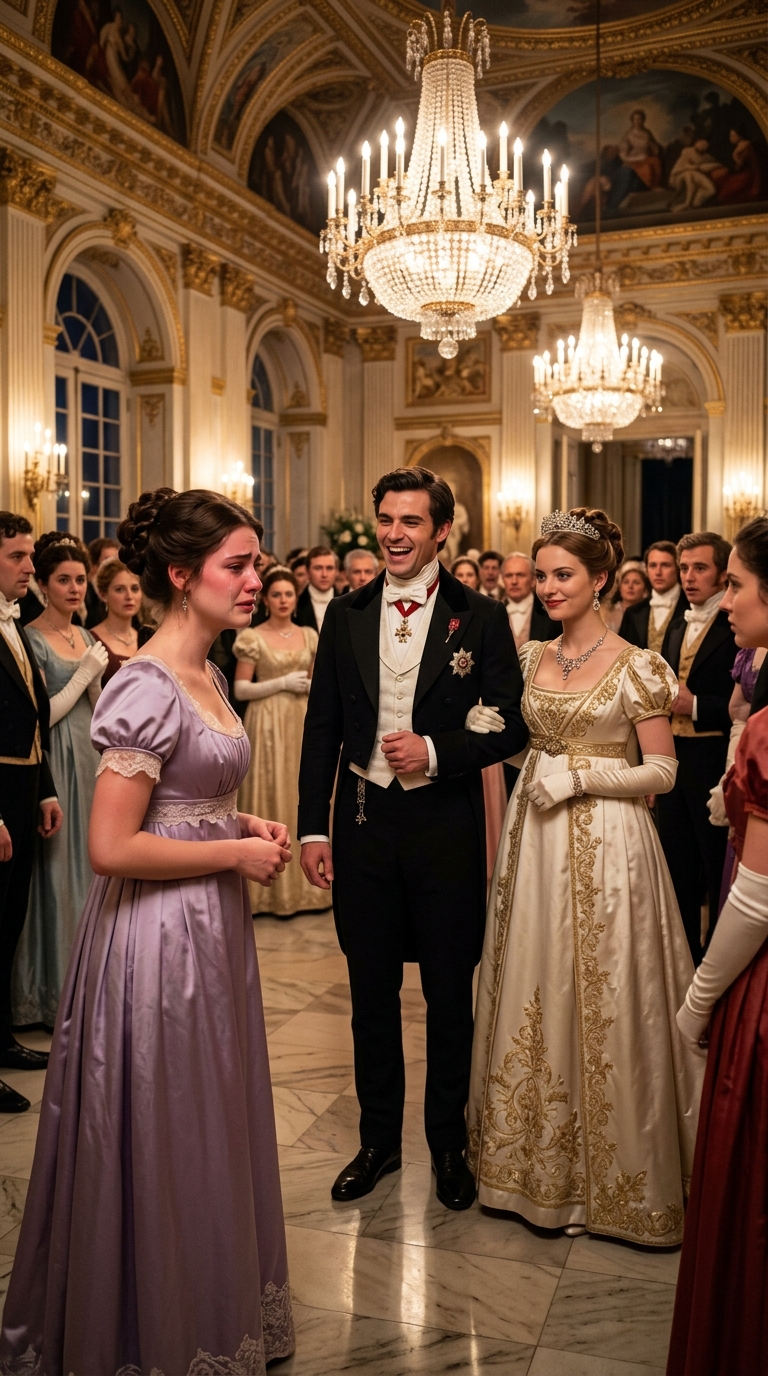
Patricio Valdés’s laughter cut through the salon like a glass shattering against the marble.
“Aren’t you still single, Mariana?” he said, raising his voice loud enough for everyone at the gala to hear. “What a shame. I thought that after falling so low, you would at least have found someone who took pity on you.”
Silence fell over the grand salon of the Palacio de Iturbide in the Historic Center of Mexico City. Crystal chandeliers sparkled over expensive dresses, dark suits, antique jewels, and smiles trained to hide venom.
Mariana Aranda did not move.
She wore a simple dark blue dress, without diamonds, without imported lace, without anything that could compete with the excess of the women around her. Before, she too had belonged to that world. Before, her surname opened doors. Before, Patricio had looked at her as if she were the center of his future.
Before everything fell apart.
Patricio stood before her with a glass in his hand and a cruel smile on his lips. Clinging to his arm was his new wife, Renata Escobedo, the only daughter of a mining businessman from Sonora. Renata wore an emerald necklace so large it looked more like a declaration of war than a jewel.
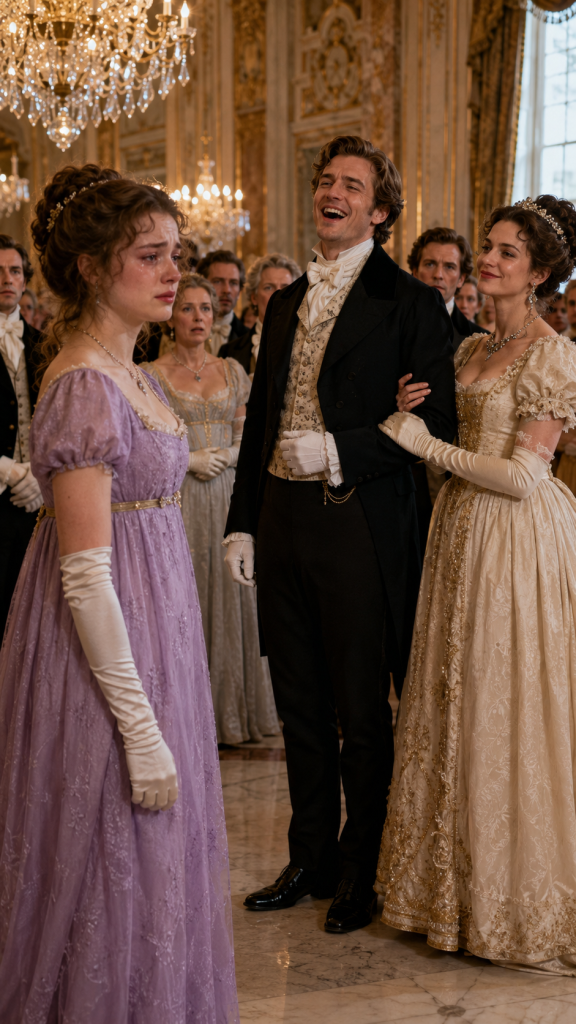
“Don’t be so harsh, darling,” Renata said with a false laugh. “Mariana can still be useful. Maybe as a lady’s companion. Or a seamstress. They say ruined women learn quickly.”
Some people pretended not to hear. Others could not hide their pleasure at witnessing a public humiliation.
Mariana clenched her fingers inside her gloves.
A year earlier, no one would have dared speak to her that way.
She was the only daughter of Don Esteban Aranda, owner of an old trading house in Veracruz, a man respected for his honor, though not for his prudence. Mariana had grown up among books, music, trips to the capital, and promises of a brilliant marriage to Patricio Valdés, heir to a powerful family from Guadalajara.
Patricio had written her letters full of vows.
He had told her he loved her.
He had told her that no blow of life could separate them.
But when Don Esteban’s ships were lost in a storm in the Gulf and debts devoured the family fortune, Patricio arrived at the small rented house where Mariana and her father had taken refuge—not to console her, but to return the ring.
“My family cannot join in ruin,” he said then, without even removing his gloves. “I’m sorry, Mariana. I need a wife who brings influence, not shame.”
Don Esteban died three weeks later, defeated by sadness and the weight of the debts. Mariana was left without fortune, without a home, and without a fiancé.
Mexican society, so devoted to appearances, buried her alive.
A distant aunt, Doña Amalia, took her in at her house in Coyoacán, but not as a beloved niece, rather as a useful burden. Mariana accompanied her cousin on visits, mended dresses, answered letters, smiled when she was supposed to smile, and disappeared when others wanted to forget her.
Everyone believed that Mariana Aranda had become an abandoned woman.
But everyone was wrong.
Mariana was no longer single.
She was the wife of one of the most powerful men in Mexico.
His name was Alejandro Santillán.
He was forty years old, ten years older than her, and owned banks, haciendas, railways, and political wills. The newspapers called him “The Wolf of Reforma” because he rarely raised his voice, but when he decided to destroy someone, he did it with documents, silence, and terrifying precision.
Alejandro had loved Mariana long before she even knew his name.
He had first seen her at a charity reception in Veracruz when she was twenty-three years old, speaking to a group of merchants about schools for the daughters of port workers. He was not impressed by her beauty, although it was evident. He was impressed by her intelligence. Mariana did not speak to adorn a conversation; she spoke because she had something to say.
Months after Don Esteban’s death, Alejandro found her in the rain, coming out of a pharmacy on Madero Street. She had no carriage. She did not have enough of a coat. She had no one waiting for her.
He stepped down from his black car without hesitation.
“Miss Aranda,” he said, removing his hat, “allow me to take you home.”
Mariana wanted to refuse, but she was trembling.
During the ride, Alejandro offered her no pity. He offered her truth.
“Your father was not a criminal,” he said. “He was an honorable man trapped by a bad bet and worse partners.”
Mariana looked at him in surprise.
“Did you know him?”
“Well enough to know that he deserved better than the whispers they left over his grave.”
What Mariana did not know then was that Alejandro had discreetly bought several of her father’s debts to prevent the Aranda name from being torn apart in the courts.
A week later, in the library of his house on Paseo de la Reforma, Alejandro asked her to marry him.
There was no music. There were no flowers. Only the fire in the fireplace, rain against the windows, and a serious man looking at her as if her answer could change the order of the world.
“I am not a man of pretty speeches,” he said. “But I am loyal. I have power, I have enemies, and I have memory. If you agree to marry me, no one will ever again use your misfortune as entertainment.”
Mariana, wounded but not defeated, recognized in Alejandro something she had never seen in Patricio: firmness without vanity.
She accepted.
They married in secret in a small chapel in Puebla, with an elderly priest and Alejandro’s administrator as the only witnesses.
The secret was not shame. It was protection.
Alejandro was about to travel to Europe to close a delicate financial negotiation with French and English investors. If his enemies discovered that he had married the ruined daughter of a dead merchant, they would use Mariana as a weapon. The press would destroy her before he could protect her publicly.
“When I return,” he promised, kissing her forehead before leaving, “you will no longer have to hide. I will present you to everyone as my wife.”
Mariana waited.
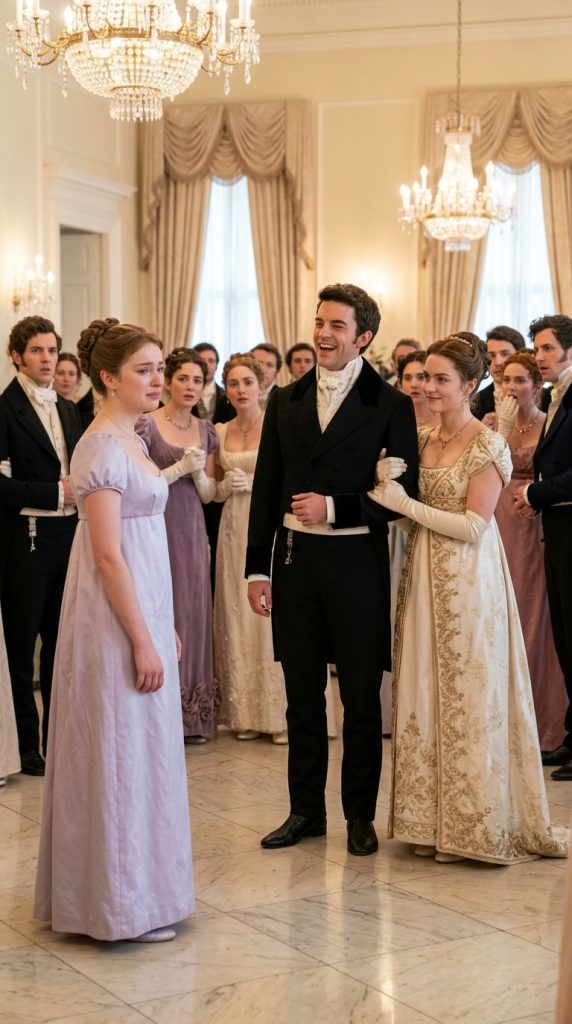
For months she endured pitying looks, poisonous comments, invitations given out of obligation. Under her simple gloves she hid a gold ring with the Santillán seal. Every night she read Alejandro’s brief letters sent from Paris, Madrid, or London. They were not romantic letters in Patricio’s style. They were firm, intense phrases, just like him.
“I will return for you.”
“Hold on.”
“No one will take your place.”
And then came the gala at the Palacio de Iturbide.
Doña Amalia forced her to attend to look after her cousin Isabel, who was more interested in flirting with a young military officer than in behaving prudently. Mariana had tried to stay home, but her aunt was blunt.
“At least be useful tonight.”
So Mariana went.
And there, among string music, French champagne, and silk fans, Patricio decided to turn her into a spectacle.
“Tell me, Mariana,” he continued, taking a step closer, “is it true that your father didn’t even leave you enough to pay for a decent dressmaker?”
Renata let out a loud laugh.
Mariana lifted her face.
“My father left me something you never had, Patricio.”
He raised an eyebrow.
“And what was that?”
“Decency.”
Some guests stifled a gasp.
Patricio’s face hardened.
“Be careful. A woman without fortune should not allow herself the luxury of insulting those who can still open doors for her.”
Mariana was about to respond, but then something strange happened.
The music stopped.
Not gradually. It cut off abruptly.
Conversations died one after another. Everyone turned toward the main entrance of the salon.
The butler, pale, struck the floor with his ceremonial staff.
“Don Alejandro Santillán.”
A murmur ran through the room.
Alejandro almost never attended social events. Men wanted his money. Politicians feared his influence. Women spoke of him in low voices, as if he were more legend than person.
He entered dressed in black, impeccable, with a face tired from the journey and eyes hard as obsidian. The entire salon seemed to shrink.
Patricio straightened immediately. His cruel expression transformed into a servile smile.
“Don Alejandro,” he said, stepping forward. “What an unexpected honor. Allow me to introduce you to my wife, Renata Escobedo de Valdés.”
Alejandro walked past him without looking at him.
Patricio remained with his mouth open.
The Wolf of Reforma crossed the salon with slow, direct, inevitable steps.
Toward Mariana.
She felt her heart pounding in her chest. She had not seen him in six months. He was thinner, more serious, but when his eyes met hers, all the coldness disappeared.
Alejandro stopped in front of Mariana.
In front of everyone’s gaze, he took her left hand. With a delicacy that contrasted with the tension in the salon, he removed the dark blue glove from her fingers.
The gold ring shone under the chandeliers.
Someone dropped a glass.
Alejandro bowed his head and kissed Mariana’s hand.
“Forgive my delay, my wife,” he said in a calm voice but audible to everyone. “The journey from Veracruz was unbearable. I trust that society has treated you with the respect that Mrs. Santillán deserves.”
The word “wife” fell over the room like thunder.
Renata stood motionless.
Patricio turned pale.
“Wife?” he stammered. “That can’t be. Mariana Aranda is a ruined woman.”
Alejandro barely turned his head.
The silence became dangerous.
“Mr. Valdés,” he said, “I recommend you measure your words. You are speaking about my wife.”
Patricio swallowed.
Alejandro continued:
“And since tonight you seem to enjoy talking about other people’s fortunes, perhaps you would be interested to know that the mortgages on the Valdés properties were acquired yesterday by my office. All of them.”
Patricio’s face lost all color.
Renata looked at him in horror.
“I also know,” Alejandro added, “that your recent marriage depends on the financial patience of your father-in-law. A patience that could end very soon if certain documents about your debts reach the right hands.”
No one was breathing.
Alejandro was not shouting. He did not need to.
“Mariana was not abandoned for lack of worth,” he said, now looking at everyone. “She was betrayed by small men who confused money with honor. Her father died with debts, yes, but also with dignity. And those debts were settled months ago. My wife does not need the approval of this room. But this room does need to remember, from today onward, that disrespecting her is disrespecting me.”
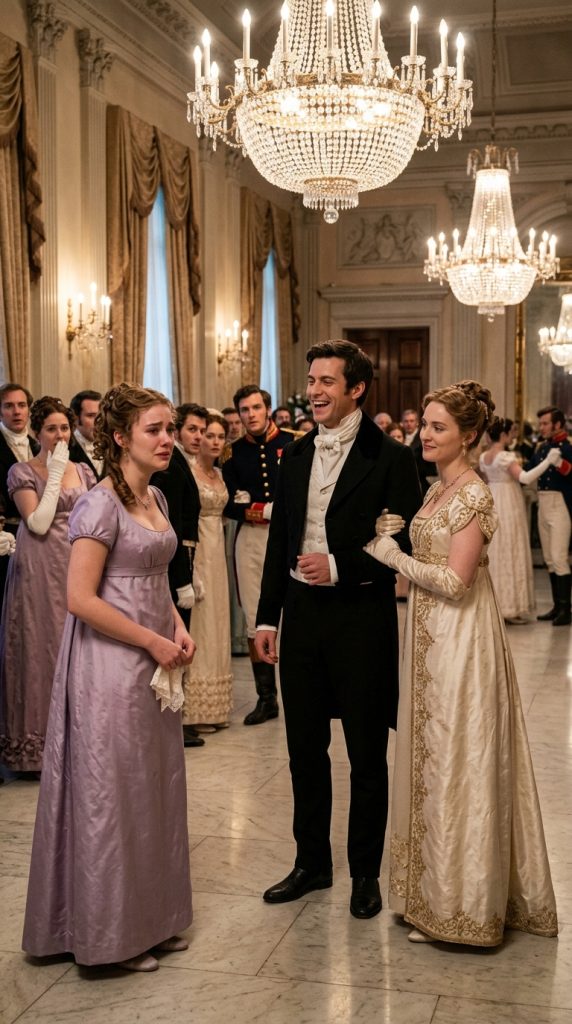
Patricio lowered his gaze.
The humiliation he had tried to give Mariana returned multiplied.
Alejandro offered his arm to his wife.
“Shall we dance?”
Mariana, with her eyes full of tears she had no intention of shedding, took his arm.
“Yes.”
The orchestra began a waltz with trembling hands. The guests opened space. Mariana and Alejandro danced in the center of the salon while everyone watched the woman they had given up for lost become, before their eyes, untouchable.
“You’re trembling,” he murmured.
“From rage,” she whispered. “And from relief.”
“Never alone again, Mariana.”
She closed her eyes for a second.
“You came.”
“I was always going to come.”
But Patricio did not accept his fall.
A week later, he tried to take revenge. Together with a former employee of Don Esteban, he forged letters to make people believe that Mariana had had indecent dealings with a foreign merchant and that her father’s debts were actually payments to cover up a scandal.
He planned to take the letters to a newspaper and blackmail Alejandro.
He never made it.
Santillán’s trusted men intercepted the plan before dawn. Alejandro took the evidence to the authorities and the creditors. In forty-eight hours, Patricio lost his properties, his father-in-law’s support, and the last remnants of prestige he had left. Renata, furious upon discovering she had married a man more indebted than noble, returned to Sonora with her jewels and without saying goodbye.
Mariana did not celebrate his ruin.
She simply breathed.
“I don’t want to live for revenge,” she told Alejandro one afternoon from the balcony of the Reforma house. “I want to live to rebuild myself.”
He looked at her with pride.
“Then we will rebuild everything.”
And they did.
Mariana restored her father’s name, not with parties, but with actions. She founded a school for the daughters of port workers in Veracruz. She reviewed the books of the old Aranda companies and discovered that some partners had taken advantage of her father’s death to hide frauds. With Alejandro’s help, she cleared the family name without destroying the innocent.
Months later, they organized a charity ball at the Santillán house.
This time Mariana did not enter hidden. She descended the main staircase dressed in pearl white, with her hair gathered and the ring visible. By her side was Alejandro, not as a savior, but as a companion.
Those who had once looked at her with pity now stood in line to greet her.
Mariana was polite to everyone.
But she did not forget.
When Doña Amalia tried to hug her as if she had always loved her, Mariana gently took her hands.
“Thank you for taking me in when I had no home,” she said. “But do not confuse a roof with affection.”
Doña Amalia lowered her gaze.
That night, when the music ended, Mariana went out to the garden. The city glowed in the distance. Alejandro found her beside a fountain, looking at the sky.
“Are you happy?” he asked.
Mariana thought of her father, the lost house, Patricio’s cruel laughter, the months of silence, the ring hidden under a glove.
Then she looked at the man who had loved her without demanding that she pretend to be invincible.
“Yes,” she said. “But not because everyone respects me now.”
“Then why?”
She smiled.
“Because I will never again forget who I am.”
Alejandro kissed her forehead.
“Mariana Santillán.”
She shook her head gently.
“Mariana Aranda de Santillán. Both. My fall and my return.”
Alejandro smiled for the first time all night.
Down in the salon, the music began again.
But Mariana was in no hurry to return.
For the first time in a long time, she did not need to prove anything.
She had been humiliated, abandoned, and given up for lost.
And yet, she had come back.
Not as a rescued woman.
But as a woman who, even in ruins, had never stopped being worthy.
