

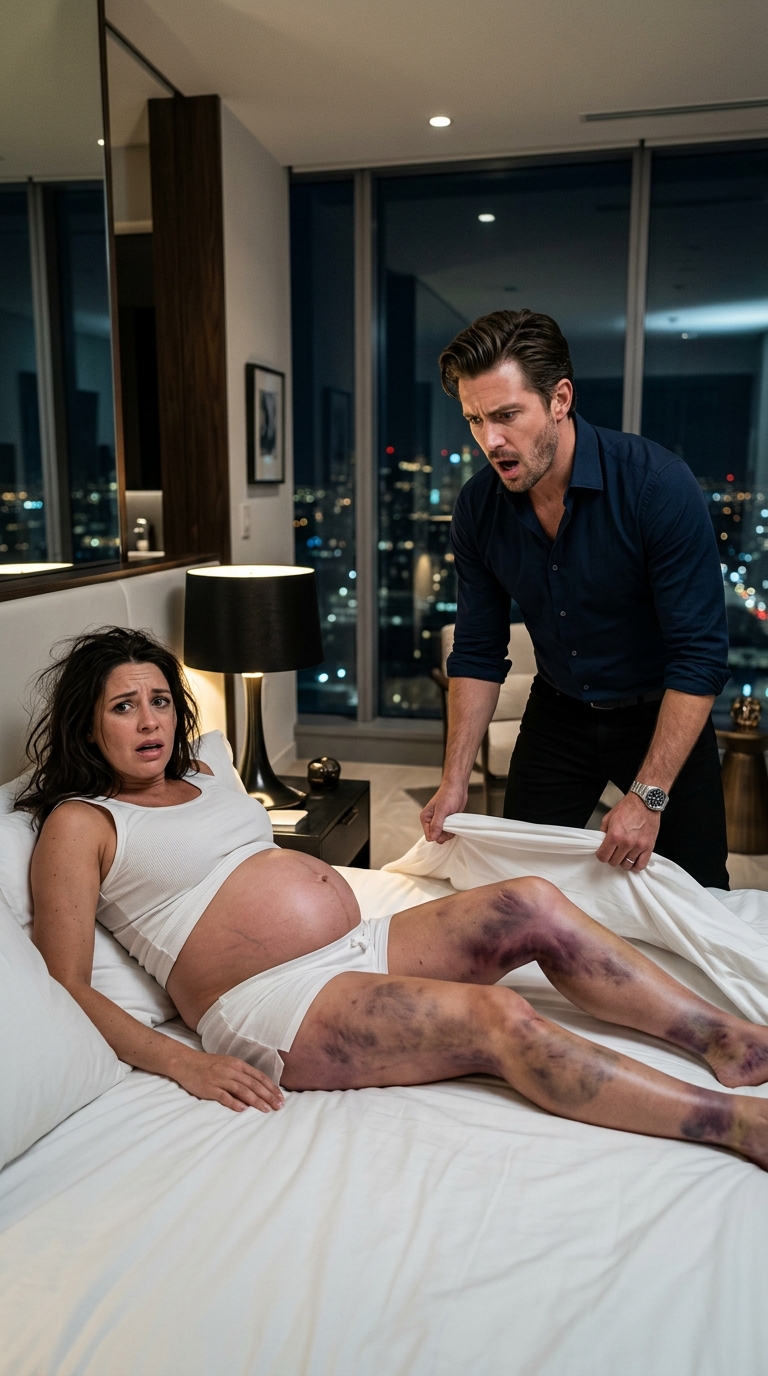
Santiago Beltran had built hotels, luxury condominiums, and half the skyline of Miami, but nothing in his life had ever prepared him for the sight of his pregnant wife crying under a white blanket, begging him not to call an ambulance. The sirens were already coming closer, slicing through the night outside their penthouse on Brickell Avenue. Valeria lay trembling on the bed, one hand pressed over her six-month belly, the other gripping the sheet like it was the last thing keeping her from falling apart.
When the paramedics arrived, Santiago didn’t move away from her side. Two EMTs rushed in with medical bags, and the moment they saw Valeria’s swollen, bruised legs, their faces changed. One of them asked how long she had been like this, and Santiago looked at his wife, waiting for an answer that would not destroy him.
Valeria whispered, “Six days.”
The female paramedic froze for half a second. “Six days?”
Santiago felt something ugly and sharp tear through his chest. Six days. Six days in his own home, under his own roof, while he attended meetings, signed contracts, answered calls from his mother, and believed his wife was just tired from the pregnancy. Six days of pain, fear, and silence while someone convinced her that he had signed away her baby.
“Who told you not to go to the hospital?” the paramedic asked gently.
Valeria’s eyes filled with terror. She looked toward the bedroom door as if expecting someone to appear there. Santiago followed her gaze, and for the first time in his life, his own home felt like a trap.
“My mother?” he asked.
Valeria closed her eyes.
That was answer enough.

At Mercy General Hospital, everything moved too fast and too slowly at the same time. Doctors surrounded Valeria. Nurses took blood, checked the baby’s heartbeat, asked questions Santiago could barely hear. Words like “blood clot,” “risk,” “possible trauma,” and “maternal emergency” floated through the air like knives.
Santiago stood in the hallway with bloodless hands and a face that no one recognized. He was used to being the man people stepped aside for, the one who spoke and had entire rooms go quiet. But now he was just a husband outside a hospital room, staring through the glass at the woman he loved while machines measured the life inside her.
A doctor in navy scrubs came out and pulled him aside. “Mr. Beltran, your wife is in serious condition, but she’s stable for now. The baby’s heartbeat is strong. We need to run more tests immediately.”
“Was this caused by pregnancy complications?” Santiago asked.
The doctor’s face tightened. “Some of it could be pregnancy-related, but the bruising around her ankles and knees does not look natural. I’m required to ask: has anyone restrained her, pushed her, or prevented her from getting medical care?”
Santiago stared at him.
“No,” he said, then corrected himself. “I don’t know.”
The doctor studied him, not with accusation, but with caution. Santiago hated that look. He hated that a stranger had to wonder whether he had harmed his own wife.
“I didn’t do this,” Santiago said, his voice breaking for the first time.
The doctor nodded carefully. “Then help us understand who did.”
Before Santiago could answer, his phone began vibrating nonstop. His mother’s name lit up the screen: Amparo Beltran. Then his cousin’s name appeared: Rodrigo Hale, attorney for Beltran Holdings. Then his mother again.
Santiago didn’t answer.
A text came through from Rodrigo.
Do not make any statements at the hospital. Call me immediately. This is a family matter.
Santiago read the words three times.
A family matter.
His wife was in a hospital bed, possibly fighting for her life, and Rodrigo had called it a family matter. Not a medical emergency. Not a crime. A family matter.
Santiago walked to the end of the hallway and called his chief of security, Marcus Reed, a former federal investigator who had worked for him for eight years.
“Marcus,” Santiago said quietly, “I need every camera from the penthouse, garage, elevator, lobby, and service entrance for the last ten days copied and secured. Do not send it to anyone. Not my mother. Not Rodrigo. Not the company legal team. Only me.”
Marcus didn’t ask why. “Understood.”
“And Marcus?”
“Yes, sir?”
“If anyone tries to delete anything, call the police.”
There was a pause. “That bad?”
Santiago looked back toward Valeria’s room. “Worse.”
By dawn, Valeria was awake but weak. Her face was pale against the hospital pillow, and her lips trembled when Santiago entered. He approached slowly, like a man walking toward a wounded animal that still didn’t know whether to trust him.
“I didn’t sign anything,” he said before she could speak. “Whatever they showed you, whatever they told you, it wasn’t me.”
Tears slid down Valeria’s temples. “Rodrigo brought the papers.”
Santiago’s jaw tightened. “What papers?”
“He said they were medical protection documents. He said your mother was worried because of the two miscarriages. He said if something happened to me, the baby would stay with the Beltran family.” She swallowed hard. “I told him I didn’t want to sign anything. He said you already had.”
Santiago closed his eyes.
Valeria continued, her voice shaking. “Your mother came with a private nurse. She said I was being selfish. She said women like me marry into families like yours and forget gratitude. She told me if I really loved you, I would protect your child from my weak body.”
Santiago gripped the edge of the bed until his knuckles turned white.
“She said that to you?”
Valeria nodded. “Then I started having pain in my legs. The nurse said it was normal swelling. She told me not to move because movement could hurt the baby. I wanted to call you, but Rodrigo said you were in Chicago finalizing a deal and you had already agreed with the plan.”
“What plan?”
Valeria stared at him with exhausted horror.
“The plan if I didn’t make it.”
For several seconds, Santiago could not breathe. He thought of every dinner where his mother had smiled at Valeria with polished cruelty. Every time Rodrigo had called her “fragile.” Every time he had dismissed Valeria’s discomfort as insecurity. He had protected deals worth billions, but he had failed to protect his wife from the people sitting at his own dining table.
“I should have listened to you,” he whispered.
Valeria looked away. “I tried to tell you.”
“I know.”
“No,” she said, finally turning back to him. “You don’t know. I told you Rodrigo scared me, and you said he was just intense. I told you your mother hated me, and you said she needed time. I told you I felt watched in that apartment, and you said security was normal in your world.”
Every word landed where it deserved.
Santiago nodded slowly. “You’re right.”
Valeria’s eyes widened slightly, as if she had expected defense, excuses, explanations. But Santiago gave her none. He sat beside her bed and lowered his head.
“You’re right,” he repeated. “And I’m sorry.”
That was the first moment Valeria truly looked at him. Not with relief, not yet, but with the faintest crack in the wall fear had built around her. Behind him, the monitor continued its steady rhythm, and beneath the sound, their baby’s heartbeat lived on.
By noon, Marcus arrived with a laptop and a face like stone. Santiago met him in a private waiting room. The blinds were closed, the coffee untouched, and the Beltran family name suddenly felt less like power and more like evidence.
Marcus opened the footage.
The first clip showed doña Amparo entering the penthouse four days earlier, elegant in a cream suit, followed by Rodrigo and a woman in scrubs. The woman carried a medical bag, but Marcus had already checked. She was not registered with any hospital in Florida. Her nursing license had been suspended two years earlier after a complaint involving falsified care records.
Santiago watched without blinking.
The second clip showed Valeria trying to walk from the bedroom to the living room. She was hunched over, one hand on her belly, clearly in pain. Amparo stepped into her path. Rodrigo closed the door behind them.
There was no audio from that camera, but the body language needed no translation. Valeria was pleading. Amparo was pointing toward the bedroom. Rodrigo was holding a folder.
The third clip came from the hallway outside the penthouse. It showed the private nurse leaving with a small cooler bag.
“What is that?” Santiago asked.
Marcus’s face darkened. “I don’t know yet. But I also found this.”
He opened another file. It was a scanned document emailed from Rodrigo’s office to Amparo two weeks earlier. The subject line read: Maternal Contingency Draft — Signature Pending.
Santiago’s name appeared on the final page.
Not typed. Signed.
But not by him.
The signature was close enough to fool a tired person, a scared woman, maybe even a careless banker. But Santiago had signed his name tens of thousands of times. This one had the wrong pressure, the wrong slant, the wrong arrogance. It was a copy built by someone who had seen his signature often enough to imitate it, but not enough to become him.
Rodrigo.
Santiago leaned back slowly. “He forged me.”
Marcus nodded. “Looks that way.”
“And my mother used it on Valeria.”
“Yes.”
Santiago looked at the screen, where the false signature glowed like a confession. He felt no rage at first. Rage would have been easier. What he felt was colder, deeper, and far more dangerous.
“Call the police,” he said.
Marcus raised an eyebrow. “Are you sure?”
Santiago looked at him. “My wife was denied medical care while pregnant. My signature was forged. Someone may have endangered my child. I’m not handling this in a boardroom.”
Marcus closed the laptop. “I’ll make the call.”
Thirty minutes later, Amparo Beltran arrived at Mercy General as if she were attending a charity luncheon. Her gray hair was perfect, her pearls flawless, her perfume expensive enough to announce her before she entered. Rodrigo walked beside her in a navy suit, phone in hand, already wearing the expression of a man prepared to control the room.
They found Santiago standing outside Valeria’s room.
“My son,” Amparo said, reaching for his hand. “Thank God. We came as soon as we heard. This is exactly why I told Valeria not to panic. Pregnant women can be so dramatic when they don’t understand their own bodies.”
Santiago did not take her hand.
Rodrigo stepped in smoothly. “Santiago, before this gets out of control, we need to speak privately. Hospitals overreact. If doctors start asking the wrong questions, they could create a legal problem for the family.”
“For the family,” Santiago said softly.
Rodrigo gave him a warning look. “You know what I mean.”
“No,” Santiago said. “I don’t think I ever did.”
Amparo’s smile faded. “Don’t speak to Rodrigo like that. He has protected this family for years.”
Santiago looked at his mother. “From what?”
She blinked.
“From women like my wife?” he asked. “From poor girls with no famous last name? From unborn babies that don’t belong entirely to you?”
Amparo’s face hardened. “Careful.”
That single word unlocked something in him.
“No,” Santiago said. “You be careful.”
Rodrigo lowered his voice. “This is grief and stress talking. You need to calm down.”
Santiago took one step toward him. “You forged my signature.”
For the first time, Rodrigo’s mouth shut.
Amparo turned pale, but only for a second. “What a ridiculous accusation.”
“I have the document.”
Rodrigo recovered quickly. “A draft document is not a crime.”
“A draft with my forged signature is.”
“It was never filed.”
“It was shown to my pregnant wife to scare her.”
Amparo’s eyes flashed. “She needed to understand reality.”
Santiago stared at her, stunned by how little she tried to hide once cornered.
“What reality?” he asked.
“That women like Valeria don’t survive in families like ours unless they know their place,” Amparo said, her voice low and poisonous. “She was turning you against us. She was carrying a Beltran child and acting like that child belonged to her alone.”
Santiago felt the hallway tilt. There it was. Not madness. Not misunderstanding. Possession.
“You wanted the baby,” he said.
Amparo did not deny it.
Rodrigo touched her arm. “Tía, stop talking.”
But Amparo was too proud to stop. “I wanted what was best for this family. That girl is unstable. Two lost pregnancies, constant crying, fear, complaints. If something happened, the child needed protection.”
“If something happened?” Santiago repeated. “Or if you made something happen?”
Rodrigo stepped forward sharply. “That’s enough.”
Before Santiago could answer, two detectives appeared behind them with Marcus. One introduced herself as Detective Laura Bennett, Miami Police Department. Her eyes moved from Santiago to Amparo to Rodrigo, and in less than three seconds she seemed to understand that everyone in the hallway had something to lose.
“Mrs. Beltran,” Detective Bennett said, “Mr. Hale, we’d like to ask you a few questions.”
Rodrigo smiled tightly. “We’ll be happy to cooperate after I speak with my client.”
“Which client?” Santiago asked.
Rodrigo turned.
“My mother?” Santiago said. “The company? Or yourself?”
That was the moment Rodrigo’s confidence cracked.
Inside the hospital room, Valeria heard raised voices and began to cry again. The nurse closed the door, but Santiago saw her through the glass. She was trying to sit up, one hand on her belly, panic returning to her face.
He turned away from his mother and cousin as if they were strangers.
When he entered the room, Valeria reached for him before she seemed to realize she had done it. Santiago took her hand carefully, afraid even his touch might hurt.
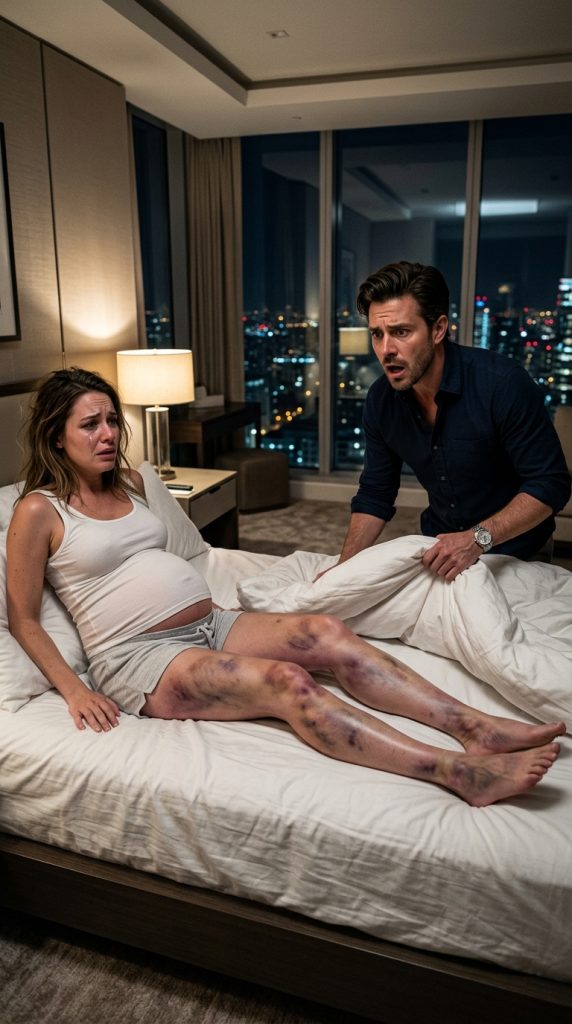
“They’re here?” she whispered.
“Yes.”
“Are they angry?”
Santiago felt sick that this was her first question.
“They’re not coming near you,” he said. “Not now. Not ever again unless you choose it.”
Valeria stared at him for a long time. “You called the police?”
“Yes.”
Her breath caught. “Against your mother?”
“Against anyone who hurt you.”
A broken sound escaped her, not quite a sob, not quite relief. She covered her mouth and shook her head. “I thought you would choose them.”
Santiago sat beside her. “So did they.”
That afternoon, the doctors confirmed the truth Santiago feared. Valeria had developed a dangerous clotting condition made worse by prolonged immobility and lack of proper treatment. The bruises suggested she had been gripped or forced to sit and lie down repeatedly. The medical team believed her condition could have become fatal if they had waited another day.
Another day.
Santiago kept hearing those words.
If he had attended one more meeting. If he had believed one more excuse. If he had gone to bed angry and waited until morning. Another day might have turned his wife into a funeral and his baby into a prize his family could raise under a false story.
That night, Santiago returned to the penthouse with Marcus and two officers. The place looked different now. The Italian marble, the glass walls, the expensive furniture, the view over Biscayne Bay—all of it felt staged, like a beautiful room built to hide ugly things.
In the bedroom, he found Valeria’s phone hidden behind a drawer, dead and wrapped in a silk scarf. She had not lost it, as his mother had claimed. Someone had taken it from her.
In the kitchen trash, Marcus found torn medication labels. In the guest bathroom cabinet, they found a bottle prescribed not to Valeria, but to Amparo’s housekeeper. The detectives took everything.
Then Santiago noticed the small black dome near the bookshelf.
A camera.
He had approved security cameras in common areas, never the bedroom. He walked toward it slowly, already knowing. The wire ran behind the wall unit into a small hidden receiver.
Marcus cursed under his breath.
Santiago almost ripped it out with his bare hands, but Marcus stopped him. “Evidence.”
Evidence.
The word became the only thing keeping Santiago from burning his entire life to the ground.
By the next morning, the story had begun leaking, but not the way Rodrigo wanted. A vague online post claimed that Santiago Beltran’s pregnant wife had suffered a “mental health episode” and that his family had been “trying to protect her from herself.” The comments were already cruel.
Santiago read the post in the hospital cafeteria and understood immediately. Rodrigo had fired the first shot.
Marcus sat across from him. “We can shut it down.”
“No,” Santiago said. “We answer with truth.”
“You sure?”
Santiago looked toward the elevator that led to Valeria’s floor. “I’m done letting them write her story.”
Within an hour, Beltran Holdings released a short statement that stunned Miami society.
Santiago Beltran has reported suspected forgery, medical neglect, unlawful surveillance, and intimidation involving members of his extended family. His wife, Valeria Beltran, is currently receiving medical care. Any claim that she was unstable, dishonest, or unfit is false and defamatory. Mr. Beltran asks for privacy as he supports his wife and unborn child.
The statement did not name Amparo or Rodrigo.
It didn’t need to.
By sunset, three board members called Santiago. Two investors demanded clarification. One senator’s wife, who had sat beside Amparo at charity galas for ten years, sent a message saying only: I am sorry. I believe Valeria.
Amparo called Santiago forty-seven times.
He answered none of them.
Rodrigo tried a different path. He came to the hospital alone that evening, without his usual arrogance, and asked to speak to Santiago in the chapel. Santiago almost refused, but curiosity pulled him there. Some men begged when cornered. Some threatened. Rodrigo, Santiago suspected, would do both.
The chapel was empty except for a row of electric candles glowing near the front. Rodrigo stood beside them, hands clasped, looking like a man rehearsing sincerity.
“You’re making a mistake,” Rodrigo said.
Santiago laughed once, without humor. “That’s your opening?”
“You think this is about Valeria, but it’s bigger. Your mother was worried about succession, inheritance, control of family assets. You know how vulnerable everything becomes if something happens to you, or her, or the child.”
“The child,” Santiago said. “My child. Not an asset.”
Rodrigo sighed. “Don’t be sentimental.”
That was the wrong thing to say.
Santiago stepped close enough that Rodrigo finally moved back. “My wife nearly died.”
“And if she had?” Rodrigo snapped. “What then? You would have handed a Beltran heir to her bakery family in Hialeah? To people who don’t know trusts, security, press, money, power?”
Santiago went still.
There it was again.
The baby was an heir, not a child. Valeria was a risk, not a mother. Love was weakness, and cruelty was planning.
“You’re done,” Santiago said.
Rodrigo’s eyes narrowed. “You don’t know what I have.”
Santiago tilted his head. “Then show me.”
Rodrigo smiled faintly. “Company records. Offshore transfers. Political donations. Construction shortcuts your father buried before he died. Your mother kept everything, Santiago. Everything. If I fall, I don’t fall alone.”
For one second, Santiago saw the trap. Rodrigo had protected the family because Rodrigo had collected the family’s sins. Every favor, every hidden payment, every buried lawsuit—he had kept receipts.
But Santiago was no longer the man Rodrigo knew.
“Then fall loudly,” Santiago said.
Rodrigo’s smile vanished.
“You think I’ll protect the company after what you did to Valeria?” Santiago asked. “You think I care about the name now? Burn it. Burn every dirty file. Hand it to the FBI, the IRS, the press, whoever you want. But understand this.”
He leaned in.
“I will not trade my wife’s life for my family’s reputation.”
Rodrigo stared at him, and for the first time since childhood, Santiago saw fear in his cousin’s eyes.
Two days later, Valeria was strong enough to give a statement. Detective Bennett came with a recorder and a victims’ advocate. Santiago waited outside because Valeria asked him to. Not because she didn’t trust him, she explained, but because she needed to say it once without watching his face break.
So Santiago sat in the hallway and listened to nothing.
That was harder than hearing everything.
When the door opened forty minutes later, Detective Bennett came out with red eyes she tried to hide. The victims’ advocate squeezed Santiago’s shoulder gently before leaving. Then Valeria called for him.
He entered and found her sitting up with pillows behind her back. She looked exhausted, but different. Not healed, not safe, not yet. But no longer silent.
“I told them,” she said.
Santiago nodded. “Good.”
“I told them about the papers. The nurse. Your mother taking my phone. Rodrigo saying nobody would believe me if I accused a Beltran.” Her voice trembled, but she continued. “I told them about the camera.”
Santiago’s throat tightened. “I’m so sorry.”
Valeria looked down at her belly. “I don’t want our baby born into that house.”
“She won’t be.”
Valeria looked up. “She?”
Santiago froze.
A small smile touched Valeria’s mouth for the first time in days. “The doctor told me while you were arguing with security about who was allowed upstairs.”
He stared at her belly, and something inside him collapsed and rebuilt itself in the same breath.
“A girl,” he whispered.
Valeria nodded. “A girl.”
Santiago covered his face with both hands. For a moment, he was not Santiago Beltran, developer, billionaire, heir, or headline. He was only a father who had almost lost everything before he even knew the shape of what he was protecting.
When he lowered his hands, Valeria was watching him.
“What do we do now?” she asked.
Santiago took a breath. “We get you well. We protect our daughter. And then we leave the Beltran name exactly where it belongs.”
“Where?”
“In the past.”
The arrests came on a rainy Thursday morning.
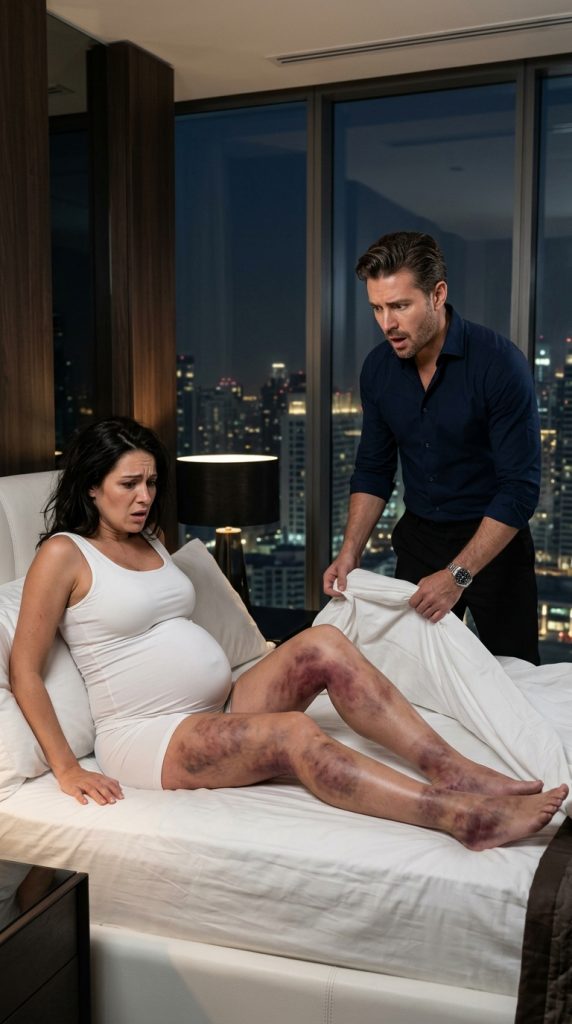
Rodrigo was taken from his office downtown after investigators found evidence of forged medical authorization forms, illegal surveillance, intimidation, and financial crimes tied to Beltran Holdings. The suspended nurse was arrested at her apartment and, after six hours of questioning, admitted Amparo had paid her ten thousand dollars in cash to “monitor” Valeria and keep her from “emotional decisions,” including calling 911.
Amparo was harder to touch. She had money, lawyers, friends, and decades of practice turning cruelty into concern. But she had also made one mistake.
She had spoken too freely in the hospital hallway.
Detective Bennett had been close enough to hear part of it, and hospital security had captured the rest on audio. Amparo’s words—“She needed to understand reality”—became the sentence that followed her everywhere.
When police arrived at her Coral Gables estate, she did not cry. She did not ask about Valeria. She asked whether the cameras outside had been moved away from the front gate.
They had not.
By evening, her arrest photo was on every local news site in South Florida.
But the most devastating blow did not come from the police. It came from Santiago himself.
He resigned as CEO of Beltran Holdings, froze the family trust pending investigation, and handed federal authorities decades of internal documents. Board members panicked. Investors threatened lawsuits. Old family friends called him reckless, emotional, ungrateful.
Santiago deleted every message without answering.
Three weeks later, Valeria left the hospital in a wheelchair, wrapped in a soft gray cardigan, her belly round and safe beneath her hands. Santiago pushed her through a private exit because the press had gathered outside the front entrance. But even there, near the ambulance bay, one photographer managed to lift a camera.
Santiago stepped in front of Valeria immediately.
“Don’t,” he said.
The photographer lowered the camera.
Valeria looked up at him. “You can’t shield me from everything forever.”
“I know,” Santiago said. “But I can start with this.”
They did not return to the penthouse. Santiago had already sold it, furniture included, except for Valeria’s grandmother’s baking bowl and a box of baby clothes she had hidden in the closet. Instead, he rented a quiet house outside Asheville, North Carolina, far from Miami society, far from charity galas, far from anyone who thought bloodline mattered more than love.
The house had a wide porch, old oak floors, and a kitchen with morning light. Valeria cried when she saw it.
Santiago panicked. “Do you hate it?”
She shook her head and laughed through tears. “No. It looks like somewhere people breathe.”
So they breathed.
Recovery was slow. Some days Valeria could walk from the bedroom to the porch. Some days she could not. Some nights she woke from nightmares, convinced someone had taken her phone, convinced Rodrigo was standing outside the door with papers in his hand.
Santiago never told her to calm down. He never said it was over. He only turned on the lamp, placed her phone in her hand, and said, “You’re here. I’m here. She’s safe.”
Little by little, Valeria began to believe him.
In the eighth month of pregnancy, a letter arrived from Amparo’s attorney. It was not an apology. It was a request to meet before trial, framed as “a private opportunity for healing.” Santiago wanted to burn it, but he showed it to Valeria.
She read it twice, then placed it on the kitchen table.
“She wants access,” Valeria said.
“Yes.”
“To the baby.”
“Yes.”
Valeria put both hands over her stomach. “No.”
That was all.
Santiago nodded. “Then no.”
The baby came during a thunderstorm.
It started as a dull pain just after midnight, while rain beat hard against the windows and the Blue Ridge Mountains disappeared into darkness. Santiago drove too carefully, which made Valeria laugh between contractions and call him the slowest billionaire in America.
At 6:42 in the morning, their daughter was born.
They named her Lucia Rose Beltran.
She was small, furious, and perfect. The moment the nurse placed her on Valeria’s chest, Valeria began to sob with a sound Santiago had never heard before. It was not fear. It was release.
Santiago stood beside them, one hand on Valeria’s hair, the other touching Lucia’s tiny back. He had signed skyscraper deals, bought land people said could never be bought, won battles in rooms full of men who mistook money for courage. None of it mattered beside the weight of his daughter’s first breath.
“She’s here,” Valeria whispered.
Santiago kissed her forehead. “Because of you.”
Months later, the trial began in Miami.
Valeria did not want to go at first. Santiago told her she never had to see those people again if she didn’t want to. But one morning, while feeding Lucia in the rocking chair by the window, Valeria looked at her daughter’s tiny sleeping face and made her decision.
“I’m going,” she said.
Santiago looked up from the coffee he had forgotten to drink. “Are you sure?”
“No,” she answered honestly. “But I’m going anyway.”
The courtroom was packed. Reporters filled the back rows. Former Beltran allies sat stiffly on one side, pretending they had never laughed at Amparo’s insults or looked away when Valeria was humiliated at dinners. Rodrigo sat at the defense table, thinner now, his perfect confidence replaced by a restless twitch in his jaw.
Amparo entered last.
She looked older, but not softer. Her pearls were gone. Her hair was pulled back severely. When she saw Santiago, her face moved with something like pain, but when she saw Valeria, that pain became hatred.
Valeria felt Santiago’s hand near hers, not grabbing, not leading. Just there.
She took it.
When Valeria testified, the courtroom changed.
She did not shout. She did not perform. She spoke clearly about the first time Amparo called her unworthy, the first time Rodrigo showed her documents, the private nurse who told her walking could kill the baby, the fear of calling Santiago because everyone around her insisted he had already chosen the child over her.
Then the prosecutor showed the forged signature.
Then the hallway footage.
Then the hidden camera.
Then the audio from the hospital.
Amparo’s own voice filled the courtroom: “That girl is unstable. She was carrying a Beltran child and acting like that child belonged to her alone.”
Someone in the gallery gasped.
Valeria did not look down.
When the defense attorney tried to suggest she had misunderstood Amparo’s intentions, Valeria turned toward the jury.
“I understood perfectly,” she said. “She didn’t think I was a person. She thought I was a container for her grandchild.”
No one spoke.
Even the judge paused before telling the attorney to continue.
Rodrigo took a plea before the trial ended. He agreed to testify about the forged documents, the intimidation plan, the financial crimes, and Amparo’s instructions. In exchange, he hoped for a reduced sentence, but his testimony destroyed the last wall Amparo had built around herself.
He admitted the signature was forged.
He admitted the legal draft was meant to frighten Valeria.
He admitted the nurse had been hired privately to keep Valeria isolated.
And finally, under oath, he admitted Amparo’s goal had been to establish grounds to question Valeria’s mental fitness if anything happened before or during childbirth.
Amparo stared straight ahead as he spoke.
She never cried.
When the verdict came, Valeria held Santiago’s hand so tightly his fingers hurt. Guilty on multiple counts. Guilty for Amparo. Guilty for Rodrigo. Guilty for the nurse who had traded another woman’s life for cash.
The courtroom erupted in whispers, but Valeria heard only one sound.
Lucia crying softly in the hallway with the sitter.
Valeria stood, turned away from Amparo, and walked out before sentencing began. Santiago followed her without hesitation.
In the hallway, she took Lucia into her arms. The baby stopped crying almost instantly, curling against her mother’s chest as if she knew exactly where safety lived.
Santiago watched them and felt the final thread break between him and the family that had raised him.
Amparo called his name from behind him.
He turned.
Two officers stood beside her. For the first time, she looked small.
“You would abandon your own mother?” she asked.
Santiago looked at Valeria. Then at Lucia. Then back at Amparo.
“No,” he said. “I’m finally choosing my family.”
That was the last thing he ever said to her.
One year later, Valeria opened a small bakery in Asheville called Rose & Flour. It was not large, not fancy, and not designed by any award-winning architect Santiago knew. The sign was hand-painted. The counters were warm wood. The front window filled every morning with cinnamon rolls, blueberry hand pies, and the kind of bread people bought when they wanted to feel less alone.
On opening day, a line formed down the block.
Santiago stood behind the counter with Lucia strapped to his chest, wearing an apron Valeria had bought him as a joke. He was terrible at wrapping pastries, worse at using the register, and completely unashamed when customers recognized him.
“Isn’t that Santiago Beltran?” one woman whispered.
Valeria heard and smiled. “Yes. He works for me now.”
The entire shop laughed, including Santiago.
By noon, they had sold out of everything.
That evening, after the last customer left, Valeria locked the door and leaned against it, exhausted and glowing. Santiago wiped flour from Lucia’s cheek, though he had no idea how it had gotten there.
Valeria looked around the bakery, then at her daughter, then at the man who had lost an empire and somehow seemed lighter without it.
“Do you ever miss it?” she asked.
“The company?”
“The money. The name. The power.”
Santiago walked to her and placed Lucia gently in her arms.
“I miss who I thought I was before I learned what I had ignored,” he said. “But I don’t miss the cage.”
Valeria studied him. “And your family?”
He looked through the window at the quiet street, the mountains turning purple in the evening light.
“You and Lucia are my family.”
Valeria’s eyes softened. “That sounds like a movie line.”
“It’s still true.”
She laughed, and for a second he saw the woman from Coyoacán again—not broken, not frightened, not hiding beneath a blanket, but fierce and warm and alive. The woman who had once refused to treat him like a king. The woman who had survived a family that mistook cruelty for legacy.
Later that night, after Lucia fell asleep, Santiago found Valeria standing on the porch. The air smelled like rain and sugar. Fireflies blinked in the yard.
He wrapped a blanket around her shoulders.
She smiled faintly. “I used to hate blankets.”
His chest tightened.
“I know.”
“For months, every time I felt one over my legs, I remembered that night.” She looked down, then back toward the dark trees. “But tonight it just feels warm.”
Santiago did not speak. Some victories were too sacred for words.
Valeria leaned against him.
“Do you know what scared me most?” she asked.
“What?”
“Not your mother. Not Rodrigo. Not even dying.” Her voice trembled, but she continued. “It was thinking my daughter would grow up hearing their version of me.”
Santiago kissed the top of her head. “She won’t.”
Valeria looked through the window at Lucia sleeping inside. “What will she hear?”
“The truth,” Santiago said. “That her mother was brave. That she fought to survive. That no last name, no money, no family empire was worth more than her life.”
Valeria closed her eyes.
“And her father?” she asked softly.
Santiago took a long breath. “That he was late. But when he finally saw the truth, he never looked away again.”
Valeria turned to him then. For a moment, neither of them moved. Then she reached for his hand and placed it over her heart.
“You came back,” she said.
“No,” Santiago whispered. “You brought me back.”
Inside the house, Lucia stirred and made a tiny sound. Valeria and Santiago both turned immediately, then smiled at the same time. There was no fear in the sound now. Just life calling them back in.
So they went.
Not into a penthouse full of secrets. Not into a mansion ruled by a name. Not into a family where love had conditions and silence had a price.
They went into a small warm house where flour dusted the kitchen counter, where baby blankets meant comfort, where the past no longer owned the door.
And years later, when Lucia asked why she had no photos with her grandmother Amparo, Valeria did not lie. She sat her daughter beside her in the bakery after closing, placed a warm roll on a napkin, and told her the truth in words a child could understand.
“Some people think love means owning someone,” Valeria said. “But real love protects. Real love listens. Real love never asks you to disappear so someone else can feel powerful.”
Lucia frowned, serious like her father. “Did Daddy protect you?”
Valeria looked across the bakery at Santiago, who was pretending not to listen while badly stacking chairs.
“He learned how,” Valeria said.
Lucia considered that, then nodded as if accepting an important business agreement. “Good.”
Santiago laughed.
Valeria laughed too.
And in that laughter, there was no empire, no scandal, no forged signature, no hospital hallway, no white blanket hiding terror beneath it.
There was only a family that had been tested by betrayal, nearly destroyed by silence, and saved by one impossible choice: to stop protecting the people who caused the pain, and start protecting the ones who had survived it.
