

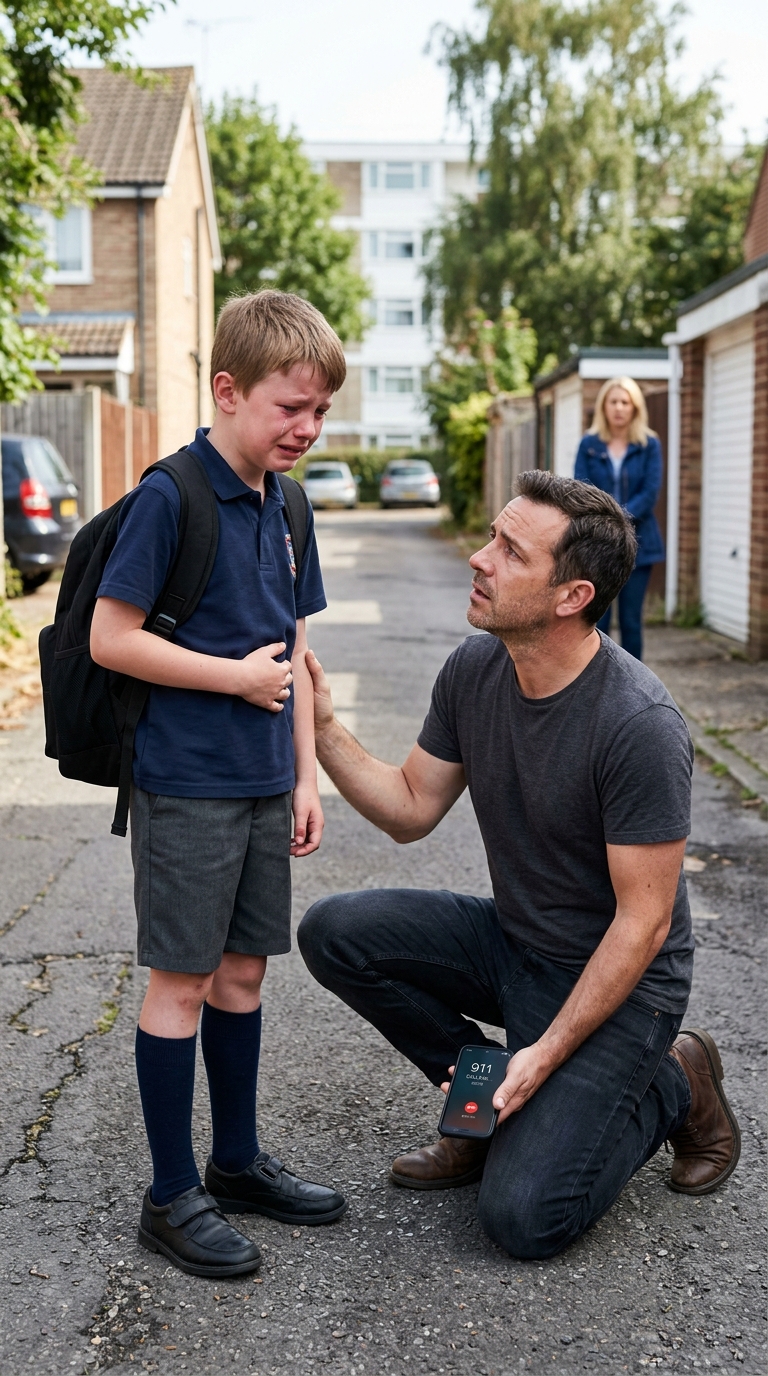
“Please don’t make me sit, Dad… please.”
Those were the first words Ethan Carter spoke when he came from his mother’s house.
He was eight, his backpack hanging off one shoulder, his lips chewed raw, his gaze distant—like part of him had been left behind in the suburban townhouse where his mother, Vanessa Carter, lived.
She didn’t step out of the SUV.
She honked twice and shouted through the half-open window.
“Don’t encourage this, Ryan. He’s being dramatic because he wants attention.”
Then she drove off as if she had dropped off a package, not her child.
I stood motionless in the doorway.
Ethan used to run to me on Sundays. He would wrap his arms around my waist, talking nonstop about cartoons, pizza, and school stories.
But not this time.
This time, he moved slowly.
Carefully.
Like each step caused pain.
“What happened, buddy?”
He avoided my eyes.
“Nothing.”
That word hit like ice. Because when a child says “nothing” while tears sit behind their eyes, they are not hiding trouble.
They are protecting someone.
Vanessa and I had been divorced nearly three years. She had weekday custody, and I had Ethan every other weekend. At first, I blamed the silence on the divorce itself.
Then he stopped singing in the car.
Then his nails were bitten down until they bled.
Then every Monday he would ask me:
“Dad, tell the judge I’m sick today.”
And when I asked why, he would whisper:
“Mom gets mad if I talk.”
I went to the school counselor. I documented injuries. I kept messages where Ethan begged not to return. But Vanessa always had explanations ready.
“He fell at soccer.”
“Ryan is turning him against me.”
“He’s emotional because his father left.”
People believed her. Vanessa was polished, involved, convincing—always smiling at school events and crying just enough when questioned.
But that afternoon, when Ethan tried to sit and immediately gasped in pain, I knew we were out of time.
I reached for my phone.
“Dad, no,” he whispered. “Mom said if you call the police, they’ll take you to jail.”
Something in me broke.
Not only had someone hurt my son.
They had trained him to fear help.
I dialed 911.
“My son just came from his mother’s house. He can’t sit down, he’s in severe pain, and he’s terrified. I need an ambulance and police immediately.”
Ethan began crying silently.
I knelt beside him.
“Listen to me, buddy. You did nothing wrong.”
The ambulance arrived first.
Then police.
Neighbors watched through curtains as sirens filled the quiet street.
The paramedic examined him briefly before her face changed completely.
“Who dropped him off like this?”
“His mother. Fifteen minutes ago.”
“And she left?”
“Yes.”
“We’re transporting immediately.”
Ethan clung to my shirt as they lifted him.
“Don’t leave me, Dad.”
“Never.”
At St. Matthew’s Medical Center, a social worker told me to wait while they followed child protection protocol. I felt helpless.
Angry.
Sick with guilt.
I had seen signs for months, yet still trusted courts and promises.
Then Vanessa burst into the lobby.
“What the hell did you do, Ryan?” she snapped. “You called an ambulance over a tantrum?”
She tried to push into the exam area, but a nurse stopped her.
“You cannot go in.”
“I’m his mother.”
“Exactly, ma’am.”
Her face drained.
An officer stepped closer.
“Why did your son arrive in this condition?”
“He fell in the bathroom,” she said too quickly.
“Then why didn’t you bring him in?”
She hesitated.
Nothing followed.
From the room, I heard Ethan cry. Then the words that froze me:
“I don’t want Marcus coming back.”
Marcus Reed.
Vanessa’s boyfriend.
A man with polished shoes, a clean truck, and a practiced smile.
I had met him twice. Each time, he gripped my hand too firmly and held eye contact too long.
“Don’t worry, Ryan,” he once said. “I take care of Ethan like he’s my own.”
Now that memory turned my stomach.
Vanessa pressed a hand to her chest.
“He’s confused,” she insisted. “Marcus wasn’t even there.”
The social worker came out, expression firm.
“Mrs. Carter, step outside.”
“That’s my son!”
“And because he is your son, we will hear him without interference.”
The night dragged on.
Doctors and specialists rotated through Ethan’s room. No one said too much, but everything was visible in their faces.
The injuries did not match a fall.
The fear was learned.
And his answers were rehearsed.
Near midnight, CPS and detectives arrived.
Vanessa stopped shouting.
She started crying instead.
“Ryan, please,” she whispered. “This is misunderstood. Children lie.”
I looked at her.
And felt nothing but horror.
“Ethan didn’t invent pain.”
She looked down.
And I realized she understood more than she admitted.
The next morning, Ethan spoke to a forensic child specialist.
Not in full sentences.
In fragments.
He said Marcus got angry when he made noise.
He said dinner was taken away as punishment.
He said Marcus called him weak when he cried.
And then:
“Mom told me not to upset Marcus because he might leave us.”
When I heard that, I walked outside and broke down against the hospital wall.
Because adults wait for systems.
Children just try to survive.
The district attorney moved for emergency protection that day.
Ethan was placed with me.
Vanessa was restricted from unsupervised contact.
Marcus was called in.
He vanished.
Two days later, he was found at a cabin in northern Pennsylvania.
When arrested, he said:
“That kid’s been manipulated by his father.”
Vanessa’s words, repeated.
A week later, Ethan’s principal called.
“Mr. Carter,” she said, “you need to see this.”
In her office, a thick folder sat on the desk.
Reports. Drawings. Notes.
“We tried to intervene,” she said quietly. “But Vanessa said you were the issue.”
“How long has this been here?”
“Months.”
She handed me a page.
A drawing: a dark house, a child under a table.
And written below:
“If I’m invisible, nobody yells at me.”
The room tilted.
That night, Ethan sat on my bed holding an old toy car.
“Dad,” he whispered, “is Marcus going to know where we live?”
“You’re safe here.”
“And Mom?”
I couldn’t answer.
Because the law could keep Marcus away.
But it couldn’t undo what had already happened.
“She heard me once,” he said suddenly.
“What do you mean?”
“The night I begged her not to leave me alone with him.”
My phone rang.
The social worker.
“Tomorrow morning,” she said, “a neighbor brought us an audio recording.”
I closed my eyes.
And when she said who recorded it, I understood the truth wasn’t finished with us yet.
