

PART 1 — What He Left Behind
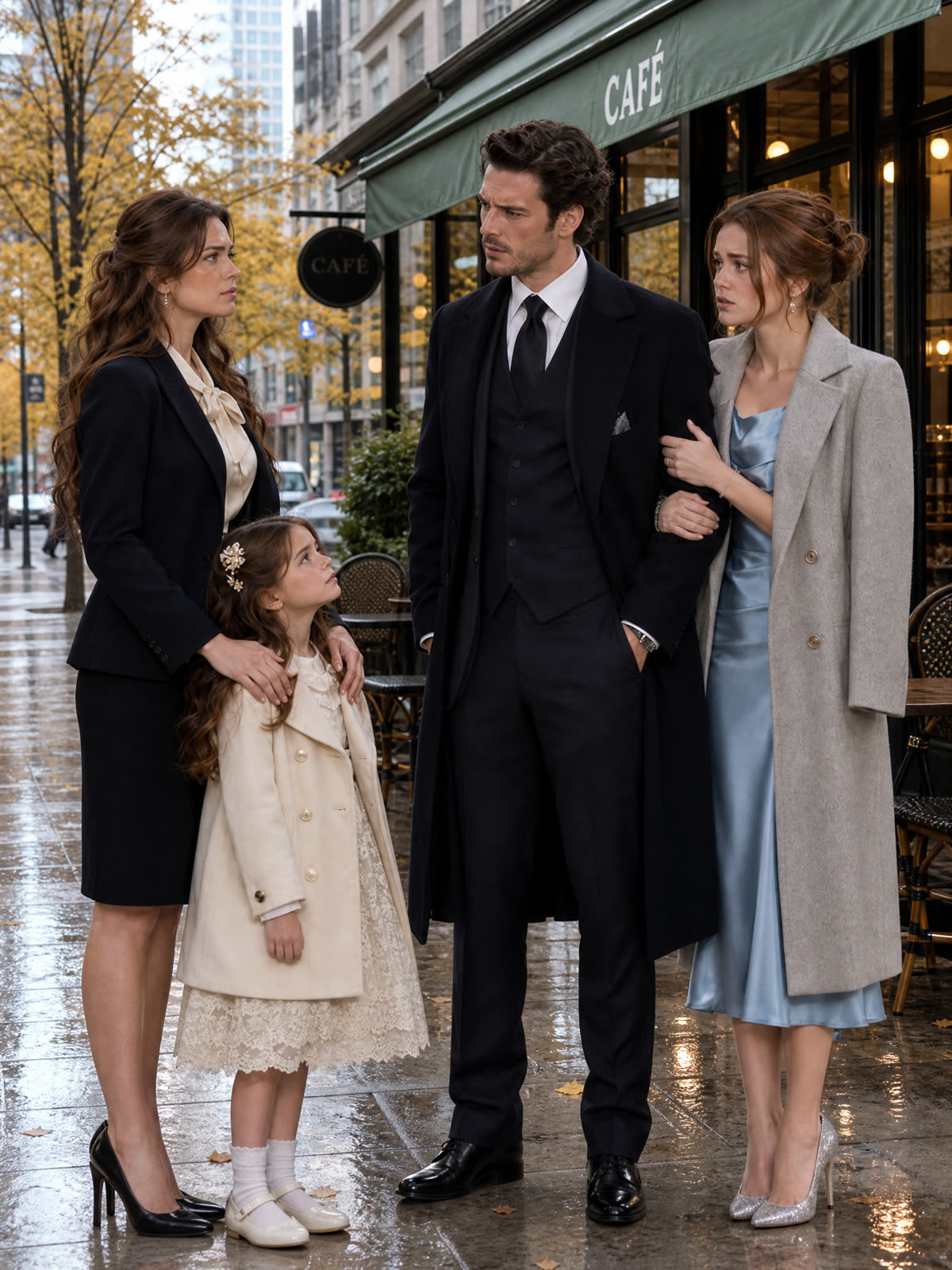
When my husband told me he loved another woman, he offered three houses, two cars, and every investment he owned in return for a divorce. I did not break down in front of him. Instead, I examined the figures, checked that everything had been included, and put my signature on the agreement. Seven years afterward, we crossed paths unexpectedly. The woman he had chosen was still beside him, but the sight of the six-year-old holding my hand stopped him cold. My daughter had his eyes, the shape of his nose, and the same small mark beside her left eyebrow. His expression that afternoon would have meant nothing without the story that came before it. To understand why he stood there unable to speak, you have to return to the evening when our marriage began coming apart.
My name is Grace Bennett. Warren Hale and I met at seventeen, became friends, fell in love, and eventually married. We spent eleven years together, six of them as husband and wife. By then, Warren was chief of thoracic surgery at one of Chicago’s most respected hospitals. He was controlled, private, and rarely brought conversations about work to our dinner table. That made one particular remark stand out. “A new doctor started in the department today. She’s short on experience, so I’ll have to supervise her personally.” I looked up from dinner. “What’s her name?” I asked. “Priya Lindqvist.” Nothing in his face appeared unusual. Still, in six years of marriage, I could not remember him mentioning a resident by name over dinner. At the time, I had no idea how often I would think about that small departure from his usual habits.
Afterward, the changes arrived gradually enough that I could have pretended not to see them. Warren had once come home around eight. Now it was ten, then eleven, and sometimes almost midnight. A fragrance I never wore lingered on his clothes. His phone, previously abandoned on whatever table happened to be nearby, suddenly went everywhere with him, even into the bathroom. For three weeks, I kept my observations to myself. Then I waited one evening beside a dinner that had gone cold. When he finally entered, the clock showed five minutes to eleven. “Warren, you have two options.” He put his keys down. “I’m listening.” I held his gaze. “Priya transfers to another department, or we get a divorce.” He did not demand to know what I meant. He did not deny the connection between them or ask where my suspicions had come from. He simply stood there looking at me. That night, he slept in his study.
The following morning, he entered our bedroom carrying a stack of papers. “Grace, I want a divorce.” He placed them on the bed between us. “I’ll leave you the three properties, the two cars, and all my stock. I won’t claim anything.” I lifted my eyes from the documents. “And you?” He swallowed before answering. “I want to be with Priya.” For several seconds, the pressure in my chest was so intense that I could scarcely think around it. Then I extended my hand. “Let me review the agreement.” I opened my laptop and went through the properties, vehicles, accounts, and investments. I checked the figures and confirmed that everything had been listed properly. Once I had finished, I reached for a pen and signed. Warren watched as though he had expected something entirely different. “That’s it? You won’t even try to win me back?” My answer was simple. “Why? You’ve already chosen.”
His face tightened. “You’ve always been like this, Grace. You never fight for anything. As long as you get enough money, you don’t care about the rest.” I gave him a joyless smile. “Don’t mistake my dignity for indifference.” He pressed his mouth into a thin line. “Priya and I have never crossed any physical line. I haven’t cheated on you.” I had spent weeks recognizing the difference between his presence in our house and his absence from our marriage. “You buy her breakfast. You drive her home. You defend her in front of everyone. You worry about her more than about your wife. Maybe you haven’t shared her bed, Warren, but for weeks now you’ve stopped sharing your life with me.” He offered no reply. “One more question,” I added. “Does she know you’re married?” His silence gave me all the answer I needed. Eventually, he signed as well. We would start the formal proceedings the following Monday. I believed that was the end of what remained between us. I was mistaken.
Three days later, his mother, Margaret Hale, asked me to meet her at an elegant café. “Grace, I’m not going to ask you to forgive my son,” she began. “But that financial settlement is absurd. Warren worked his whole life for those properties.” I answered without raising my voice. “And he decided to give them to me.” She was not satisfied. “You should at least return one house and part of the investments.” I lowered my cup onto its saucer. “Margaret, your son chose another woman. I won’t negotiate the consequences of his decision with you.” Her expression shifted. Then she said the thing that hurt more than any argument about money could have done. “You never gave him a child. Priya is young, and she’ll be able to give Warren the family he deserves.” She knew what those years had involved. She knew about the examinations, treatments, waiting, and disappointments. Even so, she had chosen those words.
They went straight through me, but I made myself breathe before responding. “Then I hope Priya can give him everything you want for him.” I rose and left the café. Two weeks later, the divorce was final. Warren departed with one suitcase, and I remained with the houses, the cars, and rooms that had become unbearably quiet. There was something neither he nor his mother knew. For several mornings, I had been waking up feeling sick. I blamed the nausea on everything that had happened, assuming my body was reacting to the strain of the separation. It seemed easier to understand it that way than to imagine any other explanation. Then, one morning, I fainted while shopping for groceries. I was taken to the emergency room, where a doctor examined my test results, smiled, and turned my attention toward an image on a monitor.
“Mrs. Bennett, you’re pregnant.” For a moment, I had no words at all. The doctor indicated a tiny flicker on the screen. “And there’s something else you need to know.” I stared at that little point of movement while she continued. “Based on the measurements and your lab work, we estimate you’re about seven weeks along,” the doctor explained. “The ultrasound shows a heartbeat, and so far everything looks like it’s progressing well.” Seven weeks. I counted backward, trying to bring the numbers into focus. Warren had still been living with me when the pregnancy began. I could remember our last night together with painful clarity. We had marked his birthday with dinner at home, and he had been particularly affectionate. Now I knew that Priya had already been working in his department. The memory felt different with that knowledge attached to it, though the tiny heartbeat before me was real.
The doctor noticed my silence. “Are you all right?” I nodded, even as tears filled my eyes. For five years, Warren and I had tried to have a baby. Whenever another test was negative, he had held me and offered the same reassurance. “As long as we’re together, that’s enough for me.” I had trusted those words. We had consulted specialists, gone through treatments, and spent more time waiting than I wanted to remember. No one had ever given us a definite reason why conception had not happened. Eventually, we spoke about it less and less. I had slowly begun to accept that motherhood might never be part of my life. Now, as my marriage ended, I was being given the very thing I had wanted for so long. There was happiness in that knowledge, but it arrived tangled with grief, disbelief, and the realization that nothing about my future would be as simple as I had thought.
I left the examination room holding the ultrasound photograph between my fingers. Outside, I sat in my car for almost an hour, looking from that small image to my phone. I thought about calling Warren and even opened his contact. Before I could do anything more, a message from Margaret appeared. “I hope you’ve reflected on the properties. Warren was far too generous, and I won’t let you take advantage of him.” I read it, then read it again. Afterward, I looked back at the photograph. If I told them now, I feared my baby would become another point of contention, another reason for them to press me into decisions. I did not want Margaret using a pregnancy to force a reconciliation. I did not want Warren returning because he felt obligated. And I could not face nine months of wondering whether the man beside me wished he were somewhere else. I put the phone away without making the call.

That choice was not as straightforward as keeping a secret and walking away. I spoke to a family law attorney, who made clear that the divorce did not remove Warren’s possible rights or responsibilities as a father. She told me to retain documentation of the pregnancy and warned me that paternity would eventually have to be addressed. I understood what she meant. I was not trying to claim that someone else was the father or erase the truth about my child’s origins. I needed time to think without the influence of a family that had so recently made me feel disposable. During those months, time felt more precious than anything else I owned. It gave me room to consider the life growing inside me separately from the marriage that had ended, even though I knew I could not keep those two stories apart forever.
The first person I told was Olivia Parker, my best friend. She arrived carrying takeout and found me on the living room floor among my medical paperwork. “Grace, you’re white as a sheet. What happened?” I passed her the ultrasound photograph. For several seconds, she looked at it without understanding. “Are you…?” I nodded. She covered her mouth, then embraced me so tightly that we both began crying. When we had settled down, she said what I had expected. “Warren has to know.” I answered, “I know.” She searched my face. “Are you going to tell him?” I lowered my eyes to the photograph. “Not now.” Olivia stayed quiet, giving me room to explain. “I’m afraid he’ll come back for the baby,” I admitted. “And that part of me will be weak enough to accept.” She took my hand. “Then don’t make any decision today. But don’t turn your fear into a lie your son or daughter has to carry someday, either.”
I carried that warning with me. Over the following weeks, I wrote Warren several letters. Each one explained that I was pregnant, that he was the father, and that I was not asking him to return to our marriage. None of them was sent. The first time I tried to find him at the hospital, I spotted him on the other side of the lobby with Priya beside him. Around her neck was a cream scarf I knew immediately. I had bought it on a trip to Boston months before we separated. He had given it to her. She tilted her face toward him to speak, and he reached up to tuck her hair gently behind her ear. It was not a dramatic gesture. That was precisely why it hurt. I recognized its ease and tenderness because, for years, I had been the person receiving it. Before either of them noticed me, I turned and walked away.
That afternoon, I accepted a finance director position in another city. The offer had been waiting on my desk for months, but until then, moving away from Warren had seemed impossible. Now there was no reason to remain. I sold one of the properties from the settlement, retained the other two as investments, and moved into a house near the water in Portland, Maine. Olivia came to see me several times while I was pregnant. She accompanied me to some appointments, helped arrange the nursery, and was there when I discovered I was expecting a girl. “What will you name her?” she asked. I looked down at the little yellow dress I had bought that morning. “Sophie.” Saying the name gave shape to a future that had previously existed mostly in medical images, paperwork, and the uncertain space between one appointment and the next.
The first time I felt her move, I was lying down with a book. I set both hands on my stomach and began laughing, suddenly and helplessly. Months had passed since laughter had come that easily. “Hi, Sophie,” I whispered. “I’m Mommy.” For the first time since the divorce, my life did not feel defined by an empty place someone had left behind. Someone else was coming into it. Sophie arrived in the early hours of a rainy April morning after a long, exhausting labor. Olivia stayed beside me until we heard her first cry. When the nurse placed her against my chest, the fear I had carried through the pregnancy seemed to fall quiet. Her fists were tiny, and dark hair clung to her forehead. She opened her eyes briefly, and I recognized Warren in them. It was not a resemblance I had to search for or persuade myself to see.
The shape, the dark color, even the solemn look were his. He had looked that way as a teenager, long before either of us knew what our marriage would become. A pang moved through me, unexpected and sharp. It was not regret about Sophie. It was sadness for the family she might have had. I kissed her forehead. “Hello, beautiful,” I murmured. “We’ve been waiting for you.” The months that followed were difficult in ways no financial settlement could soften completely. Some nights, Sophie cried for hours. Sometimes I fell asleep sitting upright with a bottle still in my hand. I learned which cry meant hunger and which meant exhaustion. I learned to keep working with far less sleep than I had once thought possible. I also learned to accept help without treating it as proof that I was failing her.
Money made certain things easier. I could afford a nanny, a comfortable home, and excellent medical care. It could not take my place when Sophie developed a fever at three in the morning. I was the one beside her bed, stroking her hair and waiting for her to settle. I never regretted becoming her mother. As she grew, her resemblance to Warren became more pronounced. At three, she frowned exactly as he did when something refused to go right. At four, she began asking questions that could not be answered by changing the subject. “Mommy, why does Olivia have a mom and a dad, and I only have you?” I sat beside her. “You have a daddy too, sweetheart.” She looked at me. “Where is he?” I drew a breath. “He lives in another city. We stopped being together before you were born.”
“Was he bad?” The question hurt more than I had anticipated. “No, Sophie. People sometimes do things that hurt others. That doesn’t mean everything about them is bad.” She took time to consider that before asking the question I had been avoiding in my own mind. “Does he know I exist?” I would not give her a lie. “We haven’t talked about you yet.” Naturally, she asked, “Why not?” I pulled her into my arms. “Because Mommy was scared and didn’t know how. But that’s something I have to fix, not you.” After she fell asleep that night, I could no longer pretend that my silence belonged only to me. I contacted my attorney again. We collected the medical records and began preparing formal notice concerning paternity. I wanted to handle it correctly. Even so, before the matter was resolved, life intervened again.
The company offered me the opportunity to lead a new division in the city where Warren and I had once lived. I accepted. By then, Sophie was six and preparing to begin first grade, a cheerful, inquisitive child who noticed more than adults sometimes expected. Returning did not fill me with excitement. Still, the city was not merely the setting of my failed marriage. It belonged to my history too. More importantly, there was something unresolved that I could not continue postponing. One September afternoon, I took Sophie to a downtown bookstore. We spent nearly an hour selecting stories before she announced that she needed ice cream. We stepped onto the shopping promenade and stopped outside a café. “Mommy, can I get chocolate and vanilla?” I gave her a look. “If you promise not to get your dress dirty.” She answered at once. “I can’t promise impossible things.”
I was laughing when I heard someone behind me say, “Grace?” I turned. Warren stood a short distance away. There were small lines around his eyes now and a little gray near his temples, but recognition was immediate. He wore a navy overcoat, and Priya Lindqvist was holding his arm. They were still together. For a moment, neither Warren nor I spoke. Then he managed an uncertain smile. “I didn’t know you were back.” I answered, “A few weeks now.” His eyes moved toward Sophie, who was concentrating on the wrapper around a small cookie. “And this little girl…?” My daughter lifted her face. “Hello,” she said politely. Warren stopped moving. I watched his attention settle first on her eyes, then her nose, then the tiny mark beside her left eyebrow. The identical mark on his own face made the silence between us suddenly different.
The color drained from him. “Grace…” He looked at Sophie again. “How old is she?” I did not look away. “Six.” Priya’s smile disappeared. Warren seemed to struggle for breath before asking, “What’s her name?” Sophie answered before I could. “Sophie Bennett,” my daughter answered before I could. “What’s yours?” His mouth opened, but nothing came out. Priya gave his arm a gentle pull. “Warren, we have to go.” He appeared not to hear her. “Grace, I need to talk to you.” I took Sophie’s hand. “Not now.” Before we could leave, my daughter studied him once more. “Mister, you have the same mark I do.” She pointed to her eyebrow. Warren slowly lifted a hand toward his own face. I would never forget that expression: a man discovering something precious that he had not even known was missing.
PART 2 — The Truth Between Us
Warren called that evening. I let the phone ring without answering. Messages followed. “I need to know if Sophie is my daughter.” Then, “Grace, please. We have to talk.” Another arrived after that. “I don’t want to fight. I only need the truth.” Eventually, I agreed to meet him two days later at my attorney’s office. A conversation that important could not happen carelessly, in the middle of the street or with Sophie listening nearby. When Warren arrived, he looked as though sleep had become impossible since our encounter. We had scarcely taken our seats before he asked, “Is she mine?” I glanced toward my attorney and then answered him directly. “Biologically, yes. I’m willing to do the appropriate paternity test.” He leaned forward. “How long have you known?” I told him, “Since a few weeks after our divorce.”
He stared at me in disbelief. “And you never thought of telling me?” I did not try to make the answer easier. “Many times.” His voice rose. “It’s been almost seven years, Grace!” My attorney intervened. “Mr. Hale, we can talk, but you have to stay calm.” Warren inhaled deeply. “Sorry.” Then his attention returned to me. “You kept her from me on purpose.” There was no useful way to hide behind softer wording. “Yes. I left because I was hurt, because I was scared, and because I didn’t want my pregnancy to become a reason for you to come back to me.” He responded immediately. “You had no right to decide for me!” I understood his anger, even if understanding it did not undo the years behind us. “You’re right about one thing,” I said. “Sophie deserved to have this settled sooner. My pain doesn’t change that.”
The certainty of that admission seemed to unsettle him. I went on before our entire history could be reduced to my decision alone. “But don’t confuse my mistake with the breakup of our marriage. I didn’t leave with someone else. You decided to go.” Warren lowered his head. We remained quiet for a long time. Eventually, he asked, “Does she know who I am?” I answered, “She knows she has a father. I haven’t given her your name yet.” He put both hands over his face. “I have a six-year-old daughter,” he murmured. “And I don’t know her favorite color.” The simplicity of those words reached me in a way his anger had not. “Yellow,” I answered. “Although now she says it’s green because she’s obsessed with frogs.” A broken laugh escaped him, and then he began to cry. I had never seen him cry that way, not even when our marriage ended.
His questions came quietly after that. “Does she like to read?” I answered, “Very much.” He asked, “Is she healthy?” I said, “Yes.” Then came the question that made me consider the life Sophie and I had built rather than the one we had lost. “Is she happy?” I thought of the pictures on the refrigerator, the shoes she left in the hallway, and the way she ran toward me after school. “Yes, Warren. She’s a happy girl.” He nodded, absorbing that. “I want to meet her.” I had known he would ask, and I had already thought about what my answer needed to protect. “You can,” I said. “But we’ll go slowly and respect what Sophie needs. I won’t let her into your life only to have you disappear from hers.” He met my eyes. “I’m not going to abandon her.” I answered, “You’ll have to prove that with actions.”
Priya learned about Sophie before the paternity results arrived. She called on a Friday afternoon from a number I had not saved, but I recognized her voice. “Grace, it’s Priya.” I replied, “I know.” After an uncomfortable pause, she continued. “I need to talk to you about Sophie.” I established the boundary immediately. “Sophie’s matters will be settled between Warren and me, with the appropriate legal advice.” She said, “I understand. But I want you to know something.” I waited. “Warren told me you two couldn’t have children. He said you’d tried for years.” I answered, “That was true.” Her next admission was quieter. “When he saw her, it was as if he’d stopped recognizing me.” I could hear the hurt in her voice. It gave me no pleasure. I had imagined seeing her again many times, but the revenge I might once have pictured was not what I wanted now.
“Priya, I haven’t called him. I haven’t tried to win Warren back. I don’t need anything from your relationship.” She responded, “I know,” she whispered. “That’s exactly why it scares me.” We fell silent before she asked, “Do you still love him?” I looked through the window into the garden. Sophie was outside with Olivia, wearing a blanket as a cape and pretending to save animals from a fire. “I loved the man I married very much,” I answered. “But that marriage ended seven years ago.” Priya released a breath. “Thank you for telling me the truth.” Before we ended the call, she added, “There’s one more thing. Warren never wanted to have children with me.” That surprised me. She explained, “At first he said we needed time. Then he said his work was too demanding. He always found an excuse.” I could not think of anything useful to say.
Priya continued, “I think I represented the life he wanted when he walked away from you. But over time, he stopped knowing what he really wanted.” After we hung up, I remained at the window looking into the garden. For years, I had assumed they were enjoying the happiness for which Warren had dismantled our marriage. Perhaps they had been happy. Perhaps, in a way I did not understand, they still were. What changed was not my knowledge of their relationship but my understanding of its limits. I had witnessed its beginning, not every day that followed. I no longer needed a complete account of what had happened between them. Their private life did not have to explain mine. Meanwhile, the test confirmed what I had always known: Warren was Sophie’s father. Soon afterward, Margaret heard about her granddaughter, and my phone began ringing repeatedly.
I eventually answered. “Grace, is it true I have a granddaughter?” I said, “Yes.” Her voice broke. “Why did you hide her from us?” I would not revisit everything through an uncontrolled telephone argument. “Margaret, I’m not going to argue about this over the phone.” She protested, “She’s a Hale! She has a right to know her family!” I took a steadying breath. “She has a right to know her origins and to form safe bonds with her family. But that doesn’t mean she can enter her life without preparation.” Margaret began crying. “I didn’t know you were pregnant.” I answered, “I know.” Then she said, “If I had known, it would have been different.” Immediately, I remembered the café, the green tea, and the coldness with which she had spoken about my inability to give Warren a child.
“Different how?” I asked. “Would you have treated me with respect because I was expecting a baby?” She had no answer. I reminded her, “The day we met after the separation, you told me Priya could give Warren the family I hadn’t managed to give him.” I could hear her breathing before she replied. “Grace, I was worried about my son.” I said, “And I was losing the man I’d shared eleven years with.” This time, she did not correct me or offer another defense. “I was cruel to you,” she finally admitted. The acknowledgment surprised me. “Yes, you were.” Then came, “I’m sorry.” I closed my eyes. I had imagined an apology bringing satisfaction, but mostly I felt tired. “I’m not the one who needs a promise now, Margaret. It’s Sophie.” I explained that a meeting could happen later, provided she respected Sophie’s pace and the arrangements made with Warren. She agreed. Before ending the call, she asked, “Does she look a lot like Warren?” I glanced at a photograph of Sophie smiling around a loose tooth. “A great deal,” I answered. “Though, luckily, her temperament is more like mine.”
Warren met Sophie for the first time in a park. Olivia and I were both there; Sophie had known Olivia all her life, and I wanted familiar people nearby. Beforehand, I had explained who Warren was in simple language, without giving her adult problems to solve. She listened with great seriousness. “Is he the man who has my same mark?” I answered, “Yes, sweetheart.” She asked, “And why didn’t he come before?” I stroked her cheek. “Because the grown-ups didn’t work some things out the way we should have. You didn’t do anything wrong.” After considering that, she asked, “Can I meet him?” I told her, “Of course you can.” When we reached the park, Warren was already waiting with a bookstore bag. He stood as soon as he saw her. Sophie stopped several steps away and studied him with the careful interest she usually gave an unfamiliar animal. “Hi,” she said at last. Warren crouched in front of her. “Hi, Sophie. I’m so glad to see you.”
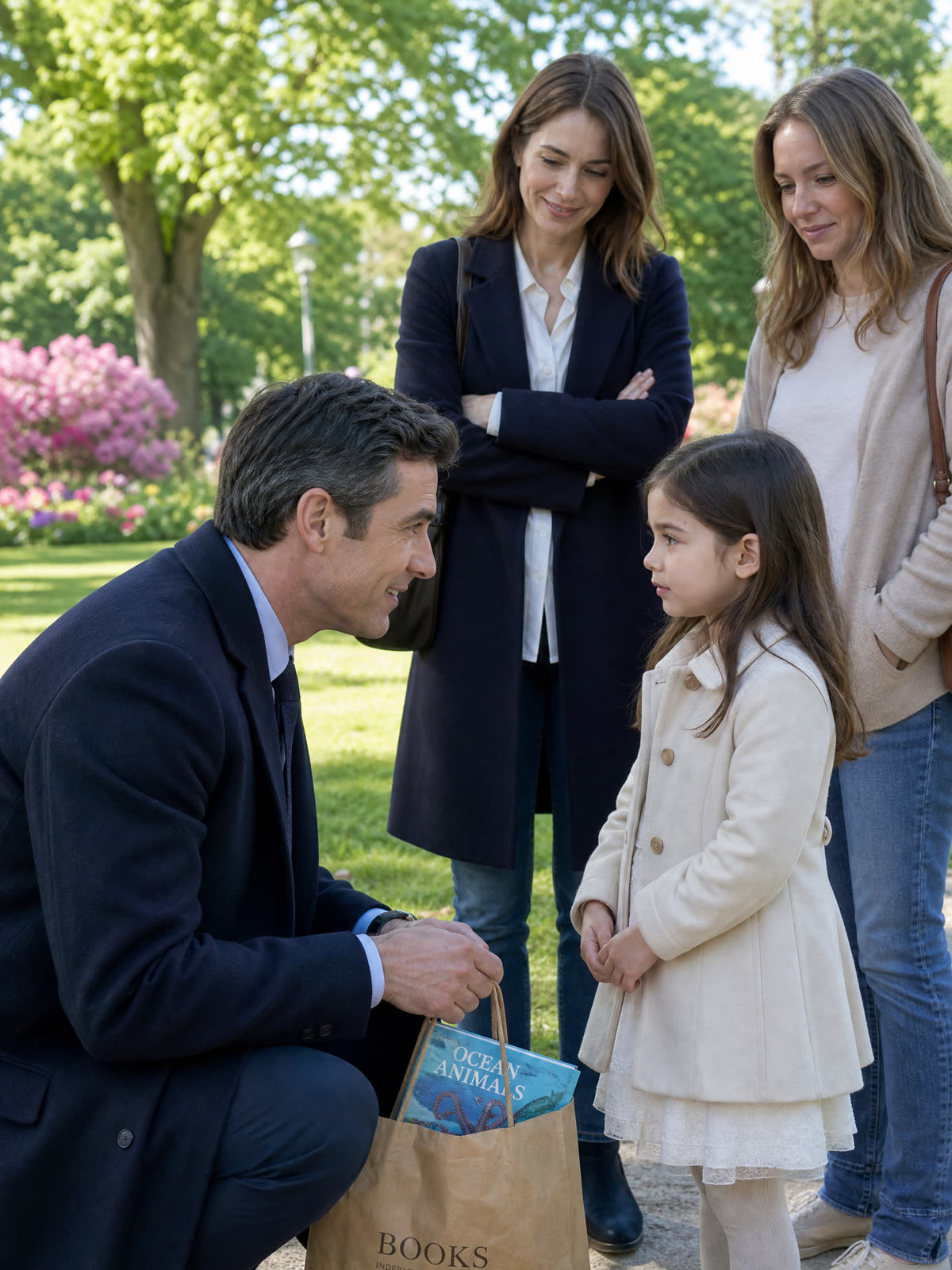
Her attention moved to the bag. “Is that for me?” His smile was nervous. “Yes. But we can talk first, if you want.” Sophie saw no reason to choose between the two. “We can do both.” He brought out an illustrated book about ocean life, and her eyes widened. “A giant octopus!” Warren looked toward me in surprise. “She likes marine animals?” I explained, “She wants to be a marine biologist,” I said. “Although last week she wanted to be an astronaut.” Sophie raised one finger to settle the matter. “I can be both.” Warren laughed, and the sound was achingly familiar without making me wish the past would return. For the next forty minutes, their conversation moved through octopuses, sharks, and creatures living far beneath the surface. They had something to talk about that belonged to Sophie, something that required no explanation of what the adults had done.
Nobody asked for a hug. Nobody tried to turn the meeting into a declaration about the rest of their lives. The absence of those demands mattered. When it was time to leave, Sophie closed the book and looked at Warren. “Are you going to come back?” His expression became serious in a way I remembered from our younger years. “Yes. If you want me to, I’ll come back.” Her response was immediate. “I want.” He swallowed before answering. “Then I’ll be here.” She extended her hand, and he shook it gently. As we walked away, she spoke quietly beside me. “Mommy, can I call him Daddy sometime?” A knot rose in my throat. I had spent years imagining what discovering her father might mean to her, but the reality was quieter and more delicate than any scene I had rehearsed in my mind.
“Whenever you want, sweetheart. You don’t have to before you’re ready.” Sophie nodded, accepting that the choice was hers. Three weeks later, at the end of a visit, she lifted her hand in farewell. “Bye, Daddy!” Warren went completely still. Then a smile spread across his face, and his eyes filled with tears. I looked away for a moment. It was not because I wanted our marriage back or because I mistook that moment for a second chance between us. I was seeing my daughter begin a relationship she had been missing without fully knowing what the absence meant. There was joy in it, along with sadness for everything that could not be supplied afterward. Nothing about that first word could return the years already gone. Still, it meant that something new was taking shape in front of me, and I could allow it without surrendering the life I had made.
The months that followed were not what I had expected when Warren first stood speechless outside the café. He honored the visits we arranged, attended school meetings when it was appropriate, and began meeting his financial obligations as Sophie’s father. In the beginning, his presents were too large. One day, he arrived with a dollhouse that scarcely fit inside his car’s trunk. Sophie was captivated. She examined it, then looked up at him. “Can you stay and put it together?” He checked his watch. A meeting at the hospital was waiting for him. I recognized the hesitation immediately; I had lived beside that expression throughout our marriage. There was a familiar pause in which work might have become the answer without any further discussion. Then Warren reached for his phone. “I’m going to let them know I’ll be late.”
He spent the next two hours on the rug, fitting small wooden pieces together while Sophie directed the placement of the furniture. The gift became something they did together rather than something he handed over before leaving. When they finally finished, she kissed his cheek. Warren shut his eyes briefly, as though he needed a moment to absorb it. Later, while Sophie went to wash her hands, he approached me. “Thank you for letting me into her life.” I did not want gratitude to blur the reason I had agreed. “I didn’t do it for you.” He answered, “I know.” He stood looking toward the garden. “Sometimes I think about everything I missed.” There was no point pretending the lost years had contained nothing important. They had been filled with the ordinary milestones that made up a child’s life.
“You missed her first steps, her first words, and a lot of birthdays,” I said. “But if you do this right, you’ll still have plenty of memories to build.” He nodded. I could acknowledge his loss without making it my responsibility to erase it. Just as I could admit my own mistake without pretending it had caused the collapse of our marriage. Those truths had to remain separate if we were going to manage what came next fairly. Sophie needed adults who could look at what had happened honestly, rather than forcing everything into one accusation or one apology. Warren continued standing beside me, and for a while the conversation seemed finished. From the other room, our daughter was still part of the afternoon he had chosen to stay for, not merely a reason for him to talk about the past.
Then he said my name. “Grace…” I recognized the hesitation before whatever he wanted to say next. “What is it?” He did not answer immediately. I waited, aware of how easily a conversation between us could begin in the present and find its way back to everything we had once been. Until then, Priya had remained part of his separate life, the woman who had been holding his arm when he first saw Sophie. I knew what she had told me on the telephone, but I had not asked him to explain their relationship. I had made no claim on him and offered no suggestion that fatherhood opened a path back into our marriage. Finally, he spoke. “Priya and I have separated.”
PART 3 — The Promises Still Ahead
I did not respond immediately. Warren continued, “We’d been struggling for a while. Sophie just forced us to admit it.” I said, “I’m sorry.” He looked at me strangely. “Are you?” I meant what I had said, but not in the way he seemed to be asking. “I don’t want you to be unhappy, Warren. It’s just that your happiness stopped being my responsibility a long time ago.” He lowered his gaze. “I’ve thought a lot about us.” I could feel the conversation approaching a place I did not want to enter. “Warren, no.” He asked, “Let me finish, please.” I waited. “When we divorced, I thought your calm meant you’d never loved me as much as I needed.” A bitter smile came before I could stop it. “That’s what you thought?” He answered, “Yes. Priya admired me. She made me feel indispensable. You always seemed able to handle everything without me.”
For several seconds, I simply looked at him. That was how he had interpreted my steadiness: not as something we could rely on together, but as evidence that he mattered less. “I was your wife, Warren. Not someone who had to pretend to be weak so you could feel important.” He closed his eyes. “I know that now.” I had no wish to minimize what our marriage had meant simply because he had misunderstood it. “I admired you. But I also knew your mistakes, your quirks, your difficult days. We lived together. That was intimacy, not lack of love.” He passed a hand through his hair. “I was wrong.” I answered, “Yes.” There was nothing cruel about agreeing. Some truths became harder to face only because they had been avoided for so long. He had mistaken the familiarity of a shared life for the absence of admiration, and the consequences had belonged to both of us.
Then he said, “And I think I never stopped loving you.” Seven years earlier, those words would have rearranged everything. I would once have given almost anything to hear them from him. But time had changed the place those words could reach. What might once have felt like rescue now sounded like an admission that had arrived after the life it might have saved was over. “Maybe you did love me,” I answered. “But there was a moment when you decided that loving me wasn’t enough to stay.” A tear slipped down his face. “Is there no chance for us?” I remained calm. “There’s a chance that you’ll be a good father to Sophie. And I want you to take it.” He asked again, more narrowly, “And for us?” I slowly shook my head. “Our marriage ended when you asked me to sign those papers.”
Warren turned toward the living room, where Sophie had begun singing while she played. “I thought that if I ever saw you again, you’d still be waiting for me.” I could remember believing something similar about myself. “I thought I’d wait for you forever, too.” I let a moment pass. “But then our daughter was born. And I discovered I could build a life without waiting for anyone.” It was not a speech meant to punish him. It was the plainest description I could give of what had happened while we were apart. Motherhood had not erased the hurt, but it had stopped that hurt from being the only thing around which my days were organized. There had been work, exhaustion, laughter, fevers, questions, and a child who needed me in the present. Somewhere inside all of that, the woman who had once imagined waiting indefinitely had become someone else.
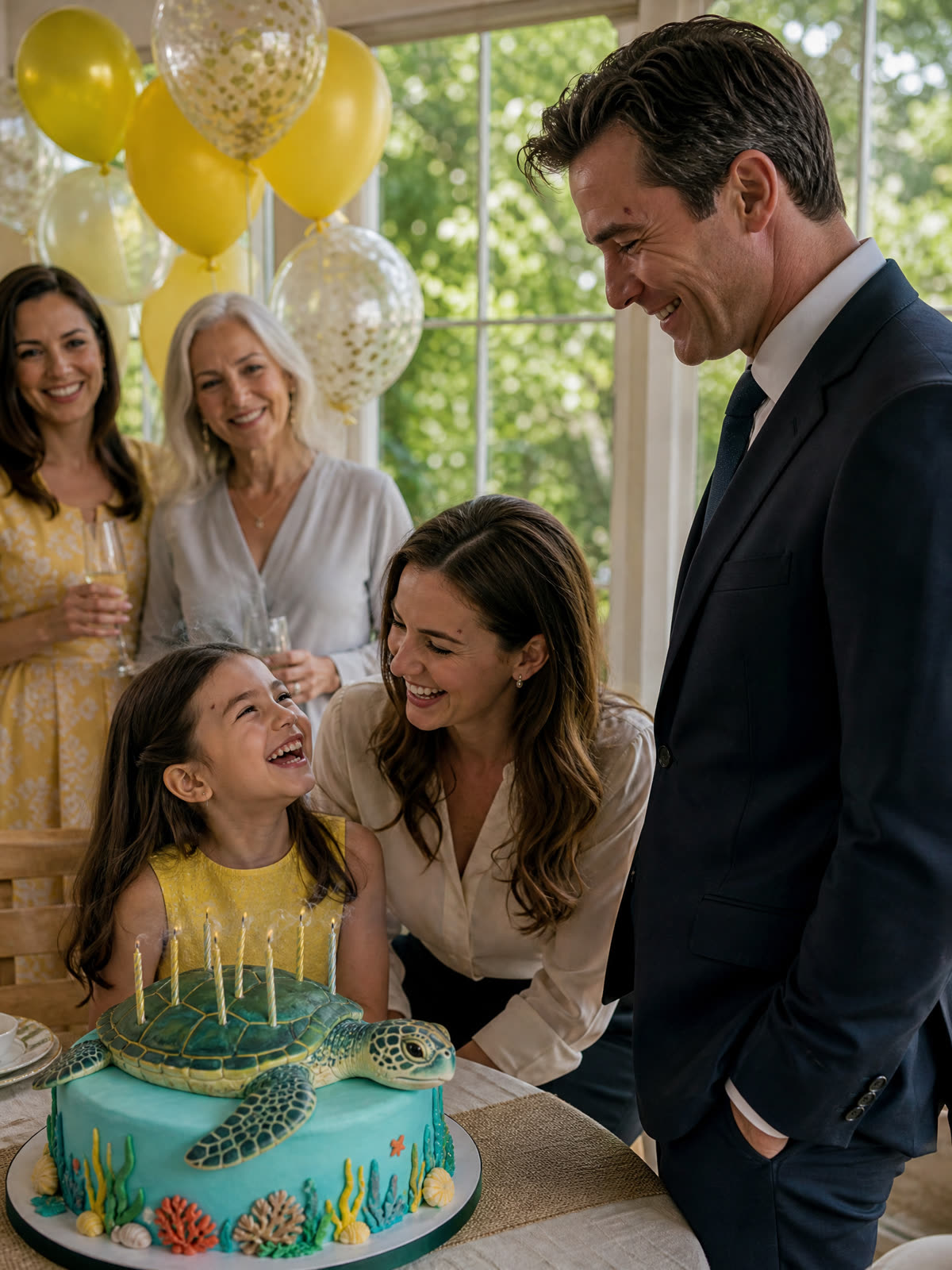
Almost a year after we met again, Sophie turned seven. We held a small celebration at home with several classmates, yellow balloons, and a cake shaped like a sea turtle. Olivia came early to help. Warren arrived carrying a carefully wrapped present and wearing a nervous expression. Margaret accompanied him. It was only her third time seeing Sophie, after meetings we had arranged thoughtfully and with care. My daughter ran toward them without carrying any of the history that made the occasion complicated for the adults. “Daddy! Grandma Margaret!” Margaret bent to embrace her. When she straightened, her eyes were wet. I watched the greeting for what it was: a little girl happy to see people who were becoming part of her life. The day belonged to Sophie, not to an accounting of who had once said what or who deserved to be forgiven first.
While Sophie opened presents, Margaret approached me. “Thank you, Grace.” I answered, “It’s her birthday,” I answered. “I want her to have a nice day.” She studied me before continuing. “I’ve thought a lot about our conversation in that café.” I stayed quiet. “Back then, I was convinced that what mattered was protecting Warren’s assets. I never asked how you felt.” She lowered her head. “I’m ashamed to remember it.” I did not know immediately what to say. The café had remained clear in my memory, not because of the money she wanted returned, but because of the ease with which she had reduced years of my life to what she believed I had failed to provide. Hearing her acknowledge another part of that cruelty did not make the original conversation disappear. It did, however, mean that she was no longer asking me to pretend it had been reasonable.
Margaret went on. “You had been part of our family for years. And I treated you as if you were only a financial problem.” Her voice faltered. “I don’t expect you to forget it.” I answered softly, “I haven’t forgotten it.” She nodded. “I know.” Across the room, Sophie was helping Warren place a candle on the cake. I looked toward them before speaking again. “But I don’t want my daughter to grow up surrounded by the grudges of adults, either.” Margaret held my hand briefly. “I’ll do everything I can not to let her down.” For the first time, I believed her. Believing that did not require me to rewrite what had happened or claim that the words no longer hurt. It meant I could recognize remorse without making Sophie responsible for my memories. There was room for boundaries and for the possibility that someone might behave differently.
When the candles were ready, Sophie insisted that everyone gather around the table. Warren took the place to her right, and I stood to her left. She reached for both our hands. “I’m going to make a wish,” she announced. Olivia reminded her, “You can’t say it out loud.” Sophie closed her eyes with exaggerated seriousness. Then she blew out all seven candles in one breath, and everyone applauded. It was a simple birthday moment, familiar in its shape, yet it contained a life I could never have predicted when I signed the settlement. Warren and I were not standing there as husband and wife. Nobody needed to pretend otherwise. We were two parents beside a child who was pleased with her turtle cake and intent on the private importance of her wish. That was enough for the moment to belong to all three of us.
After the applause, Sophie leaned closer to me. “Mommy, I think my wish is going to come true.” I asked, “Oh, yes? And what did you wish for?” She gestured for me to lower my head. “That Daddy keeps coming to my birthdays.” I looked toward Warren. He had heard her, and his eyes shone. I knelt beside her so that my answer was meant for her, not delivered over her head to the adults in the room. “Sweetheart, that’s something Daddy will have to take care of every year. But you don’t need to waste a wish on getting grown-ups to meet their responsibilities.” Her wish was tender, but the responsibility it named was not hers. I wanted her to know that she did not have to bargain with candles or be especially deserving to have her father keep showing up.
Sophie wrinkled her nose as she considered that. “Then I want another wish.” I asked, “What is it?” Her smile arrived immediately. “A puppy.” Everyone began laughing. Warren laughed too, and so did I. Perhaps it was the first time since our reunion that we shared laughter with no sadness hidden beneath it. The moment did not turn us back into the people in our wedding photograph. It did not suggest that a birthday party had repaired every loss or resolved every difficult choice. It was simply funny, and for once we could both be present inside that uncomplicated feeling. Sophie had moved from worrying about an adult promise to wishing for something entirely her own. Watching her do that mattered more to me than any polished picture of a family that no longer existed.
Once the party ended, Warren remained to help straighten the house. Sophie had fallen asleep with her new stuffed turtle in her arms. We put away the remaining boxes without saying much. When I finished closing a bag, he broke the silence. “I’ve received an offer to run a surgery program in another city.” I turned toward him. “Are you going to take it?” He replied, “I don’t know. First I want to know how it might affect Sophie.” That answer surprised me. Seven years earlier, he would have reached his decision and mentioned it over dinner afterward. Now he was thinking about the effect on someone else before deciding. It did not settle the question, but it was different from the pattern I remembered. I could see that difference without using it as a reason to reconsider our marriage.
“We can arrange visits,” I said. “What matters is that you keep whatever you promise her.” He nodded. “I will.” The offer remained his decision to make. My concern was not whether he chose the particular future I might prefer for him, but whether Sophie could rely on what he told her. Fatherhood could not remain a series of emotional discoveries. It had to become something steady enough to survive work, distance, and decisions that were inconvenient. I had told him from the beginning that actions would matter more than assurances. Nothing about a successful birthday changed that. At the same time, I could acknowledge that he was asking the question before acting, rather than expecting us to fit ourselves around a decision already made. Learning to consider Sophie was part of the work he had promised to do.
He started toward the door, then stopped. “Grace, there’s something I never told you.” I waited. He looked down at the keys in his hand. “The day you signed the agreement, I got angry because I thought you didn’t love me enough to fight for me.” Then he said, “It took me years to understand that you were the one who had been fighting for us for a long time. And that I only noticed when you stopped.” A quiet sadness moved through me. It was not the raw wound I had carried during the divorce. It felt more like touching the memory of an injury that had already become part of my history. I did not need to deny the sadness to recognize that it no longer governed me. His understanding mattered, but it could not turn the years backward or make the decisions different.
“I made mistakes too, Warren,” I answered. “I should have told you about the pregnancy sooner. Sophie deserved for us to handle things differently.” He lifted his eyes. “We can’t get those years back.” I said, “No.” Then he added, “But we can make the next ones better.” I answered, “Yes.” He gave a faint smile. “I guess that’s all I can ask for.” Neither of us was offering a way to cancel the past. We were admitting that the future did not have to repeat it exactly. Before leaving, Warren reached into his pocket and took out a small envelope. “I found this while sorting through my things.” I recognized the paper before opening it. Inside was a photograph from our wedding, an image from the beginning of the marriage whose ending had once seemed impossible to imagine.
I wore a simple dress in the photograph, and Warren’s arms were around my waist. We were smiling with the confidence of two people who believed the future was something they could shape by wanting it enough. On the back, in my handwriting, was a sentence I remembered. “No matter where life takes us, we’ll always be a team.” I ran my thumb over the words. “I thought you’d want to keep it,” Warren said. I studied the photograph a little longer, then returned it to him. “You keep it.” He looked surprised. “Are you sure?” I answered, “Yes. It was part of our story. I don’t need to hold on to every piece of proof that we were once happy.” He nodded. I was not rejecting the happiness in the picture. I simply no longer needed to keep its evidence close in order to believe it had existed.
Warren left, and I watched him cross the yard toward his car. This time, I felt no impulse to follow him. I did not cry. I closed the door and went upstairs to Sophie. She was sleeping soundly, one hand resting on the pillow and the other holding her stuffed turtle. I lay down beside her. A few minutes later, her eyes opened. “Mommy…” I answered, “What is it, sweetheart?” She asked, “Did Daddy leave?” I told her, “Yes. He’ll come see you Saturday.” She smiled drowsily. “I like that you two are friends.” I smoothed her hair. “We’re learning to get along.” It was the most honest way I could describe what we were doing. We were no longer trying to recover a marriage. We were learning how to occupy the same part of our daughter’s life without asking her to bridge the distance between us.
Sophie gazed at the ceiling for a moment. Then she asked, “Were you happy when you lived with him?” I had not expected the question. I thought about the breakfasts we had shared, the college years, and the nights he fell asleep studying while I covered him with a blanket. I remembered our wedding. I also remembered cold dinners, silences, and the morning I signed the divorce agreement. None of those memories had to erase the others. “Yes, Sophie,” I finally answered. “There were many days when I was very happy.” She asked, “And now?” I kissed her forehead. “Now, too.” That appeared to satisfy her. She closed her eyes and drifted back to sleep, leaving me awake beside her with the question still gently opening through the memories it had brought to the surface.
I thought again about the three houses, the two cars, and the investments Warren had offered on the morning he asked to leave. For a long time, he had treated that fortune as though it explained my silence. He had been wrong. The money had made starting over safer. It had provided choices, stability, and relief from worries I might otherwise have faced alone. I did not need to dismiss its value to understand its limits. It had not purchased forgiveness, and it had not undone what happened between us. Nor was it the most precious thing I had carried out of that marriage. The most precious thing was asleep beside me after her seventh birthday, holding a stuffed turtle. She was not compensation for what I had lost. She was my daughter, with a life of her own that had changed the direction of mine.
Seven years earlier, when Warren confessed that he loved someone else, I believed the life I had built was being taken away. I could not yet see the life beginning beyond it. That new life did not have to resemble my old hopes in order to make me happy. I remembered his bewilderment when I signed the agreement, his demand to know why I would not fight to keep him. At last, I understood the answer I had not been able to give him then. Some people were worth fighting for, but there were also moments when courage meant refusing to keep struggling for someone who had already chosen to leave. Accepting that choice had not meant our years together were worthless. It meant I could stop trying to make those years promise a future they could no longer provide.
I switched off the lamp. In her sleep, Sophie moved closer and slipped her small arms around my waist. Rain continued outside, but within the house there was nothing from my old life that I was waiting to recover. Everything I needed to move forward was already there. The past no longer needed a different ending before I could accept the happiness beside me. Yet the future was not a photograph or a sentence written on the back of one. It would be made out of choices that still had to be made and promises that still had to be kept. Somewhere beyond the quiet of that room, Warren still had an offer to answer. And the wish Sophie had spoken over her birthday cake still had to come true, year after year.
Disclaimer: This story is a work of fiction inspired by real-life themes. Names, characters, places and events are fictionalized, and any resemblance to real persons is purely coincidental. Images are for illustration purposes only.
