

PART 1
The doctor gave us the news at precisely 8:17 on a Monday morning.
“I’m sorry, Mr. Whitmore,” Dr. Pierce said softly. “Owen’s heart is failing faster than we expected. He’s too weak for the treatments we discussed. He’s stopped eating and refuses therapy. Realistically… we may be looking at two weeks.”
Two weeks.
My son was only twenty-five.
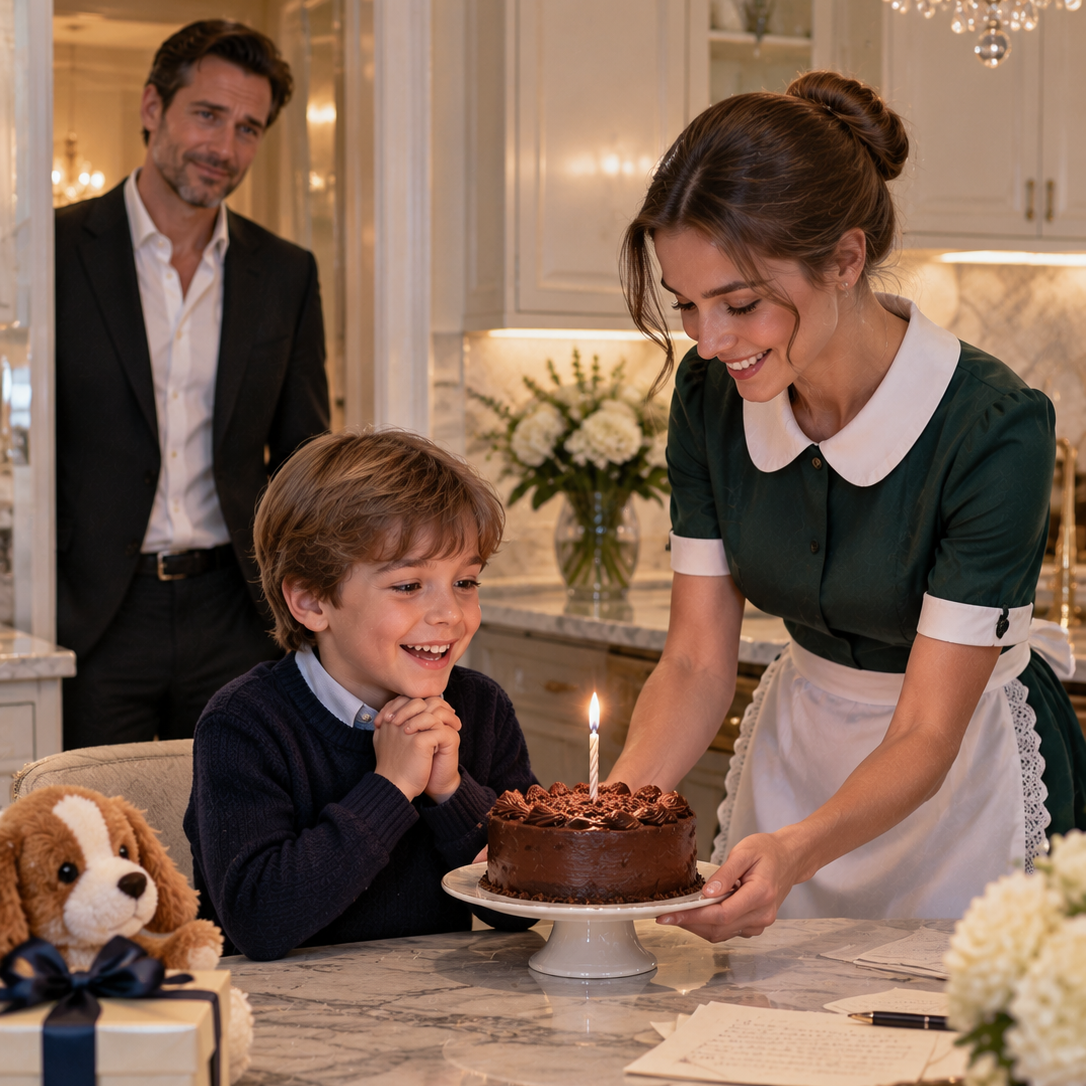
Once, Owen had been the little boy who ran barefoot across our Lake Forest estate, built crooked forts out of couch cushions, and pleaded with his mother to bake red velvet cake because it was her favorite.
Now his life had shrunk into a countdown.
I didn’t cry.
I hadn’t cried in ten years.
Not since my wife, Grace, collapsed from a brain aneurysm in the middle of dinner. One moment she was laughing, and the next, she was gone.
After that, I survived the only way I knew how.
I worked.
I bought buildings.
Closed deals.
Made fortunes.
People called me Nathan Whitmore, the millionaire who could turn abandoned neighborhoods into luxury developments.
But I couldn’t sit beside my dying son and ask him if he was afraid.
So I paid instead.
Private doctors.
Private nurses.
Specialists flown in from across the country.
Experimental evaluations.
Everything money could buy.
Everything except my time.
That afternoon, I brought Owen home.
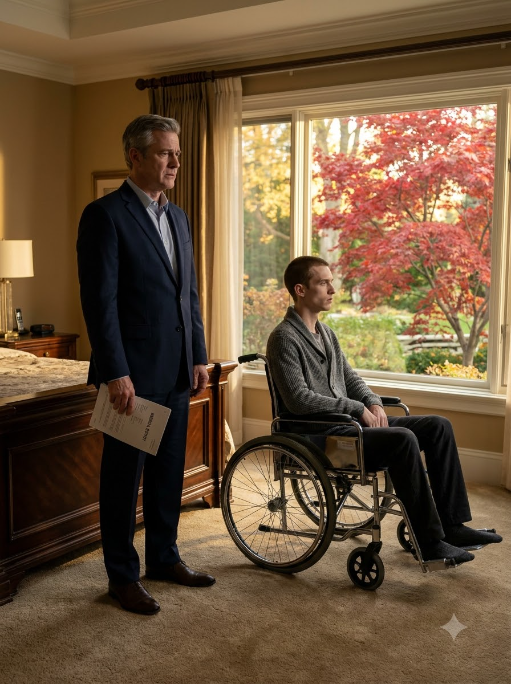
His bedroom looked out onto the Japanese maple Grace had planted the year he was born.
He sat by the window in a wheelchair, pale and painfully thin beneath a gray cardigan, staring at the tree as though it were the last thing left in the world that understood him.
He didn’t touch breakfast.
Or lunch.
Or dinner.
The first nurse quit the next morning.
“He doesn’t want help,” she whispered to me. “He doesn’t want anything.”
“Hire someone else,” I replied.
By Friday, two more nurses had left.
Then Clara Bennett arrived.
She was twenty-six, carrying a canvas suitcase and wearing a worn brown coat. Her hazel eyes looked calm, but sadness lingered somewhere behind them.
Our housekeeper, Mrs. Ellis, met her at the door.
“This isn’t ordinary housekeeping,” she warned.
“I understand.”
“Mr. Whitmore’s son is very ill.”
“I was told.”
“He doesn’t eat. He barely talks. He doesn’t like strangers hovering over him.”
Clara nodded.
“Most people don’t.”
It was the first honest thing anyone had said in my house all week.
When she stepped into Owen’s room, she didn’t fuss over him or lecture him about hope.
She simply pulled up a chair and looked out the window beside him.
Six minutes passed in complete silence.
Then she spoke.
“That tree looks like it has an attitude.”
Owen glanced at her.
“Not a bad attitude,” she went on. “Just dramatic. Like it knows it’s the prettiest thing in the yard.”
Silence.
Then my son whispered, “My mother planted it.”
Clara smiled.
“She had good taste.”
“Better taste than my father.”
It wasn’t quite a joke.
But it was close.
I stood frozen outside the bedroom door.
I hadn’t heard that tone in his voice in months.
Clara looked at him gently.
“How long has it been since you ate something you actually wanted?”
He didn’t answer.
The next afternoon, she came into his room carrying a small red velvet cake with crooked frosting and a single candle.
Owen stared at it.
“So did I.”
Clara set it on the table.
“Your mother’s recipe was in the kitchen drawer.”
I forgot how to breathe.
No one had touched Grace’s recipe box in ten years.
My son picked up a fork with trembling fingers.
He took one bite.
Then another.
And suddenly tears were sliding down his face.
For the first time in months, he wanted more.
Then Clara reached into her pocket and set a folded letter down beside his plate.
“Your mother wrote this for your twenty-fifth birthday,” she whispered.
My blood went cold.
Grace had died when Owen was fifteen.
Ten years ago.
Slowly, Owen lifted his eyes to Clara.
I stared at the letter, unable to believe it.
Because there was only one person alive who knew my wife’s handwriting.
And I was looking at it.
PART 2
Owen stared at the folded letter as though it might vanish if he blinked.
The room had gone completely still.
Outside the window, the Japanese maple swayed gently in the afternoon breeze, its crimson leaves catching the autumn light. Somewhere downstairs, a grandfather clock ticked steadily through the quiet.
Tick.
Tick.
Tick.
No one moved.
No one spoke.
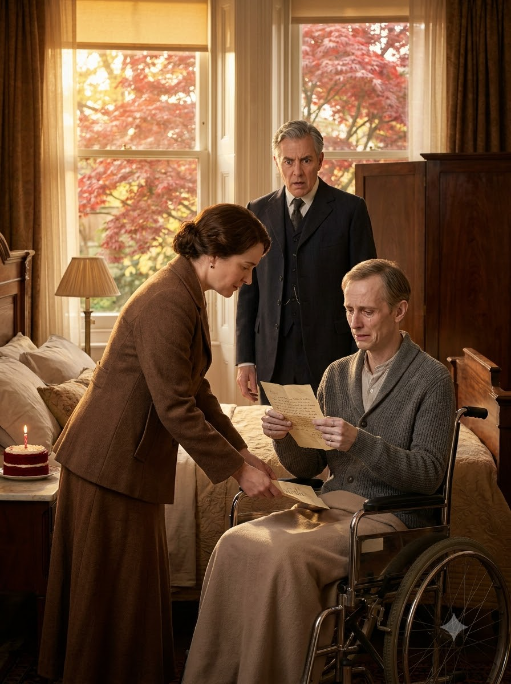
Owen reached out, his trembling fingers hovering over the yellowed parchment before finally smoothing it flat across his lap.
The handwriting on the envelope matched, exactly, the script tucked away in my archives. Grace’s handwriting. Elegant, fluid, slanting slightly to the right.
My chest tightened painfully. Grace had died instantly from a ruptured aneurysm ten years earlier. There had been no warning. No long goodbye. No window of time for her to write letters or plan future deliveries.
Yet here it was, resting under the soft autumn light of the bedroom.
“Where did you get this, Clara?” I asked, my voice dropping to something flat and dangerous as I finally crossed the threshold into the room.
Clara didn’t flinch as I entered. She rose slowly from her chair, smoothing the front of her plain wool skirt, her hazel eyes calm and unwavering.
“Your wife didn’t leave this in a kitchen drawer, Mr. Whitmore,” Clara said softly. “She left it with my mother, Sarah Bennett, ten days before she passed.”
Something shifted into place in my mind. Sarah Bennett. Grace’s closest childhood friend from her hometown in upstate New York. A woman I had cut entirely out of our lives after the funeral, because anyone from Grace’s past was too painful to face.
“Why did you wait ten years?” Owen whispered, his voice cracking as he looked up from the letter.
“Because your mother left very specific instructions,” Clara replied, turning her gentle gaze toward my son. “She told my mother, ‘Sarah, if something sudden ever happens to my health, don’t give this to Owen until he turns twenty-five. He’ll need his father’s protection while he’s young, but he’ll need my truth once he’s a man.'”
Owen broke the wax seal slowly, his weak fingers fumbling with the paper. I stood frozen at the foot of his bed, every instinct that had made me a sharp, decisive businessman completely useless against what was unfolding in front of me.
He began reading in silence, his eyes moving down the page. Within seconds his shoulders dropped, and a ragged sob broke out of his chest.
“Dad…” Owen choked out, his eyes wide with a realization that seemed to shake him to his core. “You need to see this.”
I crossed the room, my shoes heavy against the hardwood floor, and took the page from his hand. The words felt like they burned against my palms:
“My darling Owen,
If you’re reading this, it means I’m no longer there to watch over you, and you’ve reached your twenty-fifth year. I need you to listen carefully. Your father, Nathan, is a man who builds walls out of brick and money because he’s terrified of losing the people he loves. He works because the quiet reminds him of everything he can’t control. Don’t mistake his absence for a lack of love. He loves you fiercely, desperately, but he doesn’t know how to face an illness without trying to buy his way out of it.
But there’s something else you need to know, Owen. What’s happening in your body isn’t random. It’s genetic. My grandfather carried it. I carry the markers for it. And Nathan knows this. He didn’t build his real estate empire out of vanity, sweetheart. For ten years he’s been quietly selling off pieces of it to fund the Whitmore Genetic Research Foundation in Boston. He has been searching for your cure since the day I stopped breathing.”
The floor seemed to tilt beneath me.
The secret I’d spent a decade guarding, the enormous sums I’d hidden behind shell companies and anonymous medical grants so Owen would never have to grow up under the shadow of what his mother’s bloodline carried, had just been laid bare in front of him.
I closed my eyes, the weight of ten years of quiet, exhausting effort pressing down on me all at once.
“You… you never told me, Dad,” Owen whispered, his voice barely above a breath. “You let me believe you only cared about the buildings.”
“Because buildings don’t die, Owen,” I said, my voice breaking for the first time in ten years. I dropped to my knees beside his wheelchair and gripped his thin arm. “I couldn’t save your mother. There was no way to save her in time. So I decided I would build something that could save you instead. I didn’t want you living your life under a countdown.”
Clara stepped back toward the window, her expression calm and unshaken. “The countdown isn’t over yet, Mr. Whitmore,” she said quietly, glancing down at her canvas suitcase. “The Boston research team cleared the final stage of their trial this morning. That’s the real reason I’m here.”
PART 3 — The Extraction
The house shifted instantly from a quiet sickroom into something closer to a rescue operation.
Clara wasn’t an ordinary hired nurse. She was a clinical research coordinator with the very foundation I had been quietly funding through anonymous channels. She had pulled Owen’s medical file from Saint Luke’s Medical Center the same hour Dr. Pierce delivered his two-week prognosis.
“The doctors here are working off outdated information, Nathan,” Clara explained as we stood over the desk in my private study. “They see how weak Owen is and assume his organs are shutting down. But our research shows his body is in a severe metabolic crash caused by the genetic markers. If we can stabilize him long enough to get him to Boston, the gene therapy can correct the sequence.”
“What are his odds?” I asked, the businessman in me taking over.
“Forty percent if we move now,” Clara said plainly. “Zero if he stays in this bed and waits out the two weeks.”
I didn’t hesitate. I picked up the phone and called my private aviation team. “Get a medical transport jet ready at O’Hare immediately. I need a critical care crew. We’re moving him tonight.”
When we returned to prepare Owen for the trip, the illness was written plainly across him. His skin was nearly translucent, his breathing shallow and uneven. But the emptiness that had settled in his eyes was gone, replaced by something fierce and focused. The red velvet cake sat half-eaten on the tray beside him — the first real food he’d taken in a week.
“Let’s do this, Dad,” Owen whispered, his weak hand tightening around mine with surprising strength. “I want to see the maple tree bloom next spring.”
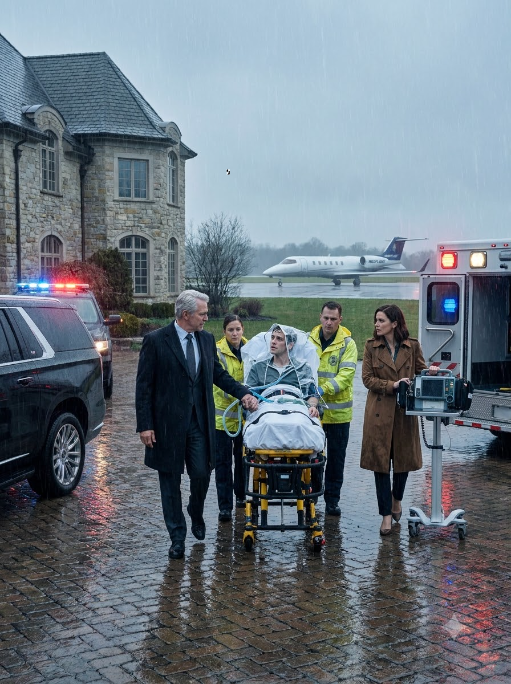
The ambulance pulled up to our gates at four in the afternoon, under a heavy autumn rain. Red and blue light flickered against the wet brick of the house, throwing long shadows across the yard.
As the paramedics carefully lifted Owen onto the gurney, Dr. Pierce stepped into the foyer, his face tight with concern.
“Mr. Whitmore, this is an enormous risk,” Dr. Pierce warned, stepping in front of me. “Moving him now could send him into cardiac arrest. You’re staking his final days on something unproven.”
I stopped and looked the older doctor squarely in the eyes.
“For ten years I treated my son like something too fragile to touch, Doctor,” I said, my voice steady. “And it brought us here — two weeks. Today we stop hiding. We’re fighting for everything.”
Clara secured the monitors inside the ambulance, her eyes fixed on the steady rhythm of Owen’s vitals. Beep. Beep. Beep. Faint, but holding.
The doors shut behind us, and the ambulance pulled out onto the dark, rain-soaked highway. I sat beside my son, holding his hand, city lights sweeping across his face like passing frames of film.
We were racing against everything, chasing the smallest possible distance between a death sentence and a chance.
FINAL — The Spring Leaf
Six months later, morning light spilled over the Lake Forest estate, warm and golden across the courtyard.
The smell of bleach and stale coffee that had filled the house for months was gone, replaced by the scent of blooming jasmine and fresh earth.
I stood on the back terrace with a cup of espresso in my hand, watching the light stretch across the lawn. Inside, the grandfather clock struck 8:17.
Exactly six months since the countdown began.
The terrace door slid open behind me. I didn’t need to turn around — I already recognized the steady rhythm of the footsteps on the stone.
Owen stepped outside. He wasn’t in a wheelchair anymore. He wore a simple navy sweater, stood tall, and his face had color in it again — nothing like the pale, hollowed look of that winter. The therapy in Boston had done exactly what it promised, clearing the illness from him down to the smallest cell.
He walked to the railing and leaned against it, looking out over the yard.
“The architects finished the plans for the new medical center downtown, Dad,” Owen said, his voice full and steady now. “The board wants your signature before we break ground Monday.”
I laughed, something in my chest finally loosening after ten years. “That signature’s yours now, Owen. You’re running that foundation.”
He smiled — a real, wide smile, the same one Grace used to wear when she’d closed a deal she was proud of. “Then I’ll sign it myself at noon.”
My eyes drifted past him, to the middle of the lawn. The Japanese maple stood there, no longer bare or beaten down by winter. Small red buds were already pushing out along its branches, reaching for the sun.
Clara Bennett walked up the garden path below, a clipboard tucked under her arm, her eyes tracking the tree’s progress. She paused beneath its branches, looked up, then glanced toward the terrace and gave us a small, familiar nod.
Owen looked down at the tree, turning the small silver key he now wore on his watch chain.
“You know, Dad,” he said quietly, watching the red leaves, “Clara was right about that tree.”
“About what?” I asked.
“It really does have an attitude,” he laughed. “It knows it’s the prettiest thing out here.”
I rested my hand on my son’s shoulder, feeling the strength that had come back into him.
For ten years I had believed that being a father meant being a fortress — a man who closed deals in silence, buried his grief in spreadsheets, and built empires to keep the world from getting too close. I thought protecting my son meant keeping the truth from him.
But I had it backwards. Owen never needed a fortress. He needed a father brave enough to be honest, to stand beside him instead of behind a wall.
We didn’t lose that Monday morning. We finally let go of the fear we’d mistaken for safety.
I took a slow sip of my espresso, watching the crimson leaves catch the morning light. The truth was finally out in the open, and it had cost us nothing we couldn’t survive. As Owen and I turned to go back inside, I knew, without a doubt, that the worst of it was behind us.
We had made it through. And this time, we brought the morning with us.
