

PART 3
Neither was Decker.
Mercer extended her hand.
“Agent Osborne.”
Florence shook it.
“Captain.”
“We reviewed the stop.”
“I expected you would.”
Mercer gestured toward a chair.
“We found procedural concerns.”
Florence sat.
“Such as?”
Mercer was direct.
“The original basis for the stop was weak.”
Florence nodded.
“And the escalation was not adequately supported.”
Another nod.
“And there were questions regarding the attempted search.”
Florence remained quiet.
Mercer looked at her.
“We’re correcting those issues.”
“How?”
“Additional training. Supervisor review requirements. Documentation changes.”
Florence considered that.
“And Sergeant Weston?”
Mercer paused.
“He’s receiving formal corrective action.”
Florence nodded.
“Is he being fired?”
“No.”
“I don’t think he should be.”
Mercer seemed surprised.
Florence continued.
“Consequences matter. So does accountability.”
Mercer nodded.
“He requested to speak with you.”
Florence looked up.
“Why?”
“He wants to apologize.”
Florence sighed.
“Fine.”
Weston entered a minute later.
He looked different.
Less certain.
He sat across from Florence.
For several seconds, he said nothing.
Then:
“I was wrong.”
Florence waited.
“I made assumptions about you based on the motorcycle, the neighborhood, and the way you answered my questions.”
She listened.
“I told myself I was investigating a complaint.”
He looked down.
“But somewhere along the way, I stopped investigating and started trying to prove what I already believed.”
Florence said nothing.
Weston continued.
“When you showed that badge, I suddenly became more careful.”
He shook his head.
“And that was the worst part.”
Florence looked at him.
“Yes.”
“I know.”
“No,” Florence said quietly.
“You know now.”
Weston looked up.
She continued:
“The point isn’t that you should have treated me better because I was an FBI agent.”
“I know.”
“You should have treated me that way because I was a person.”
Weston nodded.
“I agree.”
Florence stood.
“Then learn from it.”
He stood too.
“I will.”
She extended her hand.
After a moment, he shook it.
Not as an officer.
Not as an FBI agent.
Just two people acknowledging an uncomfortable truth.
Months later, Florence returned to Maple Street.
She was on the same red superbike.
The same black riding jacket.
The same route home.
As she approached the intersection of Maple and Grant, she noticed a patrol cruiser parked nearby.
The vehicle rolled forward.
Florence glanced at the mirror.
The cruiser followed.
For half a second, she wondered whether history was repeating itself.
Then the lights flashed.
She pulled over.
The cruiser stopped behind her.
The officer stepped out.
A young woman.
Maybe twenty-five.
She approached carefully.
“Ma’am?”
Florence lifted her visor.
“Yes?”
“I’m Officer Ruiz.”
Florence nodded.
“What’s the issue?”
Ruiz smiled.
“Nothing serious.”
She pointed toward the rear of the motorcycle.
“Your license plate bracket is loose.”
Florence looked.
It was.
She sighed.
“I didn’t notice.”
“I figured.”
Ruiz handed back the license.
“You can get it fixed when you have time.”
Florence smiled.
“Thank you.”
Ruiz took a step back.
Then paused.
“I’ve heard about you.”
Florence raised an eyebrow.
“Have you?”
“Yeah.”
Ruiz smiled.
“You’re the agent who got surrounded by half the department.”
Florence laughed.
“That’s one version.”
Ruiz laughed too.
“Have a safe ride.”
“You too.”
Florence lowered her visor.
The cruiser pulled away.
She waited a few seconds.
Then started the engine.
As she rode down Maple Street, she thought about how much could change in a year.
The street looked exactly the same.
The houses.
The porches.
The trees.
The sidewalks.
But she was no longer thinking about the officers who had surrounded her.
She was thinking about the young officer who had approached her without assumptions.
The badge had never been what protected her.
The badge had only revealed how quickly people changed when they believed she possessed authority.
What mattered was making sure respect didn’t depend on authority in the first place.
Florence accelerated gently.
The red motorcycle disappeared into the afternoon traffic.
And behind her, Maple Street became quiet again.
But somewhere in that police station, officers were still reviewing the training material that had come from her case.
At the top of the first page was a simple sentence:
**THE PERSON YOU ARE STOPPING DOES NOT HAVE TO PROVE THEIR WORTH BEFORE YOU TREAT THEM WITH DIGNITY.**
And beneath it was another:
**A BADGE SHOULD NEVER BE THE REASON YOU DECIDE SOMEONE DESERVES RESPECT.**
Florence never asked for her name to be attached to those words.
She didn’t need recognition.
She only wanted the next person stopped on Maple Street—or anywhere else—to be treated fairly before anyone discovered who they were.
That was the part worth remembering.
Not the FBI badge.
Not the motorcycle.
Not the officers who surrounded her.
The real victory was much quieter.
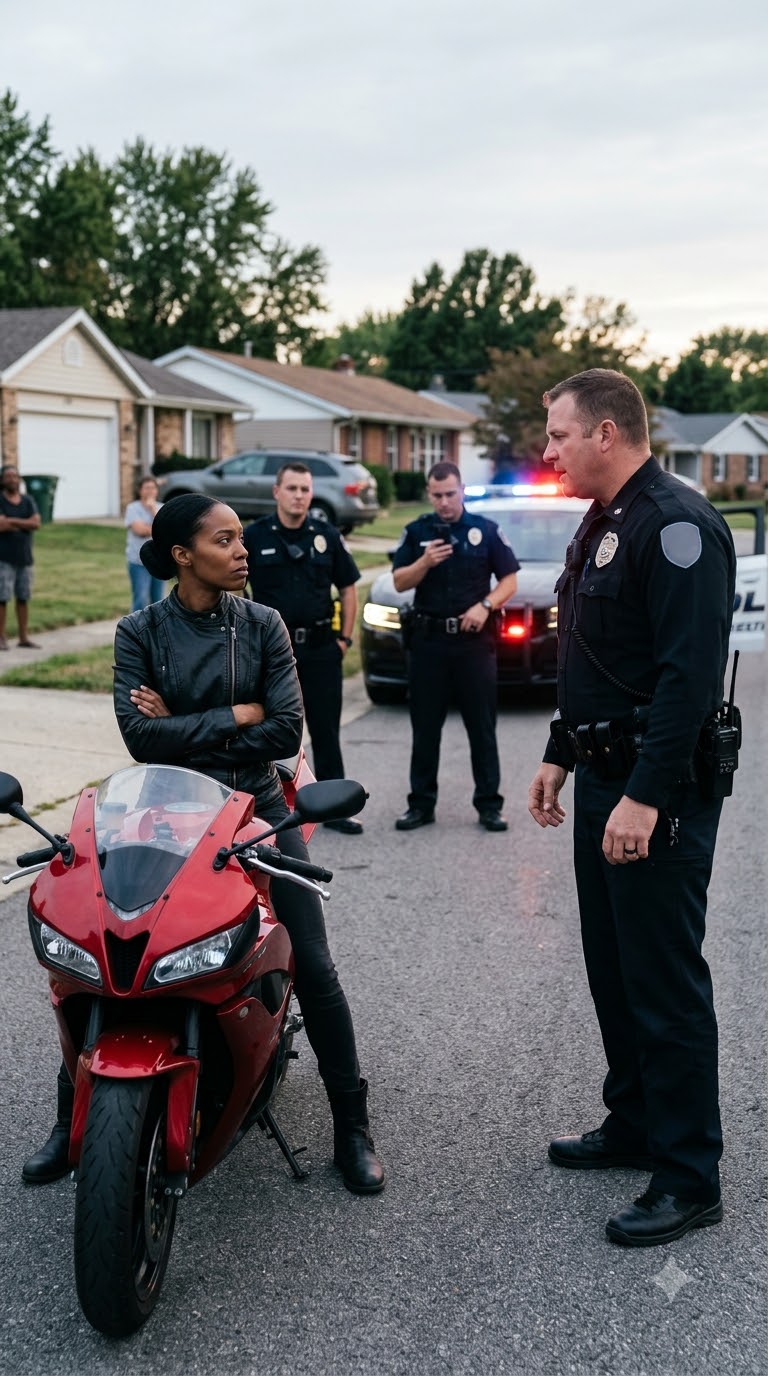
A year earlier, a Black woman had stood beside a red superbike while a group of officers decided what they thought she was.
Now, because of what happened that afternoon, more officers were learning to stop deciding who someone was before they had even listened.
And that mattered far more than any badge ever could.
