

The first thing I saw
I had not seen light for two years, three months, and seventeen days.
So when Doctor Bellanger removed the last gauze bandages from my eyes at Édouard-Herriot Hospital in Lyon, I did not cry right away. I simply stared at the white patch on the ceiling, then at the trembling shape of his white coat, then at the outline of his hand raised in front of my face.
“How many fingers, Madame Delcourt?”
I swallowed.
“Three.”
The doctor smiled.
My mother, sitting to my left, began sobbing like a child.
I remained motionless.
Because the light hurt.
Because the colors were returning too quickly.
Because in this miracle everyone had been waiting for, there was a fear I had told no one about.
For two years, I had lived in darkness with only my husband’s voice as my compass.
Antoine told me where to place my hand, where the glass of water was, which dress he had chosen for me, who had come, who had not come, who still loved me and who had forgotten me.
And I believed him.
Because when you can no longer see, you learn to trust voices.
Even when they lie.
That morning, Antoine had not come to the hospital.
He said an unexpected meeting at the notary’s office forced him to stay. He promised he would pick me up at six o’clock with white flowers, “like the first day.”
But the doctor allowed me to leave earlier.
“Go home gently,” he said. “Avoid strong lights. No intense emotions today.”
I should have listened to him.
My mother wanted to accompany me all the way home, but I refused. I wanted to see my apartment alone. To see again the walls my fingers knew better than my eyes. To see the kitchen table where I had kneaded pie dough in the dark. To see the balcony overlooking the plane trees on Cours Vitton. To see my life again.
I took a taxi.
On the way, Lyon passed through me like a foreign city. The cream-colored façades, the green shutters, the hurried passersby under the March sky, the shiny shop windows, the red traffic lights… Everything seemed too vivid, too loud, almost indecent.
I thought about Antoine.
About his face that my memory had kept younger.
About his hands that had guided me through the corridors.
About his tender voice when he told me:
“Don’t worry, Mathilde. I am your eyes now.”
That sentence had once reassured me.
In the taxi, it gave me chills.
I climbed the two floors without an elevator slowly, my hand on the railing. In front of our door, I stopped.
There was a smell of coffee.
And perfume.
Not mine.
A sweet, vanilla, bold perfume.
I opened the door with my key.
The apartment was bright.
Far too bright.
The living room curtains were drawn open, the windows wide open, and on the gray sofa I still thought was impeccable, a woman’s scarf had been thrown like a signature. Red. Silk. I recognized it before I even understood why.
My sister always wore red.
Élise.
My little sister.
The one Antoine had sworn he had taken back to Lille two years earlier, after our argument. The one he told me had rebuilt her life there, far from us, far from my illness, far from “the guilt of not knowing how to help me.”
For two years, whenever I asked why Élise never called me, Antoine would sigh.
“She never could handle your blindness, Mathilde. Some people run away from misfortune.”
I had cried for her.
I had prayed for her.
I had defended her silence.
Then I heard a laugh in the kitchen.
A woman’s laugh.
Familiar.
I moved forward silently.
Each step was a wrenching. The parquet floor I knew by touch creaked under my feet as if it wanted to warn me. My heart was beating so hard I was afraid they would hear it before they saw me.
The kitchen door was ajar.
And there, I saw.
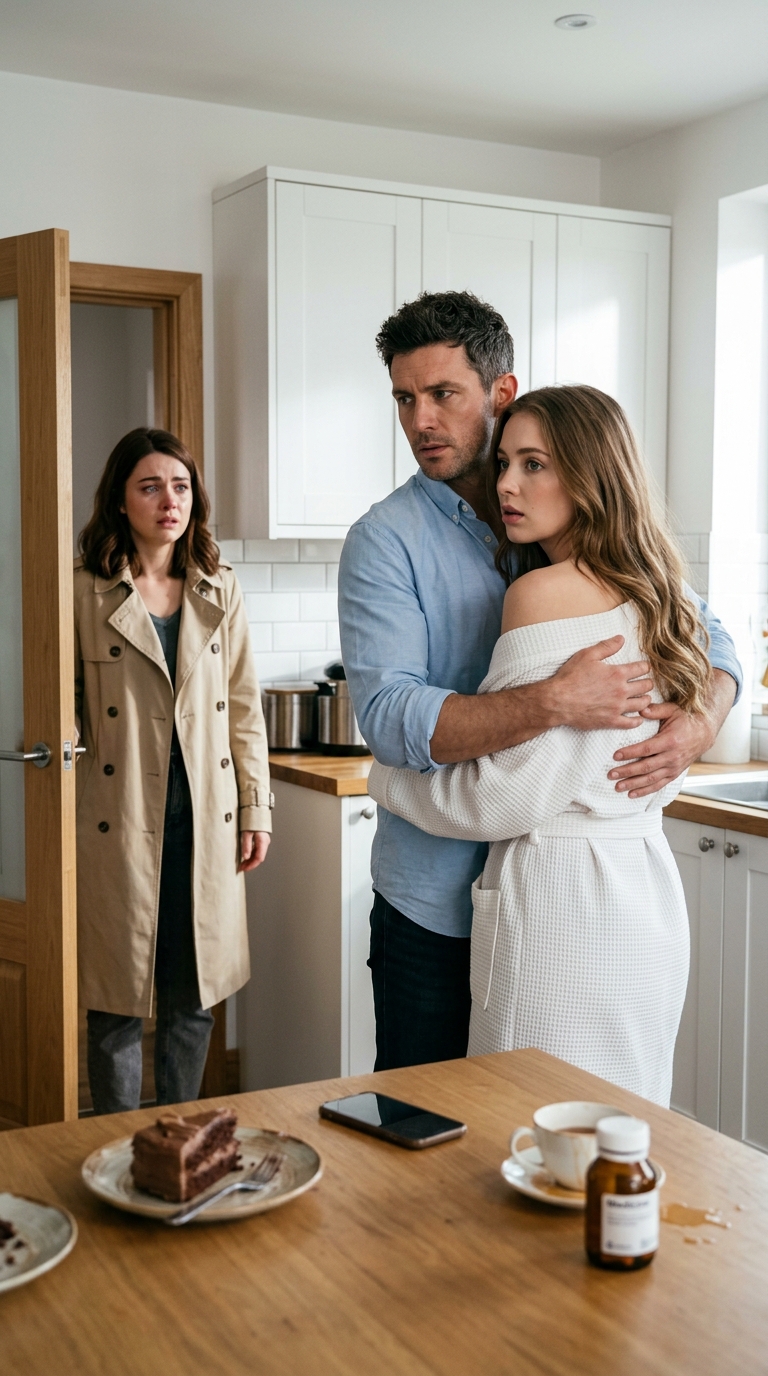
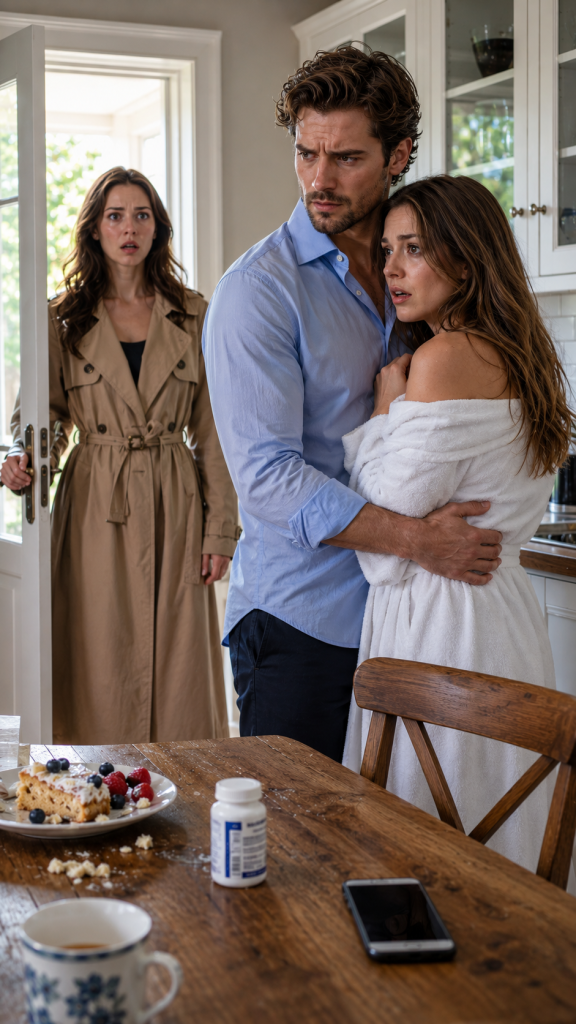
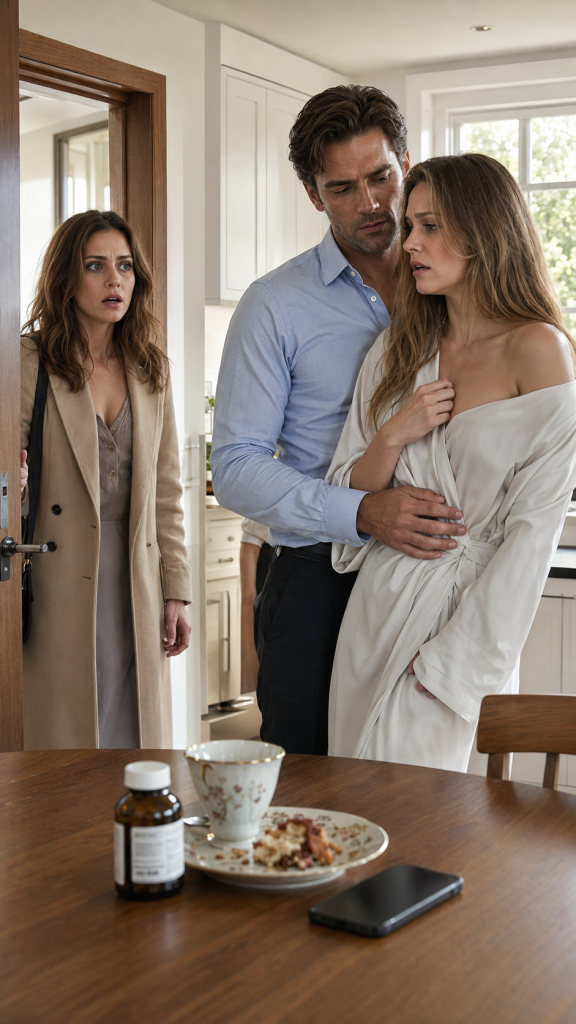
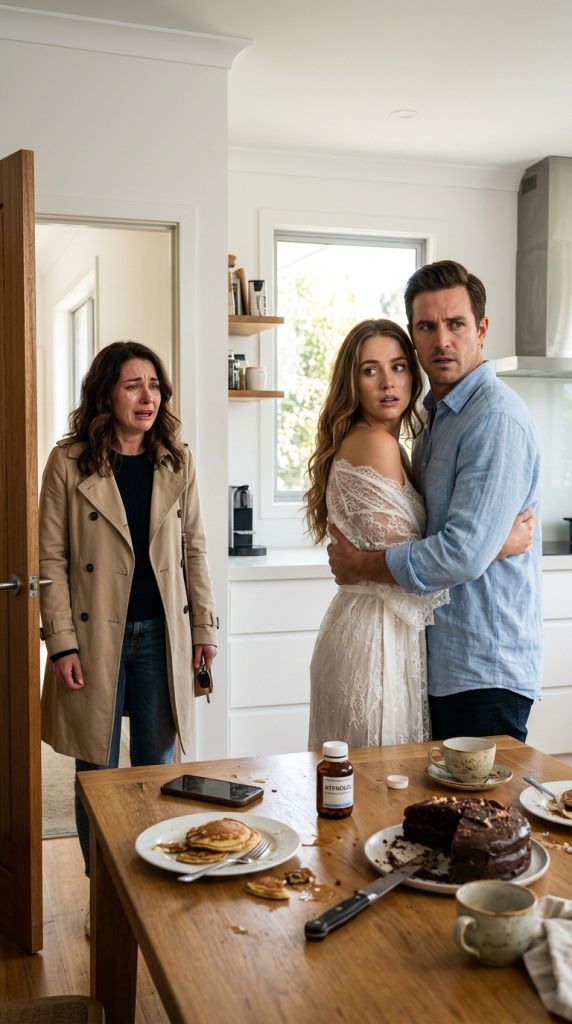
Antoine was standing between my sister’s legs.
Élise was sitting on my kitchen table — the same one where, three days earlier, I had prepared her birthday cake by touch, guided by the smell of lemon and the shape of the mold. She was wearing my white linen bathrobe. The one Antoine had given me when I came home from the hospital after the accident.
He was kissing her.
Not like a man who cheats once.
Like a man coming home.
His hands knew her body with familiar ease. Élise laughed against his mouth, her fingers in his hair, her bare feet resting on a chair I myself had repainted blue before losing my sight.
I stayed in the doorway.
Silent.
The blind woman watched them.
There was a strange moment when my mind refused to inhabit my body. I felt no anger. Not yet. Only a cold precision.
The coffee stain on the countertop.
The red nail polish on Élise’s nails.
Antoine’s phone lying near the sink.
And on the lit screen, a message.
“She’ll never see clearly enough to understand. After the sale, we leave.”
I did not move.
Élise gently pushed Antoine away.
“Are you sure she won’t be back before tonight?”
“Mathilde?” he said, laughing. “Without me, she can’t even cross the building’s hallway.”
My sister smiled.
“You’re cruel.”
“No, realistic. She depends on me for everything. Even if she recovers a little, Bellanger said it would be gradual. She’ll see shadows, shapes. Nothing more.”
I understood then.
Antoine did not know.
He did not know that I could see his back, the silver buckle of his belt, my sister’s red mouth, the whole truth laid out before me like a stage play.
Élise picked up my favorite mug, the one with the little blue flowers.
“And the papers?”
Antoine pulled away from her and opened a drawer.
“Almost ready. She’ll sign tomorrow. I’ll tell her it’s to renew the apartment insurance. She always signs where I put her finger.”
My breathing stopped.
“And Mom’s inheritance?” Élise asked.
Antoine lowered his voice.
“Already transferred to the management account. After the final power of attorney, Mathilde will have nothing left in her name. Not the apartment. Not the house in Cassis. Not the shares in the gallery.”
My mother.
The inheritance.
The gallery.
They had not only stolen my marriage.
They had prepared my social, financial, and legal disappearance.
My fingers tightened on the door handle.
I could have screamed.
I could have thrown that mug against the wall.
I could have walked in and forced them to see that the miracle had happened.
But one thing held me back.
On the countertop, near the coffee maker, there was a small brown bottle.
I recognized it immediately.
My evening drops.
The ones Antoine had given me every night since the preparatory operation. The ones he said prevented “inflammation.”
The day before, Doctor Bellanger had said a strange sentence to me:
“Your tests show residues of a product I never prescribed to you.”
I took one step closer.
Then another.
This time, Antoine heard the parquet.
He turned around.
Our eyes met.
His face lost all color.
Élise let out a cry, pulling my bathrobe over her bare legs.
I picked up the bottle between my fingers.
I read the label.
It was not my name.
It was not a prescription.
It was a homemade preparation, hastily stuck on, with three words written in black marker:
“Night dose — slow recovery.”
Antoine took a step toward me.
“Mathilde… put that down.”
I looked up at him.
For the first time in two years, he understood that I could see him perfectly.
Then I smiled.
Not because I was happy.
Because finally, he was afraid.
Behind me, in the hallway, my phone vibrated.
A message from Doctor Bellanger had just appeared:
“Do not go home alone. The results confirm deliberate poisoning. Call the police immediately.”
The first thing I saw — Part 2
Doctor Bellanger’s message shone on my phone screen like a second operation.
“Do not go home alone. The results confirm deliberate poisoning. Call the police immediately.”
For a moment, the world stopped.
The kitchen was bathed in the soft light of late afternoon. The white tiles, the glasses in the sink, the lemon cake crumbs still stuck in the grooves of the table… everything looked ordinary.
That was what was most terrifying.
Evil had not entered my home with a knife.
It had drunk my coffee.
It had slept in my bed.
It had held my hand to cross the street.
Antoine took a step toward me.
“Mathilde, listen to me.”
His voice had become low, warm, controlled again. The voice of the patient husband. The voice of the man who had taught me to doubt my own perceptions.
Élise was no longer playing. She held my bathrobe against her chest, her face pale.
“You can really see?” she asked.
I did not look at her.
I looked at Antoine.
“How long?”
He blinked.
“How long what?”
I raised the brown bottle.
“How long have you been putting this in my eyes?”
His face closed.
“You’re talking nonsense. You’ve only just regained your sight, you’re disoriented. The doctor must have warned you: the first days can cause misinterpretations.”
I laughed.
A short, empty laugh.
“Misinterpretations? Like seeing my husband kissing my sister on my kitchen table?”
Élise lowered her head.
Antoine turned toward her.
“Go get dressed.”
“Antoine…”
“Now.”
She got down from the table, her legs shaking. I then saw, hanging on the back of a chair, the green dress I had given my sister for her twenty-ninth birthday. So she had never left. She had never disappeared to Lille, never rebuilt her life far from me. She had lived in the blind spots my husband had created.
I placed the bottle on the table without really letting go of it.
My phone was still in my hand.
I pressed the side button twice.
The emergency call shortcut opened.
Antoine saw it.
His mask fell.
“Don’t do that.”
“Why? Are you afraid we’ll check?”
“I’m afraid you’ll ruin your life over a misunderstanding.”
“My life?” I said softly. “You’ve already sold it piece by piece.”
He moved closer.
This time, I stepped back.
I knew the apartment in the dark. Now that I could see, he could no longer trap me. I knew where the rug folded, where the chair creaked, where the entryway furniture left just enough space to pass.
“Mathilde, give me that phone.”
“No.”
His expression changed.
No more softness.
No more worried husband.
Just a man who had just realized his prey could see the exit.
He lunged.
I deliberately dropped the blue-flowered mug.
The porcelain shattered on the floor.
Antoine stopped by reflex, surprised by the noise. That tenth of a second was enough. I moved behind the table and threw the bottle toward the living room.
He rushed to catch it.
Not toward me.
Toward the evidence.
And that was when I understood how guilty he was.
At the same moment, a voice came from my phone.
“Police emergency, what is your emergency?”
I brought the device to my ear.
“My name is Mathilde Delcourt. I’m at 18 Cours Vitton, Lyon sixth arrondissement. My husband tried to poison me to slow my visual recovery. He’s with me. He’s trying to destroy the evidence.”
Antoine froze.
In the hallway, Élise let out a sob.
“Ma’am, are you safe?” asked the operator.
“No.”
A brief silence.
Then:
“Lock yourself in if possible. A team is on the way.”
Antoine straightened up slowly.
“You just made the biggest mistake of your life.”
I finally looked at him the way one looks at a stranger.
“No, Antoine. The first mistake of my life was believing your calmness was love.”
He walked toward me.
I ran.
I had not run in this apartment for two years. The hallway seemed to rush at me, the walls too close, the colors too violent. But my legs still knew. I pushed open the door to the guest room, entered, and turned the key.
Antoine knocked immediately.
“Open up.”
I kept my back against the door.
My breath burned.
“Mathilde, open this door.”
His voice was calm again.
It was worse than the blows.
“You’re going to call the police and tell them you panicked,” he continued. “You’ll tell them you misinterpreted a private conversation. Élise will confirm.”
From the other side of the hallway, my sister shouted:
“No.”
Silence fell.
“What did you say?” Antoine asked.
Élise’s voice trembled, but she continued.
“I won’t confirm.”
“Have you forgotten everything I’ve done for you?”
“You lied to me too.”
I closed my eyes.
A strange reflex for a woman who had just regained her sight.
Élise was crying.
“You told me the drops were prescribed. You told me she would never really recover. You told me she would be placed in a specialized home after the sale, that she would be better cared for…”
My chest tightened.
Placed.
They had prepared that too.
A falsified medical file. A wife declared dependent. Guided signatures. Assets transferred. Then a rest home, somewhere far from Lyon, far from my mother, far from my gallery, far from anyone who could ask the right questions.
Antoine did not answer right away.
Then I heard a dull sound.
Élise screamed.
“Antoine, let go of me!”
I turned the key without thinking.
When I opened the door, he was holding my sister by the wrist. Not violently enough to leave obvious marks. Just hard enough to remind her who was in charge.
He saw me.
“Very well,” he said. “Since you both want to play the victims, we’ll wait for the police together.”
But I noticed his other hand.
He had his phone.
And on the screen, an ongoing call.
Not to a lawyer.
Not to the police.
To his associate at the notary’s office.
“Who are you calling?” I asked.
He smiled.
“Someone who knows how to make documents disappear before amateurs in uniform understand what they’re looking for.”
I understood he was not just talking about the papers in the apartment.
He was talking about the inheritance.
The power of attorney.
The accounts.
Everything he had started to steal.
So I did the only thing he had never anticipated.
I called my mother.
She answered on the first ring.
“Mathilde? Are you home safely?”
“Mom, listen to me without asking questions. Go to the gallery. Now. Open the safe under Dad’s desk. The code is Grandma’s birthdate. Take the property deeds, the company shares, and the red file. Don’t let anyone in. Antoine tried to steal from me.”
My mother did not shout.
She did not cry.
She simply said:
“I’m going.”
I had never loved my mother as much as in that moment.
Antoine turned pale.
“You don’t even know what’s in that safe.”
“No,” I said. “But you do.”
In the distance, at last, sirens rose in the street.
Antoine looked at the window, then the front door, then me.
He calculated.
As always.
But this time, there was no more darkness to help him.
When the police entered, he had already put on his respectable man’s face again. Buttoned shirt, steady voice, tired expression.
“Gentlemen, my wife underwent eye surgery this morning. She is in a very unstable emotional state. I am a notary, I understand the gravity of her accusations, but I assure you that…”
“The bottle is there,” I said.
A gloved policeman picked up the small brown bottle near the sofa.
“And my doctor has the test results.”
I handed over my phone.
Doctor Bellanger’s message was still visible.
Then Élise came out of the hallway.
She had dressed hastily. Her mascara had run. She no longer looked like the triumphant woman sitting on my table.
“I want to make a statement,” she said.
Antoine slowly turned toward her.
“Élise.”
She stepped back.
“He asked me to give him the drops when he wasn’t there. He said it was treatment. He said Mathilde was fragile, that the doctors didn’t want to tell her the truth. I believed him.”
“You’re lying,” Antoine said.
But his voice trembled.
Just once.
The police heard it.
So did I.
Élise continued, as if finally purging two years of poison.
“He also told me about the signatures. He bragged that she signed everything. He said a blind woman in love was ‘easier than an elderly client.’”
I felt like my body was going to split in two.
Not because of the betrayal.
Because of the contempt.
So that was what I had been to him.
Not a wife.
An easy procedure.
Antoine was placed in custody that evening.
When the police put the handcuffs on him, he no longer looked at me.
Men like him cannot stand the faces of their witnesses.
Especially when they thought those witnesses were blind.
The following weeks were a long corridor.
Toxicological analyses.
Interrogations.
Lawyers.
Medical expert reports.
Freezing of accounts.
Provisional suspension of Antoine by the chamber of notaries.
My mother recovered the documents in time. Antoine’s associate tried to enter the gallery that evening, claiming an urgent file. She called the building guard, then the police. In the safe, they found the original of my father’s will, the property deeds for the Cassis house, and the statutes of the family gallery.
Everything Antoine had tried to divert.
Doctor Bellanger testified.
The substance in the drops was not meant to make me permanently blind. It was more perverse. It caused recurrent inflammation, mild enough to pass for a complication, strong enough to slow my recovery, prolong my dependence, and delay my autonomy.
“He didn’t want you to lose your sight,” the doctor explained to me. “He wanted you never to regain it quickly enough.”
That sentence stayed with me for a long time.
Because it summed up Antoine.
He did not destroy all at once.
He diminished.
He delayed.
He wrapped prisons in tender gestures.
Élise was charged with complicity in the financial maneuvers, but her testimony helped prove the essentials. I did not forgive her right away. Perhaps forgiveness was not even the right word.
The day she came to see me, three months later, in the restoration workshop behind the gallery, she wore a gray coat and no makeup.
“I won’t ask you to forgive me,” she said. “I just wanted to tell you that I’m going to leave. Not to Lille. For real this time.”
I continued cleaning the old frame in front of me.
“Did you love him?”
She answered after a silence.
“I loved what he said about me when I felt invisible.”
I looked up.
“So you accepted that I became invisible in your place.”
She cried.
I did not move.
“Yes,” she murmured. “And it’s unforgivable.”
For the first time, she did not try to defend herself.
Perhaps that was the day my anger began to change shape. It did not disappear. It became a boundary.
“I don’t want to see you for now,” I told her.
She nodded.
“I understand.”
“But if one day I write to you, don’t answer with excuses. Answer with the truth.”
She nodded, then left.
I watched her go.
I could finally choose what I wanted to see.
And what I refused to look at anymore.
Antoine’s trial took place the following winter.
He arrived at court in a dark suit, surrounded by two lawyers. He had lost weight. His temples had turned gray. Yet when he spoke, he still tried.
He talked about my operation, my emotions, my “excessive interpretation” of the scene discovered in the kitchen.
Then the prosecutor played the recording.
Because my phone that day had not only called for help.
It had recorded.
We heard his voice:
“She depends on me for everything.”
Then Élise’s:
“And the papers?”
Then his:
“She’ll sign tomorrow. She always signs where I put her finger.”
In the courtroom, no one moved.
Antoine finally lowered his eyes.
It was the only admission he was capable of offering.
He was convicted of administering a harmful substance, abuse of weakness, attempted patrimonial fraud, and falsification of documents. He lost his practice, his title, his freedom, and the polished reputation behind which he had hidden his cruelty.
I did not smile at the verdict.
Justice is not a celebration.
It is a door that closes.
But when I left the courthouse, Lyon was covered in pale light. My mother was waiting for me at the bottom of the steps, a blue scarf around her neck.
“Do you want me to take you home?” she asked.
I took her arm.
Then I gently let it go.
“No. I’m going to walk a bit alone.”
She understood.
Mothers sometimes understand before words are spoken.
I walked slowly along the banks of the Rhône. The bare trees drew black lines against the sky. The façades were reflected in the water. Everything was simple, clear, almost fragile.
I stopped in front of a shop window.
For two years, I had not seen my own face.
The woman looking back at me had changed.
Dark circles.
A thin scar near the temple, a souvenir of the accident.
Eyes still sensitive to light.
But she was standing.
And above all, she was looking at herself without asking anyone to tell her who she was.
A year later, I reopened the Delcourt gallery under my name only.
On the evening of the inauguration, there was champagne, restored paintings, polite strangers, moved old clients, and my mother, who told everyone that I had hung the main canvas myself.
At the back of the room, a new work drew everyone’s attention.
A large black-and-white photograph.
An empty kitchen.
A wooden table.
A broken mug on the floor.
And, in the center, an open window onto the light.
I had called it:
“The first thing I saw.”
A critic asked me why that title.
I looked at the image for a long time.
I could have answered: my husband.
I could have answered: my sister.
I could have answered: the betrayal.
But that was not true.
The first thing I had really seen that day was not their kiss.
It was not the bottle.
It was not even the lie.
It was myself.
Me, standing in the doorway.
Me, silent but not defeated.
Me, finally understanding that seeing does not only mean opening your eyes.
Seeing means stopping believing those who describe the world to you in order to trap you in it better.
So I smiled at the critic.
“Because that day, sir, I regained much more than my sight.”
Outside, the lights of Lyon came on one by one.
I closed the gallery after the last guest.
Then I went home alone.
In my apartment, the kitchen table had been replaced. The curtains were new. My white bathrobe had disappeared long ago. But I had kept the broken mug.
Not to suffer.
To remember.
I placed the key on the entryway furniture, turned on the light, and stood for a few seconds looking at my own living room.
No one was guiding me.
No one was telling me where to place my hands.
No one was choosing what I had the right to know.
I crossed the room, opened the window, and let the cold air in.
Then, for the first time in years, I made tea in my kitchen without listening for whether someone was lying behind me.
And when the steam rose in front of my eyes, clear and light, I understood that my life was not beginning again after Antoine.
It was simply returning to its true owner.
Me.
