

PART 1
Brandon Noble had first prepared to sign the closing paperwork for 447 Maple Drive.
Actually, that wasn’t entirely accurate.
He had rejected that address after his mother insisted the number carried bad luck. Eventually, his real estate agent located another house at 412 Maple Drive.
Same neighborhood, better energy.
The home was situated in Oakwood Heights, roughly forty-five minutes from Washington, D.C. It was a three-bedroom brick Colonial with a front yard large enough to require regular maintenance.
Buying it had nearly exhausted the savings Brandon had accumulated over fifteen years.
But it was his.
The neighbors just hadn’t figured that out.
Oakwood Heights wasn’t merely another suburban development.
It was a statement about social standing.
Behind its gated entrances stood expensive homes, surveillance cameras that actually worked, and a homeowners association known for sending warning letters when lawns exceeded the approved height by even half an inch.
Houses started at approximately $800,000, with many selling for considerably more.
The neighborhood’s advertising materials proudly promoted its welcoming atmosphere and growing diversity.
Yet during his initial tour, Brandon had spotted only two other Black households.
Neither family seemed comfortable holding his gaze.
In hindsight, he should have understood that silence.
At precisely eleven on Saturday morning, Brandon pulled into his driveway.
His black Honda Accord looked almost out of place among the luxury BMWs and Teslas lining the neighboring properties.
He was dressed casually in jeans, a Howard University sweatshirt, and a baseball cap covering his short hair.
He climbed out and lifted the trunk.
Inside sat four cardboard cartons, each labeled carefully in his handwriting.
Kitchen.
Bedroom.
Office.
Books.
He had already made four trips to the house earlier that week.
Every one of those visits had occurred in broad daylight. He had never behaved as though he had anything to hide.
On two occasions, he had even waved to a woman who lived three doors down.
Both times, she had ignored his greeting, watched him suspiciously, and disappeared behind her curtains.
Her name was Caroline Sullivan.
Brandon hadn’t learned that yet.
Nor did he know that she had called the police six times in the preceding month.
Four of those complaints involved Black or Latino workers who had every right to be performing their jobs at neighboring homes.
What Brandon did know was that the woman seemed unusually interested in everything he did.
The house’s previous occupants, the Harrisons, were an elderly white couple who had moved into assisted living.
Everyone Brandon had spoken to described them as wonderful neighbors who had enjoyed many happy years on the street.
Their former home had stood empty for nearly two months.
Long enough for patches of the lawn to lose their green color.
Long enough for promotional flyers and unwanted letters to fill the mailbox.
And long enough for the surrounding residents to develop their own expectations about whoever would move in next.
They imagined someone familiar.
Someone who looked like them.
Someone whose presence would preserve the comfortable image they had created of their neighborhood.
Then Brandon made an offer.
He purchased the property outright, asked for an expedited closing, and completed the transaction without difficulty.
The sale sign disappeared almost overnight.
Within hours, the neighborhood Facebook group began buzzing with questions.
Caroline Sullivan initiated the discussion.
“Does anyone know who bought the Harrison house? I haven’t seen any moving trucks. Seems odd.”
A dozen comments followed.
Nearly every one revolved around the same question.
Who?
Who?
Who?
But nobody bothered to introduce themselves to Brandon.
Nobody knocked on his door with a friendly greeting or a basket of baked goods.
Instead, they watched from behind windows and exchanged theories online.
Brandon pulled two boxes from the trunk.
Sunlight warmed the back of his neck.
A lawnmower hummed somewhere down the block.
A dog barked behind a wooden fence.
The entire neighborhood sounded like an ordinary American suburb on an ordinary weekend.
That sense of normalcy was precisely what Brandon had spent years hoping to find.
Fifteen years as a deputy U.S. marshal had given him a life that was anything but ordinary.
He had tracked fugitives across multiple states.
He had guarded witnesses whose testimony threatened violent criminal organizations.
He had spent more nights than he cared to remember sleeping in hotels, driving rental cars, and living out of suitcases.
His new house was supposed to represent stability.
A place where he could finally stop moving.
Holding the boxes against his chest, Brandon headed toward the front steps.
His keys swung from his little finger, producing a faint metallic jingle.
He briefly caught his reflection in the front window.
Nothing about the image seemed remarkable.
He was simply a homeowner carrying his belongings through his own front door.
But three houses away, Caroline Sullivan interpreted the scene very differently.
To her, Brandon was a threat.
An unwelcome presence.
Someone who disrupted the unspoken rules governing who belonged in Oakwood Heights.
Throughout the week, she had photographed his car and circulated suspicious messages among the neighbors.
“Suspicious vehicle on Maple Drive. Same car, different times. Stay vigilant, neighbors.”
Nobody had considered that the unfamiliar driver might be the new owner.
Because the possibility that a man like Brandon could afford the Harrison property had never entered their minds.
At the entrance, Brandon set one carton down and reached for his keys.
He guided a key toward the deadbolt.
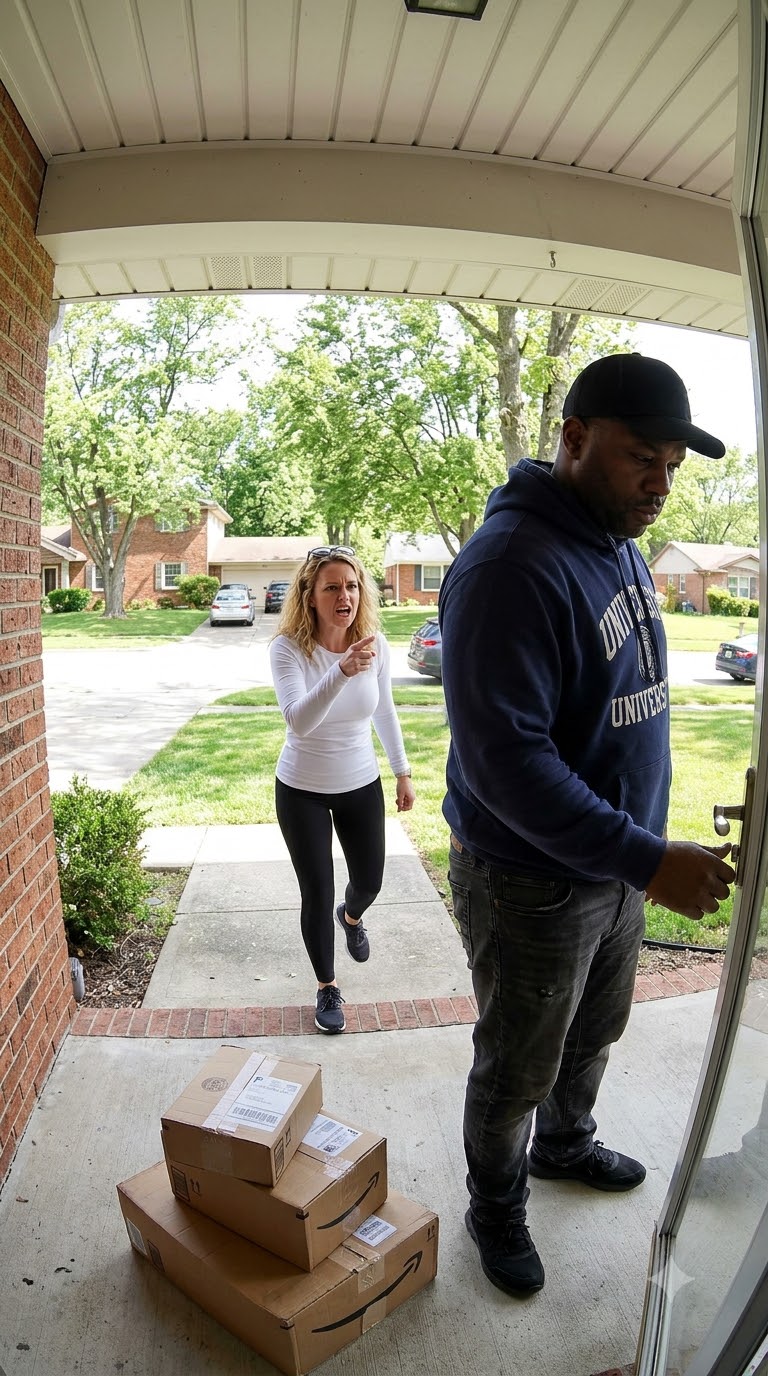
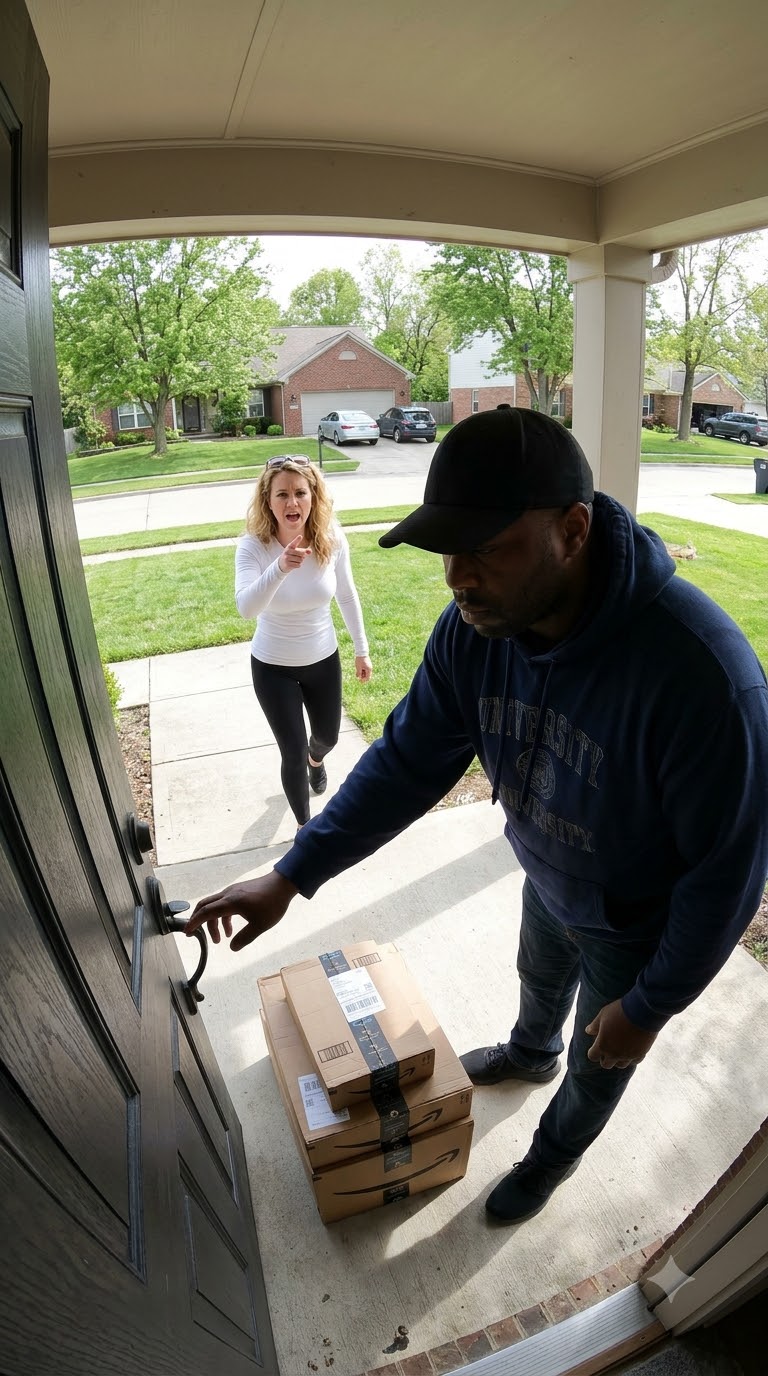
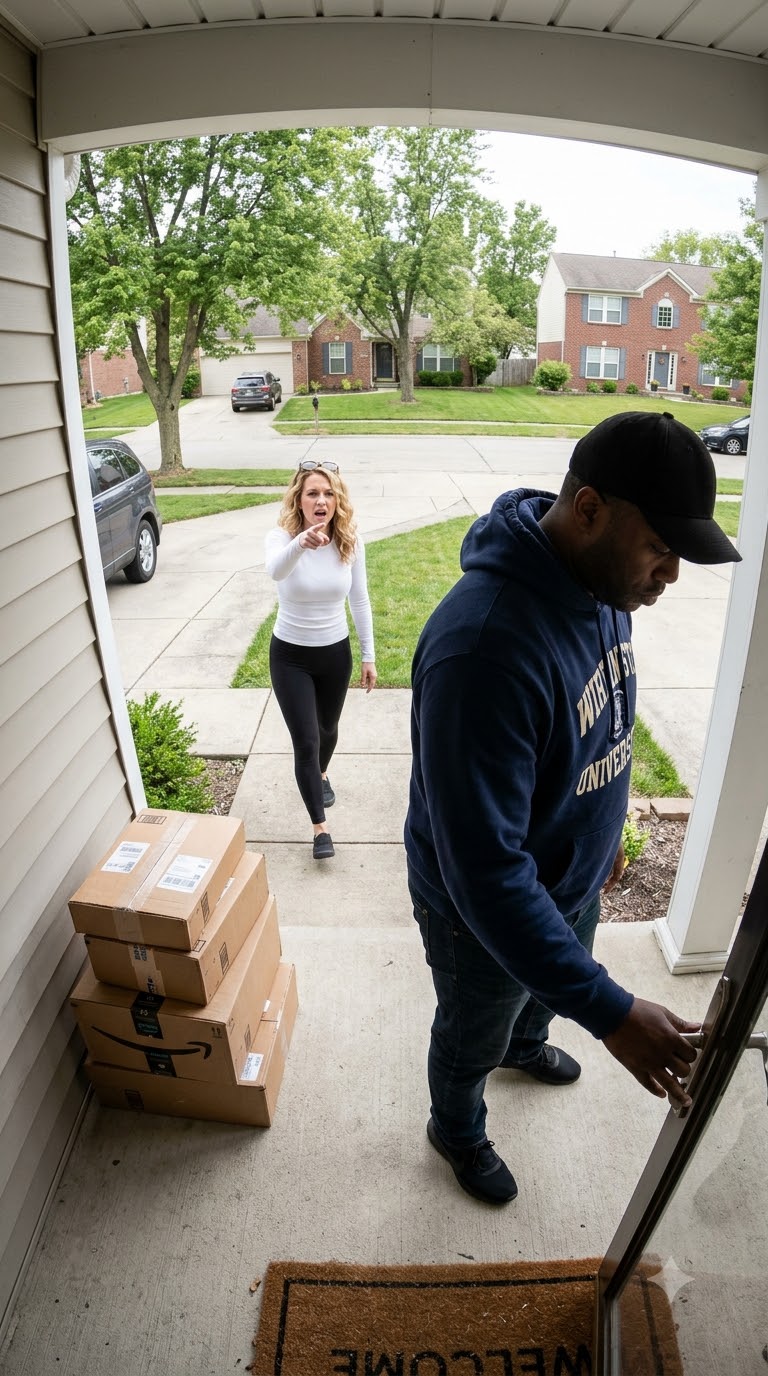
And that was when Caroline’s furious voice tore through the peaceful Saturday morning.
Brandon had encountered dangerous fugitives carrying loaded weapons.
He had confronted gang members who believed they had nothing left to lose.
He had participated in early-morning operations where a single mistake could cost someone their life.
Yet none of that experience had fully prepared him for the hostility produced by a stranger’s racial prejudice.
Nothing had prepared him for the confrontation about to unfold.
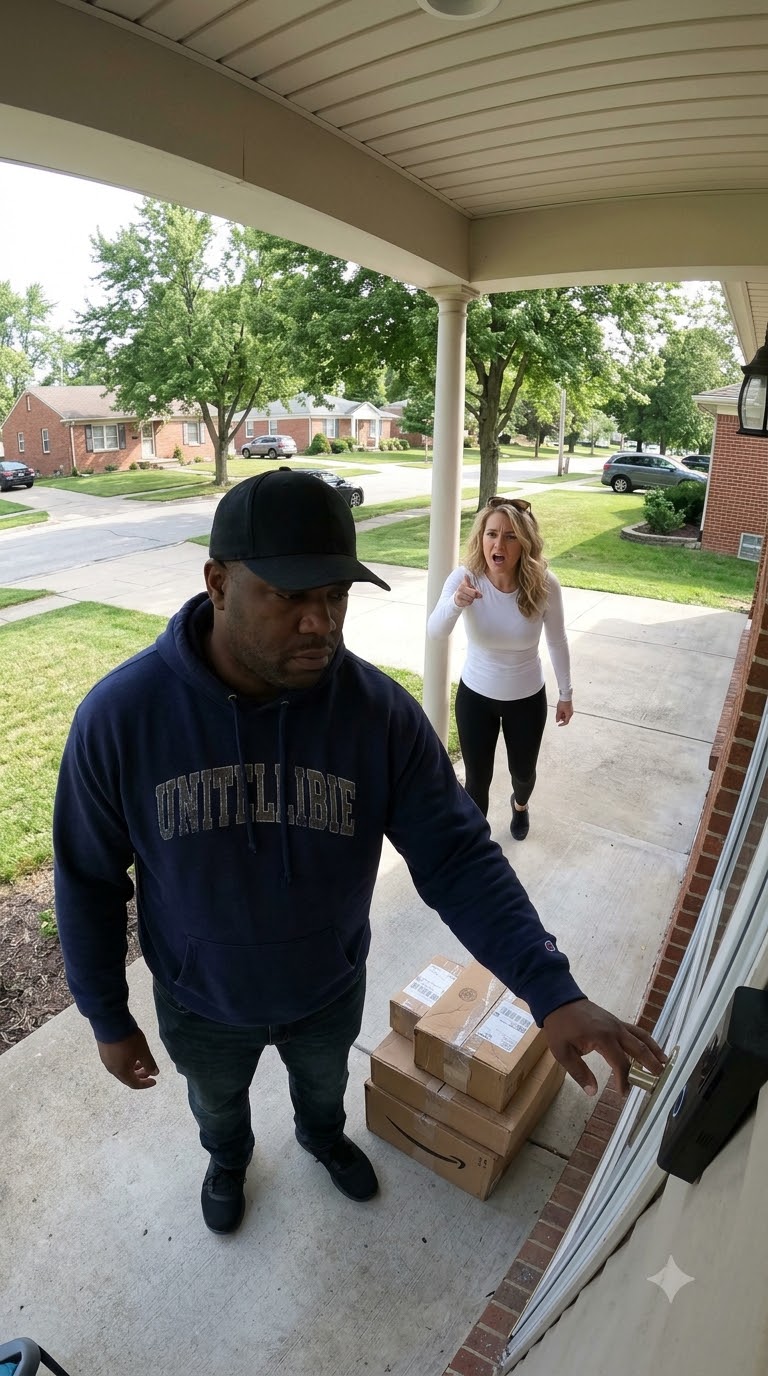
“Get your black ass away from that house right now.”
Brandon froze.
The key stopped just short of entering the lock.
Slowly, he turned toward the voice.
His movements were measured, his hands remained visible, and he carefully avoided anything that might appear threatening.
Caroline Sullivan was striding across her lawn with the confidence of someone who considered herself the unofficial owner of the entire street.
Perhaps, in her mind, she was.
Her designer workout clothes looked more expensive than anything Brandon had worn in months.
Her highlighted hair bounced around her shoulders as she approached.
“I’ve called the police. We don’t let thugs roam around here.”
“This is a good neighborhood.”
Brandon inhaled slowly.
Then he let the breath escape.
He knew this confrontation.
He had endured variations of it in grocery stores, parking garages, and even while attending college.
The surroundings changed.
The assumptions never did.
“Ma’am, I live here. This is my house.”
Caroline’s cheeks flushed a deeper shade of red.
She was shouting so aggressively that moisture collected at the edge of her lips.
“I’ve been watching you case this place for weeks, sneaking around at all hours. The Harrison’s would never sell to someone like you.”
Someone like you.
Three ordinary words weighted with generations of discrimination.
A woman emerged onto a porch two houses away.
Her mailbox read Mrs. Peterson.
She held her purse against her chest as though Brandon might suddenly charge toward her.
Her other hand held a phone, already recording.
“Ma’am,” Brandon said, forcing his voice to remain steady.
Patient.
Professional.
It was the same tone he used to calm frightened witnesses before difficult court appearances.
“I purchased this property 3 weeks ago. I have the closing documents inside. If you’ll just let me—”
“Let you break in. I don’t think so.”
Caroline lifted her phone as though she were displaying proof of a serious crime.
“I have photos of you, dates and times. You’ve been stalking this house.”
More front doors opened.
Mr. Davies appeared across the road.
A young couple stepped onto their walkway.
The Carter family gathered quietly on their porch, watching without approaching.
Their faces showed something different from the suspicion surrounding them.
They looked disappointed.
Almost exhausted.
Perhaps they had witnessed similar scenes before.
“I wasn’t stalking anything. I was moving my belongings into my house.”
“Your house?”
Caroline laughed harshly.
“You can’t afford a house on this street. What did you do? Steal someone’s identity? Forge some papers.”
Brandon clenched his jaw.
He had arrested violent criminals.
He had testified in federal proceedings involving major drug trafficking organizations.
He had received professional commendations from three different U.S. attorneys general.
And now a stranger was standing on his property, questioning whether he had the right to own it.
The sound of sirens approached from the far end of Maple Drive.
Two patrol cars rounded the corner with their emergency lights flashing.
Although the sirens stopped, red and blue reflections continued moving across the houses.
Brandon’s pulse quickened.
His training immediately supplied the familiar instructions.
Hands visible.
No sudden movements.
Stay composed.
Cooperate.
The first cruiser stopped at an angle across his driveway, obstructing part of the entrance.
Detective James Mitchell emerged from behind the wheel.
He was a white man in his forties, with a practiced expression and one hand positioned near the weapon on his duty belt.
Officer Davis stepped out from the passenger side.
He appeared younger and considerably less confident, his anxious gaze moving between Brandon and the gathered spectators.
Neither officer began by questioning Caroline.
They headed straight toward Brandon.
“Sir, step away from the door.”
Mitchell’s tone was commanding, leaving little room for discussion.
Brandon moved away from the entrance and kept his arms where both officers could see them.
“Officers, I’m the homeowner. This is a misunderstanding.”
“Sir, we received a call about a burglary in progress.”
Mitchell studied him carefully.
His attention lingered on Brandon’s sweatshirt, baseball cap, and skin color, as though those details made the accusation more believable.
“Do you have identification?”
“I do. It’s in my wallet, in my back pocket.”
“Keep your hands where I can see them.”
Mitchell moved closer.
“I’ll retrieve it.”
Brandon remained motionless while the detective searched his pocket.
Humiliation rose through his chest.
He was being treated like a suspect on the lawn he had paid for, surrounded by neighbors holding up their phones.
Mrs. Peterson whispered to Mr. Davies.
Brandon couldn’t hear what she said.
He didn’t need to.
Mitchell opened the wallet and examined the identification.
Brandon Noble.
412 Maple Drive.
The detective looked up, his expression still doubtful.
“This address?”
“Yes, sir. That’s my address. I own this house.”
Caroline immediately stepped closer.
“Don’t believe him.”
“He’s lying. Check for wants and warrants. He’s probably got a record.”
Davis radioed dispatch and requested a records search using Brandon’s information.
Brandon knew the result would be clean.
He had never even received a speeding ticket.
Still, the process meant more waiting.
More strangers watching.
More humiliation while he stood on his own property, forced to prove he wasn’t a criminal.
Mitchell held up the license.
“Sir, having an ID with this address doesn’t prove ownership. Could be fake, could be stolen.”
“My closing documents are inside the house. I can show you.”
“You’re not going inside anywhere until we verify your story.”
The detective’s voice hardened.
“For all we know, you broke in earlier and planted fake documents.”
Brandon’s hands briefly curled into fists.
He immediately opened them again.
Discipline.
He needed to stay disciplined.
Because the last thing he wanted was for an ordinary Saturday morning to become the worst day of his life.
And then his phone began ringing.
At first, the vibration was barely noticeable.
A low buzzing against his thigh.
Brandon ignored it.
The phone stopped.
Three seconds later, it started again.
Mitchell glanced toward the pocket of Brandon’s jeans.
“What’s that?”
“My phone.”
“Don’t touch it.”
“I wasn’t going to.”
The buzzing continued.
Then stopped.
Then began a third time.
Caroline folded her arms.
“Probably his accomplice.”
Brandon closed his eyes for a fraction of a second.
He had spent fifteen years learning to control his reactions under pressure, but something about the casual cruelty of that remark nearly broke through his composure.
Mitchell narrowed his eyes.
“Who’s calling you?”
“I don’t know. You told me not to reach for it.”
The detective stared at him.
For a moment, neither man spoke.
Then Mitchell extended his hand.
“Slowly. Take it out and put it on speaker.”
Brandon hesitated.
“Am I being detained?”
“Right now, you’re being investigated.”
“That wasn’t my question.”
Davis shifted uneasily.
Caroline gave an impatient sigh.
Mitchell’s expression darkened.
“Just answer the phone.”
Brandon carefully reached into his pocket.
The screen illuminated.
He recognized the caller immediately.
Deputy Director Evelyn Brooks.
United States Marshals Service.
For a moment, Brandon considered declining the call.
Evelyn was his supervisor, and he had specifically arranged to have the weekend free.
But she rarely called him repeatedly unless something required his attention.
He tapped the speaker icon.
“Brandon?”
Her voice emerged clearly.
“Where are you? I’ve been trying to reach you.”
“I’m at my new house.”
“Everything all right?”
Brandon looked at Mitchell.
Then at Caroline.
Then at the police vehicles blocking his driveway.
“Not exactly.”
There was a pause.
“What happened?”
“A neighbor reported me for breaking into my own home. Two officers are here investigating.”
Silence followed.
It lasted only a few seconds, but Brandon knew Evelyn well enough to understand what it meant.
She was choosing her next words carefully.
“Are you safe?”
“Yes, ma’am.”
“Are you restrained?”
“No.”
“Have you identified yourself?”
“I gave them my driver’s license. It has this address.”
“And?”
“They’re suggesting it might be fake.”
Mitchell stepped forward.
“Sir, who exactly are you speaking with?”
Brandon looked directly at him.
“My supervisor.”
“Where do you work?”
Brandon answered without raising his voice.
“United States Marshals Service.”
Caroline laughed.
“Oh, please.”
Mitchell’s expression changed, though not in the way Brandon had expected.
His eyes narrowed further.
“You’re claiming to be a federal officer?”
“I’m a deputy U.S. marshal.”
“Do you have credentials?”
“Yes.”
“Where?”
“In my wallet.”
Mitchell glanced at the wallet still in his hand.
He had examined the driver’s license.
He had not looked inside the separate credential compartment.
Brandon pointed toward it without moving closer.
“The other section.”
Mitchell opened the flap.
His expression became suddenly rigid.
Inside was Brandon’s official credential case.
The federal identification and badge were unmistakable.
Davis leaned over to look.
His eyes widened.
Caroline stopped smiling.
From the phone, Evelyn’s voice returned.
“Brandon, put the detective on the line.”
Brandon looked at Mitchell.
“My supervisor would like to speak with you.”
Mitchell hesitated.
Then he took the phone.
“This is Detective James Mitchell.”
“Detective, this is Deputy Director Evelyn Brooks with the United States Marshals Service. I understand you’re investigating an alleged burglary involving Deputy Marshal Brandon Noble.”
“Yes, ma’am. We received a complaint.”
“Has Deputy Noble threatened anyone?”
“No.”
“Has anyone reported seeing him force entry?”
“Not specifically.”
“Has anyone identified property he doesn’t own?”
“No, ma’am.”
“Then what evidence do you have that a burglary occurred?”
Mitchell glanced toward Caroline.
She immediately raised her voice.
“I saw him trying to get inside!”
Evelyn heard her.
“With a key?”
Mitchell said nothing.
“Detective?”
“Yes. He had a key.”
“And the address on his identification matches the property?”
“Yes.”
“Then I suggest you verify the ownership records before treating an allegation as a fact.”
Her tone remained calm.
That made the words more uncomfortable.
Mitchell swallowed.
“We’re conducting our investigation.”
“Good. Then conduct it thoroughly, professionally, and without assumptions.”
Brandon watched Mitchell’s face.
For the first time since arriving, the detective seemed uncertain.
Evelyn continued.
“Deputy Noble, are you still there?”
“Yes, ma’am.”
“I called because we need to discuss Monday’s assignment. But that can wait. Call me when this situation is resolved.”
“I will.”
“And Brandon?”
“Yes?”
“Document everything.”
The call ended.
Mitchell handed back the phone.
Caroline stared at Brandon’s credential case.
For several seconds, she seemed unable to process what she had heard.
Then she recovered.
“That doesn’t prove he owns the house.”
Brandon turned toward her.
“No. It doesn’t.”
Her expression brightened, as though she had won something.
But Brandon continued.
“And it shouldn’t have to. I shouldn’t need a federal badge to be treated fairly on my own property.”
The words settled over the driveway.
Davis lowered his gaze.
Mrs. Peterson stopped recording for a moment.
Across the street, Mr. Davies looked away.
Brandon turned back toward Mitchell.
“Now, can we verify that I own this house?”
Mitchell cleared his throat.
“We’ll contact dispatch.”
“Thank you.”
Brandon spoke politely.
But there was no warmth left in his voice.
Davis returned to the patrol car and requested a property ownership check through the appropriate county records.
While they waited, Brandon remained beside the driveway.
His cardboard boxes sat abandoned near the front door.
The sunshine had grown warmer.
A delivery truck passed slowly at the end of the street.
Ordinary life continued around him, as though nothing extraordinary was happening.
But Brandon knew something had changed.
This neighborhood would never feel quite the way it had when he first received the keys.
Caroline, meanwhile, refused to surrender.
“He’s trying to intimidate us with that badge.”
Mitchell turned toward her.
“Ma’am, please step back.”
“I’m the one who called you.”
“I understand.”
“Then do something.”
“We are.”
“Arrest him.”
Brandon looked at her.
For the first time, he allowed himself to ask the question he had been holding back.
“Caroline, what crime have you actually seen me commit?”
She blinked.
He continued.
“Not what you assumed. Not what you imagined. What did you personally see?”
“You were sneaking around.”
“At eleven in the morning?”
“You kept coming here.”
“Because I live here.”
“You were carrying boxes.”
“Because I’m moving.”
“You were trying to get through the door.”
“With my own key.”
Her mouth opened.
No words came out.
Brandon didn’t smile.
He wasn’t interested in embarrassing her.
He wanted her to understand what she had done.
But understanding required a willingness to question herself, and Caroline seemed determined to avoid that.
A voice suddenly came from across the street.
“He’s telling the truth.”
Everyone turned.
A Black woman in her late forties was walking down the Carter family’s driveway.
Her name was Denise Carter.
Brandon recognized her from his earlier visits, although they had never formally met.
She approached with her husband, Michael, following several steps behind.
Denise looked at Caroline first.
Then at Mitchell.
“We saw him moving in last Tuesday.”
Caroline stiffened.
“That doesn’t mean anything.”
Denise ignored her.
“He introduced himself to my husband when we were collecting our mail. Told us he’d bought the Harrison place.”
Michael nodded.
“He showed me the new keys because I asked whether the old owners had left the locks unchanged.”
Brandon remembered that brief conversation.
PART 2
It had lasted less than five minutes.
He had appreciated the simple friendliness.
He hadn’t realized it might eventually matter.
Denise continued.
“Caroline posted pictures of his car in the neighborhood group. I told her she should ask him directly before making accusations.”
Caroline’s face changed.
“You never said that.”
Denise lifted her phone.
“I still have the messages.”
A heavy silence followed.
Michael folded his arms.
“And this isn’t the first time.”
Caroline turned sharply.
“Excuse me?”
“You called security on my nephew last summer because he was sitting in our driveway.”
“He looked suspicious.”
“He was waiting for us to get home.”
“How was I supposed to know?”
Denise looked at her with quiet exhaustion.
“By asking.”
Brandon felt something tighten in his chest.
Not anger this time.
Recognition.
He had seen that expression on Denise’s face before.
The weary patience of someone who had spent years explaining things that should never have required explanation.
Davis returned from the cruiser.
“Detective.”
Mitchell turned.
“What?”
“The county record confirms the property transferred three weeks ago.”
“To whom?”
Davis glanced at Brandon.
“Brandon Noble.”
Nobody moved.
Davis continued.
“Full ownership. No outstanding dispute listed.”
Mitchell slowly exhaled.
He turned toward Brandon.
“All right, Mr. Noble. It appears everything checks out.”
Brandon stared at him.
Everything checks out.
As though he had been applying for permission to enter a building he already owned.
Mitchell offered the credential case and wallet.
“You’re free to go.”
Brandon accepted them.
Then he asked quietly, “Was I ever under arrest?”
“No.”
“Was I being detained?”
Mitchell hesitated.
“We were investigating a complaint.”
“That isn’t an answer.”
Davis looked toward his partner.
Mitchell’s jaw tightened.
“You were temporarily detained while we verified the situation.”
“Then I would like the incident number.”
The detective’s expression hardened again.
“For what purpose?”
“Documentation.”
Mitchell said nothing.
Brandon continued.
“I also want the names and badge numbers of both responding officers.”
Caroline made a disgusted noise.
“He’s going to sue everybody.”
Brandon didn’t look at her.
“I want an accurate record of what happened.”
Davis immediately reached for a notepad.
He wrote down the requested information and handed it over.
Mitchell seemed reluctant, but he supplied his badge number as well.
Brandon folded the paper carefully.
Then he turned toward Caroline.
“Now I need your full name.”
She recoiled.
“Absolutely not.”
“That’s your choice.”
He glanced at the mailbox three houses away.
“But I believe the responding officers already have it in the call record.”
Caroline looked toward Mitchell.
The detective avoided her gaze.
Something in her confidence began to crack.
She had expected the police to remove Brandon.
Instead, the officers had confirmed his ownership, and the man she had accused was calmly collecting the information necessary to challenge what had happened.
Yet even then, she couldn’t bring herself to apologize.
“I was protecting the neighborhood.”
Denise stepped forward.
“From what?”
Caroline looked around for support.
Mrs. Peterson lowered her phone.
Mr. Davies stared at the sidewalk.
The young couple quietly returned toward their house.
No one answered.
Brandon picked up the box he had set beside the entrance.
His arms felt heavier than they had twenty minutes earlier.
He turned the key.
The deadbolt clicked open.
Then he paused.
He looked back at the people gathered on Maple Drive.
“I spent fifteen years working to protect people who sometimes hated me before they ever met me.”
Nobody spoke.
“I bought this house because I wanted a place where I could come home, mow my lawn, read a book, and live in peace.”
His voice remained steady.
“I didn’t buy it to make anyone uncomfortable. I didn’t buy it to prove a point. I bought it because I earned it.”
He looked directly at Caroline.
“And I shouldn’t have to explain that to you.”
Then he opened his front door and carried the boxes inside.
For the first time that morning, the door closed behind him.
And he was finally alone.
Or so he thought.
His phone rang again.
This time, the caller was his mother.
Brandon stared at the screen.
He knew she would ask about the house.
She would want to know whether he had unpacked the kitchen, whether the neighborhood was quiet, whether the sunlight reached the living room the way he had described.
He almost let the call go unanswered.
But then he remembered why he had bought the house in the first place.
He answered.
“Hey, Mom.”
“Brandon, baby, how’s my handsome homeowner?”
He closed his eyes.
The warmth in her voice nearly undid him.
“It’s been an interesting morning.”
“What happened?”
He considered lying.
Telling her everything was fine.
Sparing her another story about someone treating her son as though he didn’t belong.
But his mother had spent too many years teaching him to recognize the truth.
So he told her.
He described Caroline.
The accusations.
The police.
The search.
The phone call.
By the time he finished, his mother had become very quiet.
“Baby,” she finally said, “are you okay?”
Brandon looked around the empty living room.
Sunlight fell across the hardwood floors.
The walls smelled faintly of fresh paint.
His boxes sat scattered beneath the windows.
Everything he had wanted was here.
And somehow, he felt less at home than he had an hour earlier.
“I’m trying to be.”
His mother sighed.
“I wish I could say I’m surprised.”
“I know.”
“Are you going to leave?”
Brandon looked toward the front window.
Outside, the police vehicles were finally pulling away.
Caroline was walking back toward her house.
Denise and Michael remained near their driveway.
“No,” he said.
His mother waited.
Brandon straightened.
“I’m not leaving.”
“Good.”
Then her voice softened.
“But don’t let that house become another place where you spend all your energy fighting.”
He swallowed.
“I won’t.”
“Promise me.”
“I promise.”
After ending the call, Brandon stood quietly for several minutes.
Then he opened his laptop.
He had no intention of allowing anger to make his decisions.
But he also knew that ignoring what had happened would accomplish nothing.
He created a folder.
Oakwood Heights Incident.
Inside, he saved the incident number, the officers’ names, the closing documents, and the photographs he had taken of his new home before moving in.
He wrote down the sequence of events while every detail remained fresh.
Then he contacted his real estate attorney, Marcus Bennett.
Marcus answered on the fourth ring.
“Brandon? Everything okay with the property?”
“Not exactly.”
Brandon explained.
Marcus listened without interrupting.
When the story ended, he said, “Send me everything.”
“I will.”
“And don’t post anything online yet.”
“I wasn’t planning to.”
“Good. Let me review the facts first.”
Brandon hesitated.
“Marcus, I don’t want a circus.”
“I understand.”
“I just want to live in my house.”
Marcus’s response was immediate.
“Then that’s what we’re going to protect.”
By Sunday evening, the incident was no longer confined to Maple Drive.
Mrs. Peterson had uploaded her recording to the neighborhood Facebook group.
The video began with Caroline shouting at Brandon.
It showed the officers arriving.
It captured Mitchell searching Brandon’s wallet.
And it included the moment Brandon calmly identified himself as a deputy U.S. marshal.
Within hours, hundreds of people had watched it.
By Monday morning, the recording had spread beyond Oakwood Heights.
The comments were divided.
Some residents defended Caroline.
They claimed she had merely been cautious.
Others asked why she had assumed a Black man carrying moving boxes was a burglar.
Several people questioned why the officers had treated Brandon’s identification and explanation with such skepticism.
But one comment stood out.
It came from a woman named Angela Price.
“My husband was installing cabinets in Oakwood Heights last month. Someone called the police on him too. Same street. Same woman.”
Another appeared beneath it. “My brother delivers appliances there. He’s been stopped twice.”
Then another.
“I used to work security at that development. We received complaints about Black visitors constantly.”
Brandon read the messages in silence.
He had believed his experience was an isolated confrontation.
Now he was beginning to see a pattern.
Marcus called Monday afternoon.
“I’ve reviewed the video.”
“And?”
“We need to talk.”
They met that evening at Brandon’s kitchen table.
Most of the room was still empty.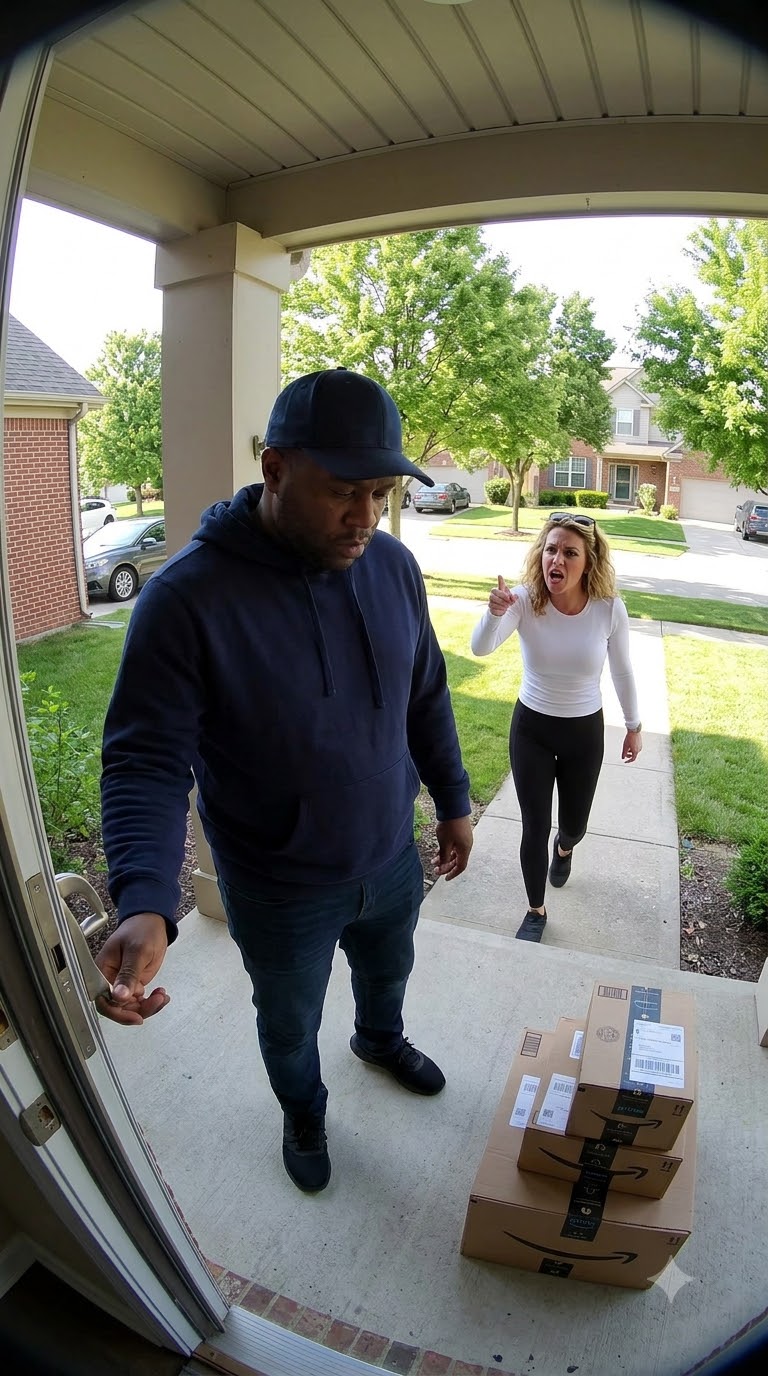
Two folding chairs stood beside a stack of unopened cartons.
Marcus placed a legal pad on the table.
“First, the good news. Your ownership is unquestionable. The closing was properly recorded, the title is clear, and nobody has any legal basis to challenge your right to occupy this property.”
Brandon nodded.
“I knew that.”
“I know you did. But I want it established.”
Marcus turned a page.
“Second, we need to separate what Caroline did from what the officers did.”
Brandon leaned back.
“Go on.”
“Caroline’s statements, her repeated complaints, and the online posts may support several possible claims depending on what the evidence establishes. But I don’t want to promise an outcome before we review the complete record.”
“And the police?”
“That’s more complicated.”
Marcus tapped the legal pad.
“They were entitled to investigate a reported burglary. The question is whether their actions remained reasonable after the information available to them undermined the accusation.”
Brandon remembered Mitchell’s words.
“For all we know, you broke in earlier and planted fake documents.”
He shook his head.
“That was the moment I realized nothing I said would be enough.”
Marcus nodded.
“Then we need the body-camera footage.”
“Can we get it?”
“We can request it through the appropriate channels.”
He continued.
“I also want the dispatch recordings, the incident report, and any available documentation concerning prior complaints at this address.”
Brandon studied him.
“Why?”
“Because I want to know exactly what Caroline told the dispatcher.”
That question stayed with Brandon long after Marcus left.
What had she said?
Had she reported seeing someone force a lock?
Had she claimed Brandon was carrying stolen property?
Or had she simply described a Black man standing outside a house?
Three days later, Marcus called with the first significant development.
He had obtained a copy of the initial incident report and confirmation that relevant recordings were being preserved.
The report described the complaint as a possible burglary involving an unidentified male attempting entry into a vacant residence.
But the house wasn’t vacant.
And Brandon wasn’t unidentified.
His vehicle had been parked in the driveway repeatedly.
His address appeared on his driver’s license.
His name was on the property record.
The entire accusation rested on an assumption that he did not belong.
Meanwhile, the homeowners association scheduled an emergency meeting.
Brandon received the notice by email.
Subject: Community Safety Concerns.
He read it twice.
The message referred to recent events on Maple Drive and promised an opportunity for residents to discuss security procedures.
It did not mention him by name.
It did not acknowledge that the supposed intruder was the lawful owner.
And it certainly did not apologize.
Brandon forwarded the email to Marcus.
His attorney responded within minutes.
“Attend if you feel comfortable. I’ll come with you.”
The meeting took place Thursday evening in the neighborhood clubhouse.
Nearly seventy residents filled the room.
Caroline sat in the front row, wearing a cream-colored jacket and an expression of injured dignity.
Brandon entered with Marcus.
Conversation stopped.
He felt the familiar weight of dozens of eyes.
But this time, he wasn’t standing alone.
Denise and Michael Carter had saved two seats beside them.
Denise smiled.
“Glad you came.”
Brandon nodded.
“Me too.”
The HOA president, Richard Whitcomb, opened the meeting.
He was a gray-haired man in his sixties who spoke with the polished confidence of someone accustomed to managing disagreements without ever admitting responsibility.
“We’re here to discuss recent security concerns and ensure that Oakwood Heights remains a safe, welcoming community.”
Brandon almost laughed.
Welcoming.
The word sounded different after Saturday.
Whitcomb continued.
“We understand that emotions have been running high, and we encourage everyone to remain respectful.”
Caroline raised her hand before he finished.
“I’d like to say something.”
Whitcomb hesitated.
“Go ahead.”
Caroline stood.
“I have lived in this neighborhood for eighteen years. I’ve always looked out for my neighbors. I’ve always reported suspicious activity. And now I’m being attacked online for trying to keep everyone safe.”
Several residents nodded.
Caroline’s voice trembled theatrically.
“I didn’t know who that man was.”
Brandon remained still.
She gestured toward him.
“He never introduced himself to me.”
Denise leaned forward.
“Neither did you.”
Caroline ignored her.
“I saw someone coming and going from an empty house. I did what any responsible person would do.”
Brandon raised his hand.
Whitcomb looked uncomfortable.
“Mr. Noble?”
Brandon stood.
He didn’t bring a speech.
He didn’t need one.
“My name is Brandon Noble. I own 412 Maple Drive.”
He looked around the room.
“I’ve lived and worked in this region for years. I spent fifteen years serving as a deputy U.S. marshal. I bought my home legally, paid for it with money I earned, and moved in like any other homeowner.”
He paused.
“On Saturday, a neighbor accused me of being a criminal because she decided I couldn’t possibly belong here.”
Caroline shifted in her seat.
Brandon continued.
“I was searched in front of my neighbors. My identification was questioned. My explanation was dismissed. And the entire time, the evidence of my ownership was available.”
Whitcomb cleared his throat.
“We understand this was an unfortunate misunderstanding.”
Brandon turned toward him.
“No.”
The room went silent.
“It wasn’t a misunderstanding.”
His voice remained calm.
“A misunderstanding would have been someone asking whether I was the new owner.”
He looked toward Caroline.
“A misunderstanding would have ended when I said the house was mine.”
Then he faced the room again.
“This continued after I explained myself, after I showed identification, and after I offered documents.”
Nobody interrupted.
“The problem wasn’t a lack of information. The problem was that some people had already decided what they believed about me.”
A man near the back raised his hand.
“But we have to be careful these days.”
Brandon nodded.
“Of course.”
The man seemed surprised.
Brandon continued.
“Being careful means paying attention to actual behavior. It doesn’t mean treating someone’s race as evidence of a crime.”
Denise began clapping.
Michael joined her.
Then several other residents.
The applause was hesitant at first.
But it grew.
Caroline stared straight ahead.
Whitcomb waited for the noise to subside.
“Mr. Noble, what would you like the association to do?”
Brandon had considered that question carefully.
“I want clear procedures for reporting genuine emergencies. I want residents reminded that suspicion must be based on behavior, not appearance. And I want the association to stop allowing neighborhood communication channels to become places where people are publicly accused without evidence.”
Whitcomb nodded slowly.
“Those are reasonable requests.”
Brandon wasn’t finished.
“I also want every new homeowner to receive the same welcome, regardless of who they are.”
That final sentence changed the atmosphere.
Because everyone in the room understood what he meant.
Nobody had welcomed him.
They had watched him.
Photographed him.
Questioned him.
And finally called the police.
After the meeting, several neighbors approached Brandon.
Some apologized.
Others simply introduced themselves.
A young couple from the corner house admitted they had seen him moving boxes but hadn’t known what to say.
Brandon shook their hands.
He wasn’t interested in making enemies.
But he wasn’t prepared to pretend that friendliness after public embarrassment erased what had happened.
As he headed toward the exit, Caroline stepped into his path.
“Mr. Noble.”
He stopped.
She looked uncomfortable.
For a moment, he thought she might apologize.
Instead, she said, “I hope you understand that I was just doing what I thought was right.”
Brandon studied her.
“I understand that you believed you were right.”
She seemed relieved.
Then he continued.
“That doesn’t make what you did right.”
Her expression tightened.
“I don’t appreciate being made into some kind of villain.”
“I didn’t make you anything, Caroline.”
He glanced toward the clubhouse doors.
“Your own words are on video.”
She stared at him.
He stepped around her and walked outside.
The night air was cool.
For the first time all week, Brandon felt as though he could breathe.
But the story was far from finished.
The following Monday, Marcus received additional records.
Among them was the emergency call that had brought Mitchell and Davis to Maple Drive.
Brandon listened to the recording in his attorney’s office.
Caroline’s voice sounded urgent.
She described a suspicious man at the Harrison property.
She insisted the home was vacant.
She said the man was attempting to enter.
Then the dispatcher asked whether she had witnessed forced entry.
Caroline hesitated.
“No, but I know he doesn’t belong there.”
The dispatcher requested a description.
Caroline supplied Brandon’s race, clothing, and vehicle.
When asked whether the man had threatened anyone, she said no.
When asked whether he possessed a weapon, she said she hadn’t seen one.
Yet she repeatedly demanded that officers respond immediately.
Brandon removed the headphones.
Marcus watched him.
“Are you all right?”
Brandon nodded slowly.
“She told them I didn’t belong there.”
“Yes.”
“Not that she saw me break anything.”
“No.”
“Not that she saw me steal anything.”
“No.”
Brandon looked down.
“Just that I didn’t belong.”
Marcus folded his hands.
“That’s why we requested the recording.”
PART 3
The police department also opened an internal review after the video attracted public attention.
Mitchell and Davis were interviewed.
Their body-camera footage was preserved.
Investigators reviewed the timing of the encounter, the officers’ decisions, and the information available before and after Brandon produced his identification.
Brandon provided a formal statement.
He described the incident without exaggeration.
He acknowledged that officers had a responsibility to investigate reported crimes.
He also explained why the continued suspicion, even after his address matched the property and he offered ownership documents, had been unreasonable and humiliating.
He didn’t ask for special treatment because he was a federal officer.
He asked why he had been denied the ordinary presumption of legitimacy that other homeowners seemed to receive.
Weeks passed.
Brandon continued unpacking.
He bought a lawnmower.
He installed shelves in his office.
He planted two small maple trees near the walkway because his mother insisted every proper home needed something living that would outlast its owner.
On Saturdays, he made coffee and sat on the back porch.
Sometimes the neighborhood felt peaceful.
Sometimes he noticed curtains moving as he walked toward his car.
He tried not to let those moments consume him.
But the experience had changed the way he saw his surroundings.
One afternoon, Denise knocked on his door carrying a plate of homemade cookies.
Brandon smiled when he opened it.
“Now this is the welcome basket I was expecting.”
She laughed.
“Better late than never.”
He invited her inside.
They sat at the kitchen table while she explained that the HOA had begun revising its community reporting guidelines.
The neighborhood Facebook group now prohibited posts accusing identifiable residents or visitors of crimes without verified information.
The association was also planning an orientation for new homeowners.
Brandon listened carefully.
“That’s a start.”
Denise nodded.
“It is.”
Then her expression grew serious.
“I wanted to tell you something.”
He waited.
“When Michael and I moved here, someone called security because our teenage son was walking home from basketball practice.”
Brandon looked at her.
“Seriously?”
She nodded.
“They said he was wandering around looking into houses.”
“What happened?”
“Security stopped him two blocks from home. He was fourteen.”
Brandon felt his stomach tighten.
Denise looked toward the window.
“He came home crying. Not because he was scared of security. Because he thought we’d made a mistake moving here.”
Brandon said nothing.
She continued.
“We stayed because we didn’t want to teach him that someone else’s prejudice gets to decide where we belong.”
Her eyes met his.
“That’s why I’m glad you stayed.”
Brandon swallowed.
“Thank you.”
Denise smiled faintly.
“And for what it’s worth, you’re not alone here.”
After she left, Brandon stood by the front window.
Across the street, children were riding bicycles.
A delivery driver carried a package toward the Davies residence.
A dog chased a ball across a lawn.
He realized that belonging wasn’t something a neighborhood could grant or withhold.
His deed already established his right to be there.
The rest would take time.
Six weeks after the incident, the police department completed its initial administrative findings.
The review identified shortcomings in how the officers assessed the complaint and documented the encounter.
Mitchell received formal corrective action and was required to complete additional training.
Davis was assigned remedial instruction concerning investigative procedures and communication during citizen encounters.
The department also announced revisions to its guidance for handling suspicious-person complaints involving residential properties.
Brandon read the letter twice.
It wasn’t everything he had hoped for.
But it was an acknowledgment that something had gone wrong.
Marcus called that evening.
“We still have decisions to make.”
“I know.”
“The administrative findings don’t resolve every possible legal question.”
“I understand.”
Marcus paused.
“Do you want to continue?”
Brandon looked at the framed photograph of his mother sitting on the mantel.
He thought about Denise’s son.
The contractors.
The delivery drivers.
The people who had been stopped, questioned, and humiliated because someone decided they looked out of place.
“Yes,” he said.
“But I don’t want revenge.”
“What do you want?”
“Accountability.”
Marcus nodded, though Brandon couldn’t see him.
“Then we’ll proceed carefully.”
The legal process moved more slowly than the online outrage.
Evidence was reviewed.
Statements were collected.
Potential claims were evaluated.
Brandon refused several interview requests from reporters who wanted to turn the incident into a sensational confrontation between a federal officer and a suburban neighborhood.
He had no interest in becoming famous.
He wanted his home to feel like home again.
Eventually, with Marcus’s guidance, he pursued a formal resolution concerning the police encounter.
The matter ended through a negotiated agreement that included additional procedural commitments and a written acknowledgment of the distress caused by the incident.
The agreement did not require Brandon to abandon his concerns, nor did it establish every disputed allegation as a legal finding.
For him, its importance lay in the fact that the incident had been documented, reviewed, and taken seriously.
Caroline’s situation unfolded differently.
Her repeated complaints became a subject of discussion within the HOA.
Several residents submitted statements describing prior incidents involving contractors, visitors, and service workers.
The association removed her from the neighborhood safety committee.
She was no longer authorized to represent the community in discussions with private security.
She stopped posting photographs of unfamiliar vehicles.
And for several months, she avoided Brandon entirely.
Then, one Saturday morning, nearly four months after the confrontation, Brandon was trimming the hedges when he noticed someone standing at the edge of his driveway.
Caroline.
She wasn’t carrying a phone.
She wasn’t shouting.
For once, she looked uncertain.
Brandon switched off the hedge trimmer.
“Good morning.”
She hesitated.
“Good morning.”
He waited.
Caroline glanced toward the house.
“I wanted to talk to you.”
“All right.”
She folded her hands.
“I’ve been thinking about what happened.”
Brandon remained silent.
She looked down.
“I was wrong.”
The words seemed difficult for her.
“I made assumptions about you that I shouldn’t have made.”
Brandon watched her carefully.
Caroline continued.
“I convinced myself I was protecting the neighborhood, but I never actually asked who you were.”
She swallowed.
“And when you told me, I didn’t believe you.”
For the first time, Brandon saw something resembling genuine shame in her expression.
“I’m sorry.”
He didn’t answer immediately.
An apology couldn’t erase the sight of two police cruisers blocking his driveway.
It couldn’t erase the feeling of being searched while strangers recorded him.
It couldn’t return the uncomplicated happiness he had felt before Caroline shouted across the street.
But he also understood that refusing to acknowledge sincere change would accomplish little.
“Thank you for saying that.”
Caroline nodded.
“I know it doesn’t fix everything.”
“No,” Brandon said gently. “It doesn’t.”
She looked toward the lawn.
“I hope someday we can be neighbors.”
Brandon considered the words.
Then he answered.
“We already are neighbors, Caroline.”
She looked up.
“The question is what kind of neighbors we’re going to be.”
Her eyes filled.
She nodded once.
Then she walked home.
Brandon watched her disappear through her front door.
He didn’t feel triumphant.
He felt tired.
But beneath the exhaustion was something else.
A small measure of peace.
That evening, his mother arrived for her first overnight visit.
She stepped out of the car carrying two bags and immediately inspected the front lawn.
“Brandon Noble, you need to water those trees.”
He laughed.
“Hello to you too, Mom.”
She embraced him tightly.
Then she stepped back and examined the house.
The red brick.
The white columns.
The neat walkway.
The newly planted maples.
Her eyes glistened.
“You did good, baby.”
Brandon looked at the house.
For months, he had associated the front entrance with the memory of Caroline’s accusations.
Now his mother was standing beneath the same doorway, smiling with pride.
He took her bags.
“Come on. I’ll show you around.”
Inside, the house had finally begun to resemble a home.
Books filled the shelves.
Family photographs lined the hallway.
A blue rug covered the living room floor.
The kitchen smelled of fresh coffee.
His mother inspected every room, asking questions and offering unsolicited decorating advice.
Then she stopped in the doorway of his office.
On the wall hung a framed photograph from Brandon’s graduation at Howard University.
Beside it was another picture showing him receiving a professional commendation.
And beneath those photographs, carefully framed, was a copy of the deed to 412 Maple Drive.
His mother studied it.
“Why’d you frame that?”
Brandon smiled.
“Thought it belonged there.”
She touched the edge of the frame.
Then she looked at him.
“You know, when you were little, you used to draw houses.”
He laughed.
“I did?”
“All the time. Big houses with trees and a dog in the yard.”
“I don’t remember that.”
“I do.”
Her voice softened.
“You always said you wanted a place nobody could make you leave.”
Brandon’s smile faded.
He remembered growing up in rented apartments.
He remembered his mother working long shifts.
He remembered moving whenever the rent increased or the building changed ownership.
He remembered promising himself that one day he would buy a house with a yard and enough space for his mother to visit whenever she wanted.
And now he had.
His mother took his hand.
“You kept your promise.”
Brandon looked at the deed.
Then at the photographs.
Then at the woman who had sacrificed so much to help him reach this moment.
“Yeah,” he whispered.
“I guess I did.”
The following weekend, Brandon hosted a small barbecue.
He invited Denise and Michael.
Their son came home from college for the occasion.
The young couple from the corner house attended.
So did several neighbors who had introduced themselves after the HOA meeting.
Children played in the backyard.
Music drifted through the open kitchen windows.
Brandon stood at the grill, laughing as Michael criticized his technique.
His mother sat beneath a patio umbrella, telling anyone willing to listen embarrassing stories about Brandon’s childhood.
For the first time since moving in, he wasn’t thinking about police reports, lawyers, or neighborhood complaints.
He was thinking about whether the burgers were burning.
Then his phone rang.
Brandon glanced at the screen.
Deputy Director Evelyn Brooks.
He smiled.
He answered.
“Yes, ma’am?”
“Brandon, am I interrupting something?”
“Just a barbecue.”
“Good. You deserve one.”
He chuckled.
“What’s going on?”
“I wanted to check in. Heard the administrative matter reached a resolution.”
“It did.”
“How are you feeling?”
Brandon looked across the yard.
Denise was laughing with his mother.
Michael was helping a child retrieve a ball from beneath a chair.
Neighbors were talking beneath the trees.
The house stood behind them, its windows glowing in the late-afternoon sunlight.
He took a slow breath.
“Better.”
Evelyn paused.
“I’m glad.”
Then she added, “You handled yourself well, Brandon.”
He looked down.
“I just tried to stay calm.”
“Sometimes that’s harder than anything else we do.”
Brandon nodded.
“You’re right.”
They spoke briefly about work.
Then Evelyn wished him a good weekend and ended the call.
Brandon slipped the phone into his pocket.
He returned to the grill.
His mother waved from the table.
“Brandon! You’re burning the food!”
Everyone laughed.
And he laughed with them.
Months earlier, a ringing phone had interrupted a confrontation that threatened to turn his first days as a homeowner into a nightmare.
That call had revealed his profession.
It had forced the officers to reconsider their assumptions.
It had changed the direction of the encounter.
But Brandon understood something now that he hadn’t fully appreciated that morning.
The badge hadn’t made him worthy of respect.
The phone call hadn’t made him innocent.
His federal credentials hadn’t made him the rightful owner of the house.
He had been all those things before anyone knew his name.
He had been a homeowner when Caroline first saw him unloading boxes.
He had been a homeowner when she shouted at him.
He had been a homeowner when the police arrived.
And he had been a homeowner when Mitchell questioned whether his identification was genuine.
Nothing about his identity had changed.
Only other people’s willingness to believe him.
That was the lesson he hoped Oakwood Heights would remember.
Not that the man Caroline accused turned out to be a deputy U.S. marshal.
Not that he had influential colleagues or an attorney who knew how to challenge official conduct.
Not that he possessed a badge capable of changing the atmosphere of a police encounter.
The lesson was simpler.
A person should not need a badge to be believed when the facts support them.
A person should not need powerful connections to be treated with dignity.
And a Black man carrying boxes into a house should not automatically become a suspect simply because someone cannot imagine him owning it.
As evening settled over Maple Drive, Brandon stood on his porch and watched the last guests depart.
The lawn was scattered with a few paper napkins.
The grill had cooled.
His mother was inside washing dishes despite his repeated objections.
Across the street, porch lights began flickering on.
Brandon looked at the two young maple trees beside the walkway.
Their leaves moved gently in the breeze.
He thought about how close he had come to allowing one ugly morning to define the entire place.
Then he reached into his pocket and took out his keys.
He held them for a moment.
Ordinary house keys.
Nothing more.
No badge.
No credentials.
No explanation required.
He unlocked the door and stepped inside.
And this time, nobody questioned whether he belonged.
Because he did.
He always had.
THE END “My brother delivers appliances there. He’s been stopped twice.”
Then another.
“I used to work security at that development. We received complaints about Black visitors constantly.”
Brandon read the messages in silence.
He had believed his experience was an isolated confrontation.
Now he was beginning to see a pattern.
Marcus called Monday afternoon.
“I’ve reviewed the video.”
“And?”
“We need to talk.”
They met that evening at Brandon’s kitchen table.
Most of the room was still empty.
Two folding chairs stood beside a stack of unopened cartons.
Marcus placed a legal pad on the table.
“First, the good news. Your ownership is unquestionable. The closing was properly recorded, the title is clear, and nobody has any legal basis to challenge your right to occupy this property.”
Brandon nodded.
“I knew that.”
“I know you did. But I want it established.”
Marcus turned a page.
“Second, we need to separate what Caroline did from what the officers did.”
Brandon leaned back.
“Go on.”
“Caroline’s statements, her repeated complaints, and the online posts may support several possible claims depending on what the evidence establishes. But I don’t want to promise an outcome before we review the complete record.”
“And the police?”
“That’s more complicated.”
Marcus tapped the legal pad.
“They were entitled to investigate a reported burglary. The question is whether their actions remained reasonable after the information available to them undermined the accusation.”
Brandon remembered Mitchell’s words.
“For all we know, you broke in earlier and planted fake documents.”
He shook his head.
“That was the moment I realized nothing I said would be enough.”
Marcus nodded.
“Then we need the body-camera footage.”
“Can we get it?”
“We can request it through the appropriate channels.”
He continued.
“I also want the dispatch recordings, the incident report, and any available documentation concerning prior complaints at this address.”
Brandon studied him.
“Why?”
“Because I want to know exactly what Caroline told the dispatcher.”
That question stayed with Brandon long after Marcus left.
What had she said?
Had she reported seeing someone force a lock?
Had she claimed Brandon was carrying stolen property?
Or had she simply described a Black man standing outside a house?
Three days later, Marcus called with the first significant development.
He had obtained a copy of the initial incident report and confirmation that relevant recordings were being preserved.
The report described the complaint as a possible burglary involving an unidentified male attempting entry into a vacant residence.
But the house wasn’t vacant.
And Brandon wasn’t unidentified.
His vehicle had been parked in the driveway repeatedly.
His address appeared on his driver’s license.
His name was on the property record.
The entire accusation rested on an assumption that he did not belong.
Meanwhile, the homeowners association scheduled an emergency meeting.
Brandon received the notice by email.
Subject: Community Safety Concerns.
He read it twice.
The message referred to recent events on Maple Drive and promised an opportunity for residents to discuss security procedures.
It did not mention him by name.
It did not acknowledge that the supposed intruder was the lawful owner.
And it certainly did not apologize.
Brandon forwarded the email to Marcus.
His attorney responded within minutes.
“Attend if you feel comfortable. I’ll come with you.”
The meeting took place Thursday evening in the neighborhood clubhouse.
Nearly seventy residents filled the room.
Caroline sat in the front row, wearing a cream-colored jacket and an expression of injured dignity.
Brandon entered with Marcus.
Conversation stopped.
He felt the familiar weight of dozens of eyes.
But this time, he wasn’t standing alone.
Denise and Michael Carter had saved two seats beside them.
Denise smiled.
“Glad you came.”
Brandon nodded.
“Me too.”
The HOA president, Richard Whitcomb, opened the meeting.
PART 4
He was a gray-haired man in his sixties who spoke with the polished confidence of someone accustomed to managing disagreements without ever admitting responsibility.
“We’re here to discuss recent security concerns and ensure that Oakwood Heights remains a safe, welcoming community.”
Brandon almost laughed.
Welcoming.
The word sounded different after Saturday.
Whitcomb continued.
“We understand that emotions have been running high, and we encourage everyone to remain respectful.”
Caroline raised her hand before he finished.
“I’d like to say something.”
Whitcomb hesitated.
“Go ahead.”
Caroline stood.
“I have lived in this neighborhood for eighteen years. I’ve always looked out for my neighbors. I’ve always reported suspicious activity. And now I’m being attacked online for trying to keep everyone safe.”
Several residents nodded.
Caroline’s voice trembled theatrically.
“I didn’t know who that man was.”
Brandon remained still.
She gestured toward him.
“He never introduced himself to me.”
Denise leaned forward.
“Neither did you.”
Caroline ignored her.
“I saw someone coming and going from an empty house. I did what any responsible person would do.”
Brandon raised his hand.
Whitcomb looked uncomfortable.
“Mr. Noble?”
Brandon stood.
He didn’t bring a speech.
He didn’t need one.
“My name is Brandon Noble. I own 412 Maple Drive.”
He looked around the room.
“I’ve lived and worked in this region for years. I spent fifteen years serving as a deputy U.S. marshal. I bought my home legally, paid for it with money I earned, and moved in like any other homeowner.”
He paused.
“On Saturday, a neighbor accused me of being a criminal because she decided I couldn’t possibly belong here.”
Caroline shifted in her seat.
Brandon continued.
“I was searched in front of my neighbors. My identification was questioned. My explanation was dismissed. And the entire time, the evidence of my ownership was available.”
Whitcomb cleared his throat.
“We understand this was an unfortunate misunderstanding.”
Brandon turned toward him.
“No.”
The room went silent.
“It wasn’t a misunderstanding.”
His voice remained calm.
“A misunderstanding would have been someone asking whether I was the new owner.”
He looked toward Caroline.
“A misunderstanding would have ended when I said the house was mine.”
Then he faced the room again.
“This continued after I explained myself, after I showed identification, and after I offered documents.”
Nobody interrupted.
“The problem wasn’t a lack of information. The problem was that some people had already decided what they believed about me.”
A man near the back raised his hand.
“But we have to be careful these days.”
Brandon nodded.
“Of course.”
The man seemed surprised.
Brandon continued.
“Being careful means paying attention to actual behavior. It doesn’t mean treating someone’s race as evidence of a crime.”
Denise began clapping.
Michael joined her.
Then several other residents.
The applause was hesitant at first.
But it grew.
Caroline stared straight ahead.
Whitcomb waited for the noise to subside.
“Mr. Noble, what would you like the association to do?”
Brandon had considered that question carefully.
“I want clear procedures for reporting genuine emergencies. I want residents reminded that suspicion must be based on behavior, not appearance. And I want the association to stop allowing neighborhood communication channels to become places where people are publicly accused without evidence.”
Whitcomb nodded slowly.
“Those are reasonable requests.”
Brandon wasn’t finished.
“I also want every new homeowner to receive the same welcome, regardless of who they are.”
That final sentence changed the atmosphere.
Because everyone in the room understood what he meant.
Nobody had welcomed him.
They had watched him.
Photographed him.
Questioned him.
And finally called the police.
After the meeting, several neighbors approached Brandon.
Some apologized.
Others simply introduced themselves.
A young couple from the corner house admitted they had seen him moving boxes but hadn’t known what to say.
Brandon shook their hands.
He wasn’t interested in making enemies.
But he wasn’t prepared to pretend that friendliness after public embarrassment erased what had happened.
As he headed toward the exit, Caroline stepped into his path.
“Mr. Noble.”
He stopped.
She looked uncomfortable.
For a moment, he thought she might apologize.
Instead, she said, “I hope you understand that I was just doing what I thought was right.”
Brandon studied her.
“I understand that you believed you were right.”
She seemed relieved.
Then he continued.
“That doesn’t make what you did right.”
Her expression tightened.
“I don’t appreciate being made into some kind of villain.”
“I didn’t make you anything, Caroline.”
He glanced toward the clubhouse doors.
“Your own words are on video.”
She stared at him.
He stepped around her and walked outside.
The night air was cool.
For the first time all week, Brandon felt as though he could breathe.
But the story was far from finished.
The following Monday, Marcus received additional records.
Among them was the emergency call that had brought Mitchell and Davis to Maple Drive.
Brandon listened to the recording in his attorney’s office.
Caroline’s voice sounded urgent.
She described a suspicious man at the Harrison property.
She insisted the home was vacant.
She said the man was attempting to enter.
Then the dispatcher asked whether she had witnessed forced entry.
Caroline hesitated.
“No, but I know he doesn’t belong there.”
The dispatcher requested a description.
Caroline supplied Brandon’s race, clothing, and vehicle.
When asked whether the man had threatened anyone, she said no.
When asked whether he possessed a weapon, she said she hadn’t seen one.
Yet she repeatedly demanded that officers respond immediately.
Brandon removed the headphones.
Marcus watched him.
“Are you all right?”
Brandon nodded slowly.
“She told them I didn’t belong there.”
“Yes.”
“Not that she saw me break anything.”
“No.”
“Not that she saw me steal anything.”
“No.”
Brandon looked down.
“Just that I didn’t belong.”
Marcus folded his hands.
“That’s why we requested the recording.”
The police department also opened an internal review after the video attracted public attention.
Mitchell and Davis were interviewed.
Their body-camera footage was preserved.
Investigators reviewed the timing of the encounter, the officers’ decisions, and the information available before and after Brandon produced his identification.
Brandon provided a formal statement.
He described the incident without exaggeration.
He acknowledged that officers had a responsibility to investigate reported crimes.
He also explained why the continued suspicion, even after his address matched the property and he offered ownership documents, had been unreasonable and humiliating.
He didn’t ask for special treatment because he was a federal officer.
He asked why he had been denied the ordinary presumption of legitimacy that other homeowners seemed to receive.
Weeks passed.
Brandon continued unpacking.
He bought a lawnmower.
He installed shelves in his office.
He planted two small maple trees near the walkway because his mother insisted every proper home needed something living that would outlast its owner.
On Saturdays, he made coffee and sat on the back porch.
Sometimes the neighborhood felt peaceful.
Sometimes he noticed curtains moving as he walked toward his car.
He tried not to let those moments consume him.
But the experience had changed the way he saw his surroundings.
One afternoon, Denise knocked on his door carrying a plate of homemade cookies.
Brandon smiled when he opened it.
“Now this is the welcome basket I was expecting.”
She laughed.
“Better late than never.”
He invited her inside.
They sat at the kitchen table while she explained that the HOA had begun revising its community reporting guidelines.
The neighborhood Facebook group now prohibited posts accusing identifiable residents or visitors of crimes without verified information.
The association was also planning an orientation for new homeowners.
Brandon listened carefully.
“That’s a start.”
Denise nodded.
“It is.”
Then her expression grew serious.
“I wanted to tell you something.”
He waited.
“When Michael and I moved here, someone called security because our teenage son was walking home from basketball practice.”
Brandon looked at her.
“Seriously?”
She nodded.
“They said he was wandering around looking into houses.”
“What happened?”
“Security stopped him two blocks from home. He was fourteen.”
Brandon felt his stomach tighten.
Denise looked toward the window.
“He came home crying. Not because he was scared of security. Because he thought we’d made a mistake moving here.”
Brandon said nothing.
She continued.
“We stayed because we didn’t want to teach him that someone else’s prejudice gets to decide where we belong.”
Her eyes met his.
“That’s why I’m glad you stayed.”
Brandon swallowed.
“Thank you.”
Denise smiled faintly.
“And for what it’s worth, you’re not alone here.”
After she left, Brandon stood by the front window.
Across the street, children were riding bicycles.
A delivery driver carried a package toward the Davies residence.
A dog chased a ball across a lawn.
He realized that belonging wasn’t something a neighborhood could grant or withhold.
His deed already established his right to be there.
The rest would take time.
Six weeks after the incident, the police department completed its initial administrative findings.
The review identified shortcomings in how the officers assessed the complaint and documented the encounter.
Mitchell received formal corrective action and was required to complete additional training.
Davis was assigned remedial instruction concerning investigative procedures and communication during citizen encounters.
The department also announced revisions to its guidance for handling suspicious-person complaints involving residential properties.
Brandon read the letter twice.
It wasn’t everything he had hoped for.
But it was an acknowledgment that something had gone wrong.
Marcus called that evening.
“We still have decisions to make.”
“I know.”
“The administrative findings don’t resolve every possible legal question.”
“I understand.”
Marcus paused.
“Do you want to continue?”
Brandon looked at the framed photograph of his mother sitting on the mantel.
He thought about Denise’s son.
The contractors.
The delivery drivers.
The people who had been stopped, questioned, and humiliated because someone decided they looked out of place.
“Yes,” he said.
“But I don’t want revenge.”
“What do you want?”
“Accountability.”
Marcus nodded, though Brandon couldn’t see him.
“Then we’ll proceed carefully.”
The legal process moved more slowly than the online outrage.
Evidence was reviewed.
Statements were collected.
Potential claims were evaluated.
Brandon refused several interview requests from reporters who wanted to turn the incident into a sensational confrontation between a federal officer and a suburban neighborhood.
He had no interest in becoming famous.
He wanted his home to feel like home again.
Eventually, with Marcus’s guidance, he pursued a formal resolution concerning the police encounter.
The matter ended through a negotiated agreement that included additional procedural commitments and a written acknowledgment of the distress caused by the incident.
The agreement did not require Brandon to abandon his concerns, nor did it establish every disputed allegation as a legal finding.
For him, its importance lay in the fact that the incident had been documented, reviewed, and taken seriously.
Caroline’s situation unfolded differently.
Her repeated complaints became a subject of discussion within the HOA.
Several residents submitted statements describing prior incidents involving contractors, visitors, and service workers.
The association removed her from the neighborhood safety committee.
She was no longer authorized to represent the community in discussions with private security.
She stopped posting photographs of unfamiliar vehicles.
And for several months, she avoided Brandon entirely.
Then, one Saturday morning, nearly four months after the confrontation, Brandon was trimming the hedges when he noticed someone standing at the edge of his driveway.
Caroline.
She wasn’t carrying a phone.
She wasn’t shouting.
For once, she looked uncertain.
Brandon switched off the hedge trimmer.
“Good morning.”
She hesitated.
“Good morning.”
He waited.
Caroline glanced toward the house.
“I wanted to talk to you.”
“All right.”
She folded her hands.
“I’ve been thinking about what happened.”
Brandon remained silent.
She looked down.
“I was wrong.”
The words seemed difficult for her.
“I made assumptions about you that I shouldn’t have made.”
Brandon watched her carefully.
Caroline continued.
“I convinced myself I was protecting the neighborhood, but I never actually asked who you were.”
She swallowed.
“And when you told me, I didn’t believe you.”
For the first time, Brandon saw something resembling genuine shame in her expression.
“I’m sorry.”
He didn’t answer immediately.
An apology couldn’t erase the sight of two police cruisers blocking his driveway.
It couldn’t erase the feeling of being searched while strangers recorded him.
It couldn’t return the uncomplicated happiness he had felt before Caroline shouted across the street.
But he also understood that refusing to acknowledge sincere change would accomplish little.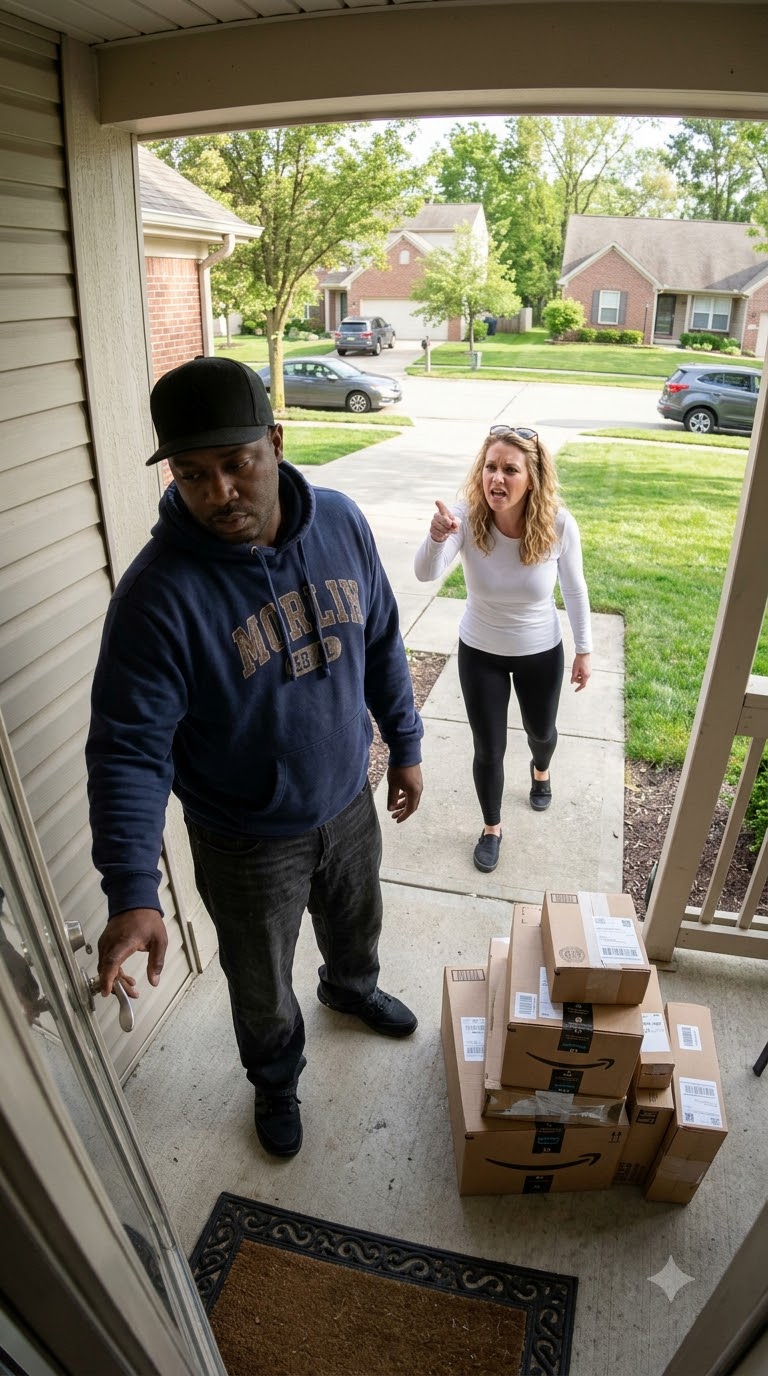
“Thank you for saying that.”
Caroline nodded.
“I know it doesn’t fix everything.”
“No,” Brandon said gently. “It doesn’t.”
She looked toward the lawn.
“I hope someday we can be neighbors.”
Brandon considered the words.
Then he answered.
“We already are neighbors, Caroline.”
She looked up.
“The question is what kind of neighbors we’re going to be.”
Her eyes filled.
She nodded once.
Then she walked home.
Brandon watched her disappear through her front door.
He didn’t feel triumphant.
He felt tired.
But beneath the exhaustion was something else.
A small measure of peace.
That evening, his mother arrived for her first overnight visit.
She stepped out of the car carrying two bags and immediately inspected the front lawn.
“Brandon Noble, you need to water those trees.”
He laughed.
“Hello to you too, Mom.”
She embraced him tightly.
Then she stepped back and examined the house.
The red brick.
The white columns.
The neat walkway.
The newly planted maples.
Her eyes glistened.
“You did good, baby.”
Brandon looked at the house.
For months, he had associated the front entrance with the memory of Caroline’s accusations.
Now his mother was standing beneath the same doorway, smiling with pride.
He took her bags.
“Come on. I’ll show you around.”
Inside, the house had finally begun to resemble a home.
Books filled the shelves.
Family photographs lined the hallway.
A blue rug covered the living room floor.
The kitchen smelled of fresh coffee.
His mother inspected every room, asking questions and offering unsolicited decorating advice.
Then she stopped in the doorway of his office.
On the wall hung a framed photograph from Brandon’s graduation at Howard University.
Beside it was another picture showing him receiving a professional commendation.
And beneath those photographs, carefully framed, was a copy of the deed to 412 Maple Drive.
His mother studied it.
“Why’d you frame that?”
Brandon smiled.
“Thought it belonged there.”
She touched the edge of the frame.
Then she looked at him.
“You know, when you were little, you used to draw houses.”
He laughed.
“I did?”
“All the time. Big houses with trees and a dog in the yard.”
“I don’t remember that.”
“I do.”
Her voice softened.
“You always said you wanted a place nobody could make you leave.”
Brandon’s smile faded.
He remembered growing up in rented apartments.
He remembered his mother working long shifts.
He remembered moving whenever the rent increased or the building changed ownership.
He remembered promising himself that one day he would buy a house with a yard and enough space for his mother to visit whenever she wanted.
And now he had.
His mother took his hand.
“You kept your promise.”
Brandon looked at the deed.
Then at the photographs.
Then at the woman who had sacrificed so much to help him reach this moment.
“Yeah,” he whispered.
“I guess I did.”
The following weekend, Brandon hosted a small barbecue.
He invited Denise and Michael.
Their son came home from college for the occasion.
The young couple from the corner house attended.
So did several neighbors who had introduced themselves after the HOA meeting.
Children played in the backyard.
Music drifted through the open kitchen windows.
Brandon stood at the grill, laughing as Michael criticized his technique.
His mother sat beneath a patio umbrella, telling anyone willing to listen embarrassing stories about Brandon’s childhood.
For the first time since moving in, he wasn’t thinking about police reports, lawyers, or neighborhood complaints.
He was thinking about whether the burgers were burning.
Then his phone rang.
Brandon glanced at the screen.
Deputy Director Evelyn Brooks.
He smiled.
He answered.
“Yes, ma’am?”
“Brandon, am I interrupting something?”
“Just a barbecue.”
“Good. You deserve one.”
He chuckled.
“What’s going on?”
“I wanted to check in. Heard the administrative matter reached a resolution.”
“It did.”
“How are you feeling?”
Brandon looked across the yard.
Denise was laughing with his mother.
Michael was helping a child retrieve a ball from beneath a chair.
Neighbors were talking beneath the trees.
The house stood behind them, its windows glowing in the late-afternoon sunlight.
He took a slow breath.
“Better.”
Evelyn paused.
“I’m glad.”
Then she added, “You handled yourself well, Brandon.”
He looked down.
“I just tried to stay calm.”
“Sometimes that’s harder than anything else we do.”
Brandon nodded.
“You’re right.”
They spoke briefly about work.
Then Evelyn wished him a good weekend and ended the call.
Brandon slipped the phone into his pocket.
He returned to the grill.
His mother waved from the table.
“Brandon! You’re burning the food!”
Everyone laughed.
And he laughed with them.
Months earlier, a ringing phone had interrupted a confrontation that threatened to turn his first days as a homeowner into a nightmare.
That call had revealed his profession.
It had forced the officers to reconsider their assumptions.
It had changed the direction of the encounter.
But Brandon understood something now that he hadn’t fully appreciated that morning.
The badge hadn’t made him worthy of respect.
The phone call hadn’t made him innocent.
His federal credentials hadn’t made him the rightful owner of the house.
He had been all those things before anyone knew his name.
He had been a homeowner when Caroline first saw him unloading boxes.
He had been a homeowner when she shouted at him.
He had been a homeowner when the police arrived.
And he had been a homeowner when Mitchell questioned whether his identification was genuine.
Nothing about his identity had changed.
Only other people’s willingness to believe him.
That was the lesson he hoped Oakwood Heights would remember.
Not that the man Caroline accused turned out to be a deputy U.S. marshal.
Not that he had influential colleagues or an attorney who knew how to challenge official conduct.
Not that he possessed a badge capable of changing the atmosphere of a police encounter.
The lesson was simpler.
A person should not need a badge to be believed when the facts support them.
A person should not need powerful connections to be treated with dignity.
And a Black man carrying boxes into a house should not automatically become a suspect simply because someone cannot imagine him owning it.
As evening settled over Maple Drive, Brandon stood on his porch and watched the last guests depart.
The lawn was scattered with a few paper napkins.
The grill had cooled.
His mother was inside washing dishes despite his repeated objections.
Across the street, porch lights began flickering on.
Brandon looked at the two young maple trees beside the walkway.
Their leaves moved gently in the breeze.
He thought about how close he had come to allowing one ugly morning to define the entire place.
Then he reached into his pocket and took out his keys.
He held them for a moment.
Ordinary house keys.
Nothing more.
No badge.
No credentials.
No explanation required.
He unlocked the door and stepped inside.
And this time, nobody questioned whether he belonged.
Because he did.
He always had.
THE END
