

PART 1
The gas pump released a quiet hiss as Marcus Hill leaned against his truck and slid his payment card through the reader. His eyes were heavy with exhaustion after spending countless hours on the highway. A few feet away, his younger brother Daniel adjusted his stance, stretched his aching shoulders, and shifted the weight of a duffel bag hanging from his arm.
Their stop in the small town was supposed to last only a few minutes. Neon signs buzzed above the convenience store, moths fluttered against the bright windows, and the unmistakable smell of gasoline filled the cool evening air.
Then a police cruiser entered the station.
Its tires scraped across the asphalt, and its headlights swept over the pumps.
Red and blue emergency lights suddenly washed across the concrete, spreading like spilled paint beneath the flickering signs.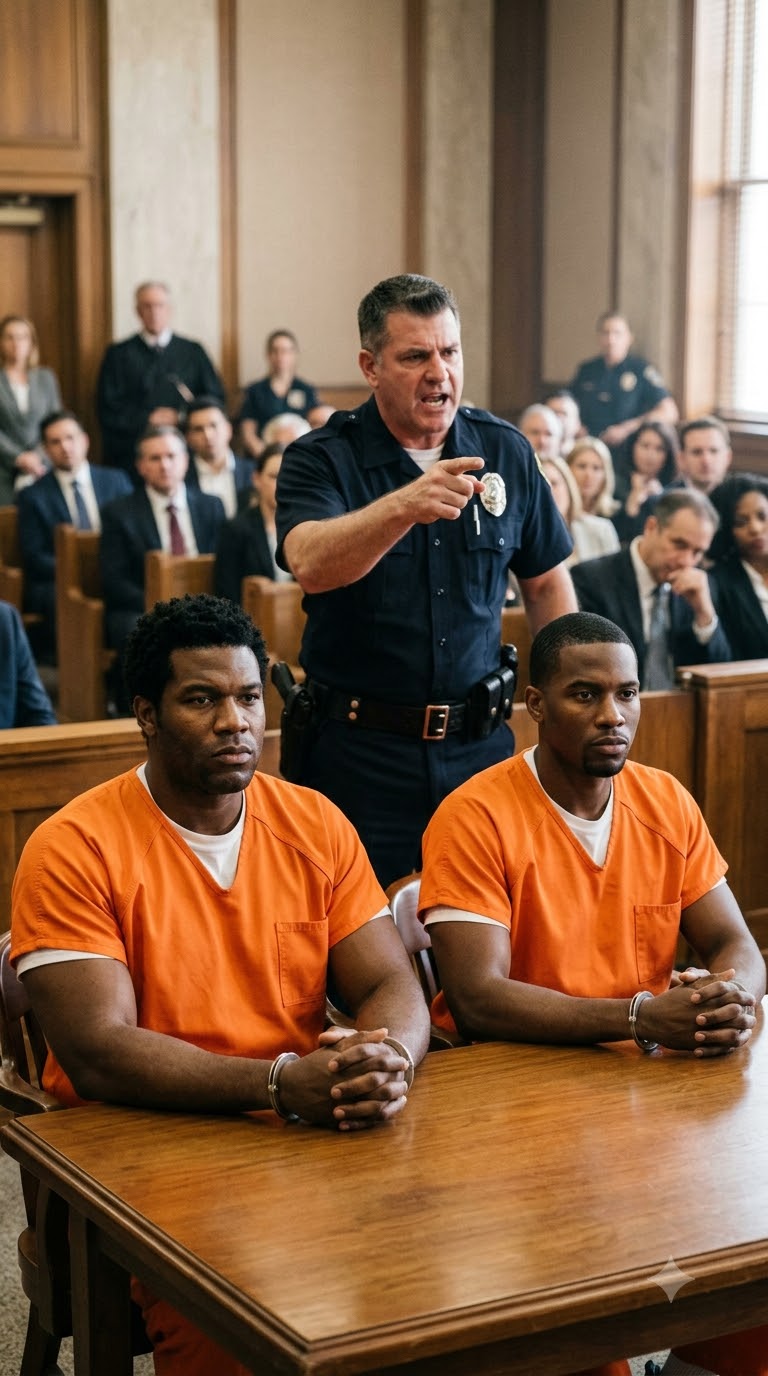
Officer Brad Whitaker climbed out slowly, one hand already hovering near the holster at his waist. There was something unmistakably threatening about his measured steps. He was not approaching two travelers to offer assistance or ask a routine question.
He was approaching them as though he had already decided they were criminals.
“You two,” Whitaker shouted, his voice cutting through the night like shattered glass. “Hands where I can see him.”
Marcus carefully removed one hand from the fuel nozzle and raised it where the officer could see it. His expression remained composed, and his movements were deliberately slow.
“Evening officer. We’re just filling up.”
“Didn’t ask what you were doing,” Whitaker snapped. “Asked for your hands.”
Daniel immediately lifted both hands, letting his heavy duffel bag slip from his shoulder onto the pavement.
“Everything all right?”
“IDs now.”
Marcus slowly reached toward his wallet, making certain that every movement was visible.
He took out his identification and held it toward Whitaker.
The officer barely glanced at the card before his lips curled into a contemptuous smile.
“Military.”
A cruel laugh escaped his mouth.
“That’s supposed to mean something here.”
Several customers stopped pumping fuel and turned toward the confrontation. Within seconds, phones appeared in their hands, their glowing screens illuminating their faces.
Yet nobody stepped forward.
Daniel tightened his jaw.
“We just got back. We’re headed home.”
Whitaker began walking around the brothers, studying them with the satisfaction of someone who believed he had discovered an easy opportunity to demonstrate his authority.
“You look nervous, agitated, suspicious.”
“I’m tired,” Daniel muttered.
“Don’t talk back.”
Without warning, Whitaker slammed Daniel against the hood of the truck.
The impact produced a sharp metallic bang.
Daniel grunted but made no attempt to resist.
“Officer,” Marcus began.
“Back up.”
Whitaker moved his hand toward his weapon.
“You think those medals mean a damn thing here?”
“Out here, I decide who’s guilty.”
The gathering spectators edged closer, more interested in witnessing a confrontation than preventing one.
A man wearing a baseball cap laughed under his breath.
“Guests serving your country don’t count much in this town.”
Nearby, an elderly veteran with closely cropped gray hair and a faded jacket decorated with military unit patches shook his head.
“This ain’t right,” he whispered.
“Quiet, old man,” another spectator hissed. “Don’t get yourself in trouble.”
Whitaker grabbed Daniel’s wrists, forced his arms behind his back, and secured the handcuffs with unnecessary force.
The metal clicked sharply in the night.
Then he faced Marcus.
“On your knees.”
Marcus drew a long breath, slowly released it, and lowered himself onto the pavement.
He was not abandoning his dignity.
He was not admitting wrongdoing.
He was relying on the discipline that years of military service had taught him.
Whitaker locked the handcuffs around Marcus’s wrists with the careless brutality of a man who viewed another person’s humiliation as entertainment.
Several phones recorded Marcus’s face.
His steady eyes.
His tightly controlled expression.
His refusal to allow anger to dictate his actions.
This was a man who had carried wounded soldiers through enemy fire overseas, yet he was now being treated like a dangerous criminal in the country he had sworn to defend.
Whitaker hauled him upright.
“Both of you under arrest.”
“Disorderly conduct. Resisting assault on an officer.”
Daniel turned toward him in disbelief.
“Assault? You slammed me first.”
“Shut your mouth,” Whitaker growled, forcing him toward the cruiser.
A patrol car door slammed.
The sound seemed to extinguish the last remaining hope that someone might intervene.
The brothers were surrounded by witnesses, but nobody offered meaningful assistance.
There were only shocked murmurs, recording phones, and curious faces waiting for something dramatic enough to share online.
Whitaker adjusted his belt and smiled.
“Another easy night.”
What he did not realize was that this encounter would become anything but easy.
The events unfolding beneath those neon lights had already begun traveling beyond the boundaries of the little town.
And someone far away from Highway 41 would soon discover precisely what had happened.
But before the truth reached the courthouse, before a single witness took the stand, there was far more to understand about Marcus and Daniel Hill than their arrest.
Their lives were not defined by handcuffs or an officer’s accusations.
They were defined by the families waiting for them, the battles they had survived, and the sacrifices strangers could not see.
Marcus Hill had learned to carry suffering quietly.
To people who did not know him, his silence could appear cold or defiant.
To his family, it was the foundation of his strength.
At thirty-two, Marcus was a widower raising a young daughter named Sophia.
She loved drawing pictures for her father with bright crayons.
Before leaving for home, Marcus had carefully placed her latest drawing inside his duffel bag.
Across the paper, crooked purple and green letters spelled out welcome home daddy.
Beneath them stood two stick figures holding hands, one dressed as a soldier and the other wearing a little dress.
When Whitaker tightened the handcuffs around his wrists, Marcus barely noticed the discomfort.
His thoughts were with Sophia.
He pictured her leaning over the kitchen table, concentrating on each letter, her small hand moving the crayon across the paper.
He remembered the way her handwriting tilted left, as though she had hurried to finish before recess.
Daniel, three years younger, had always faced hardship differently.
Marcus became quiet when life grew difficult.
Daniel kept moving.
He repaired broken furniture, rebuilt old structures, and searched for anything useful he could do with his hands.
After his latest deployment, Daniel had rebuilt their mother’s porch in Savannah.
He measured the boards, replaced the damaged supports, and hammered each plank into position himself.
Their mother, Linda, had watched from the doorway, teasing him about how seriously he approached the project.
“If my knees can hold up for 70 years,” Linda had joked, “A porch ought to last at least that long.”
Daniel had made certain it would.
Even while sitting in a holding cell, he could remember the scent of freshly cut wood and the warmth of his mother’s cheek when he kissed her goodbye.
The brothers had served together overseas.
They had endured burning deserts, unforgiving mountains, and nights when explosions turned darkness into sudden daylight.
Marcus could still remember Afghanistan with painful clarity.
The deafening helicopter blades.
The dust swirling around wounded soldiers.
The desperate calls for help during an attack.
And the moment Daniel abandoned the safety of cover to drag an injured corporal away from enemy fire.
Blood had covered Daniel’s hands.
Yet his voice remained steady as he spoke to the wounded man.
“You’re not dying here. Not today.”
Those same hands were now restrained by steel handcuffs in an American police station.
The contradiction was almost unbearable.
Daniel still carried a burn scar along his forearm from an improvised explosive device that had nearly killed them both.
Overseas, that scar represented sacrifice and courage.
In the courtroom, beneath harsh fluorescent lighting, it would be nothing more than another mark on the skin of a man the prosecution wanted jurors to fear.
Linda had never stopped calling Marcus and Daniel her boys.
Throughout their childhood, she had worked two jobs to support them.
She spent nights at the hospital and mornings cleaning other people’s homes.
She accepted exhaustion without complaint because her sons needed food, clothes, and a safe place to sleep.
When Marcus first enlisted, Linda held him so tightly that he could feel her ribs against his chest.
Three years later, when Daniel announced he would follow his brother into military service, she covered her face and cried.
She knew pride and terror could exist in the same heartbeat.
Sophia understood very little about the distant places where her father had served.
What she understood was his absence.
The empty chair at school performances.
The birthdays celebrated through a screen.
The way other children ran into their fathers’ arms while she waited for another video call.
Whenever Marcus appeared on her tablet, she leaned so close that her nose left smudges on the glass.
“When are you coming home for real?” she would ask.
Every time, Marcus felt the same painful tightness in his throat.
“Soon, baby girl. Soon.”
None of the people watching at the gas station knew those details.
They knew nothing about Sophia’s drawing or Linda’s rebuilt porch.
They had never seen Daniel carry a wounded soldier through gunfire.
They had no understanding of what the brothers had endured or what they hoped to return to.
They saw only two men accused of being suspicious.
Two men whose dignity could apparently be taken away because an officer decided his badge mattered more than their rights.
The deepest cruelty was not simply the handcuffs.
It was how quickly the brothers’ entire humanity had been erased.
Years of courage, service, and devotion were reduced to a few accusations spoken beneath flashing police lights.
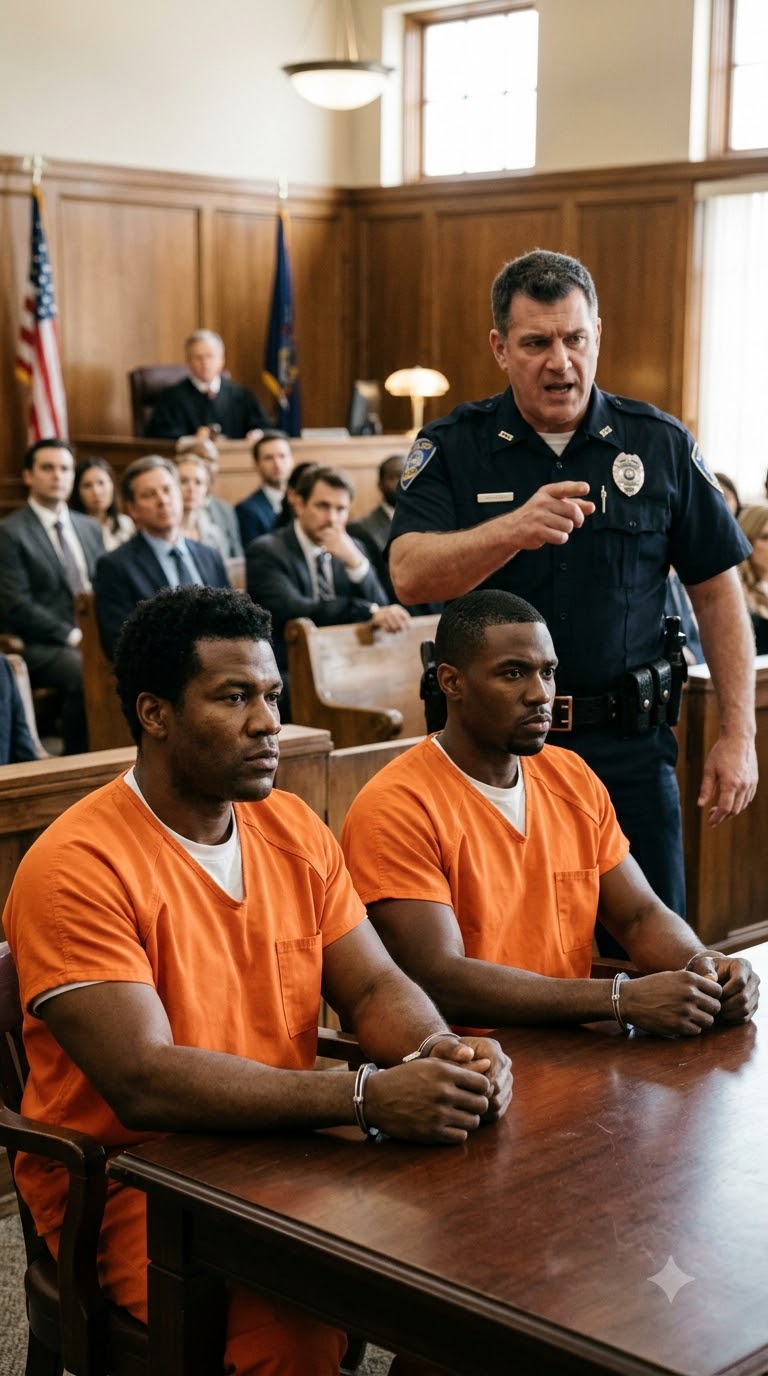
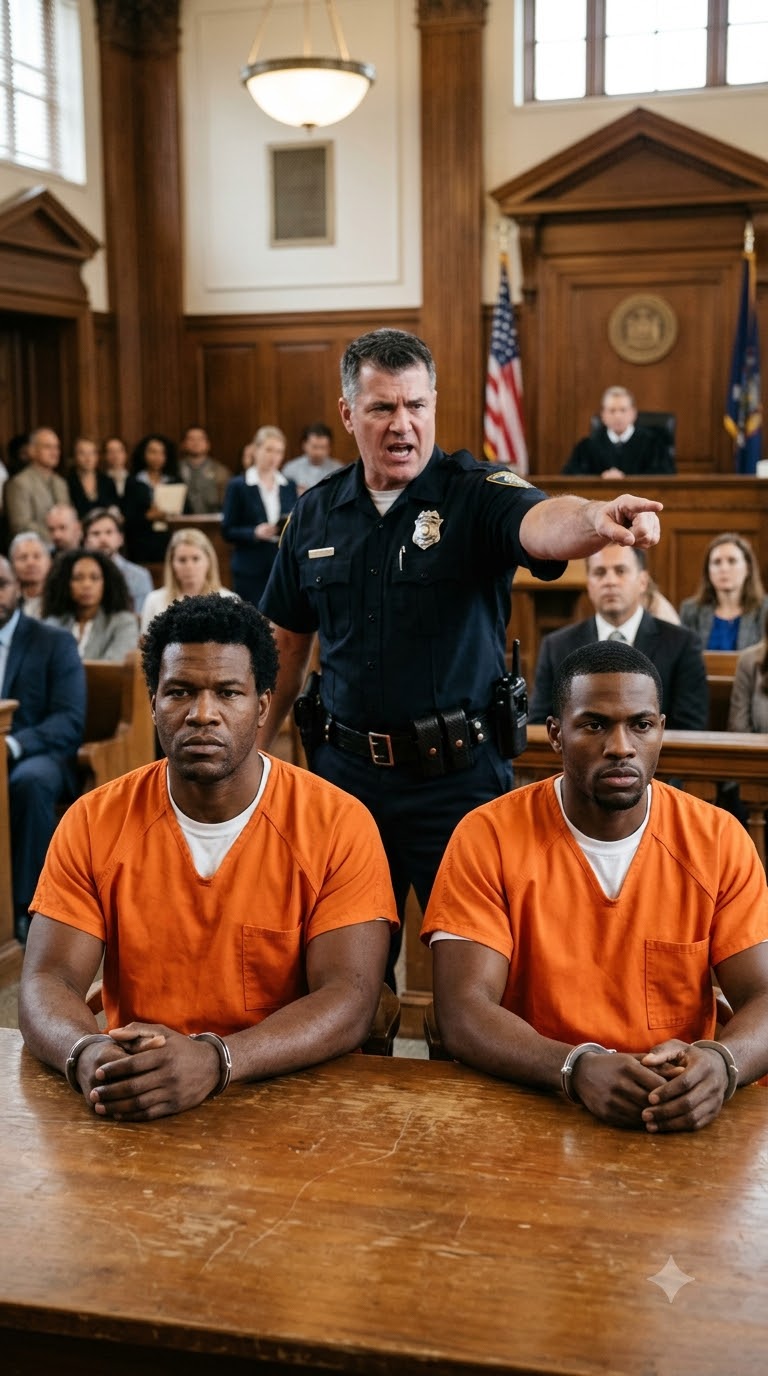
Now, inside the courtroom, Marcus shifted slightly in his chair.
Memories of home passed through his mind while the cold surroundings reminded him where he actually sat.
He looked toward Daniel.
His younger brother stared straight ahead, shoulders squared and jaw clenched as though standing at military inspection.
The restraints made a faint metallic sound when he moved.
To most people, it was barely noticeable.
To Linda, sitting behind them, each clink sounded louder than artillery.
She held Sophia’s drawing against her lap, gripping the paper so tightly that her knuckles turned pale.
The jurors did not know the Hill brothers.
Not yet.
They knew nothing about the porch in Savannah.
Nothing about the firefight in Afghanistan.
Nothing about a little girl’s crooked purple and green letters welcoming her father home.
But that was about to change.
Because someone in that town already knew what had really happened.
And the truth was getting closer.
At the police station, fluorescent lights buzzed overhead, washing everything in a tired gray glow.
Officer Brad Whitaker appeared anything but tired.
He looked delighted.
He dropped a stack of paperwork onto his desk, leaned back in his chair, and stretched like a man who had completed a particularly satisfying assignment.
“Couple of loudmouth Marines off the streets,” he announced with a grin.
“That’s called keeping the peace.”
Across the room, a younger officer shifted uncomfortably in his chair.
He kept his eyes fixed on the documents before him.
He said nothing.
Whitaker laughed.
“What?” he demanded.
“Don’t give me that look. You saw how they were acting. Aggressive. Dangerous. Could have gone south quick.”
The younger officer cleared his throat without looking up.
“Didn’t seem like.”
Whitaker’s smile vanished.
“Didn’t seem like what? You questioning my call?”
“Silence.”
“That’s what I thought,” Whitaker replied, tapping his pen against the paperwork.
“Doesn’t matter if they’ve got medals or war stories out here. I own the law. They’re nothing but nobodies without that uniform.”
He began filling out the arrest report.
Disorderly conduct.
Resisting arrest.
Assaulting an officer.
Each allegation was invented to justify conduct that had never been lawful.
He underlined the accusations twice, as though heavier ink could make them true.
A sergeant entered the room and paused beside the desk.
“You sure about all this, Whitaker?” he asked quietly.
Whitaker continued writing.
“I’m sure about what I saw. That’s all that matters. My word against theirs, and around here, my word wins.”
The sergeant frowned but walked away without challenging him.
Whitaker settled back in his chair, folded his hands behind his head, and smiled.
“By the time the jury hears this, those two will be yesterday’s news. Stripped of their dignity, their service, everything. Just another couple of guys who couldn’t keep their mouths shut.”
He believed every word.
What Whitaker failed to notice was that the younger officer had stopped typing.
Officer Caleb Morris sat motionless at his desk, staring at the incident report displayed on his monitor.
He had been employed by the department for less than two years.
He had joined because he believed police officers were supposed to protect people who could not protect themselves.
But during those two years, he had witnessed enough to understand that Brad Whitaker operated by a different set of rules.
Complaints disappeared.
Reports changed.
Supervisors looked away.
And whenever Whitaker returned from an arrest with that satisfied expression, somebody else usually paid the price.
Morris opened the department’s digital evidence system.
The arrest record showed that Whitaker had marked his body camera as malfunctioning.
Morris remembered seeing the camera’s recording indicator illuminated when Whitaker returned to the station.
He also remembered the sergeant’s uncomfortable expression.
Something was wrong.
Very wrong.
He checked the system again.
A video file had been uploaded automatically from Whitaker’s patrol vehicle.
Its status read pending review.
Morris hesitated.
Then he opened it.
The screen displayed the gas station.
Marcus stood beside his truck.
Daniel adjusted his duffel bag.
Whitaker approached them.
Morris watched the entire confrontation without moving.
He saw Daniel slammed against the hood.
He saw Marcus kneel without resistance.
He heard Whitaker threaten the brothers.
And he watched the officer invent an assault that never occurred.
When the recording ended, Morris remained staring at the screen.
He understood that this was no ordinary disagreement about an arrest.
It was evidence of a crime.
And the man responsible was sitting only a few feet away, laughing at his own paperwork.
Morris quietly preserved the recording through the department’s evidence-retention system and made a note of its identifying number.
Then he opened a blank incident memorandum.
His fingers hovered above the keyboard.
Reporting Whitaker could destroy his career in that department.
Remaining silent could destroy two innocent men’s lives.
He thought about the oath he had taken.
Then he began typing.
Across town, the elderly veteran from the gas station sat at his kitchen table with his phone beside a faded photograph.
The photograph showed a much younger version of himself standing beside fellow servicemen.
His name was Walter Bennett.
He had spent most of his life believing that courage was not the absence of fear but the decision to act despite it.
At the gas station, he had been afraid.
He had watched the officer mistreat the brothers and had done little more than whisper his disapproval.
Now he could not forget Marcus’s expression.
Nor could he forget Daniel’s refusal to fight back.
Walter picked up his phone.
During the confrontation, he had recorded several minutes of video.
Unlike some of the spectators, he had not recorded it for entertainment.
He had recorded it because he recognized injustice when he saw it.
He replayed the footage.
Then he looked at a number saved in his contacts.
For years, Walter had occasionally volunteered with a veterans’ legal assistance organization.
He knew exactly whom to call.
The person who answered listened without interrupting.
Walter explained what had happened, then sent the recording.
After a long silence, the voice on the other end spoke.
“Mr. Bennett, do not delete anything.”
Walter looked toward the photograph on his table.
“I wasn’t planning to.”
By morning, the video had reached an attorney.
By afternoon, it had reached someone else.
Someone who knew Marcus and Daniel Hill personally.
Someone whose presence in that courtroom would change everything.
And while Whitaker prepared to testify against the brothers, he had no idea that the evidence capable of exposing him was already moving toward the courthouse.
PART 2
The morning of the preliminary hearing arrived beneath a sky heavy with gray clouds.
Marcus and Daniel were brought into the courthouse through a side entrance.
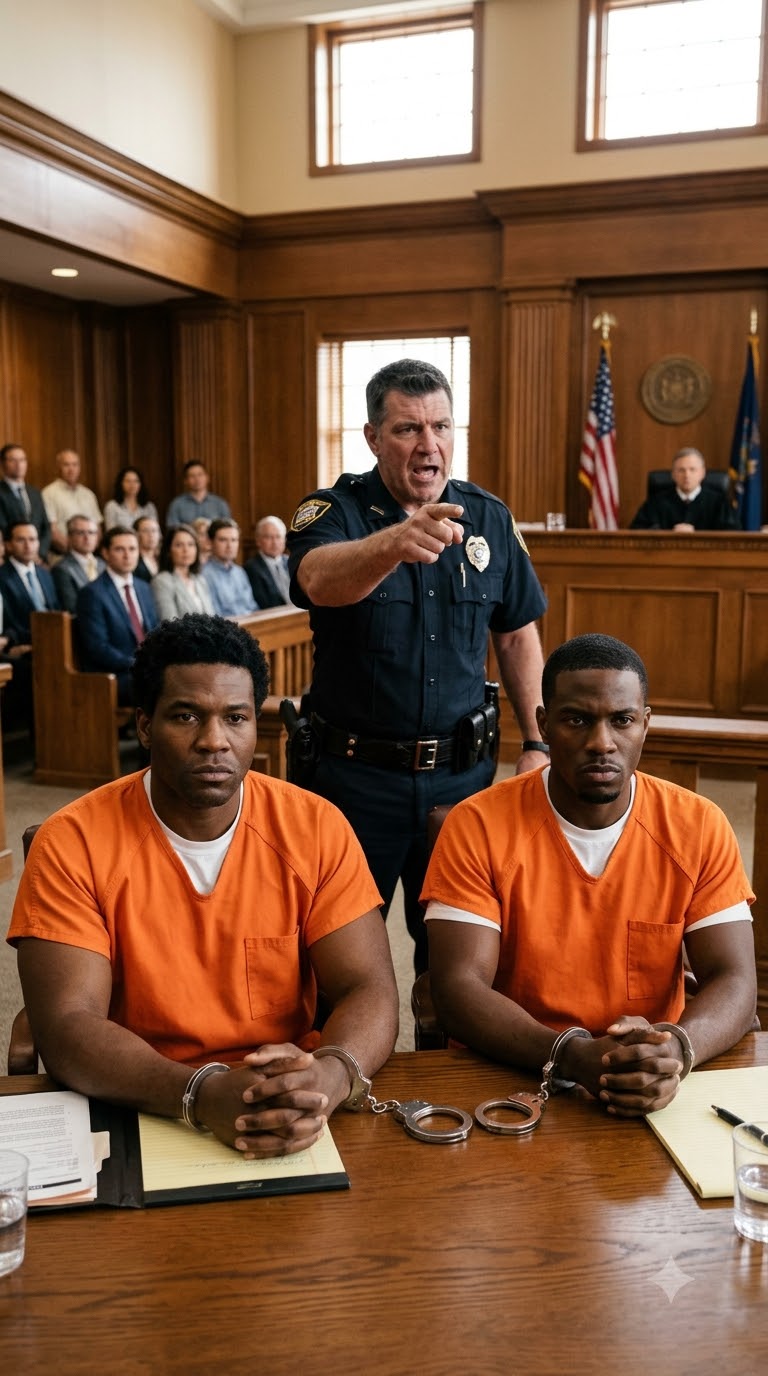
Both men wore plain clothes provided after their initial detention, but the restraints around their wrists made them look like convicted criminals before anyone had heard a single piece of evidence.
Daniel glanced at the courthouse doors.
Marcus noticed the tension in his brother’s face.
“Keep your head,” he whispered.
Daniel nodded.
He had followed that advice through firefights, emergency evacuations, and countless dangerous situations.
But being falsely accused in his own country tested his patience in a way combat never had.
Inside the courtroom, Linda sat near the front with Sophia beside her.
The little girl had insisted on bringing her drawing.
She did not understand why her father was sitting at a table with strangers instead of coming home.
She only knew that Grandma had cried the night before.
When Marcus entered, Sophia started to stand.
Linda gently caught her hand.
“Wait, sweetheart.”
Sophia looked confused.
“But Daddy’s right there.”
Marcus heard her voice.
For one brief moment, his carefully maintained composure nearly collapsed.
He turned and smiled at her.
It was a small smile, but Sophia recognized it immediately.
She lifted her drawing.
Marcus nodded.
Then a court officer directed him toward his chair.
Linda watched with tears gathering in her eyes.
She had endured years of worrying about her sons overseas.
She had imagined every terrible possibility.
But she had never imagined watching them sit in an American courtroom because a police officer had decided to lie.
The prosecutor, Assistant District Attorney Thomas Reed, arranged his documents at the opposite table.
He was an experienced attorney who had handled hundreds of routine criminal cases.
When the Hill brothers’ file first reached him, it appeared straightforward.
Two servicemen.
A roadside confrontation.
An officer alleging resistance and assault.
Yet something about the paperwork had bothered him.
The officer’s description of the assault was vague.
There was no documented injury consistent with the claimed attack.
The report mentioned aggressive behavior but described almost no specific action by either defendant.
Reed had requested the patrol footage.
The department had responded that the body camera was unavailable and that other recordings were still being processed.
He had asked again.
No recording had arrived before the hearing.
Now he stood prepared to present the evidence he had, unaware that the case was already unraveling beyond the courtroom.
Whitaker entered through a separate door.
He wore a freshly pressed uniform, polished shoes, and the confident expression of a man accustomed to being believed.
He glanced at Marcus and Daniel.
A faint smirk appeared.
Daniel noticed.
Marcus kept his eyes forward.
Whitaker took his place on the witness stand.
After being sworn in, he adjusted himself in the chair and waited for the prosecutor’s questions.
Reed began with the events at the gas station.
Whitaker described the brothers as hostile and unpredictable.
He claimed they ignored his instructions.
He said Daniel had lunged toward him.
He insisted Marcus had attempted to interfere with the arrest.
Every answer was delivered with practiced confidence.
Whitaker had told versions of similar stories before.
He understood which words made defendants sound dangerous.
Aggressive.
Uncooperative.
Threatening.
He repeated those descriptions until they seemed to fill the courtroom.
At the defense table, Daniel’s hands tightened into fists.
Marcus gently touched his brother’s arm.
Daniel loosened his grip.
Their attorney, Rebecca Lawson, listened carefully.
She had spent the previous evening reviewing the arrest report, searching for contradictions.
Lawson had represented veterans before, but she understood that military service did not place anyone above the law.
What mattered was evidence.
And the evidence in this case was suspiciously incomplete.
When her opportunity came to question Whitaker, she rose slowly.
She asked him to describe the exact moment Daniel supposedly assaulted him.
Whitaker claimed Daniel had moved aggressively toward his chest.
Lawson asked whether the officer had sustained an injury.
He said no.
She asked whether Daniel had been armed.
He admitted he had not seen a weapon.
She asked whether Marcus had struck, pushed, or threatened him.
Whitaker hesitated.
Then he insisted Marcus had interfered physically.
Lawson looked down at the report.
There was no mention of Marcus making physical contact.
She asked Whitaker to explain the discrepancy.
He shifted in his chair.
The first crack in his confidence appeared.
He claimed the situation had unfolded too quickly to document every detail.
Lawson allowed the answer to settle.
Then she asked about the body camera.
Whitaker straightened.
He said it had malfunctioned.
She asked when he first noticed the problem.
He said he could not remember.
She asked whether he had reported the malfunction before the arrest.
He claimed he had.
Lawson requested the maintenance record.
Whitaker’s jaw tightened.
The courtroom grew quieter.
At the back, Walter Bennett sat beside Officer Caleb Morris.
Morris was dressed in civilian clothes.
A sealed envelope rested on his lap.
Walter kept his eyes on the witness stand.
He had spent the previous night wondering whether he had done enough.
Now he was certain he had made the right decision.
Beside him sat another visitor.
A woman in a dark navy suit, her hair neatly arranged, her expression composed.
She had entered without attracting attention.
She carried a leather portfolio.
And she had not taken her eyes off Brad Whitaker since the hearing began.
Her name was Evelyn Carter.
She was a retired federal investigator who now served as a senior adviser to a national organization supporting service members and veterans.
Years earlier, she had worked alongside military investigators during an inquiry involving a deadly attack overseas.
Marcus and Daniel Hill had been among the servicemen whose actions saved lives during that incident.
Evelyn remembered them.
She remembered Daniel carrying a wounded corporal through hostile fire.
She remembered Marcus organizing the evacuation despite being injured himself.
She remembered the official statements, the medical reports, and the names of the men who survived because the brothers refused to abandon them.
When Walter’s video reached the veterans’ organization, Evelyn had recognized Marcus immediately.
She had contacted Lawson and arranged to attend the hearing.
She had also contacted the appropriate state authorities about possible misconduct.
Now she sat quietly, waiting.
At the witness stand, Whitaker continued insisting that his actions had been justified.
He described the brothers as men who believed their military backgrounds entitled them to special treatment.
He claimed they had challenged his authority.
Then he made a mistake.
He turned toward the defense table and smiled.
The expression lasted only a second.
But Evelyn saw it.
So did Walter.
And so did Marcus.
Lawson continued questioning him.
She asked why his report described two men resisting arrest when the gas station’s witnesses had provided conflicting accounts.
Whitaker dismissed the witnesses as unreliable.
She asked whether he had reviewed any civilian recordings.
He said he had not.
She asked whether he had made an effort to preserve them.
He claimed it was unnecessary.
Then Lawson paused.
She looked toward the back of the courtroom.
Evelyn Carter had opened her leather portfolio.
Inside were carefully arranged documents, a digital storage device, and a copy of the recording Morris had preserved.
Lawson requested permission to approach the bench.
The judge, Harold Mercer, listened as both attorneys conferred.
Reed appeared surprised.
He had not seen the footage.
Lawson explained that potentially decisive evidence had become available and that she had provided a copy to the prosecution immediately before the hearing.
The judge examined the documents.
His expression changed.
He directed the attorneys to authenticate the materials before they were introduced.
Morris was identified as the officer who had preserved the patrol recording.
Walter was identified as the civilian who had recorded the confrontation.
The judge called a brief recess so both sides could review the evidence.
Whitaker remained on the witness stand.
For the first time that morning, he looked uncomfortable.
His gaze moved toward the rear of the courtroom.
He saw Walter Bennett.
Then Caleb Morris.
Finally, his eyes settled on Evelyn Carter.
She looked directly at him.
There was no anger in her expression.
No triumph.
Only the steady, unmistakable recognition of someone who understood exactly what he had done.
Whitaker’s mouth opened slightly.
He recognized her from a previous professional encounter.
Years earlier, during a regional law enforcement training program, Evelyn had investigated complaints involving falsified incident reports.
Whitaker had attended a session where she explained how digital evidence could expose fabricated testimony.
He remembered her warning about the consequences of lying under oath.
Now she sat in the back row with a leather portfolio resting on her knees.
And the evidence he believed had disappeared was in her possession.
Whitaker suddenly stopped speaking.
The confident smile vanished.
His face lost its color.
Judge Mercer noticed the change.
He instructed the officer to remain available while the evidence was reviewed.
Whitaker swallowed hard.
For the first time, he understood that his badge might not protect him.
During the recess, Marcus remained beside Daniel.
Neither brother celebrated.
They had learned long ago that hope could be dangerous when mistaken for certainty.
Linda held Sophia close.
The little girl whispered that she wanted to go home.
Linda kissed her forehead.
“So do I, baby.”
Across the room, Reed watched the patrol recording on a laptop.
His expression became increasingly severe.
The footage showed Whitaker approaching the brothers without any visible provocation.
It showed Daniel complying.
It showed the shove.
It showed Marcus lowering himself to the pavement.
And it showed neither brother assaulting the officer.
Reed watched the video twice.
Then he compared it with Whitaker’s sworn testimony.
The contradictions were impossible to ignore.
He closed the laptop.
When court resumed, Reed rose.
He informed the judge that the newly disclosed evidence materially contradicted the prosecution’s witness.
He requested that the hearing be paused while his office evaluated the charges and the potential misconduct.
Judge Mercer agreed that the situation required immediate attention.
But Lawson asked that the defense be permitted to establish several facts on the record.
The judge allowed limited questioning.
Morris was called to testify about the recording’s preservation.
He described the automatic upload process, the original file identifier, and the steps he had taken to prevent its deletion.
He explained that he had not edited the recording.
The court confirmed the file’s chain of custody.
Walter then testified about his own video.
He described where he had been standing and what he had witnessed.
He acknowledged that he had been frightened.
He admitted he had not intervened physically.
But he stated that the brothers had complied with the officer’s instructions.
His voice shook when he described Daniel being slammed against the truck.
The judge thanked him.
Then the recording was played.
The courtroom fell silent.
Whitaker’s voice emerged from the speakers.
His threats.
His insults.
His accusations.
The sound of Daniel striking the hood.
The click of the handcuffs.
Marcus’s measured compliance.
Everything appeared exactly as it had happened.
Linda covered her mouth.
Daniel stared at the screen.
Marcus lowered his head.
Sophia, too young to understand the legal significance, recognized her father’s voice.
She reached for her grandmother’s hand.
When the video ended, nobody spoke.
Judge Mercer looked toward Whitaker.
The officer sat rigidly, his face pale.
The judge asked whether he wished to clarify his testimony.
Whitaker glanced toward the back row.
Evelyn Carter remained perfectly still.
Her eyes met his.
And once again, he could not find the words.
The silence was no longer an act of confidence.
It was fear.
The fear of a man who had built his authority on lies and suddenly discovered that the truth had survived.
Judge Mercer did not raise his voice.
He did not need to.
The evidence displayed on the courtroom screen had already stripped away the certainty with which Brad Whitaker had entered the building.
The judge asked the prosecutor to address the contradictions between the officer’s sworn testimony and the recording.
Thomas Reed stood slowly.
He had prosecuted criminal cases for years, and he understood that his responsibility was not simply to secure convictions.
It was to seek justice.
He informed the court that the state could no longer responsibly rely on Whitaker’s testimony.
He also acknowledged that the recordings undermined the essential factual basis for the charges against Marcus and Daniel Hill.
Lawson requested dismissal.
She argued that the brothers had been arrested without a legitimate basis, falsely accused of assault, and subjected to unnecessary force.
The judge reviewed the evidence and heard both attorneys.
Reed then formally moved to dismiss the charges.
Judge Mercer granted the motion.
Every charge against Marcus and Daniel Hill was dismissed.
The judge directed that their restraints be removed immediately.
For several seconds, neither brother moved.
Daniel stared at the courtroom officer approaching him.
The handcuffs opened.
The familiar metallic click sounded again.
But this time, the sound meant freedom.
Marcus watched as his own restraints were removed.
He rubbed his wrists without speaking.
The skin beneath the cuffs was bruised.
Yet the physical marks were not what occupied his thoughts.
He turned toward Sophia.
She was already standing.
Linda tried to steady her, but the little girl could no longer contain herself.
Once the judge permitted the family to approach, Sophia hurried toward her father.
Marcus dropped to one knee.
She threw herself into his arms.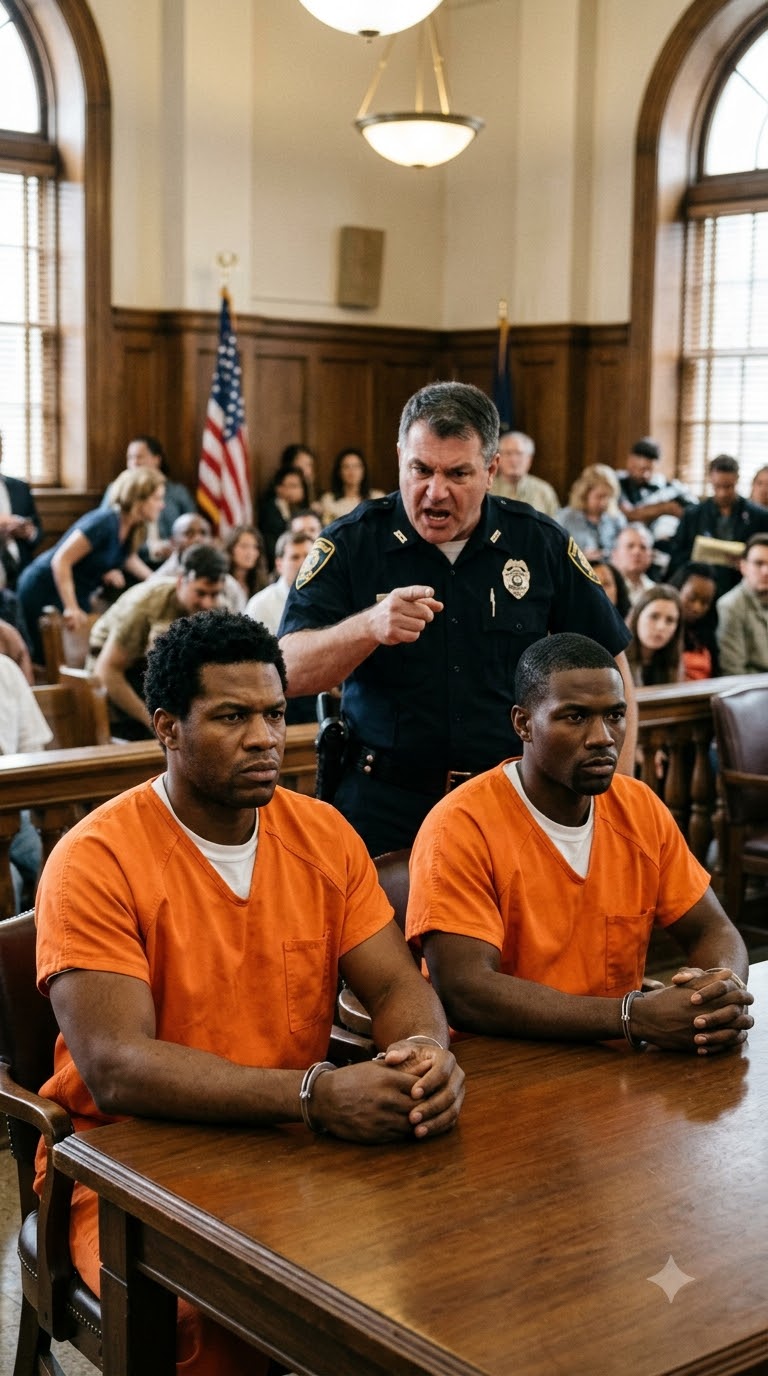
For the first time since his arrest, Marcus stopped trying to control his emotions.
He buried his face against his daughter’s shoulder.
Sophia wrapped both arms around his neck.
She had no understanding of fabricated police reports or constitutional rights.
She only knew that her father was finally holding her.
Linda approached Daniel.
He tried to smile.
Instead, his face crumpled.
His mother embraced him with the same fierce determination she had shown when he was a little boy.
For a moment, the courtroom disappeared around them.
There were no lawyers.
No spectators.
No accusations.
Only a mother holding her son and a father reunited with his daughter.
But the dismissal was not the end of the matter.
Judge Mercer directed that the recordings and relevant testimony be preserved for review by the appropriate authorities.
He also referred the apparent inconsistencies in Whitaker’s sworn statements for investigation.
The court did not declare the officer guilty of a separate crime.
That determination would require its own legal process.
But the evidence raised serious questions that could no longer be ignored.
Whitaker remained seated while the courtroom began to empty.
His uniform was still immaculate.
His badge still shone beneath the overhead lights.
Yet neither could restore the authority he had displayed so arrogantly at the gas station.
He had entered the courtroom expecting two innocent men to be humiliated.
Instead, his own testimony had been exposed.
As Marcus and Daniel prepared to leave, Evelyn Carter approached them.
Marcus recognized her immediately.
He stood straighter.
Evelyn offered a small smile.
She told him there was no need for military formality.
Then she looked at Daniel.
PART 3
She remembered the scar on his forearm.
She remembered the evacuation reports from Afghanistan.
And she remembered the wounded corporal who had survived because Daniel refused to leave him behind.
Evelyn explained how Walter’s video had reached her organization.
She described Morris’s decision to preserve the patrol recording.
She made it clear that the brothers’ freedom had not been secured by one powerful person.
It had been secured because several people chose to act.
Walter had refused to delete what he witnessed.
Morris had refused to conceal evidence.
Lawson had challenged the officer’s account.
And the prosecutor had refused to continue relying on testimony contradicted by the facts.
Marcus listened quietly.
Then he thanked them.
Daniel turned toward Morris.
The young officer looked nervous.
He knew his decision might make returning to work difficult.
He also knew he could not have lived with himself if he had remained silent.
Daniel extended his hand.
Morris accepted it.
Neither man needed a long speech.
The gesture was enough.
Outside the courthouse, reporters had gathered.
News of the recordings had spread quickly.
Several people wanted Marcus to describe his anger.
Others asked whether he believed the entire police department was corrupt.
Marcus refused to make accusations beyond what the evidence supported.
He explained that he had encountered one officer who abused his authority and others who had helped reveal the truth.
He spoke about accountability.
He spoke about the importance of preserving evidence.
And he spoke about the right of every person to be treated fairly, regardless of their background or occupation.
Daniel stood beside him.
His expression was serious.
He was not interested in becoming famous.
He wanted to go home.
He wanted to sit on the porch he had rebuilt.
He wanted to drink coffee with his mother.
He wanted to live without wondering whether another officer might decide that his silence was suspicious or his exhaustion was aggression.
The reporters continued asking questions.
But Marcus eventually excused himself.
Sophia was waiting beside Linda.
He lifted his daughter into his arms and carried her toward the parking lot.
Behind them, the courthouse doors closed.
The investigation into Whitaker began almost immediately.
The state investigative agency obtained the preserved patrol footage, the original arrest reports, the department’s camera-maintenance records, and the relevant courtroom testimony.
Investigators interviewed the gas station witnesses.
They examined the photographs and videos recorded by customers.
They compared the official timeline with the digital evidence.
The discrepancies were substantial.
Whitaker had claimed that Daniel initiated physical contact.
The video showed the officer shoving him first.
He had accused Marcus of interfering with the arrest.
The footage showed Marcus following instructions.
He had described both brothers as violent.
The recordings showed no assault by either man.
Investigators also examined Whitaker’s statement that his body camera had malfunctioned.
The available records did not support the explanation he had provided.
The inquiry expanded.
Other arrest reports bearing Whitaker’s name were reviewed.
Several contained similar descriptions of aggressive behavior without clear supporting evidence.
Complaints that had previously been dismissed were reconsidered.
Former detainees were contacted.
Some had accepted plea agreements because they feared that challenging an officer’s testimony would only make their situations worse.
Others had attempted to complain but received no meaningful response.
Not every allegation could be proved.
Some records were incomplete.
Some witnesses could no longer be located.
But the pattern was serious enough to require a broader examination of the department’s practices.
Whitaker was placed on administrative leave while the investigation continued.
The department also reviewed how supervisors had handled complaints and evidence requests.
The sergeant who had questioned Whitaker’s report was interviewed.
He acknowledged that he had noticed inconsistencies but had not pursued them.
His admission became an important part of the administrative review.
For years, Whitaker had depended on the belief that his colleagues would remain silent.
Now that silence was being examined too.
Officer Caleb Morris faced hostility from several coworkers.
Some accused him of betraying the department.
Others avoided speaking to him.
Morris considered leaving law enforcement altogether.
But he also received support from officers who believed his actions had protected the integrity of their profession.
An independent review concluded that preserving the recording had been consistent with his responsibilities.
He had not fabricated evidence.
He had not altered a report.
He had simply refused to allow potentially exculpatory material to disappear.
The distinction mattered.
Meanwhile, the Hill brothers returned to Savannah.
Linda insisted on preparing dinner the evening they arrived.
She cooked far more food than anyone could possibly eat.
Daniel teased her about feeding an entire platoon.
Marcus helped Sophia arrange her drawings on the refrigerator.
The welcome-home picture was placed in the center.
Its purple and green letters were still crooked.
Marcus stood looking at it for a long time.
Then Sophia slipped her hand into his.
She asked whether he was staying home now.
He knelt beside her.
He could not promise that life would never separate them again.
But he could promise that he would not disappear without fighting to return.
Sophia seemed satisfied.
She wrapped her arms around him.
Later that evening, Marcus sat alone on the porch.
The wooden boards creaked softly beneath his chair.
Daniel joined him with two cups of coffee.
For several minutes, neither brother spoke.
They watched the streetlights illuminate the quiet neighborhood.
Then Daniel looked at the bruises still visible around Marcus’s wrists.
He admitted that the arrest had frightened him in a way he had not expected.
Overseas, he had understood the dangers surrounding him.
He knew what enemy fire sounded like.
He knew how to react when an explosion shook the ground.
But at the gas station, the threat had come from someone wearing the uniform of a public servant.
He had not known what action would make the situation safer.
Marcus understood.
He had felt the same helplessness.
The brothers discussed what might have happened if nobody had recorded the encounter.
What if Walter had left before the arrest?
What if Morris had ignored the patrol footage?
What if the recordings had been deleted?
Their innocence would not have changed.
But proving it might have been far more difficult.
Daniel looked down at his coffee.
For the first time, he admitted that he had wanted to fight back when Whitaker slammed him against the truck.
Marcus told him he understood.
Then he reminded his younger brother that restraint had protected them when anger could have made everything worse.
Daniel nodded.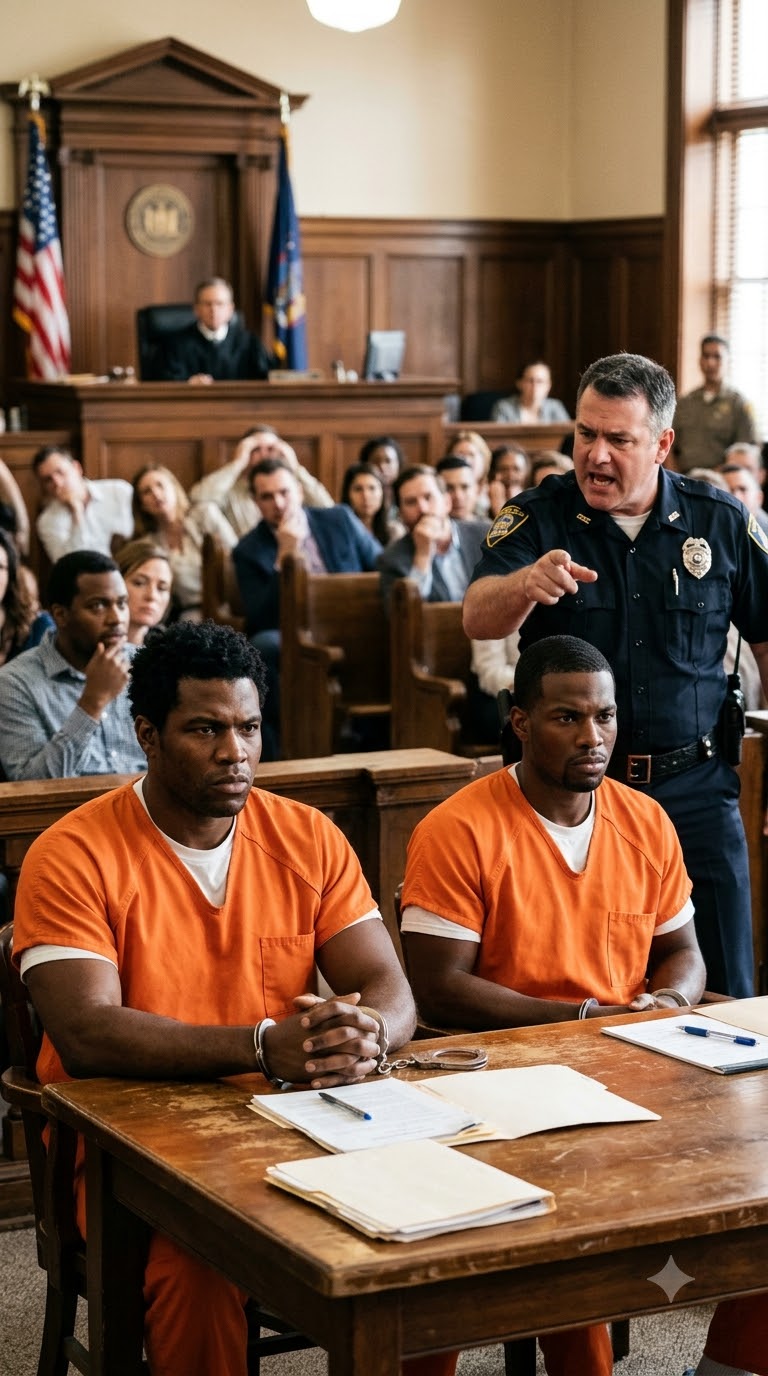
He looked toward the porch railing he had built.
For years, he had measured his strength by what he could lift, repair, or carry.
Now he was beginning to understand that strength could also mean refusing to become the person someone else wanted him to be.
Several weeks later, the brothers met with Rebecca Lawson to discuss their legal options.
The criminal charges had been dismissed, but the arrest had caused real harm.
They had lost time with their families.
They had suffered injuries and public humiliation.
Their reputations had been damaged by accusations that should never have been made.
Lawson explained that they could pursue civil claims relating to the arrest and the force used against them.
She also explained that such proceedings could take considerable time and that no result was guaranteed.
Marcus and Daniel agreed to proceed.
They did not want revenge.
They wanted accountability.
They wanted the department to confront the practices that had allowed Whitaker’s conduct to continue.
And they wanted the next person stopped on Highway 41 to have a better chance of being treated lawfully.
The civil case prompted further disclosure of departmental records.
Training documents were examined.
Complaint procedures were reviewed.
Questions were raised about whether supervisors had ignored repeated warnings.
The brothers’ legal team also requested policies governing body cameras, report preparation, and evidence preservation.
What began as a challenge to one arrest had become a broader examination of how misconduct could survive inside an institution.
During this period, Walter Bennett remained in contact with the family.
Linda invited him to dinner.
He initially refused, insisting that he had done nothing extraordinary.
But Linda would not accept that explanation.
She reminded him that he had been the only person at the gas station who openly questioned the arrest.
More importantly, he had preserved the recording when it mattered.
Walter eventually agreed to visit.
He arrived carrying an old photograph from his military service.
Daniel examined the picture with interest.
Marcus asked about the men standing beside him.
Walter told them their stories.
Some had returned home.
Others had not.
He spoke about the strange experience of surviving war and then discovering that ordinary civilian life could contain its own forms of cruelty.
Linda listened from the kitchen.
Sophia sat nearby drawing another picture.
This time, she included her father, her uncle, her grandmother, and Walter.
She gave everyone enormous smiles.
Walter laughed when she handed it to him.
He placed the drawing inside the same folder where he kept his military photographs.
Months passed.
The investigation into Whitaker reached a decisive stage.
Prosecutors reviewed the evidence and brought charges arising from the falsified account and sworn testimony.
Whitaker retained legal counsel and contested the allegations.
The proceedings were separate from the brothers’ dismissed criminal case.
Witnesses testified.
Digital records were authenticated.
The original footage was examined.
The court considered the difference between an officer making an honest mistake during a tense encounter and deliberately describing events that had not occurred.
The evidence against Whitaker was substantial.
His statements could not be reconciled with the recordings.
His explanations changed repeatedly.
And his claim that the brothers had assaulted him remained unsupported.
Following the proceedings, Whitaker was convicted of offenses connected to his false official statements and testimony.
His employment with the department ended.
The court imposed a sentence after considering the applicable law and the circumstances of the offenses.
For the first time in his career, Whitaker faced consequences that his badge could not prevent.
The decision did not erase what Marcus and Daniel had experienced.
It did not remove the memory of the handcuffs.
It did not give Linda back the hours she had spent imagining the worst.
And it did not make Sophia forget the sight of her father sitting in a courtroom.
But it established something important.
An officer’s authority did not make his version of events automatically true.
His oath required honesty.
His badge carried responsibilities.
And violating those responsibilities could bring consequences.
The department subsequently announced changes to its evidence-preservation procedures and internal complaint review process.
Those reforms were not presented as proof that every problem had been solved.
They were acknowledged as necessary steps after serious failures.
Morris continued serving as an officer.
His relationship with some colleagues remained strained, but he no longer questioned whether preserving the video had been the right decision.
He had seen the effect of his actions on the Hill family.
He had watched Sophia run into her father’s arms.
That memory was enough.
Evelyn Carter returned to her work supporting veterans.
She occasionally received letters from Marcus and Daniel.
They never forgot her presence in the back row.
But Evelyn always reminded them that the truth had depended on more than her involvement.
Walter had recorded what happened.
Morris had preserved the patrol footage.
Lawson had pursued the contradictions.
Reed had fulfilled his responsibility when the evidence undermined the prosecution.
And the judge had acted on the record before him.
Justice had required more than one person.
It had required people in different positions to choose integrity over convenience.
Eventually, Marcus and Daniel reached a resolution of their civil claims.
The outcome included financial compensation and commitments concerning departmental practices, though no settlement could undo the experience itself.
The brothers used part of the money to establish a small community initiative connecting veterans and other residents with information about legal assistance and their rights during police encounters.
They did not want the program to focus only on people who had served in uniform.
Marcus believed that every innocent person deserved the same protection.
Daniel agreed.
Their military service had shaped their lives, but it was not the reason their arrest had been wrong.
The arrest had been wrong because they had been deprived of their rights.
Because an officer had used force without justification.
Because false accusations had been written into an official report.
And because the truth should never depend on whether a person has medals, influential friends, or someone powerful sitting in the back row.
One afternoon, nearly a year after the arrest, Marcus returned to Highway 41 with Daniel.
They were traveling to visit an old military friend.
The route took them past the same gas station.
Daniel recognized it first.
For a moment, neither brother spoke.
The neon signs were still there.
The fuel pumps stood beneath the same overhead lights.
Cars moved in and out as though nothing unusual had ever happened.
Marcus pulled into the station.
Daniel looked at him.
He understood why his brother had stopped.
Some places become frightening not because of what they are, but because of what happened there.
Marcus did not want that gas station to remain a place he could never face.
He stepped out of the truck.
Daniel followed.
They filled the tank.
No patrol cruiser appeared.
No one shouted at them.
No flashing lights washed across the concrete.
It was simply an ordinary stop on an ordinary afternoon.
And that ordinariness felt extraordinary.
As Marcus replaced the fuel nozzle, an elderly man approached from the convenience store.
Walter Bennett.
He had recognized the truck.
For a moment, all three men stared at one another in surprise.
Then they laughed.
Walter shook their hands.
He asked about Linda.
He asked about Sophia.
Daniel told him the porch was still standing.
Walter smiled.
They spoke for several minutes beneath the same canopy where the arrest had occurred.
But the atmosphere was different.
There was no fear.
No humiliation.
No officer using his authority to manufacture guilt.
Only three men sharing a conversation.
Before leaving, Marcus looked across the pavement.
He remembered kneeling there with his hands behind his back.
He remembered Whitaker’s contemptuous expression.
He remembered the spectators holding their phones.
But he also remembered Walter standing among them.
The man who had whispered that the arrest was wrong.
The man who had recorded the truth.
Marcus realized that the memory no longer belonged entirely to Whitaker.
It belonged to everyone who had refused to let the lie become the final version of what happened.
That evening, Marcus returned home to find Sophia waiting on the porch.
She had grown taller.
Her handwriting had improved.
But she still loved drawing pictures for him.
She ran down the steps as soon as his truck appeared.
Marcus caught her in his arms.
Daniel followed them inside, where Linda was preparing dinner.
The house filled with familiar sounds.
Sophia talking excitedly.
Daniel laughing at something their mother said.
Dishes clattering in the kitchen.
The ordinary music of a family together.
Later, Marcus found a new drawing waiting on his pillow.
It showed two men standing beside a truck.
A little girl stood between them.
Above their heads, Sophia had written a simple message.
This time, the letters were straight.
And Marcus smiled because he understood what mattered most.
He had come home.
Not merely from deployment.
Not merely from a courthouse.
But from an experience that had threatened to steal his faith in the country he had served.
He still knew that injustice existed.
He still understood that a uniform could be abused and that institutions could fail.
But he had also witnessed courage in unexpected places.
In an elderly veteran who refused to erase a recording.
In a young officer who risked his career to preserve evidence.
In an attorney who refused to accept contradictions.
In a prosecutor who changed course when the facts demanded it.
And in a woman sitting quietly in the back row, whose steady gaze reminded a corrupt officer that the truth had finally caught up with him.
Brad Whitaker had believed that power meant deciding who was guilty.
He had believed that a badge could transform lies into facts.
He had believed that two exhausted brothers passing through a small town would never have the strength or resources to challenge him.
But he had misunderstood the very thing that made Marcus and Daniel Hill strong.
Their strength had never depended on their medals.
It had never depended on their uniforms.
And it had never depended on frightening someone else into silence.
Their strength was the discipline to remain calm when threatened, the courage to stand by the truth, and the determination to protect the people they loved.
On the night of the arrest, Whitaker had smiled and declared it another easy night.
He had been certain the story was finished.
Instead, it was only beginning.
Because the truth does not always arrive with sirens or shouted accusations.
Sometimes it arrives as a preserved recording.
Sometimes it arrives in the hands of an ordinary witness.
And sometimes it walks quietly into a courtroom, takes a seat in the back row, opens a leather portfolio, and waits for a man who has spent years lying to realize that someone finally knows the truth.
THE END
