

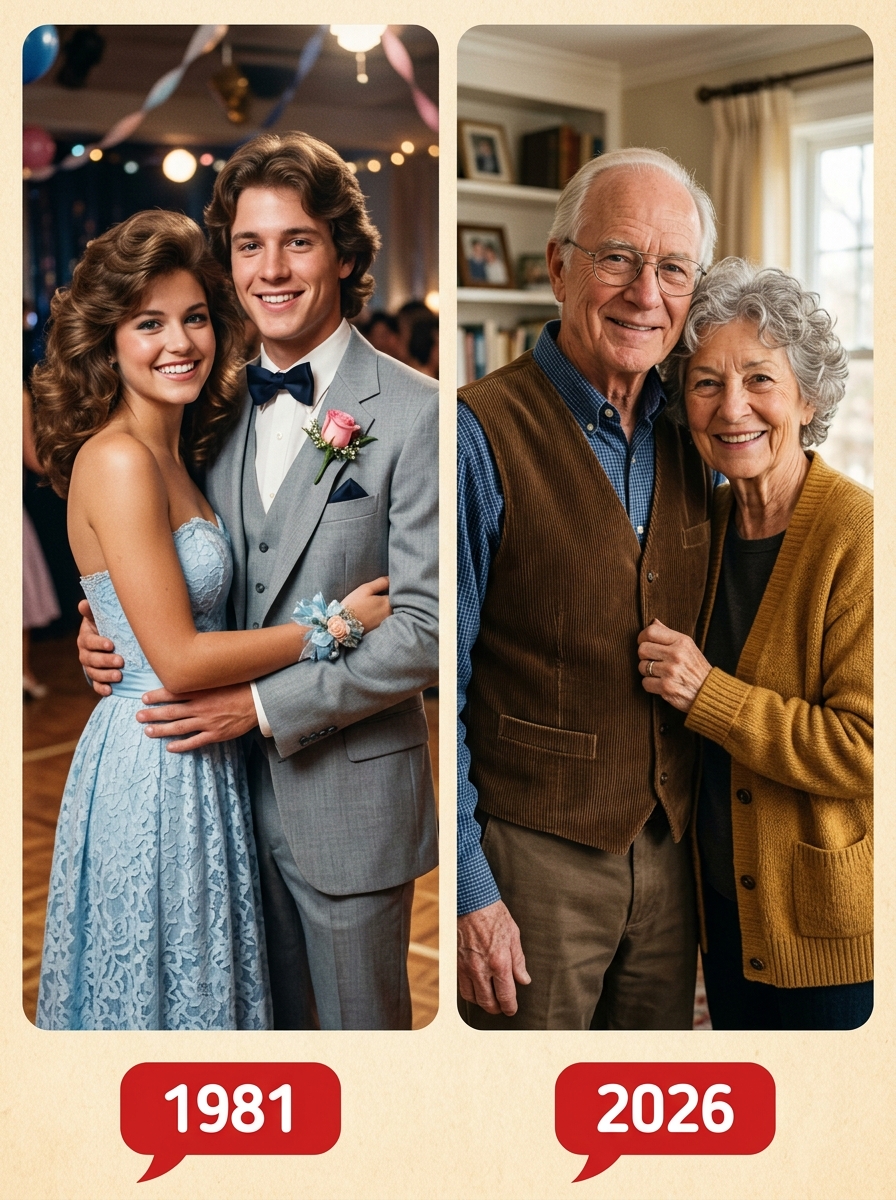
A woman who has spent decades protecting a single fragile memory is left shaken when the boy who once created it appears at her door forty-five years later. But what he brings with him reaches far beyond anything that happened on prom night.
The kettle let out its familiar whistle the way it had every morning for forty-five years, and I poured the hot water slowly, just as my mother once showed me. Morning light spilled across the kitchen floor of the small house I never left. On the windowsill rested a single photograph, its edges curled with time, showing a man with gentle eyes who had been gone longer than he had ever stayed.
My fingers drifted to the left side of my face out of habit, the way others might touch a ring.
That side of me carried a history. I was seven when gas filled our kitchen and the explosion that followed took our home in moments. My family survived, mostly. My father did not. My face never healed back the same. After the fire, Mama moved us across town. She never spoke about the neighbors, and I was too young to remember their faces clearly.
“You’re lucky to be here, sweetheart,” the nurse once told me, gently smoothing my hair.
“I don’t feel lucky,” I whispered back.
She had no reply for that.
By the time I reached high school, mirrors became something I avoided. The hallway was worse. “Hey, scarface, smile for us.”
“She should wear a mask. She’d scare crows out of a field.”
I kept walking. I always kept walking.
There was a boy back then, a year above me and a world away, named Nolan. He was the football star, the one girls whispered about during algebra. I watched him the way people watch distant weather—certain it would never reach them.
He never looked at me. I never expected him to.
When prom posters went up that spring, I sat at my desk pretending not to notice them. “Are you going?” my mother asked one evening, drying a plate.
“Nobody asked me.”
“You don’t need to be asked. You can go on your own two feet.”
“Mama, please.”
She set the plate down and looked at me with the kind of quiet certainty only she could give.
“Your father would have wanted you to go. He would have said wear the blue dress and dance until your shoes hurt.”
I cried into the dish towel. She let me. I bought the dress with my own money. I curled my hair in front of a mirror I barely recognized. I told myself I was doing it for him, the man in the photograph who had run into a burning house and never fully returned.
The gym smelled of cologne and floor polish. Streamers hung unevenly from the rafters. I walked in alone, and a few heads turned, and a few voices whispered. I found a table in the corner with empty chairs on both sides.
“Look who showed up.”
“Brave of her.”
I sat very still, hands folded in my lap. The DJ played song after song. Couples swayed under cheap colored lights. I watched them laugh and lean into each other, telling myself it was enough just to be there, just to have tried.
Then the lights dimmed for a slow song, and I lowered my gaze to the tablecloth.
That was when someone stopped in front of me.
“Would you dance with me?”
I looked up. Nolan stood there in a rented jacket, hands in his pockets, nervous in a way I had never seen before.
“Me?” I asked.
“You,” he said.
Somewhere behind him, a boy laughed too loudly.
“Is Nolan doing charity work now?”
A girl’s voice followed, sharper than the rest.
“Nolan, there are so many pretty girls here. Why would you ruin your prom like this?”
Heat rose in my face beneath the scars. I began to shake my head.
“Don’t listen to them,” Nolan said softly. “Please.” He extended his hand. I stared at it for a long moment, then placed mine in his.
He guided me onto the dance floor without hesitation. One hand rested at my waist, careful, as if I were something fragile.
“You’re shaking,” he murmured.
“I’ve never done this,” I admitted.
“Neither have I, really.”
A small, surprised laugh escaped me. “You? The football star?”
“The football star is terrible at slow songs,” he said. “Just follow me.”
We moved in small, unsteady circles while everything else blurred beyond our small circle of light. When the next song began, and then the one after it, he still didn’t let go.
“Why did you come over?” I finally whispered.
He paused. His jaw tightened briefly before easing.
“Because I wanted to,” he said. “Because I should have done it a long time ago.”
I didn’t push further. I was too afraid of what the answer might break open.
When the final song faded, he offered me his arm. “Let me walk you home.”
We took the longer route beneath the streetlights. The night air felt cool against my skin. He was quieter than he had been in the gym, starting to speak a couple of times before stopping.
“I had a good time tonight,” he said at my gate. “A real one. I want you to know that.”
“You don’t have to say that, Nolan.”
He stopped and looked directly at me.
“I’m saying it because it’s true,” he said. “Promise you’ll remember that.”
“I promise,” I whispered.
He gave a small smile, lifted his hand in a quiet wave, and walked away down the sidewalk.
I carried that promise like a candle through the rest of the summer.
Graduation came and went. He didn’t call. He didn’t write. I wrote him once that fall, sending the letter to an old address his aunt reluctantly gave me when I gathered the courage to ask. Nolan had asked his family not to share his new location, she said, and they intended to respect that.
The letter returned two months later, unopened, stamped in red.
Return to sender. No forwarding address. After that, I stopped writing and began waiting instead.
I waited through autumn, then winter, then years that quietly became decades. I never left our small town. I told myself he would return if it mattered. I never married. I told myself I was simply private.
Forty-five years passed like that—quiet, contained, the prom night sealed away like something fragile inside me.
Then yesterday morning, a sharp knock sounded at my front door.
I dried my hands on a dish towel and went to answer it, expecting the mailman.
When I opened the door, I froze. A gray-haired man stood there, leaning on a polished cane, age written across his face. But his eyes—and the hesitant smile beneath them—belonged to the boy who once crossed a gym floor for me.
I stepped aside and let him in, my hand trembling on the doorframe.
“Come in, Nolan. The kettle’s already warm.”
He moved carefully across the threshold, the cane tapping softly against the wood floor. I led him to the small kitchen table by the window—the same table where I had eaten breakfast alone for most of my life.
“You kept the house,” he said, glancing around. “I wondered if you would.” “I never had a reason to leave.”
I poured the tea with hands that didn’t fully steady themselves. He watched me, and I felt the years between us pressing against my ribs like an unfinished breath.
“Nolan,” I said, lowering myself into the chair across from him. “I’m happy to see you. But why are you here? Why now, after forty-five years?”
His teacup trembled lightly against the saucer before he set it down with care.
“One secret has followed me all this time,” he whispered. “And it has nothing to do with what you think.”
The room seemed to tilt slightly. Forty-five years of a single memory suddenly felt balanced on something fragile.
“What secret?” I asked. He looked away from me, focusing on the table.
“That night at prom,” he began, “when I walked across that gym and asked you to dance—I didn’t choose that on my own.”
The words settled on my chest like a slow pressure. I tightened my grip on my cup.
“Someone told you to do it.”
“Yes.”
I closed my eyes. The voices from school rushed back all at once. Is Nolan doing charity work now? I had buried them beneath one slow dance for nearly half a century, and now they were rising again. “Was it a dare?” I asked. “A bet? Were they laughing at me the entire time?”
“No,” he said quickly. “God, no. Please. It wasn’t like that at all.”
“Then what was it?”
“My mother,” he said. “She sat me down before prom and told me something I didn’t know. Something about you. About your family.”
“My family?”
“I came to prom that night for a reason I didn’t fully understand. I thought I was honoring something. Doing what was right.”
I set my cup down harder than I meant to, tea spilling slightly. “Nolan, please. I’ve waited forty-five years for even a word from you. Don’t give me fragments now.”
“Your father,” he whispered. “Your father was the man who pulled my little sister out of our house that night.”
The room shifted beneath me.
“What did you say?”
“The gas had been leaking between the walls for hours. When it ignited, it tore through the back of our house and into yours. Your father got your mother and you out onto the lawn, then ran next door. My sister was trapped upstairs. He carried her down, then went back for our dog. The smoke took him.” I couldn’t speak. My mother had only ever said there was a fire, and that he was brave. Nothing more, no matter how I asked.
“My mother couldn’t stay in that neighborhood after. We moved to my aunt’s before the month ended, and she never spoke your family’s name again. I was nine. My sister was four. I grew up knowing only that a neighbor had died saving her.”
His voice fractured.
“Before prom, my mother told me everything else. She said your mother had whispered to hers on the lawn that night—that she couldn’t bear for his death to become a story you would have to carry, that she wanted you to grieve a father, not a hero you could never live up to. My mother kept that promise for years. Then she gave it to me and told me to be kind to you, and if I ever found the courage, to tell you the truth.”
“So it was pity,” I whispered.
“No.” His eyes glistened. “I crossed that gym for him. But I stayed for you. Every dance, every word—it was real. I have never lied about that night. Not once. Not even to myself.”
“Then why did you disappear?”
“My mother was barely gone. I told myself you deserved someone who wasn’t carrying a debt he could never repay, or a grief he didn’t even know how to name. I convinced myself distance was kindness. That I was sparing you. I was a coward.”
He reached into his coat and placed a small velvet box into my hands. I opened it. My father’s pocket watch rested inside, its brass softened and worn by time.
“They found it on the lawn beside my sister,” Nolan said quietly. “It must have slipped from his pocket when he placed her down in the grass. We kept it. We always intended to find you.”
The tears came then—long-held, carefully buried tears I had carried for half a century.
“You weren’t a charity case,” he said. “You were the only girl in that room.”
I closed my fingers around the watch and felt, at last, the warmth of my father’s hand reaching across forty-five years, finding mine.
