

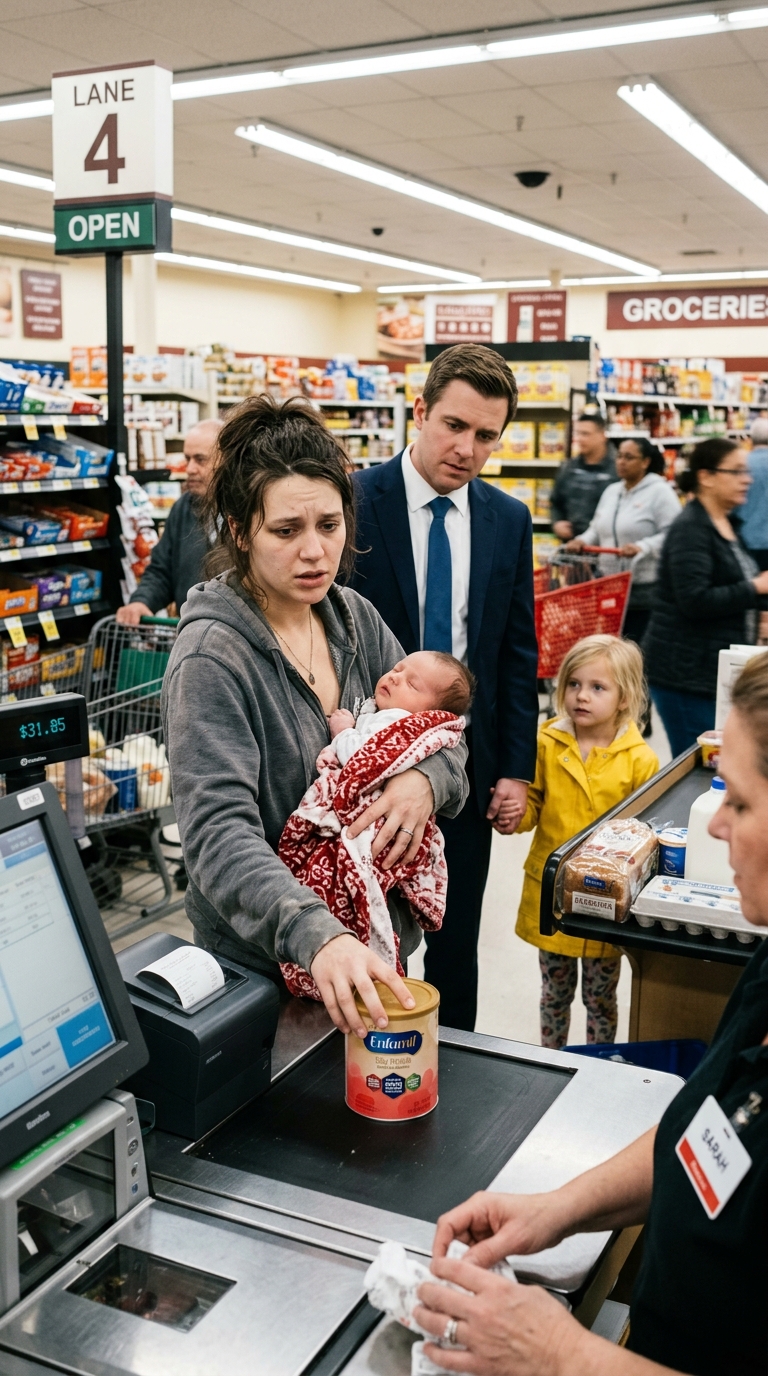
The Receipt Under Cold Lights
The big-box store in Riverton, Ohio always sounded the same—carts rattling, scanners chirping, babies fussing, and fluorescent lights humming like a tired song. People moved with their heads down, focused on lists and prices, trying not to notice anyone else.
But Hannah Mercer noticed everything.
She noticed the clock above the service desk. She noticed the thin stack of bills in her wallet. She noticed how her hands shook even when she tried to hold them still. Hannah was twenty-eight, but the last few months had aged her in quiet ways—through sleepless nights, constant worry, and the kind of stress that sits behind your ribs.
In her cart was the bare minimum: store-brand bread, oatmeal, frozen vegetables, and a couple small jars of baby food. And right on top, like it was the most important thing in the world, sat a single blue can of hypoallergenic infant formula—the only kind her pediatrician had insisted on.
“If you change brands, she’s going to have a hard time,” the doctor had said without hesitation.
Hannah’s daughter, Nora, was almost one. She had soft cheeks, bright eyes, and a trust so pure it made Hannah feel both strong and terrified. Nora didn’t know how heavy the world could be. So Hannah carried that weight for both of them.
And lately, the world had been asking for more than Hannah had to give.
The Beep That Felt Like a Verdict
At the checkout lane, the cashier looked barely old enough to rent a car. His name tag read “Evan”, and his face had the flat tiredness of someone who had been on his feet for too many hours.
He scanned each item with a quick mechanical rhythm.
Bread. Beep. Oatmeal. Beep. Frozen vegetables. Beep.
Each sound felt like a small marker in time, counting down to the moment Hannah dreaded.
When Evan lifted the blue can, Hannah’s breathing stopped.
She knew the price. She had calculated it in her head three different times while walking the aisles, like math could soften reality if she tried hard enough. But knowing something and facing it are not the same.
Beep.
The total flashed on the screen. It was more than what she had.
Evan glanced up, not unkind, just worn out.
“Is that everything today?”
Hannah nodded, swallowing hard. She opened her wallet and counted: wrinkled bills, loose coins, a couple old receipts. Her fingers trembled, not from cold, but from the heat of embarrassment crawling up her neck.
She came up short.
By just enough to hurt.
Hannah’s throat tightened. Her voice came out small.
“I’m sorry… I have to leave this one.”
She pushed the formula back across the counter as if it were nothing. But inside, it felt like surrendering with her whole body.
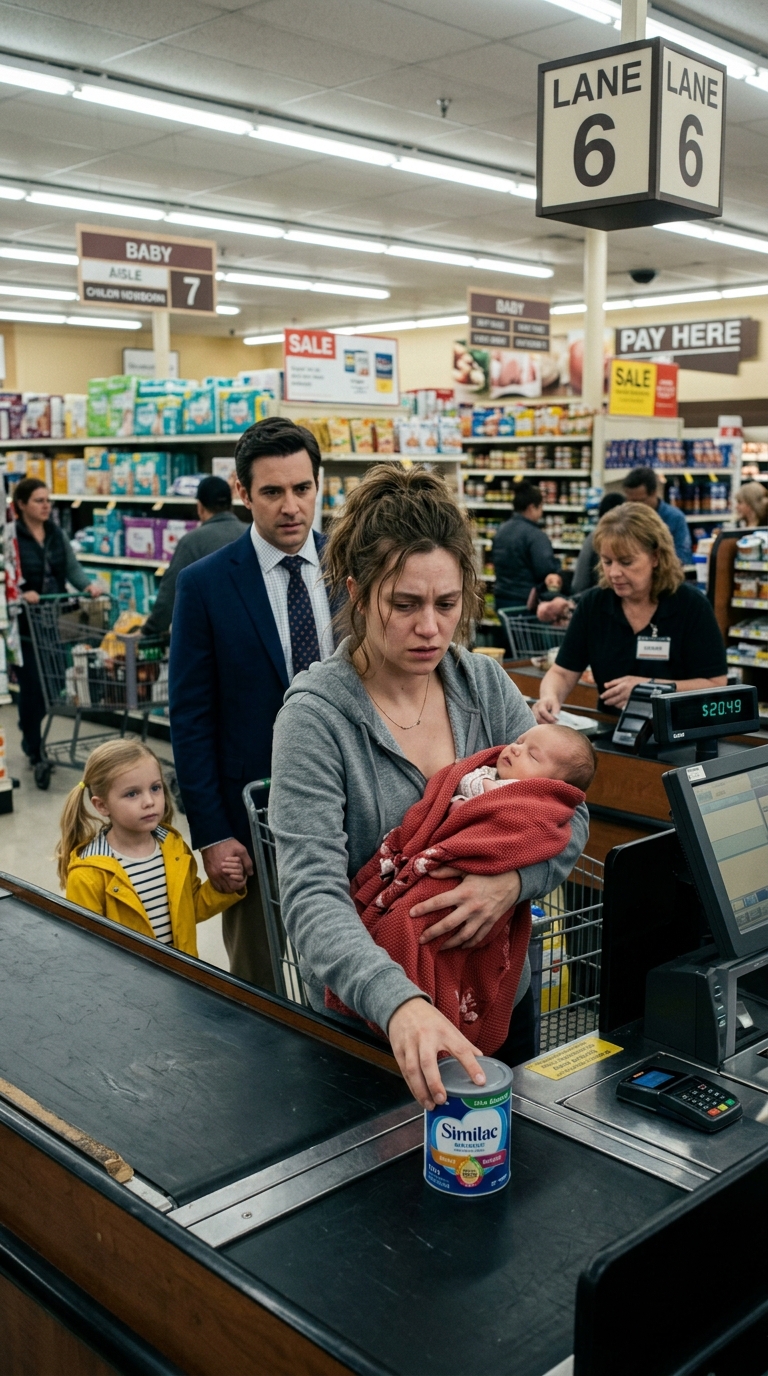
The line behind her shifted. A sigh. A throat cleared. Someone checked their phone like Hannah was stealing their evening.
Hannah wanted to disappear into her coat. She paid for what she could and took the thin plastic bag like it was heavier than it should have been. Her eyes stayed down as she walked toward the exit, trying to move fast, trying not to feel the stares she imagined.
She didn’t know someone was watching from two lanes over.
A Man Who Wasn’t Supposed to Be Noticed
A tall man stood near a display of organic juices, pretending to read labels with intense focus. He wore a plain gray coat, no flashy logo, nothing that would draw attention. Beside him, a little girl held his hand with complete confidence.
Her name was Mia. She was five, curious about everything, and brave in the effortless way only children can be.
She leaned closer to her father and whispered, “Dad… why does that lady look so sad?”
The man’s jaw tightened, not from anger, but from something deeper—something that hit him in the chest like a stone. His name was Grant Whitaker, and most of the city knew his face from business pages and charity galas. But inside the store, under those harsh lights, he was just a father with a child’s question he didn’t know how to answer.
How do you explain that sometimes a parent has to choose between dignity and necessity?
How do you tell a five-year-old that a single blue can can become a wall you can’t climb?
He brushed Mia’s hair back gently.
“She’s having a really hard day, sweetheart.”
But Grant couldn’t take his eyes off the young mother walking out with shoulders pulled in, like she was trying to make herself smaller.
Grant had sat in boardrooms where people argued over numbers too large to feel real. He had written checks that earned applause and headlines. He had attended events where generosity was almost a performance.
But this—this was quiet. This was private. This was a woman returning what her baby needed because the money simply wasn’t there.
It didn’t look dramatic. It didn’t make a scene.
And it broke something open in him.
The Bus Stop and the Quiet Collapse
Outside, the night air cut through Hannah’s coat. She walked to the bus stop, clutching the bag to her chest like it could protect her. The bench was cold metal. The streetlights turned the pavement into a dull shine.
She sat and stared at the road as if it might offer answers.
Her eyes burned, but she refused to cry. Crying in public felt like another thing she couldn’t afford. Even tears seemed like a luxury when your life was measured in pennies.
She didn’t see the man across the parking lot making a decision.
She didn’t know a simple moment at a checkout lane was about to reach backward into history—into a connection between two families she had never heard of.
The Purchase That Changed the Air Grant asked Mia to wait with the store’s security guard, a man Grant trusted, someone who knew how to keep a child calm and safe. Then Grant walked back inside with steady steps.
He went straight to the register, picked up the blue can Hannah had returned, and set it on the counter like it belonged there.
Then he added more—because he couldn’t unsee the thin grocery bag, couldn’t forget the way Hannah’s hands had trembled.
A rotisserie chicken. Fresh apples. Better bread. A small pack of cookies that looked like the kind a child’s hands would reach for.
He paid in cash.
The cashier didn’t ask questions. The scanner sang its little song again.
Beep. Beep. Beep.
Grant gathered the bags and walked out into the cold.
“I Think You Forgot This”
He found Hannah at the bus stop, curled in on herself, watching the road like she was waiting for something more than a bus. Grant slowed his pace as he approached, careful not to startle her.
“Excuse me.”
Hannah jerked her head up, alarm flashing across her face. A well-dressed man walking up at night—her body reacted before her mind could.
Grant held up the bag with the formula.
“I think you forgot this.”
Hannah’s gaze dropped to the blue can, and shame colored her cheeks.
“I didn’t forget it,” she said quietly. “I couldn’t pay for it.”
Grant nodded, calm and steady.
“I know. That’s why I bought it for you.”
Hannah shook her head fast, like accepting would be dangerous.
“I can’t take that.”
Grant didn’t push. He didn’t lecture. He simply held the bag a little closer, like he was offering warmth to someone shivering.
“Please. This isn’t charity,” he said gently. “It’s one parent helping another. Your little one needs it.”
Those words—your little one—tightened Hannah’s throat.
“Her name is Nora,” Hannah whispered, as if the name itself was fragile.
Grant’s expression softened.
“That’s a beautiful name. My daughter’s Mia. She’s five.”
Hannah looked past him and saw the little girl near the entrance, waving shyly. Something inside Hannah cracked—not into despair this time, but into relief.
Slowly, she reached out and accepted the bag.
“Thank you,” she said, voice shaking. “Really. Thank you.”
Grant gave a small nod, almost uncomfortable with gratitude.
“It’s cold, and the bus can take a while,” he said. “Let me drive you home.”
Hannah hesitated. Every instinct warned her to be careful.
But necessity has its own voice, and it often speaks louder than pride.
She looked at Mia again—safe, calm, watching.
Finally, Hannah exhaled.
“Okay,” she said softly. “But… just to the building.”
“Of course,” Grant replied.
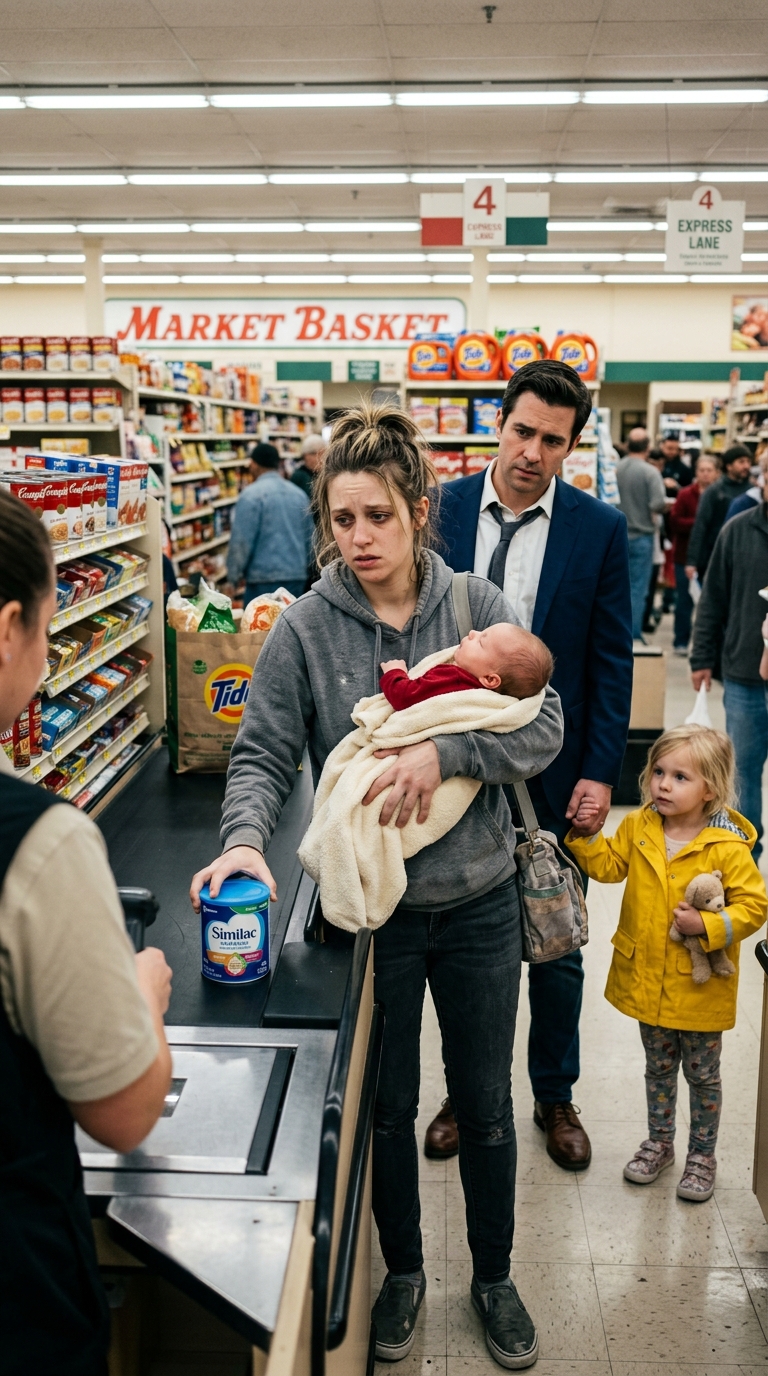
A Short Ride With Long Silence
The drive wasn’t long. It was quiet, but not awkward. Grant didn’t ask invasive questions. Hannah gave the address with a tight voice, already imagining how someone like him might react to her old apartment complex.
Mia chatted from the back seat, playing a game her father suggested—guessing shapes in the dark clouds and naming animals that might match them. Hannah listened, surprised by how normal it sounded. How gentle.
When they arrived, Grant parked and stepped out first.
Hannah reached for the bags, but Grant lifted them without hesitation.
“I’ve got it,” he said.
They climbed narrow stairs under a flickering hallway light. The walls were scuffed, the air smelled faintly of old cooking and laundry soap. Hannah fought the urge to apologize for everything—for the building, for her life, for the fact that she wasn’t someone else.
But Grant walked like none of that mattered.
Like the only thing worth doing was getting her home.
“Mama!”
When Hannah opened the apartment door, a sweet sound filled the room.
“Mama!”
Nora’s baby voice came from a small playpen in the living room. She lifted her arms like Hannah was the whole sky.
Hannah’s shoulders dropped, and she scooped her daughter up, pressing her face into soft hair. The tears she’d swallowed at the bus stop finally came, warm and unstoppable.
Not just sadness.
Relief. Love. Exhaustion. Everything.
Hannah turned, holding Nora close.
“Grant… this is Nora.”
Grant looked at the baby with an expression Hannah hadn’t expected from a man who looked like he belonged on magazine covers.
His eyes softened like he was remembering something.
“She’s perfect,” he said quietly.
The apartment was small. The furniture was old. The paint was chipped. But it was clean, and it carried the unmistakable order of someone fighting to keep life steady. Children’s books were stacked neatly. A few framed photos sat on a shelf. Love lived there, even when money didn’t.
Grant, who lived in a large house that often felt empty since his wife passed, felt something pull at him—something real, something human. Not applause. Not public praise.
Just connection.
Hannah thanked him again and again. Grant set the groceries down, gave Mia a gentle reminder to say goodnight, and then stepped back toward the door.
“Take care,” he said.
“You too,” Hannah answered.
When Grant stepped into the cold outside, he realized he felt different. Not proud. Not heroic.
Just awake.
A Mother Starts Writing Her Own Way Out
For Hannah, the next morning felt different—not because the formula sat on her kitchen counter, but because someone had seen her.
Not as a problem. Not as an inconvenience.
As a person.
She sat with a cheap notebook and wrote down what she could do, as if she needed to convince herself she still had value: dependable, organized, good with people, fast learner. She remembered the receptionist job she once had before life fell apart.
She searched listings. She applied. She didn’t magically become fearless, but she became determined.
A week later, she found an opening at a community outreach center that supported local veterans and working families. The pay was better than her restaurant shifts. The work had purpose.
That mattered.
A Father Can’t Forget What He Saw
On the other side of the city, Grant couldn’t let the moment go. His wife’s death had turned him into a man running on routine—meetings, investments, an expensive house that stayed too quiet.
He had donated plenty of money over the years, but money hadn’t healed the emptiness. And the truth was, that night in Hannah’s apartment—ten minutes under a flickering light—hit him harder than any gala.
Grant asked his head of security, a retired federal agent he trusted, to look into Hannah quietly.
Not to pry, he told himself.
Just to make sure she and the baby were okay.
When the report came back, one detail stole his breath.
Hannah’s family line traced back to a decorated sergeant named Daniel Mercer.
Grant recognized the name instantly.
His grandfather, Henry Whitaker, had spoken about Sergeant Mercer like he was more than a soldier.
“He saved my life,” Henry had said. “If it weren’t for him, you wouldn’t be here.”
Grant had heard the story so many times it felt like part of his bones. And now that name—Mercer—was attached to the young mother returning baby formula in a Megamart.
Grant sat alone in his office and stared at the report until the words blurred.
Then he made a decision.
This couldn’t end with one bag of groceries.
Building Something That Could Last
Grant didn’t want a headline. He didn’t want applause. He wanted something solid—something clear, accountable, and real.
He created a program designed to honor overlooked local service and to help descendants of those who had sacrificed: a monthly support fund paired with education assistance and job pathways.
He named it The Mercer Promise Fund—not because he wanted his name on it, but because he wanted the promise to be remembered.
A promise his grandfather had carried.
A debt of honor that deserved to be paid forward.
Hannah didn’t know any of that.
Not yet.
“The Position Was Filled… But There’s Something Else”
Days later, Hannah got a call for an interview at the outreach center. She arrived wearing her best simple outfit, nervous but prepared. She spoke from the heart—about her daughter, about working hard, about wanting stability, about wanting to help people who carried burdens the world didn’t always see.
At the end, the director smiled kindly.
“The position was already filled,” she said.
Hannah’s stomach dropped.
Then the director reached into a folder and slid a brochure across the desk.
“But there’s something else. A new program. And you qualify.”
Hannah read the bold title: The Mercer Promise Fund.
Support for local families connected to community service, education opportunities, stability resources.
Hannah looked up, stunned.
“Is this… real?”
“Completely,” the director said. “And you meet the requirements.”
Hannah signed the forms with hands that trembled like they had at the register.
But this time it wasn’t shame.
It was disbelief.
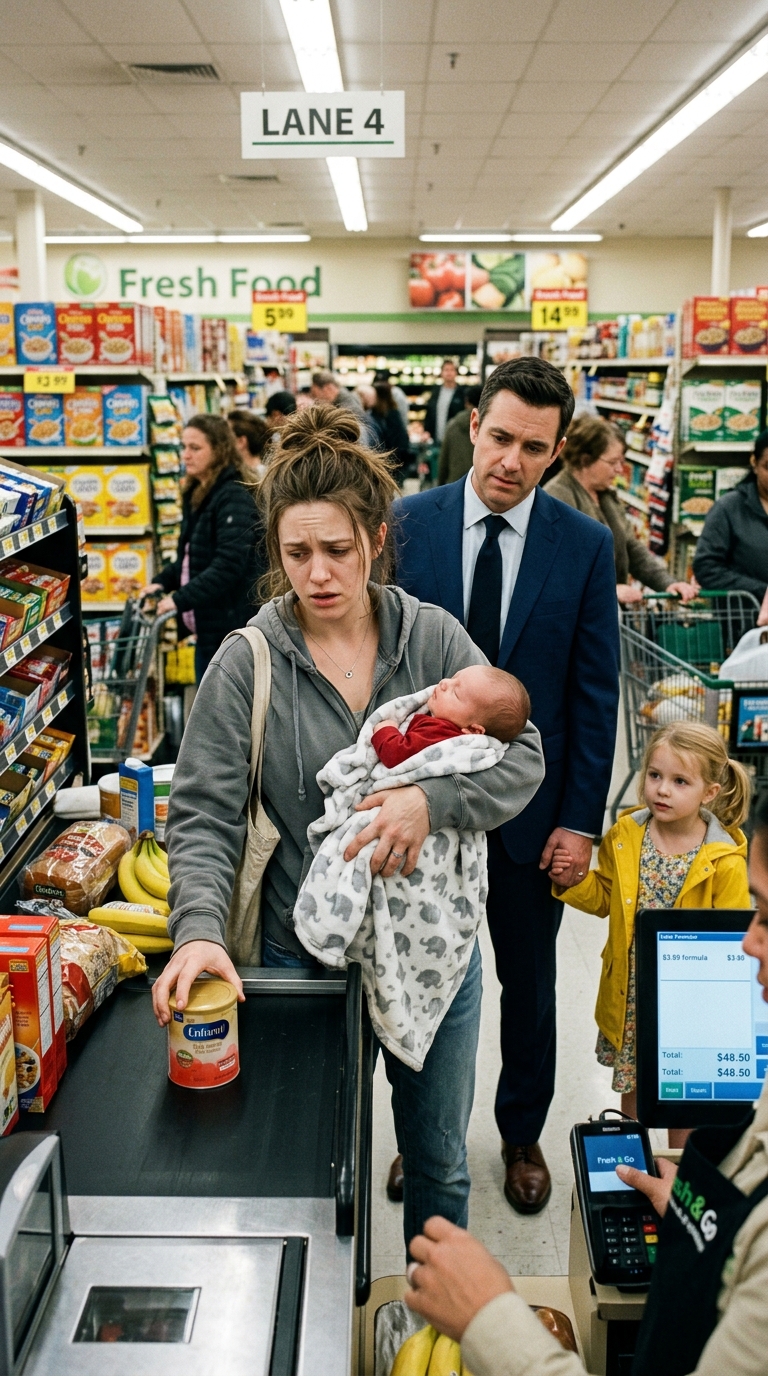
A Life That Becomes More Than Survival
With the fund support and her new job path, Hannah moved into a safer neighborhood. She bought Nora a new crib. A warm winter coat. Enough groceries that she didn’t have to count coins like they were oxygen.
She enrolled in online courses in business administration and took them seriously. During the day, she worked and played with Nora. At night, with coffee beside her, she studied.
Her life didn’t become perfect.
But it became possible.
And that changed everything.
The Room That Turned Cold Again
Progress can irritate people who live on control and suspicion.
At an event introducing the program publicly, Hannah walked into a room full of polished smiles and expensive clothing. Warm lights reflected off glass and metal. Her heart beat hard, but she kept her posture straight.
Then she saw him.
Grant Whitaker stood near the back, speaking with board members. Their eyes met, and recognition lit his face with honest surprise.
Before they could speak privately, a woman approached—elegant, influential, and sharp in a way that didn’t need volume.
Her name was Marianne Langford.
She picked up a brochure and tilted her head.
“What a convenient story,” Marianne said smoothly. “A recipient with the perfect last name. Almost like someone chose her.”
The words were poison wrapped in perfume. Heads turned. Silence widened.
Hannah felt the old familiar tremor trying to return—the feeling of being on trial.
But she didn’t look down.
“My family’s history isn’t ‘convenient,’” Hannah said, voice steady. “It’s real. And this program isn’t pity. It’s a promise kept.”
Marianne’s smile stayed sweet, but her eyes remained hard.
“Of course. A promise,” she murmured. “Or polished favoritism.”
The tension didn’t end there.
It grew.
Truth Doesn’t Need a Stage, But It Will Stand on One
A few days later, the board called a meeting. Questions were raised. Doubts were hinted at. Hannah sat across from people in suits and spoke clearly.
She didn’t dramatize her hardship. She didn’t beg. She told the truth with the dignity of someone who had carried too much for too long.
Grant listened quietly.
Then he stood.
Not to dominate the room.
To settle it.
He pulled out an old, worn notebook.
“My grandfather wrote this,” he said. “It’s his wartime journal.”
The room stilled.
Grant opened to a marked page.
“This is the day Sergeant Daniel Mercer pulled him out of danger and carried him to safety,” he said, and his voice was calm but firm. “This program didn’t come from marketing. It came from a debt my family has honored for generations.”
He read short passages—names, dates, details that held the weight of truth.
The murmurs died. Doubt fell away like a mask no one could justify wearing anymore.
The board voted not only to keep the program, but to expand it.
Marianne resigned soon after, her accusations collapsing under evidence.
Hannah went home that night and held Nora a little longer than usual, feeling something new settle in her chest.
Safety.
Two Years Later, Two Little Girls Running Free
Time did what time does when people keep showing up: it built.
Hannah completed her degree with honors and began working directly with the foundation, helping other parents who stood where she once stood—at the edge of a cliff, trying not to fall.
She became what she had needed: someone who listened without judgment and opened doors without humiliation.
Nora grew strong and bright, laughing easily, her health steady.
Mia and Nora became friends the way children do—without history or worry, just joy. They ran across parks, made up games, and lived in a world where adults didn’t have to cry at registers.
Grant and Hannah didn’t announce anything with grand speeches. What grew between them wasn’t a dramatic movie moment.
It was quieter.
Respect. Trust. Conversations that lasted. Silences that didn’t feel heavy.
A love that grew slowly—the way real things often do.
The Blue Can Nobody Forgot
One sunny Saturday, the girls played in the yard while Hannah sat beside Grant on the porch steps. She watched Nora chasing bubbles and remembered the cold lights of the store, the humiliation, the returned formula.
Hannah rested her head on Grant’s shoulder.
“I’ll never forget that night,” she whispered.
Grant squeezed her hand.
“Neither will I,” he said. “It reminded me the world can be hard… but one decision can soften it.”
Hannah breathed in and let the air out slowly.
She was no longer invisible.
She was no longer alone.
And what began with a mother returning baby formula became something no one in that store could have imagined—shared legacy, honor repaid with kindness, and proof that the quietest actions can echo for generations.
Even if your life feels measured in coins and deadlines, your worth is not something a register can calculate, and you deserve to be treated with dignity no matter what you can afford.
A child’s needs can make a parent feel powerless, but love is still a powerful force—because love keeps you standing even when shame tries to bend your spine.
When you see someone struggling in silence, remember that one gentle act—done privately and respectfully—can feel like a rope thrown to someone who’s been drowning for a long time.
Real help is not the kind that humiliates; real help is the kind that protects a person’s pride while meeting their need, because compassion without respect is not compassion at all.
The world is full of people who look “fine” on the outside, and that’s exactly why kindness should never be reserved only for the loudest pain.
Progress doesn’t always arrive as a miracle; sometimes it arrives as a small moment that reminds you to try again, apply again, believe again, and take one more step.
Honor is not only about medals and ceremonies; it is also about remembering sacrifices and turning gratitude into action that changes someone’s present and future.
People will sometimes question your blessings and assume the worst, but truth has a steady voice, and over time it can outlast every rumor that was built on jealousy.
No matter how far you climb, never forget the version of you who once prayed for a little relief, because that memory can keep your heart soft and your hands open.
If you ever wonder whether your kindness matters, remember this: a quiet decision made in a cold-lit store can become a warm legacy that reaches across families and generations.
