


Part 1: The Kitchen Conversation
For most of his life, Corbin Stanford had assumed that money could ease almost any real-world problem. At thirty-eight, he lived in an imposing stone mansion just outside Providence, Rhode Island, and ran Stanford Development, the construction company his grandfather had founded generations earlier. His mornings usually began with strong coffee, market reports, and calls about sums of money most working families would never see in their lifetimes.
But on a rainy Tuesday morning, a soft, uncertain voice coming from his own kitchen made all that wealth feel strangely meaningless.
Lianna Prescott had been the housekeeper at Corbin’s home for seven months. She showed up before seven every morning in a worn olive-colored jacket, carrying a simple cloth lunch bag. She spent her days scrubbing rooms bigger than her own apartment, buffing antique tables, and straightening closets full of designer clothes that still had their price tags on—then slipped out quietly once her shift ended.
Corbin knew almost nothing about her personal life. He knew she was reliable, that she had a baby at home, and that she almost never spoke unless spoken to first.
That morning, as Corbin headed toward the kitchen for coffee, he caught the sound of Lianna speaking quietly into her phone, her voice unsteady. He paused just outside the doorway rather than interrupt.
“Mom, I truly hate asking you for help again, but could you possibly lend me twenty-eight dollars?” Lianna murmured, leaning against the marble counter.
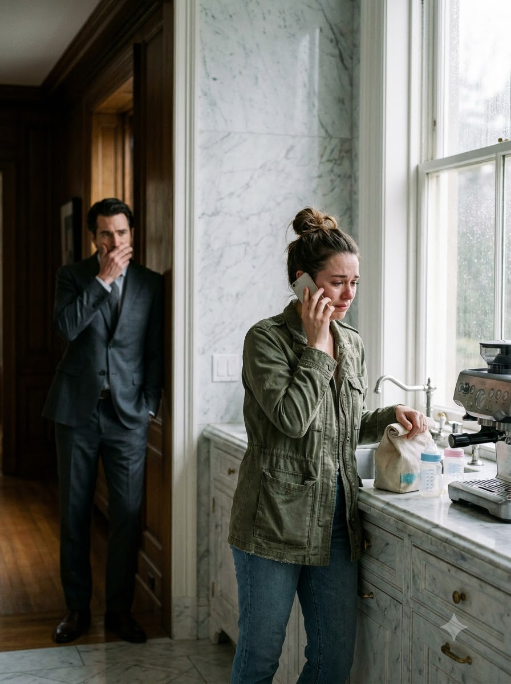
There was a pause on the other end before she went on, her voice starting to break.
“Austin is almost out of baby formula, and I thought I could make the final container stretch until my Friday paycheck, but there just is not enough left for tonight. Please do not skip buying your own groceries for my sake, because I will figure out a way to manage.”
Corbin froze in the hallway, blindsided by what he’d just heard. He’d spent more than twenty-eight dollars on a single bottle of sparkling water at a business dinner just days before.
Inside the kitchen, Lianna brushed a tear from her cheek and tried to calm her breathing.
“I will pay you back the moment my check clears in the morning, I promise,” she whispered.
Corbin retreated quietly into the hallway before she could notice he’d overheard the whole call. He went straight to his home office, shut the door firmly, and opened his laptop. For the first time ever, he searched for the going rates of infant formula, diapers, daycare, bus passes, utility bills, and rent in the towns surrounding Providence.
He jotted every figure onto a notepad, then pulled up the payroll system to check what Lianna actually earned per hour. The numbers refused to balance, so he ran through them a second time and got the same result. Even skipping every non-essential purchase, every day off, every personal indulgence, she was barely scraping by.
By midday, he’d called HR to pull her complete personnel file so he could understand her circumstances better. It showed seven months of perfect attendance—no lateness, no complaints, no missed shifts. Her emergency contact was her mother, Brenda Prescott, and her only dependent was nine-month-old Austin Prescott.
His eyes stopped on the last line of her profile: marital status, widowed. It struck him hard that he’d never even known she’d lost her husband.
Part 2: The Apartment Visit
That evening, Corbin canceled a scheduled business dinner in downtown Providence and had his driver take him straight to the address on Lianna’s job application. The neighborhood was less than thirty minutes from his estate, yet it felt like an entirely different world.
The old brick apartment building was clearly cared for by the working families who called it home. Bikes were locked to the porch railing, children’s drawings decorated a ground-floor window, and a laundromat glowed across the street.
Corbin climbed the narrow stairs carrying two heavy paper grocery bags of baby supplies. He felt oddly foolish holding them—he’d closed contracts worth hundreds of millions without a second thought, yet had stood in a pharmacy aisle for twenty minutes trying to pick the right formula.
Reaching the third floor, he heard a baby crying faintly behind Lianna’s door. He took a breath and knocked.
Lianna opened the door and went completely still, staring at him in disbelief.
“Mr. Stanford?” she asked, panic creeping into her voice. “Is there something wrong at the house that I missed today?”
“No, everything at the house is completely fine,” Corbin replied calmly.
She glanced at the bulging bags in his arms, then back at his face, worried.
“I will be there at seven tomorrow morning as usual, and I know I left a few minutes early today, but I made sure every room was clean before I stepped out,” she explained quickly.
“Lianna, I am not here about your job responsibilities,” Corbin said, trying to sound reassuring.
Confused, she stepped aside and let him see into her small living space. Simple secondhand furniture, a portable crib beside her bed, tiny baby clothes drying on a rack near the heater. On the kitchen table sat a nearly empty formula container.
She noticed him looking at it, and embarrassment washed over her face.
“Please do not fire me for bringing personal problems into this,” she begged softly.
A sharp ache of sympathy hit Corbin—even in the middle of real hardship, her greatest fear was still losing this job.
“I am definitely not here to fire you,” Corbin replied firmly.
Before he could explain the groceries, heavy footsteps sounded on the stairwell behind him.
“Corbin, I strongly advise you to step away and leave this building right now,” a sharp voice called out.
He turned to see Gordon Ramsay, Stanford Development’s longtime chief legal counsel, reaching the top landing with two security officers close behind.
“Gordon, how on earth did you know I was coming here tonight?” Corbin asked, frowning deeply.
Gordon ignored the question, his eyes fixed on the apartment doorway.
“This entire situation involves a historical corporate matter that should only be handled through proper executive channels,” Gordon said coolly.
Lianna pulled the door closer to her body, her face draining of color as she stared at the attorney. Corbin caught her tense reaction immediately and realized she wasn’t confused by Gordon’s arrival at all—she clearly knew exactly who he was.
Part 3: The Blue Envelope
“How do you know my company’s attorney?” Corbin asked, looking between Lianna and the lawyer.
Lianna glanced down at Austin, resting quietly against her shoulder, and said nothing for a long moment. Finally she gestured toward the room.
“You should probably step inside so I can show you,” she said softly.
She crossed to a wooden cabinet by the window and pulled out a thick blue envelope in a clear plastic sleeve, then spread its contents across the table—photographs, printed emails, safety logs, handwritten notes, and copies of construction records.
“My late husband worked as a site supervisor for Stanford Development,” she said, shifting her hold on the baby.
Corbin stared at her, stunned. “What was his name?”
“His name was Nathan Prescott,” she answered quietly.
Corbin searched his memory and came up with nothing, which left him deeply unsettled.
She lifted a paper from the table and handed it to him.
“Nathan was assigned to the Bayview Port overhaul four years ago, and he repeatedly reported major mechanical issues with the heavy lifting equipment on site. He told his superiors that equipment replacements had been requested multiple times, but management kept delaying orders because the project was already running behind schedule.”
Corbin took the document and started reading.
“He sent this formal email eleven days before the site failure occurred,” she added, her voice thick with emotion.
The email was blunt and unambiguous: Nathan had demanded immediate maintenance and warned that ignoring the problem put the crew at serious risk. Other attachments showed the budget denials and instructions telling workers to keep going until new machinery showed up.
“Eleven days after sending that warning, Nathan never came home from his shift,” she said softly.
Corbin lowered the email slowly as Gordon stepped into the apartment.
“That tragic incident was fully investigated and legally resolved years ago,” Gordon insisted firmly.
Lianna turned her eyes on him. “You came to my mother’s home and told me that when I was seven months pregnant.”
“Mrs. Prescott, you were provided with financial support from the firm,” Gordon replied smoothly.
“You offered me a small sum to sign legal waivers that I barely understood at the time,” Lianna shot back, her voice gaining strength. “You told me that challenging a massive corporation would take years and leave my child with nothing.”
Corbin fixed Gordon with an intense stare. “Is that really how you handled her claim?”
“It was a standard corporate settlement discussion to protect the firm from prolonged litigation,” Gordon replied calmly.
“There was nothing standard about putting pressure on a grieving widow carrying a baby whose father was killed on your job site,” Lianna said, holding the lawyer’s gaze.
The room went quiet and tense until another familiar voice spoke from the doorway.
“Corbin, that is quite enough of this,” a refined voice commanded.
Part 4: The Truth Unfolds
Corbin turned to see his mother, Evelyn Stanford, stepping into the cramped apartment in an elegant gray wool coat.
“Did you follow me here as well, Mother?” Corbin asked, frustration rising.
“Gordon alerted me to your sudden detour, and thankfully he did,” Evelyn replied, taking in the modest room before turning to her son.
Corbin held up Nathan’s email. “Did you know our company ignored safety warnings on the Bayview project?”
Evelyn sighed and adjusted her gloves. “I was aware there was a serious industrial accident, but your father managed those operational disputes when he was alive.”
“Did Father know that Nathan explicitly warned management about dangerous equipment?” Corbin pressed.
Her tone hardened. “You are questioning business choices made years ago by executives who were managing an exceptionally complicated enterprise.”
“That does not answer my question,” Corbin insisted.
Lianna stood near the crib, holding her son close as she listened. Evelyn’s gaze turned to her, cool and appraising.
“And now this young woman conveniently secures employment inside your private residence, which you must admit seems calculated,” Evelyn remarked coldly.
Lianna’s face went red with anger. “I had no idea Mr. Stanford ran the company when I accepted the housekeeping position through a employment agency, Mrs. Stanford.”
“A very convenient coincidence,” Evelyn murmured.
Lianna straightened and met her eyes directly. “There is absolutely nothing convenient about raising a fatherless child alone while counting coins at the grocery checkout line.”
Corbin looked at his mother and saw, with sudden clarity, the enormous gap between her sheltered view of the world and the hardship Lianna lived with daily.
Gordon stepped between them, gesturing toward the door. “Corbin, nothing in these papers proves any personal liability on your part, so leave this matter to the legal team.”
That single sentence settled it for Corbin. For years, his family had hidden from uncomfortable truths behind lawyers and quiet settlements.
He reached into one of the grocery bags, pulled out a fresh can of formula, and held it out to Lianna.
“Please feed Austin first,” he said gently.
Her hands shook as she took it, and she showed him where she kept warm water near the sink. For a few minutes, the argument paused entirely while she prepared the bottle and fed her son.
The baby settled and drank peacefully in her arms while the room stayed quiet. Watching the child, Corbin realized that the twenty-eight dollars Lianna had asked for that morning was only the surface of something much larger—a corporate failure worth millions, hidden beneath it.
Part 5: The Corporate Investigation
Corbin walked to the window and called Warren Hayes, a retired vice president of operations who’d worked beside his father for over twenty years before abruptly resigning after clashing with Gordon Ramsay—a resignation Corbin had never looked into.
“Warren, I need your immediate assistance to reopen an archived project file,” Corbin said.
“Which project are you looking into, Corbin?” Warren asked.
“The Bayview Port overhaul, specifically the records regarding Nathan Prescott.”
A long silence followed before Warren spoke again, sighing heavily. “So someone finally decided to pull that hidden file.”
Corbin glanced at Gordon, who was watching him closely. “What do you mean, Warren?”
“Nathan raised explicit safety concerns about damaged machinery,” Warren explained. “The field team was under intense pressure to hit deadline bonuses, and when I pushed for a full operational pause, Gordon and the senior board told me to stop causing problems for the firm.”
Anger surged through Corbin. “I am ordering a complete independent audit of every email, equipment log, and legal settlement tied to that project.”
Gordon stepped forward, his tone warning. “Corbin, consider the severe legal and financial impact on the family business before you take such drastic steps.”
Corbin met his eyes. “For the first time in my career, that is precisely what I am doing.”
Evelyn shook her head. “Your late father spent forty years building the reputation of Stanford Development.”
Corbin looked around the tiny apartment—the drying baby clothes, the secondhand furniture, the original safety reports kept in plastic sleeves because a widow had no other way to protect herself.
“Then I need to discover exactly what foundation he built it on,” he answered quietly.

Over the following two days, things moved quickly. Warren pulled together a team of independent legal and safety investigators. Sealed electronic files were opened, maintenance logs were compared, and former site workers agreed to give recorded statements.
The records confirmed that replacement parts for the equipment had been deliberately delayed to avoid project downtime, and that internal warnings had been downgraded by managers protecting their bonuses.
The audit also turned up other names—workers at other sites whose safety complaints had likewise been minimized and quietly settled.
Two days later, Warren called again while Lianna sat in Corbin’s office going through the recovered files.
“Corbin, we located Nathan’s original hand-signed safety incident report,” Warren announced.
Lianna looked up instantly, eyes wide.
“Nathan explicitly requested a work stoppage until safe replacement cranes were brought to the port,” Warren continued. “He specifically noted in writing that he was deeply concerned for the safety of the younger crew members on his shift.”
Lianna covered her face as tears started falling. For four years, she’d had to live with the company’s official story—that Nathan had been careless, ignored protocol, and caused his own death.
Now there was proof, in writing, that he’d acted heroically to protect the people around him.
“I always knew who he was,” Lianna whispered through her tears. “I knew in my heart he would never ignore a danger to his crew.”
Corbin felt that a simple apology would fall far short of what she’d carried alone for so long.
“We are going to ensure every single person knows the truth about what he did,” he promised her.
Part 6: Facing the Consequences
Corbin had every legal option available to shield himself from personal responsibility, as his lawyers kept reminding him. He hadn’t overseen the Bayview project, hadn’t seen the delayed equipment requests, had never even met Nathan Prescott. He could easily have pinned it on former managers and kept his fortune and reputation untouched.
Instead, he handed the full audit over to state regulators and announced a public review of Stanford Development’s entire operational history.
The fallout was swift and severe. Several senior executives were suspended without pay pending formal charges, Gordon Ramsay was removed from his post and asked to resign, and old accident claims were reopened for full re-examination.
Corbin held a press conference outside company headquarters.
“While I did not make these specific decisions personally, I directly benefited from an executive system that prioritized speed over human life,” he told the reporters. “That responsibility belongs to me, and I will not run away from it.”
His mother wouldn’t take his calls for weeks. Several major investors pulled out of ongoing projects, two big land deals fell apart, and the company’s value dropped sharply. Corbin didn’t waver, deciding that losing money honestly was far less frightening than keeping it through deceit.
Months later, a formal state hearing convened to officially correct the safety record. Lianna came in a simple dark dress, holding Austin on her lap with her mother beside her. Corbin sat several rows back in the gallery, deliberately not joining her table. He rejected the media’s framing of him as a wealthy rescuer of a struggling mother, knowing full well that it was Lianna who had held onto the evidence, and Nathan who had raised the original alarm.
The board formally corrected Nathan Prescott’s employment record, praised his effort to stop unsafe work, and awarded Lianna significant compensation along with lifetime educational support for Austin.
When the ruling was read, Lianna didn’t celebrate. She simply opened her blue envelope, took out a photo of Nathan smiling with his arm around her, and touched it gently.
“They finally heard what you tried to tell them, Nathan,” she whispered.
Outside the courthouse, Corbin approached her on the steps.
“Lianna,” he said quietly. “I know that no amount of legal corrections or monetary settlements can ever restore what was taken from you.”
“No, it cannot,” she agreed softly.
“And I certainly do not expect you to thank me for doing what should have been done years ago,” he added.
She studied him seriously. “Do not continue changing this company just because you feel personal guilt about my family.”
He waited for her to go on.
“Do it for the next worker whose name you do not know yet,” she said firmly.
Part 7: A New Beginning
Lianna never went back to work at Corbin’s estate. She used part of her settlement to buy a cozy apartment near her mother’s house, and a year later opened a small breakfast restaurant in Quincy, Massachusetts, called Prescott & Son Diner.
Behind the counter hung a framed photo of Nathan in his work gear, with a small brass plaque beneath it reading: Speak up when something is not right.
The diner became known for good meals, strong coffee, and Lianna’s quiet habit of covering customers who came up short. If a young mother realized at the register she was five dollars short, Lianna simply made up the difference without a word. If an elderly regular forgot his wallet, she’d smile and tell him to pay next time—remembering exactly what it felt like to need twenty-eight dollars and dread being judged for it.
Corbin, meanwhile, reshaped the culture at Stanford Development. He put mandatory third-party safety audits in place, set up an anonymous hotline for crew members to report hazards directly to senior leadership, and banned project managers from delaying safety requests to protect schedule bonuses.
During one executive meeting, a newly hired manager complained that the new safety procedures were eating into quarterly profits.
“We could easily save millions of dollars every year if we handled equipment inspections the way other firms do,” the manager argued.
Corbin looked toward the window, thinking back to the rainy morning he’d overheard Lianna whispering into her phone, embarrassed to ask her own mother for twenty-eight dollars. He thought of the nearly empty formula container, the baby clothes drying on the rack, the thick blue envelope full of ignored warnings.
He turned back to the manager, calm and certain.
“If saving money requires someone else to pay the ultimate price on our job sites, then it was never actually cheaper,” he said.
No one in the room said a word.
THE END.
