

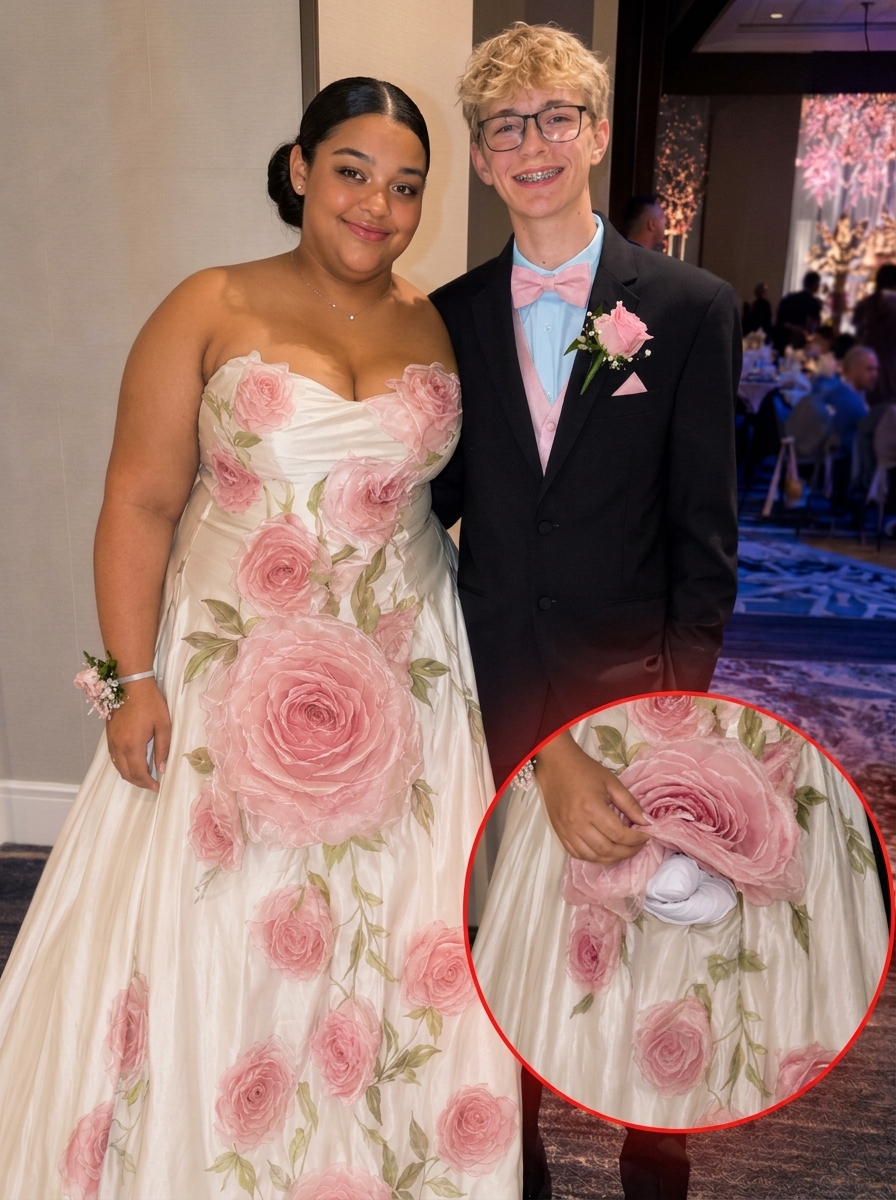
After a year of heartbreak, a mother makes one delicate attempt to bring her daughter back into life. But a painful day before prom reveals that her daughter’s silence has been hiding far more than grief. The house had learned to stay quiet after Mason passed away. A year of emptiness had settled into the walls, the forgotten coffee cups, and the closed bedroom door at the end of the hallway where my daughter now existed like a shadow of herself.
Most mornings, I stood outside that door, resting my hand against the wood and listening for any sign that she was awake.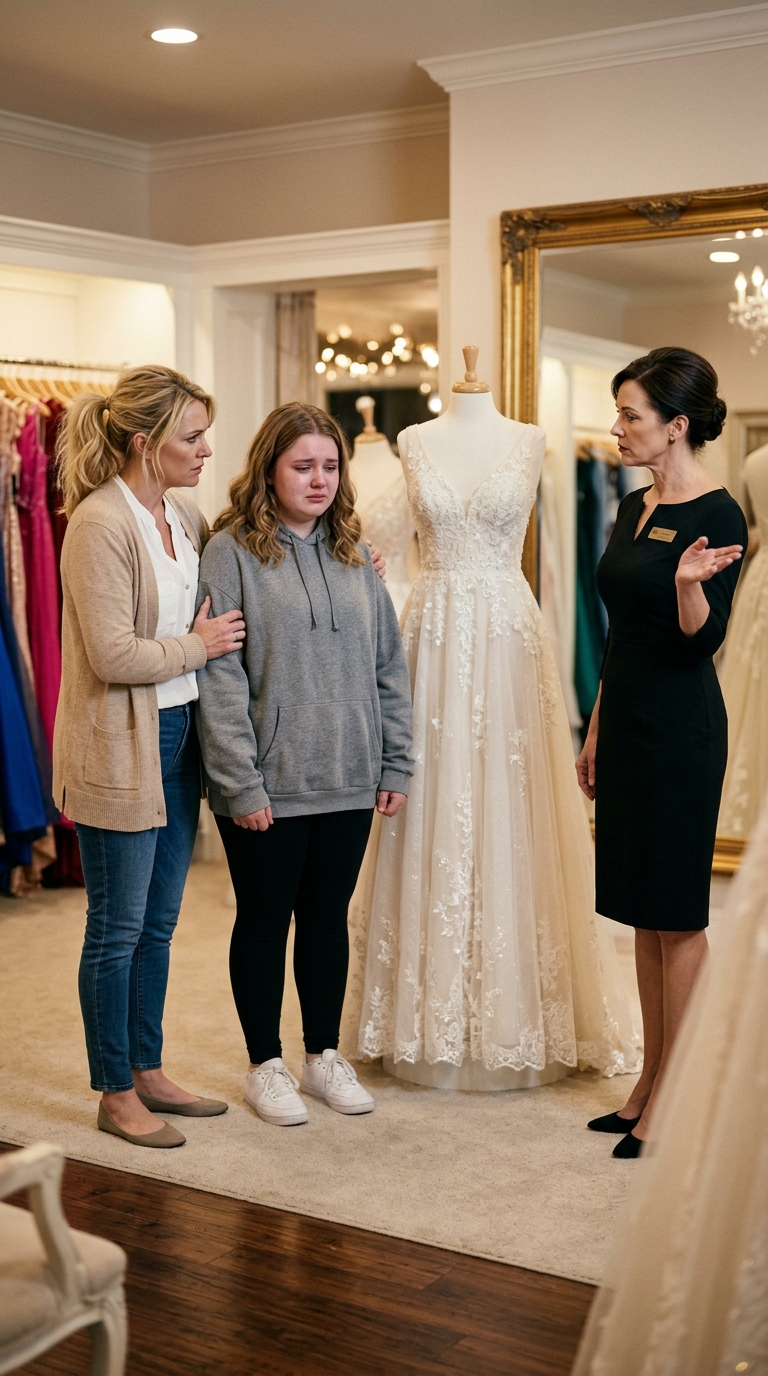
Hazel was seventeen. She used to spin around the kitchen while I made pancakes. Mason called her Hazelnut and would sneak the syrup away just to tease her. He always promised her, loud enough for everyone at the table to hear, that if no boy was brave enough to take her to prom, he would wear a tuxedo himself and bring her. He never got that chance. A truck on Route 9, a rainy road, an ordinary Tuesday.
After the funeral, Hazel stopped eating. Then she started eating too much. Then she stopped stepping outside.
Eli was the only person she allowed close. The quiet boy who lived two houses away, her best friend since sixth grade, would come over after school with her homework tucked beneath his arm.
He never knocked loudly. He never pushed her to talk. Some afternoons, I found them sitting on the porch without saying a word, Hazel resting her head against the railing while Eli quietly drew in his notebook.
“Mrs. Mave,” he said one afternoon, lifting his eyes toward me. He had called me that since he was twelve, when he decided my first name sounded too familiar and anything more formal felt too distant. “She ate half a sandwich today.”
“Thank you, Eli.”
“For what?”
“For staying with her.” He shrugged as if it meant nothing. To him, I think it truly was nothing.
I once found her journals from freshman year hidden behind a row of paperbacks. They were filled with names of girls. Names of boys. Painful little comments written in her careful handwriting, the kind of thoughts people write down because they are too difficult to say aloud.
I placed the journal back exactly where I found it.
That spring, prom invitations began appearing in other girls’ mailboxes. I saw the photos their mothers shared online, their daughters wearing beautiful dresses and holding flowers.
I knocked on Hazel’s door. “Sweetheart. Prom is in three weeks.”
“I’m not going, Mom.”
“Mason wanted you to go.”
She stayed silent for a long moment. Then I heard the bed shift and footsteps approaching before the door opened slightly.
“Mason wanted a lot of things.”
“He wanted you to wear a dress and dance and laugh,” I said. “He told me so.”
“Mom.”
“Just try one on. One dress. If you hate it, we come home and never mention it again. Deal?”
She looked at me through the small opening, and I saw something appear in her eyes that had been missing for months. It wasn’t exactly hope. Maybe it was curiosity. A tiny willingness to try.
“One dress,” she said.
I drove to the shopping center the next Saturday with both hands gripping the steering wheel and a dangerous feeling tightening in my chest. Hope. After a year of feeling nothing, I was finally allowing myself to believe something could change.
I should have known better. The first three boutiques used gentler phrases. “Limited inventory.” “Sample sizes only.” “We could special order, but not in time.” But the meaning was obvious. They believed she was too big for their dresses.
By the fourth store, I could see Hazel shrinking into herself, her shoulders pulling upward the same way they had at Mason’s funeral.
I forced my voice to stay cheerful.
“There’s one more place. The pretty one on Maple.”
“Mom.”
“Just one more, sweetheart.” The old nickname almost escaped, but I stopped myself before it could hurt her. That word belonged to Mason. Only Mason.
The boutique on Maple had a gown displayed in the window that I had already imagined her wearing. Ivory, gentle, and romantic. Hazel stood staring at the glass for a long moment, and then, in a voice I had not heard from her in a year, she asked, “Could I try the one in the window?”
The saleswoman slowly looked her over, the corners of her mouth tightening.
“That’s not going to work for you, honey. You’re too big.”
That was all. No kindness. No apology.
Hazel didn’t cry. She didn’t argue. She simply turned around, walked outside, and climbed into the passenger seat of my car. I followed behind her, my hands trembling as I held the keys.
“Hazel, I am so sorry. I am going back in there and—”
“Please drive.”
“Sweetheart—”
“Please. Just drive.”
She looked straight ahead the entire way home. I kept stealing glances at her, waiting for the moment she would break, for the tears, for any reaction at all. Nothing happened. Somehow, that frightened me more than if she had cried.
She entered the house, walked upstairs, and shut her bedroom door. A moment later, I heard the lock turn. I followed her and sat down on the carpet outside her room, leaning my back against the door.
“Hazel. Open the door. Please.”
“I’m not going to prom, Mom.”
“Honey, we can find something. We can make something ourselves, we can sew something, we can—”
“Mom. Stop.” Her voice sounded empty and drained. “I’m not going. Please just stop trying.”
I rested my forehead against the door and cried as silently as possible. I had already lost one child. Now I could feel the second one disappearing behind that door, slipping away through the small space beneath it, and I had no idea how to reach her.
I don’t know how long I stayed there. Long enough for my legs to lose feeling. Long enough for the hallway light to shift.
A few days later, someone knocked.
I opened the door wearing the same clothes from the day before. Eli stood on the porch in an old hoodie, clutching a small notebook against his chest. He looked anxious. But he also looked certain, and I had never seen that side of him before.
“Mrs. Mave. Can I talk to you out here?”
I stepped outside and gently closed the door behind me.
“Is Hazel okay? Did she text you?”
“No, ma’am.” He paused and took a breath. “I need her measurements.”
“Eli, what—”
“Prom is in two weeks. I can do this. I know how it sounds. But I need you to trust me. And I need you not to tell her anything. Not one word.”
I looked at the boy I had watched grow up just two houses away. Seventeen years old. Nervous hands with bitten nails. Holding a notebook like it contained a serious promise.
“Eli, you have never made a dress like this in your life.”
“No, ma’am. I haven’t.”
“Then how—”
“I just need you to say yes.”
I almost refused. I had every reason to. But there was something in his eyes that did not look like the uncertainty of a seventeen-year-old. Something calm and determined that I had not felt in an entire year.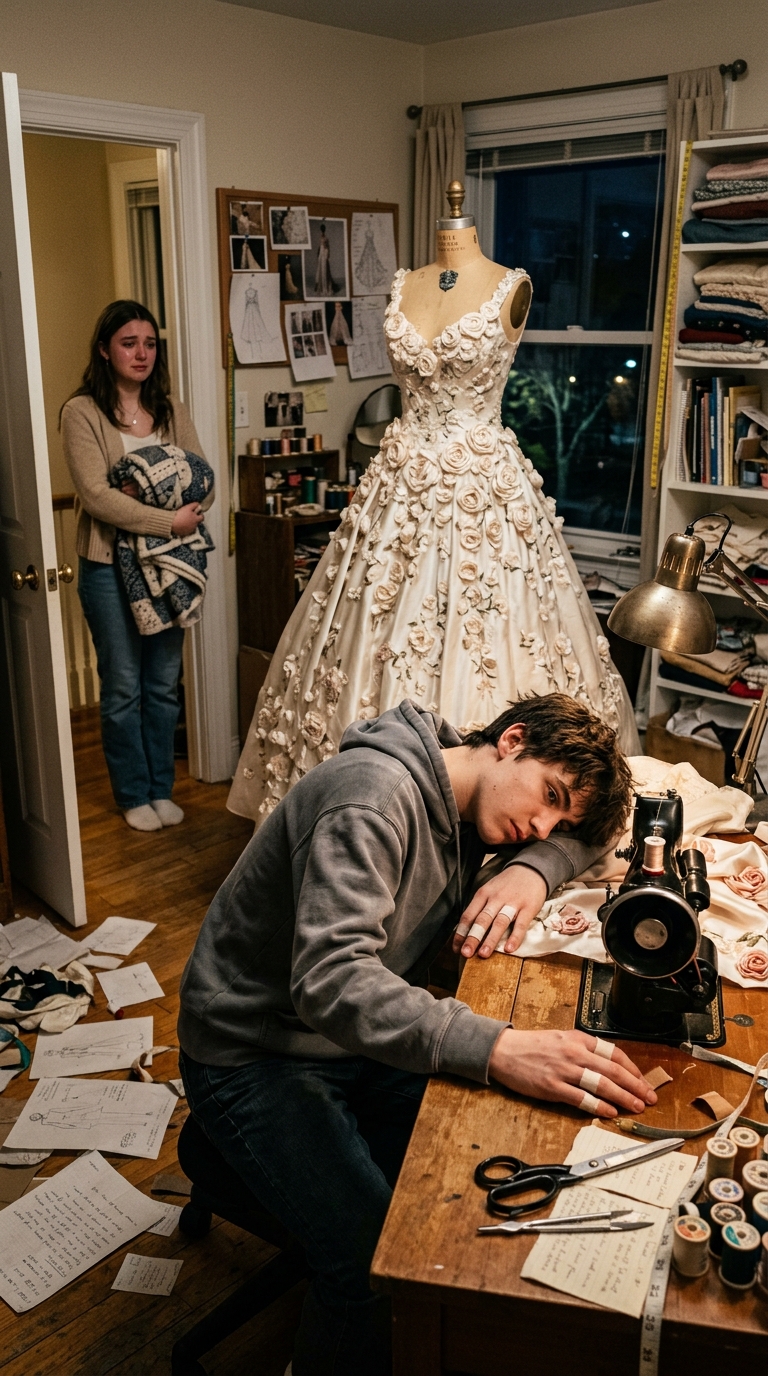
“Yes,” I whispered.
That night, I stood by my kitchen window and watched the light in Eli’s bedroom stay on until well after three in the morning, wondering what in the world I had just agreed to.
The glow from Eli’s bedroom window became the way I measured time.
Past midnight. Past two. Past three. Some nights, I stood at the kitchen sink watching that light stay on while the rest of the neighborhood slept peacefully.
His mother called me on the third day.
“Mave, his fingers are hurting,” she said. “I wrapped them with cold bandages, and he took them off. He missed a chemistry test.”
“Should I make him stop?”
“I don’t think anyone could,” she answered softly. “He’s been sitting at that machine since he was tall enough to reach the pedal. You know that.”
I did know.
I had watched her sew my curtains while Eli, only six years old, handed her pins from a magnetic dish and asked why thread came with numbers. By the time he was ten, he was drawing dress designs in the corners of his spelling assignments. At thirteen, he was modifying his own jackets using his mother’s old Singer sewing machine.
I ended the call and rested my forehead against the cold glass.
Two weeks felt impossible. Two weeks felt like a timer counting down toward another heartbreak I would have to carry for my daughter.
Meanwhile, Hazel continued to disappear.
She stopped coming downstairs for breakfast. She wore the same gray hoodie for three days straight. When I knocked on her door, she answered with only a few words. I tried to keep her connected through small excuses.
“I’m just running errands,” I would tell her, when the truth was that I was buying ivory silk thread from the craft store because Eli had sent me a list.
On the fourth day, I went into her room to change her laundry and found a notebook beneath the bed. It was not the freshman journal I had found months earlier behind the paperbacks. This one was newer. Sophomore year, written in her sharper, angrier handwriting.
Names.
Pages filled with them.
Girls who whispered as she walked by. Boys who shared cruel posts after Mason’s funeral. Comments she had saved, printed, and tucked between the pages like flowers that had long since lost their color.
I sat on her bedroom floor and read every page.
That was the real enemy.
Not the saleswoman.
Not the dress in the window.
It was the endless voices my daughter had carried silently inside herself for two years.
I took my phone and photographed each page. Then I sent the pictures to Eli.
I don’t know if this helps you, I typed. I just thought you should see what she’s been carrying.
The three dots appeared, then disappeared, then appeared again. I sat there on Hazel’s floor watching the screen, wondering what he could possibly do with years of pain less than two weeks before a dance.
Throw them away, maybe.
Read them and feel the weight of them.
I had not sent them because I had a solution.
I sent them because I could no longer carry them alone.
When his response finally came, it was only one sentence.
Some of these I already knew. Thank you for the rest.
Then another message appeared a minute later.
I know what to do with them.
I stared at those words until my phone screen went black.
Of course he knew.
He had been Hazel’s closest friend through all of it. He had witnessed the hallways I had only heard about. He had already been creating the structure of the dress.
Now he had discovered its meaning.
On the morning of day six, I made the mistake of calling the shoe store from the kitchen.
“Size eight, ivory, low heel,” I said into the phone. “For prom, yes.”
I turned around and saw Hazel standing in the doorway.
“What are you doing?”
“Hazel—”
“I told you to stop.” Her voice cracked with pain. “I told you. Why won’t you listen to me?”
“Baby—”
“You keep trying to drag me back to who I was. She’s gone, Mom. She died when Mason died. Why can’t you accept that?”
“Because I love who you are now too,” I said, my voice trembling. “I love you in this kitchen. I love you in that hoodie. I just want you to have one night.”
“For who?” she yelled. “For you? For him?”
She slammed her bedroom door so hard the picture frames shook.
I stood there frozen, still holding the phone.
I almost called Eli right then.
I almost crossed the lawn and told him to stop sewing, that I had been wrong, that I was sorry his hands were hurting.
But instead, I walked.
His mother opened the door without saying anything and simply pointed upstairs.
I pushed his door open.
He was asleep beside the sewing machine, his cheek resting against the table and one hand still holding onto a spool of thread. The photographs I had sent him were spread across the floor, names marked with pencil circles. Behind him stood the dress on a mannequin.
Ivory.
Structured.
Roses unfolding in layers down the skirt like a garden that had appeared overnight.
I stepped closer.
Something was hidden inside one of the roses. Tiny stitches, maybe words, carefully placed into the silk folds where they could only be seen if someone lifted the petal. I reached toward it, then stopped.
This was not mine to uncover.
I took a blanket from his bed, placed it over Eli, and turned off the lamp.
As I walked home through the dark yard, I finally understood.
He wasn’t making a dress.
He was creating something I did not have a name for yet.
Prom night arrived before I felt prepared.
Eli stood on our porch wearing a thrifted suit, a garment bag hanging from his arm like it held something priceless. Hazel opened her bedroom door ready to turn him away.
Then she saw the gown.
Ivory silk.
Full roses blooming down the skirt like a garden moving with every step.
“Eli,” she whispered. “Where did you…”
“Just put it on, Hazelnut.”
He called her by Mason’s nickname for her.
My knees nearly gave out.
I thought about Mason teaching Eli how to drive stick in our driveway the summer before he died, messing up his hair like he was the little brother he never had.
Hazel shook her head and stepped backward toward her bed.
“I can’t. Eli, I can’t.”
He didn’t pressure her.
He placed the gown over her desk chair and sat down on the floor, still wearing his suit, leaning against her bookshelf.
“Then I’ll sit here. Your brother made me promise, before the accident. He said if you ever got quiet, I had to get loud enough for both of us.”
A small, broken sound escaped her.
“One song,” Eli said. “That’s all. Then I bring you home.”
The silence lasted.
I watched from the hallway as she covered her mouth with both hands, looked at the dress, then looked at him.
Finally, she lifted the gown from the chair as if it weighed nothing.
Ten minutes later, she came down the stairs.
For the first time in a year, my daughter looked at herself in the mirror without turning away.
In the car, her face lost its color.
At the gym entrance, she stopped completely, one hand gripping the doorframe and the other squeezing mine so tightly my ring pressed into my skin.
“Mom. I can’t go in there. They’re all in there.”
“One song,” Eli said gently beside her. He didn’t touch her. He only extended his arm and waited.
“If you want to leave after the first note, we leave. I swear it.”
She inhaled.
She exhaled.
Then she took his arm.
Inside, everyone turned.
The same students who once whispered fell silent.
I stood among the parents, overwhelmed.
Then Eli walked toward the DJ booth.
He stood there quietly for a moment before picking up the microphone, and when he spoke, his voice was barely louder than the music.
“Sorry. I have to— I have to say one thing.”
He swallowed.
“Hazel. Look under the biggest rose.”
Her hands trembled as she reached into the fabric. She pulled out a folded piece of embroidered silk and made a sound I had never heard from her before. Then she raised it so the light revealed the dark thread woven into it.
“That dress,” Eli said more softly, as though he was speaking only to her and the microphone just happened to be there, “is made of every word that tried to break her. I turned each one into something else. One a night. For as many nights as I had.”
He stepped away from the booth without saying anything else.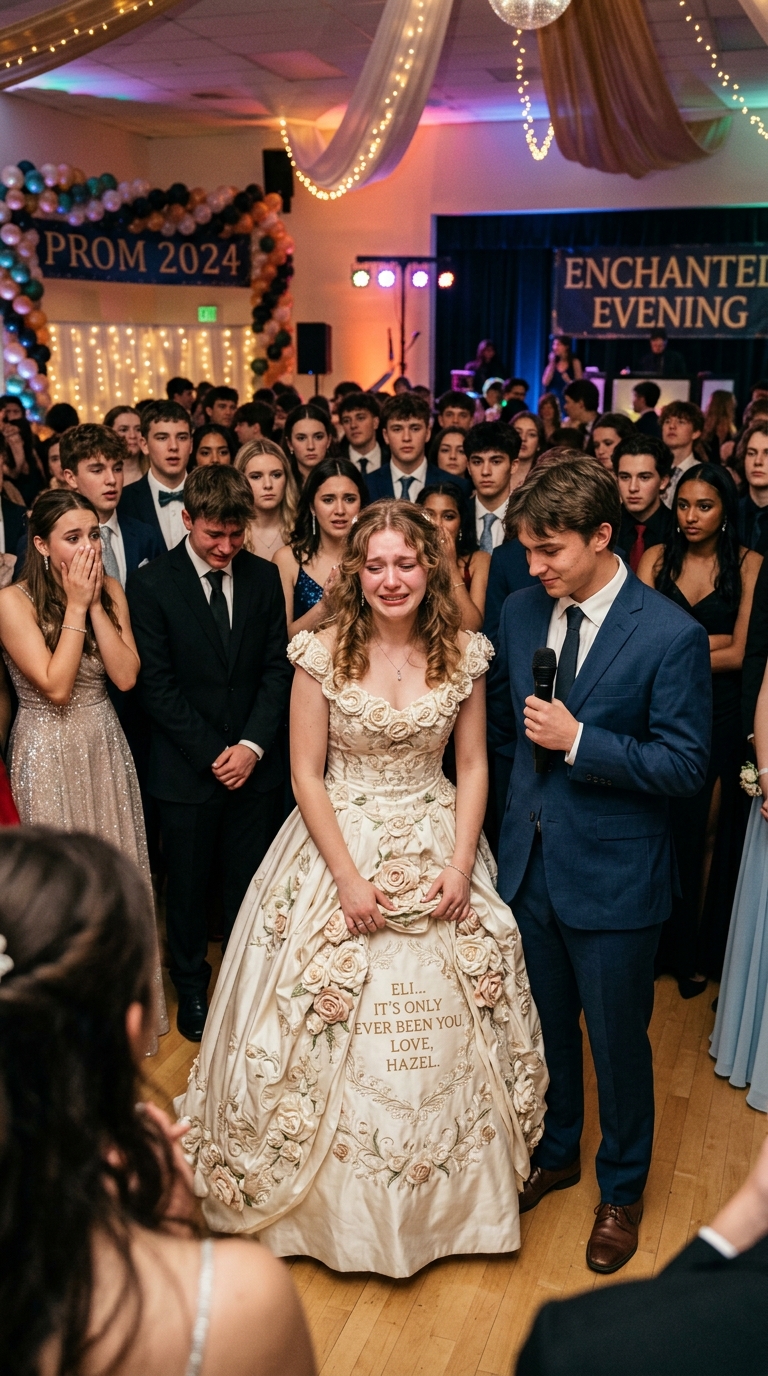
The room went completely still.
I watched the faces closest to the dance floor and saw the moment one girl in a green dress recognized her own handwriting inside a flower petal. Her hand flew to her mouth.
I saw a boy sitting at a table nearby freeze completely.
She was the first one to walk over.
She whispered something into Hazel’s ear that I couldn’t hear.
Then another girl approached.
Then the boy, tears running down his face.
Hazel finally cried.
Not because she was ashamed.
Because she had finally been seen.
I drove home alone that night and stood inside Mason’s old room. I placed my hand against his dresser.
“Someone kept your promise, baby,” I whispered. “She wasn’t alone.”
And tomorrow, I knew, she would sit at the breakfast table again.
